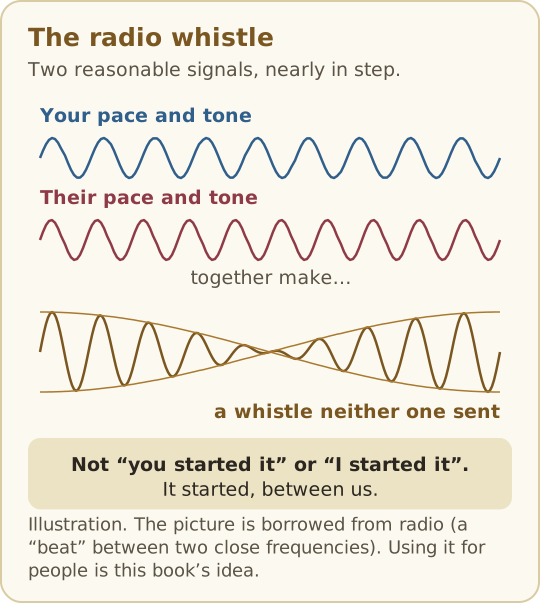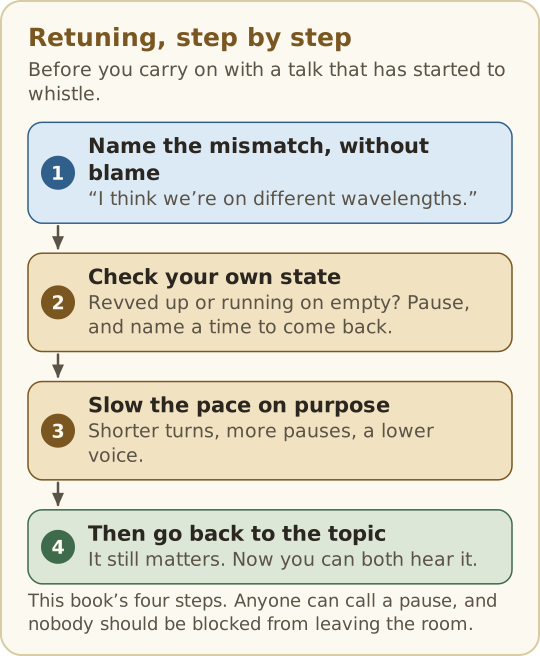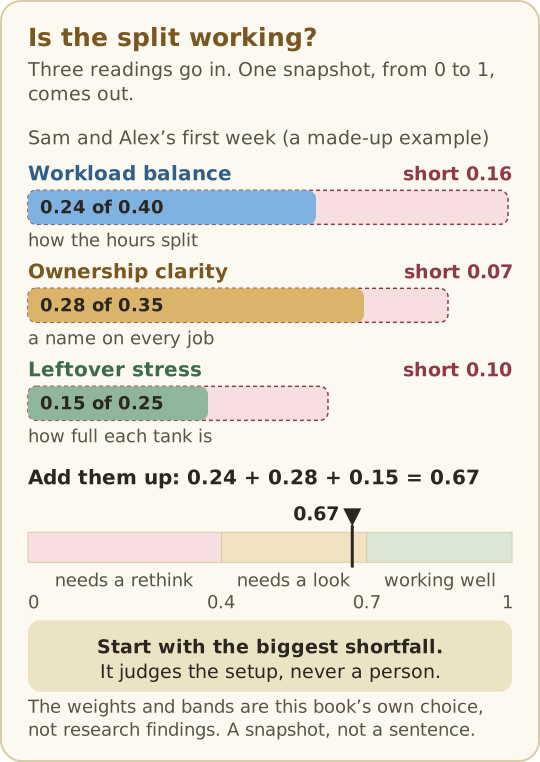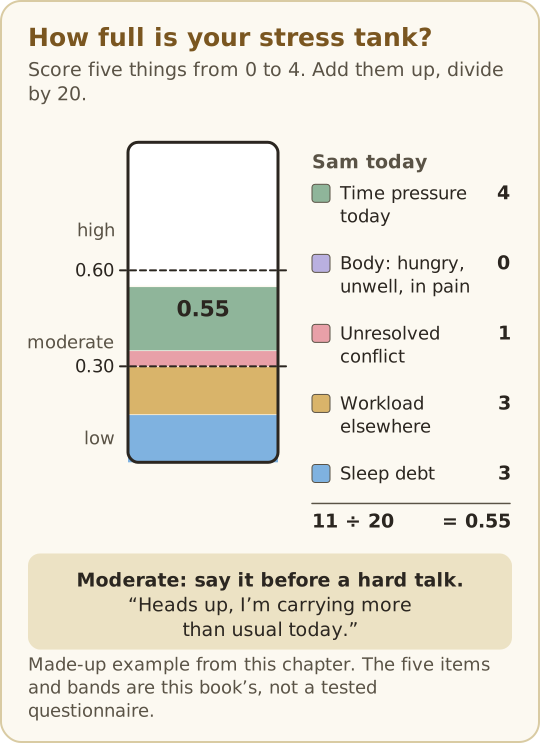
spreadloveandacceptance.comSee it fairly. Say it kindly.

Spread Love & Acceptance

Understanding yourself and the people you share a life with

The whole book · Short version

All three parts: yourself, between us, and understanding people.

by Christian

Spread Love & Acceptance

The whole book · Short version

Spread Love & Acceptance

Understanding yourself and the people you share a life with

The whole book · Short version

by Christian

Spread Love & Acceptance
spreadloveandacceptance.com

Spread Love & Acceptance: The whole book, the short version.
By Christian. Published by Spread Love & Acceptance.

This edition: October 2026. Made from the chapters at spreadloveandacceptance.com/book, where they are kept up to date.

Free to read and share. You may print, copy and share this book for personal use and for non-commercial teaching, as long as you credit “Spread Love & Acceptance, spreadloveandacceptance.com” and don’t change it or sell it.

Not therapy. This book is general education about people and relationships. It is not a diagnosis, treatment or a replacement for help from a doctor, counsellor or other trained professional, and it can’t know your situation.

If you are not safe. If you feel afraid of someone you live with, or someone controls your money, phone or movements, that is not a problem to fix with a worksheet. spreadloveandacceptance.com/safety lists free, private help. If you are in danger now, call your local emergency number.

The examples are made up. The people in the scenes and examples are invented, built from common patterns. None of them is a real person or a testimonial.

Research mentioned in the chapters is listed, with links, in the research notes at the back and at spreadloveandacceptance.com/research.

Set in Lora, Fraunces and IBM Plex Mono.

If you need help now

If you might act on thoughts of ending your life, or someone is in danger right now, call your local emergency number: 999 in the UK, 112 or 999 in Ireland, 911 in the US and Canada, 000 in Australia, 111 in New Zealand.

If you are struggling, or worried about someone else, you can talk to a trained person now. These lines are free, private and open day and night. You don’t have to be sure it is a crisis to call or text.

Where you areCall or text
United StatesCall or text 988 (the 988 Suicide & Crisis Lifeline), or chat at 988lifeline.org. You can also text HOME to 741741 (Crisis Text Line).
United KingdomCall Samaritans free on 116 123. Or text SHOUT to 85258 (Shout, a free text line).
IrelandCall Samaritans free on 116 123.
CanadaCall or text 9-8-8 (the Suicide Crisis Helpline), in English or French.
AustraliaCall Lifeline on 13 11 14, or text 0477 13 11 14.
New ZealandCall or text 1737 (Need to talk?).
Anywhere elsefindahelpline.com lists free helplines in many countries, by phone, text and chat.

For children and young people

UKChildline, 0800 1111 (free, for anyone under 19)
IrelandChildline, 1800 66 66 66 (free, for anyone up to 18)
CanadaKids Help Phone, 1-800-668-6868, or text CONNECT to 686868
AustraliaKids Helpline, 1800 55 1800 (ages 5 to 25)
New ZealandYouthline, 0800 376 633, or text 234
US988 is for every age.

If you’re worried about someone

Ask them plainly: “Are you thinking about ending your life?” Studies have found that asking does not put the idea in someone’s head, and talking about it may even ease it. Listen, stay with them if you can, and call or text one of the lines above together. Part Three, Chapter 12, page 367 says more about helping someone in a crisis, and Chapter 16, page 443 about worry, low mood and when to get help.

This book is general education, not a crisis service. The website’s tools keep what you type on your own device, so nobody there can see it or reply to it. The numbers were checked in October 2026. Numbers can change; findahelpline.com keeps an up-to-date list.

How to use this book

This is a book about seeing what is really going on, in yourself and between people, without blaming anyone, and then changing one small thing. This copy holds 26 chapters in three parts, in the short version. There is no wrong way in.

The parts

  • Part One: Self-discovery. Where you came from, who you are now and who you are becoming. You can read all of it on your own.
  • Part Two: Between us. One idea per chapter about sharing a life, a home or work with someone, each with a worksheet that puts it to use.
  • Part Three: Understanding people. How feelings, stress, trust, change, grief, groups and love work, for anyone, in any kind of relationship.

Two sizes of every chapter

Every chapter comes in a short version (about 10 to 15 minutes) and a full version with the research, more examples and more to try. This is the short version. The full version is free at spreadloveandacceptance.com/book.

Read in order, or by need

Read it front to back like any book, or start with the chapter that fits what is going on. Each chapter ends with What to remember, This connects to (the chapters that explain it or put it to use, with page numbers) and Put it to use, with codes you can scan for the matching tool.

In every chapter

  • A short scene: a made-up moment from everyday life.
  • Words you could use: sentences to say out loud.
  • Try this: one small thing to do this week.
  • Common mix-ups: easy mistakes, and what is closer to true.

The site, the program and Professor Puddles

The book has a free website with the workpapers (pages you fill in) and tools (helpers you use) that the chapters mention; the next page explains both. Nothing you type there leaves your device, and there is no account. The six-week program (spreadloveandacceptance.com/prog-01) puts Part Two to work a week at a time, and the self path does the same for Part One. Professor Puddles, the site’s friendly guide, answers questions about the book’s ideas.

Go gently

Some chapters touch hard things: grief, shame, anger, worry, trauma. Skip anything that isn’t right for today. Nothing here is a test, and nothing needs to be done all at once.

Workpapers, tools and three friends

Workpaper WP-03 Workpapers: pages you fill in

A workpaper is a page you fill in, on your own or together: a one-week log, a list of who owns which job, a short check. Each one has a number, like WP-03, and it is always called a workpaper, for example “Workpaper WP-03: One owner per job”. The blank workpapers are also at the back of this book, one page each, to copy.

Tool Tools: helpers you use on the site

A tool is an interactive helper on the website: a quiz, a calm-down timer, a card maker, or the Chat analyzer that reads a message with you. You use it and it gives you something back. It is always called a tool, for example “Tool: Chat analyzer”.

The book keeps the two apart: a workpaper and a tool never share a list. Both are free, need no account, and what you type stays on your device.

Three friends who give hints

  • Professor Puddles, the site’s cheerful raindrop professor, gives most of the hints: a thought to take with you, and the workpaper or tool that fits.
  • Tidbit, the quick, curious pup with the big smile and the collar, bounds in now and then with a playful tip.
  • Sugarfoot, the steady, gentle pup with the long soft ears and the best hugs, turns up with a calm, slow tip.

They keep to the lighter pages. Where a chapter talks about crisis, deep grief or being hurt, the pages stay quiet and plain.

Find it fast

Start with what is going on, not with chapter one. Each line points to the place in the book that helps most, and one tool to try. You can read that part on its own and stop.

Sharing the load

If this is going onReadPageTry
We keep arguing about chores.Part Two · Chapter II · One owner per job110Workpaper WP-03One owner per job
I do the remembering and planning, and nobody sees it (the mental load).Preface to Part Two · The mental load84Workpaper WP-01Who did what
We each think we do more than our share.Preface to Part Two · Why the other person doesn’t see it74Workpaper WP-01Who did what
The same job keeps slipping, week after week.Part Two · Chapter V · A repeat usually has no real owner181Workpaper WP-04What keeps coming back?
Is the way we share things fair? Can it last?Part Two · Chapter II · The setup score110ToolIs the setup working for everyone?
We’ve just had a baby and we’re both exhausted.Part Two · Chapter II · Small children and a new baby125Workpaper WP-02How much are you carrying?
We’re about to move in together.Part Two · Chapter V · Starting out: before you move in186ToolThe “Who does what?” page
Money between us feels unfair.Part Two · Chapter IV · Money between you168ToolWho does what? The Money tab
We co-parent across two homes.Part Two · Chapter III · Two homes147Workpaper WP-03One owner per job
We share a house with a housemate, or more than two of us share a home.Part Two · Chapter IV · A couple and a housemate168ToolThe “Who does what?” page
I’m raising my grandchild (kinship care).Part Two · Chapter V · Raising a grandchild187Workpaper WP-03One owner per job
Faith matters to us, or family elders expect a say.Part Two · Chapter I · Faith, culture and family voices103Workpaper WP-13The 90-second daily check-in
I’m caring for a parent or partner, and it’s wearing me down.Part Three · Chapter 12 · Your limits make your help last367Workpaper WP-02How much are you carrying?
I’m the only one who wants to try this.Part Two · Chapter II · When only one of you is on board129Workpaper WP-01Who did what (your side only)
Someone handed me this book, and I’m not sure why.If someone handed you this book13Workpaper WP-03One owner per job

Talking it through

If this is going onReadPageTry
Small things turn into big rows.Part Two · Chapter I · How stress changes your frequency93Workpaper WP-11The Calm-Down Kit
One of us goes quiet and the other pushes for an answer.Part Three · Chapter 5 · Feeling safe with someone256Workpaper WP-11The Calm-Down Kit: our pause plan
Texts and messages keep landing wrong.Part Three · Chapter 4 · Messages lose their tone239ToolChat analyzer
We move and talk at different speeds.Part Two · Chapter I · What sets the frequency93Workpaper WP-12Same moment, different speeds
A comment stings and I snap back.Part Two · Chapter IV · Let a comment land before you react161Workpaper WP-09Say it so it lands
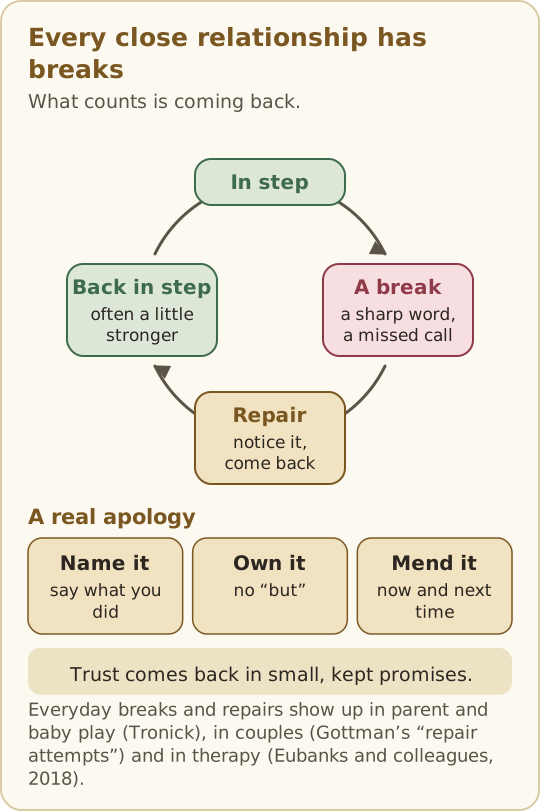
We need to say sorry and mend things.Part Three · Chapter 11 · A real apology352Workpaper WP-09Say it so it lands
Conflict at work, with a colleague or in a team.Part Three · Chapter 4 · Saying hard things kindly251Workpaper WP-09Say it so it lands
Is it us, or is it everything else going on?Part Two · Chapter III · Leftover stress132Workpaper WP-14Is it us, or is it everything else?

Knowing yourself

If this is going onReadPageTry
I can’t tell what I’m feeling.Part One · Now · When feelings are hard to name47ToolMy weather today
I’m wiped out and everything feels like too much.Part One · Now · Check your weather; one state, many words46Workpaper WP-02How much are you carrying?
ADHD: I’m overwhelmed and keep forgetting things.Part Three · Chapter 9 · ADHD, time and motivation314Tool“How to talk to me” card
I’m autistic, and people keep misreading me (or I misread them).Part One · Now · A mix-up runs both ways49Tool“How to talk to me” card
Old rules from childhood still run my reactions.Part One · Then · Write down the rulebook from home32The self path: where your lens came from
My inner critic is loud.Part Three · Chapter 7 · The critic and the soothing system286Workpaper WP-11The Calm-Down Kit
I want to change a habit, but it keeps slipping.Part One · Next · Tiny, repeatable steps65The self path, step by step

Hard seasons

If this is going onReadPageTry
Someone I love has died.Part Three · Chapter 8 · Grief comes in waves309When you’ve lost someone
I feel lonely, or I live on my own.Part Three · Chapter 5 · Building connection from where you are266Living on your own, living well
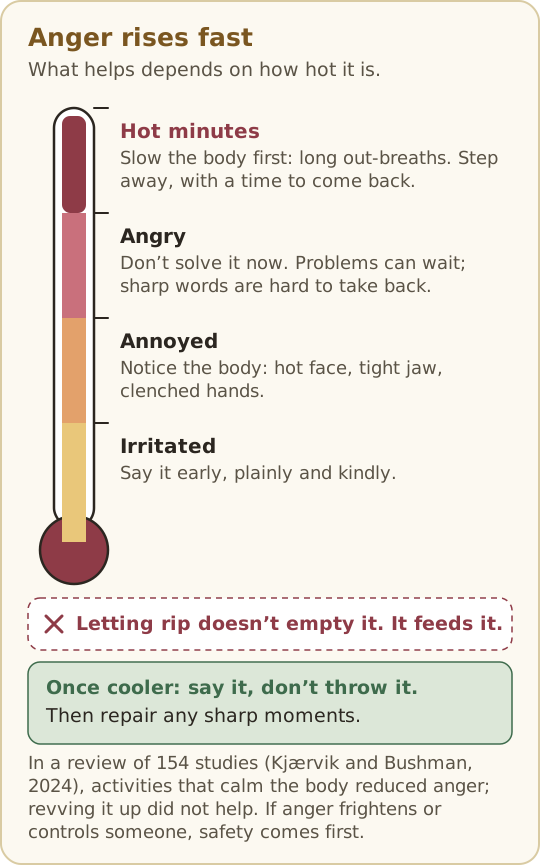
A teenager’s anger, or I’m a teenager and I’m angry.Part Three · Chapter 13 · The hot minutes394Workpaper WP-11The Calm-Down Kit
Left out of a group, a friend group or a group chat.Part Three · Chapter 17 · Groups online, and their pull455ToolChat analyzer
Worry keeps me awake, or my mood is low.Part Three · Chapter 16 · Worry time; low mood434Workpaper WP-02How much are you carrying?
I’m thinking about ending my life, or I’m worried someone is.If you need help now5The page itself

Each thing to try is marked as a workpaper (a page you fill in) or a tool (a helper you use on the site). All are free on the website, with nothing to sign up for; each chapter’s end has a code you can scan for them. Looking for a word rather than a problem? The index at the back lists the main ideas.

If someone handed you this book

Maybe it was left on your side of the bed with a page turned down. Maybe someone said, “Could you just read this bit?” Either way, you didn’t choose it. Fair enough. Here is the short version, written for you.

This isn’t a case against you

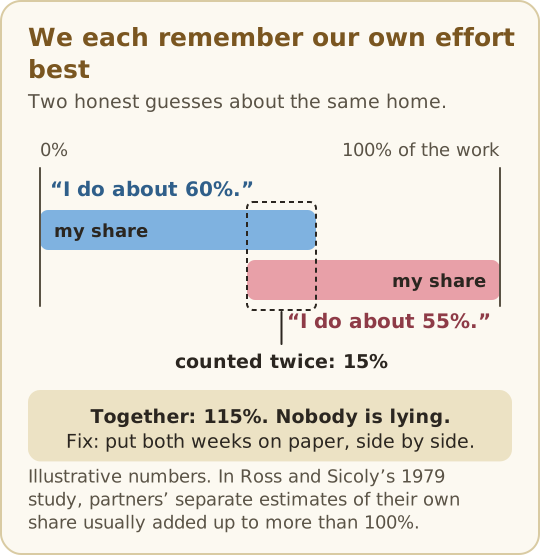
The book starts from something researchers have found again and again: when two people each estimate their share of the housework, the two answers usually add up to more than 100%. Nobody is lying. You see every minute of your own effort and only some of theirs, and so do they (Chapter II, page 110). So the book never asks who the bad guy is. Its numbers score the setup, never a person.

What’s in it for you

  • Fewer repeat arguments about the same jobs.
  • Jobs that are clearly yours, so nobody needs to remind you about them.
  • Credit for what you already do. Your jobs go on the list too: the car, the bins, the late-night lifts, the things you fix.
  • A say in what “fair” means in your house. It isn’t always 50/50 (Chapter IV, page 151).

It doesn’t ask for therapy talk, and you never fill anything in about the other person. You can say no.

A first week: three small things

  1. Log your own week. Rough minutes on “Who did what”, including the thinking part: booking, remembering, planning. Ten minutes in all. Only yours, never theirs.
  2. Ask one question, and just listen. “What’s the one job you’d most like to stop thinking about?” Don’t defend or count. Write the answer down.
  3. Take over that job, the whole of it, including the noticing (below).

Words to open the talk

“I read the bit you gave me. I don’t agree with all of it, but I get the point about the stuff nobody sees.”
“I’d rather own a couple of things properly than ‘help’ with everything. Which one would you most like off your mind?”
“Give me a week to see what I actually do. Then let’s look together.”

Best left out, for now: “Just tell me what to do” (it hands the thinking straight back), “You should have asked” and, in the first five minutes, “I do loads too.” That may be true. Save it for when you both have your logs.

Taking over a whole job, noticing included

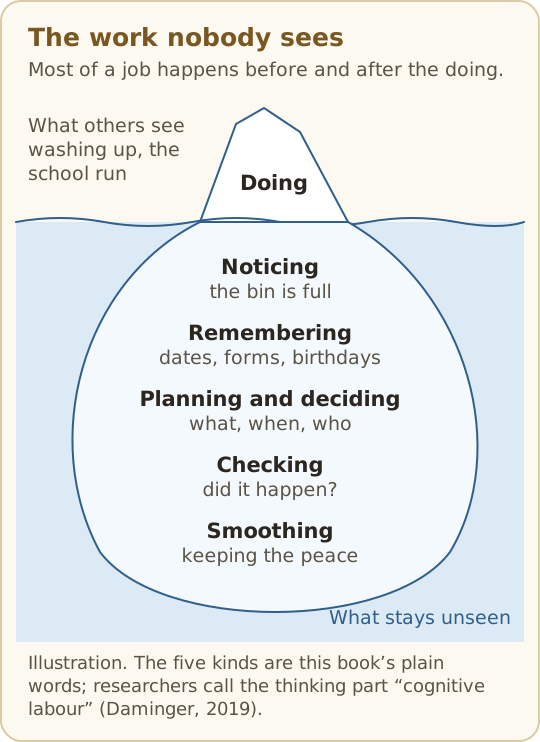
Every job has a part you can see (doing it) and parts you can’t: noticing it needs doing, remembering, planning and checking it got done (the Preface, page 74). Taking a job over means all of it.

  1. Pick one job that repeats: the children’s clothes and shoes, the bins, the car, school forms, the dentist.
  2. Get the handover once. What it involves, when it’s due, where things are, who to call. Ask your questions now, not every week.
  3. Move the remembering out of their head. A phone reminder, the calendar, a list on the fridge: anywhere but the other person.
  4. Do it start to finish for a month without being reminded. If you need reminding, fix your reminder, not the relationship.
  5. Do it your way. If the result is fine, the method is yours. Their part is to let it be done differently.
  6. Ask for a backstop if you like: someone who notices a slip and says so once, kindly. A backstop isn’t a supervisor (Chapter II, page 110).

A made-up example. Hester has always looked after the children’s clothes: spotting toes at the end of shoes, school sizes, swimming kit, passing on what’s outgrown. Wilf takes it over. Hester writes the handover note: sizes, the shop, which drawer holds the next size up. Wilf sets a reminder for the first Sunday of each month: “Shoes, uniform, kit.” In week two he misses the PE kit for a school trip. Hester says once, “The trip kit is Thursday,” and he adds “school letters” to his Sunday check. A month in, Hester says the biggest change is that she no longer thinks about shoes at eleven at night.

If you think it’s already fair

Log your week anyway. If it comes out even, that is useful to know, and the book will say so: a fair score doesn’t silence anyone, and a low one doesn’t blame anyone. And if this book feels like the wrong place to start, Find it fast, page 9 lists other ways in.

The book in two pictures

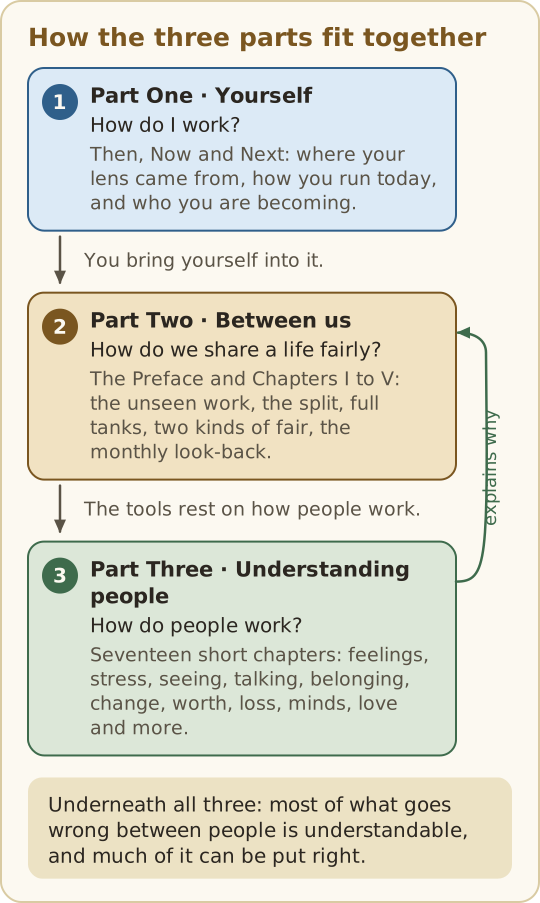
Three stacked cards: Part One, Yourself; Part Two, Between us; Part Three, Understanding people, with arrows showing how they connect.
Figure 1 How the three parts fit together: you bring yourself into every shared life, and Part Three explains why the Part Two tools work.
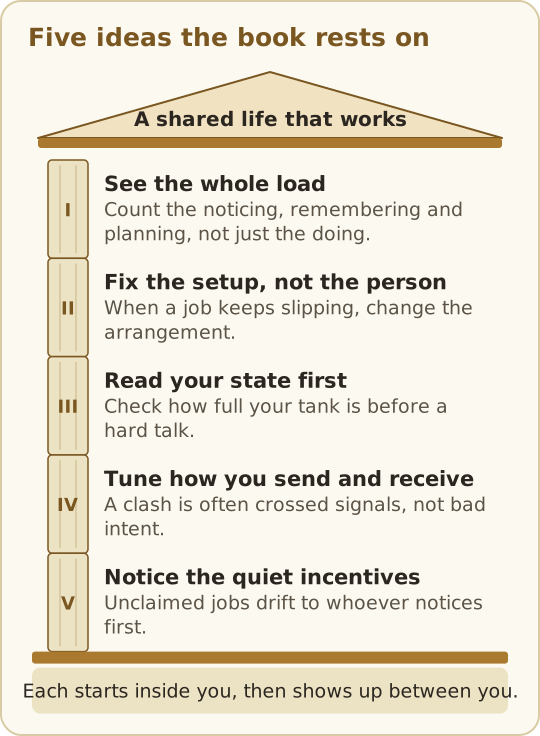
A simple building whose roof rests on five columns, one for each of the five ideas the book rests on.
Figure 2 Five ideas the whole book rests on. Each one starts inside you, then shows up between you and the people you share a life with.

The book

The Whole Book on One Page

Every chapter of Spread Love & Acceptance, in order, on one page, in the short versions. Read straight through, use your browser’s find, or print it.

Download the PDF Switch to the full versions The book’s home

About 410 minutes of reading in all. Your browser keeps your place if you come back to this page.

Part One

Self-discovery

Where you came from, who you are now and who you are becoming. You can read all of it on your own.

In this part

  1. Then Where your lens came fromKnow yourself: then, where your lens came from22
  2. Now Your wiring, weather and wordsKnow yourself: now, your wiring, your weather and your words39
  3. Next Who you are becomingKnow yourself: next, shaping who you are becoming58

Part One · Then

Know yourself: then, where your lens came from

Why you expect what you expect, and how the rules you picked up growing up still make small decisions for you today.

In this chapter

  1. You’re not one thing
  2. Your lens came from somewhere
  3. Each stage of growing up asks its own question
  4. When something happened matters
  5. Some old answers were learned without all the facts
  6. An old rule can read other people for you
  7. Write down the rulebook from home
  8. You get to choose which rules to keep
  9. The past isn’t yours to change. What you carry forward is
  10. The ideas, one at a time
  11. You, in all your relationships
  12. Inside you, and between you
  13. In the individual program
  14. The fields behind this part
  15. In real life
  16. Common mix-ups

This is where the book begins. Part One (Then, Now and Next) is about you. Part Two (a Preface and Chapters I to V) is about the people you share a life with. Part Three (Chapters 1 to 17) is about how people work. Some printed copies hold only one or two of the parts; every chapter is free to read at spreadloveandacceptance.com/book, and the book at a glance (spreadloveandacceptance.com/book/topic-start-here) there gives a one-minute tour of the whole thing.

In short:

  • You’re not one thing. A reaction comes from your wiring (it stays), the patterns life taught you (they can soften) and today’s conditions (they pass). This part is about the patterns.
  • Your lens came from somewhere: home, school, culture, money and what you lived through. Each stage of growing up asked its own question.
  • Some old rules were learned without all the facts, and they can read other people for you: “Whoever notices, does it.”
  • Write down the rulebook from home, then choose which rules to keep.
  • The past isn’t yours to change. What you carry forward is.

The big ideas: This part mostly teaches “Read your state first” and “Notice the quiet incentives”, with help from “See the whole load” and “Fix the setup, not the person”. What are the five big ideas? (They are five plain ideas the whole program is built on.)

Sunday, 10:15am

Your partner is still in bed and the kitchen is a mess. Before you’ve had a single thought, you feel it: “Of course. It’s always me.” Nobody said that. But in the house you grew up in, whoever noticed the mess cleaned it. That old rule just made a decision for you.

Or, living alone: Since his wife died, Ray’s house is quiet and nobody will see the dishes. He still can’t sit down until every one is done. Nobody is watching. An old rule from the home he grew up in still is.

  1. You’re not one thing.

    A reaction usually comes from three places at once: how you’re built (your wiring, which stays), what life taught you (patterns, many of which can soften) and what kind of day you’re having (conditions, which pass). This part is about the middle one, the patterns life taught you. Now (page 39) looks at the other two.

    Dig deeper: the three layers
  2. Your lens came from somewhere.

    Family, school, friends, culture, money at home and what you watched all taught you what to expect: of yourself, of other people, and of how a “good” partner, parent or friend behaves. By adulthood your lens doesn’t feel like a lens. It feels like simply seeing. Where your lens came from (spreadloveandacceptance.com/growing-up) walks through it, and you can read one section and stop.

    Dig deeper: the lens idea
  3. Each stage of growing up asks its own question.

    Is the world safe? Can I do it myself? Am I capable? Where do I belong? Can I be close without losing myself? And later in life: What am I building? Has my life meant something? The ages are rough and people move at their own pace. The answers you landed on can become understandings you keep using as an adult.

    Dig deeper: the stages
  4. When something happened matters.

    An experience that touches the question you were answering at the time tends to go deeper. A move at 4 is mostly about routines. A move at 14, in the middle of “Where do I belong?”, can leave a longer feeling of being the outsider. Deeper isn’t permanent, though: people keep learning all their lives.

    Dig deeper: why timing matters
  5. Some old answers were learned without all the facts.

    “I’m only okay when I’m useful.” “My needs are a burden.” “Mistakes mean I’m bad.” A child often can’t know what was going on for the grown-ups. They only know how it felt. As an adult, you’re allowed to look again with the full picture. Looking again doesn’t mean deciding it was all fine, because some things really were not okay.

    Dig deeper: old answers and fairer readings
  6. An old rule can read other people for you.

    If silence at home meant anger, a partner’s quiet evening can feel like trouble is coming. And an expectation nobody said out loud can’t be agreed to, so the other person can only miss it: “If you loved me, you’d just know.” “Whoever notices, does it.” Each is somebody’s family rule, not a law of nature. Ask before you conclude: “When you went quiet, what was going on for you?”

    Dig deeper: rules that read others
  7. Write down the rulebook from home.

    Finish these six lines the way your childhood home would have: “In my family, love looked like…” “When someone was upset, we…” “The jobs were split like this…” “Resting was okay when…” “Asking for help meant…” “The unforgivable thing was…” The rulebook page has room to write them. Nothing is saved except on your own device.

    Dig deeper: the six rulebook lines
    Filled-in example 1 The rulebook from home Nadia, on her own

    Your rulebook from home

    Write a few words on each line, the way the home you grew up in would have finished it. Skip any line you like. Then, for each one, ask: do I still want this rule?

    1. In my family, love looked like…
    Doing things. Dad fixed your bike; nobody said it.

    Do I still want this rule?

    • Keep
    • Chosen: Soften
    • Drop
    2. When someone was upset, we…
    Went quiet and waited for it to pass.

    Do I still want this rule?

    • Keep
    • Chosen: Soften
    • Drop
    3. The jobs were split like this…
    Mum noticed, planned and remembered. Dad did the big jobs.

    Do I still want this rule?

    • Keep
    • Soften
    • Chosen: Drop
    4. Resting was okay when…
    Everything else was done.

    Do I still want this rule?

    • Keep
    • Soften
    • Chosen: Drop
    5. Asking for help meant…
    You hadn’t planned well enough.

    Do I still want this rule?

    • Keep
    • Soften
    • Chosen: Drop
    6. The unforgivable thing was…
    Breaking a promise.

    Do I still want this rule?

    • Chosen: Keep
    • Soften
    • Drop

    A made-up example. Names and details are invented.

  8. You get to choose which rules to keep.

    For each line, ask: do I still want this rule? When a reaction feels bigger than the moment, try the one-minute lens check once you’ve settled: Where did I learn this? How old does this feel? Is it true here, with this person, now? What would the adult me choose? Later, you can swap rulebooks with someone you trust and choose shared rules on purpose.

    Dig deeper: the lens check, and choosing together
  9. The past isn’t yours to change. What you carry forward is.

    You couldn’t control the home you grew up in, what other people did, or what you learned before you had all the facts. What is in your hands now is smaller, and stronger: which old rules you keep, how you treat yourself about them, and where you spend your energy today. That includes people. Give your time and care where they’re met with care, and let one-sided effort shrink back to what feels fair. Matching energy with energy isn’t cold. It protects what you have, so you still have something to give.

    Dig deeper: your part, then and now

The ideas, one at a time

Each idea above again, with a real-life example, words you could use and one small step. Read one and stop if you like.

1. You’re not one thing

For example: A grandmother snaps when her grown-up son is late for lunch. Part is her wiring (she likes things on time). Part is an old rule (“late means you don’t care”). And part is that she slept badly.

Words you could use: “Some of this is me being tired, and some of it is an old thing. Give me a minute.”

Try this: Next time you react strongly, ask: is this mostly wiring, something I learned, or just today?
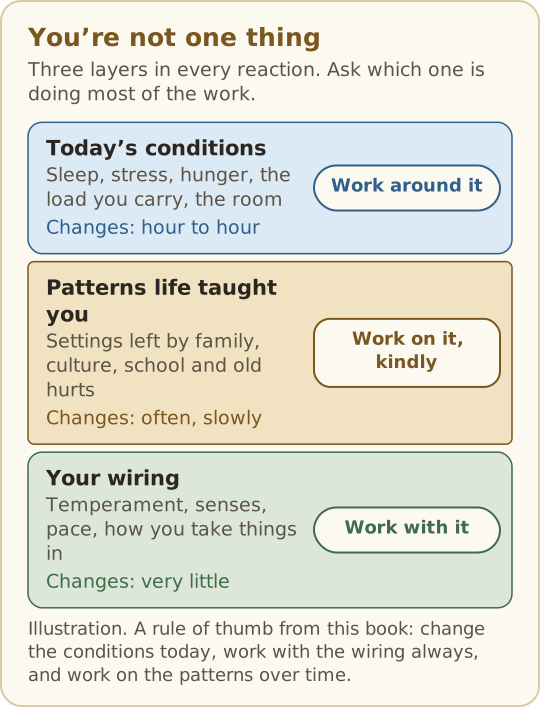
Three stacked layers: today’s conditions (work around it), patterns life taught you (work on it, kindly) and your wiring (work with it).
Figure 3 Three layers in every reaction. Each one changes at a different speed and needs a different move.

2. Your lens came from somewhere

For example: One friend grew up with big birthday parties, the other with quiet ones. A small dinner feels hurtful to one and perfect to the other.

Words you could use: “In my family this was a big deal. What was it like in yours?”

Try this: Pick one thing you think “everyone” does. Ask one person how their family did it.

3. Each stage asks its own question

For example: Someone who moved schools four times as a teen may still feel like the outsider at every new job.

Words you could use: “I think part of me is still asking whether I belong here.”

Try this: Read the questions above and notice which one still feels loud. That’s all.
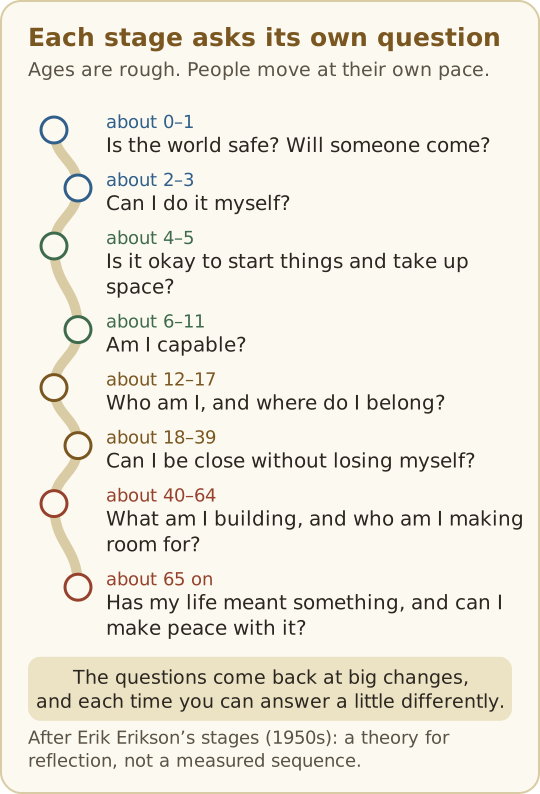
A winding path with eight stops from birth to later life, each with the question that stage of life asks.
Figure 4 Each stage of life asks its own question. The ages are rough, and the questions come back at big changes (after Erik Erikson).

4. When something happened matters

For example: Two adult siblings remember their parents’ divorce differently. One was six and remembers new routines. The other was fifteen and remembers feeling torn in half. Both are true. See Family rifts (spreadloveandacceptance.com/family-rifts).

Words you could use: “We were different ages when it happened. It makes sense we remember it differently.”

Try this: Think of one big change from growing up. How old were you, and what were you trying to work out?

5. Some old answers were learned without all the facts

For example: A foster carer who learned that “my needs are a burden” finds it hard to ask for respite (a planned break while someone else cares), even when worn out. See Foster and kinship families (spreadloveandacceptance.com/foster-and-kinship).

Words you could use: “An old voice says I shouldn’t ask. The adult me thinks asking is fair.”

Try this: Write one old belief about yourself. Under it, write what you’d tell a friend who believed it.

6. An old rule can read other people for you

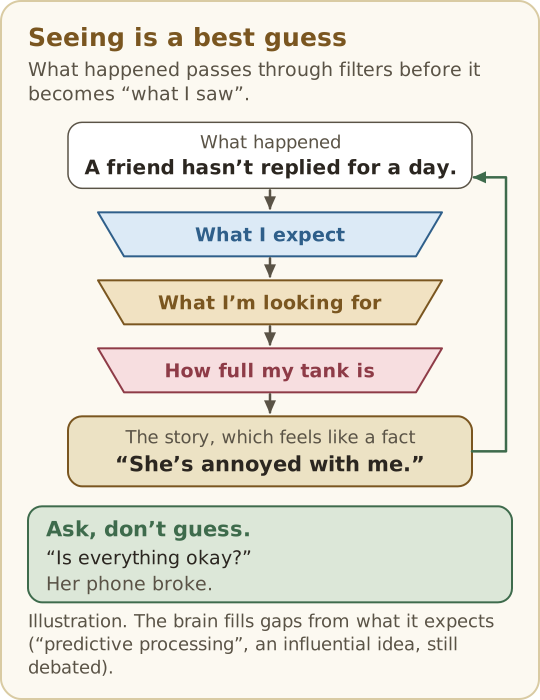
For example: A housemate leaves without saying goodbye. If quiet meant anger at home, you may think they’re upset. They may just be late for a shift.

Words you could use: “When you went quiet earlier, I wasn’t sure what it meant. Is everything okay?”

Try this: This week, when you catch yourself guessing what someone’s silence means, ask instead.

7. Write down the rulebook from home

For example: Two partners from different faiths both write “holidays belong to my family,” and finally see why December is hard. See Two faiths, one family (spreadloveandacceptance.com/two-faiths).

Words you could use: “Here’s a rule I grew up with. I’m not saying it’s right. I just want you to know it’s there.”

Try this: Finish just one of the six lines today. Leave the others for another day.

8. You get to choose which rules to keep

For example: A team leader sees that “mistakes mean I’m bad” makes them hide problems. New rule: “Mistakes are information. We fix them together.”

Words you could use: “I used to think ___. Now I’m choosing ___.”

Try this: Pick one rule from your list and write the version you would like to live by.

9. What you carry forward is yours

For example: Someone living on their own always plans the meetups with one friend, who never asks back. They stop chasing, keep the door open, and see more of the friends who reply. See Always the one reaching out? (spreadloveandacceptance.com/friends)

Words you could use: “I’d love to see you. Let me know when works for you.”

Try this: Name one relationship where you give far more than comes back, and give a little less this month. (If you are afraid of someone, this isn’t about managing them. Not safe at home? (spreadloveandacceptance.com/safety) has people to talk to.)

Tuesday morning

Two people get the same text: “Can we talk tonight?” One thinks, “Good, I like knowing ahead.” The other feels their stomach drop, because in the home they grew up in, “we need to talk” meant trouble. Same words. Two different histories.
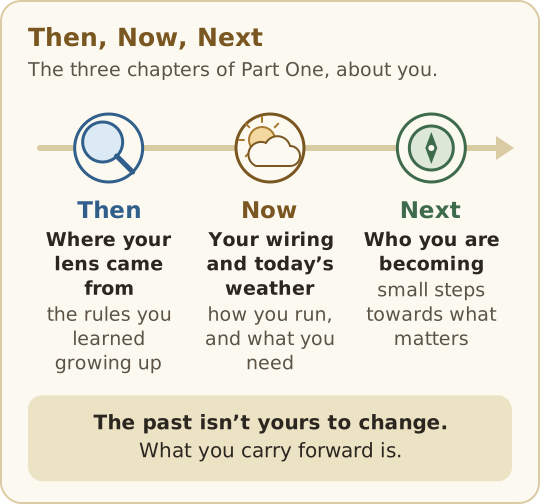
A timeline with three stops, Then, Now and Next, and the line: the past isn’t yours to change; what you carry forward is.
Figure 5 Part One in one picture: where your lens came from, how you run today, and who you are becoming. You choose what you carry forward.

You, in all your relationships

Your old rules go wherever you go, starting with how you treat yourself.

  • With yourself: The voice you use after a mistake is often an old one.
  • With a partner, or partners: Who notices, who plans, what quiet means. More than two of you means more than two rulebooks. See More than two partners at home (spreadloveandacceptance.com/more-than-two).
  • With friends: Who reaches out first, and whether asking feels okay. See Friends.
  • With family: Old roles, like the helper or the peacemaker, switch back on at the door. See For grown-up children (spreadloveandacceptance.com/grown-up-children) and Family rifts.
  • At work: Praised for being useful? You may say yes to everything, then resent it.
  • With housemates: Two rulebooks about mess, noise and guests. See Sharing a room (spreadloveandacceptance.com/sharing-a-room).
  • On your own: After a breakup, old rules can get louder. See On my own (spreadloveandacceptance.com/on-my-own).

Looking for your own situation? Help by relationship (spreadloveandacceptance.com/by-relationship) lists them all.

Inside you, and between you

  • In you: Ask whether a feeling is the size of this moment or older. Notice what you were praised or scolded for as a child still pulling on you. Holding an old rule in check is real, hidden effort.
  • Between you and others: A learned rule is part of the setup, not a flaw in anyone. Say your rules out loud, and choose shared ones.

In the individual program

This part goes with Step 3 of the individual program: write the rulebook from the home you grew up in, and choose one rule you’d like to change. You can do every step on your own.

Your next step: Step 3: see where your lens came from (spreadloveandacceptance.com/self-path) · Where your lens came from · A gentle first week · The whole book on knowing yourself (spreadloveandacceptance.com/book/topic-know-yourself)

The fields behind this part

This part draws on 4 of the author’s thirteen fields (the About page (spreadloveandacceptance.com/about) lists them all):

  • Psychology (Read your state first): The lens you learned, the stages of growing up and the old stories we carry.
  • Neurobiology (Read your state first): An old alarm can go off before you’ve had time to think.
  • Philosophy (Notice the quiet incentives): Plato’s cave: shadows that feel like the whole world. A rule you never chose can feel like simply how things are.
  • Behavioural science (Notice the quiet incentives): What got praised or scolded taught you what to do, and repeating something new teaches a new rule.

Two fields, one idea: Psychology + Neurobiology. How you feel and how your nervous system is running are the same moment, seen from two sides. An old alarm is both a feeling and a body state, so noticing it is the first step.

See how all the fields connect, in the full version (spreadloveandacceptance.com/book/self-1-then-in-depth) · The polymath way (spreadloveandacceptance.com/polymath)

In real life

  • Partners: “Of course it’s always me.” You grew up in a house where whoever noticed, did. Naming the old rule out loud, on a calm day, turns a fight about dishes into a talk about who owns what.
  • Family: A parent says, “We should talk.” You brace, because quiet meant anger in the house you grew up in. Knowing where the alarm came from, you ask first: “Is this a good talk or a worried one?”
  • Housemates: One housemate grew up where help was never asked for, only given. The other grew up where nothing happened unless you asked. Neither is rude. They are using two rulebooks.
  • Coworkers: Someone who was praised mostly for being useful says yes to everything, then resents it. Seeing the old rule helps them pause before the next yes.

Common mix-ups

  • “Looking back means blaming my family.” It isn’t about blame. Many of the adults who raised us were working with their own lenses too, and if that doesn’t fit your story, you don’t have to make it fit.
  • “If it started in childhood, I’m stuck with it.” Deeper isn’t permanent. Many old patterns soften with awareness, safety and practice, and some leave a lasting sensitivity you learn to carry and explain.
  • “Every big reaction is an old wound.” Often it’s just a full tank. Sort it first: Chapter III (page 132) helps tell leftover stress from this-moment stress.
  • “My rulebook is normal, so theirs is wrong.” Each is somebody’s family rule. Two rulebooks in one home are a setup to talk about, not a verdict on either person.
  • “I have to finish this before I go on.” You don’t. You can read one section and stop, and come back another day.
  • “If they won’t look at their rules, there’s no point looking at mine.” There is. Knowing your own rules changes how you react, even if nobody else ever reads a word of this.

A note on care: This part looks back at growing up. It is general education, not a diagnosis or therapy, and it can’t tell you what anyone has. Not every home felt calm or kind, so take only what is useful. If looking back feels heavy, you can stop and come back another day, or explore it with a qualified professional, if and when you want that. Nothing here is required, and nothing you write needs to be shared.

Try this: Think of one “always” or “never” you felt this week.

Ask: whose voice does this sound like, and how old did I feel?

Then write one sentence the adult you would rather live by, and keep it somewhere you’ll see it.
Where your lens came from → Roots & Wings: find where a trait started → The rulebook from home → Know your own wiring → (spreadloveandacceptance.com/know-yourself) Next in the book: Now → (page 39)

Contents · Open this chapter on its own page

Part One · Now

Know yourself: now, your wiring, your weather and your words

Why the same words can land differently on different days and in different people, and how to understand today’s you well enough to say what helps.

In this chapter

  1. Today is made of two layers you can work with
  2. Know how you like to be spoken to
  3. Check your weather before you speak
  4. Ask where this feeling is coming from
  5. Plan what settles you on a calm day
  6. Your needs and limits are information, not demands
  7. Being wired differently is not being wrong
  8. Explain yourself without over-sharing
  9. Do your part, and only your part
  10. The ideas, one at a time
  11. You, in all your relationships
  12. Inside you, and between you
  13. In the individual program
  14. The fields behind this part
  15. In real life
  16. Common mix-ups

In short:

  • Today has two layers you can work with: your wiring, which stays (work with it), and today’s conditions, which pass (work around them).
  • Check your state before a hard talk. Weather, the three states, the load and the battery are different words for the same thing: how much room you have today.
  • If a feeling is hard to name, start with the body. That is common, and it has a name: alexithymia.
  • Your needs and limits are information. Plan what settles you on a calm day, and say what helps in one short sentence.
  • Different isn’t wrong. A mix-up between two different minds runs both ways, so both of you adjust a little.

The big ideas: This part mostly teaches “Read your state first” and “Tune how you send and receive”, with help from “See the whole load” and “Fix the setup, not the person”. What are the five big ideas? (They are five plain ideas the whole program is built on.)

Sunday, 7:50pm

A friend asks, “Are you okay?” You say, “Fine.” The truth is you can’t tell whether you’re fine, tired or quietly bothered, and you couldn’t explain it to yourself, let alone to them.

  1. Today is made of two layers you can work with.

    Your wiring is the lasting part: your temperament, your pace, your senses, how you take in words. You work with it, by building a setup that suits you. Today’s conditions are the passing part: sleep, hunger, load, the room, the time of day. You work around them: eat first, sleep on it, talk tomorrow. Mixing the two up is where a lot of frustration comes from. (Then (page 22) covered the third layer, the patterns life taught you.)

    Dig deeper: wiring and conditions
  2. Know how you like to be spoken to.

    Your pace, your tone, how much you need spelled out and what silence means to you all change how words land. How you connect (spreadloveandacceptance.com/wavelength) helps you find words for how you think, talk and listen, with a four-letter Wave Code that is a fun description, not a test. The “How to talk to me” card (spreadloveandacceptance.com/wiring-card) puts how you take in words on one page you can share before a hard talk, not during one.

    Dig deeper: your wiring and your Wave Code
    Filled-in example 2 “How to talk to me” card Ife, made on her own to give to a friend

    Your card

    Pick what is usually true for you. Add a few words where the buttons are not enough. Leave a line blank if it does not apply.

    Who it’s for

    • A partner
    • Family
    • Chosen: A friend
    • Work (a manager or coworker)
    Name on the card, optional
    Ife

    WIRING CARD · NOT A DIAGNOSIS

    How I receive things best
    In writing. One thing at a time.
    I take words
    Literally when it matters, tone when it is light.
    Give me time to answer
    A few minutes.
    If I go quiet, it means
    I’m thinking.
    Please avoid
    Long texts or many topics at once.
    A request lands best as
    The ask in the first sentence.

    Applies more strictly when I am running low. Not a contract, and not a label. Change it when it stops being true.

    A made-up example. Names and details are invented.

  3. Check your weather before you speak.

    Every conversation runs through your own state first. Chapter III (page 132) in Part Two goes deep on the stress tank, so this part only adds the self side: a one-minute reading, on your own, before you decide what a hard moment means. My weather today (spreadloveandacceptance.com/quick-checks) is the quick one, and How much are you carrying? is the fuller one, a short worksheet.

    Dig deeper: reading your state before you speak
    Filled-in example 3 My weather today Joel, on his own, after a short night

    Check today’s weather

    The sky

    • Clear: Calm and connected
    • Chosen: Gusty: Revved up
    • Fogged in: Running on empty

    Who you’ll mostly be around today

    • A partner
    • Family
    • A co-parent
    • Roommates
    • Coworkers
    • Someone I care for
    • Friends
    • Chosen: Mostly on my own

    The pressure

    • Light
    • Chosen: Building
    • Heavy

    Ground conditions

    • Chosen: Haven’t eaten in a while
    • Thirsty
    • In pain or unwell
    • Been still all day
    • Too much noise or light
    • Running on caffeine
    • Screens since I woke up

    Last night’s sleep

    • Barely slept
    • Chosen: Short night
    • About enough
    • Properly rested

    People load

    • Barely any
    • A normal amount
    • Chosen: A lot
    • Nonstop, no gaps

    What’s blowing in

    • Chosen: Work
    • Money
    • Kids or caring
    • Health
    • Family
    • The house
    • One conversation
    • Something I can’t name

    What would actually help in the next hour?

    • Space
    • Chosen: Food or water
    • Rest
    • Chosen: To move
    • To be heard
    • A plan
    • Company
    • Quiet
    • Someone to take something off me

    Your forecast

    Gusty today
    Revved up · Some room today
    Pace
    go gently, settle first

    It’s gusty. You’re revved up. That energy is useful for doing something physical, but it is poor weather for big decisions.

    You said what would help is food or water and to move. Arrange that before anything else.

    Overall: some room today. There is less room than usual, so spend it carefully.

    If you want to send someone a line: “I’m a bit wound up today, so I’ll keep replies short. It isn’t about you.”

    A made-up example. Names and details are invented.

  4. Ask where this feeling is coming from.

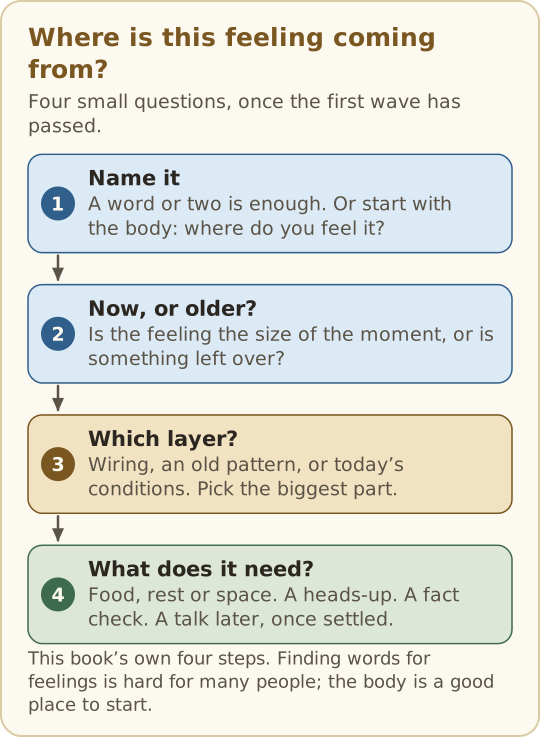
    Name it (“tight, annoyed, a bit scared”). Then ask: is this the size of the moment, or does it feel older? Which layer is it? And what does it need right now: food, space, a heads-up, reassurance, or a real conversation later? It takes a minute, and it works best once the first wave has passed.

    Dig deeper: a four-step self-check
  5. Plan what settles you on a calm day.

    When you’re wound up is a bad time to work out what helps. The Calm-Down Kit (spreadloveandacceptance.com/wp-11) is a plan you make while calm: what tends to set you off, two calming steps, and one sentence for stepping away that includes when you’ll be back. It is for you, never for the other person.

    Dig deeper: deciding ahead
  6. Your needs and limits are information, not demands.

    What helps you, what matters to you and what you have left are facts about you. Said kindly, they let other people plan around you: “A heads-up helps me,” “I can take this one, not that one,” “I’m low today, can we talk tomorrow?” Who did what (Part B) has ready-made kind ways to say no, and Say it so it lands turns a raw reaction into a fact, a feeling and an ask.

    Dig deeper: saying your needs kindly
  7. Being wired differently is not being wrong.

    Some people take in words, noise, change and feelings differently from what most social customs were built around. That is wiring, not a flaw to fix. You can understand it, plan around it and get support for it, if you choose. A mix-up also runs both ways: Wired Differently (spreadloveandacceptance.com/wired-differently) shows how two differently wired people can each misread the other, with nobody at fault.

    Dig deeper: wiring is not a flaw
  8. Explain yourself without over-sharing.

    Three short sentences cover most moments. “This is how I’m wired. It won’t change, but here’s what helps.” “This is an old alarm. I’m working on it, and here’s what helps in the moment.” “Today’s a low-battery day.” You never owe anyone your history. Share the part that helps them help you, as information and not as a list of rules.

    Dig deeper: scripts, and how much to share
  9. Do your part, and only your part.

    Today you control your words, your effort, your rest, your limits and what you ask for. You don’t control someone else’s mood, reply, pace or choices, and trying to manage them drains you fast. So do your side well, then let go of theirs. And match energy with energy: meet warmth with warmth and effort with effort, and when you keep giving far more than comes back, give a little less until it balances. It protects your battery, and a protected battery is what keeps you kind.

    Dig deeper: your circle of control, and matching energy

The ideas, one at a time

Each idea above again, with a real-life example, words you could use and one small step. Read one and stop if you like.

1. Two layers you can work with

For example: A dad who works nights finds the school-run chatter unbearable at 8am. That isn’t who he is. It’s the hour. He swaps to the afternoon pick-up, and the chatter is fun again. See Different hours (spreadloveandacceptance.com/different-hours).

Words you could use: “It’s not you, it’s the hour. Can we talk after I’ve slept?”

Try this: Write one thing that always bothers you (probably wiring) and one that only bothers you when you’re tired (conditions).

2. How you like to be spoken to

For example: A grandmother loves phone calls. Her grandson loves texts. Each thinks the other is being distant. Once they say how they like to talk, they settle on a Sunday call and texts in between.

Words you could use: “I take things in best when ___. How about you?”

Try this: Finish the sentence “I take things in best when…” and keep it for your “How to talk to me” card (a one-page note on how you like to be spoken to).

3. Check your weather first

For example: A long-distance couple notice their hard calls are always at the end of one partner’s late shift. They move serious talks to weekend mornings. See Long distance (spreadloveandacceptance.com/long-distance).

Words you could use: “I’m running on empty tonight. Can we pick this up tomorrow morning?”

Try this: For three mornings, describe your inner weather in one of the three sky words My weather today uses: clear, gusty or fogged in.

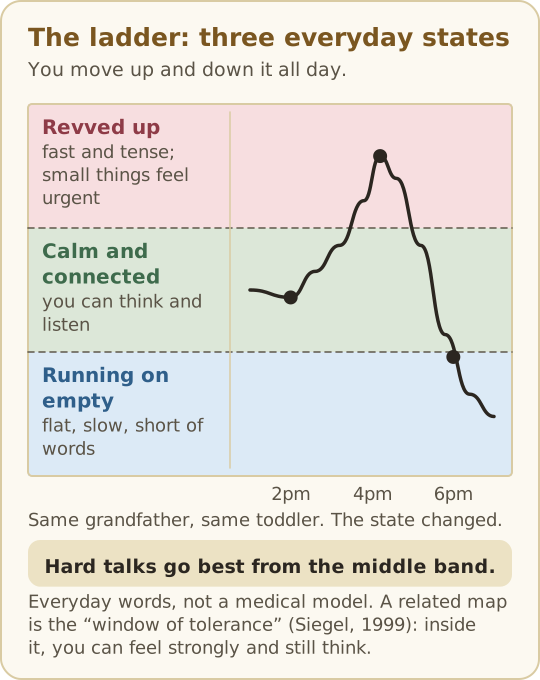
One state, many words. The book and its tools use a few everyday pictures for one thing: how much room you have today. They are different words for the same state, not different things to measure.

  • The three states (Part Three calls them the ladder): calm and connected, revved up, and running on empty.
  • My weather today uses sky words for the same three: clear is calm and connected, gusty is revved up, and fogged in is running on empty. Its pressure (light, building or heavy) is how much you were already carrying.
  • The load, also called the stress tank, is the score from How much are you carrying?, from 0 to 1. Higher means heavier.
  • The battery is the other side of the load: the energy you have left. A heavy load means a low battery.

So “gusty”, “revved up”, “a fairly full tank” and “a low battery” can all describe the same afternoon. Use whichever words suit you.

4. Where is the feeling coming from?

For example: A coworker says, “Quick question?” and your heart races. Name it: jumpy. Older? Yes, an old boss. Layer: a pattern, plus a busy day. Need: a moment to settle.

Words you could use: “Sure. Give me five minutes and I’ll be right with you.”

Try this: Next time a feeling surprises you, do just the first step: name it in two words.

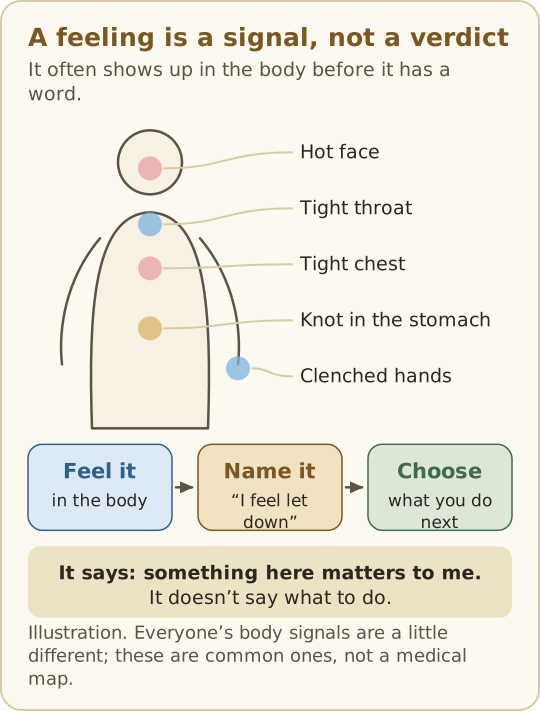
When feelings are hard to name: For some people, “What are you feeling?” is a hard question most days, not just bad ones. They notice a racing heart or a heavy stomach, but can’t tell if it is worry, anger or hunger. Psychologists call this alexithymia (“no words for feelings”). It is a trait that runs from a little to a lot, not an illness, and it is common, especially in autistic people. The feelings are there; the words come slowly. What helps: start with the body (“tight chest, skipped lunch”), choose between two words (“more tired or more annoyed?”), use the three sky words instead of feeling words, and give it time. “I’ll tell you tomorrow” is a real answer.

Four numbered steps: name it, now or older, which layer, what does it need.
Figure 6 A four-step self-check for a feeling that is bigger than you expected. Do it once the first wave has passed.

5. Plan what settles you

For example: A teenager makes a plan with herself. When a row with her mum heats up, she says, “I need ten minutes in my room, then I’ll come back.” And she comes back.

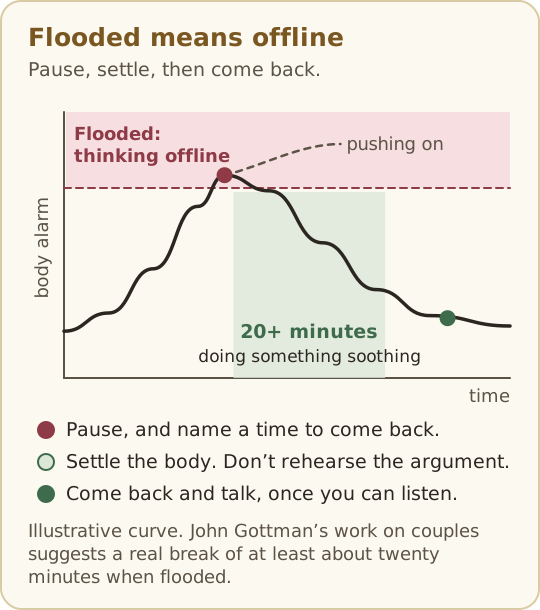
Words you could use: “I’m too wound up to listen well. I need twenty minutes, then I’ll come back.”

Try this: On a calm day, write your one stepping-away sentence, including when you’ll be back.

6. Needs are information

For example: In a home with three partners, Quinn needs an hour alone after work. Said once, kindly, it becomes part of the plan instead of a mystery. See More than two partners at home (spreadloveandacceptance.com/more-than-two).

Words you could use: “I can do ___. I can’t do ___ this week. Could we ___ instead?”

Try this: Write one need you’ve never said out loud. Practise saying it as a fact, not an apology.

7. Different isn’t wrong

For example: A woman with ADHD keeps forgetting plans with a friend. Instead of “I’m hopeless,” she says what helps: “If you text me the day before, I’ll be there.” See Neurodivergent relationships (spreadloveandacceptance.com/neurodivergent-relationships).

Words you could use: “My brain works a bit differently. Here’s what helps me get it right.”

A mix-up runs both ways: When an autistic and a non-autistic person misread each other, it is easy to blame the autistic person. The double empathy problem, named by the autistic researcher Damian Milton, is the idea that the gap runs both ways: each person reads the other through their own way of communicating, and each finds the other hard to read. In one study, a story passed along a chain of autistic people kept as much detail as one passed along non-autistic people; mixed chains lost detail faster. So nobody is the broken one. Ask “Where did we lose each other?” and both adjust a little.

Try this: Name one setting where you work best (quiet, written down, early, with music) and give yourself it once this week.

8. Explain, without over-sharing

For example: A man with a long-term illness tells a new friend, “Some days I have less energy. If I cancel, it isn’t about you.” He shares what helps, not his medical history. See When one of you is ill (spreadloveandacceptance.com/when-one-is-ill).

Words you could use: “Today’s a low-battery day. It isn’t about you.”

Try this: Pick one of the three short sentences above and say it out loud once, on your own.

9. Your part, and only your part

For example: A grown-up daughter keeps trying to stop her father worrying about her. She can’t. She can send a short “Home safe” text after long drives, then let his worry be his. See For grown-up children (spreadloveandacceptance.com/grown-up-children).

Words you could use: “I can’t stop you worrying, but I can text when I’m home.”

Try this: Write one thing you keep trying to control that isn’t yours. Next to it, write one thing that is. (If you are afraid of someone, this isn’t about managing them. Not safe at home? (spreadloveandacceptance.com/safety) has people to talk to.)

Friday, 6:40pm

“Surprise! I booked us dinner with my cousins tonight.” They meant it as a gift. You felt your chest tighten and heard yourself say “Great” in a flat voice. Later you wonder: is that just me, is it something from years ago, or am I simply wiped out after this week? Probably a bit of all three.

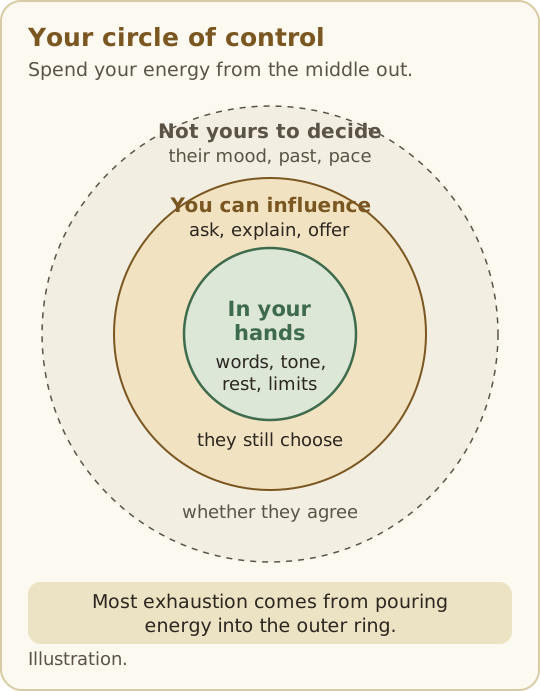
Three rings: in your hands at the centre, what you can influence around it, and what is not yours to decide on the outside.
Figure 7 Your circle of control. Spend your energy from the middle out; most exhaustion comes from pouring it into the outer ring.

You, in all your relationships

Your wiring and your weather come with you everywhere, starting with how you treat yourself on a hard day.

  • With yourself: Noticing “I’m low today” before you decide “I’m failing.”
  • With partners: A heads-up, a quiet hour, a better time to talk. Every partner, and every extra partner, has a wiring of their own.
  • With friends and family: How you like to keep in touch, and how much you can give this month. See Friends (spreadloveandacceptance.com/friends).
  • At work: An agenda ahead, a written plan, a minute before you answer.
  • With housemates: Noise, light and quiet time. See Sharing a room (spreadloveandacceptance.com/sharing-a-room).
  • On your own: Building a week that suits how you’re built. See On my own (spreadloveandacceptance.com/on-my-own).

Find your own situation in help by relationship (spreadloveandacceptance.com/by-relationship).

Inside you, and between you

  • In you: Check your state and know your wiring before you judge a reaction. Count the hidden effort, like masking (hiding or toning down how you naturally are, to fit in) or holding an old alarm down, as real load.
  • Between you and others: Change the setup, not the person. Tell people what helps, tune how you send and receive, and treat a mismatch as tuning, not a moral failing.

In the individual program

This part goes with Steps 1, 2, 4 and 5 of the individual program: check your battery, get to know your wiring, plan what settles you, and find words for what you feel.

Your next step: Step 1: check your battery (spreadloveandacceptance.com/self-path) · Step 2: your wiring · Step 4: what settles you · Step 5: find the words · The whole book on knowing yourself (spreadloveandacceptance.com/book/topic-know-yourself)

The fields behind this part

This part draws on 6 of the author’s thirteen fields (the About page (spreadloveandacceptance.com/about) lists them all):

  • Psychology (Tune how you send and receive): How you take words in and send them out, and what helps you feel understood.
  • Neurobiology (Read your state first): Your nervous system’s state comes before your words, and wiring is part of how you are built.
  • Philosophy (Tune how you send and receive): Your honesty, your ask and your tone are up to you. The other person’s answer is up to them.
  • Behavioural science (Read your state first): Try small routines on calm days, like a one-minute reading and a sentence you keep ready.
  • Holistic therapies (Read your state first): Body first, words second. Decide on a calm day what settles you.
  • Economics (See the whole load): Managing yourself costs effort that doesn’t show, and it counts as part of the load.

Two fields, one idea: Philosophy + Neurobiology. If getting revved up or shutting down is a body doing its job, it isn’t a character flaw. That changes what blame means, including the blame you aim at yourself.

See how all the fields connect, in the full version (spreadloveandacceptance.com/book/self-2-now-in-depth) · The polymath way (spreadloveandacceptance.com/polymath)

In real life

  • Partners: Sam knows surprise plans make their chest tighten, and says so on a calm day: “A heads-up helps me. It isn’t about you.” Now their partner knows what to try.
  • Family: You need a quiet half hour after a long visit. You say so before you go: “I’ll be good company after a short rest.” It sounds like a plan, not a retreat.
  • Housemates: One housemate needs an hour of quiet after work to recover. The other hears it as being shut out. A one-line note settles it: “Quiet until seven isn’t about you. I’m back after.”
  • Coworkers: Someone thinks best with the agenda a day ahead. They say it once, as how they work and not as an apology: “Could the agenda come the day before?”

Common mix-ups

  • “Knowing myself means finding the right label.” It’s about what helps, not a name. The three layers and a Wave Code are everyday words, not a diagnosis.
  • “‘That’s just how I am’ ends the talk.” It may be true, especially for wiring. It works better as a start: “This is how I’m wired, and here’s what helps.”
  • “If I tell people how I’m wired, they have to manage me.” Telling them helps their words land. You still do your part, and they still have their own needs.
  • “I’m fine” means I’m fine. Sometimes. It can also mean you’ve been tired for so long you stopped noticing. A quick reading each week shows a baseline you’ve got used to.
  • “Looking at myself is selfish.” Every conversation runs through your own state. Knowing it is part of being easier to talk with.
  • “If I need something, I have to justify it.” You don’t. “A heads-up helps me” is enough. A reason is a kindness you can offer, not a fee you owe.

A note on care: This part is general education. It isn’t a diagnosis, a test or treatment, and it can’t tell you whether you’re autistic, have ADHD or anything else, or what anyone else has. If you’d like to understand yourself more deeply, a qualified professional can help, if and when you want that. Nothing here is required, and nothing you try needs to be shared. If talking about any of this with someone ever feels unsafe, or you feel you can’t say no, stop and talk with a trained counselor on your own. When someone is afraid of their partner, counseling together isn’t advised. Not safe at home? lists free, private hotlines.

Try this: Pick one reaction you had this week, and write one line for each layer.

“My wiring part is…” “The older part is…” “Today’s part was…”

Then take a one-minute reading of your weather, and write one sentence about what helps you, in your own words. Keep it to yourself for a few days.

When it feels right, share that one sentence with one person, on a calm day.

Know your own wiring → (spreadloveandacceptance.com/know-yourself) How you connect: the style quiz → Make your “How to talk to me” card → My weather today, a one-minute self-check → How much are you carrying? → (spreadloveandacceptance.com/workpapers/wp-02-how-much-are-you-carrying) The Calm-Down Kit → Next in the book: Next → (page 58)

Contents · Open this chapter on its own page

Part One · Next

Know yourself: next, shaping who you are becoming

You aren’t finished, and some of who you become is up to you. This part is about choosing a direction, and building small steps that still work on a tired day.

In this chapter

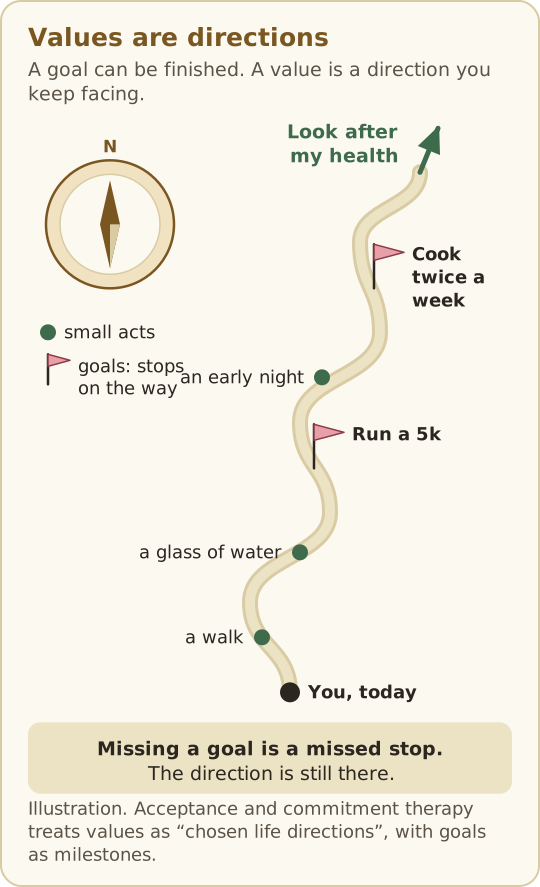
  1. Start with what matters to you
  2. Pick one small goal, in plain words
  3. Name what gets in the way
  4. Make the step tiny, and repeatable
  5. Decide ahead with a simple if-then
  6. Ask for support, as information
  7. Look back kindly once a month
  8. Kindness to yourself is part of the plan
  9. Set goals inside your circle, and spend energy where it comes back
  10. The ideas, one at a time
  11. You, in all your relationships
  12. Inside you, and between you
  13. In the individual program
  14. The fields behind this part
  15. In real life
  16. Common mix-ups

In short:

  • Start with what matters to you, in two or three plain words, then pick one small goal you can do.
  • Make the step tiny and decide ahead: “If it’s after dinner, then I put my shoes on.”
  • Ask for support as information, and look back kindly once a month.
  • A missed day is information about the plan, not a verdict on you. Change the plan.
  • Set goals inside your circle, and spend your energy where it comes back.

The big ideas: This part mostly teaches “Fix the setup, not the person” and “Notice the quiet incentives”, with help from “Read your state first”. What are the five big ideas? (They are five plain ideas the whole program is built on.)

Wednesday, 9:10pm

You meant to start walking after dinner. You meant to last week, too. Tonight you’re tired, the shoes are by the door, and you tell yourself you’ll begin on Monday.

  1. Start with what matters to you.

    A goal built on someone else’s idea of success is hard to keep up. Before you pick anything, ask: what do I want my days to be like? Write two or three plain words, like calm, close to my family, steady or creative. They are a direction, not a score. How you connect (spreadloveandacceptance.com/wavelength) can help you notice what fills you up and what drains you.

    Dig deeper: values first
  2. Pick one small goal, in plain words.

    Just one. Say it as something you will do, not something you hope will happen: “Walk for ten minutes after dinner,” not “get healthier.” Your own actions are up to you. How other people respond, and how things turn out, are not.

    Dig deeper: one goal, in plain words
  3. Name what gets in the way.

    Use what you learned in Then (page 22) and Now (page 39). Is it your wiring (a plan that ignores how you’re built is built for someone else)? An old rule (“rest has to be earned”)? Or today’s conditions (a tired evening)? Then change the arrangement, never yourself: move the step to the morning, not the person to a better version.

    Dig deeper: what gets in the way
  4. Make the step tiny, and repeatable.

    Small enough to survive your worst week. “Put my shoes on” counts. Tie it to something you already do, and do it often. This is the same idea as the 90-second daily check-in in Chapter I (spreadloveandacceptance.com/book/chapter-1-in-depth) of Part Two: small and often beats big and rare. Ten-minute start (spreadloveandacceptance.com/start-in-10-minutes) shows how small a whole path can be.

    Dig deeper: tiny, repeatable steps
  5. Decide ahead with a simple if-then.

    “If it’s after dinner, then I put my shoes on.” Deciding ahead means one less decision on a tired day, the same idea as the Calm-Down Kit (spreadloveandacceptance.com/wp-11), which you make while calm. If a plan isn’t working, that’s information about the plan, not about you. Change the plan.

    Dig deeper: if-then plans
    Filled-in example 4 The Calm-Down Kit, just for me Nell, on her own

    The Calm-Down Kit

    Your name
    Nell
    Date
    11 October 2026

    Part A: What tends to start it

    What tends to start itHow it shows up in my body first
    A long message from my sister late at nightTight chest, typing fast
    Plans changed with no warningJaw, hot face

    Part A: My two defaults

    First default
    Walking it out
    Second, if the first isn’t available
    Asymmetric breathing (4 in, 6 out)

    Part A: My pause line

    In my words
    I’m at capacity. I’m going to step away for twenty minutes, and I’ll answer properly after that.

    My pause plan (yours to share, if you like)

    My pause word or signal
    “Back in a bit”
    The shortest break I take
    20 minutes
    How I set the time to come back
    I text a time, the same day
    The first sentence when I come back
    “Thanks for waiting. I can think straight now.”

    Part B: In the moment

    Say your pause word or line, then do your first calming step. Nothing in this kit works by cold, pain or shock, and none of it is treatment.

    Part C: Coming back

    TimeWhat I didHow I feel now
    9:40 pmWalking it outStill hot
    10:05 pmAsymmetric breathing (4 in, 6 out)Settled enough

    Where that leaves you

    Next
    Settled enough: pick things back up, at the time you named. When you come back, start with one small, simple task, like putting the dishes away.
    Next small action
    Reply to my sister’s message, one line
    If you put it off: when you’ll pick it back up
    Tomorrow after lunch

    ✓ I’m going with this

    A made-up example. Names and details are invented.

  6. Ask for support, as information.

    Tell one person what you’re trying and what would help: “I’m trying to walk after dinner. Could you ask me about it on Sunday?” It isn’t a demand, they can say no, and you don’t need their agreement to start. Some goals are better with a qualified professional, and asking for one is a sensible step, if and when you want that.

    Dig deeper: asking for support
  7. Look back kindly once a month.

    It mirrors Chapter V (page 172) of Part Two, pointed at yourself. Once a month, take ten minutes: what went well? What kept slipping? Was the gap in the plan, in how much you have right now, or just a one-off week? You don’t add up old misses. You only ask what to try next month.

    Dig deeper: a monthly look at yourself
  8. Kindness to yourself is part of the plan.

    A plan that needs you to be harsh with yourself is built on a “second arrow”: the first arrow is the slip itself, and the second is the telling-off you give yourself afterwards, which hurts more and helps less. A missed day is information. Rest is part of the plan, not a prize for finishing. You can shrink a goal, change it or drop it. Nothing here is required, and you can stop any time.

    Dig deeper: kindness as part of the plan
  9. Set goals inside your circle, and spend energy where it comes back.

    A goal that depends on someone else changing is a wish. Shape each goal around what you can do: “I’ll ask once, kindly, by Friday,” not “They’ll start helping.” Then budget your energy like the limited thing it is. Put more into the people and plans that give back, and less into the ones that only take. That isn’t selfish. It’s how you keep going long enough to reach the goal, and still have something left to give.

    Dig deeper: planning inside your circle

The ideas, one at a time

Each idea above again, with a real-life example, words you could use and one small step. Read one and stop if you like.

1. Start with what matters

For example: After their youngest leaves home, a couple each write two words. Hers are “useful, outdoors.” His are “calm, curious.” Suddenly it makes sense that she wants to volunteer and he wants the garden. See Kids grown and gone (spreadloveandacceptance.com/empty-nest).

Words you could use: “What I want my days to feel like is ___.”

Try this: Write two plain words for what matters to you right now. Pencil is fine. You can change them.

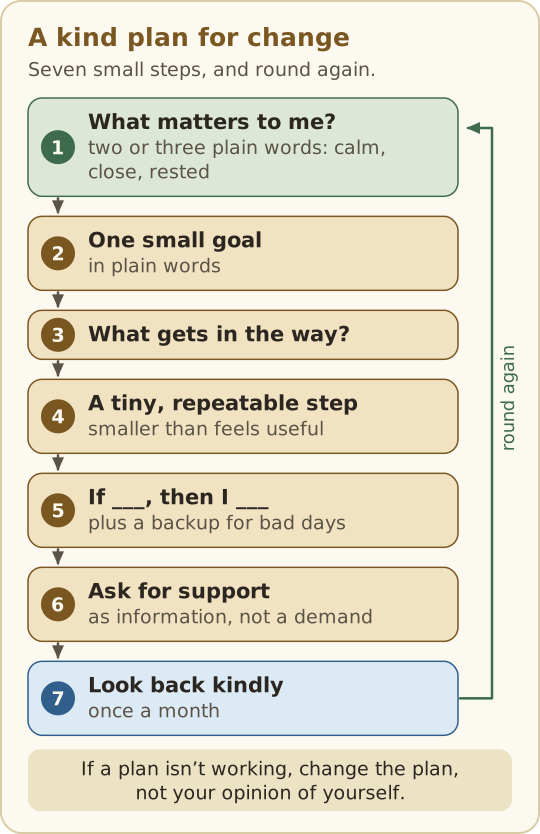
Seven stepping stones from “what matters to me?” to “look back kindly”, with an arrow going round again.
Figure 8 A kind plan for change in seven small steps. If the plan isn’t working, change the plan, not your opinion of yourself.

2. One small goal, in plain words

For example: A student in a shared dorm room wants “to be less messy.” As an action, it becomes “Put my clothes in the basket before bed.” See Sharing a room (spreadloveandacceptance.com/sharing-a-room).

Words you could use: “My one goal this month is ___.”

Try this: Rewrite one wish as something you will do, starting with “I will…”

3. What gets in the way

For example: A shift worker keeps missing his evening run. It isn’t laziness. His rota (his work timetable) changes every week. He ties the run to “my first day off” instead of “evenings.” See Different hours (spreadloveandacceptance.com/different-hours).

Words you could use: “It’s not that I don’t care. The setup doesn’t fit yet.”

Try this: Pick one thing that keeps slipping. Ask: is it my wiring, an old rule, or today’s conditions?

4. Tiny and repeatable

For example: Someone on their own after a breakup wants to “get back out there.” The tiny step: one message to one friend every Sunday. See On my own (spreadloveandacceptance.com/on-my-own).

Words you could use: “I’m starting really small, on purpose.”

Try this: Shrink your step until it takes less than two minutes.

5. Decide ahead

For example: A separated parent wants calmer handovers. Her if-then: “If I pull up outside, then I take three slow breaths before I get out of the car.” See Co-parenting (spreadloveandacceptance.com/co-parenting).

Words you could use: “If ___ happens, then I’ll ___.”

Try this: Write one if-then. Pick a cue that happens every day, like the kettle, the front door or brushing your teeth.

6. Ask for support

For example: A woman caring for her husband after a stroke asks her brother, “Could you sit with him on Thursday afternoons so I can swim?” Because it is specific, it is easy to say yes or no. See When one of you is ill (spreadloveandacceptance.com/when-one-is-ill).

Words you could use: “I’m trying ___. Would you be up for ___? It’s fine to say no.”

Try this: Name one person and one small, specific thing they could do. (If someone uses your goals to check up on you or control you, Not safe at home? (spreadloveandacceptance.com/safety) has people to talk to.)

7. Look back kindly

For example: A grandmother raising her two grandchildren looks back on the month. Bedtime is working. Homework isn’t. Next month she tries homework at the kitchen table straight after a snack. See Foster and kinship families (spreadloveandacceptance.com/foster-and-kinship).

Words you could use: “What went well, what kept slipping, and what will I try next?”

Try this: Put ten minutes in your calendar for the first of next month.

8. Kindness is part of the plan

For example: A sixteen-year-old sets a goal to revise every night, misses three nights and says, “I’m useless.” His grandmother asks, “What would you tell your best friend?” He shrinks the goal to twenty minutes.

Words you could use: “That was a missed day, not a missed life.”

Try this: Next time you miss a step, say one sentence to yourself that you would say to a friend.

9. Inside your circle

For example: You’d like your adult sister to call more. That goal sits outside your circle. Inside it: “I’ll call on the first Sunday of each month, and tell her I’d love her to call too.” See Family rifts (spreadloveandacceptance.com/family-rifts).

Words you could use: “I’d love it if ___. Either way, I’ll ___.”

Try this: Rewrite one goal that depends on someone else, so the next step is yours.

The first of the month

You open your notes. Of the four small things you tried, two stuck and two quietly stopped. Nothing went wrong. You just know now which two need a different setup.

You, in all your relationships

A goal for yourself often touches the people around you. Small steps work everywhere.

  • With yourself: Rest, health, a hobby you dropped, a kinder inner voice.
  • With partners: One small habit you offer, not one you demand. See Gaming and time together (spreadloveandacceptance.com/gaming-and-time-together).
  • With friends: One message a week. See Friends (spreadloveandacceptance.com/friends).
  • With family: A regular call, a visit you can keep up, or a first step after years apart. See Reaching out.
  • At work: One comment per meeting, one clear handover note.
  • With money: One small saving habit you control. See Money together (spreadloveandacceptance.com/money-together).
  • On your own: A week that suits you. See On my own.

Find your own situation in help by relationship (spreadloveandacceptance.com/by-relationship).

Inside you, and between you

  • In you: Treat your own routines as a setup you can adjust, not a character test. Notice the defaults and cues that steer you, and let the easy path be the one you want. Pick the step for the energy you really have.
  • Between you and others: Say what you’re trying and what would help, as information. Let people’s answers be theirs, and fix the setup, not the person.

In the individual program

This part goes with the end of the individual program: a gentle first week, then the Individual package, which turns your workpapers into a report written just for you.

Your next step: A gentle first week (spreadloveandacceptance.com/self-path) · The Individual package and your report · All six steps · The whole book on knowing yourself (spreadloveandacceptance.com/book/topic-know-yourself)

Filled-in example 5 The self path, step by step Sam, on their own, two weeks in

The path, step by step

The six steps
StepWhere it’s at
Check your batteryDone ✓
Get to know your wiringDone ✓
See where your lens came fromDone ✓
Plan what settles youNot yet
Find words for what you feelNot yet
Practice kind ways to say noNot yet

Come back gently, once a week

Pick a day and a time, and add a ten-minute reminder to your own calendar. It repeats every week and just says “10 minutes for me”.

Day
Sunday
Time
7:30 pm

What happens next

The next step is Plan what settles you: the Calm-Down Kit. Three steps done is three steps done; the rest will still be here next week.

A made-up example. Names and details are invented.

The fields behind this part

This part draws on 6 of the author’s thirteen fields (the About page (spreadloveandacceptance.com/about) lists them all):

Two fields, one idea: Philosophy + Behavioural science. Aristotle thought we become what we repeatedly do. Character, like a habit, is built by small acts, not by one big decision.

See how all the fields connect, in the full version (spreadloveandacceptance.com/book/self-3-next-in-depth) · The polymath way (spreadloveandacceptance.com/polymath)

In real life

  • Partners: One partner wants calmer evenings. They pick one small step, no phones at the table for ten minutes, and say so: “I’m trying this. Would you try it with me?” The other can say yes, not yet or no.
  • Family: You’d like to be in touch with a sibling more. “If it’s Sunday after lunch, then I call for ten minutes” is easier to keep than “I should call more.”
  • Housemates: You want the kitchen to stay clear. Your part is a setup, not willpower: “If I make a drink, then I wash the cup before I sit down.”
  • Coworkers: You’d like to speak up more in meetings. One comment per meeting, written down beforehand from the agenda, is a goal you can actually do.

Common mix-ups

  • “A goal has to be big to count.” Small and repeatable is what survives a bad week. Big goals are often just many small ones.
  • “If I miss a day, I’ve failed.” A missed day tells you about the plan. Ask what got in the way, then adjust the setup.
  • “If I know myself, I should be able to change anything.” Wiring stays. The aim is a goal that fits how you’re built, not a different you.
  • “Asking for support means I couldn’t manage alone.” It’s information that helps others help. People who ask are using the setup well.
  • “A monthly look-back means grading myself.” It’s a look, not a trial. It never adds up old misses.
  • “I’ll start on Monday.” A fresh start can help, but today’s tiny version counts too. Put your shoes on now.

A note on care: This part is general education. It isn’t therapy, coaching or medical advice, and it can’t promise any result. Goals about your health, money, work or a hard stretch in life may deserve a qualified professional, and there’s no shame in asking for one. Nothing here is required, and nothing you write needs to be shared. If a goal ever starts to feel like a weight, you can shrink it or put it down.

Try this: Write two plain words for what matters to you right now.

Write one small goal as something you will do. Then the tiniest first step, and one if-then: “If ___, then I ___.”

Put a ten-minute look-back on the calendar for a month from now. At that look-back, ask: what went well, what kept slipping, and what will I try next?

Your self-discovery path → How you connect: the style quiz → Ten-minute start → The Calm-Down Kit → Chapter V: the monthly look-back → (page 172) Part Two begins with the Preface → (page 74)

Contents · Open this chapter on its own page

Part Two

Between us

One idea per chapter about sharing a life, a home or work with someone, each with a worksheet that puts it to use.

In this part

  1. Preface The work nobody seesThe work nobody sees: invisible labour at home74
  2. Chapter I Why we get out of tuneWhy we get out of tune: communication at home93
  3. Chapter II Is the split working?Is the split working? A fair look at chores at home110
  4. Chapter III Full tanks and different anglesFull tanks and different angles: stress and perspective132
  5. Chapter IV Two kinds of fairTwo kinds of fair: equal vs fair at home151
  6. Chapter V The monthly look-backThe monthly look-back: a calm relationship check-in172

Preface to Part Two

The work nobody sees: invisible labour at home

Part Two of the book is about the people you share a life, a home or a job with, and it opens here. Running a life takes a lot of work that nobody sees. This preface helps you make that work visible, to yourself and to anyone you share it with, so you can talk about it fairly and kindly.

In this chapter

  1. Unseen work quietly adds up
  2. A lot of it is thinking, not doing
  3. The other person usually just hasn’t seen it
  4. Writing it down isn’t keeping score
  5. Each of you writes only your own side
  6. The borrowed words are there to take the blame away
  7. One small step at a time
  8. It can help in many kinds of shared life
  9. The mental load: what the research says
  10. Inside you, and between you
  11. On your own: your own unseen work
  12. The fields behind this chapter
  13. Where this comes from: the polymath way
  14. In real life
  15. More kinds of shared life
  16. Your situation, in this part of the book
  17. Common mix-ups
  18. Limits and cautions

In short:

  • Running a home takes unseen work: the noticing, remembering and planning that many people call the mental load.
  • The other person usually just hasn’t seen it. This work hides by nature. It isn’t a sign that they don’t care.
  • Each of you writes only your own side of one ordinary week, and you read the two lists together.
  • The list is for seeing, not for billing. Thank each other for the past, and plan next week.

The big ideas: This preface mostly teaches “See the whole load”, with help from “Notice the quiet incentives”. What are the five big ideas?

Sunday, 9pm

Someone notices the laundry is still in the washer, the school forms are due on Tuesday, and the birthday card never got posted. They also notice that nobody else has noticed. The house looks fine. That’s the problem.

Or, living alone: A widower says, “Since my wife died, I notice how many jobs she quietly carried: the birthday cards, the boiler service, knowing who to ring when someone was ill. I never saw them until they stopped getting done.”

  1. Unseen work quietly adds up.

    Remembering appointments, noticing the milk is low, calming a tense moment: none of it shows up on a calendar, so it rarely gets a thank-you. Over months, it piles up. The book calls this pile unbilled debt. Nobody sends a bill for it. You can thank someone for what they carried before; you just don’t bill for the past.

    For example: Marcus remembers every school form, dentist visit and bit of lunch money for their two kids. His husband, Theo, sees two kids who always seem to have what they need. The work is just out of sight.

    Words you could use: “Can I show you some of the things I keep track of? I’m not asking you to pay anything back. I just want you to see them.”

    Try this: Tonight, write down three things you did today that nobody saw. Don’t do anything with the list yet. Just notice.

    Dig deeper: the work that goes unseen
  2. A lot of it is thinking, not doing.

    Before a job gets done, someone has to notice it, remember it, plan it and check it happened. That thinking takes real time and energy, even though nobody can see it.
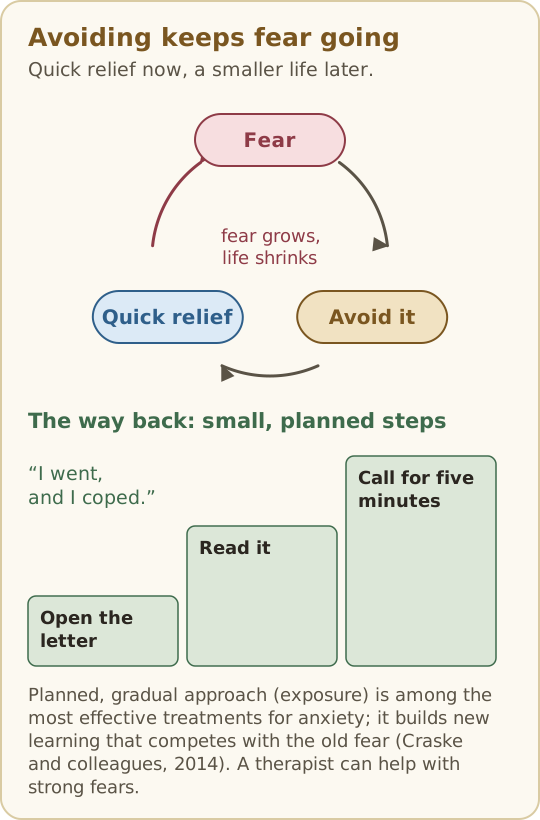
    For example: In a shared flat, Yasmin notices the internet deal is ending, compares plans, picks one and checks it went through. Paying took two minutes. The thinking took an evening.

    Words you could use: “Doing it is the quick part. Remembering it and planning it is the part I’d love some help with.”

    Try this: Pick one job at home and split it into four steps: notice, plan, do, check. Who usually does each step?

    Dig deeper: the kinds of unseen work
    An iceberg: the doing shows above the water; noticing, remembering, planning and deciding, checking and smoothing sit unseen below.
    Figure 9 The work nobody sees. Most of a job happens before and after the doing, and whoever holds that part can never fully switch off.
  3. The other person usually just hasn’t seen it.

    When this work is done well, nothing seems to happen. So the other person isn’t ignoring it. From where they stand, it looks like things take care of themselves.

    For example: Edna minds her grandchildren three afternoons a week and quietly moves her own doctor visits to fit. Her daughter thinks it all “fits in easily.”

    Words you could use: “I don’t think you’ve been ignoring it. I think it’s been hard to see from where you are.”

    Try this: Ask one person, “What’s something you do that you think I don’t see?” Then just listen, without explaining.

    Dig deeper: why it stays hidden
    Two bars: one person thinks they do about 60 percent, the other about 55 percent; together they add up to 115 percent of the same work.
    Figure 10 We each remember our own effort best. Illustrative numbers; in Ross and Sicoly’s 1979 study, partners’ estimates of their own share usually added up to more than 100 percent.
  4. Writing it down isn’t keeping score.

    The point is for both of you to see the same picture, in the same words, at the same time. Then the talk starts from facts you share, not from two different memories.

    The book calls this shared record a ledger: a plain list of who did what. It’s a way to see, not a bill.

    For example: Two coworkers sharing one job each list a week of tasks. Every client call landed on one person. They don’t argue about last year; they swap Friday calls.

    Words you could use: “I’m not trying to win anything. I’d like us both to be looking at the same list.”

    Try this: Before you show anyone a list, ask yourself: is this to plan next week, or to prove a point? Share it only if the answer is “plan.”

    Dig deeper: why a ledger isn’t a grudge
    Filled-in example 6 Who did what Marcus and Theo, a couple

    Who did what

    Person A
    Marcus
    Person B
    Theo
    Week beginning
    5 October 2026

    Part A: Who did what, this week

    DayTask noticed or doneWho did itMinutes (rough)How it came up: asked for, noticed, or thinking time?
    MonPlan the week’s mealsTheo20Thinking and planning
    MonCook dinnerMarcus45Asked for
    TueBook the boiler serviceTheo15Noticed and handled
    TueDishesMarcus20Asked for
    WedLaundry, wash to put awayTheo60Noticed and handled
    ThuRemember Marcus’s mum’s birthday cardTheo10Thinking and planning
    FriBins and recycling outMarcus10Noticed and handled
    SatBig food shopBoth70Asked for

    This week’s totals

    Marcus
    110 minutes (44%), of which 10 noticed and handled without being asked
    Theo
    140 minutes (56%), of which 105 noticed and handled without being asked (30 of them thinking and planning)
    Workload balance score
    0.88. It describes how the logged work was split this week, not anyone in it.
    Unasked-for work
    Theo did 91% of the work that was noticed and handled without anyone asking. This is the work that is easiest to miss. Say it out loud, and give the jobs that repeat a named owner.

    Part B (optional): Kind ways to say no

    Left blank this week.

    A made-up example. Names and details are invented.

  5. Each of you writes only your own side.

    Nobody fills in anything for the other person. You each note what you did, then read the two lists together. That keeps it fair and keeps it kind. Each of you also adds the context only you have, like what the week was like, so you both understand rather than judge.

    For example: Arran, Dani and Sol are three partners sharing a home. Each writes only their own list. Reading them together, Sol learns Arran has been calling the landlord every month.

    Words you could use: “I’ve written my side. Would you like to write yours, in your own words, when you’re ready?”

    Try this: Add one line of context to your own list, like “long week at work” or “the kids were ill.” It helps the other person understand, not judge.

    Dig deeper: your side, their side
  6. The borrowed words are there to take the blame away.

    The book uses a few terms from accounting and science because they describe what’s happening without saying whose fault it is. Each one is explained in plain words, and you never need them to use anything here.

    For example: Two brothers share their mum’s care. Instead of “you never help,” one says, “There’s some unseen work here we haven’t looked at.” That’s much easier to hear.

    New together? If words like “ledger” or “debt” feel heavy a few months in, use your own. “Our list” and “the stuff nobody sees” work just as well. The idea stays the same: two people looking at one honest picture, kindly, so nobody has to guess.

    Words you could use: “Let’s look at how it’s set up, not at each other.”

    Try this: Swap one blaming phrase you use, like “you never,” for a plain one, like “this job keeps landing on me.”

    Dig deeper: why the book borrows these words
  7. One small step at a time.

    Each chapter adds one idea and one tool. One week of notes is enough to start. Later come a 90-second daily check-in about how much you were carrying today, a weekly catch-up and a monthly look-back. If you use the monthly look-back later, a few lines a week is all it needs.

    For example: A nurse on nights and a partner on days hardly see each other awake. They start with one week of notes on the fridge. No changes yet.

    Words you could use: “Could we just try one week of notes and see what we notice? We don’t have to change anything yet.”

    Try this: Pick a start day this week and set one reminder on your phone. That’s the whole first step.

    Dig deeper: how the book fits together
  8. It can help in many kinds of shared life.

    Partners, family, roommates, co-parents and coworkers all share unseen work. The examples often use a couple at home, but the ideas fit anyone who shares a load.

    For example: A foster carer tracks family visits, social worker calls and school meetings. A teenager in the home quietly cooks for the younger ones twice a week. Both count.

    Words you could use: “Whatever we are to each other, we share some work. Could we look at it together?”

    Try this: Name one shared load in your life that isn’t a couple: a family group chat, a shared flat, a team at work.

    Dig deeper: who this book is for

Friday, after work

“You didn’t have to do all that,” they say, and they mean it kindly. You think: someone did. The list only ever lived in your head, so to them it looked like it took care of itself.

The mental load: what the research says

Many people call the thinking side of home life the mental load: the noticing and planning that come before a job gets done, and the checking after. Knowing the baby needs the next size of clothes. Remembering the form, the jab, the party present. It’s real work, even when it doesn’t look like any.

Studies of couples find some patterns, on average. In couples of a man and a woman, women tend to do more of the noticing and checking (Allison Daminger, 2019). After a first baby, a gap often opens: in one study of working couples, mothers took on most of the new childcare while keeping their paid hours (Jill Yavorsky and colleagues, 2015). Arlie Hochschild called the home work that starts after paid work ends “the second shift.”

There is a fair point on the other side too. Sometimes the parent who knows how things are done holds on to that, without meaning to. Researchers call it gatekeeping. When a parent openly invites the other in, and lets them do it their own way, the other parent tends to do more of the care (Sarah Allen and Alan Hawkins, 1999; Sarah Schoppe-Sullivan and colleagues, 2008).

These are averages across many homes, not a verdict on yours. In your home it may be the other way round, or already even, or shared between two men or two women. That’s why the book asks you to look at your own week on paper, instead of guessing.

For example (made up): Hollie and Gareth have a toddler and a baby, and Gareth works shifts. Their week’s minutes come out nearly even. But Hollie did almost three-quarters of the jobs nobody asked anyone to do. Their week is in Chapter II (page 125).

Words you could use: “You do lots of the doing. It’s the remembering I’d love you to take some of: whole jobs, start to finish.” Or, the other way round: “Show me once how you like it done, then let me do it my way.”

Dig deeper: the mental load, fairly

Inside you, and between you

  • In you: Notice everything you carry, including the thinking and feeling work you have never counted. Notice, too, the work others do that you may have missed.
  • Between you and others: Put both lists on one shared, fair page, so nobody has to argue about whose work “counts.” Jobs nobody claims tend to drift to whoever notices first, and a specific thank-you helps keep things steady.

Words you could use: “I want to see what you carry, too, not just what I carry.” “Could we put both our weeks on one page?”

On your own: your own unseen work

You don’t need anyone else to start seeing the unseen. For one week, notice the jobs only you remember: the appointments, the restocking, the smoothing-over. Write them down for yourself, not as a bill.

  • Count it, don’t charge it. The point is to see your real load, so you can plan your energy.
  • Notice which jobs are yours by choice and which just landed on you.
  • Pick one job you could hand back, drop or do less often, and say so kindly.

For example: Nicola, divorced, has the children every other week. On paper, she sees she still buys presents for both sides of the family. She hands his side back, kindly, in one message.

Words you could use: “I’ve noticed I’ve been doing this for both of us. From next month, could you take it on?” Or, to yourself: “That was real work, even if nobody saw it.”

Try this: Circle one job on your list that is yours by choice. Enjoy it. Then circle one that just landed on you, and decide what you’ll do about it. More for people living alone or after a breakup: On my own (spreadloveandacceptance.com/on-my-own).

In the individual program: Step 1: check your battery (spreadloveandacceptance.com/self-path) · Step 6: kind ways to say no · Part One: your circle of control (spreadloveandacceptance.com/book/self-2-now-in-depth) · The whole book on sharing the load (spreadloveandacceptance.com/book/topic-share-the-load)

The fields behind this chapter

Christian, who wrote this book, worked as a government auditor and is a polymath: someone who studied thirteen fields deeply (psychology, philosophy, behavioural science, neurobiology, economics, business, finance, holistic therapies, aromatherapy, the art of debating, politics, music and the healing power of laughter). This chapter grows from 5 of them:

  • Finance (See the whole load): The idea of an unbilled hour: work that was done and logged, but never invoiced, so the client never sees it.
  • Economics (See the whole load): Attention is limited. Every reminder you hold in your head takes up some of it.
  • Psychology (See the whole load): We remember our own effort best.
  • Philosophy (See the whole load): Telling what we know from how things look. In Plato’s Cave, people mistake shadows for the real thing.
  • Business (Notice the quiet incentives): Work that belongs to everyone belongs to no one, and it lands on whoever notices first.

Two fields, one idea: Finance + Psychology. In double-entry bookkeeping, every amount is recorded in two places, and the two must agree. And we each remember our own effort best. Put together: each person keeps their own record, and the two records are read side by side.

See how all the fields connect, in the full version (spreadloveandacceptance.com/book/preface-in-depth) · The polymath way (spreadloveandacceptance.com/polymath)

Where this comes from: the polymath way

This book is built on a polymath’s habit: looking at very different fields and noticing that the same few roots keep turning up. Those roots are balance, signal and noise, feedback loops, limited capacity, ownership, quiet incentives, and state and setting. A ledger, a nervous system and a conversation look nothing alike, yet each one has a limit, each one can lose a message in the noise, and each one stays steady only when what goes out is matched by what comes back.

Christian saw those roots across thirteen fields. The four newest to the list are the art of debating, politics, music and the healing power of laughter. They shape the gentler parts of the book: how to disagree without a fight, how a small group decides fairly, how tone and tempo change what lands, and how a shared laugh can repair a hard moment.

Read the polymath way · See how every field connects to every other

In real life

  • Partners: One of you keeps track of birthdays, presents and thank-you notes for both families. The other has never had to think about it.
  • Family: One grown-up child handles a parent’s appointments and prescription refills each week. The others see a parent who is “doing fine.”
  • Roommates: One roommate always buys the toilet paper and the dish soap. Nobody asked them to. It just keeps happening.
  • Coworkers: One person books the meetings, takes the notes and follows up afterwards. It isn’t in anyone’s job description.

Words you could use: “I didn’t know you did that. Thank you.” “Can we look at who does the remembering, not just the doing?”

More kinds of shared life

Unseen work turns up wherever people share something:

  • Two mums: one holds the baby’s dates and forms in her head; the other does lots of hands-on care.
  • More than two partners: a job nobody owns lands on whoever notices first. More than two (spreadloveandacceptance.com/more-than-two)
  • Friends: one friend always makes the plans and sends the “how are you?” Friends (spreadloveandacceptance.com/friends)
  • Teens: walking the dog and minding a sister feels like a lot to them, and like “helping a bit” to adults. For teens (spreadloveandacceptance.com/teens)
  • Grandparents and grown-up children: childcare comes with planning work, too. Grown-up children (spreadloveandacceptance.com/grown-up-children)
  • Adult siblings: one sorts a late parent’s paperwork for months. Family rifts (spreadloveandacceptance.com/family-rifts)
  • Co-parents and carers: packing the right kit for two homes; meetings and reports on top of care. Co-parenting (spreadloveandacceptance.com/co-parenting) · Foster and kinship (spreadloveandacceptance.com/foster-and-kinship)
  • Housemates, coworkers and business partners: one person always notices the bathroom, or chases the invoices. Sharing a room (spreadloveandacceptance.com/sharing-a-room)
  • Illness, different hours, distance, two faiths: the one at home more, or the one who is well, becomes the default; the ill partner manages unseen pain and energy. When one is ill (spreadloveandacceptance.com/when-one-is-ill) · Different hours (spreadloveandacceptance.com/different-hours) · Long distance (spreadloveandacceptance.com/long-distance) · Two faiths (spreadloveandacceptance.com/two-faiths)

Words you could use: “I don’t need it to be even. I need it to be seen.”

Find your own starting point: Help by relationship (spreadloveandacceptance.com/by-relationship) · How it fits your relationships (spreadloveandacceptance.com/relationships).

Your situation, in this part of the book

Some situations get their own section in Part Two:

  • Faith, culture, elders and in-laws: Chapter I (page 103)
  • Small children or a new baby: Chapter II (page 125)
  • Two homes after a split, and step-parents: Chapter III (page 147)
  • Money between you: Chapter IV (page 168)
  • A couple and a housemate: Chapter IV (page 168)
  • New together, or about to move in: Chapter V (page 186)
  • Grandparents raising a grandchild: Chapter V (page 187)

Common mix-ups

  • “If it mattered, they would have asked for help.” Unseen work is often hidden from the person doing it, too, until it’s written down.
  • “Writing it down means I’m angry.” It means you want you both to see the same picture.
  • “It has to be exactly 50/50.” The goal is a split you can both see and both agree to, not a perfect half.
  • “Mental work doesn’t count, only chores do.” Remembering, planning and checking take real time and energy. Put them on the list.
  • “We should start by going over the last ten years.” Start with one ordinary week. You can thank someone for the past without trying to settle it.
  • “The one doing less doesn’t care.” Usually they just can’t see it yet. Nobody here is the villain. Once you’ve both seen it, what you do next is a choice you make together.

Words you could use: “I don’t think either of us is the bad guy here. We just haven’t seen the same picture yet.”

Try this: Each of you, on your own, list the things you did this week that nobody saw. Then swap lists.

Next, read the other list slowly and say one thing on it you hadn’t noticed before.

Then pick one item from their list and say thank you for it, in a specific way.

If writing things down isn’t your style, a ten-minute talk over a cup of coffee with the same questions works too.

Keep it light. This is a first look, not a verdict. The fixing comes later in the book.

Turn it into a gentle week-long log: Who did what → (spreadloveandacceptance.com/workpapers/wp-01) How to say a specific thank-you → (spreadloveandacceptance.com/turning-toward)

Limits and cautions

These tools only work when each person feels free to say no, to ask for a pause, or to keep their own notes private. If talking about the split ever feels unsafe, or one of you feels you can’t say no, stop using the tools and talk with a trained counsellor on your own. When someone is afraid of their partner, counselling together isn’t advised. Not safe at home? (spreadloveandacceptance.com/safety) lists free, private hotlines.

A list should never be demanded, checked over your shoulder, or used to keep track of where you go or what you spend. If that is happening, it isn’t a ledger. It’s control, and it’s not your fault. Signs to look out for. If you are a counsellor or group leader using this book with others, see For counsellors (spreadloveandacceptance.com/for-counselors).

Contents · Open this chapter on its own page

Part Two · Chapter I

Why we get out of tune: communication at home

Why two kind, reasonable people can end up in a tangle neither of them started, and how to get back in step.

In this chapter

  1. The tangle often isn’t about the words
  2. Nearly in step is the noisy part
  3. Three things knock you out of tune
  4. Stress changes your station
  5. Nobody has to be wrong
  6. Get back in tune before you carry on
  7. Go back in with a clear sentence
  8. Small daily check-ins keep you in tune
  9. Faith, culture and family voices
  10. Inside you, and between you
  11. On your own: your side of the tuning
  12. The fields behind this chapter
  13. In real life
  14. More kinds of shared life
  15. Common mix-ups

In short:

  • A clash often isn’t about the words. Pace, tone and urgency can be out of step even when both of you mean well.
  • Nobody has to be wrong. Name it (“we’re out of tune”), pause with a time to come back, and slow down.
  • Go back in with one clear sentence: a fact, a feeling and an ask.
  • A 90-second daily check-in keeps small drifts small.

The big ideas: This chapter mostly teaches “Tune how you send and receive”, with help from “Read your state first”. What are the five big ideas?

Tuesday, 6:40pm

“I said I’d do it.” “I know, I’m just asking when.” Four sentences later, nobody is talking about the bins any more, and neither of you can point to the moment it turned.

  1. The tangle often isn’t about the words.

    Two people can each say something reasonable and still clash, because the tone underneath doesn’t match. It’s like two radios slightly out of tune: together they make a crackle that neither one was making alone.

    For example: Two housemates. “Is anyone using the oven tonight?” “Why, did I leave a mess?” A plain question was heard as a complaint.

    Words you could use: “I think the words were fine. Something in how we said them got crossed.”

    Try this: After your next small clash, ask yourself: was it the words, or the way they came out?

    Dig deeper: the radio static
    Two wave lines at nearly the same speed add up to a third pattern that swells and fades, a whistle neither one sent.
    Figure 11 The radio whistle. Two reasonable signals, nearly in step, can make a clash that neither person started: it started between you.
  2. Nearly in step is the noisy part.

    Radios on very different stations don’t whistle at each other. The whistle comes when they are close but not quite matched. People who know each other well can still clash. Research suggests we check our meaning less with people we’re close to, because we assume they already understand us.

    For example: Two sisters who talk every day clash over holiday plans far more than they ever do with cousins they see once a year. Being close means more overlap.

    Words you could use: “I think I assumed you knew what I meant. Let me say it more clearly.”

    Try this: With someone close, check one meaning today: “Just so I’ve got it right, you mean…?”

    Dig deeper: why close can be noisy
  3. Three things knock you out of tune.

    How fast you’re talking. The tone, when a simple update is heard as a complaint. And how urgent it feels: “when you get a chance” can mean tonight to one person and next week to the other.

    For example: A business partner texts “Need to talk” between two meetings. The other partner reads it as a crisis and can’t sleep. It was about a printer. A text loses most of the tone, so urgency is easy to misread.

    Words you could use: “By when would be good?” “Is this an update, or a worry?”

    Try this: Add a time to your next request. Not “at some point,” but “by Friday.”

    Dig deeper: pace, tone and urgency
  4. Stress changes your station.

    When you’re tense, you may talk faster and be more likely to hear a pause as a snub. When you’re tired and flat, your replies get slower and shorter. The Nervous System Ladder (spreadloveandacceptance.com/quick-checks), a thirty-second self-check, helps you guess which one you’re in. It’s a best guess, not a reading.

    For example: A dad gets home from a night shift and answers his teenager with one word. The teen hears “he doesn’t care.” He is just running on empty.

    Words you could use: “I’m running low right now. It’s not about you. Can we talk after I’ve slept?”

    Try this: Before a tricky talk, name your state to yourself: calm, revved up or running on empty.

    Dig deeper: how stress shifts your tune
  5. Nobody has to be wrong.

    Two radios that both work fine will still crackle if they’re slightly off. Arguing about whose fault the static is won’t clear it. Retuning (getting back in step) will.

    For example: A grandmother tells her grown-up son, “You look tired.” She means care. He hears “you can’t cope.” Neither of them is wrong about what they meant or heard.

    Words you could use: “I don’t think either of us meant it that way. Can we try that again?”

    Try this: In your next clash, say “we” instead of “you”: “We got crossed there.”

    Dig deeper: taking the blame out
  6. Get back in tune before you carry on.

    Say it out loud: “I think we’re out of sync.” Check how tense you feel. Either of you can call a pause, and the person who paused names a time to come back. Gently slow down, with shorter turns and more pauses. Only then go back to the actual topic.

    For example: Two dorm roommates agree on a pause word, “static,” on a calm day. Mid-argument about noise, one says it. They stop, and come back at 9pm as agreed.

    Words you could use: “I need ten minutes. I’ll come back at half past.”

    Try this: Agree a pause word with someone today, while you are both calm.

    Dig deeper: the four steps to retune
    Four numbered steps: name the mismatch without blame, check your own state, slow the pace, then go back to the topic.
    Figure 12 Retuning, step by step, before you carry on with a talk that has started to whistle.
  7. Go back in with a clear sentence.

    When you return to the topic, say the fact, how you feel, and what you’d like. “The bins go out early on Wednesday morning. I get anxious when they’re late. Could you put them out tonight?”

    For example: A co-parent texts: “The swim kit wasn’t in the bag. I felt stressed at drop-off. Could you pack it on Sunday nights?” A fact, a feeling, an ask.

    Words you could use: “The fact is… I feel… Could we…?”

    Try this: Write one fact, feeling and ask sentence about something small, before you need it.

    Dig deeper: going back in
  8. Small daily check-ins keep you in tune.

    A short chat each day, like the 90-second daily check-in (spreadloveandacceptance.com/workpapers/wp-13-daily-check-in), can make tiny corrections before small things drift into a big argument. Habit research suggests small routines at a regular time are easier to keep than big ones done rarely. The quiet, easy stretches are the ones that drift most, so keep it going even when nothing seems wrong (see Complacency (spreadloveandacceptance.com/complacency)).

    For example: A long-distance couple in two time zones send one 90-second voice note each morning. It’s tiny, but it keeps them in step.

    Words you could use: “Today I was carrying quite a lot. One thing I liked today was…”

    Try this: Pick a time and a cue, like right after dinner, and try the check-in for three days.

    Dig deeper: staying in tune
    Filled-in example 7 The 90-second daily check-in Priya and Dev, a couple on different shifts

    The 90-second daily check-in

    Person A
    Priya
    Person B
    Dev
    Week beginning
    5 October 2026

    Each day

    DayPersonLoadOne thing I appreciated todayOne small thing that didn’t feel greatOne thing that would help tomorrow
    MonPriyaHighYou left soup in the fridge before my night shiftWoke up to the washing still in the machineA text when you’re leaving work
    MonDevMediumYour note on the kettleBins out before I go at six
    TuePriyaHighYou kept the house quiet till noonTen minutes together at the shift change
    TueDevLowYou booked the car inMissed you at dinner again
    WedPriyaMediumBreakfast together at 8Early night
    WedDevMediumYou remembered my mum’s call

    Load this week

    Priya
    2 high, 1 medium, 0 low
    Dev
    0 high, 2 medium, 1 low

    The weekly catch-up

    Sore spot that keeps coming upTimes this weekMove to
    Washing left in the machine2One owner per job
    Missing each other at dinner2Keep watching

    A made-up example. Names and details are invented. One sentence each, then just listen: no debating, no solving.

Saturday, 10am

“We should clear out the spare room at some point.” One of you meant this month. The other heard today and has already cancelled their plans in their head. By lunchtime you’re both upset about a room nobody has touched.

Faith, culture and family voices

For many couples, faith is where they turn first. If you share a faith, it can be one of your strongest tools for staying in tune.

  • A shared rhythm: praying together, or a quiet moment after worship, can be your daily check-in.
  • A pause with a purpose: some couples pray, each on their own, before they come back to a hard talk. The pause still has a time to come back.
  • Your community: a pastor, imam, rabbi, priest or trusted elder can be a good first person to talk to. Many can also suggest a trained counsellor who shares your faith.

For example (made up): Emeka and Ngozi, married 26 years, do their monthly look-back on a Sunday after church, over lunch. When a talk gets heated, either of them can say, “Let’s pray on it and come back at eight.” And they do.

Culture shapes how you talk, too. In many families, respect for elders decides who can speak plainly to whom. One habit helps: each of you speaks to your own parents and relatives, after you’ve agreed the message together.

Words you could use: “Can we pray about this and talk again tonight?” “Mum, we love you, and we’ve thought about it carefully. This year we’ll visit in August, not at Easter.”

From two faiths or cultures? See Two faiths or cultures, one family (spreadloveandacceptance.com/two-faiths). Dig deeper: faith, elders and family far away

Inside you, and between you

  • In you: Know your own pace, your usual tone and what “soon” means to you. Notice when stress speeds you up or slows you down.
  • Between you and others: When a clash starts, treat it as a tuning problem, not a moral failing. Retune together, then translate what you meant into words the other person can hear.

Words you could use: “I think this is a tuning problem, not a you problem.” “What did you hear me say? I want to check it came out right.”

On your own: your side of the tuning

Getting out of tune takes two, but retuning can start with one. You can learn your own pace, tone and urgency, so you notice when you’re the one running fast or slow.

  • Learn your early signs of drifting: a tight chest, a clipped reply, wanting to win.
  • Learn how you take words in best, and say it once: “I hear things better in writing.”
  • When you drift, step out, settle and come back. You don’t need anyone’s permission to retune yourself.

For example: Hamid lives alone and notices his texts to friends come out short when he’s tired. Now he waits until morning to answer anything that matters.

Words you could use: “I’m tired, so I might sound shorter than I mean. Can I reply properly tomorrow?”

Try this: For one day, notice the first sign in your body that you’re drifting. Write it down. More for people on their own: On my own (spreadloveandacceptance.com/on-my-own).

In the individual program: Step 2: get to know your wiring (spreadloveandacceptance.com/self-path) · Step 4: plan what settles you · Part One: who you are today (page 39) · The whole book on talking it through (spreadloveandacceptance.com/book/topic-talk-it-through)

The fields behind this chapter

This chapter draws on 5 of the author’s thirteen fields (see the Preface (page 74) or the About page (spreadloveandacceptance.com/about)):

  • Psychology (Tune how you send and receive): The gap between intent and impact: why a clear, kind sentence can still land as an attack, once pace, tone or urgency slips.
  • Neurobiology (Read your state first): How stress changes your frequency, and how you sound and hear.
  • Philosophy (Fix the setup, not the person): Nobody has to be wrong. Zhuangzi’s Empty Boat: much of the time, the bump was no one’s plan.
  • Behavioural science (Tune how you send and receive): Small and often. A small routine at a regular time is easier to keep.
  • Holistic therapies (Read your state first): Body first, argument second. Settle your own state before you go back to the talk.

Two fields, one idea: Neurobiology + Psychology. A tired body changes how words sound and how they’re heard. So the same sentence can be fine on Saturday and a fight on Tuesday. Check your state, then say it.

See how all the fields connect, in the full version (spreadloveandacceptance.com/book/chapter-1-in-depth) · The polymath way (spreadloveandacceptance.com/polymath)

In real life

  • Partners: “Did you pay the gas bill?” is meant as a reminder. After a long day, it lands as “you forgot again.”
  • Family: A parent asks, “Are you coming on Sunday?” They mean it as a simple question. Their grown-up child hears guilt.
  • Roommates: A message says, “Can we talk about the kitchen?” One roommate meant a quick chat. The other spends all afternoon worrying.
  • Coworkers: “Quick question” arrives at 5:55pm. The sender meant tomorrow is fine. The reader thinks it’s urgent and stays late.

Words you could use: “I meant that as a question, not a complaint. Sorry it came out sharp.”

More kinds of shared life

Getting out of tune happens wherever people talk often:

  • Two dads: “Did you call the school?” is a reminder to one and a test to the other.
  • Three partners: two speak fast and one slowly, so the slow one gets talked over. More than two (spreadloveandacceptance.com/more-than-two)
  • Friends: a one-word reply after a long message reads as cold, when they were just busy. Friends (spreadloveandacceptance.com/friends)
  • Gaming and phones: “Five more minutes” means five to one person and a match to the other. Gaming and time together (spreadloveandacceptance.com/gaming-and-time-together)
  • Teens and parents: a parent’s worry comes out fast and sounds like anger. For teens (spreadloveandacceptance.com/teens)
  • Adult siblings: after years apart, an old nickname lands like an old fight. Family rifts (spreadloveandacceptance.com/family-rifts)
  • Foster and kinship carers: a child who has been hurt may hear a raised voice as danger, even when it isn’t. Foster and kinship (spreadloveandacceptance.com/foster-and-kinship)
  • Different hours, illness, two faiths: a tired shift worker, a partner in pain, or two family styles of speaking can all shift the tune. Different hours (spreadloveandacceptance.com/different-hours) · When one is ill (spreadloveandacceptance.com/when-one-is-ill) · Two faiths

Find your own starting point: Help by relationship (spreadloveandacceptance.com/by-relationship).

Common mix-ups

  • “Retuning means giving in.” It doesn’t. You still come back to the topic. You just come back when you can hear each other.
  • “If we’re out of sync, one of us must be wrong.” Two fair points in two different tones can still clash.
  • “Slowing down means I don’t care.” Slowing down is how you show you want to get it right.
  • “A pause means the topic is dropped.” A pause always comes with a time to come back.
  • “We should push through while we’re on the subject.” Pushing on through static usually makes more static.

Try this: Next time a conversation starts to go wrong, pause and say so kindly, instead of pushing through.

Before then, agree on a shared phrase, like “I think we’re out of tune.” That way it feels like a signal, not a criticism.

For one week, each of you notes one moment you felt out of step. At the end, compare: was it mostly pace, tone or urgency?

When someone says “when you get a chance,” kindly ask, “By when would be good?”

Rewind the talk → (spreadloveandacceptance.com/carrier-wave-decoder) Say it so it lands → (spreadloveandacceptance.com/workpapers/wp-09-say-it-so-it-lands) The 90-second daily check-in →

Words you could use: “I think we’re out of tune. Can we slow down?” “I want to get this right, so I’m going to go slower.”

A limit to keep in mind: These tools only work when each person feels free to say no, to ask for a pause, or to keep their own notes private. If talking things through ever feels unsafe, or one of you feels you can’t say no, stop using the tools and talk with a trained counsellor on your own. When someone is afraid of their partner, counselling together isn’t advised. Not safe at home? (spreadloveandacceptance.com/safety) lists free, private hotlines.

A pause is for both of you. If one person is never allowed to pause, or a “pause” is used to punish with days of silence, that isn’t retuning. Signs to look out for.

Contents · Open this chapter on its own page

Part Two · Chapter II

Is the split working? A fair look at chores at home

One gentle question: can the way you share the work keep going, or is one of you quietly running on empty?

In this chapter

  1. Look at the month, not last night
  2. Three things go in
  3. Balance: how the hours split
  4. Ownership: does each job have a name?
  5. Stress: how full each stress tank is
  6. One number comes out, from 0 to 1
  7. Start with the biggest shortfall
  8. It judges the setup, never a person
  9. Words this chapter uses
  10. Inside you, and between you
  11. On your own: is your own load working?
  12. The fields behind this chapter
  13. In real life
  14. Common mix-ups
  15. Small children and a new baby
  16. If only one of you wants to try this
  17. More for your situation

In short:

  • Look at the month, not last night. Use what you both wrote down, not memory.
  • Three things go in: balance (how the hours split), ownership (does each job have a name?) and stress (how full each tank is).
  • One number comes out, from 0 to 1. Start with whichever part pulled it down most.
  • It judges the setup, never a person. It’s where a talk starts, not how one ends.

The big ideas: This chapter mostly teaches “See the whole load” and “Fix the setup, not the person”, with help from “Read your state first”. What are the five big ideas?

Any given week

One of you is quietly doing eleven small things a day that the other has never had to think about. When the other one says it feels even, they mean it. From inside each person’s own week, it does.

  1. Look at the month, not last night.

    When people ask “Is this working?”, the answer usually comes from whatever happened most recently. This chapter asks a calmer question, using what you both wrote down. Re-ask it every few months, even when things seem fine, because a split that worked once can quietly go stale.

    For example: Two housemates had one awful week of dishes. The whole month showed three fine weeks and one exam week.

    Words you could use: “Can we look at the whole month before we decide anything?”

    Try this: Put a short check in your calendar for about a month from now.

    Dig deeper: what the check is for
  2. Three things go in.

    How evenly the hours are shared. Whether every regular job has a clear owner (the job list, One owner per job (spreadloveandacceptance.com/workpapers/wp-03-one-owner-per-job)). And how stressed each of you already is from everything else going on.

    A workpaper is one of the site’s free fill-in worksheets. You don’t need any of them to start. Rough notes on paper work too.

    Words you could use: “Let’s each bring our own numbers, so neither of us has to guess.”

    Try this: Open the three worksheets once, just to see what they ask.

    Dig deeper: where each number comes from
    Three bars show what each input could earn and did earn in a made-up week; they add up to 0.67, marked on a scale from 0 to 1 in the middle, “drifting” band.
    Figure 13 Is the split working? Three readings go in and one snapshot comes out. Start with the biggest shortfall. It judges the setup, never a person.
  3. Balance: how the hours split.

    From your week-long logs, work out each person’s share of the hours. An even split scores 1. One person doing everything scores 0. It doesn’t matter which person is doing more. If you agreed an uneven split that suits you (say, one of you works longer hours outside the home), compare against that split instead.

    For example: Three partners log 30 hours of home jobs: 15, 9 and 6. An even share is 10 each.

    Words you could use: “I’m not keeping score of you. I just want us both to see the hours.”

    Try this: Log one week each, and include the small jobs that take under ten minutes.

    Three or more of you? Compare each person’s share with an even share (100 ÷ number of people), or with a split you agreed. The “Who does what?” page (spreadloveandacceptance.com/lemonade-stand), where each person lists their hours, does the arithmetic.

    Dig deeper: the balance score
    Filled-in example 8 Who does what? Quick look Wren, Josh and Mei, housemates (Wren’s view)

    Quick look: who does what at home

    Mark who mostly does each job. The picture builds as you go, the thinking work too.

    Your name
    Wren
    Their name
    Josh
    Person 3
    Mei
    JobWho mostly does it
    DishesShared
    LaundryShared
    Cleaning the bathroomJosh
    Cooking dinnerMei
    Grocery shoppingWren
    Paying billsWren
    Noticing what’s running lowWren
    Planning the weekMei
    Remembering dates and appointmentsWren

    How it looks

    Here’s how it looks from your side, 9 jobs so far.

    Everyday jobs: mostly shared. 6 jobs: Wren 2 · Josh 1 · Mei 1 · Shared 2.

    Planning and remembering: mostly Wren. 3 jobs: Wren 2 · Mei 1.

    The thinking work is easy to miss, because nobody sees it happen. Saying it out loud is a good start.

    Does this match how it feels to the three of you?

    A made-up example. Names and details are invented. Pets and booking appointments were taken off the list: they don’t happen in this house.

  4. Ownership: does each job have a name?

    Each job gets two names: the owner, who does the job start to finish, and a backstop, who notices if it slipped and gently checks in (never a supervisor). It can be the same person, though a second name gives the job a gentle check. Count the jobs that have an owner, then divide by all the jobs on the list. (The backstop is a good habit on top, but the count only needs the owner.) Leave jobs nobody owns on the list. They are the ones that matter most.

    A decision you make together, like which school, can be marked “Both (decide together)”. It counts as owned, because a decision needs both voices. A job that needs doing gets one name.

    For example: Two sisters care for their dad. Nobody owned his prescription, so each thought the other had ordered it.

    Words you could use: “Can we put a name next to this one, so it doesn’t fall between us?”

    Try this: Find one job with no name, and give it an owner and a backstop today.

    Dig deeper: the ownership score
  5. Stress: how full each stress tank is.

    Each of you rates how full your own stress tank is with How much are you carrying? (spreadloveandacceptance.com/workpapers/wp-02-how-much-are-you-carrying). A higher score means more stress. Under 0.30 is low, 0.30 up to 0.60 is moderate, and 0.60 or more is high. The score uses the average of your scores. But if either of you is at 0.60 or more, talk about that first, even when the score looks fine. A setup that only works when you’re both well rested isn’t one that can last, so more stress lowers the result.

    For example: A grandmother raising two grandchildren scores 0.70. Her son, who helps at weekends, scores 0.35. Her 0.70 is the headline.

    Words you could use: “My tank is high this week. Can we plan around that, not around the average?”

    Try this: Each of you scores your own tank on the same day, before looking at the other’s.

    Dig deeper: the stress score
  6. One number comes out, from 0 to 1.

    0.70 or above: working well, the setup is holding. From 0.40 up to 0.70: needs a look, something is drifting, often who owns what. Below 0.40: needs a rethink, together. (The result is called the setup score. It looks like a probability, but it isn’t one. It’s a simple weighted sum.)

    A weighted sum means each part counts for a set share: the hours count most, then the owners, then stress.

    For example: Two friends who run a café score 0.55. Nothing is broken, but something is drifting.

    Words you could use: “This number is about our setup, not about us.”

    Try this: Write the date next to your number, so you can compare next month.

    Dig deeper: the formula and what each range means
    Filled-in example 9 Is the setup working for everyone? Rosemary and Ken, retired, married 41 years

    Is the setup working for everyone?

    Person 1 (optional)
    Rosemary
    Person 2 (optional)
    Ken

    1. How the hours split

    From Who did what or the “Who does what?” page: each person’s total hours for the week.

    Rosemary, hours
    14
    Ken, hours
    10

    2. Does each job have a name?

    From One owner per job.

    Jobs on the list
    12
    Jobs with an owner
    9

    3. How much each person is carrying

    Each person’s own score from How much are you carrying? Everyone fills in their own.

    Rosemary, load (0 to 1)
    0.45
    Ken, load (0 to 1)
    0.30

    How the setup is working

    Working well
    0.75 of 1. The setup is carrying its own weight.

    Next: nothing in the setup needs changing this week. Keep the same rhythm of check-ins.

    If you want to nudge it higher one day (optional, not urgent): hand about 2 hours a week from Rosemary to Ken, and balance would go from 0.83 to 1.00. Give one more job an owner (the person who does it and sees it through), and ownership would go from 0.75 to 0.83.

    A made-up example. Names and details are invented. It scores the setup, never a person, and never the relationship as a whole.

  7. Start with the biggest shortfall.

    The single number matters less than which of the three parts pulled it down most. In the middle band that is often ownership, which is why the calculator suggests One owner per job first. Once you’ve both seen it, what you do next is a choice you make together.

    The shortfall is how far one part fell below the most it could add.

    For example: Separated parents score 0.62. Their biggest gap: nobody owns school forms. They fix only that.

    Words you could use: “Which part pulled the number down most? Let’s start there.”

    Try this: Choose one small change, not five.

    Dig deeper: reading your result
  8. It judges the setup, never a person.

    The number isn’t a verdict on who’s better or whether the relationship works. It’s where a conversation starts, never how one ends. These tools only work when each person feels free to say no, to ask for a pause, or to keep their own notes private. If talking about the split ever feels unsafe, or one of you feels you can’t say no, stop using the tools and talk with a trained counsellor on your own. When someone is afraid of their partner, counselling together isn’t advised. Not safe at home? (spreadloveandacceptance.com/safety) lists free, private hotlines.

    For example: One partner sees 0.35: “So I’m the problem.” The other: “No. The bathroom has no owner, and you work nights.”

    Words you could use: “Whatever this shows, I’m on your side.”

    Try this: Before you start, agree that either of you can say “pause” and come back later.

    Dig deeper: what the number is not

Sunday evening

Two week-long logs and two cups of tea. One list has 31 rows. The other has 18. Nobody says anything for a moment. Then one of you says, “I honestly didn’t know about half of these.”

Words this chapter uses

  • Log: a simple list of the jobs you did this week and roughly how long each took.
  • Owner: the person who does a job from start to finish, including remembering it.
  • Backstop: the person who notices if a job slipped and gently checks in. A helper, never a boss.
  • Stress tank: how much stress you are already carrying from the rest of life.
  • Setup: the way you share the work right now. It can always be changed.
  • Setup score: one number from 0 to 1 that sums up the three readings. It describes the setup, never a person.

Invisible jobs count too. Planning meals, remembering birthdays, booking the vet and noticing the soap is running low are all work, even though nobody sees them happen. Put them in your log.

Words you could use: “I’d like to add the thinking jobs to our list, like remembering and planning. They take time too.”

Inside you, and between you

  • In you: See your own share honestly, from what you wrote down rather than from memory. See the way you share work as a setup you can redesign, not a flaw in you.
  • Between you and others: Put both people’s numbers on one page, and read the result as a note about the setup, never a verdict on a person. Clear owners leave less room for blame.

On your own: is your own load working?

This chapter asks whether a shared setup can last. You can ask the same about your own week: are you spending more energy than comes back in?

  • Add up what you carry: jobs, people and worries.
  • Set it beside what refills you: rest, help, and people who give back.
  • If it runs in the red, change your side: drop, delay, ask or say no kindly. A limit is a statement about supply, not about your worth.

For example: After a breakup, Leanne has her kids every other week, and fills the quiet weeks with favours for friends. Writing it down showed her she never rests. More in On my own (spreadloveandacceptance.com/on-my-own).

Words you could use: “I’d love to help, and I can’t this week. Can I let you know next week?”

Try this: Tonight, write three things that drained you this week and one thing that refilled you.

In the individual program: Step 1: check your battery (spreadloveandacceptance.com/self-path) · Step 6: kind ways to say no · Part One: matching energy (spreadloveandacceptance.com/book/self-2-now-in-depth) · The whole book on sharing the load (spreadloveandacceptance.com/book/topic-share-the-load)

The fields behind this chapter

This chapter draws on 6 of the author’s thirteen fields (see the Preface or the About page). The first few:

  • Finance (See the whole load): Like a small shop asking whether it can keep paying its bills, month after month. The chapter reads the setup that way, never as a verdict on the people.
  • Business (Fix the setup, not the person): Ownership clarity: one owner per job, borrowed from project work, and the maker-and-checker habit from internal controls. Every regular job gets a person who does it and a backstop who notices if it slipped.
  • Neurobiology (Read your state first): Leftover stress: a quick self-rating of the stress you’re already carrying. It borrows the idea that stress builds up in the body, but it doesn’t measure your body.
  • Economics (See the whole load): Limited capacity and the safety margin.

Two fields, one idea: Business + Economics. Unowned work falls to whoever notices first, every time. That’s what turns a fixable imbalance into a repeating one, so the check counts owners, not just the hours.

See how all the fields connect, in the full version (spreadloveandacceptance.com/book/chapter-2-in-depth) · The polymath way (spreadloveandacceptance.com/polymath)

In real life

  • Partners: After a new baby arrives, the hours tip heavily one way without anyone deciding it. The check can show it before resentment builds.
  • Family: Two siblings share care for a parent. One lives nearby and does most of the visits. Writing down the hours helps them rebalance in other ways, like paperwork and phone calls.
  • Roommates: Everyone agrees cleaning matters, but nobody owns the bathroom. The ownership score shows the gap straight away.
  • Coworkers: Two people share one role. The same three questions still work: how the hours split, who owns what, and how stretched each person is.
  • Two dads: With no old script for who does what, nothing was decided. One of them quietly took on all the school messages.
  • More than two partners: In a home of three or more, “someone will do it” often means nobody does. Owners matter even more. See More than two (spreadloveandacceptance.com/more-than-two).
  • Foster and kinship carers: Meetings, forms and contact visits are real work. See Foster and kinship families (spreadloveandacceptance.com/foster-and-kinship).
  • Shift workers: Hours can look even while sleep is not. See Different hours (spreadloveandacceptance.com/different-hours).
  • When one of you is ill: Share by energy, and agree an uneven split on purpose. See When one of you is ill (spreadloveandacceptance.com/when-one-is-ill).
  • Dorm roommates: A room agreement with names next to jobs settles most of it. See Sharing a room (spreadloveandacceptance.com/sharing-a-room).

Words you could use: “I think the way we split things worked before, and life changed. Can we look at it again together?”

Filled-in example 10 Our room agreement Kayla and Bea, first-year roommates

Our room agreement

Your name
Kayla
Their name
Bea
Quiet hours
11 pm to 7 am on weeknights, midnight on Fridays and Saturdays. Headphones after that.
Guests (daytime)
Fine with a quick text first. Not during the other one’s study or sleep time.
Overnight guests
Up to 2 nights a week, agreed the day before. A guest doesn’t stay in the room when their host isn’t there.
Cleaning
Kayla: floor and bins, Sunday. Bea: desk area and the fridge, Wednesday. Our own laundry, our own job.
Borrowing
Ask first, every time. Food on the shared shelf is for both of us.
Lights and alarms
Big light off by 11:30 on weeknights; a desk lamp is fine. One alarm, one snooze at most.
How we bring up problems
Text first if that’s easier, then talk within a few days, one topic at a time. If we’re stuck, we ask our RA to help.

Your agreement, ready to send

Our room agreement (Kayla and Bea), with every line above, ending: “We’ll look at it again together in a month.”

A made-up example. Names and details are invented. They kept most of the site’s starting point and changed two lines.

Common mix-ups

  • “A low number means the relationship is failing.” It only means the current setup needs changing. Setups change all the time.
  • “A high number means nobody can complain.” A good score never silences anyone. If something feels wrong, say so.
  • “We can just guess the numbers.” A guessed number is really just a feeling with a decimal point. Use your written logs.
  • “Taking unowned jobs off the list will help.” It raises the number and changes nothing at home.
  • “One of us can fill it in for both.” Each person writes their own log and scores their own stress tank.
  • “Fair means exactly 50/50.” Fair is what you both agree to, with eyes open. An uneven split you chose together can be fair. Chapter IV covers the kinds of fair.
  • “The backstop checks up on the owner.” No. The backstop only notices if something slipped, and asks kindly. It is help, not a check on someone.

Small children and a new baby

Small children bring a flood of new jobs, and most of them are thinking jobs: the nursery bag, the jabs, the party invites, the next size of clothes, the night wakings. That’s why the mental load (see the Preface (page 84)) often grows after a baby arrives, usually without anyone deciding it.

  • Log the kid jobs too, with the thinking time. Nights count.
  • Hand over whole jobs, not tasks: the clothes and sizes, the nursery bag, the GP and jabs. The new owner does the noticing too, in their own way.
  • Baby on the way? Write your first job list together before the birth, plan the nights, and agree to look again at six weeks, three months, and before either of you goes back to work.
  • In the first weeks, share by energy, not hours. Whoever was up in the night gets the rest; the other takes the morning.

For example (made up): Hollie and Gareth have Alfie, 3, and Poppy, 8 months. Gareth is a paramedic on shifts. Their logged minutes come out nearly even, but Hollie did almost three-quarters of the jobs nobody asked for. They don’t move minutes. They move one whole job, the children’s clothes, to Gareth.

Words you could use: “Could you own the nursery bag from now on, including noticing when we’re low on nappies? I won’t check it.”

Dig deeper: small children, new babies and shift work

Filled-in example 11 Who did what, with small children Hollie and Gareth, parents of a toddler and a baby; Gareth works shifts

Who did what

Person A
Hollie
Person B
Gareth
Week beginning
12 October 2026

Part A: Who did what, this week

DayTask noticed or doneWho did itMinutes (rough)How it came up: asked for, noticed, or thinking time?
MonPack the nursery bag: spare clothes, nappies, named milkHollie10Noticed and handled
TueBook Poppy’s one-year jabs at the GPHollie15Noticed and handled
TueBath and bedtime, both childrenGareth45Asked for
WedReply to a party invite and buy the presentHollie25Noticed and handled
WedSort outgrown clothes and order the next sizeHollie40Noticed and handled
ThuPlan the week’s meals around Gareth’s nightsHollie20Thinking and planning
ThuCook dinner and batch-cook for the weekendGareth75Noticed and handled
FriRemember the nursery photo money and formHollie10Thinking and planning
FriNight wakings with PoppyHollie60Noticed and handled
SatSwimming lesson with AlfieGareth60Asked for
SatBig food shop and nappiesBoth80Asked for
SunWashing for both children, to put awayHollie50Noticed and handled
SunFix the stair gateGareth20Noticed and handled
SunUpdate the family calendar and the childcare rotaHollie20Thinking and planning

This week’s totals

Hollie
290 minutes (55%), of which 250 noticed and handled without being asked (50 of them thinking and planning)
Gareth
240 minutes (45%), of which 95 noticed and handled without being asked
Workload balance score
0.91. It describes how the logged work was split this week, not anyone in it.
Unasked-for work
Hollie did 72% of the work that was noticed and handled without anyone asking. This is the work that is easiest to miss. Say it out loud, and give the jobs that repeat a named owner.

Part B (optional): Kind ways to say no

Left blank this week.

A made-up example. Names and details are invented. Gareth worked three night shifts this week, so his rows are fewer; the minutes are close, and the noticing is the part to talk about.

If only one of you wants to try this

That is common, and you can still start. Log your own week and score your own tank. Then share one small thing you noticed, without asking the other person to agree with your numbers.

For example: A dad noticed he spent five hours a week driving his teenage son around. He just said so, and they agreed a bus pass for two days a week. See Teens (spreadloveandacceptance.com/teens).

Words you could use: “I tried writing down my week, just for me. Can I show you one thing I noticed?”

Try this: Share one finding, not the whole list. Then let it rest for a few days.

If the other person refuses to talk about the split at all, ever, or makes you feel afraid for raising it, that isn’t a setup problem. Please read Not safe at home?

More for your situation

Money together (spreadloveandacceptance.com/money-together) · Gaming and time together (spreadloveandacceptance.com/gaming-and-time-together) · Friends (spreadloveandacceptance.com/friends) · Family rifts (spreadloveandacceptance.com/family-rifts) · Grown-up children (spreadloveandacceptance.com/grown-up-children) · Grandparents (spreadloveandacceptance.com/grandparents) · Co-parenting (spreadloveandacceptance.com/co-parenting) · Coming home (spreadloveandacceptance.com/coming-home) · Empty nest (spreadloveandacceptance.com/empty-nest) · At work (spreadloveandacceptance.com/work) · For counsellors (spreadloveandacceptance.com/for-counselors)

Try this: Each of you logs one week in Who did what (spreadloveandacceptance.com/workpapers/wp-01), first. The number only means something if you each wrote your own.

Next, fill in the job list in One owner per job together, including any jobs nobody owns yet.

Then each of you scores how full your own stress tank is in How much are you carrying? on the same day.

Put the three numbers into the calculator. Look first at the biggest shortfall, pick one small change together, and check again in a month.

Then see if the load can last → (spreadloveandacceptance.com/workpapers/calculators/is-the-setup-working-quick) The full calculator → (spreadloveandacceptance.com/is-the-setup-working)

Contents · Open this chapter on its own page

Part Two · Chapter III

Full tanks and different angles: stress and perspective

Why some reactions are bigger than what caused them, and why two people can see the same moment so differently.

In this chapter

  1. A full tank overflows
  2. Some stress is left over from earlier
  3. Check your stress tank in a minute
  4. Three everyday states
  5. There are seven angles on the same moment
  6. Both views can be true
  7. Say it instead of making each other guess
  8. A full tank means “later,” not “never.”
  9. Words this chapter uses
  10. Inside you, and between you
  11. On your own: reading your own tank
  12. The fields behind this chapter
  13. In real life
  14. Common mix-ups
  15. Two homes: co-parenting after a split
  16. If only one of you wants to try this
  17. More for your situation

In short:

  • A full tank overflows. Stress left over from earlier makes small things feel big.
  • Check your tank in a minute, and say the band out loud instead of making others guess.
  • Two people can see one moment from different angles, and both views can be true.
  • A full tank means “later,” not “never”: pause, name a time, and come back.

The big ideas: This chapter mostly teaches “Read your state first”, with help from “Tune how you send and receive”. What are the five big ideas?

Thursday, 5:15pm

They ask, perfectly pleasantly, whether you remembered to call the dentist. Your reaction is much bigger than the question deserved, and you can hear it happening while it happens.

  1. A full tank overflows.

    If you’re already tired, stretched or stressed from somewhere else, a small question can get a big reaction. That’s human. Anything decided in that moment is worth coming back to once you’ve both calmed down.

    For example: A nurse gets home after a night shift. Her housemate asks, “Did you see my message?” She snaps. It wasn’t the message. It was twelve hours on her feet.

    Words you could use: “Sorry. That was bigger than the question. I’m running on empty.”

    Try this: Notice one moment this week when your reaction was bigger than its cause.

    Dig deeper: how full your tank is
  2. Some stress is left over from earlier.

    Ask yourself: how much of this feeling is about the thing in front of me, and how much did I bring in with me? “I’m upset about the dishes” and “I’m exhausted, and the dishes are what I noticed” are different problems.

    Some of what we bring in is much older: an understanding from growing up, like “whoever notices the mess has to clean it.” If a feeling seems a lot older than the moment, Where your lens came from (spreadloveandacceptance.com/growing-up) helps you find where it started.

    For example: A teenager has a hard day at school, comes home, and explodes because a brother took the phone charger. The charger is the last drop, not the whole tank.

    Words you could use: “I think I brought this in with me. Give me ten minutes.”

    Try this: Before you react, ask: “How much of this is from earlier?”

    Dig deeper: leftover stress
  3. Check your stress tank in a minute.

    How much are you carrying? measures how full your stress tank is. A higher score means more stress in the tank. Score five things from 0 to 4: sleep, work elsewhere, any unsettled argument, how your body feels, and time pressure today. Add them up and divide by 20. Under 0.30 is low. From 0.30 up to 0.60 is moderate. 0.60 or more is high. If it has been high for a long time, it can start to feel normal, so a quick reading each week is worth it.

    For example: A man caring for his wife after surgery scores 0.65 three days in a row. That tells him he needs help, not more effort.

    Words you could use: “I checked my tank. I’m in the high band today.”

    Try this: Score yourself tomorrow morning, before you look at your phone.

    Dig deeper: the stress-tank score
    A tank filled in layers by five scores (sleep debt, workload elsewhere, unresolved conflict, body, time pressure), reaching 0.55, in the moderate band.
    Figure 14 How full is your stress tank? Five things scored 0 to 4, added up and divided by 20. Made-up example; the items and bands are this book’s.
    Filled-in example 12 How much are you carrying? Rosa, who shares her mum’s care with her brother

    How much are you carrying?

    Fill this in on your own, about yourself only. Never fill it in for someone else.

    Your name
    Rosa
    Date
    7 October 2026

    The checklist

    0 = Not at all · 4 = Very true

    Sleep debt (less rested than usual)

    • 0
    • 1
    • 2
    • Chosen: 3
    • 4

    Workload elsewhere (job, school, caregiving)

    • 0
    • 1
    • 2
    • 3
    • Chosen: 4

    Recent unresolved conflict (any source)

    • 0
    • Chosen: 1
    • 2
    • 3
    • 4

    Physical state (hungry, sick, in pain)

    • 0
    • 1
    • Chosen: 2
    • 3
    • 4

    Time pressure today specifically

    • 0
    • 1
    • 2
    • Chosen: 3
    • 4

    Your load score

    Your load today
    High load (13 out of 20 points)
    What to do
    Put off anything that doesn’t need deciding in the next hour. If you need to settle first, the Calm-Down Kit is made for this.
    If it can’t wait
    If what you’re carrying can’t wait, like caring for someone who is ill, that’s a sign to get more help, not to try harder: ask one person for one specific thing this week, and look into respite care.
    Filled most by
    sleep debt, workload elsewhere, time pressure today. Conditions, not character.
    Load score
    0.65 out of 1.00

    Optional

    ✓ Some of what I’m carrying is caring for someone

    Anything you want to name before talking
    Mum’s hospital appointment moved to Thursday, and I’m the one driving.

    A made-up example. Names and details are invented. Higher means more load. Rosa scores only herself; her brother fills in his own.

  4. Three everyday states.

    Calm and connected. Revved up. Running on empty. Knowing which one you’re in tells you whether now is a good time to talk. The Nervous System Ladder (spreadloveandacceptance.com/quick-checks), a thirty-second self-check, helps you make a best guess. These labels come from polyvagal theory, whose main claims are still debated by scientists. Here they are only everyday words, not a medical model.

    For example: In a long-distance couple, one partner takes the video call at midnight his time. He is often running on empty. They move the hard talks to weekend mornings.

    Words you could use: “I’m revved up right now. Can we talk after a walk?”

    Try this: Find one body clue for each state, like a tight jaw for “revved up.”

    Dig deeper: the three states
  5. There are seven angles on the same moment.

    Tiredness, time pressure, history, what home was like growing up, your sense of fairness, how you communicate, and stress from outside. Many arguments are two people looking from different angles, each sure the other sees what they see. The “See their side” step of Rewind the talk (spreadloveandacceptance.com/perspective-shifter), built on these seven angles, helps you picture how the same moment might look from the other side, with questions to ask instead of guesses.

    For example: Planning the holidays, one parent sees it from family habit (“We always go to my mum’s”). The other sees it from fairness (“We went to yours last year”).

    Words you could use: “Which angle are you seeing this from?”

    Try this: Guess which of the seven angles you look from most often.

    Dig deeper: the seven angles
    A circle labelled “the same moment” with seven circles around it: tiredness, time pressure, history, family script, fairness, talking style and outside stress.
    Figure 15 Seven angles on the same moment. An angle is a place to stand, not a verdict: name your own, and ask about theirs.
    Filled-in example 13 Rewind the talk: see their side Hana, about her friend Lou

    See their side

    1. What happened?
    I asked Lou if she was still coming to my birthday dinner, and she just replied “maybe”.

    2. Who are they to you?

    • Partner
    • Family
    • Roommate
    • Chosen: Friend
    • Coworker
    • Co-parent
    • My teen or child
    • Someone else

    3. What state might they have been in?

    • Calm and connected
    • Revved up
    • Chosen: Running on empty
    • I’m not sure

    4. What might have been going on around them?

    • A long or hard day
    • Chosen: Little sleep
    • Rushed or late
    • Money worries
    • Chosen: Caring for someone
    • Not feeling their best
    • A noisy or crowded place
    • Other people were there
    • Chosen: It was a text or message
    • It was late at night

    5. How are they wired?

    • They notice tone a lot
    • They take words literally
    • Chosen: They need time to process
    • They think out loud
    • They’re very direct
    • They hint rather than say
    • They like a plan
    • Noise, light or crowds get to them
    • Their language or culture differs

    6. What history might they carry?

    • This has come up before
    • They grew up with it done differently
    • Chosen: It’s a sore topic for them
    • They may feel it’s unfair

    7. What could each of you see? They may have seen or known things you didn’t

    • their whole day and workload
    • Chosen: a message, call or news you didn’t see
    • something they had already planned or done
    • how it looked from where they stood
    • a promise someone else made them
    • how they were feeling inside

    You may have seen or known things they didn’t

    • the planning you had already done
    • Chosen: the reason behind your timing
    • what you actually meant
    • how tired or stretched you were
    • the part already done
    • a deadline only you knew about

    Neither of you could fully see

    • Chosen: each other’s tone, in writing
    • what was going on in the other’s head
    • what would happen next
    • what other people had said to each of you

    Through their eyes

    Running on empty: If they were running on empty, short replies and slow answers are what a tired body does. It can look like not caring when it’s only having nothing left.

    Caring for someone: Caring for someone else uses up attention you can’t see. They may have had less to give than usual.

    Questions to check, instead of guessing: “How was your day, before this came up?” “Would it help to think about it and come back to it later?”

    A sentence to bridge the gap: “I think we may have been seeing this from different places. On my side, I knew about the reason behind my timing, and I’m not sure that came across. I’m wondering whether, for you, you were running on empty. Could we compare notes? I’d like to understand how it looked to you.”

    A made-up example. Names and details are invented. These are possibilities to check, not facts about Lou.

  6. Both views can be true.

    You can each be right about what you see and still be looking at different parts of the same thing. The question isn’t “Who’s right?” but “Which angle are you seeing this from?”

    For example: Two adult brothers argue about their late mother’s house. One sees memories. The other sees bills. Both are real.

    Words you could use: “You’re right about what you see. Can I tell you what I see?”

    Try this: Say the other person’s view back to them before you give yours.

    Dig deeper: two true views
  7. Say it instead of making each other guess.

    Before a hard conversation, each of you says how full your stress tank is and which angle you’re seeing things from. It works best before you start, not in the middle.

    For example: Two coworkers start a tense meeting with one sentence each about their tank and angle. The meeting is shorter, and calmer.

    Words you could use: “Before we start: I’m about half full today, and I’m seeing this from the time angle.”

    Try this: Use that one-line opener once this week.

    Dig deeper: using both together
  8. A full tank means “later,” not “never.”

    A high score is a reason to pause, never a way out of the talk. Say when you’ll come back, and the Calm-Down Kit (spreadloveandacceptance.com/wp-11) can help in the meantime. After your calming steps, check your tank again. Under 0.50, go back at the time you said. From 0.50 to 0.59, if you still feel hot, take another round. Still 0.60 or more after two rounds? That’s okay. Pick a new time, and say when.

    For example: A dad and his 14-year-old get heated about phone time. He says, “I’m too wound up. Let’s talk at seven.” At seven, he knocks on her door.

    Words you could use: “I need a break. I’ll come back at seven. I promise.”

    Try this: Whenever you pause, name the time you’ll come back.

    Dig deeper: pausing without avoiding

Monday morning

You both look at the same pile of mail on the table. One of you sees a to-do list. The other sees proof that nobody else ever opens the mail. Same pile. Two different pictures.

Words this chapter uses

  • Stress tank: how much stress you are already carrying, before this moment even starts.
  • Leftover stress: the part of a feeling you brought in from somewhere else, like poor sleep or a hard day.
  • This-moment stress: the part caused by what is in front of you right now.
  • Angle: the point of view you are seeing a moment from, like tiredness or fairness.
  • How much are you carrying?: a free one-minute worksheet that scores your stress tank.
  • Calm-Down Kit: a short plan for stepping away well and coming back.

Inside you, and between you

  • In you: Know how full your stress tank is, and which angle you are seeing from, before you judge a moment.
  • Between you and others: Choose the timing, pause and come back. Your state shapes how the other person’s words land, so say it out loud, and ask which angle they are seeing from.

On your own: reading your own tank

A full tank makes small things feel big. On your own, the most useful habit is a one-minute reading of your battery before you react.

  • Check your battery for a few mornings in a row and look for a pattern.
  • Before a hard moment, ask yourself how much of this is leftover from earlier.
  • Decide on a calm day what settles you, so it’s ready when you need it.

For example: Living alone after a breakup, Bryony noticed she snapped at her sister every Monday. Her mornings showed why: Sunday nights were her worst sleep of the week. See On my own (spreadloveandacceptance.com/on-my-own).

Words you could use: “Mondays are hard for me. Can we talk on Tuesday instead?”

In the individual program: Step 1: check your battery (spreadloveandacceptance.com/self-path) · Step 4: plan what settles you · Part One: what settles you (spreadloveandacceptance.com/book/self-2-now-in-depth) · The whole book on staying calm (spreadloveandacceptance.com/book/topic-calm)

The fields behind this chapter

This chapter draws on 6 of the author’s thirteen fields (see the Preface (page 74) or the About page (spreadloveandacceptance.com/about)):

  • Neurobiology (Read your state first): The autonomic nervous system runs stress and rest without asking you.
  • Psychology (Tune how you send and receive): Leftover stress versus this-moment stress, family scripts and communication styles: the angles you see a moment from.
  • Philosophy (Tune how you send and receive): Two true views of the same thing (the Blind Men and the Elephant), and the Second Arrow: what happened is the first arrow, and the story we add is the second.
  • Holistic therapies (Read your state first): Body first, argument second.
  • Behavioural science (Read your state first): Say it before the talk, with a named time to come back. Practise small routines on calm days.
  • Economics (See the whole load): A tank that’s nearly full has no room to spare.

Two fields, one idea: Philosophy + Neurobiology. What happened is the first arrow. The story we add is the second. A full stress tank makes that second arrow easier to add, so say your tank and your angle out loud first.

See how all the fields connect, in the full version (spreadloveandacceptance.com/book/chapter-3-in-depth) · The polymath way (spreadloveandacceptance.com/polymath)

In real life

  • Partners: After a bad night’s sleep, “What’s for dinner?” sounds like “Why haven’t you taken care of dinner?”
  • Family: A parent asks about your job search. They see it from the angle of worry. You see it from the angle of an old pattern: “They’ve never trusted me.”
  • Roommates: Loud music at 11pm. One roommate sees it as a fairness issue. The other grew up in a noisy house and honestly didn’t notice.
  • Coworkers: A late-night email. The sender was clearing their inbox. The reader, who is already stretched, feels pressure to answer right away.
  • Two mums: One comes home from a hard shift to a toddler’s meltdown. Her “I can’t do this” is about the shift, not the toddler or her wife. See Different hours (spreadloveandacceptance.com/different-hours).
  • More than two partners: In a home of three, a check-in round where everyone says their tank first stops two people guessing about the third. See More than two (spreadloveandacceptance.com/more-than-two).
  • Foster and kinship carers: After a contact visit, a child’s tank is often full. A slammed door that evening may be about the visit, not the carer. See Foster and kinship families (spreadloveandacceptance.com/foster-and-kinship).
  • A child with ADHD: The end of a school day can leave the tank brim full. Big talks go better after food and rest. See When a child has ADHD (spreadloveandacceptance.com/adhd-kids).
  • Two faiths: A festival can mean joy to one partner and pressure to the other. Same day, two angles. See Two faiths, one family (spreadloveandacceptance.com/two-faiths).
  • Coming out: A parent’s silence may be shock, not rejection. Your own tank may be full for weeks afterwards. See Coming out (spreadloveandacceptance.com/coming-out).

Words you could use: “I think my tank was full before you walked in. Can we start again?”

Common mix-ups

  • “A big reaction means it was a big deal.” Sometimes. Often it means the tank was already full.
  • “A high score is an excuse.” It’s a note to come back later, not a pass to skip the talk.
  • “I can tell how full their tank is.” Only they can say. Each person scores only themselves.
  • “Pausing is the same as the silent treatment.” A pause has a time to come back. The silent treatment doesn’t. Always say when.
  • “If we see it differently, one of us is wrong.” You may just be standing at different angles.
  • “Naming my angle means giving up my point.” It just helps the other person see where your point is coming from.

Words you could use: “I don’t think you’re wrong. I think we’re standing in different places. Can we swap for a minute?”

Two homes: co-parenting after a split

Children carry two homes, and changeover day fills their tank. Being quiet, clingy or cross for a few hours after a handover is common. It usually isn’t a sign that something is wrong at the other home.

  • Landing time: a snack, something familiar, and no questions about the other home for the first hour.
  • The child is never the messenger. Adult news goes adult to adult.
  • Money: follow any formal arrangement. Split the extras by a ratio you agree, keep one list, and settle up once a month.
  • With an ex, share the band, not the story: “I’m in a heavy week. Could we swap Wednesday?” Your private life stays yours.
  • An ex who won’t cooperate but isn’t dangerous: try parallel parenting. Written messages only, short and business-like, handovers at school, and your own list for your own home.
  • New partners: the parent stays the owner of anything involving the other home. A step-parent starts as a friendly adult, not the one who tells the children off.

For example (made up): Harriet gives Freya, 8, and Arlo, 5, an hour of toast and blankets when they come back from their dad’s. She stopped asking “What happened at Dad’s?” at the door. Sunday evenings got calmer.

Words you could use (a business-like message): “Hi Dylan. Freya’s school trip is on 6 November and costs £24. I’ve paid it and put it on the extras list. Thanks, Harriet.”

If you are afraid of your ex, a shared plan isn’t the right tool: see Not safe at home? (spreadloveandacceptance.com/safety) Dig deeper: two homes, money and step-parents

If only one of you wants to try this

You can do all of this on your own side. Check your own tank. Name your own angle. Pause and come back on time. The other person doesn’t have to use the words for it to help. Often, when one person starts saying it out loud, the other starts to as well.

For example: A daughter visits her dad every Sunday, and every week they clash over his health. She starts each visit with “I’m a bit tired today, so if I go quiet, it’s not you.” He never scores anything. The visits still get calmer.

Words you could use: “I’ve been trying something. I just tell you how my day was before we talk about the hard stuff.”

Try this: Start your next hard talk with one sentence about your own tank, and nothing about theirs.

A note on safety: A full tank explains a reaction. It never excuses shouting, threats or hurting anyone. If someone’s “stress” often turns into fear for you, that isn’t a tank problem. These tools only work when each person feels free to say no, to ask for a pause, or to keep their own notes private. If sharing how you feel ever feels unsafe, or one of you feels you can’t say no, stop using the tools and talk with a trained counsellor on your own. When someone is afraid of their partner, counselling together isn’t advised. Not safe at home? lists free, private hotlines.

More for your situation

Friends (spreadloveandacceptance.com/friends) · Grown-up children (spreadloveandacceptance.com/grown-up-children) · Family rifts (spreadloveandacceptance.com/family-rifts) · Co-parenting (spreadloveandacceptance.com/co-parenting) · Coming home (spreadloveandacceptance.com/coming-home) · When one of you is ill (spreadloveandacceptance.com/when-one-is-ill) · Long distance (spreadloveandacceptance.com/long-distance) · Sharing a room (spreadloveandacceptance.com/sharing-a-room) · Gaming and time together (spreadloveandacceptance.com/gaming-and-time-together) · For counsellors (spreadloveandacceptance.com/for-counselors)

Try this: Before your next hard conversation, check how full your own tank is.

Score the five things in How much are you carrying?, add them up and divide by 20.

Then say one sentence out loud, such as: “My stress tank’s about half full today, and I’m mostly seeing this from the time-pressure angle.”

If either of you scores 0.60 or more, put off anything that doesn’t need deciding in the next hour. Agree on a time to come back, and keep it.

My weather today, a one-minute self-check → How much are you carrying? → (spreadloveandacceptance.com/workpapers/wp-02-how-much-are-you-carrying) Rewind the talk: see their side → The Calm-Down Kit →

Contents · Open this chapter on its own page

Part Two · Chapter IV

Two kinds of fair: equal vs fair at home

Agree on what “fair” means before you argue about it, and give a comment a moment to land before you answer it.

In this chapter

  1. There are two kinds of fair
  2. Fair by results
  3. Fair by promises
  4. Once a job has an owner, look to the owner
  5. Covering is kind. Say it out loud
  6. Let a comment land before you react
  7. Notice, name, decide
  8. Keep the two questions apart
  9. Each idea in everyday life
  10. Inside you, and between you
  11. On your own: your own kind of fair
  12. The fields behind this chapter
  13. In real life
  14. Common mix-ups
  15. Money between you
  16. A couple and a housemate
  17. More for your situation
  18. A note on safety

In short:

  • There are two kinds of fair: by results (did it all get done?) and by promises (did each of us do what we agreed?). Agree which one you’re using.
  • Once a job has an owner, look to the owner. Covering for someone is kind when you say it out loud.
  • Let a comment land before you react: notice it, name it, then decide what to say.
  • Keep the two questions apart: “Was the job done?” is about a fact; “Did that comment hurt?” is about a feeling.

The big ideas: This chapter mostly teaches “Fix the setup, not the person” and “Notice the quiet incentives”, with help from “Read your state first”. What are the five big ideas?

The same argument, twice a month

One of you counts hours. The other counts who noticed the job needed doing. You’re both counting honestly, in two different currencies, and then arguing about the exchange rate.

  1. There are two kinds of fair.

    “Did everything get done?” and “Did each of us do what we said we’d do?” Both are reasonable. Friction starts when each of you is using a different one without realising.

    Dig deeper: the two kinds of fair
  2. Fair by results.

    This kind judges by outcomes: did the right things get done, by whoever had the time or energy? It’s flexible and easy-going. Done carefully, it counts the cost to whoever covered, but done carelessly, it can hide who is always stepping in.

    Dig deeper: judging by results
    Filled-in example 14 Who does what? The Money tab Grace and Ruth, a couple with different incomes

    Money (optional)

    One line per cost. Put what each person actually paid.

    Currency
    £ (pounds)
    BillGrace paid (£)Ruth paid (£)How it’s shared
    Rent1,100700Shared, split
    Power and water1600Shared, split
    Internet and phones090Shared, split
    Groceries300250Shared, split
    Money coming in
    Grace brings in (£)Ruth brings in (£)How it’s shared
    Pay4,2002,800Money coming in

    The summary

    Each person’s total: Grace £1,560; Ruth £1,040.

    Coming in: £7,000 (Grace £4,200, Ruth £2,800). After shared bills: £4,400 left.

    Two ways to split the shared bills. Split evenly: Ruth would put in £260 more · Split by income (60/40): it already comes out even. Pick whichever feels fair to you.

    Even isn’t always the fair answer (incomes and rooms differ), so treat this as a starting point, not a verdict.

    A made-up example. Names and details are invented. Money is a fair topic only where nobody controls the other’s money.

  3. Fair by promises.

    This kind asks whether each person did the jobs they agreed to own. It’s clear and steady, but it can feel rigid in a week when life gets in the way.

    Dig deeper: judging by promises
  4. Once a job has an owner, look to the owner.

    The owner is the person who does the job, start to finish. A second name on the list is a backstop who notices if it slipped and gently checks in, never a supervisor. (It can be the same person.) If it’s your job, the question is whether you did it, not whether someone else quietly covered for you. That protects the person who keeps filling the gaps.

    Dig deeper: agreeing which kind you’ll use
    Filled-in example 15 One owner per job Dee and Mark, foster carers

    One owner per job: caring for a child in care

    Person A
    Dee
    Person B
    Mark
    Date of this list
    4 October 2026
    The split you agreed (optional)
    Dee works three days; Mark works full time

    Who owns each job

    JobHow oftenRoughly how long? (hours each time, optional)OwnerHelper or backup (optional)Notes
    Social worker visitsMonthly1.5DeeMarkMark joins by video when he can
    Reviews and meetingsAs needed2DeeMarkDee books and preps; Mark comes to the big ones
    Daily log and placement paperworkDaily0.5DeeMarkMark writes it on Dee’s work days
    Contact visits and calls with their familyWeekly1.5MarkDeeSaturday mornings
    School liaison (designated teacher, plans)As needed1Dee
    Being there after contactAs needed1MarkDeeQuiet tea, no questions
    Health and therapy appointmentsAs needed1.5Dee
    Training and support groupMonthly2MarkMark’s turn this term

    Does every job have an owner?

    Jobs with an owner
    8 of 8. Every job has an owner.
    How the jobs are spread
    Counted by how often each job comes round, and by size or time where you gave it: Dee 61% · Mark 39%. You wrote down the split you agreed: “Dee works three days; Mark works full time”. Does this match it? It’s a starting point for a talk, not a scorecard.

    ✓ We’re agreed on this

    Who agreed (optional)
    Dee and Mark

    A made-up example. Names and details are invented. “Being there after contact” is on the list because hidden work counts.

  5. Covering is kind. Say it out loud.

    Helping out when the owner can’t is lovely. Just mention it, so the help is seen: “I put the bins out this week, since you were away.” Help that stays silent turns into unseen work, and unseen help slowly becomes expected (see Complacency (spreadloveandacceptance.com/complacency)).

    Dig deeper: covering without resentment
  6. Let a comment land before you react.

    When a remark hits harder than it should, say “Give me a second.” The idea is borrowed loosely from brain science, where the brain turns down sounds and sensations automatically, in a fraction of a second. This book’s pause is different: a few seconds you choose to take on purpose. Let the spike pass, then decide whether it needs an answer now, later or not at all.

    Dig deeper: giving a comment time to land
  7. Notice, name, decide.

    Notice it landed hard. Name it kindly: “That hit harder than you probably meant.” Then, once you’ve settled, decide how to reply. Say it so it lands (spreadloveandacceptance.com/workpapers/wp-09-say-it-so-it-lands) helps with the words.

    Dig deeper: the three steps
    Filled-in example 16 Say it so it lands Carla, who runs a café with her business partner Femi

    Say it so it lands

    Your name
    Carla
    Date
    8 October 2026

    Before you speak or send: fact, feeling, ask

    Use it on one thing that actually stung.

    Raw reaction
    Great, so I’m doing the stock order on my own again.
    What’s the fact underneath this? (One sentence, no adjectives.)
    The stock order for the café wasn’t placed by Tuesday noon, and I placed it at 4.
    What’s the feeling underneath this? (Frustrated, tired, unseen, rushed…)
    I felt stretched thin, and a bit alone with it.
    What’s the actual ask? (What do you want to happen next, specifically?)
    Could you own the Tuesday stock order from next week, with me as backup when you’re at the bank?

    Before you react: four quick checks

    Is this about a specific, nameable task or event?

    • Chosen: Yes
    • No

    Would I read this the same way if I weren’t already carrying a lot?

    • Yes
    • No
    • Chosen: Not sure

    Is there a neutral interpretation that also fits what was said?

    • Chosen: Yes
    • No

    Am I responding to their words, or to a pattern from a past conversation?

    • Chosen: Their words
    • A past pattern

    What to do next

    Ways to say it
    Quick one, no rush: could you own the Tuesday stock order from next week, with me as backup when you’re at the bank?
    Suggestions
    Your own load is part of how this reads. A few hours, or a night’s sleep, often changes how it reads. There’s a kinder reading that also fits. Try asking about it first: “Did you mean ___, or ___?”

    A made-up example. Names and details are invented. The raw reaction stays on the sheet, not in the message.

  8. Keep the two questions apart.

    “Was the job done?” is a question about a fact. “Did that comment hurt?” is a question about a feeling. Both matter. Answer them one at a time, not in the same argument.

    Dig deeper: facts and feelings, separately

Each idea in everyday life

The sections above say what each idea means. Here each one gets a real-life example, words you could say, and one small step.

1. Two kinds of fair

For example: Nisha and Kezia share a dorm room. Nisha thinks it’s fair if the room is tidy by Friday, whoever tidies. Kezia thinks it’s fair if each keeps their own half clean. See Sharing a room (spreadloveandacceptance.com/sharing-a-room).

Words you could use: “When you say fair, do you mean it all gets done, or that we each do our bit?”

Try this: Each finish this sentence, then compare: “To me, a fair week is one where…”

Two cards, fair by results and fair by promises, each with a small job list, and a tag showing a job with a named owner and a second name.
Figure 16 Two kinds of fair. Both are reasonable; trouble starts when people use different ones without saying so. Once a job has an owner, look to the owner.

2. Fair by results

For example: A grandmother is raising her grandchildren. Her grown-up son helps “wherever it’s needed” when he’s home. The house runs, but she is always the one who notices what’s needed. See Kinship families (spreadloveandacceptance.com/foster-and-kinship).

Words you could use: “I like that we’re flexible. Can we also check who ends up stepping in most?”

Try this: For one week, mark every job you picked up that wasn’t planned.

3. Fair by promises

For example: Two business partners run a café. One owns the ordering, the other the staff rota. When the rota is late, they ask the rota owner, not “the team.”

Words you could use: “It’s my job, and I can’t do it this week. Could you take it, and I’ll take the bins?”

Try this: Name one job that is “sort of everyone’s.” Agree who owns it for a month.

4. Look to the owner

For example: In a stepfamily, the 13-year-old owns feeding the dog, and his stepmum is the second name. At 7pm the bowl is empty. She says, “Dog’s dinner?” once. She doesn’t do it for him, and she doesn’t lecture.

Words you could use: “This one’s yours, start to finish. I’ll only remind you if it slips.”

Try this: Pick one job that causes friction and write two names next to it.

5. Covering out loud

For example: Two grown-up sisters take turns driving their dad to appointments. When one covers, she texts: “I took Dad Thursday since you had the late shift. Just so you know.”

Words you could use: “Thank you for covering that. How was it for you?”

Try this: Next time you cover a job, mention it in one plain sentence, the same day.

6. Let a comment land

For example: A nurse comes home from a night shift. Her husband says, “Oh, you’re up.” She hears “at last,” but says, “Give me a second, I’m very tired.” He meant he was glad to see her. See Different hours (spreadloveandacceptance.com/different-hours).

Words you could use: “That landed hard. Let me think before I answer.”

Try this: Agree on your “give me a second” phrase today, on a calm day.

7. Notice, name, decide

For example: A teenager tells her dad, “You never listen.” He feels his chest tighten (notice). He says, “That stings, and I want to hear you properly” (name). He decides it needs a real talk tomorrow (decide). See Teens (spreadloveandacceptance.com/teens).

Words you could use: “I want to answer that, just not this minute. Can we talk at eight?”

Try this: Put the three words somewhere you’ll see them, like the fridge.

Three steps, notice, name it out loud, decide once settled; then two boxes separating a fact question from a reaction question.
Figure 17 Let a comment land before you react: notice, name, decide. And keep the fact question apart from the feeling question.

8. Keep the two questions apart

For example: Separated parents share the kids across two homes. The bag came back without the school shoes (a fact). The text about it felt cold (a feeling). They sort the shoes first. See Co-parenting (spreadloveandacceptance.com/co-parenting).

Words you could use: “Can we sort the shoes first, and come back to how that text felt?”

Try this: When a talk tangles, ask, “Fact or feeling?” and finish one first.

The weekly catch-up

Sam and Alex share a home. Alex owns the bins, but Alex works late on Tuesdays, and Sam has quietly taken it out three weeks running. At the catch-up, Sam mentions it. Alex says Tuesday nights aren’t realistic with the late shifts. They agree to try a swap for the rest of the month: Sam takes the bins, and Alex takes the recycling and the weekly grocery order. They’ll settle it at the monthly look-back in Chapter V (page 172).

Wednesday, 7pm

“Thanks for doing the dishes,” one of you says, a little flatly. It was meant as a thank-you. It sounded like a criticism. Before you know it, you’ve replied to the criticism, and now there really is one.

Inside you, and between you

  • In you: Notice which kind of fair comes naturally to you, and notice the quiet habit of covering for others without saying so. When a comment stings, check your own state before you answer.
  • Between you and others: Give each job one clear owner instead of blaming. Watch how unowned jobs slide towards one person, and keep things steady by mentioning help out loud and saying thank you.

On your own: your own kind of fair

Fair starts with knowing what fair means to you, and which jobs are truly yours.

  • Write down what fair means to you, in one sentence.
  • List the jobs you own, and the ones you picked up without ever agreeing.
  • Practise letting a comment land before you answer, then reply with a fact, a feeling and an ask.

For example: Olu lives alone and has his kids every other weekend. His line: “Fair is not doing their jobs just because I miss them.” See On my own (spreadloveandacceptance.com/on-my-own).

Try this: Pick one job you took on without agreeing. Keep it on purpose, or raise it on a calm day.

In the individual program: Step 5: find words for what you feel (spreadloveandacceptance.com/self-path) · Step 6: kind ways to say no · Part One: where your sense of fair came from (page 22) · The whole book on sharing the load (spreadloveandacceptance.com/book/topic-share-the-load)

The fields behind this chapter

This chapter draws on 6 of the author’s thirteen fields (see the Preface (page 74) or the About page (spreadloveandacceptance.com/about)).

  • Philosophy (Fix the setup, not the person): Two old ideas behind fairness: judging by outcomes (consequentialist) and judging by promises (deontological).
  • Business (Fix the setup, not the person): Look to the owner.
  • Economics (Notice the quiet incentives): Two people keeping score in two currencies, then arguing about the exchange rate.
  • Neurobiology (Read your state first): How the brain turns down sounds and sensations, borrowed loosely. In the brain it is automatic and takes a fraction of a second; here it’s a few seconds you choose to take.
  • Aromatherapy (Read your state first): For some people, a familiar scent or a calmer room is a quick cue to slow down. Where and when you talk is part of the method.
  • Psychology (Notice the quiet incentives): Why a flat “thanks” can be heard as sarcasm, and why covering turns sour only when it’s silent.

Two fields, one idea: Philosophy + Business. People can mean two different things by “fair.” A job list with one owner per job makes it simple: check the job, not the person.

See how all the fields connect, in the full version (spreadloveandacceptance.com/book/chapter-4-in-depth) · The polymath way (spreadloveandacceptance.com/polymath)

In real life

  • Partners: One counts hours spent cleaning. The other counts all the planning that happened before anyone picked up a cloth. Both are real work, so put the planning on the list too, in minutes.
  • Parents: Older kids can own age-sized jobs too, like feeding the cat or packing their own lunch. Put their name on the list, with a parent as the second name.
  • Family: One sibling visits a parent every week. Another pays for extra help. Each thinks they’re doing their share, in a different currency.
  • Roommates: One wants a fixed schedule. The other prefers “whoever’s free does it.” Neither is lazy. They just use different kinds of fair.
  • Coworkers: One person quietly fixes everyone else’s slides before the meeting. Because it always gets done, nobody knows it was ever a problem.
  • More than two partners: In a home with three adults, the one who works from home is always the one who “can.” See More than two (spreadloveandacceptance.com/more-than-two).
  • Different hours: Someone who works nights sleeps in the day. Being home isn’t being free. See Different hours.
  • When one is ill: Share by energy, not hours, with a backup agreed for low days. See When one of you is ill (spreadloveandacceptance.com/when-one-is-ill).
  • Friends: One friend always hosts, and nobody thanks them anymore. See Friends (spreadloveandacceptance.com/friends).

Words you could use: “I think we’re counting in different ways. Can we put both on the list?”

Try this: Read the example closest to your home to the other person, and ask, “Does this sound like us?”

Common mix-ups

  • “If it got done, there’s no problem.” Someone may be paying for that in time and energy.
  • “Holding the owner to it is being strict.” It’s just keeping the agreement you both made. That’s kinder than quiet resentment.
  • “Letting a comment land means ignoring it.” It’s about timing, not about swallowing your feelings.
  • “‘Give me a second’ is rude.” It’s a way of taking the other person seriously enough to answer well.
  • “One kind of fair is the right one.” Both are reasonable. What matters is agreeing which one you’ll use.
  • “The owner is the boss of that job.” The owner does the job. They don’t direct everyone else, and the second name isn’t a supervisor.
  • “I covered for months, so now I can bring it all up.” A long list lands as a bill. Mention covering as it happens.

Words you could use: “I don’t think either of us is wrong. I think we’ve been using different rulers.”

Money between you

Money is where the two kinds of fair meet most often. Three common ways to share it:

  • All shared: both incomes go into one pot.
  • Separate: each keeps their own money and pays agreed bills, often half each. That’s fair by promises: the same rule for both.
  • Proportional: each puts into a shared pot in line with what they earn, and keeps the rest. That’s fair by results: each is left with a similar share.

Many couples mix them: a joint account for bills and food, and some money each that nobody has to explain. The right way is the one you both chose with your eyes open. To talk about it, start with your money stories (how money worked at home when you were growing up), then the numbers, then a “talk first” amount for big buys that applies to both of you. A limit you both chose and both keep is care, not control.

For example (made up): Niamh takes home £2,600 a month and Tariq £1,900. Rent and bills will be £1,500. They split it 58/42, in line with their pay: £870 and £630.

Words you could use: “Can we each say how money worked in our families growing up?” “Would half each, or in line with our pay, feel fairer to you?”

Dig deeper: money, step by step

A couple and a housemate

A couple sharing a home with a housemate who isn’t a partner is a different shape from three equals. Keep two lists: house jobs for all three of you (bins, bathroom, bills, the landlord), and couple jobs just for the two of you. Decide house questions with all three of you there, not in bed the night before. Hear the housemate first on anything that affects them, keep couple arguments out of shared rooms, and never ask them to be the referee.

For example (made up): Ollie and Hamza share a flat with their friend Bex. They split the rent by room (the couple has the bigger one) and the bills by person. All three hold a short house meeting on the first Sunday of the month.

Words you could use: “That’s a house question. Let’s decide it when Bex is here.”

Dig deeper: two lists, and money with three

More for your situation

Each of these pages takes the ideas in this chapter into one kind of relationship. Start from your relationship (spreadloveandacceptance.com/by-relationship) lists them all.

Try this: Agree on what counts as fair on a calm, easy day, not in the middle of a disagreement.

Start by each saying which kind of fair comes more naturally to you: results or promises.

Then pick three regular jobs and write an owner for each in the job list: the person who does it. Add a second name, someone who notices if it slips. It can be the same person.

Finally, agree on a short phrase for when something lands hard, like “Give me a second.” Agree that the other person will wait, and that the person who asked for a second will come back to it.

Write it down: one owner per job → (spreadloveandacceptance.com/workpapers/wp-03-one-owner-per-job) Say it so it lands →

A note on safety

These tools only work when each person feels free to say no, to ask for a pause, or to keep their own notes private. If talking about what’s fair ever feels unsafe, or one of you feels you can’t say no, stop using the tools and talk with a trained counsellor on your own. When someone is afraid of their partner, counselling together isn’t advised. Not safe at home? (spreadloveandacceptance.com/safety) lists free, private hotlines.

A promise is something both people chose and either can ask to change. Rules one person sets for the other, with checking, punishment or money held back, are control, and that is not your fault. See normal limits and control.

Words you could use, with someone you trust: “Things at home don’t feel fair, and I’m scared to bring it up. Can I talk it through with you?”

Contents · Open this chapter on its own page

Part Two · Chapter V

The monthly look-back: a calm relationship check-in

Once a month, look back for the problems that keep coming back, and fix the setup instead of having the same argument again.

In this chapter

  1. Weekly check-ins miss patterns
  2. You need four weeks of notes and one list
  3. Mark an ✗ for each week a job slipped
  4. A problem that keeps coming back usually has no real owner
  5. Sort each repeat into one of three kinds
  6. Count the gaps each month
  7. Look back even when nothing is slipping
  8. It’s not a review of either person
  9. Keep it short and kind
  10. Each idea in everyday life
  11. Inside you, and between you
  12. In real life
  13. Common mix-ups
  14. Starting out: before you move in
  15. Raising a grandchild (kinship care)
  16. More for your situation
  17. On your own: a monthly look at yourself
  18. The fields behind this chapter

In short:

  • Weekly check-ins miss patterns. Once a month, look back over four weeks of notes and your job list.
  • Mark an ✗ for each week a job slipped. Anything with two or more gets sorted.
  • A problem that keeps coming back usually has no real owner. Fix the setup, not the person.
  • Keep it short and kind, and look back even in the quiet months.

The big ideas: This chapter mostly teaches “Fix the setup, not the person” and “Notice the quiet incentives”, with help from “See the whole load”. What are the five big ideas?

The third Tuesday in a row

The bins again. You could have the same ten-minute back-and-forth about Tuesday. Or you could notice that Tuesday has now happened three times, and ask what it is about Tuesdays.

  1. Weekly check-ins miss patterns.

    One missed job looks like bad luck. The same job missed week after week is a pattern, and it’s easiest to see when you look at the whole month. The “audit” here is a careful, friendly look back, more like a self-check than an inspection.

    Dig deeper: why once a month
  2. You need four weeks of notes and one list.

    Bring the month’s four weekly notes from Who did what (spreadloveandacceptance.com/workpapers/wp-01) (a few lines a week is enough) and your job list from One owner per job (spreadloveandacceptance.com/workpapers/wp-03-one-owner-per-job). That’s all. Twenty minutes is usually enough. If either of your stress tanks is high that day (0.60 or more on How much are you carrying? (spreadloveandacceptance.com/workpapers/wp-02-how-much-are-you-carrying)), move it a day or two.

    Dig deeper: getting ready
  3. Mark an ✗ for each week a job slipped.

    A job “slipped” if it was noticed but not done, only done after being raised more than once, or quietly covered by someone who isn’t its owner. Look closely at every job with two or more ✗. Three or four in a month is a real pattern, not just bad luck.

    Dig deeper: gathering the month’s notes
  4. A problem that keeps coming back usually has no real owner.

    It gets patched every week and never fixed. The owner is the person who does the job, start to finish. The fix is to give the job one owner whose name sticks, or to talk honestly about whether anyone has the time and energy for it.

    Dig deeper: spotting the gaps that keep reopening
    Filled-in example 17 One owner per job: a list for two homes Laura and Dan, co-parents in two homes

    One owner per job: a list for two homes

    Person A
    Laura
    Person B
    Dan
    Date of this list
    1 October 2026
    The split you agreed (optional)
    Week on, week off; handoff Sunday at 5

    Who owns each job

    JobHow oftenOwnerHelper or backup (optional)Notes
    Pack the handoff bagWeeklyLauraDanLaura keeps the checklist and the spare kit; whoever hands over packs from it
    Send medicine and chargers with the bagWeeklyLauraDanInhaler: write the last dose time on the card
    School forms and permission slipsAs neededDanLaura
    Reply to school emails and appsWeeklyDanDan reads them Sunday night
    Kids’ doctor and dentist visitsAs neededDanDan books; tells Laura the date
    Homework help (Laura’s weeks)DailyLaura
    Homework help (Dan’s weeks)DailyDan
    Activities and sign-upsAs neededDanLauraSwimming and Cubs
    Buy clothes as they outgrow themAs neededLauraReceipts in the shared folder
    Big decisions (school, health, new activities)As neededBoth (decide together)A decision, not a job: Dan puts it on the list; talked through by phone, never at handoff

    Does every job have an owner?

    Jobs with an owner
    10 of 10. Every job has an owner.
    How the jobs sit across the homes
    Counted by how often each job comes round (a daily job about five times a weekly one): Laura’s home 52% · Dan’s home 47% · Together 1%. You wrote down the split you agreed: “Week on, week off; handoff Sunday at 5”. Does this match it? Two homes rarely split evenly, and that can be fair: weekdays and weekends, distance and work all play a part.

    A made-up example. Names and details are invented. If one parent is afraid of the other, a shared list isn’t the right tool: see Not safe at home? on this site.

  5. Sort each repeat into one of three kinds.

    No clear owner: update the job list. An owner who can’t keep up: have a kind, honest talk. A short-term cause, like illness or travel: note it and move on.

    Dig deeper: sorting each gap
    Filled-in example 18 What keeps coming back? Ash, Robin and Jules, a triad sharing a home

    What keeps coming back?

    Person A
    Ash
    Person B
    Robin
    Person C
    Jules
    Month
    September 2026

    Part A: Gather the month’s notes

    Mark an ✗ for each week a job slipped. ✗ = it slipped that week.

    TaskWeek 1Week 2Week 3Week 4Times flagged
    Cat litter✗✗✗3
    Recycling out on Thursday✗✗2
    Book Jules’s car service✗1
    Shared calendar kept up to date✗✗✗✗4

    Part B: Sort each gap

    Sort every task flagged twice or more.

    TaskNamed owner on the job list?ClassificationAction
    Cat litterNoStructural gapRobin owns it, with Ash as backup; on the one-owner list tonight
    Shared calendar kept up to dateYesCapacity issueAsh owns it but is on nights this month; talk on Sunday about what comes off Ash’s list
    Recycling out on ThursdayYesOne-off, no actionTwo bank holidays moved the day

    Part C: Wrap up the audit

    Structural gaps found
    1. Update One owner per job for each of these in this session.
    Capacity issues found
    1. Set a time for the conversation. This audit brings it to light, but it doesn’t replace it.
    One-offs
    1

    Part D (optional): Thanked, or only noticed when it’s missed?

    JobGets thankedOnly noticed when missed?One way to notice it
    Keeping the calendarRarelyYesSay thanks at Sunday dinner when it’s up to date
    Topping up the cat foodNeverYesA note on the fridge

    A made-up example. Names and details are invented. A task with no owner is a gap in the setup, not a verdict on the person who kept covering it.

  6. Count the gaps each month.

    Write down how many gaps of each kind you found. If the number of jobs with no clear owner falls over several months, the setup is working; one month can be a normal swing. If it keeps rising, something bigger has changed, and it’s worth a talk.

    Dig deeper: keeping count
  7. Look back even when nothing is slipping.

    A month with no gaps is good news, and it’s also the month most likely to go unchecked. When something has worked for a while, people stop looking, and nothing breaks on the day that happens. Keep the look-back going on quiet months, and add one question: “What’s something we’ve stopped noticing or mentioning?” That is how a look-back guards against complacency (spreadloveandacceptance.com/complacency).

    Dig deeper: the quiet months
  8. It’s not a review of either person.

    You don’t add up old hours or punish old mistakes. You can thank someone for what they carried before; you just don’t bill for the past. The only question is where the setup isn’t working yet, and what you’ll try next month.

    Dig deeper: what the look-back is for, and what it isn’t
  9. Keep it short and kind.

    Start with something that went well. Talk about the job, not the person. If a gap needs a proper talk, set it for another day using Check-ins (spreadloveandacceptance.com/check-ins). If a talk starts going badly, either of you can call a pause, and the person who paused names a time to come back.

    Dig deeper: how to talk about a pattern
    Filled-in example 19 Kitchen-table check-in: this week Linda and her grown-up son Jordan, who live together

    Our weekly check-in

    Week of Oct 5 · Linda and Jordan

    Who’s checking in (optional)
    Linda and Jordan
    One thing that went well
    Jordan cooked twice, and we ate together on Thursday.
    One thing that felt heavy
    The bathroom, again. And Mum’s back was bad all week.
    One small thing to try next week
    Jordan owns the bathroom on Saturdays. Linda stops checking it.
    Our next check-in
    Sunday after dinner

    Any jobs that slipped or came up again this week? (optional)

    • Dishes
    • Laundry
    • Trash and recycling
    • Groceries
    • Cooking
    • Chosen: Cleaning the bathroom
    • Paying the bills
    • Planning and remembering

    On the card

    One topic at a time. We’re on the same side. Tick a job once it has one owner.

    A made-up example. Names and details are invented.

Each idea in everyday life

The sections above say what each idea means. Here each one gets a real-life example, words you could say, and one small step.

1. Weekly check-ins miss patterns

For example: Four flatmates. Each week the bathroom bin overflowed, and each week it looked like bad luck. Looking at the whole month showed it happened every single week.

Words you could use: “Can we look at the whole month, not just this week?”

Try this: Pick a monthly date now, like the last Sunday, and put it in both calendars.

2. Four weeks of notes and one list

For example: A couple on different shifts keep their weekly notes in one shared note on their phones. They do the look-back on the one evening they’re both off. See Different hours (spreadloveandacceptance.com/different-hours).

Words you could use: “I’m running on empty today. Can we move the look-back to Thursday?”

Try this: Choose one place where both of you can find the weekly notes.

3. Mark an ✗ when a job slipped

For example: Two foster carers look back. The reading log was missed three weeks out of four. Three ✗ means it’s a pattern, not a bad week. See Foster and kinship families (spreadloveandacceptance.com/foster-and-kinship).

Words you could use: “This isn’t about who. It’s just which jobs slipped.”

Try this: Mark the ✗ in pencil, together, before anyone explains anything.

4. A repeat usually has no real owner

For example: Three partners share a home. “Whoever’s free” does the grocery order, and it was late three times. Nobody owned it, so everybody assumed. See More than two (spreadloveandacceptance.com/more-than-two).

Words you could use: “Whose name is next to this one? If nobody’s, shall we pick?”

Try this: For each job with two or more ✗, check that one name is written next to it.

5. Sort each repeat

For example: Separated parents look at the missed homework folder. Was nobody sure which home signs it (no owner)? Is one parent swamped (can’t keep up)? Or was it the week she had flu (a one-off)? See Co-parenting (spreadloveandacceptance.com/co-parenting).

Words you could use: “Is this a list problem, a too-much problem, or just a bad week?”

Try this: Write one of the three kinds next to every repeat before you decide what to do.

A grid of jobs by week with crosses where a job slipped, then three kinds of gap with what to do about each, then counting and closing the month.
Figure 18 The monthly look-back: mark the month, sort each repeat, count and close. The cross goes next to a job, never a person.

6. Count the gaps

For example: Two business partners write their monthly count on a whiteboard in the back office. In March, four jobs had no clear owner. By June, one did.

Words you could use: “Let’s just write the numbers down and see how they look in three months.”

Try this: Write this month’s three numbers on the back page of your notes.

7. Look back on quiet months too

For example: The kids have left home and nothing is slipping. At the look-back, one of them says, “We don’t really talk at dinner anymore.” Nothing was broken. Something was drifting. See Kids grown and gone (spreadloveandacceptance.com/empty-nest).

Words you could use: “What’s something we’ve stopped noticing or mentioning?”

Try this: Keep the date on a quiet month, and ask just that one question.

8. Not a review of either person

For example: After a month in hospital, one partner comes home to a long list of what slipped. They thank each other for what each carried instead, and fix only next month. See When one of you is ill (spreadloveandacceptance.com/when-one-is-ill).

Words you could use: “I see how much you carried. Let’s just set up next month.”

Try this: If you notice yourself adding up past hours, stop and say one thank-you instead.

9. Short and kind

For example: A mum and two teens hold their look-back over pizza. Each says one good thing first. One gap gets a new owner. It’s over in fifteen minutes. See Teens (spreadloveandacceptance.com/teens).

Words you could use: “This needs a proper talk. Can we do it Thursday, not now?”

Try this: Set a timer for twenty minutes, and stop when it rings.

The last Sunday of the month

Two mugs of tea, four weeks of notes and twenty minutes. You go down the list. Most weeks went fine. Two jobs keep coming up. That’s the whole meeting, and it’s enough.

Inside you, and between you

  • In you: Look at your own routines as a setup you can adjust. Spot the easy defaults, like “I’ll just do it,” that let a gap quietly reopen.
  • Between you and others: Look at the month together, give repeating gaps a clear owner, and keep count so jobs don’t drift back to whoever notices first.

In real life

  • Partners: Sam and Alex’s bins slipped three weeks in a row, because Alex works late on Tuesdays. After a trial swap, they make it official: Sam owns the bins, and Alex takes the recycling and the weekly grocery order, so the hours stay even.
  • Family: Three siblings keep forgetting to call their dad’s landlord about repairs. It turns out nobody ever agreed who would.
  • Roommates: The recycling overflows every other week. Everyone thought someone else was taking it down.
  • Coworkers: Meeting notes go missing twice a month. Giving note-taking a named owner fixes it by the next month.
  • Long distance: A couple in two cities do the look-back by video. Their repeat is “who calls first,” so they give it an owner per weekday. See Long distance (spreadloveandacceptance.com/long-distance).
  • Friends: Two friends notice their monthly dinner has been cancelled three times. Nobody owned booking it. See Friends (spreadloveandacceptance.com/friends).
  • Grandparents and parents: School pick-ups by grandma slipped twice, both on days she wasn’t told about. The gap was the message, not grandma. See Grandparents (spreadloveandacceptance.com/grandparents).

Words you could use: “I don’t think anyone dropped this. I think nobody ever picked it up.”

Common mix-ups

  • “This is where we settle who owes what.” Past hours are never billed to anyone, though you can still say thank you for them. You only fix the setup going forward.
  • “If a job slipped, the owner failed.” The gap might be in the list, in the owner’s capacity, or just a one-off week.
  • “One bad week means we should change everything.” Don’t make a lasting change because of a short-term cause.
  • “We can skip the weekly checks and just do this.” The monthly look-back only works if the weekly notes feed it.
  • “More gaps this month means we’re failing.” One month can be a normal swing, or it can mean life changed. That’s a reason to talk, not to worry.
  • “The look-back is for the person who keeps the notes.” It works best when both bring their notes, and both talk.

A note on safety: These tools only work when each person feels free to say no, to ask for a pause, or to keep their own notes private. If looking back together ever feels unsafe, or one of you feels you can’t say no, stop using the tools and talk with a trained counsellor on your own. When someone is afraid of their partner, counselling together isn’t advised. Not safe at home? (spreadloveandacceptance.com/safety) lists free, private hotlines.

A look-back is something you both choose. If one person demands logs of the other’s every hour, checks their phone without agreement, or uses the ✗ marks to punish, that is control, not a look-back, and it is not your fault. See Not safe at home? and normal limits and control (spreadloveandacceptance.com/money-together).

Starting out: before you move in

New together, and about to share a home? The tools work best now, before habits set. A gentle order, about one step a week:

  1. Week 1: each write down the rulebook from the home you grew up in (spreadloveandacceptance.com/growing-up), then swap. Be curious, not judging.
  2. Week 2: talk about money: your money stories first, then the split (Chapter IV (page 168)).
  3. Week 3: write your first job list, with one owner per job, thinking jobs included (One owner per job (spreadloveandacceptance.com/workpapers/fill/wp-03)).
  4. Week 4: make a pause plan (spreadloveandacceptance.com/pursue-withdraw) on a calm day.
  5. Week 5: each name three things that matter most to you about a home (Part Three, Chapter 10 (page 336)).
  6. After the move: log one ordinary week after two weeks, and do your first short look-back after four.

It isn’t a test, and it isn’t keeping score. It’s so neither of you has to guess.

For example (made up): Niamh and Tariq, eight months together, find their families meant different things by “tidy.” They agree: kitchen every night, the rest on Sunday.

Words you could use: “I don’t want us to keep score. I just want us never to have to guess. Could we try a few small things before we move?”

Dig deeper: the plan, week by week

Raising a grandchild (kinship care)

Many grandparents and other relatives raise a child whose parents can’t, and much of it is about things that keep coming back: cancelled calls, hard evenings after contact, forms. A monthly look-back helps. Some repeats you can own; some, like a parent who misses calls, you can’t. For those, own the plan for the evening after.

  • The loyalty bind: the child may love the parent who can’t look after them and you. Tell them they don’t have to choose, and don’t run the parent down in front of them.
  • Explaining an absent parent: short, true and kind, in words for their age, and always “it’s not your fault.”
  • When the parent is your own adult child and things are hard between you: keep messages about the child short and civil, for the child’s sake, and leave the door open.
  • Look after yourself: ask for respite and join other kinship carers. In England and Wales, the charity Kinship (kinship.org.uk) can help.

For example (made up): Maureen, 63, is raising her grandson Tyler, 9. Her look-back shows his mum’s Sunday call fell through three times this month. She plans those evenings (hot chocolate, his football annual) and asks her brother to take Tyler swimming on Sunday afternoons.

Words you could use, with the child: “Mum loves you. She isn’t well enough to look after you right now, and that’s not your fault.”

Dig deeper: loyalty, explaining by age, and rifts with your adult child

More for your situation

A look-back works in every kind of relationship, with small changes. These pages take it into one situation each. Start from your relationship (spreadloveandacceptance.com/by-relationship) lists them all.

On your own: a monthly look at yourself

Once a month, look back at your own month, kindly. Not a scorecard, more like a weather report.

  • What filled your battery this month, and what drained it?
  • Which of your limits held, and which slipped?
  • Choose one small thing to keep, and one to change next month.

For example: Gillian lives on her own after a divorce. Her monthly look-back shows the same ✗ three weeks running: she skipped her Thursday swim to answer work emails. She moves the emails, not the swim. See On my own.

Words you could use (to yourself): “Not a scorecard. Just this month’s weather.”

Try this: On the last day of this month, write three lines: one thing that filled you, one that drained you, one thing to change.

In the individual program: The Individual package and your report (spreadloveandacceptance.com/self-path) · Part One: a kind monthly look at yourself (spreadloveandacceptance.com/book/self-3-next-in-depth) · Step 1: check your battery · The whole book on sharing the load (spreadloveandacceptance.com/book/topic-share-the-load)

The fields behind this chapter

This chapter draws on 7 of the author’s thirteen fields (see the Preface (page 74) or the About page (spreadloveandacceptance.com/about)):

Two fields, one idea: Finance + Business. Once a month, look back like an audit: which jobs kept slipping? A job that keeps slipping usually needs an owner, not more effort.

See how all the fields connect, in the full version (spreadloveandacceptance.com/book/chapter-5-in-depth) · The polymath way (spreadloveandacceptance.com/polymath)

Try this: Put a relaxed 20-minute date on the calendar, once a month.

Until then, keep your weekly Who did what notes somewhere you can both find them.

At the look-back, start by naming one thing that went well this month.

End by writing down how many gaps of each kind you found, so over the next few months you can see if the number is falling.

Use the monthly look-back for that conversation → (spreadloveandacceptance.com/workpapers/wp-04-what-keeps-coming-back) Keep the count month by month → (spreadloveandacceptance.com/workpapers/report-01)

That’s the end of Part Two. The book goes on in Part Three: Understanding people (page 194), chapters on how people work, for anyone. To put Parts One and Two into practice first, try the six-week program (spreadloveandacceptance.com/prog-01): six gentle weeks, with one chapter and one small tool each week.

Contents · Open this chapter on its own page

Part Three

Understanding people

How feelings, stress, trust, change, grief, groups and love work, for anyone, in any kind of relationship.

In this part

  1. Chapter 1 How feelings workHow feelings work: signals, the body, and naming what you feel194
  2. Chapter 2 Stress and the nervous systemStress and the nervous system: the ladder, flooding, rest and recovery209
  3. Chapter 3 How we see each otherHow we see each other: perception, bias, and the stories we tell225
  4. Chapter 4 How communication worksHow communication works: meaning, listening, repair and messages239
  5. Chapter 5 Attachment, trust and belongingAttachment, trust and belonging256
  6. Chapter 6 Habits and changeHabits and change: why change is hard and how small steps work271
  7. Chapter 7 Self-worth, shame and self-compassionSelf-worth, shame and self-compassion286
  8. Chapter 8 Loss, grief and big life changesLoss, grief and big life changes300
  9. Chapter 9 Minds that work differentlyMinds that work differently314
  10. Chapter 10 Values, meaning and a good lifeValues, meaning and a good life: what philosophy offers everyday life336
  11. Chapter 11 Healing after hurtHealing after hurt: repair, forgiveness, and when to get help352
  12. Chapter 12 Helping others wellHelping others well: support without fixing, boundaries, and not burning out367
  13. Chapter 13 AngerAnger: what it’s for and what to do with it383
  14. Chapter 14 Personality, temperament and changePersonality, temperament and change across life399
  15. Chapter 15 Closeness and loveCloseness and love: being known, at every age414
  16. Chapter 16 Worry, low mood and traumaWorry, low mood and trauma429
  17. Chapter 17 Groups, influence and cultureFitting in: groups, influence and culture446

Part Three · Chapter 1

How feelings work: signals, the body, and naming what you feel

What feelings are for, where they start, and why putting a name to one can make it easier to carry. For anyone: on your own, at home, with friends, at work or out in the world.

In this chapter

  1. A feeling is a signal, not a verdict
  2. Feelings start in the body
  3. Naming a feeling helps you hold it
  4. More words, better tools
  5. Feelings come in layers
  6. Feelings rise and pass like waves
  7. Feelings spread between people
  8. If you weren’t brought up to talk about feelings
  9. Feeling it isn’t the same as doing it
  10. In everyday life
  11. Common mix-ups
  12. If you want to help someone else with this
  13. When to get more help
  14. Workpapers, tools and reading on this site
  15. More for your situation

In short:

  • A feeling is a signal, not a verdict. It says “something here matters to me.” It doesn’t say what to do.
  • Feelings start in the body. A tight chest or a hot face often comes before the word for it.
  • Naming helps. “I feel let down” is easier to hold than a big, nameless rush.
  • Feeling it isn’t doing it. You can let a feeling be there and still choose what you do next.

Why the tools work: this chapter explains the thinking behind these tools from earlier in the book.

  • My weather today and the daily check-in (Part One, Now (page 39); Part Two, Chapter I (page 93)) ask for one word about how you are. Naming a feeling turns its volume down a little, and a daily word catches feelings while they are still small. Big idea: read your state first.
  • Say it so it lands (Part Two, Chapter IV (page 151)) asks for a feeling, not a verdict. “I felt let down” is easier to hear than “you never care.” Big idea: tune how you send and receive.

Thursday, 4:50pm

A message from your manager: “Got a minute tomorrow?” Your stomach drops. By the time you get home you have snapped at the cat, skipped dinner and replayed every mistake from the last month. Nobody has said anything bad. Your body heard “trouble” before you had a single clear thought.

This part of the book is about how people work: you, and everyone around you. We start with feelings, because they are under almost everything else. How we talk, how we see each other and how we handle stress all run through them. This chapter teaches how feelings work first. What to do with them comes second.

  1. A feeling is a signal, not a verdict.

    Feelings are fast messages about what matters to you. Fear says “something might be a danger.” Anger says “something seems unfair, or in my way.” Sadness says “I lost something that mattered.” A signal is worth listening to. But it can be wrong about the details, the way a smoke alarm can go off for burnt toast.

    For example: You feel jealous when a friend makes a new close friend. The jealousy isn’t proof that you’re a bad person, or that your friend is leaving. It is a signal that the friendship matters to you.

    Thoughts you could try: “This feeling is telling me something matters. What is it?” “Is this the fire, or the toast?”

    Try this: Next time a strong feeling arrives, finish this sentence: “This feeling is trying to protect…”

    Dig deeper: what feelings are for
  2. Feelings start in the body.

    Often your body reacts before your mind has a word: a racing heart, a hot face, a heavy chest, a knot in the stomach. Your brain then tries to make sense of it. That’s why being hungry, tired or in pain can feel a lot like being upset. The body is sending a strong signal, and the mind guesses what it means.

    For example: A teenager comes home “furious” at their parent over nothing much. After a sandwich and a sit-down, the fury is mostly gone. Some of it was hunger wearing anger’s coat.

    Thoughts you could try: “Where is this in my body?” “Am I hungry, tired, cold or sore right now?”

    Try this: Three times today, pause and ask: “What does my body feel like right now?” Just notice. No need to change anything.

    Dig deeper: the body and the brain’s best guess
    A simple figure with five places feelings often show up first, and three steps: feel it, name it, choose.
    Figure 19 A feeling is a signal, not a verdict. It often shows up in the body first; naming it helps you choose what to do next.
    Filled-in example 20 My weather today Esme, 29, at 4:50pm, after “Got a minute tomorrow?” from her manager

    Check today’s weather

    The sky

    • Clear: Calm and connected
    • Chosen: Gusty: Revved up
    • Fogged in: Running on empty

    Who you’ll mostly be around today

    • A partner
    • Family
    • A co-parent
    • Roommates
    • Chosen: Coworkers
    • Someone I care for
    • Friends
    • Mostly on my own

    The pressure

    • Light
    • Chosen: Building
    • Heavy

    Ground conditions

    • Chosen: Haven’t eaten in a while
    • Thirsty
    • In pain or unwell
    • Been still all day
    • Too much noise or light
    • Chosen: Running on caffeine
    • Screens since I woke up

    Last night’s sleep

    • Barely slept
    • Short night
    • Chosen: About enough
    • Properly rested

    People load

    • Barely any
    • Chosen: A normal amount
    • A lot
    • Nonstop, no gaps

    What’s blowing in

    • Work
    • Money
    • Kids or caring
    • Health
    • Family
    • The house
    • Chosen: One conversation
    • Something I can’t name

    What would actually help in the next hour?

    • Space
    • Food or water
    • Rest
    • To move
    • Chosen: To be heard
    • Chosen: A plan
    • Company
    • Quiet
    • Someone to take something off me

    Your forecast

    Gusty today
    Revved up · Some room today
    Talk window
    wait about 20 minutes

    It’s gusty. You’re revved up. That energy is useful for doing something physical, but it is poor weather for deciding anything about another person.

    The ground underneath: you haven’t eaten in a while and you’re running on caffeine. That isn’t a side note. It’s likely a big part of why today feels the way it does, and it’s easier to change than character is.

    Blowing in: one conversation. Weather from one front tends to land on whoever is nearest, often someone who had nothing to do with it. Worth saying out loud before it does.

    You said what would help is a plan and to be heard. Arrange that before anything else.

    If you want to send someone a line: “I don’t need it solved. I just need you to hear this for a few minutes first.”

    A made-up example. Names and details are invented. Esme ate something, then rang her sister to be heard. She didn’t reply to the message until the morning.

  3. Naming a feeling helps you hold it.

    Putting a feeling into words can turn its volume down a little. In brain-scan research by Lieberman and colleagues (2007), simply putting a name to a feeling (“I feel scared”) turned down the brain’s alarm response. A name gives a big, cloudy rush some edges, so you can see it, talk about it and decide what to do.

    For example: Two housemates are tense all evening. One finally says, “I think I’m embarrassed about the noise complaint, and I’ve been acting cross.” The other relaxes. Now they know what’s in the room.

    Words you could use: “I think what I’m feeling is…” “I’m not sure what this is yet. Maybe worried?”

    Try this: Once a day, name one feeling out loud or on paper. A guess is fine. “Something like sad” still counts.

    Dig deeper: why naming works
  4. More words, better tools.

    “Bad” is a very blunt word. “Disappointed,” “left out,” “overwhelmed” and “ashamed” each point to something different, and each needs something different. A review by Kashdan, Barrett and McKnight (2015) found that people who can tell their feelings apart more finely tend to cope with them in healthier ways. You don’t need fancy words. You can use numbers, colours or body words too.

    For example: A dad tells his partner, “I feel bad about my mum.” They talk in circles. Then he says, “Actually, I feel guilty that I haven’t visited, and scared she’s getting worse.” Now the talk has somewhere to go.

    Words you could use: “On a scale of one to ten, I’m about a six.” “It’s less angry and more… let down.” “It feels heavy, like a grey day.”

    Try this: When you notice “bad,” try for one more exact word. When you notice “fine,” try for one more honest one.

    Dig deeper: finer words, finer tools
  5. Feelings come in layers.

    The feeling you show first isn’t always the first one you felt. Anger is often a cover for hurt or fear, because anger feels stronger and safer. And we often have feelings about our feelings: ashamed of being sad, scared of being angry. That second layer can hurt more than the first.

    For example: A grandmother is short with her daughter after the grandkids’ visit is cancelled. Under the shortness is hurt. Under the hurt is a fear: “Am I still needed?”

    Thoughts you could try: “What might be under this one?” “It’s okay to feel this. I don’t also have to feel bad for feeling it.”

    Try this: Next time you feel angry, ask gently: “Is there hurt or worry underneath?” You don’t have to say it. Just look.

    Dig deeper: first feelings and feelings about feelings
  6. Feelings rise and pass like waves.

    Most feelings, even big ones, rise, peak and settle if you don’t keep feeding them. Moods are different. They are like weather (in plain words: a background feeling that lasts hours or days) that colours everything, often without you noticing. A grey mood can make a small thing feel huge, and a good mood can make the same thing feel like nothing.

    For example: A woman living alone has a bad morning and decides “my whole life is going nowhere.” By evening, after a walk and a call with her sister, the same life looks ordinary and okay. The facts didn’t change. Her weather did.

    Thoughts you could try: “This is a wave. It will peak and pass.” “Is this a feeling about now, or a mood colouring everything?”

    Try this: Don’t make big decisions at the top of a wave. Write the decision down, and look at it again tomorrow.

    Dig deeper: waves and weather
  7. Feelings spread between people.

    We pick up each other’s feelings, often without noticing: a tense voice, a sigh, a slammed door. That’s part of how people bond. It also means stress can move round a home or a team like a cold. You can care about someone’s feeling without catching all of it.

    For example: A team leader comes into a meeting rushed and anxious. Within ten minutes the whole team feels behind. The next week, she takes two slow breaths at the door first. The meeting feels different.

    Thoughts you could try: “Is this feeling mine, or did I pick it up?” “I can stay beside their storm without standing in the middle of it.”

    Try this: Notice who you tend to “catch” feelings from. Before your next talk with them, settle yourself for one minute first.

    Dig deeper: how feelings spread
  8. If you weren’t brought up to talk about feelings.

    Many people grew up in homes, generations or cultures where feelings were kept private: “Don’t make a fuss,” “Big boys don’t cry,” “We don’t talk about that.” This is common for men and for older people, and in some cultures it is a sign of respect and strength.

    It isn’t a flaw. And it doesn’t mean you don’t feel. Many people who rarely say a feeling show it every day by doing: fixing the tap, driving someone to hospital, turning up. Caring by doing is real caring. Words can be added slowly, at your own pace, a few at a time.

    For example: A retired builder whose wife has died has never talked about feelings in his life. At his grandson’s football match, he finally says to his son, “I wasn’t brought up to say this, but I miss her. Every morning.” His son puts a hand on his shoulder. Nothing else needs to be said.

    Words you could use: “I wasn’t brought up to say this, but I miss her.” “I’m not good with words for this. It’s been a hard week.” “I don’t know what to call it. I just feel heavy.” “I’m not one for talking, but I wanted you to know I’m proud of you.”

    Try this: Pick one sentence above and say it once this week, to one person, or even just out loud on your own. Short is fine. A text counts. So does writing it down.

    Dig deeper: when feelings weren’t talked about
  9. Feeling it isn’t the same as doing it.

    A feeling usually comes with an urge: to shout, run, hide, check, fix or text. The feeling isn’t a choice. What you do with the urge is more of one. Pushing a feeling down tends to make it come back stronger, and acting on every urge can hurt people. The middle path is: let the feeling be there, and choose the action.

    For example: A father feels a hot rush of anger when his son breaks a window with a ball. He says, “I’m too cross to talk right now. Let’s sort this out in ten minutes.” The anger was real. The shouting didn’t happen.

    Words you could use: “I’m feeling a lot right now. I’m going to take a minute before I answer.” “I want to reply when I’m calmer.”

    Try this: Pick one urge you often act on too fast, like sending a sharp text. Make a rule: wait ten minutes first.

    Dig deeper: feelings, urges and choices

Friday, 9:05am

You notice the knot in your stomach again. This time you name it: “I’m scared I’m in trouble.” You remember it’s a signal, not a verdict, and you ask your manager straight away: “Is today’s chat about something I should worry about?” “Oh no, it’s about the summer rota.” The knot loosens. The feeling was real. The story it told was not.

In everyday life

  • On your own: No one else is there to notice for you, so a daily one-word check-in with yourself matters more. See On my own (spreadloveandacceptance.com/on-my-own).
  • With a partner: “What are you feeling?” can sound like a test. “Do you want to tell me, or shall I just sit with you?” is easier to answer.
  • With friends: A friend going quiet may be feeling low, not cross with you. See Friends (spreadloveandacceptance.com/friends).
  • Parents and children: Children learn feeling words from us. Naming your own (“I’m frustrated, so I’m taking a breath”) teaches more than any lesson. See For parents (spreadloveandacceptance.com/parents).
  • At work: Feelings don’t stay at home. A short “I’m a bit flat today, not upset with anyone” can stop a team guessing. See At work (spreadloveandacceptance.com/work).
  • If you show love by doing: Fixing, driving, cooking and turning up are love. If someone close shows care that way, you can thank them for it in words: “I noticed you cleared the drive. Thank you.”
  • With strangers: The rude person in the queue may be scared, in pain or grieving. You can’t know. You can choose not to catch it.

Common mix-ups

  • “Some feelings are bad.” Feelings aren’t good or bad. Some are painful, and some actions are harmful. The feeling itself is information.
  • “If I feel it, it must be true.” Feeling stupid doesn’t make you stupid. A feeling is a signal to check, not a fact.
  • “Letting it out always helps.” Shouting or hitting a pillow tends to keep anger going. Naming it, moving, or talking it through calmly helps more.
  • “Calm people don’t feel much.” Many calm people feel a lot. They have just practised letting feelings be there without acting on every one.
  • “I should be able to name it straight away.” Many people find feelings hard to name, and some find it very hard. That’s a difference, not a failing. Body words, numbers and colours count.
  • “Their face tells me what they feel.” Faces are a poor guide. People show the same feeling in different ways. Asking is kinder and more accurate than guessing.

If you want to help someone else with this

  • Ask, don’t assign. “You’re angry” can feel like a label. “You seem upset. Am I reading that right?” leaves room for them to correct you.
  • Make the feeling make sense. “Of course you’re upset, that was a lot” helps more than advice. You can make sense of a feeling without agreeing with every action.
  • Offer choices. “Do you want ideas, or just someone to listen?” Many people only want the second.
  • Accept other ways of saying it. Some people find words hard. A number, a text, a drawing or “I’m at a seven” is a real answer.
  • Don’t make their feeling about you. If their sadness makes you anxious, settle yourself first, so they don’t have to look after your feelings too.

Words you could use: “That sounds really hard.” “Do you want to talk, or would company help more?” “You don’t have to find the right word. A number is fine.”

When to get more help

Everyone has hard days and big feelings. It may be time to talk to a doctor, a counsellor or another trained professional if:

  • a low, numb, anxious or angry feeling stays most days for two weeks or more;
  • feelings are stopping you from sleeping, eating, working or seeing people;
  • you are using alcohol, drugs or other things to stop feeling;
  • you feel you can’t cope, or have thoughts of harming yourself. If that’s happening now, contact your local emergency number or a crisis line straight away. You deserve help today.

If you feel afraid of someone you live with or are close to, that fear is an important signal. It is not something to “manage” on your own. Not safe at home? (spreadloveandacceptance.com/safety) lists free, private help.

This chapter is general education, not a diagnosis or therapy. It can’t know your situation.

Workpapers, tools and reading on the website

Workpapers pages you fill in, on your own or together

  • The Calm-Down Kit (spreadloveandacceptance.com/wp-11): a plan, made on a calm day, for heated moments.

Tools helpers you use on the website

  • My weather today (spreadloveandacceptance.com/quick-checks): a short, private daily check of your mood and state.
  • Upset right now? (spreadloveandacceptance.com/upset-right-now): steps for when a feeling is very big, very fast.

Reading pages to read on the website

More for your situation

Contents · Open this chapter on its own page

Part Three · Chapter 2

Stress and the nervous system: the ladder, flooding, rest and recovery

What stress does to your body and your mind, why kind people say things they don’t mean when they are flooded, and the kinds of rest that actually help you recover.

In this chapter

  1. Stress is your body getting ready
  2. Stress depends on what you have to meet it
  3. The ladder: three everyday states
  4. When you’re flooded, thinking goes offline
  5. Stress adds up, like a tank filling
  6. Settle the body first
  7. Rest isn’t one thing
  8. Sleep and stress feed each other
  9. Stress is easier to carry when it’s shared
  10. In everyday life
  11. Common mix-ups
  12. If you want to help someone else with this
  13. When to get more help
  14. Workpapers, tools and reading on this site
  15. More for your situation

In short:

  • Stress is your body getting ready for a demand. A little helps. Too much, for too long, wears you down.
  • Three everyday states: calm and connected, revved up, and running on empty. Each one changes how you think and hear.
  • Flooded means offline. When stress is very high, listening and careful thinking get much harder. Pause, settle, then come back.
  • Rest is a skill. Different kinds of tired need different kinds of rest.

Why the tools work: this chapter explains the thinking behind these tools from earlier in the book.

  • How much are you carrying? and the stress tank (Part Two, Chapter III (page 132)) work because stress adds up from many small loads. A full tank makes small things feel big, so you check the tank before you judge the moment. Big idea: read your state first.
  • The Calm-Down Kit (Part One, Now (page 39)) settles the body before any words, because a flooded body can’t think or listen. Its “come back at a set time” rule stops a pause looking like walking out.
  • The setup score (Part Two, Chapter II (page 110)) counts stress as well as hours, because a split that looks fair on paper can still leave one person running on empty.

Monday, 7:52am

The bus is late, the kids can’t find a shoe, and your phone buzzes with a work message. Your partner says, “Have you seen my keys?” and you hear yourself snap, “I’m not your secretary!” A second later you think, “Where did that come from?” It came from a body that was already full.

The last chapter looked at feelings. This one looks at the system underneath them: your nervous system, and what happens to it under pressure. Understanding stress won’t make life less busy. It can make your reactions, and other people’s, a lot less mysterious.

  1. Stress is your body getting ready.

    When something needs dealing with, your body gears up: the heart speeds, breathing quickens, muscles tense and stress hormones rise. This is useful. It helps you catch a falling glass, meet a deadline or speak up. The trouble starts when the body stays geared up for too long, with no chance to come back down.

    For example: A nurse handles an emergency calmly and well. Two hours later, at home, she can’t sit still and cries at an advert. Her body is still running the emergency.

    Thoughts you could try: “My body is getting ready for something. That’s its job.” “The emergency is over. I can let my body catch up.”

    Try this: After something stressful, give your body a clear “it’s over” signal: a walk, a shower, a stretch or a song.

    Dig deeper: the stress response
  2. Stress depends on what you have to meet it.

    The same event can be easy for one person and huge for another. Stress grows when a demand looks bigger than what you have to meet it: time, energy, money, help, skills or sleep. That’s why a small thing can tip you over on a bad day, and why giving someone more support can shrink their stress without changing the task at all.

    For example: Two coworkers get the same tight deadline. One has a quiet evening ahead. The other has a sick child at home. Same task. Very different stress.

    Words you could use: “It’s not the task, it’s that I don’t have much left today.” “What would make this feel more doable?”

    Try this: When something feels huge, write two lists: what it asks of you, and what you have. Then ask what could make the second list longer.

    Dig deeper: demands and resources
  3. The ladder: three everyday states.

    The ladder is a picture, not a real ladder. In plain words, it means three states your body moves between during the day. This book uses three plain words for them. Calm and connected: breathing is easy and you can hear hard things. Revved up: fast, tense, and small things feel urgent or personal. Running on empty: flat, slow and short of words.

    You move up and down all day. The Nervous System Ladder (spreadloveandacceptance.com/quick-checks) is a thirty-second self-check. It gives a best guess, not a reading.

    For example: A grandfather minding a toddler all afternoon is calm at two, revved up by four and running on empty by six. The same toddler, the same grandfather. The state changed.

    Words you could use: “I’m revved up right now.” “I’m running on empty. Can this wait till morning?”

    Try this: Set three reminders today. Each time, pick a rung: calm, revved up or running on empty. No judging, just noticing.

    Dig deeper: the ladder
    Three bands, revved up, calm and connected, and running on empty, with a line showing one afternoon moving through them.
    Figure 20 The ladder: three everyday states. You move up and down it all day; hard talks go best from the middle band.
    Filled-in example 21 The ladder (the sky, in My weather today) Mike, who cares for his wife, Ann

    The sky

    Pick the one closest to true right now. This is a reading of you, never of anyone else.

    The sky

    • Clear: Calm and connected
    • Gusty: Revved up
    • Chosen: Fogged in: Running on empty

    Who you’ll mostly be around today

    • A partner
    • Family
    • A co-parent
    • Roommates
    • Coworkers
    • Chosen: Someone I care for
    • Friends
    • Mostly on my own

    The pressure

    • Light
    • Building
    • Chosen: Heavy

    Last night’s sleep

    • Chosen: Barely slept
    • Short night
    • About enough
    • Properly rested

    What’s blowing in

    • Work
    • Money
    • Chosen: Kids or caring
    • Chosen: Health
    • Family
    • The house
    • One conversation
    • Something I can’t name

    What would actually help in the next hour?

    • Space
    • Food or water
    • Chosen: Rest
    • To move
    • To be heard
    • A plan
    • Company
    • Quiet
    • Chosen: Someone to take something off me

    Your forecast

    Fogged in today
    Running on empty · Very little room today
    Talk window
    another day is kinder

    You were already carrying a heavy day before this. Treat the size of your reaction as a reading on the day, not on whoever is in front of you.

    Between you and the person you care for today: do the essentials kindly and let the rest go. If anyone can cover one thing today, ask them.

    If you need to say something now: “I’m at the end of what I can carry today. Could you take [one thing] off me?”

    A made-up example. Names and details are invented. A heavy reading is information about a day, not a failing in a person.

  4. When you’re flooded, thinking goes offline.

    At the top of the stress curve, the body is in full alarm. Careful thinking, listening and seeing the other side get much harder. Many people call this being flooded. You might say things you don’t mean, freeze, or only want to get away. It isn’t a character flaw. It’s a body that needs to come down before the talk can go on.

    For example: Two adult siblings start sorting their late father’s things. Within minutes they are shouting about a lamp. Neither cares about the lamp. Both are flooded with grief.

    Words you could use: “I’m too flooded to listen well. Can we stop for twenty minutes and come back at four?”

    Try this: Learn your own flood signs: heat, a racing heart, tunnel vision, a loud inner voice. When you notice two of them, pause.

    Dig deeper: flooding
    A curve of body alarm that crosses a “flooded” line, then comes down during a break of twenty minutes or more; a dashed line shows pushing on keeps it high.
    Figure 21 Flooded means offline. Pause and name a time to come back, settle the body for at least twenty minutes, then talk. Illustrative curve.
  5. Stress adds up, like a tank filling.

    Think of a tank (in plain words: how much stress you are already carrying today). Stress from one place spills into the next. Traffic, a hard meeting, a noisy shop and a worrying text can all fill the same tank. By evening, a tiny thing makes it overflow. The last drop gets the blame, but the tank was nearly full already. Small daily hassles count, not just big events.

    For example: A teenager explodes when asked to empty the dishwasher. The dishwasher isn’t the problem. A friendship fell apart at lunch, and the dishwasher was the last drop.

    Words you could use: “My tank was already full when I got home. That wasn’t really about you.” “Rough day? You don’t have to explain.”

    Try this: Before reacting to a small thing in the evening, ask: “How full was I before this happened?” Part Two’s Chapter III (page 132) has a simple way to tell.

    Dig deeper: why stress adds up
  6. Settle the body first.

    You can’t think your way out of a body in alarm. You can help the body come down, and the thinking often follows. Slow breathing with long out-breaths, moving, cold water on your face, a familiar song, pressure (like a heavy blanket) or simply leaving a noisy room can all help. Different things work for different people.

    For example: A manager feels her heart race before giving hard feedback. She walks round the block once, breathing out slowly. She goes in steadier.

    Thoughts you could try: “Body first, words second.” “What has helped me settle before?”

    Try this: On a calm day, list three things that settle you. Keep the list on your phone. The Calm-Down Kit (spreadloveandacceptance.com/wp-11) helps you build it.

    Dig deeper: settling the body
  7. Rest isn’t one thing.

    Lying on the sofa scrolling isn’t always rest. Recovery comes in different kinds: sleep, switching off from work in your head, real relaxation, doing something absorbing you enjoy, and feeling in charge of your own time. Different kinds of tired need different kinds of rest. Being with people restores some people and drains others.

    For example: Housemates plan a “relaxing” Saturday party. One loves it and wakes up refreshed. The other needs all of Sunday alone to recover. Both rested. They just needed different things.

    Words you could use: “I need quiet rest tonight, not people rest. It’s not about you.” “What kind of tired are you?”

    Try this: Ask yourself: am I body-tired, people-tired, brain-tired or feelings-tired? Pick a rest that matches.

    Dig deeper: kinds of rest
  8. Sleep and stress feed each other.

    Stress makes sleep harder, and poor sleep makes stress hit harder. After a short or broken night, small things feel bigger, tempers are shorter and people pull away from each other. In a brain-scan study by Yoo and colleagues (2007), one night without sleep made the brain’s alarm centre react more strongly to upsetting pictures.

    In a daily study by Gordon and Chen (2014), people reported more conflict with their partner after nights of poor sleep. And in experiments by Ben Simon and Walker (2018), people who had missed a night’s sleep kept others at a greater distance and felt lonelier. You can’t always fix sleep, but you can notice when it’s part of the story.

    For example: A nurse coming off three night shifts finds herself in tears over a parking ticket. Her sister says, “You’ve barely slept. Let’s sort it out on Thursday.” On Thursday, it’s just a parking ticket.

    Words you could use: “I slept badly. If I’m short with you today, that’s why, and it’s not about you.” “Can we talk about this after we’ve both slept?”

    Try this: Before a hard conversation, ask: “Have we both slept?” If not, pick another time. At night, try the same few calm steps before bed, in the same order, so your body learns the signal. If poor sleep goes on for weeks, talk to a doctor. Sleep problems are common and often treatable.

    Dig deeper: sleep and stress
  9. Stress is easier to carry when it’s shared.

    People calm each other. A steady voice, a hand on the shoulder or just a quiet person nearby can help a nervous system settle. Saying your state out loud also helps others read you right: “I’m stressed about work” stops a partner or friend from thinking it’s about them. Sharing stress isn’t dumping it. It’s letting someone stand beside you.

    For example: A father tells his ten-year-old, “I’m a bit stressed about money this month. It’s my grown-up job to sort it, and you’re not in trouble.” His son stops tiptoeing round him.

    Words you could use: “I’m stressed, and it’s not about you.” “Do you want help, a hug, or just some space?”

    Try this: Tonight, tell one person your state in one sentence, and ask theirs.

    Dig deeper: stress between people

Monday, 7:58am

Six minutes after the snap, you find your partner by the door. “Sorry. My tank was full before you said a word. Your keys are on the bathroom shelf.” They laugh. “Rough start?” “Very.” The morning is still busy. It isn’t a fight anymore.

In everyday life

  • On your own: No one notices you’re running on empty, so build rest in before you need it. See On my own (spreadloveandacceptance.com/on-my-own).
  • With a partner: Agree a pause word on a calm day, and that whoever pauses names a time to come back. See One of you wants to talk now, the other needs space (spreadloveandacceptance.com/pursue-withdraw).
  • With friends: A friend who cancels again may be overwhelmed, not uninterested. See Friends (spreadloveandacceptance.com/friends).
  • Parents and children: A child can’t settle until the nearest grown-up does. Your calm is borrowed before it is learned.
  • At work: A flooded colleague can’t take in feedback. Waiting an hour often works better than pushing now. See At work (spreadloveandacceptance.com/work).
  • Shift work, illness and caring: Some people run on empty for structural reasons. That calls for a different setup, not more effort. See Different hours (spreadloveandacceptance.com/different-hours), When one of you is ill (spreadloveandacceptance.com/when-one-is-ill) and Caregivers (spreadloveandacceptance.com/caregivers).
  • If you have ADHD: Keeping track of everything quietly fills the tank before the day starts. Move the remembering out of your head (a shared list, labelled alarms, one place for keys), and plan hard talks for your better time of day. More in the full chapter (spreadloveandacceptance.com/book/understanding-2-stress-in-depth).

Common mix-ups

  • “All stress is bad.” Short bursts of stress help you rise to a challenge. The problem is stress with no recovery.
  • “If I’m calm, I can’t be upset.” Calm means steady, not happy. You can be calm and sad, or calm and firm.
  • “Pausing is avoiding.” A pause with a time to come back is a way to finish the talk well. A pause with no return is avoiding.
  • “Rest is lazy.” Recovery is part of the work. Bodies and minds that never recover tend to break down.
  • “Everyone should be able to handle what I can.” People have different loads, different bodies and different resources. Compare the load, not the person.
  • “Running on empty means they don’t care.” Short replies and flat faces often mean tired, not cold.

If you want to help someone else with this

  • Be the calm, not the coach. A lower voice, slower words and a steady presence help more than “calm down.”
  • Lighten the load, not just the mood. Taking one task off someone’s list can do more than any pep talk.
  • Ask what kind of help. Practical help, company, a distraction or space? Ask, don’t guess.
  • Don’t debate someone who is flooded. Offer a break and a time to come back. Facts can wait twenty minutes.
  • Notice long stretches. If someone has been running on empty for weeks, gently mention it, and help them find support.

Words you could use: “You seem really stretched. Is there one thing I could take off your plate?” “We don’t have to sort this now. Shall we pick it up after dinner?”

When to get more help

Stress is normal. Constant stress that never lets up is a warning sign. It may be time to see a doctor, counsellor or other trained professional if:

  • you’ve felt exhausted, dread-filled or numb most days for several weeks, even after rest;
  • you can’t sleep, or sleep but never feel rested;
  • you have physical signs that worry you, such as chest pain, constant headaches or stomach trouble (always get chest pain checked straight away);
  • you’re relying on alcohol, drugs or other habits to get through the day;
  • you feel you can’t cope, or have thoughts of harming yourself. If that is happening now, contact your local emergency number or a crisis line.

If the stress comes from being afraid of someone, such as how they will react, what they will do or whether you are allowed to leave, that is not ordinary stress. Your body may be warning you. Not safe at home? (spreadloveandacceptance.com/safety) has free, private help.

This chapter is general education, not medical advice or diagnosis.

Workpapers, tools and reading on the website

Workpapers pages you fill in, on your own or together

Tools helpers you use on the website

  • The Nervous System Ladder: a thirty-second self-check.
  • Upset right now? (spreadloveandacceptance.com/upset-right-now): steps to calm down, alone or together.
  • Drift (spreadloveandacceptance.com/calm-visualizer), Brain Breakers (spreadloveandacceptance.com/soundscapes) and calm games (spreadloveandacceptance.com/pause-and-play): gentle ways to come down.

Reading pages to read on the website

More for your situation

Contents · Open this chapter on its own page

Part Three · Chapter 3

How we see each other: perception, bias, and the stories we tell

Why two people can watch the same moment and come away with two different stories, and how to see others, and yourself, a little more fairly.

In this chapter

  1. Seeing is a best guess
  2. You see what you’re looking for
  3. We fill the gaps with stories
  4. We judge ourselves by our reasons, and others by their actions
  5. Quick shortcuts can lead us astray
  6. Everyone feels like the one who sees clearly
  7. “Us” and “them” changes what we see
  8. Ask, don’t guess
  9. In everyday life
  10. Common mix-ups
  11. If you want to help someone else with this
  12. When to get more help
  13. Tools and reading on this site
  14. More for your situation

In short:

  • Seeing is a best guess. Your brain fills in a lot of what you think you see and hear.
  • We fill gaps with stories, and the story often feels like a fact.
  • We judge ourselves by our reasons and others by their actions. That gap causes a lot of hurt.
  • Ask, don’t guess. Asking is kinder and more accurate than reading minds.

Why the tools work: this chapter explains the thinking behind these tools from earlier in the book.

  • Who did what (the Preface to Part Two (page 74)) works because everyone sees their own effort more clearly than other people’s. Two honest guesses of “I do about 60%” can add up to more than 100%. Writing it down replaces two best guesses with one shared page. Big idea: see the whole load.
  • Rewind the talk: see their side (Part Two, Chapter III (page 132)) slows down a habit everyone has: judging ourselves by our reasons and other people by their actions.
  • The Chat analyzer (also called the Signal Translator) follows this chapter’s last idea: ask, don’t guess.

Wednesday, 12:15pm

You wave at a coworker across the canteen. She looks straight through you and walks off. All afternoon you wonder what you did. At four, she messages: “Sorry I didn’t stop, I’d just had a call about my dad.” She never saw you. The whole story was yours.

The first two chapters of Part Three looked inside: feelings, and the stress that shapes them. This chapter looks outward, at how we see other people. It explains why misunderstandings are so common, even between kind and clever people, and what helps.

  1. Seeing is a best guess.

    Your eyes and ears take in far less than you think. Your brain fills in the rest from what it expects. Most of the time this works well and fast. But it means what you see is partly what you expected to see. Two people can watch the same moment and honestly see different things.

    For example: Two parents watch their son at a football match. One sees him “giving up.” The other sees him “being careful with a sore ankle.” Same boy. Different guesses.

    Thoughts you could try: “This is what I see. It might not be all there is.” “What else could this be?”

    Try this: Next time you’re sure what someone meant by a look, think of two other things it could have meant.

    Dig deeper: perception as a best guess
    What happened passes through three filters, expectation, attention and mood, and comes out as a story; a side path says ask, don’t guess.
    Figure 22 Seeing is a best guess. The story that comes out feels like a fact; asking is kinder and more accurate than reading minds.
  2. You see what you’re looking for.

    Attention is like a torch in a dark room. What it lights up, you see. What it doesn’t, you can miss, even if it’s right in front of you. If you’re looking for proof that someone doesn’t care, you’ll notice every missed call and none of the little kindnesses.

    For example: A woman decides her new manager “doesn’t like her.” For a month she notices every short email. She misses that he gave her the best project.

    Thoughts you could try: “What might I be missing?” “If I were looking for the opposite, what would I see?”

    Try this: For one week, write down one kind thing a person you’re struggling with does each day. Just notice.

    Dig deeper: the torch of attention
  3. We fill the gaps with stories.

    When we don’t know why someone did something, the mind makes up a reason, fast. A late reply becomes “they’re angry.” A closed door becomes “they don’t want me.” The story arrives feeling like a fact. Memory works this way too: each time we remember something, we rebuild it a little, so two people can honestly remember the same evening differently.

    For example: A friend doesn’t reply for two days. You decide she’s fed up with you. She was on a camping trip with no signal.

    Words you could use: “The story I’m telling myself is that you’re upset with me. Is that right?”

    Try this: When you feel hurt by something someone did, write down the story you’re telling yourself. Then write one other possible story.

    Dig deeper: stories and memory
  4. We judge ourselves by our reasons, and others by their actions.

    When you are late, you know why: the traffic, the phone call, the child who lost a shoe. When someone else is late, you only see that they’re late, and it’s easy to think “they’re careless.” We all tend to blame other people’s character for things that are really about their situation.

    For example: A driver cuts in front of you, and you think “what an idiot.” Next week, rushing to the hospital, you cut someone up yourself, and you know you’re not an idiot.

    Thoughts you could try: “What might be going on for them that I can’t see?” “If I did this, what would my reason be?”

    Try this: When someone annoys you today, think of one situation that would explain it without making them a bad person.

    Dig deeper: actions and reasons
  5. Quick shortcuts can lead us astray.

    The brain uses shortcuts to save time. Many are useful. Some lead to unfair judgements: a first impression that colours everything after it, a bad moment that outweighs ten good ones, or a quick guess about someone based on their age, accent, looks or group. Having these shortcuts doesn’t make you a bad person. Not noticing them can make you an unfair one.

    For example: A housemate decides on day one that the new tenant is “messy” because of one box in the hall. Every bit of mess after that is “proof,” while her own mess goes unseen.

    Thoughts you could try: “Am I looking for proof of what I already think?” “Would I judge this the same if someone I like did it?”

    Try this: Pick one person you’ve made your mind up about. Look for one thing that doesn’t fit your view of them.

    Dig deeper: shortcuts and bias
  6. Everyone feels like the one who sees clearly.

    Most of us feel we see things as they really are, and that anyone who disagrees must be missing something, biased or not thinking straight. The other person feels exactly the same about you. Neither of you can see your own lens, only theirs.

    For example: Two adult siblings argue about how their parents raised them. Each says, “I’m just being realistic.” Both are telling the truth about what they lived through.

    Words you could use: “I think we’re both seeing this from where we stand. Can you tell me how it looks from yours?”

    Try this: In your next disagreement, explain the other person’s view back to them until they say, “Yes, that’s it.” Then give yours.

    Dig deeper: why we each feel like the realist
  7. “Us” and “them” changes what we see.

    People quickly split into groups, even over tiny things. We tend to see our own group as varied and full of individuals, and other groups as “all the same.” We give our own side the benefit of the doubt. Spending real time with people from the other group, as equals, is one of the best ways to soften this.

    For example: At work, the night shift calls the day shift “lazy,” and the day shift calls the night shift “sloppy.” After a joint team day, they start saying names instead of “them.”

    Thoughts you could try: “Would I say this about one of ‘us’?” “Who in that group do I actually know?”

    Try this: Have one real conversation this month with someone from a group you tend to see as “other.” Ask about their day, not their views.

    Dig deeper: us and them
  8. Ask, don’t guess.

    Imagining yourself in someone’s shoes is a kind start. But research suggests it doesn’t make us much more accurate about what they think. Asking does. A simple, curious question beats the cleverest guess. “What was that like for you?” is a better tool than “I know exactly how you feel.”

    For example: A grandmother thinks her teenage grandson hates visiting because he’s on his phone. She asks. He’s messaging a friend who is having a hard time, and he likes being at her house because it’s calm.

    Words you could use: “Can I check what you meant?” “What was going on for you?” “I might have this wrong. How did it look from your side?”

    Try this: Once today, swap a guess for a question.

    Dig deeper: seeing more fairly
    Filled-in example 22 Chat analyzer (also called the Signal Translator) Zoe, texting her oldest friend, who moved abroad

    Chat analyzer

    Mode

    • Chosen: I’m about to send this
    • Someone sent me this
    Type your sentence
    You always cancel on me last minute. Can we pick a time for a call on Sunday?
    Relationship
    Friends
    Channel
    Text / chat

    The read

    How it may land for most listeners
    Some words may hurt. How it may sound: sharp in places.
    What stands out
    The word “always” (words like “always” and “never” leave no room for the times it went fine).
    A clearer way to say it
    Lately it’s felt like you cancel on me last minute. Can we pick a time for a call on Sunday?
    What changed, and why
    always → lately it’s felt like. “Always” and “never” erase every exception, so the listener argues the exception.

    A made-up example. Names and details are invented. The ask stayed; only the word that would start an argument changed.

Thursday, 12:20pm

You see your coworker in the canteen again. This time you go over: “How’s your dad?” She tells you. You sit together. Yesterday’s story about what you did wrong is gone. It was only ever a guess.

In everyday life

  • On your own: We tell stories about ourselves too. “I always mess things up” is a story built from a few bright memories. Look for the ones it leaves out. See Know your own wiring (spreadloveandacceptance.com/know-yourself).
  • With a partner: After years together, we stop checking and start assuming. “I know what you meant” is the most dangerous sentence in a long relationship.
  • With friends: A friend going quiet is rarely about you. Ask before you decide. See Friends (spreadloveandacceptance.com/friends).
  • Parents and children: Children are often labelled early: “the difficult one,” “the easy one.” Labels can become lenses that only see what fits. See For parents (spreadloveandacceptance.com/parents).
  • At work: Short emails, flat faces and different working styles are easy to misread. See At work (spreadloveandacceptance.com/work).
  • In your community: People from other backgrounds, faiths or generations are easiest to see as “all the same.” See Two faiths, one family (spreadloveandacceptance.com/two-faiths).
  • With ADHD: Attention is pulled by what is new or urgent, and can lock on hard. Someone may truly not have seen or heard. Not seeing isn’t the same as not caring. Get attention first, and put requests in writing. More in the full chapter (spreadloveandacceptance.com/book/understanding-3-seeing-in-depth).

Common mix-ups

  • “I just see things as they are.” Everyone sees through a lens. Knowing that is where fairness starts.
  • “Being biased means being a bad person.” Everyone uses mental shortcuts. What matters is noticing them and checking.
  • “If I imagine their side hard enough, I’ll understand.” Imagining is a start. Asking is usually more accurate.
  • “My memory is a recording.” Memory is rebuilt each time. Two honest people can remember the same event differently.
  • “Giving the benefit of the doubt means ignoring what happened.” No. It means checking the story before deciding. If something hurtful keeps happening, that matters.
  • “Their face or tone told me what they meant.” Faces and tones vary a lot between people and cultures, and between neurotypes. They are clues, not proof.

If you want to help someone else with this

  • Don’t argue with their story first. Make sense of how they feel, then gently ask, “Is there any other way to see it?”
  • Offer information, not verdicts. “I know she had a hard week” helps more than “You’re being unfair to her.”
  • Model asking. Let people see you check your own guesses out loud: “I assumed he was annoyed. I’ll ask.”
  • Be careful with labels. Labels for children, coworkers or family members stick, and then shape what everyone sees.
  • Believe people about their own experience. Seeing other angles never means telling someone their experience didn’t happen.

Words you could use: “That sounds really hurtful. Do you know what was going on for them?” “It might be worth asking. Want to plan what to say?”

When to get more help

Seeing other people’s side is a strength. It should never mean doubting yourself when you know something is wrong. If someone often tells you that what you saw, heard or remember didn’t happen, that you’re “too sensitive” or “imagining it,” and you find yourself unsure of your own mind, take that seriously. It can be part of controlling behaviour. Signs to look out for (spreadloveandacceptance.com/safety) and Not safe at home? can help, privately.

It may also help to talk to a counsellor or other trained professional if you notice you often feel others are against you, find it hard to trust anyone, or keep getting stuck in the same painful stories about yourself. Those patterns are common, understandable and often change with support.

This chapter is general education, not diagnosis or therapy.

Tools and reading on the website

Tools helpers you use on the website

  • Rewind the talk: see their side (spreadloveandacceptance.com/perspective-shifter): a free perspective-taking tool.
  • Chat analyzer (spreadloveandacceptance.com/signal-translator): how a sentence might land before you say it.

Reading pages to read on the website

More for your situation

Contents · Open this chapter on its own page

Part Three · Chapter 4

How communication works: meaning, listening, repair and messages

Talking feels simple, because we do it all day. But every message has to travel from one mind to another, and a lot can change on the way. This chapter explains how that journey works, and what helps a message arrive the way you meant it.

In this chapter

  1. Meaning is made between two people
  2. Every message says two things
  3. Listening is something you do, not something that happens
  4. Check, don’t guess
  5. Hard things land better when they start soft
  6. Mix-ups are normal. Repair is the skill
  7. Messages lose their tone on the way
  8. Different styles aren’t wrong styles
  9. Small talk has a job, and it can be short
  10. In everyday life
  11. Common mix-ups
  12. If you want to help someone else with this
  13. When to get more help
  14. Workpapers, tools and reading on this site
  15. More for your situation

In short:

  • Meaning is made between two people. What you say and what they hear can be different, and nobody has to be wrong.
  • Every message says two things: the words, and what they seem to say about the two of you.
  • Check, don’t guess. A short question saves a long misunderstanding.
  • Mix-ups are normal. Repair is the skill. And small talk is allowed to be short.

Why the tools work: this chapter explains the thinking behind these tools from earlier in the book.

  • Say it so it lands (Part Two, Chapter IV (page 151)) uses fact, feeling and one clear ask, because every message carries the content and a second message about the relationship. Big idea: tune how you send and receive.
  • The 90-second daily check-in and “go back in with a clear sentence” (Part Two, Chapter I (page 93)) work because mix-ups are normal. Small, frequent repairs keep you in tune better than rare big talks.
  • The Chat analyzer’s whole-conversation view (once called the Conversation Reader) shows where a written conversation lost its tone, because messages lose tone on the way.

Thursday, 8:15am

“Can you call me when you’re free?” Ana meant: no rush, I have a small question about the weekend. Her brother read it on the bus and spent the whole ride wondering who was ill. Nobody did anything wrong. The message just arrived carrying something it was never meant to carry.

This chapter explains how a message travels from one mind to another, what can change on the way, and the small habits that help it arrive: listening, checking, starting soft, repairing, and a few ready-made lines for small talk.

  1. Meaning is made between two people.

    Words don’t carry meaning on their own. The person speaking has a meaning in mind. The person listening builds their own meaning from the words, the tone, the timing and everything they already expect. Most of the time the two match well enough. Sometimes they don’t, and neither person can see the gap from where they stand.

    For example: A manager writes “Let’s chat tomorrow” to a new coworker. She means a friendly catch-up. He spends the evening sure he is in trouble.

    Words you could use: “I think what I meant and what you heard might be two different things. Can we check?”

    Try this: Today, notice one moment when someone took your words differently from how you meant them. Just notice. No blame.

    Dig deeper: how meaning travels
  2. Every message says two things.

    There is what you say, and there is what it says about the two of you. “You’re late” is a fact about time. It can also say “I was worried,” or “I don’t matter to you.” People often argue about the fact when the hurt is in the second layer.

    For example: Two housemates. “Did you use my pan?” is about a pan. Underneath, it may be “Do you respect my things?” Talking only about the pan won’t settle that.

    Words you could use: “I don’t really mind about the pan. I think I wanted to know my stuff matters here.”

    Try this: Next time a small thing stings, ask yourself: what did that seem to say about us?

    Dig deeper: the two layers of a message
    Three speech bubbles: what was said, what was meant, and what was heard, ending with a check question.
    Figure 23 Every message says two things: the words, and what they seem to say about the two of you. Check, don’t guess.
  3. Listening is something you do, not something that happens.

    Hearing is automatic. Listening is a choice. Most of us listen partly to reply: to fix, defend, advise or tell our own story. Real listening means following what the other person is trying to say, and letting them know you got it, before you add anything of your own.

    For example: A teenager says school is “pointless.” Her dad starts to explain why it isn’t. She stops talking. Next time, he tries “Pointless how? Tell me about today.” She talks for twenty minutes.

    Words you could use: “So what I’m hearing is... Have I got that right?” “Do you want ideas, or do you want me to just listen?”

    Try this: In one conversation today, wait until the other person has finished, then say back what you heard before you reply.

    Dig deeper: what good listening is
  4. Check, don’t guess.

    Once we know something, it’s hard to imagine not knowing it. So we leave out steps, assume the other person can tell what we mean, and guess what they meant instead of asking. We do this most with people we know well. A short check costs a sentence. A wrong guess can cost a whole evening.

    For example: Two friends plan “something low-key” for a birthday. One pictures a takeaway on the sofa. The other books a quiet restaurant. Both are disappointed, and both thought it was obvious.

    Words you could use: “Just so I’ve got it right, you mean...?” “When you say soon, do you mean today or this week?”

    Try this: Pick one person you know well and check one meaning with them today, even if you feel sure.

    Dig deeper: why we guess, and how to check
  5. Hard things land better when they start soft.

    How a hard talk begins often shapes how it ends. A complaint about one thing (“The bins weren’t taken out”) is easier to hear than a criticism of the person (“You never help”). A simple shape works for most hard things: what happened, how you feel, and what you’d like.

    For example: A woman wants her elderly father to stop driving at night. Instead of “You’re not safe anymore,” she says: “You had two near-misses last month. I lie awake worrying. Could I drive us in the evenings?”

    Words you could use: “What happened was... I felt... Could we...?”

    Try this: Write one fact, feeling and ask sentence about something small that has been bothering you. You don’t have to send it yet.

    Dig deeper: saying hard things kindly
    Three blocks, what happened, how I feel, what I’d like, each with an example sentence, and a crossed-out criticism.
    Figure 24 Say it so it lands: what happened, how I feel, what I’d like. A complaint about an action can be heard; a criticism of the person starts a defence.
  6. Mix-ups are normal. Repair is the skill.

    Even close, kind people misunderstand each other all the time. What keeps a relationship steady isn’t never getting it wrong. It’s noticing and fixing it: “That came out wrong,” “I think I misread you,” “Can we start again?” Small repairs, made often, build trust.

    For example: At the supermarket, a stranger snaps “Excuse me!” when you block the aisle. You snap back. A second later you add, “Sorry, long day.” They smile: “Me too.” A tiny repair, and the moment is gone.

    Words you could use: “Can I try that again?” “I think I took that the wrong way. What did you mean?”

    Try this: The next time something comes out wrong, repair it within a minute, out loud. Notice how small it can be.

    Dig deeper: how repair works
  7. Messages lose their tone on the way.

    A text or email carries the words but not your face, your voice or your timing. So the reader fills in the tone, and they fill it in with however they feel right now. A tired reader hears a tired, cross message. Short replies, missing greetings and late-night timing all get read as meaning something.

    For example: A group chat for a school fundraiser. One parent replies “Fine.” to a plan. Two others decide she is annoyed. She was typing one-handed while cooking.

    Words you could use: “Quick reply, not a cross one!” “This isn’t urgent. Any time this week is fine.”

    Try this: Before you send your next tricky message, read it out loud in the grumpiest voice you can. If it sounds harsh, add a warm word or a time frame.

    Dig deeper: texts, email and tone
    Filled-in example 23 Chat analyzer: a whole conversation (once called the Conversation Reader) Dana and Raj, coworkers on the same project

    Chat analyzer: paste a conversation

    01 Paste the conversation

    Dana: Did the slides go to the client?
    Raj: Not yet, still waiting on the numbers from finance
    Dana: I needed them by 10. This always happens.
    Raj: I can't make finance go faster.
    Dana: Forget it. I'll do it myself.

    02 Which one is you?

    • Chosen: Dana (3 messages)
    • Raj (2 messages)

    03 The read

    What happened
    Ends shut down. 5 messages: 3 from you, 2 from Raj. The words don’t make it clear what it’s mostly about, so the Reader won’t guess. It starts calm. There’s no one big turn, but some tension creeps in. By the end someone has pulled back. That isn’t the same as calm: it can mean they’re overwhelmed, or hurt.
    Your part · always / never
    I said “This always happens”, and that isn’t fair: it isn’t every time. What I meant was: [one recent time, and how it felt].

    04 Check your reply before you send it

    Your reply
    Sorry, that last line wasn’t fair. When the numbers weren’t in by 10, I felt worried about the client. Could you ask finance for them by 9 next time? I’ll chase them with you.

    The check

    ✓ Says what you need or how it landed · ✓ Makes one clear ask · ✓ No verdicts, always/never, dismissals, sarcasm, jabs, comparisons or shutting the door · ✓ Stays on one topic

    Nothing in the wording is likely to add heat. Read it once more as if you were them, then send it when you’re calm.

    A made-up example. Names and details are invented. The Reader looks at one side’s part without blaming anyone.

  8. Different styles aren’t wrong styles.

    Some people say exactly what they mean. Others hint and expect you to read between the lines. Some talk fast and overlap; others need a pause to think. Families, cultures and different kinds of minds all shape this. A clash between two styles is usually a translation problem, not a character flaw.

    For example: An autistic employee answers “Is this report ready?” with “No, I need two more days.” Her manager hears blunt. She was simply being clear and honest. Once they talk about it, he finds her clarity a relief.

    Words you could use: “I’m quite direct, so if I sound blunt, I’m not cross.” “It helps me if you say exactly what you need.”

    Try this: Write one sentence about how you like to be spoken to, and share it with one person this week.

    Dig deeper: styles, cultures and minds
  9. Small talk has a job, and it can be short.

    Small talk (“Cold today, isn’t it?” “Busy weekend?”) isn’t really about the weather. Its job is to say “I see you, I’m friendly, we’re okay.” The anthropologist Bronisław Malinowski called this kind of talk “phatic communion” in 1923: talk whose main purpose is bonding, not information. Small moments like this matter more than people expect. Sandstrom and Dunn (2014) found that people who had a short, friendly exchange with a coffee-shop barista felt more belonging and a better mood than people who kept it purely efficient.

    But small talk is hard work for many people, including many autistic people, shy or anxious people and people speaking a second language. The rules are unwritten, it can feel pointless, and it uses energy. A few ready-made lines, sometimes called social scripts, take the guesswork out. Keeping it short is allowed.

    For example: A dad who dreads the school gate keeps three lines ready: “Morning! How’s your week going?” then “Oh, nice,” then “Right, I’d better get going. See you Friday.” He no longer dreads it, and the other parents think he’s lovely.

    Words you could use: To open: “Morning! How’s your week been?” “How do you know Nico?” To keep it going: “Oh, how was that?” To close: “Lovely to see you. I’d better get on.” “I’ll let you get on. Have a good day.” To opt out kindly: “I’m not great at chit-chat, but it’s really nice to see you.”

    Try this: Write your own three lines: one to open, one follow-up question, one to close. Use them once this week. If you’d rather skip ahead to a real topic, that’s fine too: “Can I ask you about something I’m actually curious about?”

    Dig deeper: small talk and social scripts

Thursday, 9:02am

Ana’s brother rings the moment he’s off the bus. “Who’s ill?” Ana laughs. “Nobody! I just wanted to ask if you’re free on Saturday.” He laughs too, a bit shakily. Next time, Ana texts: “No rush and nothing’s wrong. Quick question about Saturday, call when you’re free.” Six more words. They save him a whole bus ride of worry.

In everyday life

On your own: how you talk to yourself

Communication isn’t only between people. You also send yourself messages all day: “Typical, I always mess this up,” or “That was hard, and I handled it.” The same ideas apply. Notice the tone, check whether the message is fair, and repair it when it’s harsh.

Thoughts you could try: “Is that what I actually mean, or just how it came out?” “What would I say to a friend who did this?”

Try this: Catch one harsh sentence you say to yourself today, and rewrite it in the way you’d speak to someone you like.

With other people

The same few ideas show up everywhere people talk:

  • Partners: “We never go out anymore” sounds like a complaint about evenings. Underneath, it may be “I miss you.” Answering the second layer (“I miss you too, let’s plan something”) goes further than defending the calendar.
  • Parent and young child: “Stop that!” tells a child what not to do, but not what to do instead. “Feet on the floor, please” is easier to follow, and easier to hear.
  • Coworkers: In a meeting, silence is taken as agreement. Later, a quieter colleague says she never agreed. A round of “Anyone see it differently?” catches this.
  • Housemates: A note on the fridge saying “PLEASE clean up” reads as shouting, even if it was written in a hurry. A face-to-face chat, or a kinder note, works better.
  • Grown-up child and parent: “Are you eating properly?” is care in one generation’s language and checking-up in another’s. Both people can say what they mean and what they hear.
  • Strangers and services: On a support call, saying “I’m frustrated, but not with you” often changes how the whole call goes.
  • Feedback at work: Talk about the work, not the person, with one recent example and what good looks like. Then ask, “What’s been getting in the way?” When you’re the one receiving it, “Thanks. Can I think about it and come back tomorrow?” is a fine first answer. More, with a performance conversation (spreadloveandacceptance.com/book/understanding-4-communication-in-depth).

Common mix-ups

  • “If they loved me, they’d just know.” Closeness makes us check less, not understand more. Saying it clearly is a kindness, not a failure.
  • “I said it clearly, so it’s their fault they got it wrong.” Meaning is built by both people. You can be clear and still be misheard.
  • “Listening means agreeing.” You can fully understand someone and still see it differently. Understanding comes first; your view can come after.
  • “Being direct is rude.” Directness is a style. It can be warm and direct at the same time.
  • “Repairing means admitting I’m the bad one.” A repair just says “that didn’t go how I wanted.” Either person can make one.
  • “Small talk is fake.” It’s a way of saying “we’re okay with each other.” You’re allowed to keep it short, or to skip to a real topic.
  • “Texts are safer for hard things.” They feel safer to send, but they are easier to misread. For tender things, add warmth, or talk.

If you want to help someone else with this

Maybe a friend keeps having the same argument with their partner, or your teenager feels nobody listens. You can’t communicate for them, but you can help.

  • Listen first. The most useful thing is often to be the person who really hears them, without fixing.
  • Help them separate the two layers. “What was it about? And what did it seem to say about you two?”
  • Offer the simple shape. What happened, how they feel, what they’d like. Let them find their own words.
  • Don’t take sides on the other person’s character. You only hear one side, and they may make up next week.
  • Notice if it’s more than a mix-up. If they seem afraid of the other person, gently share Not safe at home? (spreadloveandacceptance.com/safety)

Words you could use: “Do you want me to just listen, or help you think about what to say?”

When to get more help

Most mix-ups can be eased with the ideas here. Some situations need more.

  • When talking makes things worse every time, a couples or family counsellor can slow conversations down and help both people be heard.
  • When you’re afraid of how someone will react, that isn’t a communication problem. Clearer words are not the fix, and you don’t have to keep trying. Not safe at home? lists free, private help, and signs to look out for may help you name what’s happening.
  • When someone is always “misunderstanding” you in ways that make you doubt your memory or your sense of what happened, talk with someone you trust outside the relationship.
  • When speaking or understanding is hard for you every day, because of anxiety, a hearing or language difference, or how your mind works, a doctor, speech and language therapist or counsellor may help. Needing support is not a failing.
  • If you’re overwhelmed right now, start with Upset right now (spreadloveandacceptance.com/upset-right-now).

Workpapers, tools and reading on the website

Practice: try one tool this week, with one real conversation.

Say it so it lands → (spreadloveandacceptance.com/workpapers/wp-09-say-it-so-it-lands)

Walk through a talk that went wrong → (spreadloveandacceptance.com/carrier-wave-decoder) Check the tone of a text → (spreadloveandacceptance.com/signal-translator)

Make a “how I communicate” card → (spreadloveandacceptance.com/wiring-card)

Tools helpers you use on the website

Reading pages to read on the website

More for your situation

Contents · Open this chapter on its own page

Part Three · Chapter 5

Attachment, trust and belonging

Why we need each other, how the bonds we had early on shape what we expect today, and how trust and belonging are built, lost and rebuilt, one small moment at a time.

In this chapter

  1. Belonging is a basic need
  2. Early bonds teach us what to expect
  3. Patterns, not boxes
  4. Trust is built in small moments
  5. Feeling safe with someone calms the body
  6. Fitting in isn’t the same as belonging
  7. When trust breaks, rebuilding takes time
  8. You can start building connection from wherever you are
  9. If you’re a teenager
  10. In everyday life
  11. Common mix-ups
  12. If you want to help someone else with this
  13. When to get more help
  14. Reading on this site
  15. More for your situation

In short:

  • Belonging is a basic need. Feeling lonely or left out is a signal, like hunger, not a flaw.
  • Early bonds set expectations, not a sentence. What we learned about being cared for can soften and change.
  • Trust grows in small moments. Doing what you said, again and again, matters more than big gestures.
  • You can start small. One friendly exchange, one kept promise, one kind word to yourself.

Why the tools work: this chapter explains the thinking behind these tools from earlier in the book.

  • One owner per job (Part Two, Chapter IV (page 151)) works because trust is built from small promises kept. A named owner turns a vague hope (“someone will do it”) into a promise others can rely on. Big idea: fix the setup, not the person.
  • The monthly look-back (Part Two, Chapter V (page 172)) is “not a review of either person”. Feeling safe with someone is what lets people say what went wrong without bracing for blame.

Sunday, 9:30pm

Kai sent a long message to a friend at lunchtime. It’s been read, but there’s no reply. By evening, Kai has gone from “she’s busy” to “she’s annoyed with me” to “nobody really likes me.” The friend, meanwhile, is at her nephew’s birthday, phone in a coat pocket. One silence, two very different nights.

  1. Belonging is a basic need.

    People need to feel connected, the way we need food and sleep. When we feel left out, it can hurt in a way that feels almost physical (Naomi Eisenberger and colleagues, 2003). That isn’t weakness. It’s a signal, like hunger, telling us to reach for connection.

    For example: Rhea moves to a new city for work. She’s busy and doing well, but by the third month she feels flat and teary on Sundays. Nothing is wrong with her. She’s lonely, and loneliness is a real need asking to be met.

    Thoughts you could try: “Feeling lonely doesn’t mean I’m unlikeable. It means I need connection, like anyone.”

    Try this: This week, reach out to one person, even with a short “thinking of you” message.

    Dig deeper: why we need each other
  2. Early bonds teach us what to expect.

    As children, we learn from the people who cared for us whether others will come when we need them. If help usually came, we tend to expect it. If it came sometimes, or rarely, we may learn to cling harder or to stop asking. These lessons are a starting point, not a life sentence. This is the idea of attachment, first described by John Bowlby (1969) and studied by Mary Ainsworth and colleagues (1978).

    For example: A toddler at the park runs off to explore, then runs back to check his grandmother is still on the bench, then runs off again. She is his safe base. Knowing she’s there makes him brave enough to explore.

    Words you could use: (to a child) “I’m right here. Go and look, and come back whenever you want.”

    Try this: Think of one person who was a safe base for you, at any age. What did they do that helped?

    Dig deeper: what attachment is
  3. Patterns, not boxes.

    As adults, some of us worry a lot about being left, and reach out more when we feel unsure. Some of us pull back when things get close, and need more space. Many of us feel mostly secure, and most of us mix all three.

    These are patterns that can soften and change, especially in steady, kind relationships. Cindy Hazan and Phillip Shaver (1987) first described them in adults, and later work, such as R. Chris Fraley and colleagues (2015), suggests they are sliding scales, not boxes.

    For example: When things feel tense, Ronan wants to talk it through right now. His wife Clara needs to go quiet first. He reads her quiet as “she’s leaving.” She reads his questions as pressure. Once they see the pattern, they agree: Clara says “I need an hour, and I’m coming back,” and Ronan waits.

    Words you could use: “I’m not going anywhere. I just need some quiet. Let’s talk at eight.”

    Try this: Notice what you do when you feel unsure of someone: reach out more, or pull back? No judgement, just notice.

    Dig deeper: anxious, avoidant and secure
    A square field with avoidance across and anxiety up, dots spread across it, and an arrow showing that a person’s place can shift.
    Figure 25 Attachment as two scales, not four boxes: worry about being left, and unease with closeness. Everyone sits somewhere, and can move. Dots are illustrative.
    Filled-in example 24 Our pause plan Imani and Kwame, married ten years

    Our pause plan

    Fill this in together on a calm day, or fill it in yourself and send it to your partner to change.

    Our pause word or sentence
    “Pause. I’ll be back at …”, with a hand on the heart
    Shortest break, so our bodies can settle
    30 minutes
    Whoever pauses names a clock time to come back, no later than
    the same evening
    If one of us can’t come back on time
    Send one text with a new time. No silence.
    The first sentence when we come back
    “I’m back. You first: what do you most want me to hear?”

    Your plan, ready to send

    Our pause plan

    Pause word: “Pause. I’ll be back at …”, with a hand on the heart

    Shortest break: 30 minutes

    Return time: whoever pauses names a clock time, no later than the same evening

    If one of us can’t come back on time: Send one text with a new time. No silence.

    When we come back, we start with: “I’m back. You first: what do you most want me to hear?”

    A made-up example. Names and details are invented. For relationships where everyone feels safe.

  4. Trust is built in small moments.

    Trust doesn’t usually come from big gestures. It grows from small, ordinary things done again and again: doing what you said, turning towards someone when they reach out, being the same person on a hard day as on a good one.

    For example: A new team member says she’ll send the figures by Thursday, and she does. The next week, she flags early that something will be late. By the third month, her manager trusts her completely, not because of one big moment, but dozens of small ones.

    Words you could use: “I said I’d do it by Friday. I’m running late, so here’s where it’s at.”

    Try this: Keep one small promise today, and notice how it feels to be someone who does what they said.

    Dig deeper: how trust grows
  5. Feeling safe with someone calms the body.

    Being with someone we trust can settle our nervous system. In one study, holding a trusted partner’s hand calmed the brain’s response to threat (James Coan and colleagues, 2006). A calm voice, a hand to hold, or just someone nearby can make a hard moment easier to bear. This works both ways: we can be that safe presence for others too, often without saying much.

    For example: After a panic attack, Kieran’s friend doesn’t try to fix anything. He sits next to him on the step and says, “Take your time. I’m here.” Kieran’s breathing slows.

    Words you could use: “You don’t have to talk. I’ll just sit with you.” “What would help right now: company, quiet, or both?”

    Try this: Notice who helps you feel calmer. Tell them, simply: “I always feel better after seeing you.”

    Dig deeper: a safe haven
  6. Fitting in isn’t the same as belonging.

    Fitting in means changing yourself to be accepted. Belonging means being accepted as you are. Groups like teams, families, clubs and communities can offer both. Being left out of a group hurts, even when the group doesn’t matter much to us. Real belonging grows where people feel safe to be themselves and to speak up.

    For example: At a new job, Ola laughs at jokes she doesn’t find funny and hides that she doesn’t drink. She’s fitting in, and she’s exhausted. At a book club, she says what she really thinks and people ask her to say more. That’s belonging.

    Words you could use: (in a group) “I see it a bit differently. Is it okay if I say why?” “Has everyone had a chance to say something?”

    Try this: Think of one place where you can be fully yourself. How could you spend a little more time there?

    Dig deeper: groups, work and community
  7. When trust breaks, rebuilding takes time.

    When someone lets us down badly, trust doesn’t come back with one apology. It returns slowly, as words are matched by actions over time. The person who broke trust can own what happened and be patient. The person who was hurt can decide, at their own pace, whether and how much to trust again.

    For example: Two adult sisters fall out after one shares a private story at a family dinner. The apology is a start. What rebuilds trust is the months afterwards, when the story never comes up again and the sister checks before sharing anything.

    Words you could use: “I know sorry isn’t enough. I’ll show you, and you can take whatever time you need.”

    Try this: If you’ve broken someone’s trust, name one specific thing you’ll do differently, and do it.

    Dig deeper: rebuilding trust
  8. You can start building connection from wherever you are.

    If you feel alone right now, big friendships can feel out of reach. But belonging starts small: a chat with a neighbour, a regular class, an online group about something you love, a kind word to yourself. Even small, light contact with people we barely know can lift our mood (Gillian Sandstrom and Elizabeth Dunn, 2014).

    For example: After his divorce, Martin starts saying more than “thanks” to the man at the coffee stall. A few weeks later they talk football every morning. It isn’t a deep friendship, but it makes Mondays easier, and it reminds him he can still connect.

    Words you could use: “I’m new around here. Is there anything you’d recommend?” “I loved what you said in the group. Would you like to get a coffee sometime?”

    Try this: Have one small, friendly exchange with someone you don’t know well this week.

    Dig deeper: building connection

Monday, 8:10am

Kai’s phone buzzes. “Sorry! Phone was in my coat all day at my nephew’s party. Loved your message. Coffee Thursday?” Kai notices how far last night’s story had run: from “she’s busy” all the way to “nobody likes me.” Next time a reply is slow, Kai decides to send a light “No rush, just thinking of you,” and let the silence be just a silence.

If you’re a teenager

A made-up example. Ezra, 16, sees a photo of his three closest friends at the cinema, and finds out there’s a group chat he isn’t in. It hurts like a punch. Being left out really does register a bit like pain. Instead of posting something sharp, he messages one friend: “Bit gutted not to be asked. Did I do something?” It turns out they thought he’d be at football. One friendship really is drifting, though, and that’s allowed to hurt too.

Words you could use: “Bit gutted not to be asked. Did something happen?” “I’d like to come next time, even if I can’t always make it.” “I miss how we used to be. Are we okay?”

Dig deeper: more worked examples

In everyday life

  • Partners: One partner texts a lot when apart; the other forgets. Agreeing on one goodnight message keeps both feeling connected.
  • Parents and children: A child who acts up at pick-up may simply be releasing a long day with the safest person they know.
  • Friends: A friend who always cancels may be overwhelmed, not uncaring. Asking “Is it easier if we do something short?” keeps the door open.
  • Coworkers: A team where mistakes can be admitted without blame builds trust faster than one where everyone hides them.
  • Housemates: A weekly shared meal, even a simple one, can turn people who share a kitchen into people who look out for each other.
  • Community: A neighbour who waves every morning is a small, real part of feeling at home.

On your own: belonging with yourself

Belonging isn’t only about other people. It also includes how you treat yourself. If you’re kind to yourself on a bad day, you carry a little safe base wherever you go. People who learn to comfort themselves often find it easier to let others in, too, because they’re less afraid of being let down.

Thoughts you could try: “I’m allowed to need people.” “Today was lonely. That’s hard, and it won’t always be like this.”

More for people on their own: On my own (spreadloveandacceptance.com/on-my-own).

Common mix-ups

  • “Needing people means I’m needy.” Needing connection is human. Everyone has this need, even those who hide it well.
  • “My attachment style is fixed for life.” Patterns can change, especially through steady, kind relationships and reflection.
  • “An ‘anxious’ or ‘avoidant’ label explains everything.” Labels can help you notice patterns, but people are more than a type. Use them for curiosity, not judgement.
  • “Jealousy and checking up show how much they love me.” Reaching for reassurance is human, and so is asking for something out of care for the relationship. Controlling who someone sees, or checking their phone without agreement, is not love and is not an attachment style. See signs to look out for (spreadloveandacceptance.com/safety).
  • “If I forgive, I have to trust again straight away.” Forgiving and trusting are different. Trust can return slowly, or not at all, and that’s your call.
  • “Belonging means everyone likes me.” Belonging usually means a few people who know you as you are. That’s enough.

If you want to help someone else with this

  • Be a steady presence. Reliability matters more than big gestures. Turn up when you said you would.
  • Take loneliness seriously. If someone says they feel alone, don’t rush to “But you have so many friends!” Listen first.
  • Invite, and keep inviting. People who feel left out may say no a few times. A warm, no-pressure invitation still matters.
  • Make room in groups. Notice who is on the edge, and ask their view.
  • Don’t diagnose. Avoid telling someone they’re “so avoidant” or “so clingy.” Ask what would help instead.

Words you could use: “I’m here, and I’m not going anywhere.” “We’re having a few people over on Friday. No pressure, but I’d love you to come.”

When to get more help

  • If loneliness has lasted a long time, or comes with low mood, hopelessness or thoughts of not wanting to be here, please talk to a doctor or a mental health service. If you are in danger right now, call your local emergency number or see Upset right now (spreadloveandacceptance.com/upset-right-now).
  • If fear of being left, or of getting close, keeps hurting your relationships, a counsellor or therapist can help you understand where it comes from and how to change it.
  • If someone uses your need for them against you, by cutting you off from friends, checking where you are, or threatening to leave to get their way, that is not about attachment. Not safe at home? lists free, private help.
  • If trust was broken in a way that frightened you, you don’t owe anyone a second chance. Your safety comes first.

Reading on the website

Practice: pick one small way to turn towards someone this week.

Turning towards: small moments of connection → (spreadloveandacceptance.com/turning-toward) When one talks and one goes quiet → (spreadloveandacceptance.com/pursue-withdraw) How to apologise so it counts → (spreadloveandacceptance.com/apology-languages)

Reading pages to read on the website

More for your situation

Contents · Open this chapter on its own page

Part Three · Chapter 6

Habits and change: why change is hard and how small steps work

Why it’s so hard to change, even when we really want to, and what actually helps: small steps, a kinder setup, patience with slips, and remembering that other people’s change belongs to them.

In this chapter

  1. Change is hard for good reasons
  2. Habits run on cues
  3. Start smaller than feels useful
  4. Change the setup, not just your willpower
  5. Being in two minds is normal
  6. Slips are part of change
  7. Change sticks when it fits who you want to be
  8. You can support change, but not force it
  9. In everyday life
  10. Common mix-ups
  11. If you want to help someone else with this
  12. When to get more help
  13. Workpapers, tools and reading on this site
  14. More for your situation

In short:

  • Change is hard for good reasons. Habits save effort, so the old way is always the easy way.
  • Small and set up beats big and willpower. Make the first step tiny and change the setup around you.
  • Slips are part of change. A missed day is information about the plan, not proof about you.
  • Other people’s change is theirs. You can support it. You can’t force it.

Why the tools work: this chapter explains the thinking behind these tools from earlier in the book.

  • One small step a week (the six-week program; Part One, Next (page 58)) works because change that lasts starts smaller than feels useful, and an if-then plan does the deciding ahead of time.
  • The setup score and One owner per job (Part Two, Chapter II (page 110); Part Two, Chapter IV (page 151)) change the setup instead of asking for more willpower. Habits follow cues and easy paths. Big ideas: fix the setup, not the person and notice the quiet incentives.
  • What keeps coming back? (Part Two, Chapter V (page 172)) treats a repeat as information, not failure, because slips are a normal part of change.

Monday, 7:05am

The plan was a walk before work. The trainers are by the door. But the phone is in your hand, and somehow it’s 7:40 and you’re scrolling with cold coffee. By evening, a quiet voice says: “See? You never stick to anything.” That voice is wrong. You aren’t weak. You’ve met a habit.

  1. Change is hard for good reasons.

    Much of what we do each day runs on autopilot. That saves energy, which is why habits exist. The downside is that the old way is always quicker and easier than the new one. Change asks your brain to do something effortful, again and again, until the new way becomes the easy one.

    For example: Jodie wants to stop snapping at her kids in the morning rush. She means it every night. Every morning, the same rush brings the same snap. She isn’t a bad parent; the morning is a well-worn groove.

    Thoughts you could try: “This is hard because it’s a habit, not because I’m failing.” “Old grooves take time to fill in.”

    Try this: Pick one thing you’d like to change and write: “When does it usually happen? Where? What’s going on just before?”

    Dig deeper: why change is hard
  2. Habits run on cues.

    Most habits have a trigger: a time, a place, a feeling, a person, or the thing you just did. The cue starts the routine, and some kind of reward (relief, comfort, a little buzz) keeps it going. If you know the cue, you can plan for it.

    For example: A man notices he reaches for snacks not when he’s hungry but when he opens his laptop after dinner. The cue is the laptop. He starts making tea first instead.

    Thoughts you could try: “What happened right before I did that?” “What was I getting from it?”

    Try this: For three days, each time the habit happens, jot down the cue: time, place, feeling, or what you were doing.

    Dig deeper: cues and routines
    A loop of three circles: cue, routine, reward.
    Figure 26 Habits run on cues. Over time the cue alone is enough, so change the setup, not just your willpower.
  3. Start smaller than feels useful.

    Big goals are inspiring but easy to drop. Tiny steps feel almost silly, and that’s why they work: they’re easy enough to do on a bad day. Tie the new step to something you already do: “After I put the kettle on, I’ll...” Once it sticks, you can grow it.

    For example: Two housemates want a tidier kitchen. Instead of a big weekly clean they never do, they agree: “After dinner, we each wipe one surface.” It takes two minutes, and the kitchen stays nicer.

    Words you could use: “Let’s start with something tiny, and see if it sticks.” “After I ..., I will ...”

    Try this: Shrink your change until it takes two minutes or less. Write it as “After I ___, I will ___.”

    Dig deeper: why small steps work
    Filled-in example 25 Your done list Bernie, 71, living on his own

    Your done list

    Write down one small thing that went right, however small.

    A small win
    Went to the Thursday quiz with Rita and Joe
    Who it was with
    With a friend

    This week: 4 small wins

    Went to the Thursday quiz with Rita and Joe · Thu, Oct 8 · With a friend

    Cleared one shelf in the spare room · Wed, Oct 7

    Rang my brother back · Tue, Oct 6 · With family

    Walked to the post office instead of driving · Mon, Oct 5

    A made-up example. Names and details are invented. A done list is for encouragement, not proving who does more.

  4. Change the setup, not just your willpower.

    Willpower runs low when we’re tired, hungry or stressed. Your surroundings don’t. Make the new habit easier (put it in sight, get things ready the night before) and the old one a little harder (move it out of reach, add a step). Small changes to your setup can do more than any amount of trying harder.

    For example: A teenager wants to sleep better. Instead of “trying not to scroll,” he charges his phone in the kitchen. It works far better than willpower ever did.

    Words you could use: (to yourself or a partner) “What could we change about the setup so this gets easier?”

    Try this: Make one small change to your space today that makes the new habit easier or the old one harder.

    Dig deeper: shaping your setup
  5. Being in two minds is normal.

    Part of you wants to change. Part of you doesn’t, and that part usually has its reasons: the old habit gives comfort, saves effort, or protects you from something. Pushing harder against that part rarely works. Listening to it often does.

    For example: Asif wants to drink less, but he also loves the Friday pub with his team. Instead of “never again,” he asks what Friday gives him: friends, laughing, unwinding. He keeps the Friday, and switches to alcohol-free after the first drink.

    Thoughts you could try: “What does the old habit give me?” “What would make the change worth it to me, not just to others?”

    Try this: Write two lists: “What I like about how things are” and “What I’d like about changing.” Both lists are allowed.

    Dig deeper: readiness and mixed feelings
  6. Slips are part of change.

    Nearly everyone who changes something slips back sometimes. One slip doesn’t undo your progress. What often does is the thought that follows: “I’ve blown it, so why bother?” Treating yourself kindly after a slip makes it more likely you’ll start again, not less.

    For example: After three calm weeks, a dad shouts at his son over homework. That night he says, “I shouted, and I’m sorry. I’m working on it.” The next day he’s back on track. The slip became a repair, not a reason to give up.

    Thoughts you could try: “A slip is a moment, not a verdict.” “What made today harder, and what can I plan for next time?”

    Try this: Decide now what you’ll do after a slip: one kind sentence to yourself, and one small step to start again.

    Dig deeper: slips and starting again
  7. Change sticks when it fits who you want to be.

    Change done only to please others, or out of shame, is hard to keep. Change that connects to what you care about, the kind of person, parent, friend or colleague you want to be, has deeper roots. Each small action is a vote for that person.

    For example: A woman who wants to “be better at keeping in touch” reframes it: “I’m someone who shows up for my friends.” Sending one voice note a week becomes part of who she is, not a chore.

    Thoughts you could try: “Who am I becoming with this step?” “This matters to me because...”

    Try this: Finish this sentence for your change: “I want to do this because I care about...”

    Dig deeper: values and who you’re becoming
  8. You can support change, but not force it.

    It’s natural to want people we love to change: to drink less, tidy more, look after themselves. But other people’s change belongs to them. Pressure tends to make people dig in. What helps more: saying clearly what you need, asking what would help, and noticing their small steps out loud.

    For example: A coworker keeps missing deadlines. Instead of “You need to be more organised,” his teammate asks, “What would make the handover easier for you?” They set up a shared checklist, and the deadlines improve.

    Words you could use: “I can’t change this for you, but I’d love to help if you want me to.” “I noticed you did that this week. That really helped.”

    Try this: Notice one small positive change someone else made this week, and tell them.

    Dig deeper: change with other people

Two weeks later, 7:05am

The trainers are still by the door, but the phone now charges in the kitchen overnight. The plan has shrunk too: shoes on and out to the end of the road. Some mornings that’s all. Most mornings it turns into a walk. On the day you miss, the voice says “See?” and you answer it: “A missed day is a slip, not a verdict. Tomorrow, the end of the road.”

In everyday life

  • Partners: One partner wants to spend less time on phones in the evening. They agree on a basket for both phones after nine, not a rule for one person.
  • Parents and children: A picture chart of the bedtime steps makes a new routine easier for a young child than reminders ever did.
  • Friends: Two friends who want to move more meet for a Saturday walk. The friendship is the reward that keeps the habit going.
  • Coworkers: A team that keeps forgetting actions starts ending every meeting with “Who does what by when?” It’s a tiny habit with a big effect.
  • Housemates: A shared list on the fridge works better than anyone trying to remember.
  • Big life changes: A move, a new baby or a new job breaks old routines. That’s disruptive, and it’s also a good moment to start new habits.
  • If you have ADHD: Make the cue impossible to miss, do the step the moment it appears, and make the reward come now. Expect novelty to wear off and swap the method, rather than blaming yourself. More in the full chapter (spreadloveandacceptance.com/book/understanding-6-change-in-depth).

On your own: a kind plan for change

If you’re working on something alone, put the ideas together in one small plan:

  • One change. Not five. Pick the one that would make the most difference, or the one that feels most doable.
  • One cue. “After I ___, I will ___.”
  • One setup tweak. Make it easier to start.
  • One tired-day version. The smallest version you can still do on a bad day.
  • One kind sentence for slips. Written down, ready to use.

The individual program walks through this step by step: The self path (spreadloveandacceptance.com/self-path) and Know yourself, next (page 58).

Common mix-ups

  • “If I really wanted it, I’d just do it.” Wanting is only the start. Habits, setup, tiredness and stress all matter.
  • “It takes 21 days to form a habit.” There’s no magic number. In one study, led by Phillippa Lally (2010), it took about two months on average, with a very wide range.
  • “One slip means I’ve failed.” Slips are normal. Starting again is the skill.
  • “Being hard on myself will keep me on track.” Harshness tends to make people give up. Kindness makes it easier to try again.
  • “If I nag enough, they’ll change.” Pressure often makes people dig in. Ask, support and notice instead.
  • “Routines mean being rigid.” For many people, especially autistic people, routines are what make life manageable. Change can respect that.
Three rising curves that level off, reaching 95 percent of their own plateau at about 18, 66 and 254 days; a small dip shows a missed day is not a reset.
Figure 27 How long a new habit takes to feel automatic: about two months on average, with a very wide range. Illustrative shapes based on Lally and colleagues (2010).

If you want to help someone else with this

  • Ask before advising. “Would ideas help, or would you rather just talk it through?”
  • Help them find their own reasons. “What would be different for you if this changed?”
  • Help with the setup. Offer practical things: a lift to the gym, a shared calendar, a quieter evening.
  • Notice small steps out loud. Encouragement for small wins often helps more than pointing out what’s still missing.
  • Be kind about slips. “That’s okay, tomorrow’s a new go” helps more than “I knew it.”
  • Look after yourself. You can care deeply and still set limits on what you’ll put up with.

Words you could use: “I’m on your side with this. What would help?” “You’ve done this three days running. That’s not nothing.”

When to get more help

  • If a habit is harming your health or life, such as drinking, drugs, gambling, eating or self-harm, please talk to a doctor or a specialist service. Needing help with this is common and nothing to be ashamed of.
  • If you can’t stop even though you’ve tried many times, professional support can make a real difference. It isn’t a sign of weakness.
  • If change feels impossible because you’re exhausted or low most days, that may be burnout or depression. A doctor or counsellor can help.
  • If someone is demanding you change in ways that frighten you, or punishing you when you don’t, that isn’t support. Not safe at home? (spreadloveandacceptance.com/safety) lists free, private help.
  • If you’re overwhelmed right now, start with Upset right now (spreadloveandacceptance.com/upset-right-now).

Workpapers, tools and reading on the website

Practice: pick one tiny change and try it for a week.

The 90-second daily check-in → (spreadloveandacceptance.com/workpapers/wp-13-daily-check-in)

Quick checks → (spreadloveandacceptance.com/quick-checks)

The self path →

Reading pages to read on the website

More for your situation

Contents · Open this chapter on its own page

Part Three · Chapter 7

Self-worth, shame and self-compassion

Why your worth isn’t a score you keep earning, how shame is different from guilt, and how being kind to yourself makes it easier, not harder, to grow.

In this chapter

  1. Your worth isn’t a score
  2. Guilt says “I did a bad thing.” Shame says “I am bad.”
  3. Shame makes you want to hide
  4. The inner critic is trying to protect you
  5. Self-compassion isn’t letting yourself off
  6. Comparing yourself pulls your worth outside you
  7. You can own a mistake without drowning in it
  8. Worth is learned between people, and we can give it
  9. In everyday life
  10. Common mix-ups
  11. If you want to help someone else with this
  12. When to get more help
  13. Tools and reading on this site
  14. More for your situation

In short:

  • Your worth isn’t a score. It doesn’t rise and fall with each day’s results.
  • Guilt and shame are different. Guilt says “I did a bad thing.” Shame says “I am bad.” Guilt is easier to put right.
  • Self-compassion isn’t letting yourself off. Being kind to yourself after a mistake makes it easier to own it and grow.
  • Worth is something we can give. How we treat each other teaches people what they are worth.

Why the tools work: this chapter explains the thinking behind these tools from earlier in the book.

  • “Writing it down isn’t keeping score” (the Preface to Part Two (page 74)) and “It judges the setup, never a person” (Part Two, Chapter II (page 110)) matter because shame makes people hide and defend. Tools that measure the setup, not anyone’s worth, keep shame out of the room. Big idea: fix the setup, not the person.
  • “Covering is kind. Say it out loud” (Part Two, Chapter IV (page 151)) is the everyday version of owning a slip without drowning in it.

Thursday, 11:20pm

You sent the wrong file to the whole team. Someone noticed, fixed it, and said “no worries.” Hours later you are still awake, replaying it. The voice in your head isn’t saying “that was a mistake.” It’s saying “you’re useless. They all know it now.”

This chapter is for anyone: on your own, at home, with friends, at work or in your community. It teaches how self-worth and shame work first, then what you can do. Nothing here is a diagnosis. Take what helps and leave the rest.

  1. Your worth isn’t a score.

    Many of us carry a quiet scoreboard: I’m worth something when I’m useful, liked, slim, busy, top of the class or never a bother. Psychologists call these “conditions of worth.” The trouble is that any score can drop. If your worth rises and falls with each day’s results, every bad day feels like a verdict on you.

    For example: A retired teacher feels lost since she stopped working. She’s fine. But for forty years, “I’m needed” was how she knew she mattered.

    Thoughts you could try: “Today went badly. That’s about today, not about my worth.” “I matter on days I achieve nothing.”

    Try this: Finish the line “I feel okay about myself when I…” three times. Those are your scores. Just notice them.

    Dig deeper: worth that doesn’t have to be earned
  2. Guilt says “I did a bad thing.” Shame says “I am bad.”

    Guilt is about something you did, so it points towards fixing it: saying sorry, making it right. Shame is about who you are, and that feels impossible to fix. So shame tends to make people hide, freeze, blame someone else or lash out. Research on the two feelings, such as June Tangney and Ronda Dearing’s (2002), suggests guilt is more likely to lead to repair.

    For example: A teenager breaks his mum’s favourite mug. Guilt says, “I should tell her and help pay for a new one.” Shame says, “I ruin everything,” and he hides the pieces in the bin.

    Thoughts you could try: “What exactly did I do? What would make it right?” “I made a mistake. I am not a mistake.”

    Try this: Next time you feel bad about something, ask: is this about what I did, or who I am? If it’s who you are, turn it into one thing you did.

    Dig deeper: guilt, shame and repair
    One mistake splits into two roads: guilt leads to owning it, saying sorry and putting it right; shame leads to hiding, blaming or lashing out. Self-compassion is the bridge.
    Figure 28 Guilt says “I did a bad thing.” Shame says “I am bad.” Guilt is easier to put right, and self-compassion helps you cross over.
  3. Shame makes you want to hide.

    Shame shows up in the body first: a hot face, eyes down, a sinking stomach, wanting the floor to swallow you. It can also come out sideways, as sudden anger or a cold, closed face. That’s why a small comment can start a big fight: it touched shame, and shame defends.

    For example: A coworker says in a meeting, “Didn’t we already cover this?” His colleague snaps back. Later she realises the snap wasn’t about the question. She felt stupid in front of everyone.

    Words you could use: “I think I felt embarrassed just then, and it came out sharp. Can I try again?”

    Try this: Learn your own shame signs. Next time you suddenly want to disappear or snap, name it quietly: “That’s shame.”

    Dig deeper: how shame works in the body
  4. The inner critic is trying to protect you.

    That harsh voice usually started as protection. If you criticise yourself first, maybe nobody else can hurt you. If you’re hard on yourself, maybe you’ll never fail again. It meant well. But a voice that only threatens keeps your body on alert, and it is tiring to live with.

    For example: A young dad tells himself “idiot” every time he forgets something for the baby. His own father used that word. The voice is old, borrowed and not his.

    Thoughts you could try: “Thanks for trying to protect me. I can take it from here.” “Whose voice is that, really?”

    Try this: Write down one thing your inner critic says often. Then ask: would I say this to a friend I love? What would I say instead?

    Dig deeper: the critic and the soothing system
    Filled-in example 26 Flip it Hamish, 44, after a mistake at work

    Flip it

    What’s on your mind?
    I got the figures wrong in the client report and my manager had to fix it. I’m hopeless at this job.

    What kind is it?

    • A complaint about someone
    • A worry
    • Chosen: Being hard on myself
    • Anger

    The flip

    What a good friend might say
    “That sounds like a hard moment. One mistake is not the whole of you. You’re not hopeless. You’re a person having a hard day.”
    Kinder words for yourself
    “I had a hard moment. I’m human. Next time I’ll [one thing].”
    One next step
    [one small thing, like a short sorry, a reminder on your phone, or some rest]

    Talking to yourself the way you’d talk to a friend is a simple form of self-compassion. Being harsh rarely makes the next try easier. This is a starting point. Change any words you like.

    Hamish’s own words, after changing the flip
    I got two figures wrong and it was caught before the client saw it. I’m human. Next time I’ll ask a colleague to check the numbers before it goes out.
    His next step
    Send my manager a two-line sorry and the checking plan, today, then go home on time.

    A made-up example. Names and details are invented. The flip is a starting point: Hamish changed the words until they were true and sounded like him.

  5. Self-compassion isn’t letting yourself off.

    Self-compassion means treating yourself the way you would treat a good friend who is struggling. One well-known model has three parts: kindness instead of attack, remembering that everyone struggles, and noticing the pain without drowning in it. Studies, such as one by Juliana Breines and Serena Chen (2012), suggest people who are kind to themselves after a failure are often more likely to try to improve, not less.

    For example: A woman fails her driving test for the third time. Instead of “I’m hopeless,” she tries: “This is hard. Lots of people need more goes. What will I practice before the next one?” She books another lesson.

    Thoughts you could try: “This is a hard moment.” “Other people feel this too.” “What do I need right now?”

    Try this: Put a hand on your chest or arm, if that feels okay, and say those three lines slowly to yourself once today.

    Dig deeper: what self-compassion is, and isn’t
  6. Comparing yourself pulls your worth outside you.

    We all measure ourselves against others. It’s how humans work out where they stand. But feeds full of other people’s best moments make that measuring unfair. Self-esteem that depends on being better than others goes up and down a lot. Self-compassion doesn’t need you to win.

    For example: Two old friends meet up. One has a new house, the other is renting a room. The renter spends the evening quietly ranking herself, and misses that her friend is lonely and wanted to talk.

    Thoughts you could try: “I’m comparing my inside to their outside.” “Their good news doesn’t take anything from me.”

    Try this: Notice one comparison today. Then swap it for a question about the other person: “How are you, really?”

    Dig deeper: comparison and steady self-worth
  7. You can own a mistake without drowning in it.

    Owning a mistake is easier when it doesn’t mean you’re worthless. A simple shape helps: say what you did, say the effect, say what you’ll do now. Then stop. You don’t need to beat yourself up as proof that you’re sorry.

    For example: A housemate forgot to pay her share of the bill, and the internet was cut off. “I forgot to pay. That left you without internet all weekend. I’ve paid it and set a reminder.” Done, without a speech about being a terrible person.

    Words you could use: “I did this. I can see it affected you like this. Here’s what I’m doing about it.”

    Try this: Think of one small thing you still feel bad about. Write the three-part sentence. Decide whether to send it, say it or simply let it rest.

    Dig deeper: owning it, repairing it, letting it rest
  8. Worth is learned between people, and we can give it.

    Children learn their worth from how they are treated, and adults keep learning it. How we talk to each other matters: “you did a careless thing” leaves room to change; “you’re so careless” doesn’t. Praise for effort and for who someone is, not only for results, helps people feel they matter on bad days too.

    For example: A team lead starts each project review with “what did we learn?” instead of “who got it wrong?” Over time, people own up to problems earlier.

    Words you could use: “I’m glad you’re here, whatever happened today.” “That didn’t work. You’re still welcome here.”

    Try this: Say one thing to someone today that isn’t about their results: “I like how you…” or “I’m glad I know you.”

    Dig deeper: how worth is given and learned

Friday, 9:15am

You write one line to the team: “Sorry for the mix-up with yesterday’s file, the right one is attached.” Then you notice the old voice and talk back to it the way you would to a friend: “You made a mistake. You fixed it. That’s what a decent colleague does.” The voice gets quieter. Nobody mentions the file again, and by lunch you’ve stopped thinking about it too.

In everyday life

  • Partners: “You forgot to call” lands as “you’re a terrible partner,” and the reply comes out as a defence instead of a sorry.
  • Parents and children: A child who is told “you’re so naughty” hears who they are. “That was a naughty thing to do” leaves them a way back.
  • Friends: One friend always says yes to everything, then quietly burns out, because saying no feels like risking being dropped.
  • Work: Someone hides a small error for weeks because owning it feels like proving they don’t belong there.
  • Community: A newcomer at a club makes one mistake, feels everyone saw, and never comes back.

On your own: a kinder voice to keep

You don’t need anyone else to start this. You only need to notice how you talk to yourself, and to practice one gentler sentence.

  • Catch the critic’s favourite words: “always,” “useless,” “pathetic,” “should.”
  • Swap one of them for a fact: “I was late twice this week” instead of “I’m hopeless.”
  • Keep a short list of things you did well, or simply did, on hard days. Getting up counts.

Thoughts you could try: “I’m allowed to be a work in progress.” “I can be disappointed in what I did and still be on my own side.”

Common mix-ups

  • “Self-compassion is self-pity.” Self-pity says “only me, poor me.” Self-compassion says “this is hard, and other people go through it too.” It connects you to others.
  • “If I’m kind to myself, I’ll get lazy.” Research suggests the opposite is more common: fear of your own attack makes people avoid trying and hide mistakes.
  • “Self-worth means thinking I’m great.” It doesn’t. It means you matter even on the days you’re not great.
  • “Feeling shame means I’m a bad person.” Shame is a feeling, not a fact. Almost everyone feels it.
  • “Owning a mistake means agreeing I’m worthless.” The opposite. You can only really own a mistake when it doesn’t threaten your whole self.
  • “I should just feel confident.” Confidence comes and goes. Kindness towards yourself is something you can practice on the days it’s gone.

If you want to help someone else with this

  • Separate the person from the act. Talk about what happened, never about what kind of person they are.
  • Don’t argue with their shame. “You’re not useless!” can feel like being told they’re wrong to feel it. Try: “It sounds like you feel really low about it. I don’t see you that way.”
  • Make repair easy. Help them find one small thing they can do, so the feeling has somewhere to go.
  • Notice them on ordinary days. Kindness when nothing has gone wrong teaches worth best.

Words you could use: “That sounds like it’s weighing on you. Want to work out one thing that would help?” “You don’t have to earn being cared about.”

When to get more help

Everyone feels shame and self-doubt sometimes. It’s worth talking to a doctor, counsellor or therapist if harsh thoughts about yourself are there most days, if they stop you working, eating, sleeping or seeing people, or if you feel you deserve to be hurt. Therapies such as compassion-focused therapy and cognitive behavioural therapy are built to help with exactly this.

If you are having thoughts of hurting yourself or not wanting to be here, please tell someone today. In the US and Canada, call or text 988. In the UK and Ireland, call Samaritans free on 116 123. In Australia, call Lifeline on 13 11 14. In New Zealand, call or text 1737. Anywhere else, findahelpline.com lists free helplines. If you are in danger right now, call your local emergency number.

If someone close to you keeps telling you you’re worthless, stupid or lucky to have them, that isn’t a self-esteem problem. It can be a way of controlling someone. Signs to look out for (spreadloveandacceptance.com/safety) and Not safe at home? have free, private help.

Tools and reading on the website

Tools helpers you use on the website

  • Upset right now? (spreadloveandacceptance.com/upset-right-now) for a feeling that is too big to think through
  • Ask Professor Puddles (spreadloveandacceptance.com/ask), the site’s chat host, to help you find a kinder sentence

Reading pages to read on the website

  • Shame and guilt (spreadloveandacceptance.com/library/emotions), in the site’s library of research notes
  • Self-compassion (spreadloveandacceptance.com/library/connection) and self-esteem (spreadloveandacceptance.com/library/motivation)
  • Perfectionism and social comparison (spreadloveandacceptance.com/library/life)
  • Masking (spreadloveandacceptance.com/library/wiring), for anyone who has spent years trying to seem “normal”
  • Where your lens came from (spreadloveandacceptance.com/growing-up), for where an old inner voice might have started

More for your situation

Find your own starting point: Help by relationship (spreadloveandacceptance.com/by-relationship).

Contents · Open this chapter on its own page

Part Three · Chapter 8

Loss, grief and big life changes

What grief is, why it comes in waves, how it shows up in the body, and how to carry a loss, or a big change, without having to “get over it.”

In this chapter

  1. Grief is love with nowhere to go
  2. Grief comes in waves, not neat stages
  3. Grief lives in the body, too
  4. Some losses nobody sees
  5. People grieve in different ways
  6. You don’t have to let go
  7. Big changes are losses too, even the good ones
  8. Most people find a way through, and support helps
  9. Losing a partner in later life
  10. In everyday life
  11. Common mix-ups
  12. If you want to help someone else with this
  13. When to get more help
  14. Tools and reading on this site
  15. More for your situation

In short:

  • Grief is love with nowhere to go. It hurts because the person, place or life mattered.
  • It comes in waves, not stages. A good week and then a bad day is normal, not going backwards.
  • You don’t have to let go. Many people keep a bond with the person they lost, and that’s healthy.
  • Most people find a way through. Support helps, and some losses need more help. Both are normal.

Why the tools work: this chapter explains the thinking behind these tools from earlier in the book.

  • Who did what and the setup score (the Preface to Part Two (page 74); Part Two, Chapter II (page 110)) help after a death, an illness, a move or a new baby, because a big change quietly moves jobs from one person to another. Looking at the month again lets you share the new load on purpose. Big idea: see the whole load.
  • “A full tank means later, not never” (Part Two, Chapter III (page 132)) fits grief: grief fills the tank, so some talks wait for a better day, with a time named.
  • Where your lens came from (Part One, Then (page 22)) looks at older losses that still shape how you react today.

Saturday, 9:05am

Six months on, you’re doing fine. Then, in the supermarket, you see the cereal your dad always bought, and you have to leave your trolley in the aisle and sit in the car. Nobody around you knows. It feels like day one again.

This chapter is for anyone who has lost someone or something: a person, a pet, a marriage, a friendship, health, a home, a job, a country or a future you had pictured. It explains how grief works first, then what can help. There is no right way to grieve, and nothing here is a timetable.

  1. Grief is love with nowhere to go.

    Grief is what we feel when something we were attached to is gone. It isn’t only for deaths. A divorce, a miscarriage, a diagnosis, a move, a friend who drifted, or children leaving home can all bring real grief. The size of the grief usually matches the size of the bond, not what other people think the loss “should” mean.

    For example: A man is surprised how hard he takes his dog’s death. His friends say “it was just a dog.” But that dog walked with him every morning for twelve years.

    Thoughts you could try: “This hurts because it mattered.” “My grief doesn’t need anyone’s permission.”

    Try this: Name one loss you’ve been carrying that you haven’t called grief. Say it to yourself: “I’m grieving…”

    Dig deeper: what grief is, and what counts
  2. Grief comes in waves, not neat stages.

    You may have heard of five stages: denial, anger, bargaining, depression, acceptance. They came from listening to dying patients, and were never meant as steps everyone follows in order. Most people swing back and forth: some hours deep in the loss, some hours getting on with life. That back-and-forth is healthy. Laughing at a funeral, or having a good day, doesn’t mean you’ve stopped caring.

    For example: A widow feels guilty that she enjoyed lunch with her sister. Then she cries all evening. Both were grief doing its work.

    Thoughts you could try: “A good hour isn’t a betrayal.” “This is a wave. Waves pass.”

    Try this: Let yourself have one small break from grief today, without guilt: a walk, a show, a meal with a friend.

    Dig deeper: waves, and the swing between loss and life
    A line swinging between a loss lane and a restoration lane over time, with a sudden spike set off by a song or a date.
    Figure 29 Grief comes in waves, not neat stages. Moving back and forth between loss and everyday life is part of healthy grieving.
  3. Grief lives in the body, too.

    Grief can bring tiredness, poor sleep, no appetite or extra appetite, aches, a tight chest, forgetfulness and a foggy head. Your brain is slowly learning that someone or something it expected to be there isn’t. That takes time, and it uses energy.

    For example: A teacher whose mother died keeps losing her keys and forgetting meetings. She worries something is wrong with her memory. It’s grief fog, and it eases as the months pass.

    Words you could use: “I’m grieving, so I’m slower than usual. Could you send me a reminder?”

    Try this: Pick three basics to protect this week: one regular meal, a set bedtime, and a short walk outside.

    Dig deeper: the grieving body and brain
  4. Some losses nobody sees.

    Some losses are hard to explain. Someone is still alive but changed, through dementia, addiction or illness. Someone is gone but not dead, like an estranged parent or a missing relative. Some losses aren’t recognised by others: an ex-partner’s death, a pregnancy loss, a friend you met online. Grief without a ceremony, or without other people noticing, can feel very lonely.

    For example: A woman’s father has dementia. He’s still here, and she still visits, but the dad who knew her is fading. She’s grieving someone who hasn’t died.

    Words you could use: “I’m grieving something people might not see as a loss. It is one for me.”

    Try this: If a loss of yours had no ceremony, make a small one: light a candle, write a letter, plant something, visit a place.

    Dig deeper: ambiguous and unrecognised grief
  5. People grieve in different ways.

    Some people grieve by talking and crying. Others grieve by doing: fixing, organising, working, building something. Neither is more loving. Families often clash because one person thinks the other “isn’t grieving” when they are just grieving differently. Culture, faith, age and how your mind works all shape it, too.

    For example: After their son’s death, one parent wants to talk about him every evening. The other spends weekends restoring his old bike. Each feels the other is getting it wrong. Both are grieving him.

    Words you could use: “I think we grieve differently. Can you tell me what helps you, and I’ll tell you what helps me?”

    Try this: Ask someone who shares your loss: “What has helped you most, even a little?” Listen without correcting.

    Dig deeper: grieving styles and families
    Filled-in example 27 Write it through Edith, 74, seven months after her husband died, writing to her son and daughter

    Write it, wait, then send

    Who is it to?

    • Partner
    • Co-parent or ex
    • Chosen: Family
    • Friend
    • Housemate
    • Coworker
    • More than one person
    • Someone else
    Their name (optional)
    Malcolm and Fiona
    Your name (optional)
    Mum

    What kind of message?

    • Raise something
    • Reply to something
    • Chosen: Make a plan
    • Say sorry
    • I need a pause
    What we need to plan (one thing)
    How often we ring and visit. Since your dad died in March, I’ve had a call every evening at seven and a visit every Sunday.

    How I feel about it

    • Chosen: tired
    • rushed
    • frustrated
    • unseen
    • taken for granted
    • overwhelmed
    • stretched thin
    • worried
    • hurt
    • disappointed
    • left out
    • alone with it
    • confused
    • embarrassed
    • annoyed
    • sad
    • on edge
    • hopeful
    • Chosen: grateful
    What I suggest (one clear suggestion)
    Could we change to a call on Wednesdays and Sundays, and I’ll ring you if I need you in between?
    What I’m NOT saying (optional, but it helps)
    I’m not pushing you away. I love hearing from you, and I miss your dad too.

    When I’d like a reply

    • Today
    • Tomorrow
    • Chosen: By the weekend
    • No rush

    A gentle check

    House rules: ✓ One topic · ✓ Facts, not verdicts · ✓ No always or never · ✓ No sarcasm or ALL CAPS · ✓ No “you” accusations · ✓ Says what you’re asking for · ✓ A reply-by time

    No sharp words found. It reads as calm and clear.

    A made-up example. Names and details are invented. Fiona rang the same evening: “Of course. Will you still tell us on a bad day?” Edith said she would.

  6. You don’t have to let go.

    An older idea said healthy grief meant “moving on” and cutting ties. Many grief researchers now see it differently: people often keep a bond with who they lost, in memories, rituals, conversations in their head, and values they carry forward. The relationship changes shape. It doesn’t have to end.

    For example: A teenager wears her grandfather’s watch to exams. She doesn’t believe in luck. It just feels like he’s with her.

    Thoughts you could try: “What would they say about this?” “I carry this part of them with me.”

    Try this: Choose one way to keep a bond: cook their recipe, tell a story about them, or keep one of their habits.

    Dig deeper: continuing bonds
  7. Big changes are losses too, even the good ones.

    A new baby, a promotion, retirement, moving country, a child starting school, coming out, or getting well after a long illness can all bring grief for the old life. Change often has three parts: an ending, a confusing in-between time, and a new beginning. The middle part is the hardest, and the easiest to rush.

    For example: A couple moves to a new city for a great job. Six months in, one of them feels low and guilty: “We wanted this.” They also lost friends, a favourite café and a whole way of life.

    Thoughts you could try: “I can be glad about this and still miss what came before.” “I’m in the in-between. It’s supposed to feel unsettled.”

    Try this: For one change you’re going through, write: what ended, what feels unclear, and one small thing that’s new and good.

    Dig deeper: endings, the in-between, beginnings
  8. Most people find a way through, and support helps.

    Research suggests that many people, over time, find they can live with a loss and still feel joy, even though they never forget. Being with people who let you talk, or not talk, helps. For some, though, grief stays stuck at full strength for a long time and makes daily life very hard.

    Doctors call this prolonged grief: a strong longing for the person, or being taken over by the loss, most days, still going many months after the death (usually a year or more for adults) and getting in the way of life. That isn’t weakness, and there is specific help for it.

    For example: A year after his wife died, a man still can’t go into their bedroom or see friends. His doctor refers him to a grief counsellor. Slowly, things begin to move.

    Words you could use: “It’s been a long time and it isn’t getting any easier. I think I need more help.”

    Try this: Write down two people you could text on a hard day, and one place you could call if those people aren’t enough.

    Dig deeper: resilience, support and stuck grief

Saturday, 9:40am

You sit in the car for ten minutes and let the wave come. Then you go back in, and you buy the cereal. At home you text your sister: “Saw Dad’s cereal in the shop and cried in the car park.” She replies straight away: “Same thing happened to me with his aftershave. Call tonight?” The wave doesn’t mean you’re back at day one. It means he’s still part of your Saturdays.

Losing a partner in later life

After a long marriage, the loss is in everything: the empty chair, the jobs that were always theirs, the paperwork done alone, the first birthday and anniversary without them. Do one small thing at a time. One drawer counts. Ask someone to sit with you for the forms.

Your grown-up children have lost a parent, and you have lost a partner. You may grieve on different timetables. If they start checking on you every day, that comes from love and worry, not control. You can still say what helps: “I love that you ring. Could we make it two evenings a week, and I’ll ring you if I need you?”

Dig deeper: the first year, and grown-up children

In everyday life

  • Partners: After a miscarriage, one partner wants to talk and the other goes quiet. Each worries the other doesn’t care.
  • Parents and children: A child laughs and plays the day after a funeral, then cries at bedtime. Both are grief.
  • Friends: A friend stops calling after your diagnosis, not from coldness but because they don’t know what to say.
  • Work: A colleague returns after a death and everyone avoids the subject. She feels her loss has been erased.
  • Community: A neighbourhood loses its library, or a town loses its factory, and many people grieve the same thing together.

On your own: carrying it gently

Grief can be lonely, even with people around. Some things help when you’re carrying it alone:

  • Give the day a small shape: one meal, one walk, one person you message.
  • Expect harder days around dates, and plan something gentle for them.
  • Write to who you lost, or about what you lost. Nobody else needs to read it.

Thoughts you could try: “I don’t have to do this fast.” “Today I only need to get to tonight.”

If someone close to you has died: Grief and later life (spreadloveandacceptance.com/grief) goes further, with family after a loss, coming back to people, and a new chapter on your own. On a heavy night, try For a hard evening.

Common mix-ups

  • “There are five stages, in order.” Most people go back and forth. There is no correct order.
  • “After a year you should be over it.” Grief changes over time, but there’s no deadline. Anniversaries and birthdays often bring it back.
  • “If I’m not crying, I’m not grieving.” Some people grieve by doing, thinking or staying busy. That counts.
  • “Moving on means forgetting.” You can build a new life and keep a bond with who you lost.
  • “Good changes shouldn’t make me sad.” Every change ends something. Missing the old life is normal.
  • “I shouldn’t mention their name, it’ll upset them.” Many grieving people say hearing the name is a comfort. Ask.

If you want to help someone else with this

  • Show up, and keep showing up. Support often floods in for two weeks and then stops. A text at three months, or on a birthday, can mean a great deal.
  • Offer something specific. “Can I drop off dinner on Thursday?” is easier to say yes to than “let me know if you need anything.”
  • Say the name. Share a memory. Let them talk, or not.
  • Don’t fix or explain. Skip “everything happens for a reason” and “at least…”. Try “I’m so sorry. I’m here.”
  • Comfort in, vent out. If you’re upset too, lean on people further from the loss, not on those closest to it.

Words you could use: “I don’t know what to say, but I’m here.” “I was thinking about your mum today. I remember her laugh.” “I’m going to the shop, what can I bring you?”

When to get more help

Grief is not an illness. But it’s worth talking to a doctor or a grief counsellor if, after many months, the pain isn’t easing at all, you can’t manage daily life, you feel life has no meaning without the person, or you are drinking or using other things to get through. Many hospices, faith communities and charities offer free bereavement support, including for children.

If you are having thoughts of not wanting to be here, please tell someone today. In the US and Canada, call or text 988. In the UK and Ireland, call Samaritans free on 116 123. In Australia, call Lifeline on 13 11 14. In New Zealand, call or text 1737. Anywhere else, findahelpline.com lists free helplines. If you are in danger right now, call your local emergency number.

If a loss involved violence, or you are grieving a relationship you left because you weren’t safe, Not safe at home? (spreadloveandacceptance.com/safety) has free, private help, including after you separate.

Tools and reading on the website

Tools helpers you use on the website

  • Upset right now? (spreadloveandacceptance.com/upset-right-now) for a wave that feels too big

Reading pages to read on the website

More for your situation

Find your own starting point: Help by relationship (spreadloveandacceptance.com/by-relationship).

Contents · Open this chapter on its own page

Part Three · Chapter 9

Minds that work differently

How autistic, ADHD, sensory and learning differences work, why they are differences and not character flaws, and how people with different minds can meet in the middle.

In short:

  • Brains vary, like bodies do. Different isn’t broken, and differences can still be disabling in a world built for one kind of mind.
  • Overload isn’t a choice. Meltdowns, shutdowns and burnout are what happens when a nervous system has had too much.
  • Some things help a lot: less masking, room to stim, time for deep interests, and real rest.
  • Meet in the middle, out loud. Ask what helps, say what helps you, and use the words each person chooses.

Why the tools work: this chapter explains the thinking behind these tools from earlier in the book.

  • The “How to talk to me” card and “know how you like to be spoken to” (Part One, Now (page 39)) work because different minds need different input. Saying things plainly is an adjustment that helps almost everyone. Big idea: tune how you send and receive.
  • One owner per job and the written job list (Part Two, Chapter IV (page 151)) move memory out of anyone’s head and onto paper. That helps ADHD and autistic minds most, and everyone a little. Big idea: fix the setup, not the person.

Monday, 8:15am

“Can you just put your shoes on?” For the third time. Your child is lying on the hall floor, hands over his ears, because the new socks “feel wrong.” You’re late. He’s not being difficult. To him, the sock seam feels like sandpaper, and the alarm clock is still ringing in his head.

This chapter is for anyone: neurodivergent people, diagnosed or not, and the people who live, work and learn with them. It explains how these minds work first, then what helps. It can’t diagnose anyone, and only you get to choose the labels you use for yourself.

  1. Brains vary, like bodies do.

    People’s brains differ in how they take in the world, focus, move, read, remember and connect with others. “Neurodiversity” is the idea that this variety is natural. “Neurodivergent” describes people whose minds work differently from what is treated as typical. Different isn’t broken. And at the same time, differences can be disabling, especially when the world is built for one kind of mind.

    For example: A man who struggled all through school finds out at 40 that he is dyslexic. He’s relieved: he was never lazy or stupid. His brain just processes written words differently.

    Thoughts you could try: “Maybe this isn’t a flaw. Maybe it’s a difference that needs a different setup.”

    Try this: Think of one thing that’s hard for you that’s easy for others. Ask: is it effort, or is it a different kind of brain?

    Dig deeper: neurodiversity and disability
    A crossed-out line from “less” to “more”, and a six-spoke wheel with two different, uneven profile shapes.
    Figure 30 Brains vary, like bodies do. A mind has a profile with its own shape, not a place on a line from “a little” to “a lot”. Different, not broken.
  2. Autism is a different way of sensing and connecting.

    Autistic people often communicate more directly and literally, have deep and focused interests, feel senses more (or less) intensely, and find predictability calming. Autism isn’t a line from “mild” to “severe.” Each autistic person has their own mix of strengths and needs, which can change day to day. Misunderstandings between autistic and non-autistic people usually run both ways.

    For example: An autistic coworker says, “Your slides have three typos.” She means it as help. Her colleague hears criticism. Neither is wrong; they’re using different rules for what kind means.

    Words you could use: “I like it when people say exactly what they mean. You can be direct with me.” “Do you want my honest view, or just support right now?”

    Try this: In one conversation today, say exactly what you mean, with no hints. Notice whether it makes things easier.

    Dig deeper: autism and the double empathy problem
  3. ADHD is about steering attention, not lacking it.

    People with ADHD often have plenty of attention, but find it hard to point it where they choose. Boring tasks can feel impossible; interesting ones can swallow hours. Time can feel slippery (“now” and “not now”), and feelings can come fast and big. It’s a real difference in how the brain manages itself, not a lack of effort or care.

    For example: A woman with ADHD forgets her friend’s birthday, then spends six hours making her an amazing handmade card. The forgetting and the focus come from the same brain.

    Words you could use: “I care about this. My brain drops things. A reminder really helps, and it doesn’t annoy me.”

    Try this: Move one thing you keep forgetting out of your head and into the world: an alarm, a note on the door, or a basket by the exit.

    Dig deeper: ADHD, time and motivation
  4. Everyone has a sensory profile.

    We all take in sound, light, touch, smell, taste, movement and signals from inside the body. Some people feel these strongly and get overloaded by noise or scratchy clothes. Others need more input: movement, strong flavours, pressure. Overload isn’t being fussy. It’s a body at its limit.

    For example: Two housemates argue about the kitchen radio. One finds silence eerie; the other finds the radio painful. A rule helps: radio on mornings, headphones in the evening.

    Words you could use: “It’s not you. The noise in here is too much for me right now. Can we move somewhere quieter?”

    Try this: Notice one sound, light or texture that drains you, and one that calms you. Make one small change today.

    Dig deeper: senses, overload and needs
  5. Learning differences aren’t about intelligence.

    Dyslexia (reading and spelling), dyscalculia (numbers), dyspraxia (coordination and planning movement) and language disorders are specific differences, not a measure of how clever someone is. Many people have a “spiky” profile: very strong in some areas, struggling in others. The right tools, like audiobooks, spoken notes or extra time, can level the ground.

    For example: A teenager with dyspraxia is called clumsy at football. In drama, he writes and directs the school play. Same boy, different task.

    Words you could use: “I learn better when I can listen than when I read. Could you send a voice note instead?”

    Try this: Ask someone you live or work with: “What’s the easiest way for you to take in information?” Then use it.

    Dig deeper: spiky profiles and learning tools
  6. Masking costs energy.

    Many neurodivergent people learn to hide their differences: copying others, forcing eye contact, holding back movements, rehearsing small talk. This is called masking. It can help someone get through a day, but it uses a lot of energy, and over years it can lead to exhaustion, anxiety and burnout.

    For example: A student seems fine all day at college, then comes home and can’t speak for an hour. She’s not being rude. She’s recovering from a day of performing.

    Words you could use: “I need some quiet time after work. It’s how I recharge, not a sign I’m upset with you.”

    Try this: Notice one place where you can drop the mask a little, and one person you can be fully yourself with. Spend a bit more time there.

    Dig deeper: masking, energy and burnout
  7. Autistic burnout is more than being tired.

    Autistic burnout is a deep, long-lasting exhaustion. Working with autistic adults, Raymaker and colleagues (2020) described it as long-term exhaustion, loss of skills (like speech, planning or self-care) and lower tolerance of noise, light and other input. It comes from long stress without enough support, and often lasts months. Rest, fewer demands and less masking help. Pushing harder usually makes it worse.

    Words you could use: “I’m in burnout. I need fewer demands for a while, not a pep talk.” “I can’t do phone calls at the moment. Can we message instead?”

    Try this: If you think you might be in burnout, list three demands you could drop, delay or share for a month. If it goes on, or you feel hopeless, talk to a doctor.

    Dig deeper: burnout, rest and recovery
  8. Meltdowns and shutdowns aren’t choices.

    A meltdown is an involuntary loss of control when overwhelm gets too much: crying, shouting, running off or lashing out. A shutdown is the quiet version: going still, losing speech, not being able to respond. Neither is a tantrum. In interviews by Phung and colleagues (2021), autistic young people described meltdowns and shutdowns as separate experiences, both linked to overload. What helps is less: less noise, fewer words, fewer questions, more space and safety. Talking can wait.

    Words you could use: (to someone else) “You’re safe. I’m right here. No need to talk.” (for yourself) “I’m overloaded. I need quiet for twenty minutes.”

    Try this: On a calm day, agree a simple signal for “I’m overloaded” and a quiet place to go.

    Dig deeper: meltdowns and shutdowns
  9. Stimming helps, so let it be.

    Stimming means repeated movements or sounds, like rocking, flapping, tapping, humming, pacing or fiddling with something. Most people stim a little (think of a jiggling foot). For many autistic people it matters a lot. In interviews by Kapp and colleagues (2019), autistic adults described stimming as a way to cope with overwhelming emotions and sensations, and objected to efforts to stop harmless stimming. If it isn’t hurting anyone, it doesn’t need stopping.

    Words you could use: “Rocking helps me think. It doesn’t mean anything’s wrong.” “You don’t need to stop. It’s fine with me.”

    Try this: Notice what your own hands or body do when you’re stressed, focused or happy. That’s your stim.

    Dig deeper: stimming
  10. Deep focus makes switching hard.

    Some minds, often autistic and ADHD ones, focus deeply on one thing at a time. That focus can be a gift: real expertise, flow and joy. It also makes switching tasks hard, so being interrupted can feel like being pulled out of water. Warnings before a change, and routines, help a lot.

    For example: A dad calls his daughter to dinner three times and gets more frustrated each time. Then he tries a ten-minute warning, and a five. She comes to the table calm.

    Words you could use: “Dinner is in ten minutes. I’ll come and get you at five to.” “Can you give me a warning before we switch?”

    Try this: Before you interrupt someone who’s focused, give a heads-up and a time. See if it goes more smoothly.

    Dig deeper: monotropism, flow and transitions
  11. Deep interests are a source of joy and rest.

    Many autistic people have deep, intense interests, often called special interests. The theory of monotropism (Murray, Lesser and Lawson, 2005) describes autistic attention as pulled strongly into a few things at a time. In a survey of autistic adults by Grove and colleagues (2018), people who were more motivated by and engaged with their special interests reported higher wellbeing, though very intense engagement went with lower wellbeing.

    Words you could use: “Can I tell you about this for five minutes? It’s how I unwind.” “Tell me more. What’s the best bit?”

    Try this: Ask someone about their favourite subject, and let them talk for five minutes without steering.

    Dig deeper: special interests and wellbeing
  12. Meet in the middle, out loud.

    When two kinds of mind live or work together, neither should have to do all the adjusting. Clear, explicit words help everyone: say what you mean, give times, write things down, ask what helps. Changes made for one person, like quiet spaces, written agendas or flexible hours, often help many others too.

    For example: A team starts sending meeting agendas a day early. It was for one autistic colleague. Soon everyone says meetings are shorter and better.

    Words you could use: “What would make this easier for you?” “Here’s what helps me. What helps you?”

    Try this: Swap one “how I work best” fact with someone today: one thing that helps you, and ask for one that helps them.

    Dig deeper: adjustments that help everyone
    Filled-in example 28 “How to talk to me” card, for work Tom, autistic, for his new manager

    Your card

    Who it’s for

    • A partner
    • Family
    • A friend
    • Chosen: Work (a manager or coworker)
    Name on the card, optional
    Tom

    WIRING CARD · NOT A DIAGNOSIS

    How I receive things best
    A written list.
    I take words
    Literally.
    Give me time to answer
    Write it down so I can answer later.
    Please avoid
    A hard topic with no warning. Correcting me in public.
    A request lands best as
    “Could you ___ by ___?”
    Also good to know about me
    If I go quiet, I’m processing, not upset. Tell me the plan, and tell me if it changes. Noise, light or touch can wear me out.
    Sensory needs
    Short breaks in long talks.

    Sent with one line: “Here’s a short card about how I work best. It’s not a request for anything big; it just helps us avoid crossed wires.”

    A made-up example. Names and details are invented. Sharing a card is always the person’s own choice.

  13. Labels are tools, and they belong to the person.

    A diagnosis can bring understanding, support and community. Some people find their way to a label through self-discovery first. Many autistic adults prefer “autistic person”; others prefer “person with autism.” The kindest rule is simple: ask, and use the words the person chooses. And never try to diagnose someone else, especially in an argument.

    For example: During a row, a partner says, “You’re so autistic.” It lands as an insult and ends the talk. Later, he apologises and asks what his partner actually needs.

    Words you could use: “How do you like to describe yourself?” “I’m wondering if I might be neurodivergent. I’d like to find out more.”

    Try this: If you’ve wondered about yourself, write down what you’ve noticed, and decide one small next step: reading, talking to someone, or asking a doctor.

    Dig deeper: diagnosis, identity and words
  14. Finding out later in life.

    More and more adults are finding out they are autistic, or have ADHD, in their thirties, fifties or seventies. Many were missed as children, especially women. In interviews by Leedham and colleagues (2020), women diagnosed at forty or older described how exhausting it had been to go so long without an explanation, and how much the diagnosis changed how they understood their lives. Relief, grief and joy can all come together.

    Words you could use: “I’ve just found out I’m autistic. I’m still working out what it means.” “That explains so much about my life.”

    Try this: If you’ve found out later in life, look for one autistic-led group, book or online space, and give yourself time to make sense of it.

    Dig deeper: diagnosis later in life
  15. Getting things started and finished is a skill of its own.

    Planning, starting, switching, remembering what you were doing and keeping track of time are called executive function. Many autistic and ADHD people find some of these harder, on some days more than others. A review of 235 studies by Demetriou and colleagues (2018) found differences in executive function in autism on average, with a lot of variation between people. It isn’t laziness. It’s the brain’s self-management system working differently, and it often helps to move the managing out of your head and into the world.

    For example: A woman can write a brilliant report but can’t get herself to post a parcel. Putting the parcel by the door, with a sticky note and a phone alarm, gets it done.

    Words you could use: “Could you send me that as a list? Spoken steps fall out of my head.” “I’m not ignoring it. Starting is the hard bit for me.”

    Try this: Pick one task that keeps not happening. Make the first step tiny and visible: a note, an alarm, or the thing left where you’ll trip over it. See routines that help (spreadloveandacceptance.com/adhd-kids) and Wired differently (spreadloveandacceptance.com/wired-differently).

    Dig deeper: executive function in daily life
  16. When demands feel like a threat.

    Some people, often autistic, feel strong anxiety when asked or expected to do things, even things they want to do. Avoiding the demand can look like refusing, joking, distracting or a meltdown. The profile was first described as “pathological demand avoidance,” or PDA, by Newson and colleagues (2003).

    It is not in the main diagnostic manuals, and researchers disagree about it: a review by Kildahl and colleagues (2021) found the evidence limited and mostly based on parent reports. Many people who identify with it prefer the phrase “persistent drive for autonomy.” Whatever it is called, what helps tends to be the same: less pressure, more choice, and requests that feel like invitations.

    For example: A boy who refuses “Put your coat on now” happily puts it on when his dad says, “It’s cold out. Coat or jumper, your choice.”

    Words you could use: “I wonder if we could…” “No rush. Which would you rather?” (for yourself) “Being told makes it harder. Can I choose when?”

    Try this: Turn one daily instruction into a choice or an invitation this week, and see what changes.

    Dig deeper: demand avoidance, carefully
  17. Not recognising faces isn’t rudeness.

    Prosopagnosia, or face blindness, means finding it hard to recognise people’s faces, sometimes even close friends out of context. It can be something you’re born with, and it often runs in families (NHS). Many autistic people also find remembering faces harder, as a review by Weigelt and colleagues (2012) found. People who don’t recognise you may be relying on voices, hair, clothes or where they usually see you.

    For example: A man walks past his neighbour in the supermarket without a word. She feels snubbed. Later he explains he didn’t recognise her without her dog. Now she says hello first, with her name.

    Words you could use: “I’m bad with faces, so please say who you are when you say hi.” (to someone else) “Hi, it’s Jo from next door.”

    Try this: If faces are hard for you, tell one or two people you see often. If not, try saying your name when you greet someone out of context.

    Dig deeper: face blindness
  18. Not speaking isn’t the same as having nothing to say.

    Some autistic people speak rarely, sometimes, or not at all, and some lose speech when stressed. Many communicate through AAC (augmentative and alternative communication): typing, letter boards, picture cards, apps or sign. Using AAC doesn’t stop speech developing; a review by Millar, Light and Schlosser (2006) found it did not hold speech back, and may help it. The safest starting point is to presume competence: assume the person understands and has something to say, and give them the time and tools to say it.

    For example: At a family meal, a non-speaking teenager types on her tablet. Her uncle used to talk about her in front of her. Now he waits, reads her reply, and answers her directly.

    Words you could use: “Take your time. I’ll wait.” “Would you rather type or point?” (for yourself) “I can’t talk right now. I can type.”

    Try this: Talk to the person, not about them. Wait longer than feels natural for an answer.

    Dig deeper: non-speaking people and AAC
  19. Telling friends and dates is your choice.

    Whether to tell someone you’re autistic or ADHD, and when, is up to you. Telling can bring understanding: in a study by Sasson and Morrison (2019), people formed better first impressions of autistic adults when they knew they were autistic, especially if they knew more about autism.

    But people don’t always respond well, and interviews by Au-Yeung and colleagues (2025) describe autistic adults weighing hope for support against fear of not being believed. Many people share a little at a time, starting with what helps rather than a label.

    For example: On a second date, a woman says, “I’m autistic, so I’m pretty direct, and I’d rather walk than sit in a loud bar.” Her date says, “Honestly, same.”

    Words you could use: “I’m autistic. For me that means…” “I won’t always pick up hints, so please just tell me.” (if someone shares with you) “Thanks for telling me. What helps?”

    Try this: Write one sentence about what helps you, without a label. Practise it. You can add the label later if and when you want to.

    Dig deeper: disclosure in friendships and dating
  20. Finding your people.

    Many autistic people describe finding other autistic people as a turning point: not having to translate, explain or mask. Research backs this up. Cooper, Smith and Russell (2017) found that autistic people who felt more connected to other autistic people had higher self-esteem, and through that, less anxiety and depression. Being autistic can be an identity and a community, not only a diagnosis.

    For example: After a late diagnosis, a man joins an online group for autistic adults who love maps. For the first time, a conversation doesn’t tire him out.

    Thoughts you could try: “There are people who work like me.” “I can belong somewhere without masking.”

    Try this: Look for one autistic-led group, book, podcast or online space about something you love.

    Dig deeper: autistic community and identity

Monday, 8:30am

You stop asking. You sit on the hall floor next to him and say quietly, “Socks feel wrong?” He nods. You switch off the alarm clock that’s still beeping in the bedroom and fetch the old seamless pair. Two minutes later his shoes are on. You’re ten minutes late, and nobody shouted. That evening you order three more pairs of the seamless socks, and he chooses the colours.

In everyday life

On your own

Knowing how your mind works helps you build a life that fits it, and spot burnout early. See Get to know your wiring (spreadloveandacceptance.com/self-path).

  • With a partner: Swap “how I work best” notes: how you like plans, messages, touch and time alone. See Neurodivergent relationships (spreadloveandacceptance.com/neurodivergent-relationships).
  • Parents and children: Behaviour often has a sensory or overload reason. Ask “What’s too much right now?” before “Why are you doing this?”
  • With friends: A friend who cancels at the last minute may be out of energy, not out of care. Offer easy options, like a walk or a message.
  • At work: Written agendas, clear deadlines and quiet spaces help many people, not only neurodivergent ones. See Neurodiversity at work (spreadloveandacceptance.com/work).
  • If you have ADHD and share a home: Make the chore tools lighter. Log three days, not seven, with a tally on the fridge. Own a few jobs completely, each with a labelled alarm, instead of helping a bit with everything. Forgetting is a setup problem to fix together. More in the full chapter (spreadloveandacceptance.com/book/understanding-9-minds-in-depth).

Common mix-ups

  • “Everyone’s a bit autistic.” Everyone has some traits in common, but autism is a whole pattern, present across life. The phrase can make real needs sound small.
  • “ADHD just means you can’t sit still.” Many people with ADHD, especially girls and women, are mostly inattentive or restless on the inside.
  • “They seem fine to me.” Masking can hide a lot. Seeming fine isn’t the same as being fine.
  • “Adjustments are special treatment.” They remove barriers so people can do what’s expected. Glasses aren’t special treatment either.
  • “Autistic people lack empathy.” Many feel others’ feelings strongly. Differences in how empathy is shown run both ways.

If you want to help someone else with this

  • Believe them about what’s hard, what hurts and what helps, even if it’s different for you.
  • Be clear. Say what you mean, give times, and write down anything important.
  • Ask, don’t assume. Every neurodivergent person is different. “What helps you?” beats any list.
  • Protect their energy. Quiet time, warnings before changes and a way out of loud places aren’t extras.
  • Enjoy their interests. Listening to someone talk about what they love is one of the warmest things you can do.

Words you could use: “Is there anything about this place, or this plan, that would make it hard for you?” “You don’t have to explain. Just tell me what you need.”

When to get more help

If you wonder whether a difference is part of ongoing difficulties at school, work or home, for you or someone you care for, a doctor, school support staff or a psychologist can talk you through an assessment. Waiting lists can be long, so start early and write down what you notice.

Burnout, depression and anxiety are more common among neurodivergent people, often because of the stress of living in a world that doesn’t fit. If you’re exhausted most days, losing skills you used to have, or feeling hopeless, please talk to a doctor. If you are having thoughts of hurting yourself, please tell someone today.

In the US and Canada, call or text 988. In the UK and Ireland, call Samaritans free on 116 123. In Australia, call Lifeline on 13 11 14. In New Zealand, call or text 1737. Anywhere else, findahelpline.com lists free helplines.

A difference never excuses harm, and it never makes someone deserve harm. If someone uses your differences to control or belittle you, Not safe at home? (spreadloveandacceptance.com/safety) has free, private help.

Tools and reading on the website

Tools helpers you use on the website

  • Communication style quiz (spreadloveandacceptance.com/communication-style-quiz) for a friendly look at how you send and receive words

Reading pages to read on the website

More for your situation

Find your own starting point: Help by relationship (spreadloveandacceptance.com/by-relationship).

Contents · Open this chapter on its own page

Part Three · Chapter 10

Values, meaning and a good life: what philosophy offers everyday life

What matters to you, how to find it, what to do when two good things pull against each other, and what a few very old ideas can offer an ordinary, busy week.

In this chapter

  1. Values are directions, not finish lines
  2. Your strong feelings point to what you value
  3. Two good things can pull in different directions
  4. Put your effort where it can land
  5. A good life is more than a good mood
  6. Meaning comes from ordinary places
  7. Different values aren’t wrong values
  8. Values live in small, everyday acts
  9. In everyday life
  10. Common mix-ups
  11. If you want to help someone else with this
  12. When to get more help
  13. Tools and reading on this site
  14. More for your situation

In short:

  • Values are directions, not finish lines. You never “complete” kindness. You keep turning towards it.
  • Strong feelings point to what you value. Anger often guards fairness; hurt often guards closeness.
  • Meaning comes from ordinary places. People, care and everyday work give most of us most of our meaning.
  • Values live in small acts. One small thing this week, done because it matters, counts.

Why the tools work: this chapter explains the thinking behind these tools from earlier in the book.

  • “Two kinds of fair” (Part Two, Chapter IV (page 151)) works because people value different good things. Agreeing which kind of fair you mean stops two good values fighting. Big idea: notice the quiet incentives.
  • “Start with what matters to you” (Part One, Next (page 58)) turns a value into one small goal, because values are directions, not finish lines.

Sunday, 9pm

The week ahead is full, and none of it feels like yours. You’re not sad, exactly. You just can’t remember the last time you did something because it mattered to you, and not because it was next on the list.

This chapter is about values: the things you care about, the direction you want your life to face, and what makes a life feel good and worth living. It borrows from psychology, and from philosophy, which has been asking “how should I live?” for more than two thousand years. You don’t need to have read any of it. Everything here is in plain words.

  1. Values are directions, not finish lines.

    A goal is something you can tick off: run a 5k, paint the hall, pass the test. A value is a direction you keep walking in: looking after your health, making your home feel cared for, being a fair friend. You never “finish” kindness. That’s why values still work on the days when goals fall apart.

    For example (on your own): Bethan planned to go to the gym three times this week and went once. She felt like a failure. Then she asked what the goal was for: “looking after my body, so I have energy for my kids.” She walked for twenty minutes at lunch. The goal slipped. The direction didn’t.

    Thoughts you could try: “What is this goal for? What do I care about underneath it?” “I can’t do the big thing today. What’s one small step in the same direction?”

    Try this: Pick one goal you have. Ask “what is this for?” three times in a row, and write down where you end up.

    Dig deeper: goals and values
    A winding path towards a value that points off the page, with goals as flags and small everyday acts as dots, and a compass beside it.
    Figure 31 Values are directions, not finish lines. Goals are stops on the way; missing one doesn’t change the direction.
  2. Your strong feelings point to what you value.

    You don’t have to invent your values from nothing. They show up in your strongest reactions. Anger often means something you care about has been stepped on. Envy can point to something you want for yourself. Sadness often shows what you love. A feeling is a signal, and a value is often what it’s pointing at.

    For example (a coworker): Sacha is furious when a colleague takes credit for the team’s work. Under the anger is a value: fairness, and seeing people’s effort. Once Sacha names it, he can talk about fairness in the next meeting, instead of just being angry at one person.

    Words you could use: “I think I’m upset because fairness really matters to me. It isn’t about wanting to win.”

    Try this: Think of the last time you felt strongly, good or bad. Finish this sentence: “That mattered to me because I care about…”

    Dig deeper: finding your values
  3. Two good things can pull in different directions.

    Most hard choices aren’t good against bad. They are good against good: honesty and kindness, freedom and safety, family and rest. Feeling torn doesn’t mean you’re confused or weak. It means you care about more than one thing. Even when you choose well, it’s normal to feel a little sad about the side you didn’t choose.

    For example (a parent and child): A mum cares about being honest and about protecting her eight-year-old. When the family dog is very ill, she doesn’t pick one. She tells the truth, gently, in words a child can hold: “Biscuit is very poorly. The vet is helping, and we’ll look after him together.”

    Thoughts you could try: “Which two good things are pulling at me here?” “Can I honour some of both, even if I can’t have all of either?”

    Try this: Name a choice you feel stuck on. Write the good thing on each side. Notice how it feels to see that you’re torn between two goods, not between right and wrong.

    Dig deeper: when values clash
  4. Put your effort where it can land.

    About two thousand years ago, a teacher called Epictetus, who had been born into slavery, taught that some things are up to us and some aren’t. Your own choices, effort and how you treat people are up to you. Other people’s choices, the weather and the past are not. Worry often goes to the second pile. Values live in the first.

    For example (a partner): Ingrid wants her partner to enjoy Christmas with her family. She can’t make him enjoy it. She can plan a shorter visit, include a walk he’ll like, and be warm herself. That’s her part, and it’s enough.

    Words you could use: “I can’t make this go well. I can choose how I show up.”

    Try this: Write one worry in two columns: the parts that are up to you, and the parts that aren’t. Pick one small thing from the first column and do it.

    Dig deeper: what is up to us
  5. A good life is more than a good mood.

    Feeling good matters. But many thinkers, from the Greek philosopher Aristotle to psychologists today, describe a second kind of wellbeing: growing, using your strengths, being a good friend, and doing things that matter even when they’re hard. Aristotle called it flourishing. He thought we build it the way we build any skill: by practice, a little at a time.

    For example (a friend): Jade spent a month helping a friend move out of a bad flat. It was tiring and not much fun. But looking back, she says it was one of the best months of her year. It wasn’t pleasant. It was worthwhile.

    Thoughts you could try: “Was today a good day, or a worthwhile day? Both count.”

    Try this: Tonight, write down one thing that felt good today and one thing that felt worthwhile. Notice whether they are the same thing.

    Dig deeper: happiness and flourishing
  6. Meaning comes from ordinary places.

    Researchers who study meaning often describe three parts. Your life makes some sense to you. You are heading somewhere. And your life matters to someone. Most meaning doesn’t come from big moments. It comes from people, from work done with care, and from small roles that others count on.

    For example (in the community): Walter is retired and lives alone since his wife died. His days went quiet. Now he reads to children at the library one morning a week. It gives him a reason to iron a shirt, and people who notice when he isn’t there.

    Thoughts you could try: “Who would notice if I didn’t show up? Who do I show up for?”

    Try this: List three roles you play, big or small: neighbour, sister, the one who waters the office plants. Next to each, write who it matters to.

    Dig deeper: where meaning comes from
    Filled-in example 29 Keep your little rituals alive Lachlan and Sunita, who lead a hybrid team of nine together

    Keep your little rituals alive

    Person A
    Lachlan
    Person B
    Sunita
    Date
    2 October 2026

    Part A: Our rituals, big and small

    Ritual or habitHow oftenHow it’s doingWhat it gives us, or what got in the way
    Monday coffee call, cameras optionalWeeklyFadingHalf the team stopped coming when it moved to 8:30
    Friday “one good thing” round in the team chatWeeklyAliveFive minutes; people notice each other’s work
    A card and lunch when someone leavesNow and thenAlivePeople leave feeling thanked
    Office day with lunch togetherMonthlyStoppedStopped when the office moved; the three who work from home felt like guests
    Hello and goodbye in the chat, start and end of dayDailyNew ideaSo nobody wonders who’s around

    Part B: Where your rituals stand

    Your rituals
    5 rituals listed. Alive: 2 · Fading: 1 · Stopped: 1 · New idea: 1.
    Fading or stopped
    Monday coffee call, cameras optional, Office day with lunch together.
    New ideas
    Hello and goodbye in the chat, start and end of day.

    Rituals lapse for ordinary reasons: a new job, a baby, a move, an illness, a hard year. A stopped one isn’t a failure. Pick one to restart below, or let it go on purpose.

    Part C: One to restart, or start

    The ritual
    Monday coffee call
    The smallest version that still counts
    Ten minutes at 9:15, no work talk, cameras optional
    The first time: when, and who will suggest it
    Next Monday; Sunita sends the invite
    What would make it easy to skip, and how we’ll protect it (optional)
    A busy week. We keep it then too, just shorter.

    Part D (optional): One to let go, with thanks

    The ritual
    Office day with lunch together
    What it gave us
    A day all together, back when we all lived near the office

    A made-up example. Names and details are invented. The sheet is written for couples and families, and it works for a team: the rituals are what make a group feel like one.

  7. Different values aren’t wrong values.

    Two people can share a home, a family or a team and still put the same good things in a different order. One puts safety first; another puts adventure first. The philosopher Isaiah Berlin argued that there are many real goods in life, and they can’t all be ranked on one scale. That leaves room to disagree without either person being bad.

    For example (housemates): Jasper values a calm, tidy home. His housemate Darnell values an open door and friends dropping by. For months it was “messy” against “uptight.” Once they named the values, it became a plan: open house on Fridays, quiet Sundays.

    Words you could use: “I think we care about different good things here. Can we each say what matters to us about it?”

    Try this: In your next disagreement, ask: “What matters to you about this?” Listen for the value, not just the position.

    Dig deeper: living with different values
  8. Values live in small, everyday acts.

    A good life is built mostly from small things done again and again: how you greet people, whether you keep small promises, how you talk about someone who isn’t in the room. The Chinese teacher Confucius taught that small, everyday courtesies shape who we become. Later thinkers who wrote about care said that being good starts with paying attention to the person in front of you.

    For example (a stranger): At the supermarket, an older man is struggling with the card machine. You wait without sighing, and say “No rush.” It costs forty seconds. It might be the kindest moment of his day.

    Thoughts you could try: “What would the person I want to be do in the next five minutes?” “When I drift from my values, I don’t need to punish myself. I just turn back.”

    Try this: Pick one value. Choose one tiny act that shows it, and do it each day this week.

    Dig deeper: everyday ethics

Sunday, 9:20pm

You write three words on the back of an envelope: “people, health, making things.” Then one small thing for this week under each: call Gran, walk on Wednesday, finish the shelf. The week is still full. But now some of it is yours.

In everyday life

  • On your own: Three words on an envelope can be enough. Look at them on Sunday and pick one small thing for each. See Part One, Next (page 58).
  • With a partner: You may rank the same values differently, like security and adventure. Say what each of you is protecting before you argue about the plan.
  • Family: Two generations can both value “family” and mean different things by it: being close by, or being free to go. Ask what it means to them.
  • Friends: Friendships often rest on one shared value, like loyalty or fun. Naming it can help when life pulls you apart. See Friends (spreadloveandacceptance.com/friends).
  • At work: When a job keeps asking you to act against a value, the strain shows up as tiredness or cynicism. Naming the clash is a first step. See At work (spreadloveandacceptance.com/work).
  • In your community: Volunteering, a faith group or a club can be a place to act on a value with other people.

Common mix-ups

  • “Values are rules.” Rules say what you must do. Values say what you care about. Rules can be handed to you. Values have to be yours to work.
  • “If I really valued it, I’d never fail at it.” Everyone drifts from their values. The value is the direction you turn back to, not proof that you never wandered.
  • “Meaning has to be something big.” For most people, most meaning comes from small, steady things: people, care, ordinary work.
  • “Happiness is the point of life.” Feeling good matters. So does doing things that matter. A worthwhile day can be a tiring one.
  • “My values should match my partner’s, or my family’s.” Close people often share some values and rank others differently. That’s normal, and it can be talked about.
  • “Philosophy is only for clever people.” The old questions are everyone’s questions: what matters, what’s fair, what’s up to me. You’re already asking them.

If you want to help someone else with this

  • Ask, don’t tell. “What matters most to you about this?” helps more than “Here’s what you should care about.”
  • Notice values out loud. “You stayed late to help your friend. Loyalty really matters to you, doesn’t it?” People often see their values for the first time in someone else’s words.
  • With children, name the value when you see it: “You shared, even though you wanted it. That was generous.” It teaches more than a lecture.
  • Don’t use values as a weapon. “I thought you valued family” is a guilt trip, not a question. Ask what family means to them instead.
  • Respect a different order. You can disagree with someone’s choice and still see the good thing they were reaching for.

Words you could use: “What would a good outcome look like to you?” “What do you want to be able to say about how you handled this, a year from now?”

When to get more help

Feeling a bit lost or flat for a while is part of being human. But some signs mean it’s worth talking to someone trained:

  • Life has felt empty or pointless for more than two weeks, and things you used to enjoy don’t reach you. That can be depression, which is common and treatable. A doctor or counsellor is a good first step.
  • You have thoughts of not wanting to be alive. Please talk to someone today. In the US and Canada, call or text 988. In the UK and Ireland, call Samaritans free on 116 123. In Australia, call Lifeline on 13 11 14. In New Zealand, call or text 1737. Anywhere else, findahelpline.com lists free helplines. If you are in danger now, call your local emergency number.
  • Someone in your life is pushing you to give up what matters to you, cutting you off from friends, or making you afraid to disagree. That’s about control, not values. The page When it’s more than a rough patch (spreadloveandacceptance.com/safety) can help you think it through.

Some therapies, such as acceptance and commitment therapy (ACT), work directly with values. A counsellor can help you find yours when everything feels foggy.

Tools and reading on the website

Tools helpers you use on the website

Reading pages to read on the website

More for your situation

More in Part Three

← Chapter 9: Minds that work differently (page 314) · Chapter 11: Healing after hurt → (page 352) · All chapters in the contents (spreadloveandacceptance.com/contents)

A limit to keep in mind: This chapter shares ideas to think with, not answers to follow. Your values are yours to find, and it’s fine if they change as your life does.

Contents · Open this chapter on its own page

Part Three · Chapter 11

Healing after hurt: repair, forgiveness, and when to get help

How hurt heals: why it lingers, how small breaks get mended, what a real apology sounds like, what forgiveness is and isn’t, and when it’s time to get more help.

In this chapter

  1. Hurt is real, and healing takes time
  2. Every close relationship has breaks. Repair is what counts
  3. Telling someone they hurt you
  4. A real apology names it, owns it, and mends it
  5. Forgiveness isn’t forgetting, excusing or going back
  6. You can heal even if they never say sorry
  7. Trust comes back in small, kept promises
  8. Going back is a choice. Safety comes first
  9. Look after the hurt part of you
  10. In everyday life
  11. Common mix-ups
  12. If you want to help someone else with this
  13. When to get more help
  14. Tools and reading on this site
  15. More for your situation

In short:

  • Hurt is real, and healing takes time. Replaying it doesn’t mean you’re weak. It means it mattered.
  • Repair is what counts. Every close relationship has breaks. A real apology names it, owns it and mends it.
  • Forgiveness isn’t going back. You can forgive without forgetting, excusing or letting someone back in.
  • Safety comes first. You can heal even if they never say sorry, and you never owe anyone a risk to your safety.

Why the tools work: this chapter explains the thinking behind these tools from earlier in the book.

  • “Get back in tune before you carry on” and “go back in with a clear sentence” (Part Two, Chapter I (page 93)) are repair in small: breaks are normal, and coming back is the skill. Big idea: tune how you send and receive.
  • The monthly look-back (Part Two, Chapter V (page 172)) includes “look back even when nothing is slipping”, because small hurts repaired early don’t harden into resentment.

Thursday, 2am

It was one sentence, three weeks ago. They’ve probably forgotten it. You haven’t. It plays again, word for word, and you think of all the things you could have said back. You’re tired of carrying it, and you don’t know how to put it down.

Everyone gets hurt, and everyone hurts other people, mostly without meaning to. This chapter explains how hurt works, how relationships mend, and how you can heal, with or without the other person. It’s for small hurts and bigger ones. If someone is hurting you on purpose, or you feel afraid, start with safety first: Not safe at home? (spreadloveandacceptance.com/safety)

  1. Hurt is real, and healing takes time.

    Being hurt by someone shows that something mattered: the person, your trust, your sense of being respected. The mind replays hurts because it’s trying to understand them and keep you safe. Healing isn’t a straight line. The feeling can come back on an anniversary, or when something reminds you. That doesn’t mean you’ve failed. It means you’re still healing.

    For example (on your own): Months after a friend said something cruel at a party, Kwesi feels a jolt when he hears that song again. He reminds himself: “That’s an old bruise being pressed, not a new wound.”

    Thoughts you could try: “This hurts because it mattered.” “A feeling coming back doesn’t mean I’m back at the start.”

    Try this: When a hurt replays, notice it, name it (“there’s that memory again”), and gently bring your attention to something in the room you can see or touch.

    Dig deeper: why hurt lingers
  2. Every close relationship has breaks. Repair is what counts.

    No relationship is smooth all the time. People snap, forget, misread and let each other down. Research on parents and babies, on couples and on therapy all points the same way: breaks are normal. What matters most is whether they get mended. A small repair, done soon, often makes a relationship feel safer than if the break had never happened.

    For example (a parent and child): Dad snaps at his son for spilling juice. Twenty minutes later he sits down next to him: “I was grumpy and I shouted. That wasn’t fair. Spills happen. Want to help me make a new one?”

    Words you could use: “Can I have a do-over? That came out badly.” “I didn’t like how I spoke to you earlier. I’m sorry.”

    Try this: Think of a small break this week, with anyone. Go back and repair it with one sentence.

    Dig deeper: breaks and repair
    A loop of four boxes: in step, a break, repair, back in step; below, three parts of a real apology.
    Figure 32 Every close relationship has breaks; what counts is the repair. A real apology names it, owns it and mends it.
  3. Telling someone they hurt you.

    People can’t mend what they don’t know about. Saying “that hurt” is a risk, but it gives the relationship a chance. It works best when you describe what happened and how it felt, rather than what kind of person they are. Pick a calm moment, not the middle of an argument.

    For example (a friend): Amara says to her friend: “When you told the group about my breakup before I was ready, I felt exposed. I’d like to be the one who shares my news.” She didn’t call her friend a gossip. She said what happened and what she needs.

    Words you could use: “When… happened, I felt… What I’d like is…” “I’m telling you because I want us to be okay.”

    Try this: Write your sentence before you say it: what happened, how you felt, what you’d like. Keep it to three short lines.

    Dig deeper: saying “that hurt”
    Filled-in example 30 Write it through Carys, writing to her brother Owen

    Write it, wait, then send

    Who is it to?

    • Partner
    • Co-parent or ex
    • Chosen: Family
    • Friend
    • Housemate
    • Coworker
    • More than one person
    • Someone else
    Their name (optional)
    Owen
    Your name (optional)
    Carys

    What kind of message?

    • Chosen: Raise something
    • Reply to something
    • Make a plan
    • Say sorry
    • I need a pause
    What happened (facts only, one thing)
    At Dad’s 70th on Saturday, you said to everyone at the table that I don’t visit. I visited three times in September.

    How it landed for me

    • tired
    • rushed
    • frustrated
    • unseen
    • taken for granted
    • overwhelmed
    • stretched thin
    • worried
    • Chosen: hurt
    • disappointed
    • left out
    • alone with it
    • confused
    • Chosen: embarrassed
    • annoyed
    • sad
    • on edge
    • hopeful
    • grateful
    What I’m asking for (one clear ask)
    Could we talk on the phone this week about how we share the visits?
    What I’m NOT saying (optional, but it helps)
    I’m not angry with you as a person.

    When I’d like a reply

    • Today
    • Tomorrow
    • Chosen: By the weekend
    • No rush

    A gentle check

    House rules: ✓ One topic · ✓ Facts, not verdicts · ✓ No always or never · ✓ No sarcasm or ALL CAPS · ✓ No “you” accusations · ✓ Says what you’re asking for · ✓ A reply-by time

    No sharp words found. It reads as calm and clear.

    A made-up example. Names and details are invented. Then the tool asks her to wait before she sends it.

  4. A real apology names it, owns it, and mends it.

    “Sorry if you were upset” doesn’t heal much. A real apology says what you did, takes responsibility without excuses, shows you understand how it affected the other person, and offers to put it right or do things differently. Research, such as a study led by Roy Lewicki (2016), suggests owning it and offering repair are the parts that matter most.

    For example (a coworker): Leila presented a shared idea in a meeting as if it were hers. The next day she tells her colleague: “I presented our idea as mine. That wasn’t fair to you. I’ll email the team today and say it was joint work.”

    Words you could use: “I did… That was my doing. I can see it left you feeling… Here’s what I’ll do.”

    Try this: Next time you say sorry, check for the four parts: what I did, it was mine, how it affected you, what I’ll do now. See Apology languages (spreadloveandacceptance.com/apology-languages) for more.

    Dig deeper: what makes an apology work
  5. Forgiveness isn’t forgetting, excusing or going back.

    Forgiveness is usually described as letting go of resentment and the wish to get even. It’s something that happens inside you. It doesn’t mean saying what happened was okay. It doesn’t mean forgetting. And it doesn’t mean you have to trust the person again or have them in your life. Forgiveness is a choice, often a slow one, and you never owe it on someone else’s timetable.

    For example (a grown-up child and a parent): Danielle forgave her father for missing much of her childhood. She still keeps visits short, and she still doesn’t leave her kids alone with him when he drinks. Forgiving him and protecting her family both feel right.

    Thoughts you could try: “I can let go of wanting to get even, and still keep my limits.” “I don’t have to forgive today. I can just stop feeding the anger today.”

    Try this: Write down what forgiving someone would mean to you, and what it would not mean. Seeing the difference can make it feel possible, or show you that you aren’t ready, which is fine too.

    Dig deeper: what forgiveness is
  6. You can heal even if they never say sorry.

    Waiting for an apology that never comes can keep you stuck. The person may be gone, unwilling, or unable to understand. Healing doesn’t have to depend on them. You can make sense of what happened, tell your story to someone safe, and decide what it means for you now.

    For example (an ex-partner): After a hard breakup, Martha writes a letter she never sends. She says everything: what hurt, what she wished, what she’s taking with her. Then she puts it away. Nothing changed for him. Something shifted for her.

    Thoughts you could try: “I don’t need them to understand for my healing to count.”

    Try this: Write about the hurt for fifteen minutes, three or four days in a row. Write about the facts and your feelings. If it ever makes you feel much worse, stop, and talk to someone instead.

    Dig deeper: healing on your own
  7. Trust comes back in small, kept promises.

    After trust is broken, one big apology rarely rebuilds it. Trust grows back slowly, in many small moments where someone does what they said they’d do. If you broke trust, being patient and consistent matters more than a grand gesture. If you were let down, it’s fair to watch what someone does, not just what they say.

    For example (partners): Declan hid a credit card debt from his partner. After it came out, he offered to share his bank statements each month, without being asked. After a year of small, steady openness, his partner says she can breathe again.

    Words you could use: “I know my words aren’t enough. I want to show you, over time.” “I need to see it for a while before I can feel it.”

    Try this: If you’re rebuilding trust, choose one small promise you can keep every week, and keep it.

    Dig deeper: how trust is rebuilt
  8. Going back is a choice. Safety comes first.

    After a hurt, you can mend the relationship, change its shape, or step away. All three can be healthy. If someone keeps hurting you after you’ve told them, if you feel afraid of them, or if they control, threaten or put you down, the work is to protect yourself, not to repair. Counselling together isn’t advised when someone is afraid of their partner.

    For example (housemates): Ellie’s housemate borrowed money twice and didn’t pay it back. Ellie forgave the first time. The second time, she said: “I won’t lend money again. I still want us to get on in the house.” A limit, not a war.

    Words you could use: “I’m not angry any more, and I’m not going back to how it was.” “I need some distance while I work out what I want.”

    Try this: Ask yourself three questions: Is it safe? Has the hurt stopped? Do I want this relationship in my life? Your answers can guide what comes next. If you feel unsafe, see signs to look out for.

    Dig deeper: limits, distance and safety
  9. Look after the hurt part of you.

    Hurt lives in the body as well as the mind: poor sleep, a tight chest, feeling jumpy. Healing goes better with basic care: rest, food, movement, people who are kind to you, and talking to yourself the way you’d talk to a hurting friend. Some people find they grow after something painful. That can happen, but it’s not a test you have to pass.

    For example (a stranger): A man shouted at Idris on the bus, calling him names. For days he felt shaky. He told a friend, went for long walks, and said to himself, “That was about him, not me. I’m safe now.” Slowly, the shakiness faded.

    Thoughts you could try: “This was hard. Anyone would be shaken. What do I need right now?”

    Try this: Pick one small act of care for today: an early night, a walk, a warm drink, a call to someone kind. Calm tools are in Upset right now? (spreadloveandacceptance.com/upset-right-now)

    Dig deeper: healing in body and mind

Saturday, 11am

You’ve written it all down, every word of it. Then a smaller version: “When you said that, I felt small. I’d like you to know.” You haven’t decided whether to send it. But the 2am replays have gone quieter, because now it’s on paper, not just in your head.

In everyday life

  • On your own: Writing the hurt down, every word, then a shorter version, can quieten the replays. You don’t have to send it.
  • With a partner: Small breaks happen daily. A quick “That came out wrong. Can I try again?” mends most of them. See How to apologise so it counts.
  • Family: Old family hurts often need a different talk from new ones, and sometimes more time apart. See Family rifts (spreadloveandacceptance.com/family-rifts).
  • Friends: A friend may not know they hurt you. “Can I tell you something that stung? I’d rather say it than drift.” keeps the door open.
  • At work: Keep it to the facts and what you need next time. A short note afterwards helps both of you remember the same thing.
  • After someone has died: You can still heal a hurt with someone who is gone, by writing to them or talking it through with someone you trust. See Grief and later life (spreadloveandacceptance.com/grief).
  • After an affair: The shock is real for both people. Couples can recover, and some decide to part; both can be done with care. Trust returns through kept promises over months, and a couples therapist can help. More in the full chapter (spreadloveandacceptance.com/book/understanding-11-healing-in-depth).
  • If you decide to separate: Part as kindly as you can. Tell children together, without blame, and never ask them to choose. Write decisions down, and consider family mediation where it’s safe. More in the full chapter.

Common mix-ups

  • “If I forgive, I’m saying it was okay.” Forgiving isn’t excusing. You can forgive and still say it was wrong.
  • “If I forgive, I have to let them back in.” Forgiveness and going back are separate choices.
  • “A good relationship never has breaks.” Every close relationship has them. Mending them is what builds safety.
  • “Saying sorry means it’s fixed.” An apology opens the door. Trust comes back through what happens next.
  • “I should be over this by now.” Healing has no deadline. Feelings returning doesn’t mean you’re back at the start.
  • “I can’t heal unless they admit it.” Their apology can help, but your healing can go ahead without it.

If you want to help someone else with this

  • Listen before you advise. “That sounds really painful” helps more than “You should just let it go.”
  • Don’t rush forgiveness. Pushing someone to forgive can feel like being told their hurt doesn’t matter.
  • Don’t push them to cut someone off, either. It’s their relationship and their choice, unless they’re in danger.
  • If you caused the hurt, give a real apology and then give them time. Don’t ask them to make you feel better about it.
  • If they mention fear, threats or control, take it seriously and share Not safe at home?

Words you could use: “Do you want to talk it through, or would it help more to take your mind off it?” “Whatever you decide about them, I’m on your side.”

When to get more help

Some hurts are too heavy to carry alone, and getting help is a sign of strength, not weakness. Think about talking to a doctor, counsellor or therapist if:

  • More than a month after something frightening, you still have flashbacks, nightmares, feel constantly on edge, or avoid places and people that remind you of it. These can be signs of trauma, and there are well-tested treatments for it, such as trauma-focused talking therapies.
  • The hurt is taking over: you can’t sleep, work or enjoy anything, or you’re drinking or using more to cope.
  • The hurt came from abuse or violence, now or in the past. The page Free, private people to talk to includes specialist lines.
  • You’re having thoughts of hurting yourself or someone else. Please reach out today. In the US and Canada, call or text 988. In the UK and Ireland, call Samaritans free on 116 123. In Australia, call Lifeline on 13 11 14. In New Zealand, call or text 1737. Anywhere else, findahelpline.com lists free helplines. If anyone is in danger now, call your local emergency number.

If you and someone else both want to mend things, a couples or family counsellor can help, as long as nobody is afraid of the other.

Tools and reading on the website

Tools helpers you use on the website

Reading pages to read on the website

More for your situation

More in Part Three

← Chapter 10: Values, meaning and a good life (page 336) · Chapter 12: Helping others well → (page 367) · All chapters in the contents (spreadloveandacceptance.com/contents)

A limit to keep in mind: This chapter is for everyday hurts and for thinking about bigger ones. It isn’t therapy, and it isn’t a reason to stay somewhere unsafe. If you’re afraid of someone, the most healing step is getting safe. Not safe at home?

Contents · Open this chapter on its own page

Part Three · Chapter 12

Helping others well: support without fixing, boundaries, and not burning out

How to help someone without taking over: asking what they need, listening first, caring without drowning, keeping kind limits, what to do in a crisis, and how to keep going without burning out.

In this chapter

  1. Ask what kind of help they want
  2. Listening is a kind of help
  3. Fixing it for them can take away their power
  4. Care without drowning in their feelings
  5. Your limits make your help last
  6. Notice when you’re running on empty
  7. In a crisis, stay with them and bring in help
  8. Don’t wait for someone else to step in
  9. Let other people help you too
  10. In everyday life
  11. Common mix-ups
  12. If you want to help someone else with this
  13. When to get more help
  14. Tools and reading on this site
  15. More for your situation

In short:

  • Ask what kind of help they want. “Ideas, or just someone to listen?” saves a lot of misfires.
  • Listening is help. Fixing it for someone can take away their power.
  • Your limits make your help last. Caring from a steady place helps more than drowning in their feelings.
  • In a crisis, stay and bring in help. It’s okay to ask directly about suicide, and to call for help.

Why the tools work: this chapter explains the thinking behind these tools from earlier in the book.

  • One owner per job: sharing the care (Part Two, Chapter IV (page 151)) works because help lasts when it is shared and named. Carers burn out when everything is “just helping” and nobody else owns a job. Big idea: see the whole load.
  • How much are you carrying? (Part Two, Chapter III (page 132)) helps you notice when you are running on empty before you snap or stop.

Wednesday, 7:15pm

Your friend is telling you about her awful week. You have five good ideas before she’s finished her first sentence. You share them all. She goes quiet, then says, “Yeah, maybe.” You both hang up feeling a bit worse, and you’re not sure why.

Most of us want to help the people around us. But helping well is a skill, and good intentions don’t always land. This chapter explains how support works, why “fixing” can backfire, and how to care for others in a way you can keep up. It’s for friends, partners, parents, coworkers, carers, neighbours, and anyone who has ever wanted to help and didn’t know how.

  1. Ask what kind of help they want.

    Help comes in different kinds. Some people want ideas. Some want someone to listen. Some want a practical hand, like a meal or a lift. Some just want company. Giving the wrong kind, even kindly, can leave someone feeling unheard. The simplest fix is to ask.

    For example (a friend): In the scene above, a better start would have been: “That sounds like a rotten week. Do you want ideas, or do you just want to vent?” She would have said “vent,” and the call would have gone very differently.

    Words you could use: “Do you want ideas, a listening ear, or a hand with something?” “What would help most right now?”

    Try this: Next time someone tells you about a problem, ask what kind of help they want before you give any.

    Dig deeper: kinds of support
    A speech bubble asking “Ideas, or just someone to listen?” above four tiles: listening, practical, ideas, making sense.
    Figure 33 Ask what kind of help they want. Fixing it for them can take away their power, and your limits make your help last.
  2. Listening is a kind of help.

    Being truly heard is powerful. It helps people calm down, think more clearly, and often find their own answers. Good listening means paying attention, not interrupting, checking you understood, and showing that their feelings make sense, even if you’d feel differently.

    For example (partners): Ravi comes home upset about his boss. Instead of “Just quit,” his partner says: “So he criticised you in front of everyone, after you stayed late all week. No wonder you’re furious.” Ravi’s shoulders drop. Ten minutes later, he has his own plan.

    Words you could use: “So what happened was… Have I got that right?” “That makes sense. Anyone would feel that way.”

    Try this: In one conversation today, listen for two whole minutes without giving advice. Then sum up what you heard.

    Dig deeper: how listening helps
  3. Fixing it for them can take away their power.

    When we love someone, we want to make the problem go away. But doing things for people that they could do themselves can leave them feeling less capable. Helping well often means helping someone do it, not doing it for them. It respects that it’s their life and their choice.

    For example (a parent and a grown-up child): Rosalind’s 24-year-old son is struggling with a job application. She wants to rewrite it. Instead she asks, “Want me to read it and tell you what stands out?” He makes the changes himself, and feels proud when he gets the interview.

    Thoughts you could try: “Is this mine to fix, or theirs to solve with my support?” “What do they want to do here?”

    Try this: Notice the urge to fix. Before acting, ask: “Would you like me to do that, or help you do it?”

    Dig deeper: support without taking over
  4. Care without drowning in their feelings.

    Feeling someone’s pain as if it were your own can wear you out fast. Researchers separate this “empathic distress” from compassion: warm concern from a steadier place. Compassion still cares deeply. It just doesn’t require you to sink with the other person. A steady helper is more useful than a second person drowning.

    For example (housemates): When Abi’s housemate went through a breakup, Abi cried every night with her and couldn’t sleep. After a week she was exhausted. She changed approach: kind and present, but also taking breaks, and reminding herself, “This is her pain. I can care without carrying all of it.”

    Thoughts you could try: “I can be with them in this without making it mine.” “I care, and I’m steady.”

    Try this: After a heavy conversation, do something that brings you back to yourself: a walk, a shower, five slow breaths. It isn’t abandoning them. It’s refilling.

    Dig deeper: empathy and compassion
  5. Your limits make your help last.

    Saying yes to everything isn’t kindness in the long run. It leads to resentment, exhaustion and, eventually, not being able to help at all. Limits tell people what you can give, so your yes means something. A kind no, with a suggestion of what you can do, is still help.

    For example (siblings): Kojo’s sister keeps asking to borrow money. He loves her and he’s running out. He says: “I can’t lend money any more. I can help you go through your bills on Sunday, if you’d like.”

    Words you could use: “I can’t do that, but I can do this.” “I want to help, and I need to stop at nine tonight.”

    Try this: Write down one thing you’re giving that you can’t keep giving. Plan a kinder, smaller version you could offer instead.

    Dig deeper: boundaries in helping
  6. Notice when you’re running on empty.

    People who help a lot, like carers, parents, nurses, teachers and the friend everyone calls, can burn out. Signs include feeling exhausted most of the time, feeling numb or cynical about the people you help, getting ill more often, or dreading the next call. It doesn’t mean you’re a bad helper. It means you need help too.

    For example (a carer): Helen has looked after her husband since his stroke. She snaps at him, then feels terrible. Her doctor says it sounds like carer strain. A local carers’ group and a few hours of respite each week give her back a little of herself, and she’s gentler at home.

    Thoughts you could try: “Looking after myself is part of looking after them.”

    Try this: Rate your energy from 1 to 10 each evening for a week. If it’s often 3 or lower, ask someone for one specific kind of help. See Caring for someone you love (spreadloveandacceptance.com/caregivers).

    Dig deeper: burnout and refilling
  7. In a crisis, stay with them and bring in help.

    If someone tells you they’re thinking of ending their life, or you’re worried they might be, it’s okay to ask them directly. Research, such as a review led by Tim Dazzi (2014), suggests asking about suicide doesn’t put the idea in someone’s head; it can bring relief. You don’t have to be their therapist. Your job is to listen, stay with them, and help them reach trained support.

    For example (a coworker): A colleague says, “Sometimes I think everyone would be better off without me.” Kirsty says gently: “I’m really glad you told me. Are you thinking about ending your life?” She says she’s had thoughts. Kirsty stays with her and they call a crisis line together.

    Words you could use: “Are you thinking about suicide?” “I’m glad you told me. You don’t have to go through this alone. Let’s call someone together.”

    Try this: Save a crisis number in your phone now, so you have it if you ever need it. In the US and Canada, call or text 988. In the UK and Ireland, call Samaritans free on 116 123. In Australia, call Lifeline on 13 11 14. In New Zealand, call or text 1737. Anywhere else, findahelpline.com lists free helplines. If someone is in immediate danger, call your local emergency number.

    Dig deeper: helping in a crisis
  8. Don’t wait for someone else to step in.

    When lots of people see something go wrong, each person can assume someone else will act. Psychologists call this the bystander effect. Knowing about it helps you break it. You don’t have to be a hero. Small, safe actions count: asking “Are you okay?”, getting staff, or calling for help.

    For example (a stranger): On a train, a man is making a young woman uncomfortable. Yvonne doesn’t confront him. She sits next to the woman and asks loudly, “Hi! Is this the train to Leeds?” The woman joins in the chat, and the man moves away.

    Words you could use: “Are you okay? Do you need anything?” To someone else nearby: “Can you get the driver? I’ll stay here.”

    Try this: Think of one safe thing you could do if you saw someone in trouble in a public place: distract, get help, or check in afterwards. Having a plan makes it easier to act.

    Dig deeper: helping strangers and community
  9. Let other people help you too.

    Helping goes both ways. People who are good at giving help are often bad at receiving it. But letting others help is a gift to them, too: most people like being useful to someone they care about. Relationships where only one person ever helps tend to feel uneven over time.

    For example (on your own, as a new parent): Nkechi kept saying, “We’re fine, thanks,” to every offer after the baby came. When she finally said yes to a neighbour’s offer of a meal, the neighbour was delighted, and they became friends.

    Words you could use: “Yes, thank you. That would really help.” “Could you do one thing for me this week?”

    Try this: Say yes to the next small offer of help you get, even if you could manage without it.

    Dig deeper: receiving help
    Filled-in example 31 One owner per job: sharing the care Margaret and Alan, with their daughter Sue

    One owner per job: sharing the care

    Person A
    Margaret
    Person B
    Alan
    Person C
    Sue
    Date of this list
    6 October 2026

    Who owns each job

    JobHow oftenRoughly how long? (hours each time, optional)OwnerHelper or backup (optional)Notes
    Medicines and the pill box (as the care team directs)Weekly0.5MargaretSueSue checks it on Sundays
    Book and go along to medical appointmentsAs needed3SueMargaretSue drives; Mum comes too
    Insurance and paperworkMonthly1AlanSueDad can do this from his chair
    Night care and night-time callsDaily1MargaretAsk the nurse about a night sitter
    Sunday call with the familyWeekly0.5Alan
    Book respite: a break for the main carerMonthly0.5SueMum’s Thursday afternoon off
    Groceries and mealsWeekly2SueMargaretOnline shop, Sue orders

    Does every job have an owner?

    Jobs with an owner
    7 of 7. Every job has an owner.
    Who’s carrying more right now
    Margaret 63% · Alan 9% · Sue 28%. Does this match what you agreed? If it doesn’t match, ask which job could move first. It’s a starting point for a talk, not a scorecard.

    Changes to the list

    DateWhat changedWho
    6 Oct 2026Sue takes Tuesday nights from next week, so Margaret gets one full night’s sleep.Margaret, Alan and Sue

    A made-up example. Names and details are invented. This is about who owns each job, not medical advice.

The next Wednesday, 7:15pm

Your friend calls again. This time you say, “Rough week? Do you want ideas, or just to talk it out?” She laughs and says, “Just talk.” You listen. At the end, she says, “I think I know what I’m going to do.” You didn’t give her a single idea, and it was the most helpful call you’ve had in months.

In everyday life

  • On your own: Helping yourself counts too. Ask yourself the same question: “Do I need ideas right now, or just some rest?”
  • With a partner: “Do you want me to help, or just to hear it?” works at home as well as anywhere.
  • Family: Caring for a parent or a child with extra needs is long-haul help. Share the load early. See Caring for someone you love.
  • Friends: The friend everyone calls needs someone to call too. Notice who that might be.
  • At work: Covering for a struggling coworker is kind for a week. Longer than that, it needs a real conversation with the team. See At work (spreadloveandacceptance.com/work).
  • With strangers: In an emergency, point to one person: “You in the blue coat, please call for help.” A crowd often waits for someone else.
  • If you have ADHD: Helping is interesting and urgent, so a fast “yes” is easy. Try “I’d like to help. Let me check my week and come back to you tonight.” And ask for the practical help you need too. More in the full chapter (spreadloveandacceptance.com/book/understanding-12-helping-in-depth).

Common mix-ups

  • “Helping means solving the problem.” Often, helping means listening, being there, or helping someone find their own answer.
  • “If I really cared, I’d feel everything they feel.” Caring from a steady place helps more and lasts longer.
  • “Good helpers never say no.” Good helpers last because they know their limits.
  • “Asking about suicide might give them the idea.” Research suggests it doesn’t, and asking can help someone open up.
  • “I’ll make it worse if I step in.” There are small, safe ways to help. Doing nothing often feels worse for the person in trouble.
  • “I should be able to manage without help.” Everyone needs help sometimes. Receiving it is part of a healthy relationship.

If you want to help someone else with this

This whole chapter is about helping others, so here’s help for the helpers around you:

  • Notice the helpers. The carer, the friend everyone calls, the coworker who always covers. Ask them how they are, and mean it.
  • Offer specific help. “Can I take the kids on Saturday morning?” is easier to accept than “Let me know if you need anything.”
  • Give them permission to rest. “You’re allowed a night off. I’ve got this.”
  • If a helper seems burned out, share Caring for someone you love or suggest they talk to a doctor.

Words you could use: “You look after everyone. Who looks after you?” “I’d love to do something for you this week. What would help?”

When to get more help

  • If someone is in danger now, call your local emergency number.
  • If someone talks about suicide, stay with them and contact a crisis line together. In the US and Canada, call or text 988. In the UK and Ireland, call Samaritans free on 116 123. In Australia, call Lifeline on 13 11 14. In New Zealand, call or text 1737. Anywhere else, findahelpline.com lists free helplines.
  • If someone tells you they’re being hurt or controlled at home, believe them, don’t confront the other person yourself, and share Not safe at home? (spreadloveandacceptance.com/safety)
  • If you’re burned out as a helper or carer, talk to your doctor, a carers’ organisation or a counsellor. Respite and support are not luxuries.
  • If helping someone is becoming unsafe for you, step back and bring in professionals. You can still care from a safer distance.

Tools and reading on the website

Tools helpers you use on the website

  • Check-ins (spreadloveandacceptance.com/check-ins), for tender conversations, and Professor Puddles (spreadloveandacceptance.com/ask) if you want help finding words.

Reading pages to read on the website

More for your situation

More in Part Three

← Chapter 11: Healing after hurt (page 352) · Chapter 13: Anger → (page 383) · All chapters in the book’s contents (spreadloveandacceptance.com/book/)

A limit to keep in mind: This chapter is about everyday helping. It isn’t training in crisis care or therapy. When someone’s safety is at risk, the most helpful thing you can do is bring in people trained to help.

Contents · Open this chapter on its own page

Part Three · Chapter 13

Anger: what it’s for and what to do with it

What anger is for, what to do in the hot minutes, how to repair afterwards, and how to tell when anger has turned into harm. For anyone, in any kind of relationship, or on your own.

In this chapter

  1. Anger is a signal about something that matters
  2. Anger often guards a softer feeling
  3. Anger rises in the body fast
  4. In the hot minutes: slow the body first
  5. Letting rip doesn’t empty it
  6. Step back and look from the outside
  7. Say it, don’t throw it
  8. After anger, repair
  9. When anger becomes harm
  10. If you’re a teenager
  11. In everyday life
  12. Common mix-ups
  13. If you want to help someone else with this
  14. When to get more help
  15. Workpapers, tools and reading on this site
  16. More for your situation

In short:

  • Anger is a signal that something seems unfair, blocked or threatening. The feeling is allowed. What you do with it is the part you choose.
  • The first minutes are about the body. Slow down, breathe out long, and step away with a time to come back.
  • Letting rip doesn’t empty anger. Shouting tends to feed it. Calming the body, then putting it into words and repairing any sharp moments, helps more.
  • Anger that frightens, controls or hurts someone has become harm. That needs more help, and safety comes first.

Why the tools work: this chapter explains the thinking behind these tools from earlier in the book.

  • The Calm-Down Kit (Part One, Now (page 39)) works because anger rises in the body first. Slowing the body is what makes the words possible. Big idea: read your state first.
  • “Let a comment land before you react” and “Notice, name, decide” (Part Two, Chapter IV (page 151)) are the step back this chapter describes: look from the outside, then choose.

Tuesday, 6:10pm

Your brother texts: “Can’t take Mum to the hospital on Thursday after all. Sorry!!” It’s the third time this month. Your jaw sets and your thumbs start typing fast: “TYPICAL. You never…” Your heart is pounding, your face is hot, and the message is nearly sent.

Many of us were taught anger was rude or dangerous, or grew up around anger that was frightening. But anger itself is a normal human feeling, and it often points at something real. This chapter explains how anger works first, and what to do with it second.

  1. Anger is a signal about something that matters.

    Anger usually says “That’s not fair,” “You’re in my way” or “Someone crossed a line.” It pushes us towards a problem, to change it. It can also land on the wrong person, or be far bigger than the problem.

    For example: A woman keeps finding her lunch gone from the office fridge. Her anger tells her a line has been crossed, and gets her to raise it.

    Thoughts you could try: “What is this anger trying to protect?” “Is this about fairness, a blocked plan, or feeling unsafe?”

    Try this: Next time you feel angry, finish this sentence privately: “I’m angry because something I care about, which is ___, seems ___.”

    Dig deeper: what anger is for
  2. Anger often guards a softer feeling.

    Anger can arrive first because it feels stronger and safer than what sits under it: hurt, fear, shame, worry or plain tiredness. In Chapter 1 (page 194) we called this layers. Finding the layer underneath often shows what you actually need.

    For example: A man snaps at his teenage daughter for coming home an hour late. Under the anger is a cold hour of fear: “What if something happened?” When he says that part, she hears it, and apologises.

    Words you could use: “I’m angry, and I think underneath I was really scared.” “I came across cross. I think I’m actually hurt.”

    Try this: After the next angry moment, when you’re calm, ask: “Was there hurt, fear or tiredness under it?”

    Dig deeper: what anger can cover
  3. Anger rises in the body fast.

    A hot face, a tight jaw, a pounding heart, a louder voice, fists or shoulders tensing. This is the body getting ready for a fight, and it can happen in seconds. When anger is high, careful thinking and listening get much harder. Chapter 2 (page 209) calls this being flooded: so stirred up that the thinking part of you goes quiet for a while.

    For example: Arguing about the bins, a woman notices her hands shaking and realises she can’t hear a word her housemate says. That’s her sign to stop.

    Thoughts you could try: “My body is ready for a fight. That doesn’t mean I have to have one.” “Where is this in my body?”

    Try this: Learn your own early signs. Write down two or three, like “jaw tight” or “talking faster.” They are your cue to slow down.

    Dig deeper: anger in the body
  4. In the hot minutes: slow the body first.

    When anger is high, settle your body before you try to sort anything out. Simple steps help: stop talking or typing, breathe out slowly (longer out than in), unclench your hands, and if you can, move away for a while. A large review of 154 studies by Kjærvik and Bushman (2024) found that activities which calm the body, like slow breathing, relaxation and mindfulness, reduced anger, while ones that rev you up showed little or no benefit.

    For example: A dad feels his temper rising while helping with homework. He says, “I’m getting frustrated, and that’s not your fault. I’m going to get a glass of water and come back in five minutes.” He does. The homework gets done.

    Words you could use: “I’m too angry to talk well right now. I’ll come back at eight.” “I need ten minutes. I’m not leaving the conversation, I’m coming back to it.”

    Try this: Make a three-step plan on a calm day: your early sign, the words you’ll say, and where you’ll go for ten minutes. Upset right now? (spreadloveandacceptance.com/upset-right-now) has steps for the hottest moments.

    Dig deeper: what to do in the moment
    A thermometer with four levels, irritated, annoyed, angry and the hot minutes, each with what helps at that level.
    Figure 34 Anger rises fast, and what helps depends on how hot it is. In the hot minutes, slow the body first; letting rip feeds it.
    Filled-in example 32 The Calm-Down Kit Pat, a grandmother raising her grandson Jay, 13

    The Calm-Down Kit

    Whose kit is this? (your name)
    Pat (Nan)
    Date
    4 October 2026

    Part A: What tends to start it

    What tends to start itHow it shows up in my body first
    Door slammed after a call with his mumShoulders up by my ears
    Being shouted at in front of the neighboursHot face, can’t find words

    Part A: My two defaults

    First default
    Gating (lower the lights, step out)
    Second, if the first isn’t available
    Low, steady sound

    Part A: My pause line

    In my words
    I’m too wound up to listen well. I’m putting the kettle on for twenty minutes. I’ll come and find you at half past.

    Our pause plan (agree it together, and share it)

    Our pause word or signal
    “Kettle time”
    The shortest break we take
    20 minutes
    How we set the time to come back
    Whoever pauses says a time before they go
    The first sentence when we come back
    “I’m back. Let’s start again, slower.”

    Part B: In the moment

    Say your pause word or line, then do your first calming step. Nothing in this kit works by cold, pain or shock, and none of it is treatment.

    Part C: Coming back

    TimeWhat I didHow I feel now
    5:10 pmGating (lower the lights, step out)Settled enough

    Where that leaves you

    Next
    Settled enough: go back to the conversation, at the time you named. When you come back, start with one small, simple task, like putting the dishes away.
    Next small action
    Sit with Jay and agree one screen-time rule
    If you put the conversation off: when you’ll pick it back up
    After tea, at 6

    ✓ I’m going with this

    A made-up example. Names and details are invented. Jay agreed the pause plan with her on a calm Sunday. “Gating”, one of the kit’s calming steps, means cutting down what comes in through the senses: lower the lights, turn the sound down, or step out of the room.

  5. Letting rip doesn’t empty it.

    Many people believe anger is like steam: let it out, by shouting, slamming or hitting a pillow, and it will be gone. Research doesn’t support this. In a well-known study by Bushman (2002), angry people who hit a punching bag while thinking about the person who annoyed them ended up angrier, not calmer.

    So does going over and over what happened in your head: in studies by Bushman and colleagues (2005), people who dwelt on a provocation were later more aggressive, even towards someone who only mildly annoyed them. Anger tends to fade faster when the body is calmed and the mind has something else to do for a while.

    For example: After a row with a coworker, a man spends his lunch telling three people how awful she is. By the afternoon he’s angrier than ever. Next time, he takes a walk instead, and by two o’clock he can think clearly.

    Thoughts you could try: “Going over this again is feeding it.” “I can come back to this later, when I’m calmer.”

    Try this: If you notice yourself replaying an argument, set a timer for twenty minutes and do something absorbing. Come back to the problem after.

    Dig deeper: venting and going over it
  6. Step back and look from the outside.

    Once the body has settled a little, it helps to look at the moment as if you were watching from across the room. What happened? What might the other person have been dealing with? In experiments by Mischkowski, Kross and Bushman (2012), people who looked back on an annoying moment “like a fly on the wall,” rather than reliving it, felt less angry and acted less aggressively. Rethinking what happened, which psychologists call reappraisal (Gross, 1998), helps too.

    For example: Furious that a friend cancelled again, a woman imagines telling the story to a kind stranger. Told that way, she remembers her friend is caring for a sick parent. The anger softens into worry.

    Thoughts you could try: “If I were watching this from the side, what would I see?” “What else might be going on for them?”

    Try this: Write two lines about the moment, starting with your own name instead of “I”: “Wes got angry because…”

    Dig deeper: stepping back
  7. Say it, don’t throw it.

    Anger is often a fair message sent in a hurtful way. When you are calmer, you can still say you were angry, and why, without attacking. A simple shape helps: what happened (the facts), how you felt, and what you’re asking for.

    For example: Instead of “You always let me down,” a woman says to her sister: “When you cancelled Mum’s appointment again, I felt really angry and alone with it. Can we make a plan for who takes her, for the next three months?”

    Words you could use: “I was angry about what happened on Monday. Can I tell you why?” “When ___ happened, I felt ___. What I’m asking for is ___.”

    Try this: Write your angry message, then rewrite it in the three-part shape before you send anything. See Chapter 4 (page 239) for more on saying hard things.

    Dig deeper: saying anger in words
  8. After anger, repair.

    Everyone gets angry, and most of us say something sharp sometimes. What matters a great deal is what happens next. A short, real repair (naming what you did, without “but,” and saying what you’ll do differently) helps rebuild trust.

    For example: A grandmother shouts at her grandson for breaking a vase, and he cries. An hour later she sits with him: “I shouted, and that was scary. The vase isn’t as important as you. I’m sorry.” He hugs her.

    Words you could use: “I was sharp with you earlier. That wasn’t fair, and I’m sorry.” “I’m still upset about what happened, and I also shouldn’t have spoken to you that way.”

    Try this: Think of one recent moment when your anger landed on someone. Is there a short repair you could still make? Chapter 11 (page 352) has more on apologies that land.

    Dig deeper: repair after anger
  9. When anger becomes harm.

    Feeling angry is human. But some things done in anger are harm, whatever the feeling behind them: hitting, pushing, throwing things at or near someone, breaking their things, threatening, shouting so someone is scared, or using anger to control what another person does, wears, spends or who they see. People walking on eggshells around you is a sign too. Anger is never a reason someone deserves to be hurt.

    For example: A man realises his partner and children go quiet when he comes home in a bad mood. He doesn’t hit anyone, but they are afraid of him. He talks to his doctor and joins an anger course.

    Words you could use: “I think my anger is scaring people I love. I want help with it.” (If it’s happening to you) “I’m frightened of how they get when they’re angry.”

    Try this: If this sounds like you, see help with your own anger (spreadloveandacceptance.com/parents). If you’re afraid of someone else’s anger, Not safe at home? (spreadloveandacceptance.com/safety) lists free, private help.

    Dig deeper: when anger becomes harm

Tuesday, 6:40pm

You put the phone face down and walk round the block. Breathing out long, you notice what’s under the anger: you’re tired, and you’re scared about Mum. Back home you send a different message: “I’m really frustrated. This is the third time and I feel alone with Mum’s care. Can we talk tonight and make a plan?”

Your brother rings within ten minutes. His shifts have changed and he’s been too embarrassed to say. You make a plan together. The anger was right that something needed to change. It just needed words instead of capitals.

If you’re a teenager

A made-up example. Maisie, 16, has her phone taken at ten, mid-chat with her friends. She shouts and slams the door. The next morning, calmer, she says: “It felt like you didn’t trust me. Sorry for the door. Could I have ten minutes’ warning?” Her dad says yes.

Being angry with a parent is normal, and arguments often feel most intense in the middle teens. A rule given out of care isn’t control, even when it feels unfair. A calm ask the next day works more often than a slammed door.

Words you could use: “I’m too angry to talk properly. Can we talk tomorrow?” “It’s not the rule I mind, it’s how it happened.” “Could we try it for two weeks and then check?”

Dig deeper: more worked examples

In everyday life

  • On your own: Anger at yourself counts too. “I’m so stupid” is anger turned inward. Speak to yourself as you would to a friend who made the same mistake. See Chapter 7 (page 286).
  • With a partner: Agree on a pause word on a calm day, and a time you’ll always come back. See When we keep having the same fight (spreadloveandacceptance.com/how-to-stop-fighting-with-your-partner).
  • Parents and children: Children copy what we do with anger more than what we say about it. See For parents.
  • With family and friends: Old anger can flare at gatherings. Plan a short break. See Family rifts (spreadloveandacceptance.com/family-rifts).
  • At work: Anger at work is common and rarely said. “I’m frustrated about the deadline change. Can we talk about what’s realistic?” keeps it useful. See At work (spreadloveandacceptance.com/work).
  • If you have ADHD: Anger can arrive fast and big, then pass quickly. Plan for the speed: a three-word pause line (“Back in ten”), and a rule to wait before you send anything. More in the full chapter (spreadloveandacceptance.com/book/understanding-13-anger-in-depth).
  • Managing a clash between two people: Hear each person alone first, then together, about what happened, not about each other. Often the fight is about the setup, like two people who both think they own the same job. A worked example.

Common mix-ups

  • “Anger is a bad feeling.” Anger is a normal feeling. Some things done in anger are harmful. The feeling itself is information.
  • “Letting it out is healthy.” Shouting or hitting things tends to keep anger going. Calming the body and then talking helps more.
  • “They made me angry, so it’s their fault I shouted.” Someone can do something unfair. What you do next is still yours.
  • “Holding it in is the safe option.” Swallowing anger for years tends to come out sideways: as coldness, sarcasm or a sudden explosion. Saying it calmly and early is safer.

If you want to help someone else with this

  • Keep yourself safe first. If someone’s anger scares you, step away. You don’t have to stay and calm them down.
  • Lower, slower, fewer words. Speak quietly and simply. Don’t argue the point while they are flooded.
  • Take the message, not the blow. Often there’s something fair under the anger. You can hear that part and still say the way it was said wasn’t okay.

Words you could use: “I want to hear this, and I can’t while we’re both shouting. Can we try again at seven?” “I can tell this really matters to you.”

When to get more help

Everyone gets angry. It may be time to talk to a doctor, a counsellor or an anger management course if:

  • your anger feels out of control, or you often regret what you do or say when angry;
  • people close to you seem nervous or walk on eggshells around you;
  • you have hit, pushed, thrown things, broken things or threatened anyone;
  • anger is hurting your work, your friendships or your health;
  • you are using alcohol or drugs to cope with angry feelings.

Help for anger works for many people: a review of anger treatments by Del Vecchio and O’Leary (2004) found medium to large benefits. It is good for your health too: a review by Chida and Steptoe (2009) linked anger and hostility with a higher risk of heart disease. Asking for help is a responsible thing to do. Help with your own anger has first steps.

If you are afraid of someone else’s anger, that fear is an important signal. Not safe at home? lists free, private help. If you or anyone is in danger right now, call your local emergency number.

This chapter is general education, not therapy.

Workpapers, tools and reading on the website

Workpapers pages you fill in, on your own or together

  • The Calm-Down Kit (spreadloveandacceptance.com/wp-11): a plan, made on a calm day, for heated moments.

Tools helpers you use on the website

Reading pages to read on the website

More for your situation

Contents · Open this chapter on its own page

Part Three · Chapter 14

Personality, temperament and change across life

What personality is, where temperament comes in, how people change across their lives, and how to live and work with people who are made differently from you, without putting anyone in a box.

In this chapter

  1. Traits are dials, not boxes
  2. Temperament is the starting point
  3. Situations matter too
  4. Introvert and extravert is about energy, not liking people
  5. People change across life
  6. You can change on purpose, a little at a time
  7. Every trait has gifts and costs
  8. Differences are about fit, not fault
  9. In everyday life
  10. Common mix-ups
  11. If you want to help someone else with this
  12. When to get more help
  13. Tools and reading on this site
  14. More for your situation

In short:

  • Traits are dials, not boxes. Everyone sits somewhere along each one, and most people are near the middle.
  • Temperament is a starting point. Babies already differ in how active, cautious or easily upset they are. What happens next matters too.
  • People keep changing. On average, people grow steadier and more organised as they get older, and you can change on purpose, slowly.
  • Different isn’t wrong. Most clashes between personalities are about fit, not fault.

Why the tools work: this chapter explains the thinking behind these tools from earlier in the book.

  • The “How to talk to me” card and the style quiz (Part One, Now (page 39)) describe how you lean on a few dials, not which box you are in. Most clashes are about fit, not fault.
  • One owner per job (Part Two, Chapter IV (page 151)) lets people with different temperaments share a home or team without changing who they are: you arrange the jobs around the differences. Big idea: fix the setup, not the person.

Saturday, 3:00pm

It’s your aunt’s seventieth birthday. You’re standing quietly by the cake when she says, loud enough for everyone: “Oh, you were always the shy one!” Everyone laughs. You smile, but something stings. You’re forty-two. You teach thirty children every day. Are you still “the shy one”? Were you ever?

We all describe people by their personality: “She’s so laid-back,” “He’s a worrier,” “They’re the organised one.” Descriptions like these can turn into boxes. This chapter looks at how personality actually works, what stays the same, and what changes.

  1. Traits are dials, not boxes.

    Personality is your usual pattern of thinking, feeling and acting. Many psychologists describe it with five broad traits, often called the “Big Five”: openness (curious about new ideas and experiences), conscientiousness (organised and careful), extraversion (drawn to people and busy places), agreeableness (warm and cooperative) and emotional stability (how steady your moods are).

    The same five turned up in work such as McCrae and Costa (1987), whether people rated themselves or were rated by people who knew them. Each one is a dial, not a switch. Most people sit somewhere in the middle of most dials.

    For example: Two friends take a quiz. One gets “introvert,” the other “extravert.” When they look at their actual scores, they are only a few points apart, both near the middle.

    Thoughts you could try: “I’m more of this than that, some of the time.” “A label is a summary, not a whole person.”

    Try this: For each of the five dials, mark where you think you sit, from one to ten. Then ask: where would a close friend put you?

    Dig deeper: the five dials
    Five rows, one per Big Five trait, each a line between two plain-language ends with a hump showing most people near the middle.
    Figure 35 Traits are dials, not boxes: most people sit near the middle of each. Illustrative shapes.
  2. Temperament is the starting point.

    Temperament is the part of personality we can see from very early on. Some babies are very active, some calm; some settle easily into new routines, others take time; some react strongly to noise or change. In their long-running study, Thomas and Chess (1977) described these early differences, and the idea of “goodness of fit”: how well a child’s temperament fits what the people and places around them expect.

    For example: A slow-to-warm-up toddler cries at every new playgroup. Her mum stops pushing her to join in straight away and lets her watch from her lap for ten minutes first. By the third week, she joins in on her own.

    Words you could use: “You like to watch first. That’s fine. Join in when you’re ready.” (to yourself) “I need time to warm up. That’s how I’m made, not a flaw.”

    Try this: Think about what you were like as a small child, from what family say or what you remember. What seems the same now? What seems different?

    Dig deeper: temperament and fit
  3. Situations matter too.

    Personality is a pattern, not a rule. The same person can be loud with family and quiet at work, organised in their job and messy at home, patient with children and short with call centres. A trait tells you what someone tends to do across many situations, not what they will do in this one.

    For example: A manager thinks a new colleague is “cold.” At the team’s charity football match, the same colleague is chatty, funny and warm. The office was the thing that was quiet, not him.

    Thoughts you could try: “I’ve only seen them in one setting.” “Where am I most myself, and where am I least?”

    Try this: Before deciding what someone is “like,” try to see them in one different setting, or ask them about one.

    Dig deeper: person and situation
  4. Introvert and extravert is about energy, not liking people.

    People who are more introverted often enjoy people very much, but find busy, noisy social time uses up energy, and need quiet to recover. People who are more extraverted often feel energised by company and busy places. Most of us are a mix (sometimes called ambivert). Neither is better. They just need different things to feel at their best.

    For example: After a wedding, one partner wants to go on to the after-party; the other wants bed and silence. They agree: one goes for an hour, the other goes home, and they have breakfast together.

    Words you could use: “I loved tonight, and I’m out of social energy. It’s not about you.” “Shall we go together, and I’ll head home at ten?”

    Try this: Notice what refills you after a busy week: company, quiet, or a bit of both. Plan one of those this weekend.

    Dig deeper: introversion and extraversion
  5. People change across life.

    Personality is fairly stable, but it isn’t fixed. A large review by Roberts, Walton and Viechtbauer (2006) found that, on average, people become more organised, more emotionally steady and more confident with others as they move through adult life, with much of the change between 20 and 40. A later review by Bleidorn and colleagues (2022) found that emotional steadiness kept growing right across the lifespan. Big life events, roles and relationships all play a part.

    For example: A man who was a nervous, disorganised student becomes a calm, steady nurse in his forties. His friends from school barely recognise him. He says, “Life kept asking me to cope, and slowly I learned how.”

    Thoughts you could try: “Who I was at fifteen isn’t who I have to be now.” “People I knew years ago may have changed too.”

    Try this: Write down one way you have changed in the last ten years. What helped it happen?

    Dig deeper: how personality changes with age
  6. You can change on purpose, a little at a time.

    People who want to change a trait can, slowly, mostly by acting differently in small ways, again and again. In a study by Hudson and Fraley (2015), people who set goals to change one of their traits tended, over sixteen weeks, to change in the direction they wanted. A review by Roberts and colleagues (2017) found that therapy was often linked to lasting change too, especially towards more emotional steadiness.

    For example: A woman who wants to be less shy at work makes one small plan: say one thing in each team meeting. After two months, speaking up feels ordinary.

    Thoughts you could try: “I don’t have to become a different person. I can practise one different thing.”

    Try this: Pick one small action that fits who you’d like to be more of, like “reply to messages the same day” or “say hello first.” Do it three times this week. See Chapter 6 (page 271) on habits.

    Dig deeper: changing on purpose
  7. Every trait has gifts and costs.

    There isn’t a “good” personality. Each trait helps in some places and gets in the way in others. Very agreeable people are kind and easy to be with, and may find it hard to say no. Very conscientious people are reliable, and may struggle to rest. People high in openness love new things, and may get bored with routine. Knowing your mix helps you use the gifts and plan for the costs.

    For example: A highly organised woman feels irritated by her relaxed housemate. Then the boiler breaks, and the housemate is the one who stays calm and finds a plumber at 10pm. She starts to see his calm as a strength.

    Thoughts you could try: “What is the gift in this trait, and what is the cost?” “What they do that annoys me might be the flip side of something I value.”

    Try this: Pick one trait of yours that people sometimes complain about. Write down one time it helped.

    Dig deeper: gifts and costs
  8. Differences are about fit, not fault.

    When two people with different personalities share a home, a family or a job, friction is normal. A tidy person and a relaxed one, a planner and someone spontaneous, a talker and someone who needs quiet: neither is wrong. What helps is naming the difference and agreeing how to live with it. Personality is also different from neurodivergence and from mental health conditions. If something feels bigger than personality, Chapter 9 (page 314) may help.

    For example: A couple fight about holidays: one wants every hour planned, the other wants to wander. They agree on one plan for the morning and a free afternoon. They both enjoy it more.

    Words you could use: “I think we’re just made differently here. What would work for both of us?” “I’m a planner and you’re not. Can we plan half and leave half?”

    Try this: Think of one person you clash with. Name the difference without blame: “I like ___; they like ___.” Then think of one small arrangement that would suit you both.

    Dig deeper: fit, not fault
    Filled-in example 33 How you connect: the style quiz Mo, before moving in with his friend Callum

    The style quiz: just my Wave Code

    Twelve quick either/or taps, about two minutes.

    Your first name (optional)
    Mo

    Someone asks you a big question. You…

    • Answer right away and figure it out as I talk
    • Chosen: Need a moment, or a day, to think first

    A sudden change of plans feels…

    • Chosen: Fine, maybe even fun
    • Jarring. I need a heads-up or a transition

    Starting something new, you want…

    • Chosen: The why and the big vision
    • The first concrete step

    When something bothers you, you usually…

    • Say it plainly so we can fix it
    • Chosen: Hint at it, or wait for the right moment

    Someone says “I’m fine.” You…

    • Believe them. Fine means fine
    • Chosen: Check their tone to see if they really are

    …and seven more like these.

    Mo’s four leanings (his Wave Code: S F N A)

    What each letter means
    Pace: leans Slow Simmer (S, not Quick Spark) · Lens: leans Forest (F, not Trees) · Sending: leans Nuanced (N, not Direct) · Receiving: strongly Attuned (A, not Explicit)
    The nickname the tool gives it: the Willow
    Reflective and soft-spoken. Feels the undercurrents of every room.
    Watch for
    agreeing in the moment just to fill the silence; your real needs getting lost in the cushioning.

    Mo’s style-quiz statement: “About how I’m wired: I think first and talk second, I tend to hint rather than say it straight, I see the big picture first, and I like to take my time.”

    A made-up example. Names and details are invented. A Wave Code is shorthand for four preferences, each a lean along a dial, not a type or a box. “Leans” means near the middle. Answers can change with the day, the setting and the person you’re with.

Saturday, 5:30pm

Later, as people are leaving, you sit down next to your aunt. “I was the shy one, wasn’t I,” you say. “I still like quiet. These days I stand in front of thirty children every morning.” She laughs. “Well, I was a terror at your age, and look at me now: I do flower arranging.” You both laugh. You were never just “the shy one.” Neither of you is who you were at ten, and that’s fine.

In everyday life

On your own

Knowing your own mix helps you plan a life that suits you: how much company, how much quiet, how much routine, how much new. “I’m just not a people person” might be true, or an old label worth testing.

  • With a partner: Different traits are normal. A shared plan (“I’ll handle bills; you handle holidays”) often works better than trying to change each other. See When we keep having the same fight (spreadloveandacceptance.com/how-to-stop-fighting-with-your-partner).
  • With friends: A quiet friend who doesn’t text much may still care a great deal. Ask what kind of contact suits them. See Friends (spreadloveandacceptance.com/friends).
  • Parents and children: A child’s temperament isn’t a sign of good or bad parenting. Adjusting to fit them is a skill, not giving in. See For parents (spreadloveandacceptance.com/parents).
  • Family: Family roles (“the clever one,” “the difficult one”) can stick long after they stop fitting. You’re allowed to grow out of them.
  • At work: Teams need a mix. Ask “How do you like to work?” rather than guessing from a quiz. See At work (spreadloveandacceptance.com/work).

Common mix-ups

  • “You’re either an introvert or an extravert.” Most people are somewhere in the middle, and it can shift with setting and mood.
  • “Personality is set by adulthood.” It keeps changing, slowly, across the whole of life.
  • “Some personalities are better.” Every trait has gifts and costs. What matters is fit and how you use it.
  • “Online type quizzes tell you who you are.” Many popular quizzes sort people into a handful of types. Real people are spread along each dial, not sorted into groups. Use quizzes for fun and conversation, not as a label. That includes this book’s own Wave Code: four leanings on four dials, not a box.
  • “They’re just difficult.” “Difficult” often means “different from me.” It can also hide stress, illness or a need nobody has asked about.
  • “Changing would mean being fake.” Practising something new feels unnatural at first. Over time, it becomes part of you.

If you want to help someone else with this

  • Drop the old labels. Notice if you still describe someone the way they were years ago, and look for who they are now.
  • Ask, don’t type. “What helps you recharge?” or “How do you like to plan things?” beats guessing from their personality.
  • Notice growth out loud. “You handled that so calmly” can help someone see a change they hadn’t noticed.
  • Don’t use personality as a weapon. “You’re so uptight” or “You’re just lazy” closes doors. Describe the action, not the person.

Words you could use: “I used to think of you as the shy one. I don’t think that fits any more.” “What do you need to be at your best this week?”

When to get more help

Personality differences are normal and don’t need fixing. It may be worth talking to a doctor, counsellor or psychologist if:

  • a pattern in how you feel, think or relate to people keeps causing you or others real distress, across many parts of life;
  • you feel very unsure who you are, or your moods swing so much it’s hard to cope;
  • worry, low mood or fear of people is stopping you from living the life you want.

Please don’t diagnose yourself or anyone else with a “personality disorder” from what you read online. Those are clinical terms that only a qualified professional can use, after a proper assessment.

A personality trait never excuses controlling, frightening or hurtful behaviour. If you’re afraid of someone close to you, Not safe at home? (spreadloveandacceptance.com/safety) lists free, private help.

This chapter is general education, not a diagnosis or therapy.

Tools and reading on the website

Tools helpers you use on the website

  • How you connect (spreadloveandacceptance.com/wavelength): four quick dials for how you think, talk and listen. Its four-letter Wave Code is shorthand for four preferences, not a type.
  • Communication style quiz (spreadloveandacceptance.com/communication-style-quiz).

Reading pages to read on the website

More for your situation

Contents · Open this chapter on its own page

Part Three · Chapter 15

Closeness and love: being known, at every age

How closeness grows, what it means to feel truly known, how love changes over the years, and how it looks in every kind of relationship, at every age, including for people on their own.

In this chapter

  1. Love comes in many forms
  2. Closeness grows from being known
  3. Closeness is built a step at a time
  4. Feeling understood matters most
  5. Old maps show up in love
  6. Love changes over time
  7. Love at every age
  8. Love is something you do
  9. If you’re a teenager
  10. In everyday life
  11. Common mix-ups
  12. If you want to help someone else with this
  13. When to get more help
  14. Reading on this site
  15. More for your situation

In short:

  • Love comes in many forms. Friends, family, partners, chosen family and the love you give yourself are all real love.
  • Closeness grows from being known. You share something real, and the other person responds with understanding and care.
  • Love changes over time. Early excitement often settles, and long love can stay warm, close and even exciting.
  • Love is something you do, in small ways, every day. It never includes fear or control.

Why the tools work: this chapter explains the thinking behind these tools from earlier in the book.

  • The 90-second daily check-in (Part Two, Chapter I (page 93)) has an appreciation line, because closeness grows from small, frequent moments of being seen and known.
  • Who did what (the Preface to Part Two (page 74)) matters for love too: work one person never sees slowly wears closeness down. Big idea: see the whole load.

Friday, 10:30pm

You and Charlie have shared a home for eleven years. Tonight you’re both on the sofa, both on your phones. You realise you can’t remember the last time you talked about anything except bills, the boiler and whose turn it is to cook. You love Charlie. You just feel, oddly, a little alone in the same room.

This chapter isn’t only about romance. It’s about closeness in all its forms: what helps people feel near to each other, why it can fade, and how it can grow again. It builds on Chapter 5 (page 256), on attachment and trust.

  1. Love comes in many forms.

    The ancient Greeks had several words for love: for friends, for family, for romantic partners and for strangers. Today people love in many ways too: lifelong friendships, partners of any gender, people with more than one partner, chosen family, people who are asexual or aromantic and build deep closeness without romance or sex, and people on their own who pour love into friends, family, pets, work and community. No form is the “real” one. A life can be full of love without a partner in it.

    For example: A woman in her fifties who has never wanted a partner says her closest relationship is with her best friend of thirty years. They’ve been through two house moves, one cancer scare and countless Sunday phone calls. “That’s my great love story,” she says.

    Thoughts you could try: “Who are the people I love, in all the forms it takes?” “The love I have counts, even if it doesn’t look like a film.”

    Try this: Write down three people (or more) you love, of any kind. Next to each, write one way you show it.

    Dig deeper: the many forms of love
  2. Closeness grows from being known.

    Intimacy isn’t only about touch or romance. At its heart is being known. Psychologists Reis and Shaver described it as a back-and-forth: one person shares something real about themselves, and the other responds in a way that leaves them feeling understood, accepted and cared for. In a diary study by Laurenceau, Barrett and Pietromonaco (1998), feeling that the other person really responded was a big part of what made everyday conversations feel intimate.

    For example: Two brothers who talk mainly about football are driving to their dad’s care home. One says, “I find these visits really hard.” The other says, “Me too. I always feel guilty on the way home.” They’ve never felt closer.

    Words you could use: “Can I tell you something I haven’t said out loud before?” “Thank you for telling me. That makes sense.”

    Try this: Share one small, true thing with someone you care about: a worry, a hope, or something that made you happy this week. Then notice how they respond.

    Dig deeper: intimacy as being known
    Five hearts for friends, family, partners, chosen family and yourself, above a loop: you share, they respond, you feel known.
    Figure 36 Closeness grows from being known: you share something real, the other person responds with understanding, and you share a little more.
  3. Closeness is built a step at a time.

    People usually get close by sharing a little more, and a little more, when it feels safe. In a well-known study by Aron and colleagues (1997), pairs of strangers who took turns asking gradually more personal questions (now known as the “36 questions”) felt closer after 45 minutes than pairs who made small talk. The same idea works in friendships and long relationships: closeness grows when both people take small, matched steps.

    For example: Two new neighbours start with weather and parking. Over a few months, it becomes “How’s your mum doing?” and later, “Can I tell you what’s really been going on?” Neither rushed it.

    Words you could use: “What’s something you’re looking forward to?” “What’s been on your mind lately?” “What was the best part of your week?”

    Try this: Ask someone one question a little deeper than usual. If they answer, share something of your own back.

    Dig deeper: building closeness step by step
  4. Feeling understood matters most.

    What makes someone feel loved is often less about grand gestures and more about feeling understood. Researchers call this responsiveness: noticing, understanding and caring about what matters to the other person. It shows in small moments, like how you react to good news. Gable and colleagues (2004) found that people whose partners usually met their good news with real interest and warmth felt closer and more satisfied together.

    For example: A teenager says, “I got picked for the band!” Her grandad stops what he’s doing, smiles, and asks, “What instrument? When’s the first concert?” She talks for twenty minutes.

    Words you could use: “Tell me everything!” “That sounds like it really mattered to you.” “What was that like?”

    Try this: The next time someone shares good news, put your phone down and ask two follow-up questions.

    Dig deeper: responsiveness
  5. Old maps show up in love.

    The patterns from Chapter 5 (page 256) often come out most strongly with the people we love most. Hazan and Shaver (1987) suggested that adult love uses the same attachment system as childhood bonds. When closeness feels shaky, some people reach harder for reassurance; others pull back to feel safe. Neither is bad. Both are ways of protecting something precious.

    For example: When his partner goes quiet, Leo texts five times in an hour. His partner, who goes quiet to calm down, feels crowded. They agree: “I need an hour, and I’ll message you at eight.” Leo can wait for a known time.

    Words you could use: “I’m feeling unsure of us right now. Can you tell me we’re okay?” “I need some space, and I’m coming back. Let’s talk at eight.”

    Try this: Notice what you do when closeness feels shaky: reach out, pull back, or both. Tell someone you trust what helps you feel safe again.

    Dig deeper: attachment in adult love
  6. Love changes over time.

    Early love is often intense, with racing thoughts and a lot of longing. Over years, it usually settles into something calmer and deeper. That isn’t failure. A review by Acevedo and Aron (2009) found that some people in long relationships still report strong romantic love, without the anxious, obsessive edge of early love, and that this was linked to being happier together.

    In experiments by Aron and colleagues (2000), couples who tried a new, mildly challenging activity together felt better about their relationship afterwards than couples given a dull task.

    For example: After twenty-five years, a couple take a pottery class. They’re both terrible at it and laugh all evening. On the way home, one says, “I feel like we’re on a date.”

    Thoughts you could try: “Calm isn’t the same as cold.” “What could we try that’s new for both of us?”

    Try this: Plan one small new thing with someone you love: a new walk, a new recipe, a new place. New for both of you matters more than big.

    Dig deeper: how love changes
  7. Love at every age.

    Love looks different across a life. Teenagers’ first loves can be huge and real. Adults juggle love with work, children and caring for parents. Many older people choose to spend their time with fewer, closer people. Carstensen and colleagues (1999) linked this to feeling that time is more limited, which makes the most meaningful relationships matter more. People find new love at seventy and eighty. People lose great loves and carry them always. All of it counts.

    For example: A widower of seventy-eight meets a woman at his walking group. His children are surprised. He says, “I loved your mother for fifty years. I still do. And I’m allowed to be happy now.”

    Thoughts you could try: “It’s never too late to be close to someone.” “Missing someone is a form of love too.”

    Try this: Reach out to someone from another generation this week: an older relative, a younger neighbour or a colleague. Ask them about love in their life, if it feels right.

    Dig deeper: love across the lifespan
  8. Love is something you do.

    Feelings of love come and go. The actions of love can be steady: turning towards someone when they speak, keeping small promises, saying thank you, saying sorry, making room for who they are. Physical closeness, like a hug or holding hands, matters a lot to some people and less to others, and sex is part of closeness for some relationships and not others. What matters is that both people feel comfortable and free to say yes or no. Love never includes fear, threats or control.

    For example: A friend notices her friend has been quiet since his divorce. She doesn’t say “I love you,” but every Thursday she texts, “Walk?” and turns up. That is love too.

    Words you could use: “What makes you feel most loved by me?” “Is this okay for you?” “I noticed you’ve been quiet. I’m here.”

    Try this: Ask someone you love, “What’s one small thing that makes you feel cared for?” Then do it this week.

    Dig deeper: love as action
    Filled-in example 34 Our time-together deal Jamal and Tess, a couple; Jamal games most evenings

    Our time-together deal

    Your name
    Jamal
    Their name
    Tess
    Game nights (or long phone time)
    Tuesday and Friday evenings, plus Sunday afternoon
    Heads-up rule
    Say before a session over an hour, and roughly when it ends.
    When one of us asks for time
    Finish this match, then I’m yours. No new one.
    Our protected evening
    Wednesday, from 7: we cook together
    Phone-free times
    Dinner, and the first 20 minutes in bed
    Chores before the session
    Dishes and our own jobs for the day are done first.

    Your deal, ready to send

    Our time-together deal (Jamal and Tess), with each line above. A link holds the deal as it is right now: if either of you changes something, send a new link.

    A made-up example. Names and details are invented.

The next Friday, 10:30pm

This time you leave both phones in the kitchen. You make two cups of tea and ask, “What’s something you’ve been thinking about lately that you haven’t told me?” Charlie is quiet for a moment, then talks about their dad getting older, and how scared they are of the phone ringing. You listen, and share your own worry about work. It’s midnight before you notice the time. Nothing big was fixed. But you both feel known again.

If you’re a teenager

First love can be huge and real. So can a first breakup. A made-up example: Ines, 16, is dumped by message on a Tuesday night and cries until 2am. “You’ll get over it” from an adult doesn’t help. What does: telling her cousin, who just listens; muting the chat instead of rereading it; and a rule of no checking their profile after ten. Weeks later she notices a whole day without thinking about it.

Words you could use: “I don’t need advice, I just need to tell someone.” “Can we reply when we can, not all day?” If you’re ending it: “I don’t want to go out any more. I’m sorry. It isn’t about something you did wrong.”

Dig deeper: more worked examples

In everyday life

On your own

Being single, widowed, divorced or happily alone doesn’t mean a life without love. Friendships, family, community and the way you treat yourself are all places where love lives. If you want a partner and don’t have one, that longing is real and worth being gentle with. See On my own (spreadloveandacceptance.com/on-my-own) and Grief and later life (spreadloveandacceptance.com/grief).

  • Partners: Most partners drift into talking only about jobs and bills. One real question a week can bring you back. See Turning towards (spreadloveandacceptance.com/turning-toward) and Check-ins (spreadloveandacceptance.com/check-ins).
  • More than two partners: Closeness with each person needs its own time and attention. See More than two (spreadloveandacceptance.com/more-than-two).
  • Friends: Friendship is love too, and it needs tending like any other. See Friends (spreadloveandacceptance.com/friends).
  • Family: Parents, children, siblings and grandparents often love each other deeply and say it rarely. A short “I’m glad you’re my sister” can mean a lot.
  • Long distance: Being known can still happen across miles, through small, regular check-ins. See Long distance (spreadloveandacceptance.com/long-distance).
  • Different levels of desire: Very common in long relationships, and nobody’s fault. Talk at a calm time, keep some affection that doesn’t have to lead anywhere, and remember a kind “no” isn’t a rejection of the person. A qualified sex therapist or couples therapist can help. More in the full chapter (spreadloveandacceptance.com/book/understanding-15-love-in-depth).

Common mix-ups

  • “Real love means a romantic partner.” Friendship, family and chosen family are real love.
  • “If the spark fades, love is over.” Early intensity usually settles. Many long relationships stay warm, close and lively.
  • “If they loved me, they’d just know what I need.” Nobody reads minds. Saying what helps is a gift, not a failure.
  • “Jealousy proves love.” Feeling jealous is human, and asking for something out of care for the relationship is not control. Checking up without agreement, cutting someone off or punishing them is not love. See signs to look out for.
  • “Intimacy means sex.” Intimacy means being known. It can include physical closeness, or not.
  • “Love should be effortless.” Love usually takes small, steady effort, and that effort is part of what love is.

If you want to help someone else with this

  • Respect their kind of love. Don’t assume everyone wants a partner, children or one kind of relationship.
  • Be a safe person to tell things to. Listen without judging, and keep what they share private.
  • After a loss or breakup, keep showing up. Many people get lots of support for two weeks and then very little.
  • If you’re worried about someone’s relationship, stay close and kind rather than criticising their partner. If they seem afraid, gently share Not safe at home?

Words you could use: “I’m always glad to hear from you.” “You don’t have to explain your relationship to me. I just want you to be happy and safe.”

When to get more help

  • If you feel very lonely or low most days for two weeks or more, talk to a doctor or counsellor.
  • If closeness feels frightening, or you keep ending up in relationships that hurt you, a counsellor or therapist can help you understand why.
  • Couples, family or relationship counselling can help when you feel stuck, distant or keep having the same fight.
  • If someone you love controls you, frightens you, checks your phone, cuts you off from friends or pressures you into anything you don’t want, that isn’t love. Not safe at home? lists free, private help.
  • If you’re in danger now, call your local emergency number. Upset right now? (spreadloveandacceptance.com/upset-right-now) can help you take the first step.

This chapter is general education, not therapy.

Reading on the website

Reading pages to read on the website

More for your situation

Contents · Open this chapter on its own page

Part Three · Chapter 16

Worry, low mood and trauma

How worry and anxiety work, the difference between a low patch and depression, what trauma is and isn’t, what helps day to day, how to support someone, and when and where to get more help. For anyone, in any kind of relationship, or on your own.

In short:

  • Worry, low mood and the after-effects of trauma are common, human and treatable. They are not weakness, and they are not your fault.
  • They all run through the stress system from Chapter 2 (page 209). Small, steady things that settle the body and reconnect you with life help more than big pushes.
  • Avoiding and withdrawing feel safer but keep things going. Small steps back in, a little at a time, help most.
  • Talking therapies work for many people, and so can medicines. If it has lasted weeks, is getting in the way of life, or you feel unsafe, get help. If you might act on thoughts of ending your life, call or text 988 (US) or call Samaritans on 116 123 (UK and Ireland) now.

Why the tools work: this chapter explains the thinking behind these tools from earlier in the book.

  • The daily check-in’s “low, medium or high” (Part Two, Chapter I (page 93)) works because worry and low mood shrink the room you have. Saying so lets the people around you adjust. Big idea: read your state first.
  • “A full tank means later, not never” (Part Two, Chapter III (page 132)) names a time to come back, because avoiding a thing keeps fear going, and a named time doesn’t.
  • Pick one small goal (Part One, Next (page 58)) fits low mood: doing often comes before feeling better.

Sunday, 10:50pm

The house is quiet. You’ve checked the front door twice. Tomorrow is the hospital appointment, and the same three thoughts go round: what if it’s bad, what if I can’t cope, what if there’s nobody to tell. Your chest is tight and your mind won’t stop. You haven’t really wanted to see anyone for a few weeks either. Everything feels like too much effort.

Almost everyone worries, feels low or goes through something frightening at some point. For some people these feelings settle by themselves. For others they stick, grow and start to shape every day. This chapter explains how they work, what tends to help, and when it’s time to ask for more help. It can’t diagnose anyone. If any of this is about you right now, you are not alone, and things can get better.

  1. Worry and anxiety are the body’s alarm.

    Fear is the body’s alarm for danger that is here now. Anxiety is the same alarm ringing about something that might happen. Worry is the thinking part: “What if…?” on repeat. They use the same stress system as Chapter 2 (page 209): a racing heart, tight chest, shallow breathing, a churning stomach, poor sleep. The alarm is trying to protect you. The trouble is that it can be set too sensitive, and it can’t tell a real tiger from a worrying email.

    For example: A teenager’s heart pounds before every class presentation. Nothing bad has ever happened. Her alarm still treats a room of classmates like danger.

    Thoughts you could try: “This is my alarm, not a fact.” “My body is getting ready to protect me. I can thank it and carry on.”

    Try this: When worry rises, breathe out slowly, longer out than in, five times. Then name three things you can see. It tells the body the danger isn’t here right now.

    Dig deeper: how anxiety works
  2. Avoiding keeps fear going.

    When something makes us anxious, stepping away brings quick relief. But the relief teaches the brain, “Good thing we escaped.” Next time, the fear is a little bigger and the world a little smaller. What helps is the opposite: going back towards the feared thing in small, chosen steps, and staying long enough to learn that you can cope. Therapists call this exposure. Craske and colleagues (2014) describe how it works best when each step tests what you expect to happen.

    For example: After a panic attack on a bus, a man starts walking everywhere. With his sister’s help he takes one stop, then two, then a whole journey. The fear fades as his brain learns buses are survivable.

    Thoughts you could try: “What do I think will happen? Let’s see what actually happens.” “Uncomfortable isn’t the same as dangerous.”

    Try this: Pick one small thing you’ve been avoiding. Break it into three steps, from easiest to hardest. Do the easiest one this week.

    Dig deeper: avoidance and small steps
    A loop of fear, avoiding and quick relief, then a staircase of small planned steps leading to “I went, and I coped.”
    Figure 37 Avoiding keeps fear going. Small, planned steps back in help most, and a therapist can help with strong fears.
  3. Give worry a time and a place.

    Trying hard not to worry rarely works. What helps many people is postponing it: noticing a worry, writing it down, and saving it for a set “worry time” later in the day. In an early study by Borkovec and colleagues (1983), people who practised this for four weeks reported worrying less each day. In worry time, sort each worry: is there something I can do? If yes, plan one step. If not, practise letting it go.

    For example: A father caring for his own dad keeps a worry notebook by the kettle. At 6pm he gives it fifteen minutes. Many of the morning’s worries already look smaller.

    Thoughts you could try: “Noted. I’ll think about that at six.” “Can I do anything about this today? If not, it can wait.”

    Try this: Choose a fifteen-minute worry time, not just before bed. Keep a note on your phone for worries that pop up in between.

    Dig deeper: worry time and problem-solving
    Filled-in example 35 Flip it Tolu, 17, at 1am, three days before an exam

    Flip it

    What’s on your mind?
    What if I fail my chemistry exam on Friday and don’t get into the course I want?

    What kind is it?

    • A complaint about someone
    • Chosen: A worry
    • Being hard on myself
    • Anger

    The flip

    The best outcome would be
    [what you hope for]
    The main thing in the way
    I fail my chemistry exam on Friday and don’t get into the course I want
    If that happens, I’ll
    [one small thing you could do]
    One step today
    [something that takes ten minutes or less]

    This is WOOP, from Gabriele Oettingen’s research: Wish, Outcome, Obstacle, Plan. The worry becomes the obstacle you plan for. This is a starting point. Change any words you like.

    Tolu’s version
    Best outcome: I pass, and I feel I did my best. In the way: I freeze on the long questions. If that happens, I’ll do the short questions first and come back. One step today: one long question from a past paper, then bed.
    When the worry comes back at 1am
    It goes on the list for tomorrow’s worry time, 5pm, ten minutes.

    A made-up example. Names and details are invented. If worry is stopping you sleeping or eating most days, tell someone you trust, or your doctor.

  4. Low mood is common. Depression is more than a bad week.

    Everyone has low days, and sadness after a loss or a disappointment is normal. Depression is different: low mood, or losing interest in things you used to enjoy, most of the day, nearly every day, for two weeks or more, often with poor sleep, tiredness, changes in appetite, feeling worthless or guilty, and finding it hard to think. It can look like sadness, or like irritability, numbness or just running on empty. It is a health problem, not a character flaw.

    For example: A retired teacher notices he has stopped going to his walking group, isn’t reading, and wakes at four every morning. He tells himself he’s just old. His daughter gently suggests it might be depression, and that it’s treatable.

    Words you could use: “I’ve not been myself for a few weeks, and I don’t think it’s just tiredness.” “I don’t enjoy things I used to. Can I talk to you about it?”

    Try this: If you’ve felt low or lost interest most days for two weeks or more, book a talk with a doctor this week. Write down what you’ve noticed to take with you.

    Dig deeper: low mood and depression
  5. Doing often comes before feeling better.

    Low mood says, “Wait until you feel like it.” But withdrawing makes life emptier, which deepens the low. A well-tested approach called behavioural activation turns this round: plan small, doable things that bring a bit of pleasure, meaning or achievement, and do them whether you feel like it or not. A review of 26 trials by Ekers and colleagues (2014) found it helped with depression, though many of the studies were small.

    For example: A woman living alone after her divorce plans three small things a day: a ten-minute walk, one call or message, one task she can finish. Some days they feel pointless. Over a few weeks, the days start to feel less flat.

    Thoughts you could try: “I don’t have to feel like it to do it.” “Small counts.”

    Try this: Write down three tiny things for tomorrow: one for pleasure, one for connection, one you can finish. Tick them off, however small.

    Dig deeper: behavioural activation
  6. Sleep, moving and people do a lot of the work.

    These sound too simple to matter, but the evidence for them is solid. Improving sleep can lift mood: in a large trial with university students, Freeman and colleagues (2017) found that an online sleep course reduced insomnia, and with it some other mental health difficulties.

    Exercise helps depression too: a review of 218 trials by Noetel and colleagues (2024) found walking or jogging, yoga and strength training all helped. And belonging to groups protects: Cruwys and colleagues (2013) found that people with depression who joined groups were less likely to relapse.

    For example: A new dad, exhausted and flat, agrees with his partner on one protected long sleep each weekend each, a pram walk every morning, and a weekly game of five-a-side.

    Words you could use: “I need help protecting my sleep for a while.” “Would you come for a short walk with me? I find it hard to go on my own.”

    Try this: Pick the one basic that is most off for you right now, sleep, moving or people, and make one small change to it this week.

    Dig deeper: sleep, exercise and connection
  7. Trauma is about what happened, and what it left behind.

    Trauma usually means going through, or seeing, something that threatened life or safety, such as violence, abuse, a serious accident, war, or the sudden death of someone close. It is very common: in surveys across 24 countries, Kessler and colleagues (2017) found about 7 in 10 adults had been through at least one.

    Most people recover over time. A smaller number develop post-traumatic stress disorder (PTSD), with memories that come back vividly, avoiding reminders, feeling on high alert, and sleep problems. Ordinary hard times and stress hurt too, even when they aren’t trauma in this sense.

    For example: Months after a car crash, a woman still jumps at screeching brakes and avoids driving at night. She isn’t “overreacting.” Her alarm learned that cars can mean danger, and hasn’t unlearned it yet.

    Thoughts you could try: “My reactions make sense after what happened.” “It’s in the past, even if my body doesn’t feel that yet.”

    Try this: If something frightening happened more than a month ago and it still shapes your days, talk to a doctor. Trauma-focused talking therapies help many people.

    Dig deeper: what trauma is and isn’t
  8. After something frightening: safety, choice and no pressure.

    After a frightening event, people need safety, practical help, warmth and choice. They don’t need to be made to talk. In fact, a review of single-session “debriefing” after trauma by Rose and colleagues (2002) found it did not prevent PTSD, and might make things worse for some. Services that are “trauma-informed” (SAMHSA, 2014) put safety, trust, choice and working together first. The same ideas help in families, friendships and workplaces.

    For example: After a break-in, a grandmother doesn’t want to talk about it. Her grandson doesn’t push. He fixes the lock, stays the night, and says, “If you ever want to talk about it, I’m here.” A week later, she does.

    Words you could use: “You don’t have to tell me anything. What would help right now?” “You’re safe now. I’m staying.”

    Try this: If someone you love has been through something frightening, ask one practical question (“What do you need today?”) and one open one (“How are you doing, really?”), and let them choose.

    Dig deeper: trauma-informed care
  9. Talking therapies help many people, and medicines can too.

    Cognitive behavioural therapy (CBT) teaches practical ways to notice and change patterns of thinking and doing. It is one of the most studied talking therapies: a review of over a hundred meta-analyses by Hofmann and colleagues (2012) found the strongest support for anxiety problems and stress, and support for many other problems too.

    Guidelines such as NICE (2022) also recommend guided self-help, behavioural activation, exercise groups and, for some people, antidepressants. Questions about medicine, including starting, changing or stopping it, are for a doctor or prescriber. Please don’t stop a medicine suddenly without advice.

    For example: A young man is embarrassed to ask for help with panic attacks. His GP refers him to a short course of CBT. Eight sessions later, he’s back on the train to work.

    Words you could use: “I’d like to talk about my mood. It’s been going on for a while.” “What are my options, and what do you recommend for someone like me?”

    Try this: Write three lines before an appointment: what you’ve noticed, how long, and what it’s stopping you doing. It makes the first conversation easier.

    Dig deeper: what treatment involves

Monday, 7:30am

Last night you wrote the three worries on the back of an envelope and told them: tomorrow. You slept, a bit. This morning you breathe out long at the kitchen window, then text your neighbour: “Hospital at ten. A bit scared. Fancy a cuppa after?”

She replies with three hearts and “Of course.” The appointment is still the appointment. But you’re not facing it alone, and you’ve noticed something: it’s been weeks of feeling flat. You add a line to the envelope: “Ask the doctor about my mood too.”

If you’re a teenager

Exams, friends, group chats and the future can all pile up, often at 1am. A made-up example: Tolu, 17, can’t sleep before a chemistry exam. She writes the worry down for tomorrow’s ten-minute worry time, plans one small step, and puts her phone in another room. The next day she tells her mum, and it helps more than she expected.

If worry or low mood is stopping you sleeping, eating or going to school most days for a few weeks, tell someone you trust or your doctor. Under 19 in the UK, you can call Childline free on 0800 1111.

Words you could use: “I keep worrying at night. Can I talk it through?” “I don’t need you to fix it. I just need to say it.”

Dig deeper: give worry a time and a place

In everyday life

  • On your own: Living alone can make worry louder at night and low mood quieter and easier to miss. A daily small contact, a call, a message, a walk with someone, protects you. See On your own: when it’s lonely (spreadloveandacceptance.com/on-my-own).
  • With a partner: Low mood can look like not caring; anxiety can look like nagging. Name it: “I’m low, not cross with you.” See Chapter 2 (page 209) on stress in two people.
  • Parents and children: Children and teens get anxious and low too. Calm, routine and listening help more than reassurance on repeat. See For parents (spreadloveandacceptance.com/parents) and For teens (spreadloveandacceptance.com/teens).
  • With friends and family: A friend who keeps cancelling may be struggling, not drifting. Keep inviting, with no pressure. See When a friend goes quiet (spreadloveandacceptance.com/friends).
  • After a loss: Grief and depression overlap but aren’t the same. See Chapter 8 (page 300) and Grief and later life (spreadloveandacceptance.com/grief).
  • At work: Stress, worry and low mood are common at work and rarely spoken about. A short, honest line to a manager often opens up support. See At work (spreadloveandacceptance.com/work).
  • If you have ADHD: Avoidance often looks like putting things off. Make the first step almost silly (“open the envelope”), set a ten-minute timer, or do it with someone else in the room. More in the full chapter (spreadloveandacceptance.com/book/understanding-16-worry-in-depth).

Common mix-ups

  • “Anxiety means something is wrong with me.” Anxiety is a normal alarm. It becomes a problem when it’s too loud, too often, or starts shrinking your life.
  • “Depression is just sadness. Snap out of it.” Depression affects sleep, energy, thinking and body as well as mood. Nobody snaps out of it, but many people recover with the right help.
  • “Everything bad that happens is trauma.” Trauma usually means threat to life or safety. Other hard things still hurt and still deserve care, and the word doesn’t need to fit for help to be fair.
  • “Talking about trauma straight away helps everyone.” Some people want to talk, some don’t. Forcing it can make things worse. Safety and choice come first.
  • “Asking someone about suicide puts the idea in their head.” It doesn’t. A review by Dazzi and colleagues (2014) found no evidence that asking increases suicidal thoughts, and it may help.

If you want to help someone else with this

  • Notice and ask. “You’ve seemed low lately. How are you doing, really?” Then listen more than you talk.
  • Don’t argue with the feeling. “Cheer up” and “It could be worse” push people away. “That sounds really hard” keeps them close.
  • Offer something specific. A walk, a meal, a lift to the doctor, sitting together. Small and practical beats big and vague.
  • Ask directly about safety if you’re worried. “Are you having thoughts of ending your life?” If yes, stay with them, and get help together today.
  • Look after yourself too. Supporting someone who is struggling is tiring. See Chapter 12 (page 367).

Words you could use: “I’m not trying to fix it. I just want you to know I’m here.” “Would it help if I came with you to the doctor?”

When to get more help

Talk to a doctor, a counsellor or a mental health service if:

  • you’ve felt low, empty or hopeless, or lost interest in things, most days for two weeks or more;
  • worry or panic is stopping you doing things, or you’re avoiding more and more;
  • something frightening happened over a month ago and still shapes your days and nights;
  • you’re using alcohol, drugs, food or anything else to cope;
  • you’re not sleeping, eating or looking after yourself;
  • you have thoughts of harming yourself.

If you might act on thoughts of ending your life, or you are in danger, get help now. Call your local emergency number (911 in the US and Canada, 999 in the UK, 112 in most of Europe). In the US, call or text 988, the Suicide & Crisis Lifeline, or text HOME to 741741. In the UK and Ireland, call Samaritans free on 116 123, or text SHOUT to 85258.

In Canada, call or text 988. In Australia, call Lifeline on 13 11 14. In New Zealand, call or text 1737. Under 19 in the UK? Childline is free on 0800 1111. Anywhere else, findahelpline.com lists free helplines in your country. More are on Someone to talk to, free (spreadloveandacceptance.com/outside-help).

In England you can usually refer yourself to NHS Talking Therapies without seeing a GP first. Find a counsellor or therapist has more places to start. If someone at home is hurting or frightening you, Not safe at home? (spreadloveandacceptance.com/safety) lists free, private help.

This chapter is general education. It isn’t a diagnosis or a substitute for care from a professional.

Workpapers, tools and reading on the website

Workpapers pages you fill in, on your own or together

  • The Calm-Down Kit (spreadloveandacceptance.com/wp-11): a plan, made on a calm day, for hard moments.

Tools helpers you use on the website

  • Upset right now? (spreadloveandacceptance.com/upset-right-now): steps for when a feeling is very big, very fast.
  • My weather today (spreadloveandacceptance.com/quick-checks): a quick daily check-in on stress, sleep and people.

Reading pages to read on the website

More for your situation

Contents · Open this chapter on its own page

Part Three · Chapter 17

Fitting in: groups, influence and culture

Why fitting in pulls so hard, how groups shape what we say and do, how culture and family set the unwritten rules, and how to stay yourself, and disagree kindly, without losing your place. For anyone in any group: a family, a friendship, a team, a faith, a neighbourhood or a group chat.

In short:

  • The pull to fit in is old and strong. Being left out hurts, so we bend to stay in. That’s human, not weak.
  • Groups shape us more than we notice: what we say, what we think is normal, and sometimes what we’re willing to do.
  • Cultures and families each have unwritten rules. They differ a lot, and so do the people inside them.
  • You can belong and still be yourself. One calm, kind voice saying “I see it differently” often frees others to say so too.

Why the tools work: this chapter explains the thinking behind these tools from earlier in the book.

  • The rulebook from home (Part One, Then (page 22)) and House rules for us (One owner per job) write down the rules nobody wrote down, so a group can choose them instead of just following them. Big idea: notice the quiet incentives.
  • The monthly look-back (Part Two, Chapter V (page 172)) is “not a review of either person”. That is what lets people speak up early, before the group drifts.

Thursday, 9:20pm

The family group chat is buzzing. Someone has posted a joke about your cousin’s new partner, and the laughing faces are piling up. Your thumb hovers. You don’t find it funny. You also don’t want to be the one who “can’t take a joke.” Everyone else seems fine with it. You start typing a laughing face.

We all belong to groups, and we need them. Chapter 5 (page 256) looked at belonging: why we need each other and how trust grows. This chapter looks at the other side: how groups pull on us, why we go along, and how to stay true to yourself while staying connected.

  1. The pull to fit in is old and strong.

    For most of human history, being part of a group meant survival. Being left out still feels alarming. In studies by Williams and colleagues (2000), people who were simply left out of an online ball-throwing game, by strangers they would never meet, felt worse and less like they belonged. So we bend to stay in: laughing at jokes, keeping quiet, going along.

    For example: A new starter at a warehouse laughs at a teasing nickname he dislikes, because he wants to be one of the team.

    Thoughts you could try: “Wanting to fit in is normal. I still get to choose what I go along with.”

    Try this: Notice one moment this week when you went along with something to fit in. No judging. Just notice.

    Dig deeper: why being left out hurts
  2. We go along more than we think.

    In Solomon Asch’s famous experiments (Asch, 1956), people judged which of three lines matched another line. When the actors around them all gave the same wrong answer, people went along with the group on about a third of the answers, even though the right answer was obvious.

    Many never went along at all. Later research, such as a review by Bond and Smith (1996), found the effect is real but varies: it has been smaller in more recent studies, and larger in cultures that put the group first.

    For example: In a meeting, everyone praises a plan. One woman sees a big problem, but stays quiet. Afterwards, two colleagues tell her they had doubts too.

    Thoughts you could try: “Would I say this if I were on my own?” “If I’m thinking it, someone else might be too.”

    Try this: Before a group decision, write down your own view first. Then listen to the group.

    Dig deeper: Asch and what came after
    A line-matching card and two rows of people: alone against a group giving the wrong answer, and with one ally giving the right one.
    Figure 38 We go along more than we think, and one other voice changes a lot. In Asch’s studies, going along fell sharply when one other person gave the right answer.
  3. Authority can lead people a long way.

    In Stanley Milgram’s experiments (Milgram, 1963), many ordinary people kept giving what they believed were painful electric shocks to a stranger, because a man in a lab coat told them to. (No shocks were real.) Burger (2009) repeated part of it safely and found similar results. But the studies are also debated: later researchers, such as Haslam and Reicher (2012), argue people went along when they believed in the cause, not blindly, and many people refused.

    For example: A nurse is told by a senior doctor to give a dose that looks wrong. She checks, speaks up, and is right. Checking is not disloyalty.

    Words you could use: “Before I do this, can I check one thing?” “I’m not comfortable with this. Can we look at it again?”

    Try this: Think of one person whose word you tend to follow without question. Is there anything you’d want to check next time?

    Dig deeper: Milgram and its critics
  4. “Us and them” forms fast.

    Part of how we see ourselves comes from our groups: our family, town, team, faith or job. Tajfel and Turner (1979) called this social identity. It brings pride and loyalty. It also makes us quick to favour “us” and to see “them” as all the same, even when the groups are formed on almost nothing. Knowing that this happens is the first step to catching it.

    For example: Two branches of a family always sit apart at weddings. Nobody quite remembers why. One year, a cousin swaps the seating plan, and the two sides discover they like the same terrible music.

    Thoughts you could try: “Am I seeing a person, or a group?” “What do we have in common?”

    Try this: Think of a “them” in your life. Name one person from that group as an individual: something they like, something they worry about.

    Dig deeper: social identity
  5. Norms are the rules nobody wrote down.

    Every group has norms: what you wear, how you speak, what you laugh at, what you never mention. We often guess the norms wrong. In studies at a university, Prentice and Miller (1993) found that most students were privately less comfortable with heavy drinking than they thought everyone else was. Each person thought they were the odd one out, so everyone kept going along.

    For example: In an office, everyone answers emails at midnight because they think it’s expected. When one manager says, “I don’t expect replies after six,” relief spreads.

    Thoughts you could try: “Is this really what everyone thinks, or just what everyone does?”

    Try this: Pick one unwritten rule in a group you’re in. Ask one person, privately, what they really think of it.

    Dig deeper: norms and wrong guesses
    Filled-in example 36 House rules for us Shona and her son Dexter, 15

    House rules for us

    Person A
    Shona
    Person B
    Dexter
    Date of this list
    3 October 2026

    Our rules, and who keeps each one

    RuleWho keeps itWhy it matters to ShonaWhy it matters to Dexter
    Phones charge in the kitchen from 10 on school nightsBoth (decide together)I sleep better knowing you’re not up at 2Fine if it’s both our phones, not just mine
    Homework before games, Monday to ThursdayDexterLess nagging from meWeekends are mine, then
    Say where you’re going and when you’ll be backBoth (decide together)So I don’t worryMum does it too, so it’s fair
    Friday tea together, no phones at the tableBoth (decide together)It’s my favourite hour of the weekOnly if I can pick the food sometimes

    Does every job have an owner?

    Rules with someone who keeps them
    4 of 4. Every rule has someone who keeps it.

    Changes to the list

    DateWhat changedWho
    3 Oct 2026Dexter asked for weekends without phone rules. Agreed for a month, then we look again.Shona and Dexter

    A made-up example. Names and details are invented. The norms nobody wrote down, written down, with room for both of them to change them.

  6. Cultures differ, and so do people inside them.

    Cultures differ in how much they put the individual or the group first. Researchers call this individualism and collectivism (Hofstede, 1980). In some, “standing out” is admired. In others, fitting in and keeping harmony are signs of maturity. Neither is better. But be careful with labels: a large review by Oyserman and colleagues (2002) found the differences were smaller and less tidy than often claimed, and individuals vary hugely within every culture.

    For example: A woman raised in a close-knit family moves in with a partner who grew up encouraged to “do your own thing.” He sees her daily calls home as clingy; she sees his rare calls as cold. Both are following the rules they learned.

    Words you could use: “Where I grew up, this was normal. What was normal for you?”

    Try this: Name one thing you think of as simply “how people should behave.” Where did you learn it? Might someone else have learned the opposite?

    Dig deeper: culture, with care
  7. Every family is a small culture.

    Families have their own norms: how loud people are, how feelings are shown, who does what, what’s talked about and what isn’t, how you say sorry, or if you do. We often only notice our family’s rules when we live with someone from a different family. Part One (page 22) looks at the rules you grew up with.

    For example: Two housemates clash over the kitchen. In one’s family, you wash up straight away. In the other’s, you wash up in the morning. Neither is lazy or fussy; they grew up in different small cultures.

    Words you could use: “In my family we always… What did yours do?” “Shall we make our own rule?”

    Try this: Write three rules from the family you grew up in. Keep one you value, and question one you don’t.

    Dig deeper: family cultures
    Filled-in example 37 Kitchen-table check-in: family plan Amaka and Chris, new parents, with Chris’s parents

    Our family plan

    A plan for the family, not a list of chores.

    Who’s in this plan (optional)
    Amaka, Chris, Nana Joy and Grandad Pete
    Visits
    Sunday lunch every other week, 12 to 3. Text the day before.
    Advice
    Ask first: “Do you want ideas, or just to talk?”
    The baby’s or children’s routines
    Nap at 1. Back to sleep on her back, always. Ask us before any new food.
    A regular job for a grandparent or relative
    Grandad Pete does the Tuesday morning walk with the pram.
    We’ll look at this again on
    The first Sunday of December

    On the card

    One topic at a time. We’re on the same side.

    A made-up example. Names and details are invented. Two family cultures, one plan written on purpose.

  8. Online groups pull harder and faster.

    Group chats, forums and social media make group pressure quicker and more public. Likes and replies show the norm instantly. In a study of over half a million posts, Brady and colleagues (2017) found that messages with more moral and emotional words spread further, mostly among people who already agreed. Outrage travels fast; quiet doubts don’t.

    For example: A parents’ group chat turns against a teacher after one angry post. A dad who knows the teacher well sends a calm message: “I’d want to hear her side before we decide.” Two others agree.

    Thoughts you could try: “Would I say this to their face?” “The loudest posts aren’t the whole group.”

    Try this: Before you react to a heated post, wait ten minutes. Then decide whether to reply, reply privately, or not reply at all.

    Dig deeper: groups online
  9. You can belong and still be yourself.

    Belonging is being accepted as you are; fitting in is changing to be accepted (see Chapter 5 (page 256)). Good groups have room for difference. It helps to know your own values, to have more than one group, and to have at least one ally. In Asch’s experiments, when just one other person gave the right answer, going along with the group dropped sharply.

    For example: A teenager loves chess but his friends tease it as “nerdy.” He joins a chess club as well as keeping his friends. With two groups, neither one can decide who he is.

    Thoughts you could try: “Which groups let me be fully myself?” “Who would back me up if I spoke?”

    Try this: Write down three things you value. Next time a group pulls you, check: is this in line with them?

    Dig deeper: staying yourself
  10. Disagree kindly, and early.

    You don’t have to choose between going along and starting a war. A kind dissent is short, calm, about the issue rather than the people, and leaves room for others. Speaking early is easier than speaking late. And you don’t have to do it in front of everyone: a private word often works better.

    For example: Back to the group chat. Instead of a laughing face, you message your aunt privately: “I know it was meant as a joke, but it might hurt. Could we leave it?” She deletes it.

    Words you could use: “I see it a bit differently. Can I say why?” “I’m not comfortable with that joke.” “I might be the only one, but I’d like us to think again.” “Can we hear from people who haven’t spoken yet?”

    Try this: Choose one sentence from above that feels like you. Say it out loud a few times, so it’s ready when you need it.

    Dig deeper: kind dissent

Thursday, 9:40pm

You delete the laughing face. Instead, you message your aunt, who posted the joke: “I know it was meant to be funny, but it might hurt if they see it. Could we leave it?” A few minutes later the joke disappears. Then your cousin messages you privately: “Thank you. I saw it before it went. Means a lot.” Nobody fell out. The group is still the group. It just has a bit more room in it now.
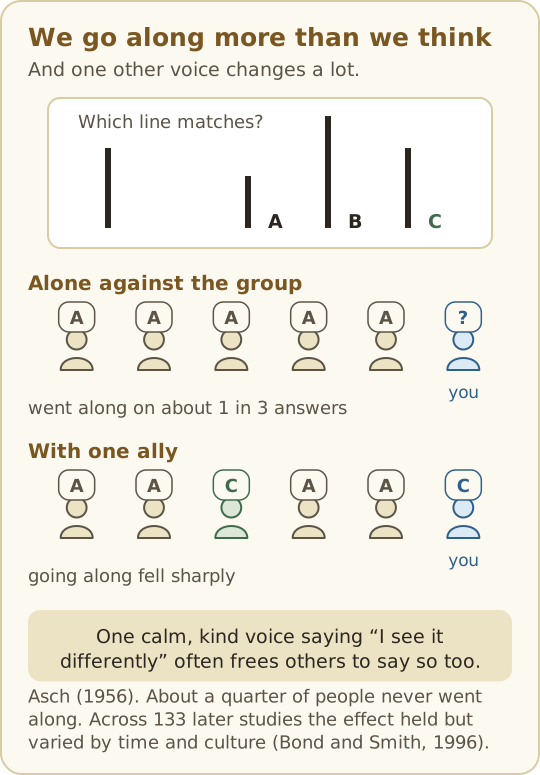
If you’re a teenager

Group chats are where a lot of friendship happens, and a lot of hurt. A made-up example: Rhys, 15, finds a photo of himself from PE being joked about in his class chat. He doesn’t answer back.

He screenshots it, mutes the chat and tells his sister, and they tell his form tutor. Then a girl in his class messages him privately: “That wasn’t funny. Sorry I didn’t say anything.” Most people in a group chat don’t like what’s happening. They just think everyone else does.

Words you could use: “I’m not okay with this. Please delete it.” To a friend: “That wasn’t okay. Are you alright?” To an adult: “Something’s happening online and I need help with it.”

Dig deeper: groups online

In everyday life

  • On your own: Having no group can be as hard as having a pushy one. Look for groups built around something you enjoy, so the belonging comes with the activity. See Chapter 5 (page 256) and casual ties (spreadloveandacceptance.com/library/connection).
  • With a partner: Two families, two sets of rules. Talk about them openly, and make your own. See family scripts (spreadloveandacceptance.com/library/life).
  • Parents and children: Children and teens feel peer pressure strongly. Help them practise a “no” that saves face. See For teens: friends (spreadloveandacceptance.com/teens).
  • With family: Old family roles (the joker, the peacekeeper, the black sheep) can be hard to step out of. See Old roles (spreadloveandacceptance.com/family-rifts).
  • At work: Teams where people feel safe to speak up make better decisions. See At work (spreadloveandacceptance.com/work) and the library on teams (spreadloveandacceptance.com/library/teams).
  • Online: Mute, leave or take a break from groups that leave you feeling worse. You’re allowed.
  • When everyone agrees too fast: That’s called groupthink. If you lead, share your view last and ask for one risk from each person before deciding. More in the full chapter (spreadloveandacceptance.com/book/understanding-17-groups-in-depth).
  • Teams rarely in one room: Write decisions down, go round everyone before deciding, and keep a short check-in so people at home aren’t forgotten. More in the full chapter.

Common mix-ups

  • “Only weak people conform.” Everyone is influenced by groups. Knowing that makes you more free, not less.
  • “Milgram proved people will do anything they’re told.” Many people refused, results varied a lot with the setup, and the studies have real critics. People seem most likely to go along when they believe in the cause.
  • “Culture explains everything about a person.” Culture shapes us, but people vary hugely within every culture. Ask the person, don’t assume.
  • “Disagreeing will ruin the relationship.” Calm, kind disagreement often builds trust. Swallowing it for years tends to do more harm.
  • “Fitting in is the same as belonging.” Fitting in means changing to be accepted. Belonging means being accepted as you are.

If you want to help someone else with this

  • Be the ally. If someone speaks up, back them up, even quietly: “I think that’s a fair point.” One ally makes a big difference.
  • Make room. In any group you lead, invite quieter people and different views: “What haven’t we thought of?”
  • Check in privately. If someone seems to be going along against their wishes, ask gently, away from the group.
  • Watch for exclusion. Notice who is left out of chats, plans and jokes, and bring them in.

Words you could use: “I noticed you went quiet when they said that. Are you okay?” “I’d like to hear what you think, even if it’s different.”

When to get more help

Group pressure is part of life. It may be time for more help if:

  • a group, family or partner controls who you see, what you wear, what you spend or what you believe, or punishes you for disagreeing;
  • you feel you can’t leave a group without being threatened, shamed or cut off from everyone you know;
  • you’re being bullied, at school, at work or online;
  • being left out or pressured is leaving you very low, anxious or hopeless.

Talk to someone you trust, a counsellor or a doctor. Not safe at home? lists free, private help if someone at home controls or frightens you. For low mood or worry, see Chapter 16 (page 443). If you are thinking about ending your life, please tell someone today.

In the US and Canada, call or text 988. In the UK and Ireland, call Samaritans free on 116 123. In Australia, call Lifeline on 13 11 14. In New Zealand, call or text 1737. Anywhere else, findahelpline.com lists free helplines.

This chapter is general education, not therapy.

Reading on the website

Reading pages to read on the website

More for your situation

Contents · Open this chapter on its own page

Afterword

What the book adds up to

A short look back at the whole book: what each part was for, the few ideas that run through all of it, and where to go next. For anyone who has read some or all of it, in any kind of relationship, or on your own.

In this chapter

  1. Three parts, one idea
  2. Six threads that run through the book
  3. Notice before you judge
  4. Settle before you speak
  5. Say it plainly and kindly
  6. Small steps beat big pushes
  7. Repair is normal
  8. Your part, and only your part. Safety first
  9. Where to go from here

In short:

  • Part One was about you: where your lens came from, how you work now, and where you want to go.
  • Part Two was about sharing a life: seeing the work, sharing it fairly, and talking about it kindly.
  • Part Three was about people: how feelings, stress, trust, change, loss, minds and groups work.
  • The thread through all of it: notice before you judge, settle before you speak, say it plainly and kindly, take small steps, repair, and keep everyone safe.

You don’t need to have read every page to get something from this one. If you skipped around, that’s how most people read. The book was written so you could start anywhere, stop anywhere and pick it up again.

Three parts, one idea

Part One: Yourself (page 22) looked at the lens you see through: what life taught you, how your mind and body work now, and what matters to you next. It came first because everything else depends on it. You can’t share a life well if you don’t know how you work.

Part Two: Between us (page 74) looked at the quiet work of running a shared life, a home, a family, a team, and how to see it, share it fairly and talk about it without blame. Each chapter came with a worksheet, because ideas only help when they turn into something you do.

Part Three: Understanding people (page 194) looked at how people work: feelings, stress, how we see each other, how we talk, why we need each other, how we change, our worth, loss, different minds, values, healing, helping, anger, personality, love, worry and low mood, and the pull of groups.

Underneath all three is one idea: most of what goes wrong between people is understandable, and much of it can be put right. Not by trying harder to be perfect, but by seeing more clearly and acting a little more kindly.

Six threads that run through the book

The book rests on five big ideas, set out at the front: see the whole load, fix the setup, not the person, read your state first, tune how you send and receive and notice the quiet incentives. The six threads below are the same ideas said as everyday habits, plus one rule that sits around all of them: safety first. The table after the list shows how they match.

  1. Notice before you judge.

    A sharp word, a forgotten job or a quiet evening usually has a reason: tiredness, a full stress tank, a different family rule, a different kind of mind. Asking “What might be going on?” before “What’s wrong with them?” changes most conversations. See Chapter 3 (page 225).

  2. Settle before you speak.

    When the body is flooded, nobody listens well. Slow the breath, step away with a time to come back, then talk. See Chapter 2 (page 209) and Chapter 13 (page 383).

  3. Say it plainly and kindly.

    What happened, how it felt, what you’re asking for. Clear is kind, for everyone. See Chapter 4 (page 239).

  4. Small steps beat big pushes.

    One job with one owner. One walk. One message. One step on the ladder. Change that lasts is usually small and repeated. See Chapter 6 (page 271).

  5. Repair is normal.

    Everyone gets it wrong. What keeps relationships going is coming back: a short, real apology and a plan for next time. See Chapter 11 (page 352).

  6. Your part, and only your part. Safety first.

    You can change what you do. You can’t make anyone else change, and you never have to accept being frightened, controlled or hurt. If that’s happening, getting safe comes before working it out. See Not safe at home? (spreadloveandacceptance.com/safety)

How the six threads match the five big ideas

ThreadBig idea
Notice before you judgeSee the whole load; fix the setup, not the person
Settle before you speakRead your state first
Say it plainly and kindlyTune how you send and receive
Small steps beat big pushesFix the setup, not the person; notice the quiet incentives
Repair is normalTune how you send and receive
Your part, and only your part. Safety first.Not one of the five: the frame around all of them
Three panels for the three parts with six coloured threads running across all of them, each labelled with one of the book’s six threads.
Figure 39 Six threads that run through the whole book, from Part One to Part Three.

Where to go from here

  • On your own: The self path (spreadloveandacceptance.com/self-path) turns Part One into a few steps you can take at your own pace.
  • With someone: The six-week program (spreadloveandacceptance.com/prog-01) turns Part Two into one small step a week, for a home, a family or a team. Miss a week? Pick up anywhere.
  • With a question: Ask Professor Puddles (spreadloveandacceptance.com/ask), the site’s private helper, about anything in the book.
  • Want the evidence? The research behind this book lists every study the book draws on, in plain words, with how strong the evidence is.
  • Read it again, differently: every chapter has a fuller version, and the contents (spreadloveandacceptance.com/book/) lists them all.
  • When it’s more than a book can help with: Help beyond this book (spreadloveandacceptance.com/outside-help) lists counsellors, helplines and support groups.

Any day, any time

You close the book. Nothing at home has changed yet. But maybe next time a sharp word lands, you’ll wonder what’s under it. Maybe you’ll breathe out before you answer. Maybe you’ll say the thing plainly, or say sorry sooner. That’s all this book was ever asking for: a little more understanding, a little more often. Thank you for reading.

This book is general education, not therapy. If you are struggling, please reach out: someone to talk to, free.

Contents · Open this chapter on its own page

Workpapers and tools in this book

Every workpaper and tool the chapters point to, in two separate lists, with the chapters that mention each one. All of them are free at spreadloveandacceptance.com, with no account, and what you type stays on your device.

Workpapers mentioned in this book

Pages to fill in, on your own or together.

Tools mentioned in this book

Interactive helpers to use on the site.

How the numbers work

Every number in this book is arithmetic you can do with a pencil. None of them is a test, a diagnosis or a verdict on anyone: they describe a week, a load or a way of sharing work. The weights and cut-offs are this book’s own rules of thumb, not research findings, and you are free to disagree with them. The worked examples are the book’s own, so you can check them against the chapters.

Two habits run through all of them. Scores are rounded to two decimal places before their band is read, so the number you see and the words you see always agree. And nobody’s score is ever worked out for them: if someone’s own answer is missing, the total waits.

The load: How much are you carrying?

You score five things from 0 (not at all) to 4 (very true), about the last day or two: sleep debt, workload elsewhere, unresolved conflict, your physical state, and time pressure today.

load = (sleep + workload + conflict + body + time) ÷ 20

The answer runs from 0 to 1, and higher means heavier. Under 0.30 is a light load, 0.30 up to 0.60 a medium load, and 0.60 or more a high load. (The worksheet splits each band in two for its words: very light under 0.15, light, medium on the lighter side under 0.45, medium on the heavier side, high under 0.80, and very high from 0.80.) Your battery is the other side of the same thing, the energy you have left: a high load means a low battery. The battery is a picture in words, not a second score.

Worked example Rosa, from Part Two, Chapter III, page 132, scores sleep 3, workload 4, conflict 1, body 2 and time 3.

3 + 4 + 1 + 2 + 3 = 13; 13 ÷ 20 = 0.65, which is a high load.

Two or more of you: each person scores only themselves, and the shared figure is the plain average of everyone’s own scores. If any one person is at 0.60 or more, treat that as the headline, whatever the average says.

Coming back after a pause (the Calm-Down Kit): if you like numbers, take the score again after a calming round. Under 0.50, go back at the time you named. From 0.50 to 0.59, take another round. At 0.60 or more after two rounds, put it off to a named time. The kit’s line sits at 0.50 on purpose: you don’t need a light load to come back, just less than half.

My weather today: the room in your day

My weather today shows words, not numbers: a sky (clear, gusty or fogged in) and how much room you have today. Behind the words sits a rough tally from 0 to 100, where higher means a heavier day. You only see it if you tick “Show the numbers behind this”.

What you pickedAdds
The sky: clear, gusty, fogged in0, 26, 34
The pressure: light, building, heavy (skipped: 6)0, 10, 20
Last night’s sleep: properly rested, about enough, short night, barely slept (skipped: 6)0, 2, 10, 18
People load: barely any, a normal amount, a lot, nonstop (skipped: 4)0, 3, 9, 14
Ground conditions (hungry, thirsty, in pain and so on)4 each, up to 14
What’s blowing in (work, money, health and so on)3 each, up to 10

Under 45 reads as lots of room today, 45 to 64 as some room, and 65 or more as very little room.

Worked example Joel, from Part One, Now, page 39, picks gusty, building pressure, a short night, a lot of people time, one ground condition (hungry) and one thing blowing in (work).

26 + 10 + 10 + 9 + 4 + 3 = 62: some room today, with less than usual, so the forecast says to go gently and settle first.

Workload balance: how evenly the hours are shared

Two people. Work out each person’s share of the logged hours as a percentage.

balance = 1 − (the difference between the two percentages ÷ 100)

50/50 scores 1.00; one person doing everything scores 0.00. It doesn’t matter which of you does more. Balance ignores the total, which is one reason the load sits beside it.

Worked example Rosemary logs 14 hours and Ken 10 (Part Two, Chapter II, page 110). Out of 24 hours, that is 58.3% and 41.7%.

1 − (58.3 − 41.7) ÷ 100 = 1 − 0.167 = 0.83

Three or more people, or an agreed split. The same idea, said more generally: how much of the week would have to change hands to reach the target, compared with the most that ever could.

each share = that person’s hours ÷ everyone’s hours target = an even share (1 ÷ number of people), or the split you agreed moved = ½ × the sum of every |share − target| most = 1 − the smallest target share balance = 1 − moved ÷ most

Worked example Three partners log 15, 9 and 6 hours (Chapter II, page 110): shares 0.50, 0.30 and 0.20, against a third each.

moved = ½ × (0.167 + 0.033 + 0.133) = 0.167; most = 1 − 0.333 = 0.667; balance = 1 − 0.167 ÷ 0.667 = 0.75. In hours, 0.167 × 30 = 5 hours a week would change hands for an even split.

With an agreed split, use it as the target: co-parents who agreed 60/40 and log 12 and 8 hours score 1.00.

Ownership: does every job have a name?

ownership = jobs with a named owner ÷ all the jobs on the list

The calculator counts a job as owned when it has one named owner. A backstop, the person who notices if it slipped, is a good habit and has its own column, but the score only needs the owner. The starter jobs on the worksheet don’t count until you give them an owner or change them. Never raise the score by deleting the jobs nobody owns: they are exactly what the score is there to show.

Worked example Rosemary and Ken list 12 regular jobs, and 9 have an owner: 9 ÷ 12 = 0.75.

Who carries more of the list. A score of 1.00 can still mean one person owns everything, so One owner per job also shows each person’s share of the list, with each job weighted by how often it comes round and how big it is:

weight of a job = how often × size how often: daily 5, weekly 1, ongoing 1, monthly 0.25, as needed 0.1 size: small 0.5, medium 1 (the default), big 2 (or, where you gave the hours each time: hours ÷ 0.5) share = the weights of that person’s jobs ÷ the weights of all the jobs

A job you decide together counts the same for each of you; on a list for two homes it shows as “Together” instead.

Worked example One person owns the cooking (daily, medium: 5) and the bills (monthly, medium: 0.25). The other owns the laundry (weekly, big: 2) and the car (as needed, medium: 0.1). Each owns two jobs, but 5.25 ÷ 7.35 = 71% of the list’s weight sits with the first person, and 29% with the second.

Who’s carrying more right now. Who did what flags the busiest person when their share of the logged minutes (or of the work done without being asked) is at least half, and at least 20 points over an even share: 70% or more for two people, 53% or more for three. In the Preface, page 74’s example, one partner did 105 of the 115 minutes that were noticed and handled without anyone asking: 91%, so the sheet says so.

The setup score: can the way you share the work last?

setup score = balance × 0.40 + ownership × 0.35 + (1 − the average load) × 0.25

The weights add up to 1, so the score runs from 0 to 1, and here higher means the setup is working better, the opposite of the load. The load is the only part that counts against the score, which is why it enters as 1 − load. 0.70 or more reads as working well (the “Who does what?” page says “holding”); 0.40 up to 0.70 as needs a look (“drifting”); below 0.40 as needs a rethink, together. It is a snapshot of the setup, never a probability and never a verdict on anyone.

Worked example Rosemary and Ken (Chapter II, page 110): balance 0.83, ownership 0.75, and their own load scores are 0.45 and 0.30, an average of 0.375.

0.83 × 0.40 + 0.75 × 0.35 + (1 − 0.375) × 0.25 = 0.333 + 0.263 + 0.156 = 0.75: working well.

The shortfall is what each part could have earned minus what it did earn: balance 0.40 − 0.333 = 0.067; ownership 0.35 − 0.263 = 0.088; load 0.25 − 0.156 = 0.094. The biggest shortfall is the load, which usually eases outside the chore list (more sleep, a lighter week elsewhere). The calculator’s “what would help most” is the single change with the biggest gain: handing about 2 hours a week from Rosemary to Ken would take balance from 0.83 to 1.00, worth 0.067. Naming one more job’s owner would be worth 0.029, and a load lower by 0.10 on average 0.025.

The overall score adds a fourth part, retuning: of the moments that landed badly this week, how many you retuned before answering.

overall = balance × 0.35 + ownership × 0.30 + (1 − load) × 0.20 + retuning × 0.15 (no rough moments this week: leave retuning out, and divide the first three parts by 0.85)

In Chapter II’s first worked example (balance 0.60, ownership 0.80, an average load of 0.40, and 3 of 5 rough moments retuned): 0.21 + 0.24 + 0.12 + 0.09 = 0.66.

The 30-day look-back: what shifted this month?

The look-back splits the last 30 days into four weeks (the first takes the first ten days). For each part you filled in (balance, ownership, the load, and last-minute rescues), it compares the start of the month with the end:

start = the average of weeks 1 and 2 end = the average of weeks 3 and 4 it shifted if end − start is 0.10 or more (balance, ownership, load), or 1 a week or more (rescues); anything smaller didn’t shift

One next step: a part that moved the wrong way comes first (the biggest move for its size). Otherwise, the first of these that is still true at the end: ownership under 0.70, balance under 0.70, 2 or more rescues a week, or anyone’s load at 0.60 or more. If none is, keep the same rhythm and look again in 30 days.

Hours to change hands over the month: for each person, the hours they did minus their share of everyone’s hours, added up week by week. Half the sum of those gaps (ignoring the minus signs) is how many hours would change hands to make the month even.

Worked example Suppose Rosemary and Ken keep going for a month (made up, like them). Their four weeks: hours 14 and 10, 15 and 9, 13 and 11, 12 and 12; jobs with an owner 9, 9, 11 and 11 of 12; Rosemary’s load 0.45, 0.50, 0.40, 0.35 and Ken’s 0.30 every week; rescues 3, 2, 1, 1.

PartStart (weeks 1–2)End (weeks 3–4)ChangeReads as
Balance(0.83 + 0.75) ÷ 2 = 0.79(0.92 + 1.00) ÷ 2 = 0.96+0.17Better
Ownership0.750.92+0.17Better
Average load0.390.34−0.05About the same
Rosemary’s own load0.480.38−0.10Lighter
Rescues a week2.51−1.5Fewer

Three of the four parts shifted, all for the better, and nothing is left on the watch list, so the next step is to keep the rhythm. The setup score went from 0.73 to 0.87. Over the month Rosemary did 54 hours and Ken 42, so 6 hours would have changed hands for an even month.

On your own: is your week sustainable?

The “Who does what?” page’s “just me” view adds up the hours your week is spoken for (jobs, the thinking work, care and so on) and compares them with a waking week of about 112 hours (16 waking hours, 7 days).

share = the hours spoken for ÷ 112

Under 50% reads as sustainable, 50% up to 70% as full but workable, and 70% or more as stretched. A made-up example: 50 hours spoken for is 45%, which leaves real room; 80 hours is 71%, a lot to keep up week after week.

All of these are this book’s own ways of putting things into numbers. They have not been tested in research studies, and they shouldn’t be quoted as findings. The free calculators on the website do the arithmetic for you, and each one has a “How is this worked out?” note.

Blank worksheets

Photocopy or print these pages, as many times as you like, and fill them in by hand. Each one is a blank copy of a worksheet in the book. The free fillable versions on the website do the sums for you, and keep what you type on your own device.

Who did what

Fillable version: spreadloveandacceptance.com/workpapers/fill/wp-01.html

Write down what actually happened this week, before anyone starts remembering it as a story. Write down only what you did or saw yourself; never fill in someone else’s side for them.

Person APerson BWeek beginning

Part A: Who did what, this week

One row for each task noticed or done, including the invisible ones: remembering, planning, booking, forms. Time spent only thinking, noticing or planning counts too: log it as “Thinking and planning”.

DayTask noticed or doneWho did itMinutes (rough)How it came up: asked for, noticed, or thinking time?

This week’s totals

Person A: minutes (and %), of which noticed and handled without being askedPerson B: minutes (and %), of which noticed and handled without being asked
Workload balance score: 1 − (A% − B%, ignoring any minus sign) ÷ 100 =

Part B (optional), Kind ways to say no: say why the request is fair, say honestly what you have left, and offer something instead.

Describes how the logged work was split this week, not anyone in it. How the score works: “How the numbers work”, at the back.

How much are you carrying?

Fillable version: spreadloveandacceptance.com/workpapers/fill/wp-02.html

Fill this in on your own, about yourself only. Never fill it in for someone else.

Your nameDate

The checklist

Score each row based on how the last 24–48 hours have actually gone. Circle one: 0 = Not at all, 4 = Very true. Living with a long-term illness? Your physical row may always be high. That is load, not a mood.

Not at allVery true
Sleep debt (less rested than usual)01234
Workload elsewhere (job, school, caregiving)01234
Recent unresolved conflict (any source)01234
Physical state (hungry, sick, in pain)01234
Time pressure today specifically01234

Your load score

Points (add the five circled numbers): ____ out of 20Load score: points ÷ 20 = ____ out of 1.00

Higher means a heavier load (and a lower battery). Under 0.30: light. 0.30 to 0.59: medium. 0.60 or more: high. Put off anything that doesn’t need deciding in the next hour.

Optional

Some of what I’m carrying is caring for someone

Anything you want to name before talking

A high score is a way to press pause, not a way out. It means “let’s come back to this tomorrow,” not “this doesn’t need to happen.”

One owner per job

Fillable version: spreadloveandacceptance.com/workpapers/fill/wp-03.html

Every regular job gets one owner: the person who does it and sees it through. If you like, add a helper or backup who pitches in, notices if it slips, or covers it on a bad week. List the invisible jobs too: forms, gifts, renewals, planning, appointments.

Date of this listThe split you agreed (optional)

Who owns each job

JobHow oftenOwnerHelper or backup (optional)Size (optional)Notes

How often: Daily, Weekly, Monthly, As needed, Ongoing. Size: Small, Medium, Big.

Does every job have an owner?

Jobs with an owner: ____ of ____ = ____ out of 1.00

Changes to the list (optional)

DateWhat changedWho

Where we’ve landed

Agreeing means everyone has read this version and knows who owns what. It doesn’t mean every job feels perfectly fair, only that ownership is clear.

We’re agreed on this

Who agreed (optional)
Look at this again on (optional)

What keeps coming back?

Fillable version: spreadloveandacceptance.com/workpapers/fill/wp-04.html

A monthly look-back, done together, across four weeks of Who did what and One owner per job. It looks for the tasks that keep slipping. The goal is to find where the setup needs a fix, not to tally what anyone owes.

Month

Part A: Gather the month’s notes

List every task that was noticed but not done, or done only after being raised more than once. Mark an ✗ for each week it came up.

TaskWeek 1Week 2Week 3Week 4Times flagged

Part B: Sort each gap

Sort every task flagged twice or more. A structural gap has no clear owner (fix One owner per job now). A capacity issue has an owner who can’t keep up (set a time for an honest conversation). A one-off has a temporary cause (note it and move on).

TaskNamed owner on the job list? (Yes / No)ClassificationAction

Part C: Wrap up the audit

Structural gaps foundCapacity issues foundOne-offs

Part D (optional): Thanked, or only noticed when it’s missed?

JobGets thanked (Often / Sometimes / Rarely / Never)Only noticed when missed? (Yes / No)One way to notice it

Not a bill for the past, and not a performance review. A task with no owner is a gap in the setup, not a verdict on the person who kept covering it.

Say it so it lands

Fillable version: spreadloveandacceptance.com/workpapers/fill/wp-09.html

A self-check each of you uses on your own side of a conversation. Use it on one thing that actually stung.

Your nameDate

Before you speak or send: fact, feeling, ask

Raw reaction (optional, and just for you)
What’s the fact underneath this? (One sentence, no adjectives.) For example: “The bins went out late on Tuesday.”
What’s the feeling underneath this? (Frustrated, tired, unseen, rushed…) A feeling about you, not a verdict about them.
What’s the actual ask? (What do you want to happen next, specifically?) Something the other person can say yes to.

Before you react: four quick checks

CheckCircle one
Is this about a specific, nameable task or event?Yes · No
Would I read this the same way if I weren’t already carrying a lot?Yes · No · Not sure
Is there a neutral interpretation that also fits what was said?Yes · No
Am I responding to their words, or to a pattern from a past conversation?Their words · A past pattern

A “No” or “Not sure” on the second check, a “Yes” on the third or “A past pattern” on the fourth are good reasons to pause first. A kind “not right now” and a time to come back keeps it honest.

The Calm-Down Kit

Fillable version: spreadloveandacceptance.com/workpapers/fill/wp-11.html

A short plan, made ahead of time, for calming your body down enough to have the conversation, or to put it off honestly. Fill in Part A on an ordinary day, not a hard one. Your kit is yours; only the pause plan is made to share.

Whose kit is this? (your name)Date

Part A: What tends to start it

What tends to start itHow it shows up in my body first

Part A: My two defaults

Pick two calming steps now: asymmetric breathing (breathe in for 4, out for 6) · naming the room (5 things you see, 4 you hear, 3 you can touch) · weight and pressure (feet pressed flat into the floor, or something warm held in both hands) · gating (cutting noise and light: lower the lights, step out) · walking it out · a low, steady sound.

First defaultSecond, if the first isn’t available

Part A: My pause line

Say how you are, how long you need, and when you’ll be back: “I’m at capacity. I need ten minutes. I’ll be back at quarter past.”

Our pause plan (agree it together, and share it)

Our pause word or signalThe shortest break we takeHow we set the time to come backThe first sentence when we come back

Part B, in the moment: say your pause word or line, then do your first calming step.

Part C: Coming back

Still hot? Another round. Twice? Name a new time. Settled enough to listen? Go back at the time you named. (For number fans: your load score, 0 to 1. Under 0.50 go back; 0.50 to 0.59 another round; 0.60 or above after two rounds, put it off.)

TimeWhat I didHow I feel now (Still hot / Settled enough)Load before (0–1)Load after (0–1)
Next small actionIf you put the conversation off: when you’ll pick it back up

Where I’ve landed

I’m going with this

Look at this again on (optional)

Nothing in this kit works by cold, pain or shock, and none of it is treatment.

The 90-second daily check-in

Fillable version: spreadloveandacceptance.com/workpapers/fill/wp-13.html

Each person answers each prompt in one sentence, about their own day, and fills in only their own rows. No debating, no solving, no arguing back. Anything that needs a real discussion waits for the weekly catch-up.

Week beginning

Each day

DayPersonLoad (Low / Medium / High)One thing I appreciated todayOne small thing that didn’t feel greatOne thing that would help tomorrow
Mon
Mon
Tue
Tue
Wed
Wed
Thu
Thu
Fri
Fri
Sat
Sat
Sun
Sun

The weekly catch-up (optional)

Skim the week for anything that came up more than twice, and move it to the right worksheet.

Sore spot that keeps coming upTimes this weekMove to (One owner per job / Say it so it lands / Keep watching)

Where we’ve landed

We’re agreed on this

Who agreed (optional)
Look at this again on (optional)

Same moment, different speeds

Fillable version: spreadloveandacceptance.com/workpapers/fill/wp-12.html

For a few moments that come round often, each person marks how fast they want to move, how much they want to talk, and how urgent it feels. Each person fills in only their own rows, ideally before looking at the other’s. There are no right answers.

Date

Part A: Each person’s speed

Speed: right away · within the hour · later the same day · after a night’s sleep. Talk: quiet time first · a few words, then act · talk it all through. Urgency: low · medium · high.

MomentPersonSpeedTalkUrgencyWhat helps me (optional)
A plan changes at the last minute
A bill, letter or form needs dealing with
Something breaks or goes wrong at home
One of us is upset about something
Deciding what to do with free time

Part B: Where your speeds differ

For each moment, count how many steps apart your answers are on each list. Start with the biggest gap: a difference in pace, not in how much anyone cares.

Part C: One small agreement

MomentWhat we’ll tryTry it until

Where we’ve landed

Agreeing means you have both seen the gaps and will try the agreement. It doesn’t mean either of you has to change speed for good.

We’re agreed on this

Who agreed (optional)
Look at this again on (optional)

Not a compatibility test and not a diagnosis. Run it again every few months, or after a big change.

Is it us, or is it everything else?

Fillable version: spreadloveandacceptance.com/workpapers/fill/wp-14.html

A one-week log that keeps two things apart: pressure from outside (money, work, health, sleep, family) and friction that really starts between you. A line or two each evening, each person about their own day. Write what happened, not who was wrong.

Week beginning

Part A: Each evening

DayPersonOutside pressure today (None / A little / A lot)Where it came fromA tense moment between us (if any)Looking back, it was mostly (Outside pressure / Between us / Some of both / Not sure yet)
Mon
Mon
Tue
Tue
Wed
Wed
Thu
Thu
Fri
Fri
Sat
Sat
Sun
Sun

Part B: The week at a glance

Tense moments on heavy days: ____ of ____

Part C: What got blamed on the wrong thing?

The momentWhat it seemed to be aboutWhat was really going onWhat would help next time

Part D: One plan for the pressure

The pressure we’re facing right nowHow we’ll flag a heavy dayWhat we’ll go easy on until it passesOne bit of outside help we could ask for (optional)

Outside pressure explains a hard day. It doesn’t excuse unkindness, and it doesn’t make what anyone felt less real.

Keep your little rituals alive

Fillable version: spreadloveandacceptance.com/workpapers/fill/wp-15.html

Every three months or so, a short look at the small shared habits that keep you close: the morning coffee, the Sunday walk, the birthday breakfast. Nobody is to blame for one that lapsed.

Date

Part A: Our rituals, big and small

How it’s doing: Alive (still happening, still means something) · Fading (on autopilot or less often) · Stopped · New idea. How often: Daily, Weekly, Monthly, Yearly, Now and then.

Ritual or habitHow oftenHow it’s doingWhat it gives us, or what got in the way

Part C: One to restart, or start

The ritualThe smallest version that still countsThe first time: when, and who will suggest itWhat would make it easy to skip, and how we’ll protect it (optional)

Part D (optional): One to let go, with thanks

The ritualWhat it gave us

Where we’ve landed

We’re agreed on this

Who agreed (optional)
Look at this again on (optional)

A ritual is something you would both miss, not a test of love. Look at this sheet again in about three months.

Words used in this book

The book’s own words, each in one plain sentence. More at spreadloveandacceptance.com/glossary.

Alexithymia
Finding it hard to notice, name or describe your own feelings. It is a trait on a scale, not an illness, and it is more common in some autistic people. Naming body signals first can help.
Backstop
The second name on a job: someone who notices if it slipped and checks in kindly. Not a supervisor. A job counts as owned once it has an owner; the backstop is a good habit on top.
Battery
Your battery is how much energy you have left today. Full means you have room to spare; low means you’re running on empty. “How much are you carrying?” measures the other side of it, your load: a higher load score means a heavier load, and a lower battery. For example: After a poor night and a long workday, your load score is high and your battery is low, so a small request feels big.
A bid
A bid is any small reach for attention or connection, like “look at this,” a sigh or a joke. For example: They show you a photo of a dog. Looking and smiling back is turning towards it.
Calm-Down Kit
The Calm-Down Kit is your own short list of what settles your body, chosen ahead of time so you don’t have to think when you’re wound up. For example: A glass of cold water, a walk to the corner, and three long breaths out.
Carrier wave
The carrier wave is the feeling that travels underneath the words: the tone that arrives before the meaning does. For example: “Fine.” can carry calm, hurt or tiredness. The carrier wave tells you which.
Check-in
A check-in is a short, planned talk that keeps small things small. The daily one takes about ninety seconds, with no debating. For example: “Load today: heavy. Thank you for the dishes. One small thing: the car. My ask: could you fill it up?”
Complacency
Complacency is what happens when something has worked for a long time and you stop checking on it. It isn’t laziness or a lack of love. It’s a setup nobody has looked at lately. For example: “How was your day?” “Fine.” Months go by and nobody has asked a real question.
Double empathy
The idea, from the autistic researcher Damian Milton, that misunderstandings between autistic and non-autistic people run both ways: each finds the other hard to read, so neither side is simply “missing” something.
Drift
Drift is how two people slowly fall out of step when nobody checks in, even when nothing is wrong. For example: Three busy weeks, no real talk, and small things start to feel big.
Flooded
Flooded means being so wound up that listening stops working for a while. The kind thing is a short pause with a time to come back. For example: “I need twenty minutes. Can we talk again at eight?”
Frequency
Your frequency is your natural pace: how fast you decide, talk, reply and recover. For example: One person answers a text in a minute; the other answers at the end of the day. Neither is wrong.
Gatekeeping
Holding on to how a home or child-care job must be done, so the other person steps back. Researchers first described it in mothers (“maternal gatekeeping”), but anyone can do it.
Groupthink
When a close group wants agreement so much that doubts go unsaid and a poor decision goes ahead. Irving Janis named it in 1972.
If-then plan
A small plan written as “If this happens, then I will do that”, which makes a new habit easier to start (Peter Gollwitzer).
A kind no
A kind no says what you can and can’t do right now, without blaming anyone. For example: “I can’t take that on this week. I could help on Saturday.”
Kinship care
When a grandparent, aunt, older sibling or family friend raises a child whose parents can’t.
The ladder
Three everyday states: calm and connected, revved up, running on empty. My weather today calls them clear, gusty and fogged in. A best guess about your state, not a measurement.
Ledger
A notebook where you write down what happened, so you can look at it calmly later. The book works the same way: see what is really going on, without blame, then change one small thing.
The load
The load is all the work of a shared life, including the thinking, planning and remembering that nobody sees. For example: Buying the gift is one job. Remembering the birthday, picking the gift and wrapping it are three more.
Masking
Masking is hiding the way you’re wired to fit in, which can be very tiring over time. For example: Forcing eye contact and rehearsing small talk all day, then needing the evening to recover.
Mental load
The noticing, planning and remembering behind running a shared life: knowing the shoes are too small, booking the appointment, keeping the list. It is real work, even though nobody sees it.
Monotropism
A theory of autistic attention: attention gathers deeply on a few things at a time, rather than spreading thinly across many. Switching away can take real effort.
My weather today
My weather today is a one-minute check on your own conditions today, like sleep, stress and energy: Clear means calm and connected, Gusty means revved up, and Fogged in means running on empty. For example: Short night, busy day: the forecast says to keep big talks for tomorrow.
Owner (one owner per job)
The owner of a job is the one person who makes sure it gets done from start to finish, so nobody has to keep asking. For example: Sam owns the recycling: noticing it’s full, taking it out and buying the bags.
Parallel parenting
Co-parenting with as little direct contact as possible: each home runs its own way, and messages stay short, polite and about the children.
Pressure
Pressure, in My weather today, is how much you were already carrying today: light, building or heavy. Behind the forecast sits a rough tally from 0 to 100; under 45 leaves room in the day, 65 or more means go gently. It is a reading of what you told it, not a score or a grade. For example: A pressure of 40 leaves room in the day; 75 means go gently and leave big things for later.
Prolonged grief
Grief that stays intense and gets in the way of daily life for a long time after a death (usually a year or more for adults). It is treatable; a GP or doctor is a good first step.
Psychological safety
A shared sense in a group or team that you can speak up, ask a question or admit a mistake without being punished or embarrassed (Amy Edmondson).
Repair
A repair is anything that stops a tense moment from getting worse, like a joke, a softer tone or “Can we start over?” For example: “I said that badly. What I meant was…”
Retune
To retune is to notice you’ve fallen out of step with someone and adjust together: slower, softer, or at a better time. For example: “Can we start that again? I came in too fast.”
The rulebook from home
The rulebook from home is the unwritten set of rules you grew up with, about love, upset, chores and rest, that you may still expect others to follow. For example: “Whoever notices the mess cleans it” was the rule at home, so a messy kitchen feels like “It’s always me.”
Rumination
Going over the same worry or regret again and again without getting closer to an answer.
Second arrow
The extra pain we add on top of a hard moment, such as being angry at ourselves for being sad. The first arrow is the event; the second is what we tell ourselves about it (a Buddhist image).
Setup score
The one number from Is the setup working for everyone?: balance, ownership and stress added up with weights (0.40, 0.35 and 0.25), from 0 to 1. 0.70 and up is working well, 0.40 to 0.69 needs a look, under 0.40 needs a rethink, together. It judges the setup, never a person.
Static
Static is the crackle between two people when the words are fine but the tone, pace or timing doesn’t match. For example: You ask “When will you do it?” calmly. They hear pressure. Nobody meant harm, but it crackles.
Stress tank
How much stress you are already carrying, from How much are you carrying?: a load score from 0 (empty) to 1 (full). Under 0.30 is low, 0.30 to 0.59 moderate, 0.60 and up high. A fuller tank means less room to take more on. (Your battery is the other side of it: energy left.)
Talk window
The talk window says whether now is a good time for a big conversation: open, wait a little, or closed for today. For example: Your window says “wait,” so you ask to talk after dinner instead of right now.
Unbilled debt
Unbilled debt is the work of a shared life that got done but was never noticed or thanked. For example: You remembered the dentist appointment, and nobody knew there was anything to remember.
Wave Code
Four letters from the style quiz in How you connect, one for each of four preferences about how you take in and send words. Each letter shows where you lean on a dial today: a shorthand for preferences, not a personality type.
Window of tolerance
The range in which you can feel strong feelings and still think and talk. Above it you are flooded or revved up; below it you shut down. A phrase from the psychiatrist Dan Siegel.
Wired differently
Being wired differently means your brain works in a less common way, such as being autistic, ADHD, dyslexic or highly sensitive, which changes how words land. For example: A hint like “the bins are full” may be heard as a plain fact, not a request.
Wiring
Your wiring is the way your brain and senses take in words, sound, change and people. It stays the same from day to day. For example: Some people need a plan in writing. Others think best out loud.
Workpaper
A workpaper is a short worksheet. Each person fills in their own, then you read them together. For example: “Who did what” is a week’s log of who did what.
Your lens
Your lens is the set of understandings about yourself, other people and what they owe you that you picked up growing up and still use without noticing. For example: “Rest is earned” can feel like plain fact, until you notice it was your family’s rule.

List of figures

  1. Figure 1How the three parts fit together · Front of the book16
  2. Figure 2Five ideas the whole book rests on · Front of the book17
  3. Figure 3Three layers in every reaction · Where your lens came from28
  4. Figure 4Each stage of life asks its own question · Where your lens came from30
  5. Figure 5Part One in one picture · Where your lens came from34
  6. Figure 6A four-step self-check for a feeling that is bigger than you expected · Your wiring, weather and words48
  7. Figure 7Your circle of control · Your wiring, weather and words52
  8. Figure 8A kind plan for change in seven small steps · Who you are becoming64
  9. Figure 9The work nobody sees · The work nobody sees77
  10. Figure 10We each remember our own effort best · The work nobody sees79
  11. Figure 11The radio whistle · Why we get out of tune95
  12. Figure 12Retuning, step by step, before you carry on with a talk that has started to whistle · Why we get out of tune99
  13. Figure 13Is the split working? · Is the split working?113
  14. Figure 14How full is your stress tank? · Full tanks and different angles135
  15. Figure 15Seven angles on the same moment · Full tanks and different angles139
  16. Figure 16Two kinds of fair · Two kinds of fair159
  17. Figure 17Let a comment land before you react · Two kinds of fair163
  18. Figure 18The monthly look-back · The monthly look-back182
  19. Figure 19A feeling is a signal, not a verdict · How feelings work197
  20. Figure 20The ladder · Stress and the nervous system213
  21. Figure 21Flooded means offline · Stress and the nervous system216
  22. Figure 22Seeing is a best guess · How we see each other228
  23. Figure 23Every message says two things · How communication works242
  24. Figure 24Say it so it lands · How communication works245
  25. Figure 25Attachment as two scales, not four boxes · Attachment, trust and belonging260
  26. Figure 26Habits run on cues · Habits and change274
  27. Figure 27How long a new habit takes to feel automatic · Habits and change282
  28. Figure 28Guilt says “I did a bad thing.” Shame says “I am bad.” Guilt is easier to put right, and self-compassion helps you cross over · Self-worth, shame and self-compassion289
  29. Figure 29Grief comes in waves, not neat stages · Loss, grief and big life changes303
  30. Figure 30Brains vary, like bodies do · Minds that work differently317
  31. Figure 31Values are directions, not finish lines · Values, meaning and a good life339
  32. Figure 32Every close relationship has breaks; what counts is the repair · Healing after hurt355
  33. Figure 33Ask what kind of help they want · Helping others well370
  34. Figure 34Anger rises fast, and what helps depends on how hot it is · Anger388
  35. Figure 35Traits are dials, not boxes · Personality, temperament and change402
  36. Figure 36Closeness grows from being known · Closeness and love417
  37. Figure 37Avoiding keeps fear going · Worry, low mood and trauma433
  38. Figure 38We go along more than we think, and one other voice changes a lot · Groups, influence and culture449
  39. Figure 39Six threads that run through the whole book, from Part One to Part Three · What the book adds up to467

List of filled-in examples

  1. Example 1The rulebook from home · Nadia, on her own · Where your lens came from25
  2. Example 2“How to talk to me” card · Ife, made on her own to give to a friend · Your wiring, weather and words41
  3. Example 3My weather today · Joel, on his own, after a short night · Your wiring, weather and words42
  4. Example 4The Calm-Down Kit, just for me · Nell, on her own · Who you are becoming60
  5. Example 5The self path, step by step · Sam, on their own, two weeks in · Who you are becoming69
  6. Example 6Who did what · Marcus and Theo, a couple · The work nobody sees80
  7. Example 7The 90-second daily check-in · Priya and Dev, a couple on different shifts · Why we get out of tune101
  8. Example 8Who does what? Quick look · Wren, Josh and Mei, housemates (Wren’s view) · Is the split working?114
  9. Example 9Is the setup working for everyone? · Rosemary and Ken, retired, married 41 years · Is the split working?118
  10. Example 10Our room agreement · Kayla and Bea, first-year roommates · Is the split working?124
  11. Example 11Who did what, with small children · Hollie and Gareth, parents of a toddler and a baby; Gareth works shifts · Is the split working?127
  12. Example 12How much are you carrying? · Rosa, who shares her mum’s care with her brother · Full tanks and different angles136
  13. Example 13Rewind the talk: see their side · Hana, about her friend Lou · Full tanks and different angles140
  14. Example 14Who does what? The Money tab · Grace and Ruth, a couple with different incomes · Two kinds of fair152
  15. Example 15One owner per job · Dee and Mark, foster carers · Two kinds of fair154
  16. Example 16Say it so it lands · Carla, who runs a café with her business partner Femi · Two kinds of fair156
  17. Example 17One owner per job: a list for two homes · Laura and Dan, co-parents in two homes · The monthly look-back174
  18. Example 18What keeps coming back? · Ash, Robin and Jules, a triad sharing a home · The monthly look-back176
  19. Example 19Kitchen-table check-in: this week · Linda and her grown-up son Jordan, who live together · The monthly look-back179
  20. Example 20My weather today · Esme, 29, after a worrying message from her manager · How feelings work198
  21. Example 21The ladder (the sky, in My weather today) · Mike, who cares for his wife, Ann · Stress and the nervous system214
  22. Example 22Chat analyzer (also called the Signal Translator) · Zoe, texting her oldest friend, who moved abroad · How we see each other233
  23. Example 23Chat analyzer: a whole conversation (once called the Conversation Reader) · Dana and Raj, coworkers on the same project · How communication works247
  24. Example 24Our pause plan · Imani and Kwame, married ten years · Attachment, trust and belonging261
  25. Example 25Your done list · Bernie, 71, living on his own · Habits and change275
  26. Example 26Flip it · Hamish, 44, after a mistake at work · Self-worth, shame and self-compassion291
  27. Example 27Write it through · Edith, 74, widowed, writing to her grown-up son and daughter · Loss, grief and big life changes305
  28. Example 28“How to talk to me” card, for work · Tom, autistic, for his new manager · Minds that work differently324
  29. Example 29Keep your little rituals alive · Lachlan and Sunita, who lead a hybrid team together · Values, meaning and a good life343
  30. Example 30Write it through · Carys, writing to her brother Owen · Healing after hurt356
  31. Example 31One owner per job: sharing the care · Margaret and Alan, with their daughter Sue · Helping others well376
  32. Example 32The Calm-Down Kit · Pat, a grandmother raising her grandson Jay, 13 · Anger389
  33. Example 33How you connect: the style quiz · Mo, before moving in with his friend Callum · Personality, temperament and change407
  34. Example 34Our time-together deal · Jamal and Tess, a couple; Jamal games most evenings · Closeness and love422
  35. Example 35Flip it · Tolu, 17, worrying about an exam at 1am · Worry, low mood and trauma434
  36. Example 36House rules for us · Shona and her son Dexter, 15 · Groups, influence and culture452
  37. Example 37Kitchen-table check-in: family plan · Amaka and Chris, new parents, with Chris’s parents · Groups, influence and culture454

Research notes

The 445 studies and books the chapters mention, chapter by chapter, each with what it found in plain words and where to read it. Each entry was looked up and checked: most against the paper itself or its abstract, some (mostly older books) against a publisher’s or library’s record. Unchecked works are left out. The full list, with notes on how strong each finding is, is at spreadloveandacceptance.com/research.

Part One · Then Where your lens came from

Part One · Now Your wiring, weather and words

Part One · Next Who you are becoming

Preface to Part Two The work nobody sees

Part Two · Chapter I Why we get out of tune

Part Two · Chapter II Is the split working?

Part Two · Chapter III Full tanks and different angles

Part Two · Chapter IV Two kinds of fair

Part Two · Chapter V The monthly look-back

Part Three · Chapter 1 How feelings work

Part Three · Chapter 2 Stress and the nervous system

Part Three · Chapter 3 How we see each other

Part Three · Chapter 4 How communication works

Part Three · Chapter 5 Attachment, trust and belonging

Part Three · Chapter 6 Habits and change

Part Three · Chapter 7 Self-worth, shame and self-compassion

Part Three · Chapter 8 Loss, grief and big life changes

Part Three · Chapter 9 Minds that work differently

Part Three · Chapter 10 Values, meaning and a good life

Part Three · Chapter 11 Healing after hurt

Part Three · Chapter 12 Helping others well

Part Three · Chapter 13 Anger

Part Three · Chapter 14 Personality, temperament and change

Part Three · Chapter 15 Closeness and love

Part Three · Chapter 16 Worry, low mood and trauma

Part Three · Chapter 17 Groups, influence and culture

Index

Key ideas and the pages where the book talks about them. Chapter names are in the contents.

Spread Love & Acceptance · The whole book

A calm, practical book about the quiet work of sharing a life. It starts with you: where your lens came from, how you work today and who you are becoming. Then it looks at what happens between people who share a home, work or care. And it ends with how people work: feelings, stress, trust, change, loss, anger, love and the groups we belong to.

“See it fairly. Say it kindly.”

  • Two sizes of every chapter: short and full
  • Everyday scenes, words you could use and one small thing to try
  • Free tools and worksheets that stay on your device
  • For every kind of relationship, and for people on their own

Free to read at spreadloveandacceptance.com/book

by Christian · Spread Love & Acceptance

Last updated: October 2026. From spreadloveandacceptance.com. Free to read and share for personal and non-commercial teaching use, with credit.