Part Three · Chapter 17
Fitting in: groups, influence and culture
In short:
- The pull to fit in is old and strong. Being left out hurts, so we bend to stay in. That’s human, not weak.
- Groups shape us more than we notice: what we say, what we think is normal, and sometimes what we’re willing to do.
- Cultures and families each have unwritten rules. They differ a lot, and so do the people inside them.
- You can belong and still be yourself. One calm, kind voice saying “I see it differently” often frees others to say so too.
Why the tools work: this chapter explains the thinking behind these tools from earlier in the book.
- The rulebook from home (Part One, Then) and House rules for us (One owner per job) write down the rules nobody wrote down, so a group can choose them instead of just following them. Big idea: notice the quiet incentives.
- The monthly look-back (Part Two, Chapter V) is “not a review of either person”. That is what lets people speak up early, before the group drifts.
Thursday, 9:20pm
The family group chat is buzzing. Someone has posted a joke about your cousin’s new partner, and the laughing faces are piling up. Your thumb hovers. You don’t find it funny. You also don’t want to be the one who “can’t take a joke.” Everyone else seems fine with it. You start typing a laughing face.
Why do we laugh at jokes we don’t find funny, agree with plans we doubt, and follow rules nobody wrote down? Why do some groups bring out the best in us and others the worst? This chapter looks at the pull of groups: belonging pressure, conformity, obedience, “us and them,” norms, culture, family culture and life online. Then it turns to the practical question: how to stay yourself, and disagree kindly, without losing your place. It follows on from Chapter 5, which looked at why we need each other in the first place.
Social psychology has some of the most famous experiments in all of psychology, and some of the most argued about. So this chapter is careful to say what later research found when people tried to repeat them. Where it helps, sections also look at what philosophers have said, at how things look across cultures, or at how they can look for autistic people.
Ideas marked This site’s idea: are our own ways of putting things into practice, not established science.
The pull to fit in is old and strong
Humans evolved in small groups where being cast out could be deadly. It is not surprising that being left out still sets off alarm bells, and that we will go to some lengths to avoid it.
Psychology
Baumeister and Leary (1995) argued that the need to belong is a basic human motivation, as described in Chapter 5. Exclusion research shows how sensitive that need is. In a series of studies, Williams and colleagues (2000) had people play a simple online ball-throwing game with two other “players,” who were really controlled by a computer. When the others stopped throwing the ball to them, people reported feeling worse and a lower sense of belonging, even though the game was trivial and the other players were strangers on the internet. The first study alone involved nearly 1,500 people from 62 countries. Later studies using the same game found similar effects in many settings.
That sensitivity has a cost. Because exclusion hurts, we often pay to avoid it: by laughing along, keeping quiet, or hiding parts of ourselves. Most of the time this is small and harmless social glue. Sometimes it means going along with things we know are wrong.
Philosophy
The Confucian Analects contains a line often translated as: “The gentleman seeks harmony, not sameness; the small person seeks sameness, not harmony.” It draws a distinction this whole chapter relies on. Harmony means different voices fitting together. Sameness means everyone sounding alike. A group can be close and harmonious without asking its members to be identical.
Thoughts you could try: “Wanting to fit in is human. I still get to choose what I go along with.” “Harmony, not sameness.”
We go along more than we think
Conformity means changing what we say or do to match a group. Sometimes it’s because we think the group knows better. Sometimes it’s because we don’t want to stand out.
Psychology
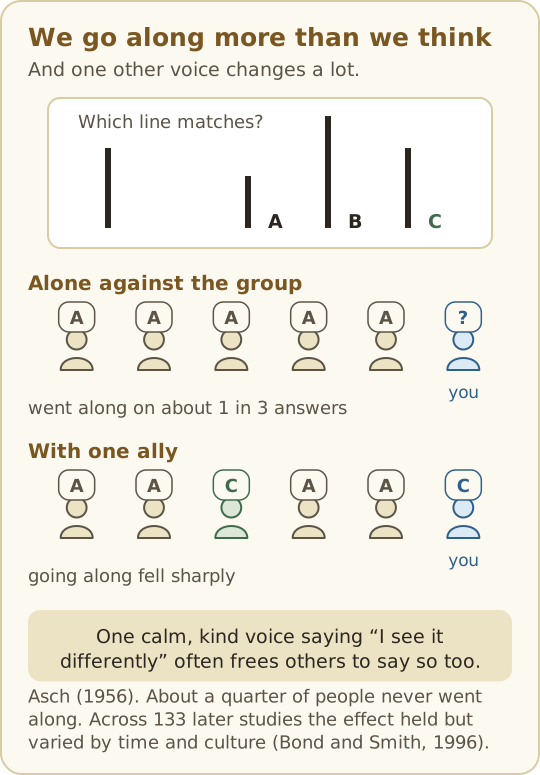
In Solomon Asch’s line-judging experiments, reported in full by Asch (1956), a participant sat with a group of others who were secretly working with the experimenter. On each trial, everyone said aloud which of three lines matched a target line. On some trials, the whole group gave the same obviously wrong answer. Across these trials, participants went along with the wrong answer on roughly a third of their responses. But the averages hide a lot: about a quarter of people never went along at all, while a few went along nearly every time. When even one other person gave the right answer, conformity fell sharply. Many people who went along said afterwards that they had doubted their own eyes, or simply hadn’t wanted to stand out.
How well has this held up? In a review of 133 studies using Asch’s task in 17 countries, Bond and Smith (1996) found that conformity was a reliable effect, but it varied. It had declined in the United States since the 1950s, and it tended to be higher in cultures that place more value on the group. Asch’s findings are best read not as “people are sheep,” but as “social pressure is real, varies with time and place, and is much weaker when you are not alone.”
Through an autistic lens
Many autistic people describe a strong commitment to saying what is true, which can make “just go along with it” feel wrong. At the same time, many have learned to mask, copying others to avoid standing out, at a real cost to energy and wellbeing (see Chapter 9). Both can be true for the same person. Groups that value accuracy over agreement, and say so, are often easier places for autistic people to be themselves.
Thoughts you could try: “Would I say this if I were on my own?” “If I’m thinking it, someone else probably is too.”
Authority can lead people a long way
Obedience is going along with an instruction from someone in authority. It keeps hospitals, flights and kitchens running. It can also lead people to do things they would never choose.
Psychology
In Stanley Milgram’s best-known experiment, reported in Milgram (1963), 40 men were told they were taking part in a study of learning. They were asked to give electric shocks of increasing strength to a “learner” in another room each time he got an answer wrong. The learner was an actor and no shocks were real, but the participants didn’t know that. As the learner protested and then fell silent, the experimenter calmly told them to continue. Twenty-six of the forty continued to the highest level on the machine. Many showed great distress while doing so. Milgram later ran many variations, and obedience varied widely: it dropped when the experimenter gave instructions by phone, when the participant had to be close to the learner, or when other “participants” refused.
The studies have been repeated and challenged. For ethical reasons, Burger (2009) stopped his partial replication at the point where the learner first protested. He found that obedience up to that point was only a little lower than in Milgram’s day. But others have questioned what the studies really show. After working through Milgram’s archives, the writer and psychologist Gina Perry (2013) argued that the procedure was less standardised than reported, and that many participants doubted the shocks were real. Haslam and Reicher (2012) argued that people did not follow orders blindly: they were most likely to continue when they identified with the experimenter and believed the work was worthwhile, not simply because they were told to. Their reading is less “people obey anyone” and more “people do harmful things when they’re persuaded the cause is good.”
Philosophy
The philosopher Hannah Arendt, reporting on the trial of the Nazi official Adolf Eichmann, coined the phrase “the banality of evil.” Her point was that great harm can be done by ordinary people who stop thinking for themselves, not only by monsters. Her account has itself been debated by historians. But it sits alongside the research in a useful way: the protection is to keep thinking, keep asking “Is this right?”, and keep talking to others who might see it differently.
In practice
Healthcare, aviation and other safety-critical fields now train people to question instructions that look wrong, using phrases like “I need some clarity” or “I have a concern.” They found that respectful challenge saves lives. The same idea works at home and at work: checking isn’t disloyalty. See psychological safety in the library.
Words you could use: “Before I do this, can I check one thing?” “I have a concern about this.” “I’m not comfortable doing that. Can we find another way?”
“Us and them” forms fast
Our groups become part of who we are. That gives us pride, loyalty and support. It also makes it very easy to divide the world into “us” and “them.”
Psychology
Social identity theory, set out by Tajfel and Turner (1979), proposes that part of our self-image comes from the groups we belong to, and that we are motivated to see our groups positively, often by comparing them favourably with others. In earlier “minimal group” experiments, Henri Tajfel and colleagues divided schoolboys into groups on almost meaningless grounds, such as which of two abstract painters they supposedly preferred. Even so, the boys tended to give more rewards to their own group, sometimes even when that meant their group got less in absolute terms, as long as it got more than the other group.
The same research points to ways through. When people share a larger identity (the whole family, the whole team, the whole town), old divisions soften. Seeing members of another group as individuals, and working together on a shared goal, also helps. Chapter 3 shows how “us and them” even changes what we see. Social identity can also protect: for people who are often stigmatised, a positive group identity can be a source of strength, as the autistic lens below shows.
Through an autistic lens
For many autistic people, finding other autistic people is a turning point. In a study of over 500 people, Cooper, Smith and Russell (2017) found that autistic adults who identified more strongly with other autistic people tended to have higher self-esteem, and through that, lower anxiety and depression. Identity, here, is not a label put on someone from outside. It is a group to belong to, on your own terms. See Chapter 9 on autistic community.
Thoughts you could try: “Am I seeing a person, or a group?” “What larger ‘us’ do we both belong to?”
Norms are the rules nobody wrote down
Norms are a group’s shared sense of what is normal and what is expected. They save effort: you don’t have to work out every situation from scratch. They can also trap a group in habits that nobody actually wants.
Psychology
Psychologists distinguish what people do (descriptive norms) from what people think they should do (injunctive norms). Both shape behaviour, and we often misjudge both. In a series of studies, Prentice and Miller (1993) asked university students how comfortable they were with drinking habits on campus, and how comfortable they thought the average student was. Most students thought others were more comfortable than they were themselves. This is called pluralistic ignorance: everyone privately doubts, everyone assumes they’re the only one, and so the norm survives. Over time, some students shifted their own views towards the norm they had wrongly imagined, and those who felt out of step felt more alienated.
The hopeful side is that norms can change quickly once people see what others really think. A single person saying the quiet thing aloud can reveal that many others felt the same.
Philosophy
John Stuart Mill, in On Liberty (1859), warned about a “tyranny of the majority” that works not only through laws, but through opinion and custom: the quiet pressure to think and live like everyone else. He argued that people should be free to live differently, as long as they don’t harm others, and that society gains from “experiments of living.” Norms are useful. Mill’s point is that they shouldn’t be unquestionable.
Thoughts you could try: “Is this what everyone thinks, or just what everyone does?” “What would happen if I asked?”
House rules for us
- Person A
- Shona
- Person B
- Dexter
- Date of this list
- 3 October 2026
Our rules, and who keeps each one
| Rule | Who keeps it | Why it matters to Shona | Why it matters to Dexter |
|---|---|---|---|
| Phones charge in the kitchen from 10 on school nights | Both (decide together) | I sleep better knowing you’re not up at 2 | Fine if it’s both our phones, not just mine |
| Homework before games, Monday to Thursday | Dexter | Less nagging from me | Weekends are mine, then |
| Say where you’re going and when you’ll be back | Both (decide together) | So I don’t worry | Mum does it too, so it’s fair |
| Friday tea together, no phones at the table | Both (decide together) | It’s my favourite hour of the week | Only if I can pick the food sometimes |
Does every job have an owner?
- Rules with someone who keeps them
- 4 of 4. Every rule has someone who keeps it.
Changes to the list
| Date | What changed | Who |
|---|---|---|
| 3 Oct 2026 | Dexter asked for weekends without phone rules. Agreed for a month, then we look again. | Shona and Dexter |
A made-up example. Names and details are invented. The norms nobody wrote down, written down, with room for both of them to change them.
Fill in your own: House rules for us (spreadloveandacceptance.com/
Culture, with care
Culture is the set of shared habits, values and meanings a group passes on. It shapes how we greet, argue, grieve, raise children and show love. It is also easy to oversimplify.
Psychology
In a large survey of employees of one multinational company across dozens of countries, Hofstede (1980) described differences on several dimensions, the best known being individualism and collectivism: how far people see themselves as independent individuals, or as members of close groups with duties to each other. Markus and Kitayama (1991) developed a related idea: an “independent” self that stresses uniqueness, and an “interdependent” self that stresses relationships and fitting in. These ideas help explain why, for example, speaking up, saying no or showing pride can carry very different meanings in different places.
But the research comes with important caveats. When Oyserman, Coon and Kemmelmeier (2002) pooled many studies, they found the differences were often smaller and less consistent than the textbook picture suggests: for example, European Americans were not more individualistic than African Americans or Latino Americans, and not less collectivistic than Japanese or Korean participants. Henrich, Heine and Norenzayan (2010) pointed out a different problem: most psychology research has been done with people from Western, educated, industrialised, rich and democratic societies, who turn out to be unusual in many ways. What looks like “human nature” in a textbook may be one culture’s habits.
Across cultures
Every culture contains huge variety: by region, class, generation, faith, family and personality. Many people live between cultures, and switch between them. Cultures also change, sometimes fast. So culture is a useful question (“How did you learn to do this?”), but a poor assumption (“People from there are like this”).
Words you could use: “Where I grew up, this was normal. What was normal for you?” “Is this a culture thing, a family thing or a you thing?”
Every family is a small culture
Families have their own languages, jokes, rituals, roles and rules: who decides, who cooks, how loud an argument gets, whether feelings are said or shown, how money is talked about, and what never gets mentioned.
Psychology
Family therapists describe “family scripts”: patterns of behaviour passed down and repeated, often without anyone choosing them (see family scripts in the library). Families also assign roles, like the responsible one, the funny one or the problem, that can stick long after they fit. We tend to notice our own family’s culture only when we meet another: when we move in with a partner, share a house, or join a family by marriage. What felt like “just how things are” turns out to be one way among many.
In practice
Part One looks at the rules you grew up with, and which ones you want to keep. With a partner, housemates or co-parents, it helps to bring the hidden rules into the open and choose new shared ones on purpose, rather than each assuming theirs is the normal one. Old roles can be stepped out of, gently: “I know I’m usually the one who sorts it out. This time, I’d like someone else to.”
Words you could use: “In my family we always… What did yours do?” “Shall we make our own rule for this?”
Our family plan
A plan for the family, not a list of chores.
- Who’s in this plan (optional)
- Amaka, Chris, Nana Joy and Grandad Pete
- Visits
- Sunday lunch every other week, 12 to 3. Text the day before.
- Advice
- Ask first: “Do you want ideas, or just to talk?”
- The baby’s or children’s routines
- Nap at 1. Back to sleep on her back, always. Ask us before any new food.
- A regular job for a grandparent or relative
- Grandad Pete does the Tuesday morning walk with the pram.
- We’ll look at this again on
- The first Sunday of December
On the card
One topic at a time. We’re on the same side.
A made-up example. Names and details are invented. Two family cultures, one plan written on purpose.
Fill in your own: Kitchen-table check-in: family plan (spreadloveandacceptance.com/
Groups online
Group chats, forums and social media are groups too, with norms, leaders, in-groups and out-groups. They move faster, are more public, and can be harder to leave.
Psychology
Online, the group’s reaction is visible and instant: likes, replies and shares show you the norm within seconds. Brady and colleagues (2017) analysed over half a million social media posts about divisive political issues and found that each additional moral and emotional word in a message (words like “shame,” “evil” or “disgust”) was linked to it spreading about 20% further, mainly among people who already shared the poster’s views. That helps explain why outrage can run through a group chat in minutes, and why quieter, more nuanced voices are easily drowned out. Many of the same forces in this chapter show up online in stronger form: pressure to agree, “us and them,” and wrong guesses about what most people think.
In practice
A few habits help: pause before reacting to a heated post; take disagreements to a private message; remember that the loudest voices aren’t the whole group; and mute, leave or take a break from groups that leave you feeling worse. If online contact turns into threats, harassment or control, save the evidence and get support.
For teenagers, group chats are where a lot of friendship happens, and where a lot of hurt can happen too: being left out of a new chat, a screenshot shared without asking, a joke at one person’s expense that everyone “likes”. If it is happening to you, you don’t have to answer back in the chat. You can screenshot it, leave or mute the chat, and tell an adult you trust. If you see it happening to someone else, a private “that wasn’t okay, are you alright?” helps more than you’d think.
Thoughts you could try: “Would I say this to their face?” “The loudest posts aren’t the whole group.” “I can reply later, privately, or not at all.”
Teams that are rarely in one room
Many teams now work partly or wholly from home. The group is still a group, with norms, in-groups and out-groups, but much of it becomes invisible. People in the office hear the corridor conversation; people at home hear the decision afterwards, if at all. Quiet people can disappear on a screen. And nobody sees that a colleague has been struggling for weeks.
Small, written agreements do most of the work:
- Write decisions down, where everyone can see them, so nobody depends on having been in the room.
- One person remote means everyone joins from their own screen, so the people at home aren’t watching a meeting from the ceiling.
- Go round the group before a decision, so silence isn’t taken as agreement.
- Keep a short daily or weekly check-in: how full is your load (low, medium or high), one thank-you, and one thing that got in the way. The 90-second daily check-in has a team version.
- Keep a few small rituals alive, like a Friday “one good thing” round. Chapter 10 has a filled-in example for a hybrid team.
- Say when you are offline, and agree what counts as urgent, so being reachable doesn’t become a competition.
Words you could use: “Before we decide, can we hear from everyone on the call?” “Can someone write that decision in the channel?” “I’m logging off at five. If it’s urgent, ring me.”
You can belong and still be yourself
The aim isn’t to stop being influenced by groups. That’s neither possible nor desirable: groups teach us, support us and make us better. The aim is to stay connected without losing yourself.
Psychology
Several findings point the same way. Allies matter enormously: in Asch’s studies, a single partner who gave the right answer cut conformity sharply. Having more than one group helps: Cruwys and colleagues (2013) found that belonging to more social groups was linked to better mental health, and with several groups, no single one gets to define you. Knowing your own values helps you notice when a group is pulling you away from them (see Chapter 10). And good groups make room for difference on purpose: teams where people feel safe to speak up and admit mistakes tend to learn and perform better, as Edmondson (1999) found.
The distinction from Chapter 5 is worth repeating: fitting in means changing yourself to be accepted; belonging means being accepted as you are. If a group only accepts you when you hide who you are, it may be giving you fitting in, not belonging.
Philosophy
The Southern African idea of ubuntu, often summed up as “a person is a person through other persons,” holds that we become ourselves through our relationships, not in spite of them. It doesn’t ask people to dissolve into the group. It asks communities to make room for each person to become fully human. Seen this way, staying yourself in a group isn’t selfish. It is what a healthy group needs from you.
Thoughts you could try: “Which groups let me be fully myself?” “Who would back me up if I spoke?” “Is this group asking me to fit in, or letting me belong?”
Disagree kindly, and early
Disagreeing with a group can feel like risking your place in it. Done well, it usually doesn’t. It often earns respect, and it helps the group make better decisions.
Psychology
The research above suggests what makes dissent work. It is easier with an ally, so look for one, or be one. It is easier early, before a view hardens into a decision. It lands better when it is about the issue, not the people, and when it is calm and short. It is often more effective in private than in public, where people can change their minds without losing face. And, as the norms research shows, you are rarely as alone as you think.
This site’s idea: Notice, name, offer. Notice what you think before the group decides. Name your view briefly and kindly, as yours (“I see it a bit differently”). Offer a way forward: a question, an alternative, or a pause to think. Then let the group respond. You have done your part even if the group goes another way.
Groupthink
The psychologist Irving Janis (1972) gave this pull a name: groupthink. In a close, friendly group under pressure, the wish to agree can crowd out a realistic look at the options. Doubts go unsaid because nobody wants to spoil the mood, silence is read as agreement, and the group feels surer than it should. Janis built the idea from case studies of policy decisions, and later research supports parts of it more than the whole model. The everyday lesson holds: a team that always agrees quickly may not be thinking together.
Leaders can do a lot to prevent it. Share your own view last, not first. Ask for the risks before the benefits. Ask one person to argue the other side on purpose, and rotate the job. Collect concerns in writing before the meeting, so quieter people are heard. In a study of 51 work teams, Edmondson (1999) found that teams who felt it was safe to take interpersonal risks, such as admitting a mistake or asking a naive question, did more of the learning that went with better results.
At work: power, and managing up
Disagreeing with someone who has more power than you is harder, and that is normal. Some things make it easier and kinder:
- Go early and, where you can, go privately. “Can I flag a risk before Thursday?” gives a manager room to change course without losing face.
- Bring facts and a suggestion, not only a worry: what you’ve seen, what it might cost, and one thing that would help.
- Managing up isn’t flattery. It means helping your manager help you: telling them how you like to get updates, what you need to do your best work, and what is getting in the way, before it becomes a problem.
- If you manage people, remember the gap. Your “just a thought” can land as an order, and your silence as disapproval. Ask what people need from you, and thank people who bring you bad news.
Through an autistic lens
Autistic people are sometimes told their disagreement is “rude” when it is simply direct. It can help to add a short frame (“I’m saying this because I care about getting it right”), and it is also fair to ask a group to take direct feedback as information, not attack. Written dissent, such as a follow-up email or a message after the meeting, is a valid choice for anyone who finds it hard to speak up in the moment.
Words you could use: “I see it a bit differently. Can I say why?” “I might be the only one, but I’d like us to think again.” “Can we hear from people who haven’t spoken yet?” “I’m not comfortable with that joke.” “Can I come back to you on this tomorrow?”
Putting it together
We are group animals. The need to belong makes exclusion painful, so we bend to fit in, sometimes in small, harmless ways, sometimes in ways we regret. Asch and Milgram showed how strong social pressure and authority can be, and later work showed that both vary a great deal with the situation, the culture and whether we believe in the cause. Groups become part of who we are, which brings both loyalty and “us and them.” Norms and cultures give us shared rules, and we often guess them wrong. Families are small cultures of their own, and online groups turn everything up. The way through isn’t to stop belonging. It’s to keep thinking, find allies, belong to more than one group, know your values, and disagree kindly and early.
- Harmony, not sameness. Good groups have room for difference.
- You’re rarely the only one. Others often share the doubts nobody says.
- One voice frees others. Be the ally, and look for one.
- Culture is a question, not an answer. Ask the person.
- Belonging, not fitting in. You shouldn’t have to hide to be accepted.
Worked examples
These are made-up examples built from common patterns, not real people.
Family: the group chat
Back to the opening. You don’t send the laughing face. You message your aunt privately: “I know it was meant to be funny, but it might hurt if they see it. Could we leave it?” She deletes it. Your cousin thanks you. Nothing dramatic happened. The family’s unwritten rule shifted, a little.
Partners: two family cultures
In Leyla’s family, problems are talked about loudly and at once. In Duncan’s, they are left until everyone has calmed down. Each thinks the other’s way is wrong. They write down both families’ rules, laugh at a few, and agree a new one: say it within a day, at a normal volume, after a cup of tea.
Teenagers: the dare
A group of friends are daring each other to shoplift. Fourteen-year-old Toby doesn’t want to. He says, “Nah, I’m good, I’ll meet you outside,” and walks out. Another boy follows him. Later, two more admit they didn’t want to either.
Teenagers: picked on in the group chat
Rhys is 15. In his class group chat, someone starts posting a photo of him from PE with jokes underneath. Each one gets more laughing faces. Nobody is exactly cruel to his face, but he starts dreading his phone and makes excuses not to go to school. He thinks, “If I react, it’ll get worse.”
He screenshots the messages, mutes the chat and shows his older sister. Together they tell his form tutor, who deals with it quietly. What surprises Rhys most is a private message from a girl in his class: “That wasn’t funny. Sorry I didn’t say anything.” Most people in a group chat don’t like what is happening. Like the people in the norms research above, they just think everyone else does.
Words you could use, as a teenager: “I’m not okay with this. Please delete it.” To a friend it’s happening to: “That wasn’t okay. Are you alright?” To an adult: “Something’s happening online and I need help with it.”
At work: the meeting
A team is about to approve a plan Rukhsana thinks will overload the newest staff. She has spoken up before and felt ignored, so this time she asks a colleague beforehand whether he sees the same problem. He does. In the meeting she says, “I see a risk for the new starters. Can we look at the workload before we decide?” Her colleague backs her up. The plan is changed.
At work: the plan everyone liked
Gethin leads a team planning a new booking system, and the mood is great. Everyone likes the plan, and the launch date is set. Juno, the newest person, has doubts about the date but doesn’t want to be the one who spoils it. That is groupthink in miniature. This time, Gethin has started a habit: before any big decision, he asks everyone to write down one risk, and he speaks last. Juno writes: “The launch is the week the remote team is off for training.” Two others had noticed the same thing and said nothing. The date moves by a week. Nobody remembers it as a disagreement.
Housemates: the kitchen rules
Four housemates from four different countries keep clashing over cooking smells, washing up and noise. Instead of arguing about whose way is normal, they each describe how things worked at home, then write a short house agreement. The cooking smells stay. The 2am pans go.
Online: the neighbourhood group
A neighbourhood group turns against a family after a rumour about their dog. Jacqui, who knows them, posts: “I’d want to check this before we decide. I’ll ask them.” She messages the family privately, finds the rumour is wrong, and posts that calmly. The thread goes quiet. A few people message her to say thank you.
An autistic adult and a new group
Rory, who is autistic, has always found social groups exhausting. After a late diagnosis, he joins an online group for autistic adults who like trains. For the first time, he doesn’t have to translate himself. He still sees his old friends, but he feels steadier with them too, because he no longer feels he has to be someone else everywhere.
Exercises
- Your groups map. List the groups you belong to: family, friends, work, faith, clubs, online. For each, note: can I be fully myself here? Where can’t I, and why?
- Before the group. Before your next group decision, write your own view down first. Afterwards, compare it with what you said.
- Unwritten rules. Write three unwritten rules from your family, workplace or friendship group. For each, ask: who benefits? Would anyone miss it?
- Find the individual. Think of a group you tend to see as “them.” Learn one thing about one person from that group.
- Your dissent sentence. Choose one sentence for disagreeing kindly. Practise it out loud until it feels natural.
- Be the ally. This week, back up someone who speaks up, even with a quiet “I agree.”
When it goes wrong, and when it goes right
When it goes wrong, nobody says what they think. Everyone assumes they’re the only one with doubts. Jokes that hurt go unchallenged. The loudest voices set the norm, and “us and them” hardens. People who disagree are mocked or pushed out, so others stay quiet. Some people leave, and some stay but hide. In the worst cases, groups do harm that no individual in them would have chosen.
When it goes right, people say what they think, kindly and early. Disagreement is treated as useful information. Leaders ask for other views and thank people who give them. Quieter members are drawn in. Differences in background and culture are talked about with curiosity. People belong to several groups, so no single one has total power. The group stays close, and has room in it for everyone to be themselves.
Helping someone else
If someone you care about is under pressure from a group, the most useful thing you can be is an ally: someone who sees what they see and says so. Ask privately what they really think, and listen without pushing. Help them find words, and other groups where they can be themselves. If you lead a group, make room on purpose: ask quieter people first, invite disagreement, and thank people who give it. Notice who is being left out of chats, plans and jokes, and bring them in. And if a group is controlling someone, cutting them off from others, or threatening them for leaving, take it seriously and help them get support.
Words you could use: “I noticed you went quiet when they said that. Are you okay?” “I’d really like to hear what you think, even if it’s different.” “You’re not the only one who feels that way.”
Questions people often ask
Are the Asch and Milgram studies still believed?
Partly. Conformity in Asch’s task has been found many times, though it varies with culture and has declined over time in some places. Milgram’s findings have been partly replicated, but how to interpret them is still debated: many researchers now think people go along most when they believe in the cause, not simply because they’re told to. Both remind us that situations shape behaviour more than we expect.
Is conformity always bad?
No. Following shared norms lets groups work: queues, traffic rules, taking turns to speak. Learning from others is often wise. The problem is going along when it conflicts with your values or with the truth, or when it harms someone.
How do I disagree without looking difficult?
Keep it short, calm and about the issue. Say it as your view (“I see it differently”). Offer a way forward. Choose the moment: early, and sometimes privately. Most people respect disagreement made like that.
My partner and I come from very different cultures. Where do we start?
With curiosity rather than judgement. Ask each other how things worked at home, what you each want to keep, and what you’d both like to do differently. Then make your own shared rules. Remember that your partner is a person, not a culture.
How do I help my teenager with peer pressure?
Help them practise a “no” that saves face (“Nah, I’m good”), and agree a code word they can text you for a lift home, no questions asked that night. Encourage friendships in more than one group. And show them, in your own life, that you can disagree and still belong.
Should I leave a group that doesn’t accept me?
Sometimes. It may be worth trying to change it first, especially if you have allies. But if a group keeps asking you to hide who you are, or punishes you for disagreeing, it’s fair to step back and put your energy into groups where you can belong as yourself.
Limits, safety and more help
- This chapter is general education. It isn’t therapy, and it can’t assess anyone’s safety.
- If a partner, family or group controls who you see, what you do or what you believe, threatens you for leaving, or uses shame and fear to keep you in line, that is not ordinary group pressure. Not safe at home? lists free, private help.
- If you are being bullied, at school, at work or online, keep a record and tell someone who can act: a teacher, a manager, HR or the platform.
- If being left out or pressured is leaving you very low, anxious or hopeless, see Chapter 16. If you are thinking about ending your life, please tell someone today. In the US and Canada, call or text 988. In the UK and Ireland, call Samaritans free on 116 123. In Australia, call Lifeline on 13 11 14. In New Zealand, call or text 1737. Anywhere else, findahelpline.com lists free helplines.
More on the site: Chapter 5: belonging and trust, psychological safety, family scripts, the false consensus effect and casual ties.
Last updated: October 2026