Part Two: Between us · Chapter V
The monthly look-back
The third Tuesday in a row
The bins again. You could have the same ten-minute back-and-forth about Tuesday. Or you could notice that Tuesday has now happened three times, and ask what it is about Tuesdays.
Like the tools in earlier chapters, the look-back in this chapter checks a shared setup over time. It never judges either person’s character, and it never settles “who owes what” for hours already passed.
The idea is borrowed from accounting, where a shortfall that keeps coming back gets a careful look at month-end. Here, the shortfall is a job that keeps falling short, and the look-back is a careful, friendly look at your month’s notes, more like a self-check than an inspection.
In short:
- Weekly check-ins miss patterns. Once a month, look back over four weeks of notes and your job list.
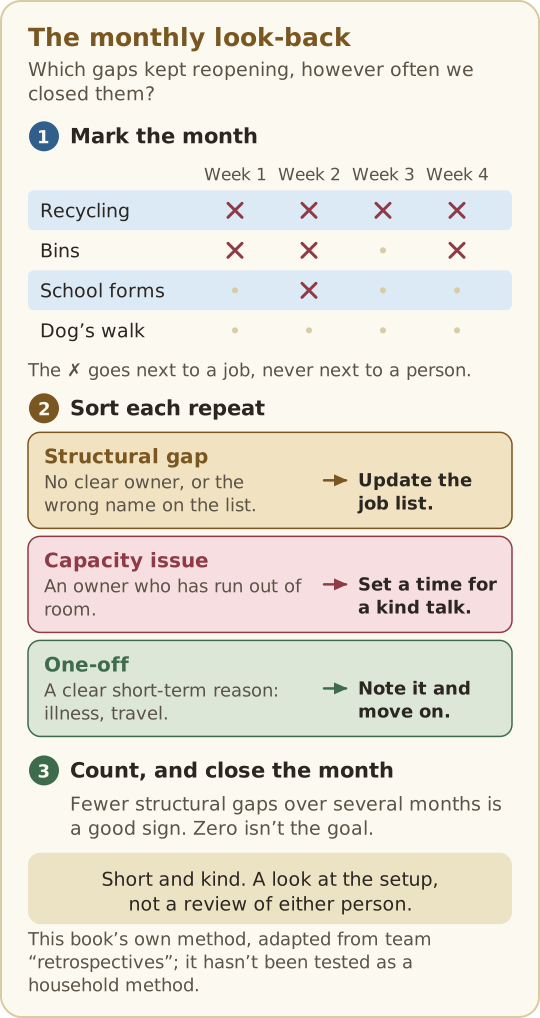
- Mark an ✗ for each week a job slipped. Anything with two or more gets sorted.
- A problem that keeps coming back usually has no real owner. Fix the setup, not the person.
- Keep it short and kind, and look back even in the quiet months.
Where this fits: the five big ideas
The whole program rests on five big ideas. Each one starts inside you and then shows up between you and other people. This chapter mostly teaches “Fix the setup, not the person” and “Notice the quiet incentives”, with help from “See the whole load”. (Borrowed from systems thinking, behavioural economics and ledger accounting.)
- In you: Look at your own routines as a setup you can adjust. Spot the easy defaults, like “I’ll just do it,” that let a gap quietly reopen.
- Between you and others: Look at the month together, give repeating gaps a clear owner, and keep count so jobs don’t drift back to whoever notices first.
Why a monthly look, on top of the weekly ones
By this point in the book, two rhythms are already running. There’s the 90-second daily check-in. And there’s the weekly catch-up, a short end-of-week talk where you tally the week in the “Who does what?” page (where each person lists their hours) and take a quick look at your job list (One owner per job).
Both are useful because they are small and frequent. But small, frequent checks have a blind spot. A job that slips for one week looks like bad luck. The same job slipping week after week is a pattern, and patterns are easy to miss week by week. They show up best when you step back and look at a whole month.
The monthly look-back is that step back. Instead of asking “How did this week go?”, it asks: which gaps kept reopening, however many times we closed them?
Why a month, and why notes beat memory
A month is long enough for a repeat to show up three or four times, and short enough that you still remember what was going on. It also matches how many households already run: rent, bills and school letters come monthly.
Notes matter because memory is a poor counter. The last argument feels like it happens “all the time.” The quiet weeks are forgotten. Four short weekly notes give you something steadier than either person’s memory, and they take the “I’m sure it was more than that” out of the conversation.
A look-back in three settings
- Housemates. Five people in a shared house hold a twenty-minute house meeting on the first Sunday of the month. Each brings one thing that kept slipping. See Sharing a room.
- A small team at work. Many teams already do this and call it a retrospective: what went well, what kept going wrong, what to try next. It’s the same habit with different words.
- A family with school-age kids. A short family meeting with snacks. Each person names one good thing and one thing that kept getting forgotten. The kids often spot the gaps first.
If only one of you is on board
You can do a look-back on your own notes: which of your jobs slipped, and which jobs you kept picking up that aren’t yours. Then invite the other person once, with the result, not the method: “I noticed the recycling has needed doing every week and I’ve done it each time. Could we give it an owner?” A finding is easier to say yes to than a new meeting.
Honest research notes
- Research: People judge how often something happens by how easily examples come to mind, so recent and vivid moments feel more common than they are. Amos Tversky and Daniel Kahneman called this the availability heuristic. More in the Library.
- Research: Looking back together at a stretch of work, asking what went well and what to try next, is a common team practice called a retrospective. More in the Library.
- This site’s idea: Using a monthly look-back at home, with its ✗ count, is the site’s own adaptation. It hasn’t been tested as a household method.
Getting ready
- Your four weekly notes from this month, in Who did what, the one-week log. A few lines a week is all it needs.
- Your current job list from One owner per job.
- The What keeps coming back? sheet, on paper or on screen.
- Twenty minutes, at a time you’ve both agreed on, when neither of you is rushed, hungry or worn out.
If either of your stress tanks is high that day (0.60 or more on How much are you carrying?, which measures how full your stress tank is), move the look-back. It can wait a day or two.
Getting ready in different setups
- Long distance or different hours. Do it by video, or in a shared note that each person fills in, then talk for ten minutes. Pick a time that isn’t straight after a night shift. See Long distance and Different hours.
- Separated co-parents. Keep it about the children’s jobs only, short and in writing if talking is hard. Your parenting plan or court order comes first. See Co-parenting.
- Foster and kinship carers. Your own household notes are separate from the records your agency or social worker asks for. Some gaps, like contact visits, belong in the care plan, not your look-back. See Foster and kinship families.
- Children and teens. Keep it short, give them a job in the meeting (reading out the list, keeping time), and start with one good thing each.
Common mix-up: “Our notes have to be detailed.” They don’t. Three lines a week is plenty. Detail makes the notes harder to keep, and the look-back only needs to know which jobs slipped.
A note on safety: Each person’s notes are their own. Nobody should demand to see the other’s notes, check their phone, or ask for an hour-by-hour account. That is monitoring, not a look-back. If it’s happening to you, see Not safe at home?
Step one: gather the month’s notes
Go through the four weekly logs. Write down every job that slipped in any week. A job slipped if it was noticed but not done, if it only got done after someone raised it more than once, or if its owner couldn’t do it and someone else quietly covered. Mark an ✗ for each week it happened.
In accounting terms, you are reconciling the plan (the job list: who should do each job) against the log (Who did what: who did it). Every difference is an item to explain.
One ✗ is normal life. Two are worth a look. Three or four in one month is a real pattern, not just bad luck.
Common mix-ups: An ✗ is not a grade, and it goes next to a job, never next to a person. “Bins: ✗ ✗ ✗” is a fact about a job. “Alex: ✗ ✗ ✗” is a scorecard, and it will start an argument. If a job slipped because someone covered it, it still gets an ✗: the point is to find the jobs where the plan and real life don’t match.
For example: Three adult siblings share their mum’s care. Their month shows “Mum’s prescriptions” with three ✗. Nobody failed: each thought the pharmacy delivery covered it, and it only did some months.
Words you could use: “Let’s mark the jobs first and talk about why afterwards.”
What a gap looks like at this scale
A single missed job is an event. A real gap is a job that keeps producing the same event, month after month, without ever landing on a steady owner. It’s the difference between “the bins didn’t go out on Tuesday” and “the bins have quietly become nobody’s job for three months.” The first is ordinary noise. The second is a gap in the job list that the weekly check-ins keep patching instead of fixing.
This matters because gaps like these are where the unbilled debt from the Preface grows fastest. It doesn’t come from any single missed job. It comes from the same job being argued over from scratch every time it comes back, because it never got a name that stuck.
Why a repeat points to the setup
If the same job keeps slipping whoever is meant to do it, the cause is usually in the arrangement: no clear owner, an owner with no time at that moment of the week, or a job that only one person ever notices. Asking “Who keeps failing?” finds someone to blame. Asking “What about this setup keeps failing?” finds something you can change.
- A grandparent raising grandchildren. School forms kept getting missed. The forms went into one child’s bag and the grandad never saw the bag. The fix was a tray by the door, not trying harder. See kinship care.
- A couple when one comes home. After months away, the returning partner wants to help with “everything,” so nothing gets a new owner and old jobs keep slipping. See the handover week.
- A parent and a child with ADHD. “Remember your PE kit” slipped every week. A checklist on the door, owned by the child and backed up by the parent, closed the gap. See When a child has ADHD.
- Research: When a job is shared among several people, each tends to feel less responsible for it (diffusion of responsibility, from work by John Darley and Bibb Latané). More in the Library.
- Research: Quality-improvement thinkers such as W. Edwards Deming argued that most repeated problems come from the system people work in, not from the people. More in the Library.
One owner per job: a list for two homes
- Person A
- Laura
- Person B
- Dan
- Date of this list
- 1 October 2026
- The split you agreed (optional)
- Week on, week off; handoff Sunday at 5
Who owns each job
| Job | How often | Owner | Helper or backup (optional) | Notes |
|---|---|---|---|---|
| Pack the handoff bag | Weekly | Laura | Dan | Laura keeps the checklist and the spare kit; whoever hands over packs from it |
| Send medicine and chargers with the bag | Weekly | Laura | Dan | Inhaler: write the last dose time on the card |
| School forms and permission slips | As needed | Dan | Laura | |
| Reply to school emails and apps | Weekly | Dan | Dan reads them Sunday night | |
| Kids’ doctor and dentist visits | As needed | Dan | Dan books; tells Laura the date | |
| Homework help (Laura’s weeks) | Daily | Laura | ||
| Homework help (Dan’s weeks) | Daily | Dan | ||
| Activities and sign-ups | As needed | Dan | Laura | Swimming and Cubs |
| Buy clothes as they outgrow them | As needed | Laura | Receipts in the shared folder | |
| Big decisions (school, health, new activities) | As needed | Both (decide together) | A decision, not a job: Dan puts it on the list; talked through by phone, never at handoff |
Does every job have an owner?
- Jobs with an owner
- 10 of 10. Every job has an owner.
- How the jobs sit across the homes
- Counted by how often each job comes round (a daily job about five times a weekly one): Laura’s home 52% · Dan’s home 47% · Together 1%. You wrote down the split you agreed: “Week on, week off; handoff Sunday at 5”. Does this match it? Two homes rarely split evenly, and that can be fair: weekdays and weekends, distance and work all play a part.
A made-up example. Names and details are invented. If one parent is afraid of the other, a shared list isn’t the right tool: see Not safe at home? on this site.
Fill in your own: One owner per job (two homes) (spreadloveandacceptance.com/
Step two: sort each repeat
For every job with two or more ✗, decide which of three kinds of gap it is. (As in Chapter II, the owner is the person who does the job, start to finish. The second name on the list is only a backstop who notices if it slipped and gently checks in.)
| Kind of gap | What it means | What to do |
|---|---|---|
| Structural gap | There’s no clear owner, or the named owner isn’t the person actually doing it. | Update the job list in this session, and agree on the change together. |
| Capacity issue | There’s a named owner, but they’ve been unable to keep up with it. | Set a time for an honest, kind conversation about handing it over or changing it. Don’t just quietly promise to try harder. |
| One-off | It slipped more than once, but for a clear short-term reason, such as illness, travel or a busy month at work. | Note it and move on. Don’t make a lasting change because of a short-term cause. |
For a capacity conversation, two workpapers help: Who did what, which besides the log has kind scripts for saying “not right now,” and the fact-feeling-ask shape in Say it so it lands.
The three kinds, in different homes
- Structural gap, housemates. The hallway light bulb has been out for weeks. Nobody owns “things that break.” They give it an owner.
- Capacity issue, a carer. A woman caring for her husband after a stroke owns the bills and the shopping, and both keep slipping. She isn’t careless. She’s out of hours. The talk is about who else can help, not about her trying harder. See When one of you is ill and Caregivers.
- One-off, a family in grief. In the month after a funeral, half the list slipped. That is a one-off, and the kindest look-back that month is very short.
Common mix-ups, and how to fix them
- Calling a capacity issue a structural gap, to avoid a hard talk. Moving the job to someone else without asking how the first person is doing can miss the real problem. Fix: ask, “Is it the job, or is it everything?”
- Calling the same gap a one-off every month. “It was just a busy month,” three months running, isn’t a one-off anymore. Fix: if a one-off comes back the next month, sort it again.
- Deciding the kind for someone else. Only the owner can say whether they’re out of capacity. Fix: ask, don’t diagnose.
If only one of you is on board
Sort your own jobs honestly. If one of yours is a capacity issue, say so first: “The school forms keep slipping, and I think I’m out of room this term. Could we talk about it Thursday?” Going first makes it easier for the other person to say the same about theirs, later.
A note on safety: A capacity talk needs both people to be able to say “I can’t” without fear. If saying no leads to anger, threats or punishment, that is not a capacity problem you can fix with a list. See Not safe at home?
What keeps coming back?
- Person A
- Ash
- Person B
- Robin
- Person C
- Jules
- Month
- September 2026
Part A: Gather the month’s notes
Mark an ✗ for each week a job slipped. ✗ = it slipped that week.
| Task | Week 1 | Week 2 | Week 3 | Week 4 | Times flagged |
|---|---|---|---|---|---|
| Cat litter | ✗ | ✗ | ✗ | 3 | |
| Recycling out on Thursday | ✗ | ✗ | 2 | ||
| Book Jules’s car service | ✗ | 1 | |||
| Shared calendar kept up to date | ✗ | ✗ | ✗ | ✗ | 4 |
Part B: Sort each gap
Sort every task flagged twice or more.
| Task | Named owner on the job list? | Classification | Action |
|---|---|---|---|
| Cat litter | No | Structural gap | Robin owns it, with Ash as backup; on the one-owner list tonight |
| Shared calendar kept up to date | Yes | Capacity issue | Ash owns it but is on nights this month; talk on Sunday about what comes off Ash’s list |
| Recycling out on Thursday | Yes | One-off, no action | Two bank holidays moved the day |
Part C: Wrap up the audit
- Structural gaps found
- 1. Update One owner per job for each of these in this session.
- Capacity issues found
- 1. Set a time for the conversation. This audit brings it to light, but it doesn’t replace it.
- One-offs
- 1
Part D (optional): Thanked, or only noticed when it’s missed?
| Job | Gets thanked | Only noticed when missed? | One way to notice it |
|---|---|---|---|
| Keeping the calendar | Rarely | Yes | Say thanks at Sunday dinner when it’s up to date |
| Topping up the cat food | Never | Yes | A note on the fridge |
A made-up example. Names and details are invented. A task with no owner is a gap in the setup, not a verdict on the person who kept covering it.
Fill in your own: What keeps coming back? (spreadloveandacceptance.com/
A worked example month
Here’s what Sam and Alex’s look-back sheet looks like at the end of a month:
| Job | Wk 1 | Wk 2 | Wk 3 | Wk 4 | Total ✗ | Kind |
|---|---|---|---|---|---|---|
| Bins out (Tuesday night) | ✗ | ✗ | ✗ | 3 | Structural gap | |
| School forms signed | ✗ | ✗ | ✗ | 3 | Capacity issue | |
| Dishes before bed | ✗ | ✗ | 2 | One-off | ||
| Plants watered | ✗ | 1 | (normal life) |
✗ = it slipped that week. A blank means the job went fine.
- The bins are Alex’s on paper. But Alex works late on Tuesdays, so for three weeks Sam quietly took it out. At the weekly catch-up in Chapter IV, they agreed to try a swap for the rest of the month, and in week 4 Sam took it out with no trouble. The named owner wasn’t the person doing it, so it’s a structural gap. Now they make the trial swap official: Sam owns the bins, and Alex takes the recycling and the weekly grocery order, so the hours stay even. They update the job list on the spot.
- The school forms have a clear owner, Sam, who is swamped this term. That’s a capacity issue. They set a time for a proper talk on Thursday evening instead of solving it now.
- The dishes slipped during the two weeks Alex was travelling. That’s a one-off. They note it and change nothing.
Result: one structural gap, one capacity issue, one one-off. They write those three numbers down. The whole thing takes eighteen minutes.
A second month: three siblings and their dad
Three grown-up siblings share the care of their dad, who lives alone. One lives nearby, one an hour away, one abroad. They do their look-back on a video call, using a shared list.
- Calling Dad’s landlord about repairs: 3 ✗. Nobody had ever agreed who would. A structural gap. The sibling abroad takes it, because it can be done by email from anywhere.
- Weekly visit: 2 ✗. The sibling nearby owns it and has been working double shifts. A capacity issue. They book a separate call for Sunday.
- Dad’s food order: 1 ✗, the week the website was down. Normal life.
The sibling abroad says, “I know I can’t visit. I want to own something real.” That sentence did more than the list. When old hurts make even this kind of call hard, see Family rifts.
Step three: close the month and keep count
- Update the job list for every structural gap.
- Set a time for the conversation for every capacity issue. The look-back finds the issue. It doesn’t replace the conversation.
- Write down how many structural gaps, capacity issues and one-offs you found.
A falling number of structural gaps is a good sign, over several months; one month can be a normal swing. A number that keeps rising usually means something bigger has changed, such as a new job, a new baby or a move, and that change may need its own conversation.
The look-back also feeds back into Chapter II. If a gap was a blank row, filling it in raises next month’s ownership score. If the names were filled in but wrong, like the bins, the score holds steady, but now it’s true: the list names who really does each job. Only the look-back catches that kind of gap. The progress report (your progress, week by week) can keep the monthly counts, including how many gaps came back after being fixed the month before. That repeat count is the one to watch most closely.
Common mix-up: “Our goal is zero.” A count of zero can mean a solid setup, or that someone has stopped marking ✗ to keep the peace. Fix: the count is for noticing a direction over months, not for winning a month.
- Research: Goodhart’s law, from economics, warns that when a measure becomes a target, people start managing the number instead of the thing it was measuring. More in the Library.
- Research: An unusually bad month is often followed by a more ordinary one, simply by chance. Statisticians call this regression to the mean. It’s why one month is never enough to judge a change.
If only one of you is on board: keep your own count of the jobs you own and the jobs you covered. Over three months, it shows you whether things are settling or whether you’re carrying more and more. That is useful to know for yourself, whether or not you ever show it to anyone, and it’s good evidence for a calm conversation if you choose to have one.
Words you could use: “I’ve been keeping a simple count for three months. Can I show you what I noticed?”
The quiet months
The look-back is built to find gaps, so it is tempting to skip it when there aren’t any. That’s the month it matters in a different way. Where audits are done well, a control that has always worked is still tested again on a schedule, because working so far is not the same as working now. People are no different. A month with no ✗ can mean the setup is solid. It can also mean nobody has looked closely, or that one person is quietly covering so well that the page looks clean.
On a quiet month, keep the same twenty minutes and add three questions:
- What’s going well that we haven’t said out loud?
- Is anything small that we’ve stopped mentioning because it didn’t seem worth it?
- Does the job list still match life as it is now?
The first question gives thanks a place. The second catches what slow drift hides. The third is the review date for the whole setup. This is the same re-check that the Complacency guide sets out for every kind of relationship and for yourself, and a quiet month is a good time to practise it.
Quiet months, in three relationships
- An empty nest. With the kids gone, the list is short and nothing slips. The look-back finds a different gap: they haven’t planned anything together in months. See Kids grown and gone.
- Old friends. Nothing has gone wrong, but one of them has started every catch-up for a year. A quiet month is a gentle time to say so. See Friends.
- Gaming and time together. No chores slipped, but evenings have drifted into separate screens. The question “What have we stopped noticing?” brings it up without blame. See Gaming and time together.
- Research: People adapt to good things as well as bad ones, so what once felt special starts to feel normal. Psychologists call this hedonic adaptation. Saying thanks out loud is one way to keep noticing. More in the Library.
Common mix-up: “If nothing’s wrong, the look-back is a waste of time.” Fix: make the quiet-month version shorter, not absent. Ten minutes and three questions is enough, and it keeps the habit alive for the month you need it.
If only one of you is on board: ask the three questions of yourself, then share one answer. “Something I’ve stopped saying: I really like how you handle the car stuff.” Starting with a thank-you is the easiest way into a quiet-month talk.
How to talk about a pattern
When a gap needs a real conversation, use Check-ins for the order: one topic, a good moment, and hearing each other back before answering. Try the Chat analyzer, which shows how a sentence may land, on the sentence that names the pattern.
How you say it matters. A pattern said as a verdict (“You never put the bins out”) will get argued with. A pattern said as a repeated fact (“The bins have slipped three weeks in a row. What’s getting in the way on Tuesdays?”) can get an owner. Keep the month from turning into overload, blame or criticism of the person. The ground rules are how the conversation stays a repair.
Give context on both sides before you decide anything. A gap that looks like neglect from one side may be a heavy month from the other, and a job that “always gets done” may be getting done at a cost nobody has said out loud. Each person says briefly what the month was like for them, and the other repeats back what they heard. Only then do you decide who owns what. The Complacency guide has words for raising something someone has stopped noticing.
If the talk starts going badly, either of you can call a pause, and the person who paused names a time to come back.
A good habit: open every look-back by each naming one thing that went well this month. Turning Towards has more ideas for small, specific thank-yous.
Naming a pattern, in three relationships
- Coworkers: “The client notes have been missing after three of the last four calls. What would make it easier to write them up?”
- A parent and a teen: “Your bike’s been left out in the rain three times this month. What would help you remember?” (Not: “You never look after your things.”)
- Two faiths, one family: “Both of our holiday seasons ended with me doing all the cooking. Can we plan next time differently?” See Two faiths.
Words you could use: “This has come up three times this month. What’s getting in the way?” “I’d like to hear what this month was like for you before we decide anything.”
If only one of you is on board: name the pattern as a repeated fact, once, and ask one question. Then listen. You can’t make the other person join the look-back, but a calm question often gets a calmer answer than a meeting would.
- Research: John Gottman’s research found that how a hard conversation starts strongly predicts how it ends. A gentle start (describe, feel, ask) goes better than an accusation. More in the Library.
- Research: Saying back what you heard before answering, often called reflective listening, helps people feel understood. More in the Library.
Our weekly check-in
Week of Oct 5 · Linda and Jordan
- Who’s checking in (optional)
- Linda and Jordan
- One thing that went well
- Jordan cooked twice, and we ate together on Thursday.
- One thing that felt heavy
- The bathroom, again. And Mum’s back was bad all week.
- One small thing to try next week
- Jordan owns the bathroom on Saturdays. Linda stops checking it.
- Our next check-in
- Sunday after dinner
Any jobs that slipped or came up again this week? (optional)
- Dishes
- Laundry
- Trash and recycling
- Groceries
- Cooking
- Chosen: Cleaning the bathroom
- Paying the bills
- Planning and remembering
On the card
One topic at a time. We’re on the same side. Tick a job once it has one owner.
A made-up example. Names and details are invented.
Fill in your own: Kitchen-table check-in: this week (spreadloveandacceptance.com/
What the look-back is for, and what it isn’t
The monthly look-back, set out as a working sheet in What keeps coming back?, does three things:
- It finds which jobs are real repeating gaps, not one-off misses.
- It decides whether each gap needs a new owner or a conversation about capacity.
- It closes the month cleanly, so next month starts from a fixed setup instead of the same unresolved argument.
It is not a monthly performance review of either person. And it never goes back to add up hours that were “owed.” Past hours can’t be handed back, and billing for them doesn’t fix anything; it just turns a look-back into a grievance. That doesn’t mean pretending they didn’t happen. You can thank someone for what they carried before (“I see how much you’ve been carrying”); you just don’t bill for the past. The only question the look-back asks about the past month is where the setup failed to hold. So the setup, not anyone’s effort or affection, is what changes for next month.
It also doesn’t replace the weekly catch-up. The monthly look-back only works because the weekly notes keep feeding it real information. Skip the weekly checks, and the monthly one becomes guesswork.
No blame, still responsible
Fields where mistakes can be serious, like aviation and healthcare, learned that when mistakes are punished, people hide them, and when they lead to learning, people report them. So they review what went wrong without assigning personal blame. The same thinking keeps a look-back honest at home. “No blame” doesn’t mean “nobody is responsible.” The owner still owns the job next month. It just means the question is what to change, not who to shame.
Common mix-up: “If we can’t bill past hours, the person who carried more just loses out.” Fix: say thank you for what was carried, and change who carries next month. That is how the balance is restored, going forward.
- Research: Blameless reviews, and the idea of a “just culture” described by Sidney Dekker and James Reason, separate honest mistakes from reckless ones. More in the Library.
- This site’s idea: Not billing for past hours is a choice this book makes, not a research finding. It keeps the look-back pointed forward.
Starting out: before you move in
Most of this book’s examples are people who have shared a home for years. If you’re a few months in and about to move in together, the tools work even better now, before habits set. Here is a gentle order to use them in, about one step a week. None of it is a test, and you can stop at any point.
| When | What to do together | The tool |
|---|---|---|
| Week 1 | Each write down the rulebook from the home you grew up in: who did what, how money was talked about, what “tidy” meant. Swap, and be curious rather than judging. | The rulebook from home, and Part One: Then |
| Week 2 | Money: your money stories first, then the numbers, the split you’ll use, and a “talk first” amount for big buys. | Money between you and the “Who does what?” page’s Money tab |
| Week 3 | Your first job list for the new place, with one owner per job, thinking jobs included: bills, the landlord, birthdays, the food shop. | One owner per job |
| Week 4 | A pause plan, made on a calm day: your pause word, how long each of you needs, and how you’ll come back. | Our pause plan and Chapter I |
| Week 5 | What matters most: each name three things that matter most to you about a home (quiet, friends round, faith, family nearby, saving) and where they might pull against each other. | Part Three, Chapter 10: Values, meaning and a good life |
| After the move | After two weeks, each log one ordinary week. After four weeks, do your first monthly look-back: short, kind, and mostly about what’s going well. | Who did what, then What keeps coming back? |
The reasoning. In the first months, nothing has an owner yet, so jobs go to whoever notices first, and that quickly becomes a habit neither of you chose. A few small talks now are far easier than untangling a habit later.
Bringing it up without it feeling like an audit
Eight months in, a worksheet can feel like a test. Say what it’s for: not keeping score, but never having to guess. Use your own words for the tools (“our list,” “our monthly chat”), keep each step to one evening or less, and drop anything that doesn’t help.
A worked example: Niamh and Tariq
Made up. Niamh and Tariq have been together eight months and move in at the end of next month.
- Week 1: Niamh’s family tidied as they went. Tariq’s did one big clean on Sunday. Neither is wrong. They agree: the kitchen every night, the rest on Sunday morning.
- Week 2: They choose a split in line with their pay (worked through in Chapter IV), and put the £100 Tariq sends his mum on the list from day one.
- Week 3: Tariq owns the bills and the landlord. Niamh owns the food shop and the meal plan. Tariq owns the bins, with Niamh as backstop.
- Week 4: Their pause word is “kettle.” Tariq needs about twenty minutes to settle, Niamh about ten, so the one who pauses says when they’ll be back.
- Week 5: Tariq would like his mum to visit often. Niamh needs quiet weeknights. They agree on weekend visits, with one weeknight a month for Sunday-lunch leftovers and his mum’s stories.
- After the move: At their first look-back, the recycling slipped twice. Nobody owned it. Now Niamh does.
Common mix-ups, and how to fix them
- “If we need a plan, something must be wrong.” Planning is what people do for things that matter, like a holiday or a wedding. A home is one of them.
- “We’ll work it out as we go.” You will, and the first few months decide a lot of it by default. A little planning makes the defaults your choice.
- “The list will make us feel like flatmates.” Keep it short and light, and keep it in its place: one list, one monthly chat. The rest of the time is just your life together.
Words you could use: “I don’t want us to keep score. I just want us never to have to guess. Could we try a few small things before we move?” “How did your family split the jobs when you were growing up?”
More: Money together: moving in. This site’s idea: the week-by-week order.
Raising a grandchild (kinship care)
Many grandparents, aunts, uncles, older siblings and family friends end up raising a child whose parents can’t, for a while or for good. It’s an act of great love, and it comes with work nobody planned for: school all over again, contact with the child’s parent, sometimes social workers or courts, and your own feelings about all of it. This section is written for the carer. It uses the monthly look-back, because so much of kinship care is about things that keep coming back.
The things that keep coming back
Cancelled contact calls, a hard evening after a visit, the school phoning, forms piling up: these are patterns, not one-offs. Use What keeps coming back? on your own, or with a partner or helper, and sort each repeat like any other. Some have no owner (who rings the school back?). Some are capacity issues (you are doing too much). And some, like a parent who misses calls, are outside your control. For those, the job you can own is the plan for the evening after.
An evening-after plan (made up): When a call with Mum is cancelled, say so plainly and early (“Mum can’t ring tonight”), don’t guess her reasons out loud, offer one comfort (hot chocolate, a game, football on the telly), let him be cross or sad without fixing it, and write the next planned call on the calendar together.
The child’s loyalty bind
Children in kinship care often love the parent who can’t look after them, and the carer who does. They may feel that being happy with you is disloyal to their mum or dad, or they may protect the parent by not talking about them. Some act up after contact; some go quiet.
- Give permission to love both. “You can love your mum and live with me. You don’t have to choose.”
- Don’t run the parent down in front of the child, even when you’re angry with them. Say the facts plainly and kindly.
- Keep promises small, and don’t make them for the parent. Not “Mum’s coming,” but “Mum is planning to come. If she can’t, we’ll still go to the park.”
Explaining an absent parent, at different ages
Most guidance for carers suggests the truth, told simply, in words that fit the child’s age, and told again as they grow. Short, true and kind, and always clear that it isn’t their fault.
- Under 5: very short and concrete. “Mummy isn’t well enough to look after you. Granny looks after you now, and Granny is staying.”
- 5 to 8: a little more, with the same core. “Mum has an illness that makes it hard for her to look after children. It’s not your fault, and nothing you did caused it. The grown-ups are making sure you’re looked after.”
- 9 to 12: more of the why, and room for questions. “Your mum is having a really hard time with her drinking. She loves you. Right now she can’t keep you safe and settled, so you live with me. You can ask me anything, and if I don’t know, I’ll say so.”
- Teenagers: the fuller truth, and their own views. They may be angry with their parent, or with you. Let them feel both. Ask what they want to know, and what they want to tell friends and school.
School, and the child’s social worker if there is one, can often help you find the words. Some children like a simple life story book with photos of where they’ve lived and the people who love them.
When you and the child’s parent don’t get on
Often the parent is your own adult child. You may be angry, grieving and worried all at once, and they may resent you for raising their child. Most advice about family rifts says to step back from someone who hurts you. In kinship care you often can’t, because the child needs contact.
- Keep it business-like, for the child’s sake. Short, civil messages about the child: times, school, health. It’s the same approach as co-parenting across two homes (Chapter III).
- Hold the parent and the child apart in your mind. You can be hurt by your son or daughter and still greet them warmly at a visit, for the child.
- Leave the door open, without pressure. Family estrangement is more common than many people think, and some families do find their way back, often slowly (Karl Pillemer, 2020).
- Grieve your own losses too: the life your child might have had, the grandparent you expected to be, the retirement you planned. Pauline Boss called loss with no clear ending “ambiguous loss.” Naming it can help.
Words you could use, with your adult child: “I’m not trying to replace you. I’m keeping him safe and settled until things change. He talks about you, and I want your visits to go well.” With the child: “Mum loves you. She isn’t well enough to look after you right now, and that’s not your fault.”
Look after yourself
Raising a child a second time round is tiring. Research on grandparents raising grandchildren finds real rewards and real strain, and a strong need for support (Bert Hayslip and Patricia Kaminski, 2005). Respite (a regular break), a group of other kinship carers, and help with money and school are all worth asking for. In England and Wales, the charity Kinship (kinship.org.uk) offers advice and local support groups for kinship carers. Foster, adoptive and kinship families lists more support, in the UK and elsewhere.
A worked example: Maureen and Tyler
Made up. Maureen, 63, has raised her grandson Tyler, 9, since he was six. Her daughter, Kerry, rings on Sundays when she can. Maureen does her monthly look-back on her own, with a cup of tea, on the first Monday of the month.
In October, two things came up three times: Kerry’s Sunday call didn’t happen, and Tyler had a meltdown at bedtime on those Sundays. The first is outside Maureen’s control. The second she can plan for. She writes an evening-after plan (hot chocolate, his football annual, no guessing about Kerry’s reasons out loud) and asks her brother to take Tyler swimming on Sunday afternoons, so waiting for the phone isn’t the whole day.
She also sends Kerry one short message: “Tyler looks forward to your calls. If Sunday at six doesn’t work, would another time be easier? Love, Mum.” Kerry replies a week later and suggests Wednesdays. It isn’t fixed, but it’s a step.
Common mix-ups, and how to fix them
- “If I tell him the truth, it will hurt him.” A simple, kind truth usually hurts less than a mystery he fills in himself, often by blaming himself.
- “Staying civil with her means I’m letting it go.” Civil is for the child. Your feelings about what happened are real too, and they deserve a place: a friend, a support group or a counsellor.
- “I should be able to manage on my own.” Nobody raises a child alone well for long. Asking for respite is part of doing it well.
Research notes
Bert Hayslip and Patricia Kaminski (2005) reviewed research on grandparents raising grandchildren: the costs and rewards, how varied these families are, and the need for support. Karl Pillemer (2020) drew on a national survey to show that family estrangement is more common than people assume and that some people reconcile. Pauline Boss (1999) named “ambiguous loss.” This site’s idea: the evening-after plan, and using the monthly look-back for the parts of kinship care that keep coming back.
Your part, and only your part
In the look-back you can only fix the gaps you own, and offer help with the rest. You can’t make someone keep a rhythm. Keep the rhythms you can keep, notice which ones are kept in return, and let your effort follow: more where it’s shared, less where it isn’t, so the rhythm doesn’t run on one person’s energy.
The idea runs through the whole book: you can only do what’s in your control, and you protect your own energy by matching energy with energy, giving in proportion to what comes back, with room for seasons when someone can’t. Part One covers it in full: your circle of control, and matching energy.
On your own: a monthly look at yourself
Once a month, look back at your own month, kindly. Not a scorecard, more like a weather report.
- What filled your battery this month, and what drained it?
- Which of your limits held, and which slipped?
- Choose one small thing to keep, and one to change next month.
In the individual program: The Individual package and your report · Part One: a kind monthly look at yourself · Step 1: check your battery The Individual package puts every workpaper for the path into one fillable PDF, with a report written just for you. · The whole book on sharing the load
More for your situation
A monthly look-back works in every kind of relationship, with small changes. These pages take it into one situation each. Start from your relationship lists them all.
- Couples and partners: More than two partners · Money together · Gaming and time together · Different hours · Coming home · When one of you is ill
- Families: Foster, adoptive and kinship families · When a child has ADHD · Grown-up children · Adult siblings and family rifts · Kids grown and gone · Two faiths, one family
- Friends, housemates and work: Friends · Sharing a room · Coming out as an adult
- On your own, or helping others: On my own · For counsellors, coaches and group leaders
Where the thirteen fields meet in this chapter
This chapter draws on 7 of the author’s thirteen fields (see the Preface or the About page). Here is what each one brings, and which of the five big ideas it serves.
| Field | What it brings here | Big idea |
|---|---|---|
| Finance | The month-end close: reconcile the plan against the log, so next month starts clean. | See the whole load |
| Business | The audit habit, used as a friendly self-check. A failure that keeps repeating usually means a missing control (auditors call it a deficiency), here a job with no real owner. | Fix the setup, not the person |
| Economics | A deficit is a shortfall. Past hours can’t be handed back, so they aren’t billed afterwards: chasing them only turns a look-back into a grievance. | Notice the quiet incentives |
| Behavioural science | Patterns show up best at the right scale. One slip is noise; three or four in a month is a pattern that’s easy to miss week by week. | Notice the quiet incentives |
| Psychology | A pattern said as a verdict gets argued with. Said as a repeated fact, it can get an owner. | Tune how you send and receive |
| Philosophy | The Ship of Theseus, an old puzzle: is a ship rebuilt plank by plank still the same ship? A home’s agreements get rebuilt a little at a time, and they’re still yours, as long as you keep the plans up to date. | Fix the setup, not the person |
| Holistic therapies | Body first, argument second: not on a day when either stress tank is high. A calm look-back a few days late beats a tense one on time. | Read your state first |
How they connect
The word in brackets is the root the two fields share; the polymath page explains all seven. From the most obvious connection to the most abstract:
- Obvious: Finance + Business (feedback loops). A monthly close and an audit are the same habit: step back, find what didn’t reconcile, fix the control. In this book that’s the monthly look-back, about twenty minutes a month. This holds up “Fix the setup, not the person”.
- Hidden: Economics + Behavioural science (quiet incentives). The easiest default, “I’ll just do it,” is the one that reopens the gap. A monthly count makes the default visible, so the job gets a name that sticks. This holds up “Notice the quiet incentives”.
- Abstract: Economics + Philosophy (balance). Past hours can’t be handed back. What can change is who carries next month. So the only question the look-back asks about last month is where the setup failed to hold. A ledger that looks forward is a fairness choice, not just an accounting one. This holds up “Fix the setup, not the person”.
Connect any two fields yourself · Ask Professor Puddles how all thirteen connect
When it goes wrong, and when it goes right
When it goes wrong, the look-back turns into a list of complaints. Every ✗ becomes “you, again.” Old hours get added up. Someone leaves feeling judged, and next month both people quietly find a reason to skip it.
When it goes right, it’s short, a little dull and oddly calming. A couple of jobs get new owners. One talk gets scheduled. The number of gaps is written down. Over the next few months it gets smaller, and you both notice the difference at home.
Questions people often ask
We missed a few weekly logs. Can we still do the look-back?
Yes. Use what you have, and be honest about the gaps in your notes. Just avoid making big changes based on thin information.
What if we disagree about which kind of gap something is?
Start with the simplest question: does the job have a named owner, and is that person the one actually doing it? If you still disagree, call it a structural gap and look at the job list together. Updating the list is low-risk and easy to undo.
How long should it take?
About twenty minutes. If it runs much longer, you’re probably solving capacity issues in the meeting. Schedule those as separate talks.
Can someone help us prepare?
Professor Puddles, the site’s friendly chat host, can help you word the sentence that names a pattern.
Limits and cautions
- The look-back finds patterns in jobs. It can’t tell you why someone feels the way they do. That still needs a conversation.
- Don’t use it in a week when either of you is very stretched. A calm look-back a few days late beats a tense one on time.
- Agreements made for an old life often need changing. The Ship of Theseus is a good story to keep in mind: a ship rebuilt plank by plank is still the same ship, and a home whose agreements get rebuilt is still your home, as long as you keep the plans up to date.
- These tools only work when each person feels free to say no, to ask for a pause, or to keep their own notes private. If looking back together ever feels unsafe, or one of you feels you can’t say no, stop using the tools and talk with a trained counsellor on your own. When someone is afraid of their partner, counselling together isn’t advised. Not safe at home? lists free, private hotlines.
Closing the month, and starting again
This is the last chapter of Part Two, but the program keeps going around. Each month, you look back, change one or two things, and start again. You see the work, stay in tune, check the split can last, know what you’re carrying, agree what fair means, and look back again. The aim was never a perfect ledger. It’s a shared life where nobody is quietly carrying more than the other can see.
That’s the end of Part Two. The book goes on in Part Three: Understanding people, chapters on how people work, for anyone. To put Parts One and Two into practice first, try the six-week program: six gentle weeks, with one chapter and one small tool each week.
Last updated: October 2026