Preface to Part Two · Between us
The work nobody sees
Sunday, 9pm
Someone notices the laundry is still in the washer, the school forms are due on Tuesday, and the birthday card never got posted. They also notice that nobody else has noticed. The house looks fine. That’s the problem.
Or, living alone: A widower says, “Since my wife died, I notice how many jobs she quietly carried: the birthday cards, the boiler service, knowing who to ring when someone was ill. I never saw them until they stopped getting done.”
Every home keeps a set of accounts that nobody agreed to keep.
Someone notices the milk is low. Someone remembers the dentist appointment three weeks away. Someone senses the mood in the room shifting before an argument starts, and quietly steers it somewhere calmer. None of this shows up on a calendar. None of it gets a thank-you, because you can only thank someone for work you have seen. And this kind of work is hidden by nature: when it’s done well, nothing seems to happen.
In short:
- Running a home takes unseen work: the noticing, remembering and planning that many people call the mental load.
- The other person usually just hasn’t seen it. This work hides by nature. It isn’t a sign that they don’t care.
- Each of you writes only your own side of one ordinary week, and you read the two lists together.
- The list is for seeing, not for billing. Thank each other for the past, and plan next week.
Where this fits: the five big ideas
The whole program rests on five big ideas. Each one starts inside you and then shows up between you and other people. This preface mostly teaches “See the whole load”, with help from “Notice the quiet incentives”. (Borrowed from finance and economics.)
- In you: Notice everything you carry, including the thinking and feeling work you have never counted. Notice, too, the work others do that you may have missed.
- Between you and others: Put both lists on one shared, fair page, so nobody has to argue about whose work “counts.” Jobs nobody claims tend to drift to whoever notices first, and a specific thank-you helps keep things steady.
Put together, the five big ideas make one simple loop: you see the load, redesign the setup around it, check your state before you talk, tune the message so it lands, and keep an eye on the quiet incentives that let things slide back.
| Big idea | Where the book teaches it |
|---|---|
| See the whole load | This preface, Chapter II and Chapter V |
| Fix the setup, not the person | Chapter II, Chapter IV and Chapter V |
| Read your state first | Chapter III, with help in Chapters I, II and IV |
| Tune how you send and receive | Chapter I, with help in Chapter III |
| Notice the quiet incentives | This preface, Chapter IV and Chapter V |
Unbilled debt: the work that goes unseen
Over months and years, that hidden work builds up like a debt that only one person can see on their books. The other person usually isn’t refusing to pay it. Most of the time, they don’t know it exists.
This book calls that gap unbilled debt: the difference between the work someone does and the work anyone notices. In a business, an unbilled hour is work that was done and logged, but never invoiced, so the client never sees it. At home, it’s much the same. The work was real. It just never made it onto the page that the other person reads.
This debt isn’t repaid in hours, and nobody sends a bill. It’s cleared by being seen, thanked and shared differently from here on. You can thank someone for what they carried before; you just don’t bill for the past.
Plato’s Cave is an old story about people who mistake shadows for the real thing. At home, the few bits of work you happen to see are the shadows. The whole job is the real thing.
The reasoning. A debt nobody can see can’t be talked about, so it can’t be shared. It doesn’t disappear, though. It turns into tiredness for the person carrying it, and confusion for the person who isn’t (“Why are you so upset about a birthday card?”). Naming it as a debt, not a failing, lets both people look at the gap without either one being on trial.
Worked examples
- Two partners, both men: Stefan handles every family birthday, the car insurance and the dog’s vet visits. Omari works longer hours and thinks they split the home “about half and half.” After a week of notes, Omari sees about four hours of Stefan’s work he had never counted. He doesn’t pay it back. He thanks Stefan for the past, and takes over the car and the vet from next month.
- A grown-up daughter and her father: Since her mother died, Siobhan has quietly taken over her father’s bills, medicines and doctor visits. Her father thinks she “pops in now and then.” When she writes it down, she realises it’s most of her Saturdays. She doesn’t send a bill. She asks him which parts he’d like to do again himself, and asks her brother to take the pharmacy run. See Caregivers.
- Two housemates: Tilly is the one who always restocks the toilet roll, washing-up liquid and bin bags. It costs her money as well as noticing. They set up a small shared kitty and a list on the fridge. The unseen work becomes a shared job. See Money together.
Common mix-ups, and how to fix them
- “Unbilled debt means they owe me hours.” It doesn’t. The fix is to be seen, thanked and shared differently from now on. If you catch yourself adding up the past, switch to planning next week.
- “If I name it, I’m calling them lazy.” Name the work, not the person: “Here’s a job that’s been invisible,” not “Here’s what you never do.”
- “It’s only a debt if it’s big.” Most unbilled work comes in small pieces. Small and often is exactly how it builds up.
If only one of you is on board: Write your own week anyway. Use it to see your real load, plan your energy and choose one job to hand back or let go. You can share a single item, kindly, without sharing the whole list.
Words you could use: “I’ve been carrying a few things you might not have seen. I’d like to show you, not to blame you, just so we see the same picture.”
A note on safety: If someone insists you owe them for everything they do, keeps a tally to make you feel small, or controls the money so you can’t say no, that isn’t this idea. That is control. Not safe at home? lists free, private help, and Money together explains the difference between normal limits and control.
Research notes
Sociologist Arlie Hochschild, with Anne Machung, described “the second shift” in 1989: the home work many people do after their paid work ends, much of it unseen. Later research on gratitude (for example, Amie Gordon and colleagues in 2012) found that people who felt appreciated by their partner tended to be more appreciative in return, and that appreciation was linked to staying together. This site’s idea: the name “unbilled debt” and the rule that it’s cleared by being seen and shared, not by being repaid.
The kinds of unseen work
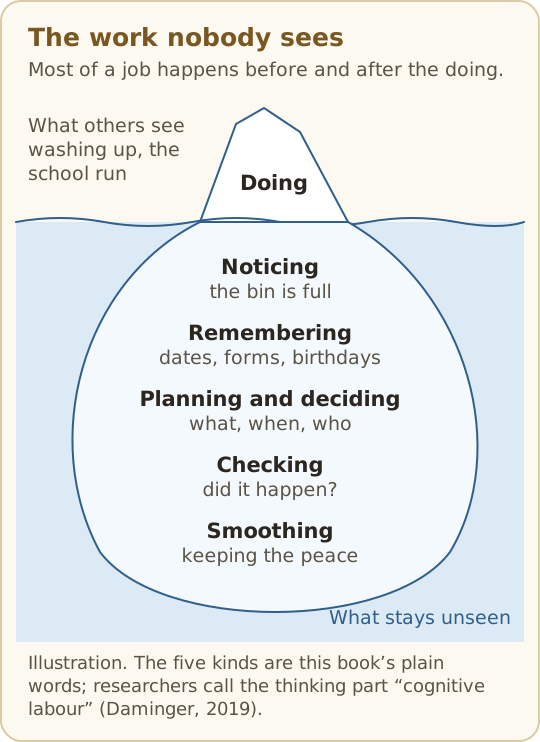
Unseen work isn’t one thing. It helps to name the different kinds, because each one hides in a different way.
- Noticing. Seeing that something needs doing: the bin is full, the child has grown out of their shoes, the car is due for service.
- Remembering. Holding dates and details in your head: birthdays, bin day, which form goes back to school on which day.
- Planning and deciding. Working out the options and choosing one: what to cook this week, which plumber to call, when to visit family.
- Checking. Making sure the thing actually happened, and following up when it didn’t.
- Smoothing. Keeping the peace, keeping in touch with relatives, cheering someone up, and sensing when a conversation needs to slow down.
People who study home life often call the thinking parts of this the “mental load” or “cognitive labour.” The name matters less than the idea: a job is more than the few minutes it takes to do it. Someone has to carry it in their head first.
The reasoning. When people say “we split the chores,” they usually mean the doing. But each job has a front end (noticing, remembering, planning, deciding) and a back end (checking, following up). Whoever holds the front end is the one who can never fully switch off. Naming the five kinds lets you split the whole job, not just the visible slice.
Worked examples
- Separated co-parents: Both parents do school runs. But one parent is the one who reads every school email, knows which week is non-uniform day and remembers to tell the other. They agree that each parent owns all school emails for their own weeks. See Co-parenting.
- Kinship carers: A grandmother raising her grandson does the visible care, and also the smoothing: keeping the boy in touch with his mum, handling birthdays that bring up big feelings, and calming things after phone calls. Once she names that work, her partner starts taking the Sunday phone calls. See Foster, adoptive and kinship families.
- Two business partners: One partner does the client work. The other notices when contracts are due, plans the cash flow and checks the invoices were paid. Neither had counted the second list as “work.” They give it a name, “running the business,” and a regular slot.
Common mix-ups, and how to fix them
- “If I do the task, I’ve shared it.” Not if someone else still has to remind you. Try taking a job start to finish: noticing, doing and checking.
- “Smoothing is just my personality.” It may come easily, but it still takes energy. Put it on the list with a rough number of minutes.
- “Lists are for planners.” You don’t have to like lists. A five-minute chat with the five words (notice, remember, plan, check, smooth) does the same job.
If only one of you is on board: Sort your own list into the five kinds. Most people find one kind takes far more of their time than they thought. That alone can explain why you feel tired.
Words you could use: “Could you take this one from start to finish, including remembering it? That’s the part I’d most like to put down.”
A note on safety: Smoothing can hide something harder. If you spend your days managing someone’s moods so they don’t explode, that is not ordinary home work. You don’t have to manage it alone: Not safe at home?
Research notes
Sociologist Allison Daminger (2019) split the thinking side of home work into four stages: anticipating a need, identifying options, deciding and monitoring. Anthropologist Micaela di Leonardo (1987) named “kin work”: the cards, calls and visits that keep a wider family connected. Arlie Hochschild’s term “emotional labour” (1983) was first about paid jobs, but people now often use it for the smoothing work at home. This site’s idea: the five plain words, and adding “smoothing” as its own kind.
The mental load: what research finds, and what it doesn’t
The thinking side of home work has a popular name: the mental load. It means the noticing and planning (and the checking afterwards) that turn “we should” into “it’s done.” This book calls it unseen work, and the five kinds above are its parts. If you came looking for the words “mental load,” this section is for you.
What the studies find, on average
- The thinking work is often shared less evenly than the doing. Allison Daminger (2019) interviewed 35 couples and split the thinking work into four parts: anticipating a need, identifying options, deciding and monitoring. Women did more of it overall, especially the anticipating and the monitoring. Deciding was shared more evenly. Often neither partner fully saw it.
- A first baby can open a gap. Jill Yavorsky, Claire Kamp Dush and Sarah Schoppe-Sullivan (2015) used time diaries from working couples. After a first baby, mothers took on most of the extra childcare without cutting their paid hours, and the couples’ own reports made things sound more equal than the diaries did. Other long-term studies found that, on average, couples’ satisfaction dips after a first baby (Brian Doss and colleagues, 2009; Carolyn and Philip Cowan, 1992). A dip is common. It isn’t a sign you chose wrong.
- “The second shift.” Arlie Hochschild, with Anne Machung (1989), described the home work many working parents do after paid work ends, and the stories couples told themselves about the split being fair.
- The other side of the coin: gatekeeping. Sarah Allen and Alan Hawkins (1999) described “maternal gatekeeping”: beliefs and habits that, without anyone meaning it, keep the other parent at the edge, like redoing their jobs, holding all the standards, or being the only one who knows. About one in five mothers in their study fitted the pattern, and those mothers did more of the family work. Later, Sarah Schoppe-Sullivan and colleagues (2008) found that fathers of babies were more involved when mothers actively encouraged them (“gate-opening”). Any parent can hold the gate, and any parent can open it.
What the research doesn’t say. These are patterns across many homes. They don’t tell you who carries what in yours. Plenty of men carry the mental load. Plenty of couples share it well. In two-mum and two-dad homes it falls in its own ways. And in some homes the person carrying less is ill, on nights, or has simply never been shown the list. The book’s answer is the same in every case: each of you writes your own side, and you look at one week together. The averages explain why the gap is so common. They never settle who is right.
Handing over a whole job, thinking included
The most common trap after a first look is this: the person who did less offers to “help more,” and the person who did more becomes the manager, handing out tasks. The doing moves, but the noticing doesn’t. “Just tell me what to do” is kind, and it still leaves one head holding the list.
So hand over whole jobs. A whole job has all five parts: noticing, remembering, planning, doing and checking.
- Pick a job that repeats and can belong to one person: the children’s clothes and sizes, the nursery bag, birthdays on one side of the family, the car.
- Hand it over once, properly. Ten minutes: what it involves, where things are, what tends to go wrong. Write it on the job list with the new owner’s name.
- The new owner does it their way. Not worse, just different. The old owner doesn’t redo it or check behind them. That is the gate-opening part.
- Agree a backstop. The backstop steps in only if something will actually go wrong (a missed jab, not a mismatched outfit), says so plainly, and hands the job back.
- Look again in a month, in the monthly look-back (Chapter V).
For example (made up): Hollie hands Gareth the children’s clothes: noticing what’s too small, knowing the sizes, buying the next lot, and the bag of hand-me-downs for her sister. In week one, Gareth asks three questions and orders shoes in the wrong width. Hollie bites her tongue. By week four, Gareth notices Alfie’s wellies are tight before she does. The job, and the noticing, have moved. Their whole week is in Chapter II.
Common mix-ups, and how to fix them
- “The research proves my partner is doing less.” It doesn’t. It shows patterns across many homes. Use your own week.
- “Gatekeeping means it’s my fault.” No. It names a habit, not a fault, and it often grows from being the only one who knew. Opening the gate is one small, generous step.
- “If I take the job, they’ll criticise how I do it.” Agree the backstop rule first: step in only if something will go wrong, not because it’s done differently.
If only one of you is on board: Pick one whole job to put down or hand back, and say so once, kindly. Even one job, fully handed over, can make the load feel lighter.
Words you could use: “Could you own the kids’ clothes from now on, all of it, including noticing when things get too small? I promise not to redo it.” “Show me once how you like it done. Then let me find my own way.”
Research notes
The studies above are Daminger (2019); Yavorsky, Kamp Dush and Schoppe-Sullivan (2015); Doss and colleagues (2009); Cowan and Cowan (1992); Hochschild and Machung (1989); Allen and Hawkins (1999); and Schoppe-Sullivan and colleagues (2008). Most were done with couples of a man and a woman in the US, so they say less about other kinds of home. This site’s idea: the five-part “whole job” and the backstop rule.
Why the other person doesn’t see it
There are a few plain reasons this work stays hidden, and none of them need anyone to be careless.
- Success looks like nothing. When the milk never runs out, nobody sees the person who kept it from running out.
- It happens inside someone’s head. You can see someone doing the dishes. You can’t see them remembering the field trip money.
- It comes in tiny pieces. Thirty seconds here, two minutes there. Each piece is too small to mention, but together they fill a day.
- Reliable work gets used to. A job that always gets done stops being noticed, and a person who is always there stops being thanked. Minds get used to whatever stays the same. That quiet drift is called complacency, and it is part of why unseen work can stay unseen for years.
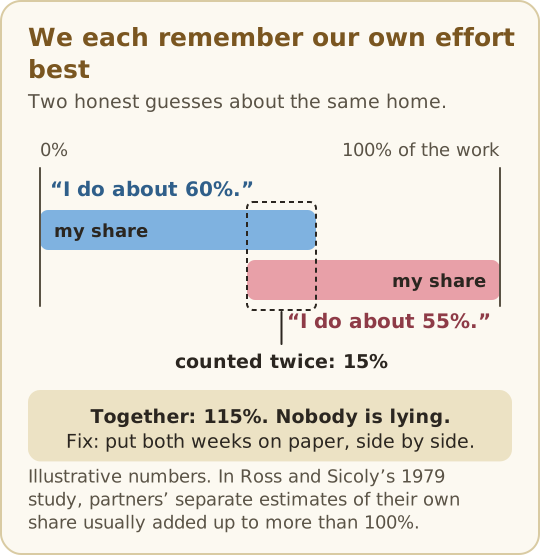
- We remember our own effort best. In a well-known 1979 study, married couples each estimated their own share of household jobs. For most couples, the two estimates added up to more than 100 percent. The likely reason isn’t dishonesty: we each remember our own effort more easily than someone else’s.
That last point is why this book never asks, “Who is right about how much they do?” Both people are usually describing their own week as they honestly remember it. The fix is to put both weeks on paper, side by side. Not seeing it is nobody’s fault. Once you’ve both seen it, what you do next is a choice you make together.
The reasoning. If you think the other person is choosing not to see, you’ll feel hurt and talk like a prosecutor. If you know the work is hidden by nature, you can talk like a guide: “Let me show you something.” The same facts, a very different talk.
Worked examples
- Partners on different hours: Zainab works from home and Craig works shifts. Because Zainab is “around,” deliveries, repairs and the dog all drift to her. Craig honestly thinks she has “a quiet day.” They swap places for one Saturday, and Craig sees how many small interruptions there are. See Different hours.
- A teen and their parents: Sixteen-year-old Jesse looks after a younger brother three afternoons a week. Their parents see a child who is “home anyway.” When Jesse writes down the snacks, homework help and settling arguments, the parents are surprised, and agree to pay Jesse a little and cover one afternoon. See For teens.
- Two partners after one has come home: After months working away, Jude comes home and doesn’t know where anything is now, or who does what. The partner who stayed has built a whole system in their head. Talking through the hidden system, slowly, helps Jude find a place in it. See Coming home.
Common mix-ups, and how to fix them
- “They should just notice.” Hidden work can’t be noticed from outside. Show it once, plainly, and see what happens next.
- “They know, they just don’t care.” Sometimes that’s true, but it is rarely the first explanation. Start with “Did you know?” before deciding.
- “I do more, so my memory must be right.” Everyone remembers their own effort best, including you. That is why both sides go on paper.
If only one of you is on board: Make your own work a little more visible without a big talk: a shared calendar, a list on the fridge, or a quick “I’ve booked the boiler service” message. Visible work is easier to thank and easier to share later.
Words you could use: “I don’t think you’ve been ignoring it. I think it’s been out of sight. Can I show you what it looks like from my side?”
A note on safety: If someone refuses to see your work and also mocks, threatens or punishes you when you raise it, the problem isn’t visibility. Signs to look out for.
Research notes
The 1979 study above is by Michael Ross and Fiore Sicoly, and it is one of the best-known findings about how we remember shared work. Psychologists also describe “habituation”: we stop noticing things that stay the same, which helps explain why reliable work fades from view. This site’s idea: linking that fading to complacency in close relationships.
Writing it down is not keeping score
This is not a book about keeping score to win an argument. A ledger that only one person gets to read isn’t really a ledger. It’s a grudge (an old hurt you keep holding on to) with neater handwriting.
The point of writing anything down is the opposite of scorekeeping. It makes the hidden column visible to both people, in the same terms, at the same time. Then the conversation can start from facts you share instead of two different memories.
Here is a simple test. Scorekeeping looks backward and asks who owes whom. A shared ledger looks forward and asks what to change next week. If a list is being used to prove a point, it has turned into scorekeeping. Put it down, and come back to it when you can both use it to plan.
The reasoning. Scorekeeping makes people defensive, and defensive people stop listening. A shared ledger works only when both people feel safe to look at it. So the rules are simple: both write, both read, the past gets thanks, and the future gets the changes.
Worked examples
- Two women married for twenty years, now with an empty nest: Without the kids, old patterns are suddenly loud. Instead of listing two decades of who did what, they each log one week of the new, quieter life and plan from there. See Empty nest.
- Two friends sharing a holiday: One booked the flights, the rooms and the car. Instead of a resentful tally at the airport, she says, “I did the bookings this time. Could you do the planning for the day trips?” See Friends.
- Dorm roommates: A cleaning rota starts to feel like a scoreboard. They swap it for a short room agreement they look at once a month, and only talk about what to change next. See Sharing a room.
Common mix-ups, and how to fix them
- “If I don’t keep score, I’ll be taken advantage of.” Keeping a record is fine. Using it as a weapon isn’t. Write it to plan, and share it on a calm day.
- “If they wrote less, they did less.” Some people write short lists. Ask about what’s missing before you decide.
- Bringing the list into a fight. Put it away. Name a calm time to look at it together.
If only one of you is on board: Keep your list for your own clarity. Share what you need in one forward-looking sentence, without the list.
Words you could use: “I’m not trying to settle the past. Can we look at next week together?”
A note on safety: If you are made to account for every minute or every penny, that is not a shared ledger. It’s monitoring. Not safe at home?
Research notes
Psychologists Margaret Clark and Judson Mills described two kinds of relationships: “exchange” ones, where people track what they give and get, and “communal” ones, where people give based on each other’s needs. Their research suggests that strict tit-for-tat tallies tend to feel cold in close relationships. Studies of couples have also often found that how fair the split feels matters a lot for satisfaction, sometimes more than the exact hours. This site’s idea: a ledger read together, looking forward, is a way to keep caring about needs without letting one person’s load stay hidden.
Who did what
- Person A
- Marcus
- Person B
- Theo
- Week beginning
- 5 October 2026
Part A: Who did what, this week
| Day | Task noticed or done | Who did it | Minutes (rough) | How it came up: asked for, noticed, or thinking time? |
|---|---|---|---|---|
| Mon | Plan the week’s meals | Theo | 20 | Thinking and planning |
| Mon | Cook dinner | Marcus | 45 | Asked for |
| Tue | Book the boiler service | Theo | 15 | Noticed and handled |
| Tue | Dishes | Marcus | 20 | Asked for |
| Wed | Laundry, wash to put away | Theo | 60 | Noticed and handled |
| Thu | Remember Marcus’s mum’s birthday card | Theo | 10 | Thinking and planning |
| Fri | Bins and recycling out | Marcus | 10 | Noticed and handled |
| Sat | Big food shop | Both | 70 | Asked for |
This week’s totals
- Marcus
- 110 minutes (44%), of which 10 noticed and handled without being asked
- Theo
- 140 minutes (56%), of which 105 noticed and handled without being asked (30 of them thinking and planning)
- Workload balance score
- 0.88. It describes how the logged work was split this week, not anyone in it.
- Unasked-for work
- Theo did 91% of the work that was noticed and handled without anyone asking. This is the work that is easiest to miss. Say it out loud, and give the jobs that repeat a named owner.
Part B (optional): Kind ways to say no
Left blank this week.
A made-up example. Names and details are invented.
Fill in your own: Who did what (spreadloveandacceptance.com/
Your side, their side
Every tool in this book follows one rule: each person fills in only their own side. You write what you did, how you felt and how full your stress tank is. You never fill those in for the other person, and they never fill them in for you.
This rule does two jobs. It keeps the facts honest, because you are the only expert on your own week. And it keeps the tools kind, because a list you write about someone else quickly starts to feel like a report on them. After you have each written your own side, you read them together.
Each of you also holds context the other can’t see: what your week was like, what you were carrying, what you assumed, what you meant. Giving yours, and asking for theirs, is how two people come to understand each other instead of trading two verdicts. It matters most when one of you has stopped noticing the other’s work, or the other has stopped saying so. Context is the way back in (see how to bring it up).
The reasoning. Everyone is the expert on their own week. As soon as one person writes about the other, the list becomes a report, and the other person has to defend themselves instead of adding what they know.
Worked examples
- Three partners: Arran, Dani and Sol each write their own side. Dani’s list is short, but her context line says “two night shifts and a migraine.” Nobody argues about the short list. See More than two partners at home.
- Two adult siblings who haven’t spoken much: After their father’s funeral, Patrick and Marta each write what they did over those weeks. Marta had handled the will and the house; Patrick had sat with their father every night in hospital. Neither knew what the other had carried. See Family rifts.
- An interfaith couple: Yusuf keeps track of Ramadan, Eid and his family’s visits. Eleanor keeps track of Christmas, Easter and her family’s. Writing their own sides shows both of them are doing a full set of “festival work.” See Two faiths, one family.
Common mix-ups, and how to fix them
- “I’ll just fill in theirs to save time.” Don’t. Even a kind guess turns the list into a report on them.
- “Context is making excuses.” Context isn’t an excuse. It’s what makes the numbers make sense. “I did less this week because my mum was in hospital” is information.
- “My list is right and theirs is wrong.” Two honest lists can disagree. Talk about the gap with curiosity: “What did that job look like from your side?”
If only one of you is on board: Write only your side, and add your context. If you share it, say what it is: “This is just my week, as I saw it.”
Words you could use: “Would you write your side, in your own words? I won’t fill in anything for you.”
A note on safety: Nobody should be made to write their side, or have their notes read without asking. Your notes are yours to keep private.
Research notes
Psychologists use the term “naive realism” (from Lee Ross and colleagues) for the everyday sense that we see things as they really are, and that people who disagree must be missing something. Two side-by-side lists are a simple way to check that feeling. This site’s idea: the “your side, their side” rule for every tool.
Why the book borrows these words
You’ll notice this book borrows words from accounting, engineering and the science of stress. That’s on purpose. These fields are good at one particular thing: describing how a system is working right now without blaming anyone for it.
A set of accounts that doesn’t balance isn’t evil. A body under stress isn’t broken. Both are just information: a place to start, not a judgment of either person’s worth.
Here are the main ideas, in plain words:
| The idea | What it means | Where |
|---|---|---|
| Unbilled debt | Work that got done but nobody saw or thanked | This preface |
| Why we get out of tune | A picture of two people who are slightly out of step, so fine words come out as a clash | Chapter I |
| Is the split working? | A simple check of whether the way you share the work can keep going. It uses only what you both wrote down, not what either of you remembers in the heat of the moment. It’s about the setup, never a person | Chapter II |
| Leftover stress (how full your tank is) | How full your stress tank already is from other things | Chapter III |
| Seven angles on the same moment | Seven different angles from which two people can see the same moment | Chapter III |
| Fair by promises | An agreement that each job is judged by whether its owner did it | Chapter IV |
| Letting a comment land before you react | Giving a comment a moment to land before you react to it | Chapter IV |
| The monthly look-back | A look back each month for jobs that keep slipping: a careful, friendly self-check, not an inspection | Chapter V |
When the words don’t help: if the borrowed words start to feel cold, drop them. Plain words work just as well. “Unbilled debt” can simply be “the stuff nobody sees.”
If you’re new together: words like “ledger,” “debt” and “audit” can sound heavy eight months in, as if you’re about to be inspected. You’re not. The ledger idea is simply this: both of you can see the same honest list, so nobody has to carry it all in their head or guess. Call it “our list.” Call the monthly look-back “our monthly chat,” and the setup check “how it’s going.” Start with one light week, and stop if it isn’t useful. Chapter V has a gentle plan for moving in together.
Words you could use: “Can we look at the setup, not at each other?” “I think this job has no owner.”
How the book fits together
What follows is set out as a working ledger, not a lecture. You read a chapter, try its tool, and build a small habit. The steps go like this:
- See the work. Each of you logs one ordinary week with Who did what, then you read the two logs side by side.
- Notice when you’re out of step. Chapter I explains why fine words can still clash, and how to retune.
- Check whether the split can last. Chapter II turns your notes into one simple number about the setup, never about a person.
- Know what you’re carrying. Chapter III helps you tell leftover stress from this-moment stress, and name the angle you’re seeing things from.
- Agree on what fair means. Chapter IV gives every job a clear owner, the person who does it start to finish, and gives every comment a moment to land.
- Look back once a month. Chapter V finds the jobs that keep slipping and fixes the setup.
Along the way, three rhythms keep things running: a 90-second daily check-in that asks how much you were carrying today, a short weekly catch-up where you tally the week in the “Who does what?” page (where each person lists their hours) and glance at your job list, and a monthly look-back.
The goal isn’t a perfect 50/50 split measured to the minute. It’s a home where both people can see the whole picture, and neither one is quietly carrying a debt the other doesn’t know about.
Going at your own pace. You don’t have to do every step. Some people stop after the first week, because seeing it was enough. Others pick it up again a year later, after a new baby, a move or an illness. Coming back is part of the plan.
If only one of you is on board: Start at step 1 with only your own week, then read Part One, which is written for one person.
Words you could use: “Could we try one week, just to see what we notice? We can stop after that if it’s not useful.”
Who this book is for
The examples often use two people sharing a home, because that’s where unseen work is easiest to picture. But the ideas fit any shared load: partners, grown-up siblings looking after a parent, roommates, co-parents in two homes, friends on a trip, and coworkers sharing a role. How it fits your relationships shows where to start in each one.
The tools are written for two people. If more people share the load, each person still writes their own side, and you read all the lists together. Chapter II shows how to compare three or more shares.
Many kinds of shared life
Unseen work looks a little different in each kind of relationship. A few starting points:
- Couples of every kind: same-sex, mixed-sex, married or not. Some research suggests same-sex couples often share housework more evenly, partly because they can’t fall back on old gender habits and have to talk it through. That talking is exactly what this book offers.
- More than two partners: each person writes their own side, and you read all the lists together. More than two partners at home.
- Friends: the plan-making and keeping in touch. Friends.
- Parents, children and teens: teens do more than adults often see. For teens · When a child has ADHD.
- Grandparents and grown-up children: childcare help, and the planning that comes with it. Grandparents · For grown-up children.
- Adult siblings and family rifts: caring for a parent, or sorting things out after a loss. Family rifts.
- Separated co-parents: two homes, one child, and a lot of handover work. Co-parenting.
- Foster, adoptive and kinship carers: Foster, adoptive and kinship families.
- Housemates and dorm roommates: Sharing a room.
- Coworkers and business partners: the meeting notes, the follow-ups, the invoices. At work.
- When one of you is ill or disabled: share by energy, not hours. When one of you is ill.
- Long distance and different hours: Long distance · Different hours · Coming home.
- Two faiths or cultures: Two faiths, one family · Coming out as an adult.
- People on their own: your unseen work is real too. On my own.
See every relationship in one place: Help by relationship. If you lead a group or work with families, For counsellors, coaches and group leaders shows how to use the book with others.
Your situation, in this part of the book
Some situations get a full section of their own in Part Two:
- Faith, culture, elders and in-laws: Chapter I
- Small children or a new baby: Chapter II
- Two homes after a split, and step-parents: Chapter III
- Money between you: Chapter IV
- A couple and a housemate: Chapter IV
- New together, or about to move in: Chapter V
- Grandparents raising a grandchild: Chapter V
Common mix-ups, and how to fix them
- “This is a couples’ book.” The examples often use couples, but every tool works for any shared load.
- “With three or more of us, it’s too complicated.” Keep the one rule: each person writes only their own side. Then look for jobs that nobody owns.
- “At work, this isn’t my place.” You can still make your own unseen work visible, and suggest one owner for each recurring task.
Research notes
Psychologist Lawrence Kurdek’s studies of gay and lesbian couples found they tended to divide household work more evenly than many mixed-sex couples, often by agreement rather than habit. Research on “diffusion of responsibility” (John Darley and Bibb Latané, 1968) found that people are less likely to step in when they think someone else might, which helps explain why shared jobs in groups slip. This site’s idea: applying both to homes of every shape, with one owner per job.
An example week
Here is how a first week might go for two people, Bram and Laila, who share a flat.
Each of them keeps a Who did what log for seven days. Bram’s list has 24 rows. Laila’s has 19. When they swap, each finds things they never knew about. Laila didn’t know Bram had been paying the electric bill each month. Bram didn’t know Laila had been setting up the landlord’s repair visits by email for months.
Nobody had been lazy, and nobody had been hiding anything. Each of them had simply been working out of the other’s sight. They end the evening with two thank-yous and one change: the electric bill goes on the shared calendar.
That’s a good first week. Nothing got settled or judged. Two people just saw more of the same picture.
Two more first weeks
A father and his grown-up son, living together: Since Aarav moved back home after university, he and his father, Sanjay, have bickered about “helping out.” Each logs a week. Sanjay is surprised by how much cooking Aarav does on his late-shift days. Aarav is surprised that his father spends an hour a week on the bills and the boiler. They agree that Aarav owns Tuesday and Thursday dinners, and Sanjay stops reminding him. See For grown-up children.
A couple where one partner is ill: Mia has long COVID. Ellis does most of the visible housework. When they log a week, Ellis sees that Mia does all the online shopping, appointment booking and family messages from bed. They stop counting hours and start counting energy: Mia keeps the jobs she can do lying down; Ellis keeps the lifting and carrying. See When one of you is ill.
In all three weeks, the first result is the same: surprise, then a thank-you, then one small change.
Your part, and only your part
You can’t make anyone see the unseen work, and you can’t write their side of the ledger. You can write your own side honestly, say it once, kindly, and then match what you take on to what comes back. If you keep carrying more than your share with nothing in return, stepping back towards your share isn’t a punishment. It protects the energy you need to stay kind.
The idea runs through the whole book: you can only do what’s in your control, and you protect your own energy by matching energy with energy, giving in proportion to what comes back, with room for seasons when someone can’t. Part One covers it in full: your circle of control, and matching energy.
On your own: your own unseen work
You don’t need anyone else to start seeing the unseen. For one week, notice the jobs only you remember: the appointments, the restocking, the smoothing-over. Write them down for yourself, not as a bill.
- Count it, don’t charge it. The point is to see your real load, so you can plan your energy.
- Notice which jobs are yours by choice and which just landed on you.
- Pick one job you could hand back, drop or do less often, and say so kindly.
In the individual program: Step 1: check your battery · Step 6: kind ways to say no · Part One: your circle of control The Individual package puts every workpaper for the path into one fillable PDF, with a report written just for you. · The whole book on sharing the load
Where the thirteen fields meet in this chapter
Christian, who wrote this book, worked as a government auditor and is a polymath: someone who studied thirteen fields deeply and looked for the places where they meet. The thirteen are psychology, philosophy, behavioural science, neurobiology, economics, business, finance, holistic therapies, aromatherapy, the art of debating, politics, music and the healing power of laughter. This chapter, on unbilled debt, draws on 7 of them. Here is what each one brings, and which of the five big ideas it serves. (Music and the healing power of laughter are part of the thirteen too, though they do not meet the preface’s idea directly.)
| Field | What it brings here | Big idea |
|---|---|---|
| Finance | The idea of an unbilled hour: work that was done and logged, but never invoiced, so the client never sees it. It gives the book its ledger. | See the whole load |
| Economics | Attention is limited: you can only keep track of so much at once. Every reminder you hold in your head takes up some of that room. | See the whole load |
| Psychology | We remember our own effort best. In a well-known 1979 study, married couples each estimated their own share of household jobs, and for most couples the two estimates added up to more than 100 percent. | See the whole load |
| Philosophy | Telling what we actually know from how things look. In Plato’s Cave, people mistake shadows for the real thing, which is why you compare two views instead of trusting one. | See the whole load |
| Business | Work that belongs to everyone belongs to no one, and it quietly lands on whoever notices first. | Notice the quiet incentives |
| Politics | How a group decides: who has a voice, and what counts. Putting both lists on one shared page is a small act of fair rules, so nobody has to argue about whose work “counts.” | Notice the quiet incentives |
| The art of debating | Separate the claim from the person, and hear the strongest version of the other side before you answer. It is why the lists are shared as information, not as a bill, and read with curiosity before anyone replies. | Tune how you send and receive |
How they connect
The fields don’t just sit side by side. They meet, and each meeting point is where a tool comes from. From the most obvious connection to the most abstract:
The word in brackets is the root the two fields share; the polymath page explains all seven.
- Obvious: Finance + Economics (limited capacity). An unbilled hour, from finance, meets limited attention, from economics, and together they make unbilled debt: real work that never reached the books. Seeing it is the first job of the whole program. This holds up “See the whole load”.
- Hidden: Business + Economics (quiet incentives). Nobody decides that one person will carry the noticing. The setup decides it, by rewarding whoever spots the job first. That quiet drift is why the book names the jobs before it splits them. This holds up “Notice the quiet incentives”.
- Abstract: Finance + Psychology (balance). In double-entry bookkeeping, every amount is recorded in two places, and the two must agree. The book borrows that habit: each person keeps their own record, and the two records are read side by side. Because we each remember our own effort best, one record alone can’t show the whole week. That’s why a ledger only one person can read is “a grudge with neater handwriting,” and why every tool has your side and their side. This holds up “See the whole load”.
Seven of the thirteen fields meet in the preface, and all of them point at the same quiet fact: the work was real, it just never made it onto the page.
Connect any two fields yourself · Ask Professor Puddles how all thirteen connect
The four newest fields are the art of debating, politics, music and the healing power of laughter. Read the polymath way · see all 78 pairs
When it goes wrong, and when it goes right
When it goes wrong, one person keeps a private list for months and brings it out in the middle of an argument. The other feels ambushed, argues with the list, and nothing changes except that both feel worse.
When it goes right, both people write their own lists in the same week, on purpose. They read them on a calm evening. Each says what surprised them. They thank each other for something specific. Then they decide one small thing to change and when they’ll look again.
Questions people often ask
What if the other person doesn’t want to do this?
You can still start with your own list. Share it as information, not as a bill: “I wrote down my week because I was curious. Would you look at it with me?” Invite them, and let the answer be theirs. If they say no, that’s an answer too. Don’t bring the list up in a disagreement; keep it for your own clarity.
Do we have to write everything down forever?
No. One week is enough to start. If you use the monthly look-back later, a few lines a week is all it needs. If writing things down isn’t your style, a ten-minute talk over a cup of coffee with the same questions works too.
What if our lists show a big gap?
That’s useful to know, and it doesn’t need fixing tonight. Chapter II and One owner per job are there to help you rebalance calmly.
Does this only count chores?
No. Planning, remembering, keeping in touch and calming things down all count. Put them on the list with a rough number of minutes.
What if there are more than two of us?
Each person writes only their own side, and you read all the lists together. Look especially for jobs nobody claims, because those drift to whoever notices first. More than two partners at home and Sharing a room have fill-ins for groups.
What if one of us can’t do much right now?
That’s a season, not a failing. Illness, a new baby, grief or a hard job can all shrink what someone can give. Share by energy, not hours, and agree when you’ll look again. When one of you is ill and Grief go further.
Can I use this with my teenager?
Yes, gently. Let them write their own side, including school and the work of looking after siblings or pets. Thank them for something specific before you ask for anything new. For teens is written for them.
Where can I ask my own question?
Professor Puddles, the site’s friendly chat host, can talk any part of the book through with you.
Limits and cautions
- This book offers ways to see and talk about shared work. It isn’t therapy, and it can’t tell you whether a relationship is right for you.
- These tools only work when each person feels free to say no, to ask for a pause, or to keep their own notes private. They are never a way for one person to build a case against the other.
- If talking about the split ever feels unsafe, or one of you feels you can’t say no, stop using the tools and talk with a trained counsellor on your own. When someone is afraid of their partner, counselling together isn’t advised. Not safe at home? lists free, private hotlines.
Last updated: October 2026