Part Two: Between us · Chapter II
Is the split working?
Any given week
One of you is quietly doing eleven small things a day that the other has never had to think about. When the other one says it feels even, they mean it. From inside each person’s own week, it does.
Before anything else: this chapter describes a rough self-reflection tool, not a scientific instrument. Its number, the setup score, is not a proven statistical model, and it never judges either person or the worth of the relationship. It scores one narrow thing: whether the way you currently share the household work looks like it can last, based on what you wrote down. Think of a small shop asking whether it can keep paying its bills, month after month, not whether it had a good Saturday. The answer is about the shop, not about whether the owners are good people.
In short:
- Look at the month, not last night. Use what you both wrote down, not memory.
- Three things go in: balance (how the hours split), ownership (does each job have a name?) and stress (how full each tank is).
- One number comes out, from 0 to 1. Start with whichever part pulled it down most.
- It judges the setup, never a person. It’s where a talk starts, not how one ends.
Where this fits: the five big ideas
The whole program rests on five big ideas. Each one starts inside you and then shows up between you and other people. This chapter mostly teaches “See the whole load” and “Fix the setup, not the person”, with help from “Read your state first”. (Borrowed from ledger accounting, systems thinking and nervous-system science.)
- In you: See your own share honestly, from what you wrote down rather than from memory. See the way you share work as a setup you can redesign, not a flaw in you.
- Between you and others: Put both people’s numbers on one page, and read the result as a note about the setup, never a verdict on a person. Clear owners leave less room for blame.
Where the idea comes from
- The check uses only what you both wrote down (your logs and your own self-ratings), not what either of you remembers in the heat of the moment. Whatever it shows is about the setup, never about either of you.
- The idea is borrowed from accounting, where people ask whether a business can keep going on what comes in. Here, a setup that can last is one where the work gets done without one person quietly running out of energy.
- The result is a simple weighted sum we call the setup score. It isn’t a probability, and it doesn’t predict anything.
What the check is for
Sooner or later, everyone who shares a home asks some version of “Is this actually working?” Usually the answer comes from whatever happened most recently: last night’s dishes, this morning’s tone. That answers the question at the wrong scale.
The check asks a narrower, calmer question: based on what’s actually written down this month, does the way we share the work look like it can last, or is it quietly running down its reserves? “Written down” means three things: the hours logged in the “Who does what?” page (where each person lists their hours) or in Who did what, the jobs with named owners in the One owner per job list, and each person’s own stress score from How much are you carrying?. You’ll meet the stress meter and the job list properly in Chapters III and IV; rough numbers are fine for now.
Why written down, not remembered. Memory is not a neutral record. You remember your own effort in detail, because you were there for all of it. You mostly hear about the other person’s effort second-hand, or not at all. So almost everyone sincerely feels they do a bit more than their share. Writing down one ordinary week is the simplest fix anyone has found.
Research note. In a well-known 1979 study, psychologists Michael Ross and Fiore Sicoly asked married partners, separately, how much of each everyday task they were responsible for. Added together, the two answers usually came to more than 100%. Nobody was lying. Each person simply remembered their own part more easily. Later studies found the same pattern in work teams and group projects.
The same question in different homes:
- Housemates in a shared flat: “Is this working?” usually arrives as a note on the fridge after a bad weekend. A month of logs turns the note into a conversation. See Sharing a room.
- A long-distance couple: They don’t share a kitchen, but they share the work of staying close: planning visits, booking travel, starting the calls. That work can be logged too. See Long distance.
- A grandfather raising his granddaughter: His “household” includes her school, her social worker and her other grandparents. The check helps him see whether his load can last, and what to ask the wider family for. See Foster and kinship families.
A common mix-up: “We only need this when things are bad.” The checks you take in calm months are the ones that make a bad month easier to read, because you have something to compare it with.
Words you could use: “I don’t think either of us is keeping count on purpose. Can we each write down one normal week, so we’re looking at the same picture?”
The three inputs
The setup score combines three readings, each one covered elsewhere in the book:
| Input | Where it comes from | What it shows |
|---|---|---|
| Workload balance | The “Who does what?” page, or Who did what | How evenly the logged hours are shared |
| Ownership clarity | An owner and a backstop for each job, One owner per job | How many regular jobs have an owner (a backstop is a good habit, but not part of the count) |
| Leftover stress (how full your tank is) | How much are you carrying?, explained in Chapter III | How full each person’s stress tank already is from other things |
Each input is a number from 0 to 1, worked out from the worksheets, not from what anyone recalls in the middle of an argument.
What counts as work: the parts nobody sees
A log only helps if it catches the whole job. Many jobs have a part you can see (doing it) and a part you can’t (noticing it needs doing, planning it, deciding how, and checking it got done). The hidden part is easy to miss from the outside, and it often settles on one person by habit.
- Thinking work: meal planning, the shopping list, school forms, remembering appointments, knowing when the car needs a service.
- Keeping-in-touch work: birthdays, cards, calls to older relatives, arranging get-togethers, smoothing things over in the wider family.
- Care work: medicines, appointments and comfort for a child, an older parent or a partner who is ill. See When one of you is ill and Caregivers.
- Money admin: paying bills, tracking spending, sorting tax and benefits. See Money together.
- Faith and culture work: getting ready for festivals, keeping traditions, teaching children two sets of customs. See Two faiths, one family.
- Carer paperwork: for foster and kinship carers, reviews, meetings and contact arrangements.
Log these in minutes. Five minutes of remembering, ten times a week, is close to an hour.
Research note. Sociologist Arlie Hochschild’s book The Second Shift (1989) described working parents, mostly mothers, coming home to a second job of housework and childcare. Sociologist Allison Daminger (2019) later described the “cognitive” part of household work: anticipating needs, identifying options, deciding and monitoring. In the couples she studied, that part was often less evenly shared than the physical tasks. Anthropologist Micaela di Leonardo (1987) used the term “kin work” for the work of keeping a wider family connected. Most of this research looked at mother-and-father households, but the same jobs exist in every kind of home.
A common mix-up: “Thinking isn’t really work.” If it takes time and attention, and the house would notice if it stopped, it counts.
Words you could use: “Can we add the remembering and planning to the list? I think a lot of my week is in that part, and I’d like us both to see it.”
Workload balance
Take the week’s logged hours and work out each person’s share as a percentage. Then:
workload_balance = 1 − (difference between the two percentages ÷ 100)A perfectly even week (50% and 50%) scores 1.00. A week where one person did everything (100% and 0%) scores 0.00. A 70/30 week scores 1 − 40 ÷ 100 = 0.60.
The score is the same whichever person is doing more. The arithmetic doesn’t care who is carrying the load, only whether it is shared. Rough hours are fine. Counting to the minute would only look more precise than it is.
Balance doesn’t look at the total. A 50/50 split of a very long week can still wear you both out, which is one reason stress is in the formula too.
If you agreed an uneven split. If you both agreed an uneven split that suits you (say, one of you works longer hours outside the home), compare against the agreed split instead of 50/50. The full calculator has a setting for this.
Three or more of you. Compare each person’s share with an even share (100 ÷ number of people), or with a split you agreed. The “Who does what?” page does the arithmetic for you.
The reasoning. An uneven load keeps building, whether anyone notices it or not. A person can carry more than their share for a season, for a new baby, an exam or an illness. A setup that needs one person to carry more for ever is, almost by definition, one that can’t last.
Three or more, worked through. Three partners in a triad log 15, 9 and 6 hours: 30 in all, so their shares are 50%, 30% and 20%. An even share is a third each. The full calculator works out how much of the week would have to change hands to make it even (about 0.17, a sixth of the week), and compares it with the most that could ever need to move (0.67, if one person did everything). Balance = 1 − 0.17 ÷ 0.67 = 0.75. With two people, this gives exactly the same answer as the simple formula above. See More than two partners at home.
In different homes:
- Shift workers: Kemi works nights and Stuart works days. Their home hours split 50/50, but Kemi does her half on four hours’ sleep. Balance looks perfect. The stress input tells the rest. They move the jobs that need a clear head to whoever is rested, not just to whoever has time. See Different hours.
- When one partner is ill: Two women, one with a long-term illness, agree an 80/20 split by energy for now. Against an even split, balance is 1 − 60 ÷ 100 = 0.40. Against their agreed split, it’s 1.00. The agreed number is the honest one, as long as the agreement is real and they look at it again every few months. See When one of you is ill.
- A parent and a teenager: 50/50 isn’t the goal here. They agree something like 85/15, which grows as the teen does. Logging still helps, because it shows the teen what the house takes. See Teens.
Mix-ups, and how to fix them:
- “We’re 50/50, so we’re fine.” Balance ignores the total. Two people evenly sharing a very heavy week can both be worn out. Fix: read balance next to stress, never alone.
- “The agreed split is whatever the main earner says.” An agreed split has to be agreed by everyone it affects. Fix: write it down with the date, and a date to look at it again.
- “Paid work cancels out home work.” The split counts home jobs. Paid work sits beside it. If one of you works longer hours outside, that’s exactly what an agreed split is for.
If only one of you is on board: You can’t work out balance alone, but you can log your own hours. Share your total as information, not as a charge: “I spent about 14 hours on the house this week. I didn’t know it was that many.”
A note on safety: An “agreed” uneven split is only agreed if each person could have said no. If one person sets the split, controls the money that could pay for help, or makes the other afraid to raise it, the number isn’t the problem, and no formula will fix it. Money together explains the difference between normal limits and control, and Not safe at home? lists free, private hotlines.
Research note. Large time-use surveys in many countries (such as the American Time Use Survey) have found for decades that, on average, women in mixed-sex couples do more unpaid housework and care than men, though the gap has narrowed. Psychologist Lawrence Kurdek’s studies of gay and lesbian couples found they were more likely to divide housework in a balanced way, often by negotiating rather than by default. Across many studies, whether the split feels fair to each person matters more for how happy they are than whether it is exactly equal. None of these averages describe your home. That’s why the check uses your own log.
Words you could use: “I want our split to be one we both chose, not one that just happened.”
Quick look: who does what at home
Mark who mostly does each job. The picture builds as you go, the thinking work too.
- Your name
- Wren
- Their name
- Josh
- Person 3
- Mei
| Job | Who mostly does it |
|---|---|
| Dishes | Shared |
| Laundry | Shared |
| Cleaning the bathroom | Josh |
| Cooking dinner | Mei |
| Grocery shopping | Wren |
| Paying bills | Wren |
| Noticing what’s running low | Wren |
| Planning the week | Mei |
| Remembering dates and appointments | Wren |
How it looks
Here’s how it looks from your side, 9 jobs so far.
Everyday jobs: mostly shared. 6 jobs: Wren 2 · Josh 1 · Mei 1 · Shared 2.
Planning and remembering: mostly Wren. 3 jobs: Wren 2 · Mei 1.
The thinking work is easy to miss, because nobody sees it happen. Saying it out loud is a good start.
Does this match how it feels to the three of you?
A made-up example. Names and details are invented. Pets and booking appointments were taken off the list: they don’t happen in this house.
Fill in your own: Who does what? Quick look (spreadloveandacceptance.com/
Ownership clarity
In One owner per job, every regular job gets two names. The owner is the person who does the job, start to finish. The second name is a backstop who notices if it slipped and gently checks in, never a supervisor. They can be the same person, though a second name gives the job a gentle check: if one person is both names, nobody else will notice a slip. (The idea is borrowed from project work. The doer-and-backstop pairing also borrows the “maker and checker” habit from internal controls, where one person does a task and another looks it over.)
ownership_clarity = jobs with an owner ÷ all jobs on the listSo if you list 10 jobs and 8 have an owner, the score is 0.80. The count needs only the owner’s name, the same way the job list and the calculator count it. A backstop is a good habit on top, and the job list has a column for one.
One exception: decisions. On the job list you can mark a row “Both (decide together).” Use it for decisions that need both voices, like a school choice or a big purchase, and it counts as owned. Don’t use it for jobs that need doing, like packing the bag or homework help. A job marked “Both” tends to belong to nobody, which is the problem the list is there to solve. Even for a shared decision, it helps if one name owns putting it on the agenda.
One warning: don’t improve this score by shortening the list. Deleting the jobs nobody owns raises the number and changes nothing at home. If a job is real and unowned, it belongs on the list as an unowned row. That’s exactly the row the score is there to show.
The reasoning. Work that anyone could do tends to be done by no one. When a job belongs to everyone, each person feels a little less responsible for it, and assumes someone else has it. Naming one owner is the cheapest fix there is. The backstop solves a second problem: when the owner is ill, away or overloaded, somebody already knows the job exists.
Research note. In the “bystander” studies by John Darley and Bibb Latané (1968), people were slower to help when they believed others were also there to help: responsibility spread thin across the group. Project managers use responsibility charts (one well-known kind is called RACI) that name exactly one person accountable for each task. The owner-and-backstop pair is a home-sized version of that habit. This site’s idea: the backstop’s job is to notice and ask kindly, never to inspect.
In different homes:
- Dorm roommates: Four students, one bathroom, nobody’s job. They write a room agreement with one owner each week, rotating, and a backstop who is next on the list. See Sharing a room.
- Adult siblings and a parent: After their mother’s stroke, the sister who lived nearby became the owner of everything by default. Listing the jobs let her brother, three hundred miles away, own the bills and the insurance calls. If siblings are barely speaking, the list can be shared in writing, or through a cousin both trust. See Adult siblings and family rifts.
- Foster carers: Two carers split the agency paperwork, school meetings and the drive to contact visits. Each job gets an owner, and the backstop covers when the owner is at work. See Foster and kinship families.
- Business partners: Two partners in a small firm both “keep an eye on” the shared inbox, so customers wait for days. One owner per weekday ends it. See At work.
Mix-ups, and how to fix them:
- “The owner just does the visible part.” Then the remembering stays with the old owner. Fix: the owner owns the whole job, including noticing, planning and remembering.
- “The backstop checks the owner’s work.” Fix: the backstop doesn’t inspect, redo or grade. They notice a slip and ask once, kindly.
- “I’ll just own everything, to be safe.” Ownership goes up and balance goes down. The score catches this, because balance carries more weight.
- “We handed it over, so it’s done.” A job handed over without the know-how comes back. Fix: write a two-line note: when it’s due, and where things are.
If only one of you is on board: List the jobs you own now, including the thinking part. Then offer to hand over one whole job, with its note. A specific offer is easier to say yes to than “you need to do more.”
A note on safety: A backstop who checks constantly, criticises, or punishes a slip is not a backstop. If “checking” feels like being watched or tested, or you feel afraid of getting a job wrong, that’s not a setup problem. Not safe at home? lists free, private hotlines.
Words you could use: “I’ll own the bins from now on, including remembering bin night. Can you be the backstop, and just text me if you see they’re still out?”
Our room agreement
- Your name
- Kayla
- Their name
- Bea
- Quiet hours
- 11 pm to 7 am on weeknights, midnight on Fridays and Saturdays. Headphones after that.
- Guests (daytime)
- Fine with a quick text first. Not during the other one’s study or sleep time.
- Overnight guests
- Up to 2 nights a week, agreed the day before. A guest doesn’t stay in the room when their host isn’t there.
- Cleaning
- Kayla: floor and bins, Sunday. Bea: desk area and the fridge, Wednesday. Our own laundry, our own job.
- Borrowing
- Ask first, every time. Food on the shared shelf is for both of us.
- Lights and alarms
- Big light off by 11:30 on weeknights; a desk lamp is fine. One alarm, one snooze at most.
- How we bring up problems
- Text first if that’s easier, then talk within a few days, one topic at a time. If we’re stuck, we ask our RA to help.
Your agreement, ready to send
Our room agreement (Kayla and Bea), with every line above, ending: “We’ll look at it again together in a month.”
A made-up example. Names and details are invented. They kept most of the site’s starting point and changed two lines.
Fill in your own: Our room agreement (spreadloveandacceptance.com/
Leftover stress (how full your tank is)
Each of you fills in your own How much are you carrying?, about yourself only. It measures how full your stress tank is: a higher score means more stress in the tank. You score five things from 0 to 4: sleep, workload elsewhere, any unresolved conflict, how your body feels, and time pressure today. Add them up and divide by 20. Under 0.30 is low, 0.30 up to 0.60 is moderate, and 0.60 or more is high. Then take the average of your two scores.
Look at each person’s own score too. The setup score uses the average, so it can read “working well” while one of you is struggling. That’s why there is a second rule: if either person is at 0.60 or more, talk about that first, whatever the score says. The score is about the setup; the high tank is about a person’s week, and it comes first in the conversation.
This is the only input that counts against the result. The formula uses 1 − stress, so more stress means a lower score. That’s on purpose: a way of sharing work that only holds up when both people are well rested isn’t one that can last.
Never estimate the other person’s score for them. If one column is missing, the full calculator won’t work it out, and that’s the right answer.
Why only you can score you. Stress is felt from the inside. A guess about someone else’s tank, however kind, quietly overrules their own account of their life. And the scores only mean something if both were made the same way, by the person who lives with them.
In different homes:
- A carer and a partner who is ill: The carer scores 0.75 for three months running. The split may be as fair as it can be, and still not last. The fix is outside help, not a better split. See Caregivers.
- A parent and a teenager in exam season: The teen scores 0.65. They agree to lighten the teen’s jobs for three weeks, with an end date. That is an agreed uneven split, chosen on purpose.
- New parents: Both score over 0.60. That is the headline. Big changes to the setup can wait, and small ones (one owner for night feeds on weekends) can’t. See New parents.
Mix-ups, and how to fix them:
- “Your score is low, so you’ve got no excuse.” A score describes a tank. It never sets what someone owes. Fix: read it as information, not as a ruling.
- “I’m more stressed than you.” It isn’t a contest. Both scores are true. Fix: plan around the higher one.
- “My body score is always high.” With a long-term illness or disability, the body item may be high every day. Fix: score honestly, and compare with your own usual, not with anyone else’s.
If only one of you is on board: Score your own tank and share the band, not the details: “I’m in the high band this week.” That alone can change how a conversation goes.
A note on safety: If you feel pressured to report a lower score than you feel, or your score is used against you, stop using the tool. And if the stress in your tank is fear of someone at home, that isn’t leftover stress. Not safe at home? lists free, private hotlines.
Research note. Researchers study stress with tested questionnaires, such as Sheldon Cohen’s Perceived Stress Scale (1983). How much are you carrying? is not one of them. This site’s idea: it is a short reflection prompt made for this book, and it can’t tell you anything about your health. The everyday idea that stress adds up over time does have research behind it: the neuroscientist Bruce McEwen called that build-up “allostatic load.” The worksheet borrows only the everyday idea.
Words you could use: “My tank is about 0.6 this week. It’s not about you. It’s work and sleep. Can we keep tonight light?”
The formula, in plain language
Rather than a mystery score, the setup score is a simple weighted sum:
setup_score = (workload_balance_score * 0.4)
            + (ownership_clarity_score * 0.35)
            + (1 - average_leftover_stress) * 0.25
The weights add up to 1, so the result is always between 0 and 1. Read it as a snapshot, not a sentence. The calculator Is the setup working for everyone? does the arithmetic for you:
- 0.70 or above (“working well”): The current setup is holding. Keep the same rhythm of check-ins (short, regular talks about how things are going).
- 0.40 up to 0.70 (“needs a look”): Something in the three inputs is drifting, often ownership first. Start with the biggest shortfall (see below).
- Below 0.40 (“needs a rethink, together”): The work, as it is currently shared, doesn’t look like it can last. That’s a statement about the setup, not about either person’s love, effort or worth. Setups get renegotiated all the time.
Why these weights?
The weights are a judgment, not a result from research. They say that uneven hours matter a little more than unclear ownership, and that both matter more than everyday stress. Unclear ownership comes a close second because it’s what turns a fixable imbalance into a repeating one: work with no owner falls to whoever notices first, every time. If you change the weights in the full calculator, write the change down, because your old results won’t compare with your new ones.
This site’s idea. The formula, the weights and the three bands were made for this book. They have not been tested in research studies, and they shouldn’t be quoted as findings. They are a clear, open way for two or more people to look at the same thing, and you are free to disagree with them.
Mix-ups, and how to fix them:
- “0.40 means a 40% chance we’ll make it.” No. It isn’t a probability, and it doesn’t predict anything about the relationship.
- “Let’s change the weights until the number looks better.” Fix: choose weights before you see the result, and keep them for at least a few months.
- “The calculator decides what we do.” It points at a shortfall. You decide what to do about it, together.
Is the setup working for everyone?
- Person 1 (optional)
- Rosemary
- Person 2 (optional)
- Ken
1. How the hours split
From Who did what or the “Who does what?” page: each person’s total hours for the week.
- Rosemary, hours
- 14
- Ken, hours
- 10
2. Does each job have a name?
From One owner per job.
- Jobs on the list
- 12
- Jobs with an owner
- 9
3. How much each person is carrying
Each person’s own score from How much are you carrying? Everyone fills in their own.
- Rosemary, load (0 to 1)
- 0.45
- Ken, load (0 to 1)
- 0.30
How the setup is working
- Working well
- 0.75 of 1. The setup is carrying its own weight.
Next: nothing in the setup needs changing this week. Keep the same rhythm of check-ins.
If you want to nudge it higher one day (optional, not urgent): hand about 2 hours a week from Rosemary to Ken, and balance would go from 0.83 to 1.00. Give one more job an owner (the person who does it and sees it through), and ownership would go from 0.75 to 0.83.
A made-up example. Names and details are invented. It scores the setup, never a person, and never the relationship as a whole.
Fill in your own: Is the setup working for everyone? (spreadloveandacceptance.com/
A worked example
Sam and Alex each log one ordinary week.
- Balance: Sam logged 14 hours and Alex logged 6. That’s 70% and 30%, so balance = 1 − 40 ÷ 100 = 0.60.
- Ownership: They list 10 regular jobs. 8 have an owner. Ownership = 8 ÷ 10 = 0.80.
- Stress: Sam’s stress check adds up to 11, so 11 ÷ 20 = 0.55 (moderate). Alex’s adds up to 5, so 5 ÷ 20 = 0.25 (low). The average is 0.40. Neither score is 0.60 or more, so the average tells the story.
(0.60 × 0.4) + (0.80 × 0.35) + ((1 − 0.40) × 0.25)
=    0.24    +     0.28      +        0.15
=    0.67
0.67 is in the middle band: something is drifting. Now watch what small changes do:
- If Alex takes over 3 of Sam’s hours a week, the split becomes 11 and 9 hours (55% and 45%). Balance rises to 0.90, and the result becomes 0.36 + 0.28 + 0.15 = 0.79.
- If they also give owners to the 2 unowned jobs, ownership rises to 1.00, and the result becomes 0.36 + 0.35 + 0.15 = 0.86.
For contrast, a household where the split is 90/10 (balance 0.20), only 4 of 10 jobs are owned (0.40), and average stress is 0.70 scores 0.08 + 0.14 + 0.075 = about 0.30. That’s the “kind rethink” band. It doesn’t mean anyone failed. It means the setup is asking too much of someone, and it’s time to redesign it together.
Two more worked examples, from different homes
A triad. Three partners log 15, 9 and 6 hours, so balance is 0.75 (worked through in the balance section above). They list 12 regular jobs, and 7 have an owner: ownership = 7 ÷ 12 = 0.58. Their three stress scores are 0.55, 0.40 and 0.25, so the average is 0.40, and nobody is at 0.60 or more.
(0.75 × 0.4) + (0.58 × 0.35) + ((1 − 0.40) × 0.25)
=    0.30    +     0.20      +        0.15
=    0.65
That’s the middle band. The shortfalls are 0.10 for balance, 0.15 for ownership and 0.10 for stress, so ownership comes first. In a home of three, “someone will do it” is especially easy to believe. If they give owners to the five unowned jobs, ownership becomes 1.00 and the result becomes 0.30 + 0.35 + 0.15 = 0.80.
Separated co-parents. Shreya has the children four nights a week and Marek has them three, and they agreed a 60/40 split of the parenting jobs. They log 12 and 8 hours: exactly 60/40, so balance against the agreed split is 1.00. 9 of 12 jobs have an owner: 0.75. Shreya’s tank is 0.65 and Marek’s is 0.30, so the average is about 0.48.
(1.00 × 0.4) + (0.75 × 0.35) + ((1 − 0.475) × 0.25)
=    0.40    +     0.26      +        0.13
=    0.79
0.79 reads “working well.” But Shreya is at 0.65, in the high band, and that is the headline. The number is right about the setup and silent about her week. So they move one whole job to Marek for a month (school shoes and the dentist, including remembering them), whatever the score says. See Co-parenting.
Reading your result: start with the shortfall
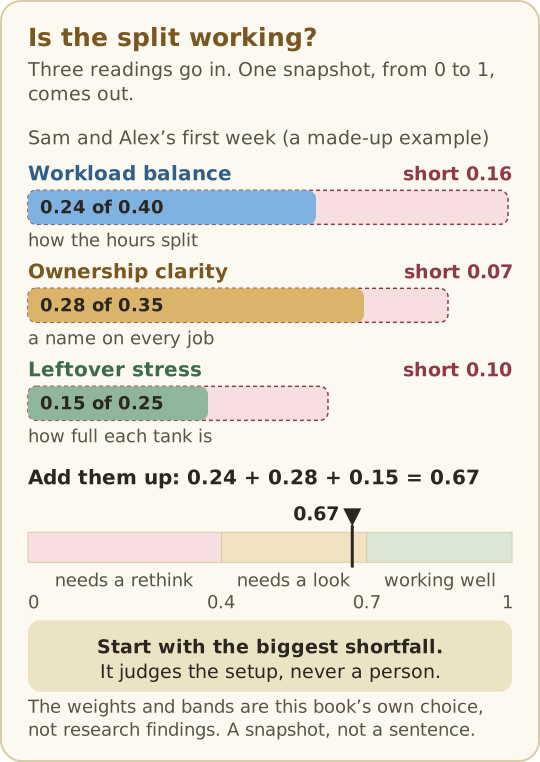
Each part can earn up to its weight: 0.40 for balance, 0.35 for ownership, and 0.25 for stress. The gap between what a part earned and what it could have earned is the shortfall. The shortfall, not the total, is the part you can act on.
In Sam and Alex’s first week:
| Part | Could earn | Earned | Shortfall |
|---|---|---|---|
| Balance | 0.40 | 0.24 | 0.16 |
| Ownership | 0.35 | 0.28 | 0.07 |
| Stress | 0.25 | 0.15 | 0.10 |
Start with the biggest shortfall. In the middle band that is often ownership, which is why the calculator suggests One owner per job first. For Sam and Alex it is balance, and the two are often linked: giving a job a clear owner is often how some of the hours move. Once you’ve both seen it, what you do next is a choice you make together.
What to try, by shortfall:
- Balance is biggest: move one whole job, with its thinking part, from the fuller person to the other. Moving “help” rarely moves hours. Moving a job does.
- Ownership is biggest: sit down with the job list and give every unowned row an owner and a backstop, even for a trial month.
- Stress is biggest: the setup may be fine and life is heavy. Lower the load for a while: drop, delay, buy help if you can, or ask the wider family. Pick the timing of hard talks with care (Chapter III).
In different homes: housemates often find ownership is the gap (nobody owns the shared spaces). Couples after a new baby often find balance is the gap. Carers often find stress is the gap, even when the split is as fair as it can be. Adult children who have moved back home often find the gap is in the thinking work: the parent still remembers everything. See For grown-up children.
A common mix-up: fixing all three at once. Fix: one change, one month, then look again. You’ll learn what actually moved the number.
If only one of you is on board: pick the shortfall that sits in your own circle of control. If your own tank is the gap, the change can be yours alone.
Words you could use: “The biggest gap is ownership. Can we try owners for every job, just for this month, and see how it feels?”
The wider view: the overall score
The full calculator also shows a second number, the overall score. It adds a fourth input, retuning frequency: of the moments this week that landed badly, how many did you retune before answering (see Chapter I)? Its weights are 0.35 for balance, 0.30 for ownership, 0.20 for stress and 0.15 for retuning. Stress enters as (1 − stress) here too, and the same bands apply. If Sam and Alex retuned 3 of 5 rough moments (0.60), their overall score is 0.21 + 0.24 + 0.12 + 0.09 = 0.66. If nothing landed badly this week, leave retuning blank; the calculator works the overall score out from the other three. And five moments is a small number, so watch the trend, not one week.
The two numbers answer different questions. The setup score asks, “Can this workload last as it’s set up?” The overall score asks, “Is the whole system working, including how we repair after friction?” They can disagree, and that difference is useful. A home can share the work well and still be struggling to repair after clashes.
One reading is a snapshot. A month of readings is a trend.
A split that was fair once can go stale. Hours, jobs and energy change with a new baby, a new job, an illness or a move, and a setup nobody has re-checked keeps running on the old numbers. Take a fresh reading when life changes, and every few months even if nothing seems wrong. “It has always worked” is an assumption, not a result (see Complacency). When you read the number together, let each person say what sits behind their own figures. The same hours can mean a calm week for one person and a very heavy one for the other.
A single reading tells you about one week. The trend over several weeks tells you whether anything is really changing. The progress report helps you keep the numbers week by week. The monthly look-back in Chapter V feeds back into this chapter. Fixing a gap it finds keeps the ownership score true, or raises it, because the list now names who really does each job. If the gap was a blank row, filling it in raises the score. If the names were filled in but wrong, the score won’t move; only the look-back catches that kind of gap.
Life changes that are worth a fresh reading:
- A new baby, a new child joining the family through fostering or adoption, or a grandchild coming to live with you. See New parents and Foster and kinship families.
- Someone coming home after time away, such as deployment, work away or a long hospital stay. The setup changed while they were gone. See Coming home.
- The children growing up and leaving. Jobs disappear, but the old split often stays. See Empty nest.
- Retirement, a new job, new shifts, or one of you becoming ill. See Retired together, Different hours and When one of you is ill.
- A new person moving in: a partner, a housemate, a parent. See More than two.
Research note. Many studies of the “transition to parenthood” have found that after a first baby, couples’ split of housework often becomes more traditional than either partner expected, and that satisfaction with the relationship, on average, dips for a while. Averages hide a lot of variety, but the pattern is a good reason to take a fresh reading after any big change, rather than wait for it to feel wrong.
Words you could use: “Our split was set up for a life we don’t have any more. Can we look at it as if we were starting fresh?”
Small children and a new baby
Small children multiply the work, and most of what they add is thinking work. Somebody has to know the nursery’s spare-clothes rule, when the next jabs are due, which party is on Saturday and who’s buying the present, that the toddler has grown out of his shoes again, and where the Calpol is at 3am. On a list these look small. In a head, they never switch off.
That is part of why the gap described in the Preface so often opens after a first baby. One parent is home more in the early months, becomes the one who knows, and stays the one who knows long after both are back at work. Nobody decides it. It’s a quiet incentive: whoever notices first ends up owning it.
Logging a week with small children
- Put the kid jobs on the list: the nursery or school bag, forms and photo money, the GP and jabs, party replies and presents, outgrown clothes, bath and bedtime, night wakings, the childcare rota.
- Log the thinking time. In Who did what, use “Thinking and planning” for minutes spent fitting the week around shifts, comparing nurseries or keeping the family calendar.
- Nights count. Log night wakings in minutes, and note who was on shift.
- Look at two numbers, not one. The minutes can be even while the noticing isn’t. Who did the work nobody asked for?
- Keep it light. With a baby, rough minutes in a notes app or on the fridge are plenty. Three or four days can be enough to see the pattern.
Before the baby comes, and the first months
- Before the birth, write the new job list together: feeds, nappies, washing, nights, visitors, registering the birth, the health visitor, the baby’s appointments. Give each job an owner before anyone is too tired to decide.
- Plan the nights. Whatever feeding looks like, agree who covers which part of the night, and protect one stretch of sleep for each of you where you can. The parent who isn’t feeding can own the nappy, the settling or the early morning.
- Don’t let the parent on leave become the only one who knows. From early on, give the other parent whole jobs they own end to end, like bath time, the baby’s washing or the health visitor appointments, and let them do it their way. That’s the gate-opening from the Preface.
- In the first weeks, share by energy, not hours. Hours stop meaning much when nobody sleeps. Ask, “Who has the most left in the tank today?”
- Look again at set points: at six weeks, at three months, and before either of you goes back to work. A split that worked at two weeks rarely works at six months.
- Let people help, with an owner. When grandparents and friends offer help, one of you owns saying yes and giving them a clear job.
Feeling further apart after a baby is common. Long-term studies have found that couples’ satisfaction, on average, dips after a first baby (Doss and colleagues, 2009). It doesn’t mean you chose wrong. It means you’re tired and the setup needs redesigning, which is what this chapter is for. If either of you feels low most days for more than a couple of weeks after the birth, or can’t enjoy anything, tell your GP, midwife or health visitor. Low mood after a baby is common in mothers and in fathers, and help works.
When one of you works shifts
Shift work makes the doing uneven from week to week, and the thinking work drifts to whoever keeps regular hours. Two habits help. Leave a short note at the shift change: what happened, what’s coming up, what’s running low. And choose owners who can do their jobs across shifts, like online orders, the nursery bag packed the night before, or GP calls on days off. Compare a whole month, not one week, because shift patterns rarely repeat neatly. See Different hours.
Common mix-ups, and how to fix them
- “I do the night feeds, so I don’t need to do the remembering.” Nights are real work, and they count. The remembering still needs owners, or it lands on one head by default.
- “Just tell me what needs doing.” It’s kindly meant, and it keeps one person as the manager. Take a whole job instead.
- “We’ll sort it out when things calm down.” With small children, things don’t calm down for years. A rough list now beats a perfect one later.
If only one of you is on board: Log your own few days, including the night-time and thinking minutes, and hand over just one whole job, kindly.
Words you could use: “Can we each write down a few days, including the night stuff and the remembering? I think the doing is pretty even. I’m not sure the noticing is.” “Could you own the nursery bag from now on, including noticing when we’re low on nappies? I won’t check it.”
Research notes
Yavorsky, Kamp Dush and Schoppe-Sullivan (2015) found, using time diaries, that mothers took on most of the added childcare after a first baby. Doss and colleagues (2009) found sudden average declines in relationship quality after a first birth, and Cowan and Cowan (1992) describe how strain commonly rises as partners become parents. In a randomised trial, Mark Feinberg and Marni Kan (2008) found that Family Foundations, classes for couples expecting a first baby that focus on teamwork as parents, improved co-parenting and some parts of parent and baby wellbeing. This site’s idea: the set points for looking again, and logging the noticing apart from the doing.
A worked example: Hollie and Gareth
Made up. Hollie works four days a week as a pharmacist. Gareth is a paramedic on twelve-hour shifts, and this week he did three nights. Alfie is 3 and goes to nursery; Poppy is 8 months. Each of them logs their own side for a week. Here is what came out:
- The minutes are close: Hollie 290, Gareth 240. The balance score is 0.91.
- The noticing isn’t. Hollie did 72% of the work that was noticed and handled without anyone asking, including all of the thinking and planning.
- Gareth is surprised, and a little hurt: he cooks, does bath and bedtime, and fixed the stair gate. All true, and all on the list. They agree the doing is well shared.
So they don’t move minutes. They move one whole job: Gareth now owns the children’s clothes and sizes, noticing included, with Hollie as backstop only if something will actually go wrong. They’ll look again in a month. Their log is below.
Who did what
- Person A
- Hollie
- Person B
- Gareth
- Week beginning
- 12 October 2026
Part A: Who did what, this week
| Day | Task noticed or done | Who did it | Minutes (rough) | How it came up: asked for, noticed, or thinking time? |
|---|---|---|---|---|
| Mon | Pack the nursery bag: spare clothes, nappies, named milk | Hollie | 10 | Noticed and handled |
| Tue | Book Poppy’s one-year jabs at the GP | Hollie | 15 | Noticed and handled |
| Tue | Bath and bedtime, both children | Gareth | 45 | Asked for |
| Wed | Reply to a party invite and buy the present | Hollie | 25 | Noticed and handled |
| Wed | Sort outgrown clothes and order the next size | Hollie | 40 | Noticed and handled |
| Thu | Plan the week’s meals around Gareth’s nights | Hollie | 20 | Thinking and planning |
| Thu | Cook dinner and batch-cook for the weekend | Gareth | 75 | Noticed and handled |
| Fri | Remember the nursery photo money and form | Hollie | 10 | Thinking and planning |
| Fri | Night wakings with Poppy | Hollie | 60 | Noticed and handled |
| Sat | Swimming lesson with Alfie | Gareth | 60 | Asked for |
| Sat | Big food shop and nappies | Both | 80 | Asked for |
| Sun | Washing for both children, to put away | Hollie | 50 | Noticed and handled |
| Sun | Fix the stair gate | Gareth | 20 | Noticed and handled |
| Sun | Update the family calendar and the childcare rota | Hollie | 20 | Thinking and planning |
This week’s totals
- Hollie
- 290 minutes (55%), of which 250 noticed and handled without being asked (50 of them thinking and planning)
- Gareth
- 240 minutes (45%), of which 95 noticed and handled without being asked
- Workload balance score
- 0.91. It describes how the logged work was split this week, not anyone in it.
- Unasked-for work
- Hollie did 72% of the work that was noticed and handled without anyone asking. This is the work that is easiest to miss. Say it out loud, and give the jobs that repeat a named owner.
Part B (optional): Kind ways to say no
Left blank this week.
A made-up example. Names and details are invented. Gareth worked three night shifts this week, so his rows are fewer; the minutes are close, and the noticing is the part to talk about.
Fill in your own: Who did what (spreadloveandacceptance.com/
Your part, and only your part
The score describes the setup you share, but your levers are your own: your jobs, your hours and what you agree to take on. You can propose a fix; you can’t make the other person accept it. If the balance stays one-sided, step your load back towards your share on purpose, and say so kindly. Matching effort with effort protects your stress tank, and your tank is part of the score too.
The idea runs through the whole book: you can only do what’s in your control, and you protect your own energy by matching energy with energy, giving in proportion to what comes back, with room for seasons when someone can’t. Part One covers it in full: your circle of control, and matching energy.
When only one of you is on board
Often one person is keen and the other is wary. That’s understandable: numbers can feel like a trap. You don’t need the other person’s agreement to start on your own side.
- Log only your own week. Never log theirs.
- Share one finding, as information, not as a charge: “I didn’t realise I spend four hours a week on lifts.”
- Make one specific offer: hand over one whole job, or ask for one. Specific requests are easier to say yes to.
- Adjust your side if nothing changes. Step back towards your share on purpose, and say so kindly.
This works for friends too, where one person always does the planning. See Friends. And it works across generations, where a grown-up child does all the arranging for a parent. See Grandparents.
Words you could use: “You don’t have to fill anything in. I just wanted to tell you what I noticed about my own week.”
If raising the split leads to threats, punishment, or a fear of what will happen, stop. That’s a safety question, not a setup question. Not safe at home? can help.
On your own: is your own load working?
This chapter asks whether a shared setup can last. You can ask the same about your own week: are you spending more energy than comes back in?
- Add up what you carry: jobs, people and worries.
- Set it beside what refills you: rest, help, and people who give back.
- If it runs in the red, change your side: drop, delay, ask or say no kindly. A limit is a statement about supply, not about your worth.
For example: After a divorce, Neil lives alone and has his kids on alternate weeks. On kid weeks he is the owner of everything. On the other weeks he says yes to every favour at work. Adding it up showed him he never had a week that refilled him. He kept one evening a week free on purpose. See On my own.
Words you could use: “I can’t take that on this week. Ask me again next month.”
In the individual program: Step 1: check your battery · Step 6: kind ways to say no · Part One: matching energy The Individual package puts every workpaper for the path into one fillable PDF, with a report written just for you. · The whole book on sharing the load
Where the thirteen fields meet in this chapter
This chapter draws on 6 of the author’s thirteen fields (see the Preface or the About page). Here is what each one brings, and which of the five big ideas it serves.
| Field | What it brings here | Big idea |
|---|---|---|
| Finance | Whether a setup can keep going on what comes in, month after month. The chapter reads the setup that way, never as a verdict on the people. | See the whole load |
| Business | Ownership clarity: one owner per job, borrowed from project work, and the maker-and-checker habit from internal controls. Every regular job gets a person who does it and a backstop who notices if it slipped. | Fix the setup, not the person |
| Neurobiology | Leftover stress: a quick self-rating of the stress you’re already carrying. It borrows the idea that stress builds up in the body, but it doesn’t measure your body. | Read your state first |
| Economics | Limited capacity and the safety margin. The weights are an open judgment about what matters most, not a hidden law. | See the whole load |
| Philosophy | How we know what we know. The check uses only what you both wrote down (your logs and your own self-ratings), not what either of you remembers in the heat of the moment. | Fix the setup, not the person |
| Behavioural science | One reading is a snapshot; a month of readings is a trend. And a score you can raise by shortening the list measures the wrong thing. | Notice the quiet incentives |
How they connect
The word in brackets is the root the two fields share; the polymath page explains all seven. From the most obvious connection to the most abstract:
- Obvious: Business + Economics (ownership and structure). Unowned work falls to whoever notices first, every time. That’s what turns a fixable imbalance into a repeating one, and it’s why ownership carries almost as much weight as the hours. This holds up “Fix the setup, not the person”.
- Hidden: Behavioural science + Business (quiet incentives). If you can raise the ownership score by deleting the jobs nobody owns, the score is rewarding the wrong thing. (This is sometimes called Goodhart’s law: once a number becomes the goal, it stops measuring well.) Keeping the unowned rows on the list keeps the number honest. This holds up “Notice the quiet incentives”.
- Abstract: Philosophy + Finance (balance). The setup score says whether an arrangement can last. It can never say whether the people in it are worthwhile. Aristotle’s kinds of friendship and Buber’s I and Thou sit behind that line: the number describes the setup, never the person. This holds up “Fix the setup, not the person”.
Connect any two fields yourself · Ask Professor Puddles how all thirteen connect
When it goes wrong, and when it goes right
When it goes wrong, one person guesses both sets of numbers, gets a low score, and says, “See? The number proves it.” The other person argues with the number instead of talking about the week. Now the tool has become a weapon.
When it goes right, each person brings their own log and their own stress score. They work out the number together, look at the biggest shortfall, and choose one small change. A month later, they check again and see whether it moved.
Going right, in a different home: Two grown-up brothers share their father’s care after years of not speaking much. They each log a month of calls, visits and paperwork, and swap logs by email rather than in person. Neither number is used as proof. They each pick one job to own, and agree to swap logs again in three months. See Adult siblings and family rifts.
Questions people often ask
Our score is 0.69. Should we worry?
No. The bands are rough guides, not cliffs. 0.69 and 0.71 describe almost the same week. Watch the trend and the shortfalls, not the exact border.
What if our hours are even but it still feels unfair?
That’s important information. Hours don’t capture everything, such as who does the planning or who covers the gaps. Try adding the planning and noticing to your logs, in minutes. Chapter IV is about the different kinds of fair.
Does our score mean we’re a good or bad match?
No. It says nothing about compatibility. It only describes how the work is shared right now.
Can I ask someone to walk me through it?
Yes. Professor Puddles, the site’s friendly chat host, can explain any part of the calculation.
We’re three or more. Does this still work?
Yes. Each person logs their own hours and scores their own tank. The “Who does what?” page and the full calculator handle any number of people. See More than two partners at home.
We don’t live together. Can we still use it?
Yes, for any shared job: co-parents across two homes, siblings caring for a parent, a long-distance couple sharing the planning, coworkers sharing a role. Count the shared jobs, not the house.
My partner says logging is controlling.
Logging your own week is not control. Logging someone else’s, checking it, or demanding their numbers would be. Say that clearly, offer to log only your own, and let them choose. If the subject can’t be raised at all without fear, see Not safe at home?
Can a counsellor or group leader use this with people?
Yes, as a reflection exercise, with the same rules: each person fills in only their own, and anyone can stop. See For counsellors and group leaders.
We have different faiths or cultures, and different ideas of who does what.
Then the agreed split matters even more. Talk about what each of you grew up with before you set a target. See Two faiths, one family and Chapter IV.
What this number is not
It is not a relationship-compatibility score. It is not a fairness verdict about who’s the better person. It never uses anyone’s tone of voice, private thoughts or way of talking as an input. It only uses the three worksheets above, which each person fills in for themselves and both then read together.
If the number is ever used to end a conversation (“well, the number says…”) instead of starting one, it’s being misused. A low score doesn’t assign blame, and a high score doesn’t silence anyone. The number’s only job is to give two people a shared, low-drama place to start the month’s review together, which Chapter V describes at the monthly scale.
Aristotle’s Three Kinds of Friendship and Buber’s I and Thou explain why the number must never stand in for the person. Aristotle noticed that arguments about fairness come up most in friendships built on being useful to each other. Buber said we all need to treat some things as an “It,” but a life lived only that way is missing something. This number is an It. Use it, then put it down and turn back to the person.
These tools only work when each person feels free to say no, to ask for a pause, or to keep their own notes private. If talking about the split ever feels unsafe, or one of you feels you can’t say no, stop using the tools and talk with a trained counsellor on your own. When someone is afraid of their partner, counselling together isn’t advised. Not safe at home? lists free, private hotlines.
More for your situation
- Money together: saver and spender styles, moving in, and the difference between normal limits and control.
- Gaming, phones and time together: when free time, not chores, feels uneven.
- More than two partners at home: sharing a home among three or more.
- Sharing a room: a room agreement for dorms and flats.
- Foster and kinship families and When a child has ADHD: when the care load is bigger than most.
- Adult siblings and family rifts and For grown-up children: sharing care across a family.
- When one of you is ill and Different hours: sharing by energy and by the clock.
- Coming home, Empty nest and On my own: when life changes the setup.
- Two faiths, one family and Coming out: when family expectations shape who does what.
- For counsellors and group leaders: using this chapter with others.
Last updated: October 2026