Part Two: Between us · Chapter II
Is the split working? A fair look at chores at home
One gentle question: can the way you share the work keep going, or is one of you quietly running on empty?
In short:
- Look at the month, not last night. Use what you both wrote down, not memory.
- Three things go in: balance (how the hours split), ownership (does each job have a name?) and stress (how full each tank is).
- One number comes out, from 0 to 1. Start with whichever part pulled it down most.
- It judges the setup, never a person. It’s where a talk starts, not how one ends.
The big ideas: This chapter mostly teaches “See the whole load” and “Fix the setup, not the person”, with help from “Read your state first”. What are the five big ideas?
Any given week
One of you is quietly doing eleven small things a day that the other has never had to think about. When the other one says it feels even, they mean it. From inside each person’s own week, it does.
-
Look at the month, not last night.
When people ask “Is this working?”, the answer usually comes from whatever happened most recently. This chapter asks a calmer question, using what you both wrote down. Re-ask it every few months, even when things seem fine, because a split that worked once can quietly go stale.
For example: Two housemates had one awful week of dishes. The whole month showed three fine weeks and one exam week.
Words you could use: “Can we look at the whole month before we decide anything?”
Try this: Put a short check in your calendar for about a month from now.
Dig deeper: what the check is for -
Three things go in.
How evenly the hours are shared. Whether every regular job has a clear owner (the job list, One owner per job). And how stressed each of you already is from everything else going on.
A workpaper is one of the site’s free fill-in worksheets. You don’t need any of them to start. Rough notes on paper work too.
Words you could use: “Let’s each bring our own numbers, so neither of us has to guess.”
Try this: Open the three worksheets once, just to see what they ask.
Dig deeper: where each number comes from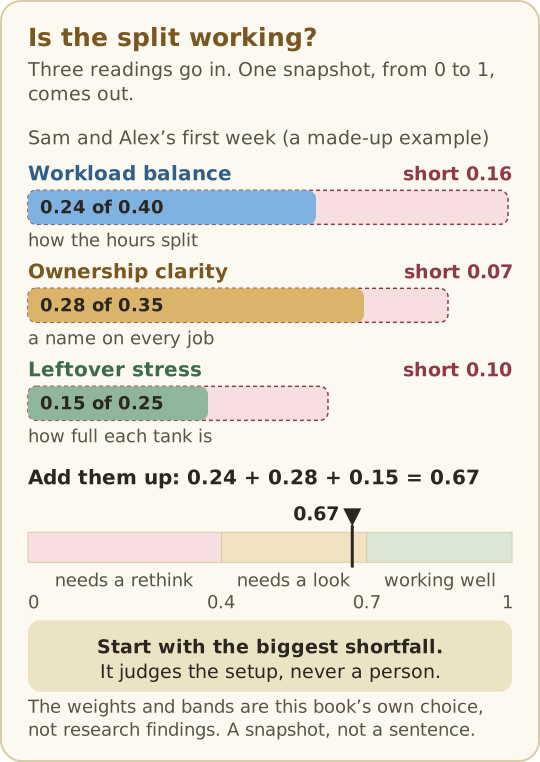
Figure 13 Is the split working? Three readings go in and one snapshot comes out. Start with the biggest shortfall. It judges the setup, never a person. -
Balance: how the hours split.
From your week-long logs, work out each person’s share of the hours. An even split scores 1. One person doing everything scores 0. It doesn’t matter which person is doing more. If you agreed an uneven split that suits you (say, one of you works longer hours outside the home), compare against that split instead.
For example: Three partners log 30 hours of home jobs: 15, 9 and 6. An even share is 10 each.
Words you could use: “I’m not keeping score of you. I just want us both to see the hours.”
Try this: Log one week each, and include the small jobs that take under ten minutes.
Three or more of you? Compare each person’s share with an even share (100 ÷ number of people), or with a split you agreed. The “Who does what?” page, where each person lists their hours, does the arithmetic.
Dig deeper: the balance scoreFilled-in example Who does what? Quick look Wren, Josh and Mei, housemates (Wren’s view) Quick look: who does what at home
Mark who mostly does each job. The picture builds as you go, the thinking work too.
- Your name
- Wren
- Their name
- Josh
- Person 3
- Mei
Job Who mostly does it Dishes Shared Laundry Shared Cleaning the bathroom Josh Cooking dinner Mei Grocery shopping Wren Paying bills Wren Noticing what’s running low Wren Planning the week Mei Remembering dates and appointments Wren How it looks
Here’s how it looks from your side, 9 jobs so far.
Everyday jobs: mostly shared. 6 jobs: Wren 2 · Josh 1 · Mei 1 · Shared 2.
Planning and remembering: mostly Wren. 3 jobs: Wren 2 · Mei 1.
The thinking work is easy to miss, because nobody sees it happen. Saying it out loud is a good start.
Does this match how it feels to the three of you?
A made-up example. Names and details are invented. Pets and booking appointments were taken off the list: they don’t happen in this house.
Fill in your own: Who does what? Quick look (spreadloveandacceptance.com/
lemonade-stand) -
Ownership: does each job have a name?
Each job gets two names: the owner, who does the job start to finish, and a backstop, who notices if it slipped and gently checks in (never a supervisor). It can be the same person, though a second name gives the job a gentle check. Count the jobs that have an owner, then divide by all the jobs on the list. (The backstop is a good habit on top, but the count only needs the owner.) Leave jobs nobody owns on the list. They are the ones that matter most.
A decision you make together, like which school, can be marked “Both (decide together)”. It counts as owned, because a decision needs both voices. A job that needs doing gets one name.
For example: Two sisters care for their dad. Nobody owned his prescription, so each thought the other had ordered it.
Words you could use: “Can we put a name next to this one, so it doesn’t fall between us?”
Try this: Find one job with no name, and give it an owner and a backstop today.
Dig deeper: the ownership score -
Stress: how full each stress tank is.
Each of you rates how full your own stress tank is with How much are you carrying?. A higher score means more stress. Under 0.30 is low, 0.30 up to 0.60 is moderate, and 0.60 or more is high. The score uses the average of your scores. But if either of you is at 0.60 or more, talk about that first, even when the score looks fine. A setup that only works when you’re both well rested isn’t one that can last, so more stress lowers the result.
For example: A grandmother raising two grandchildren scores 0.70. Her son, who helps at weekends, scores 0.35. Her 0.70 is the headline.
Words you could use: “My tank is high this week. Can we plan around that, not around the average?”
Try this: Each of you scores your own tank on the same day, before looking at the other’s.
Dig deeper: the stress score -
One number comes out, from 0 to 1.
0.70 or above: working well, the setup is holding. From 0.40 up to 0.70: needs a look, something is drifting, often who owns what. Below 0.40: needs a rethink, together. (The result is called the setup score. It looks like a probability, but it isn’t one. It’s a simple weighted sum.)
A weighted sum means each part counts for a set share: the hours count most, then the owners, then stress.
For example: Two friends who run a café score 0.55. Nothing is broken, but something is drifting.
Words you could use: “This number is about our setup, not about us.”
Try this: Write the date next to your number, so you can compare next month.
Dig deeper: the formula and what each range meansFilled-in example Is the setup working for everyone? Rosemary and Ken, retired, married 41 years Is the setup working for everyone?
- Person 1 (optional)
- Rosemary
- Person 2 (optional)
- Ken
1. How the hours split
From Who did what or the “Who does what?” page: each person’s total hours for the week.
- Rosemary, hours
- 14
- Ken, hours
- 10
2. Does each job have a name?
From One owner per job.
- Jobs on the list
- 12
- Jobs with an owner
- 9
3. How much each person is carrying
Each person’s own score from How much are you carrying? Everyone fills in their own.
- Rosemary, load (0 to 1)
- 0.45
- Ken, load (0 to 1)
- 0.30
How the setup is working
- Working well
- 0.75 of 1. The setup is carrying its own weight.
Next: nothing in the setup needs changing this week. Keep the same rhythm of check-ins.
If you want to nudge it higher one day (optional, not urgent): hand about 2 hours a week from Rosemary to Ken, and balance would go from 0.83 to 1.00. Give one more job an owner (the person who does it and sees it through), and ownership would go from 0.75 to 0.83.
A made-up example. Names and details are invented. It scores the setup, never a person, and never the relationship as a whole.
Fill in your own: Is the setup working for everyone? (spreadloveandacceptance.com/
workpapers/ calculators/ is-the-setup-working-quick) -
Start with the biggest shortfall.
The single number matters less than which of the three parts pulled it down most. In the middle band that is often ownership, which is why the calculator suggests One owner per job first. Once you’ve both seen it, what you do next is a choice you make together.
The shortfall is how far one part fell below the most it could add.
For example: Separated parents score 0.62. Their biggest gap: nobody owns school forms. They fix only that.
Words you could use: “Which part pulled the number down most? Let’s start there.”
Try this: Choose one small change, not five.
Dig deeper: reading your result -
It judges the setup, never a person.
The number isn’t a verdict on who’s better or whether the relationship works. It’s where a conversation starts, never how one ends. These tools only work when each person feels free to say no, to ask for a pause, or to keep their own notes private. If talking about the split ever feels unsafe, or one of you feels you can’t say no, stop using the tools and talk with a trained counsellor on your own. When someone is afraid of their partner, counselling together isn’t advised. Not safe at home? lists free, private hotlines.
For example: One partner sees 0.35: “So I’m the problem.” The other: “No. The bathroom has no owner, and you work nights.”
Words you could use: “Whatever this shows, I’m on your side.”
Try this: Before you start, agree that either of you can say “pause” and come back later.
Dig deeper: what the number is not
Sunday evening
Two week-long logs and two cups of tea. One list has 31 rows. The other has 18. Nobody says anything for a moment. Then one of you says, “I honestly didn’t know about half of these.”
Words this chapter uses
- Log: a simple list of the jobs you did this week and roughly how long each took.
- Owner: the person who does a job from start to finish, including remembering it.
- Backstop: the person who notices if a job slipped and gently checks in. A helper, never a boss.
- Stress tank: how much stress you are already carrying from the rest of life.
- Setup: the way you share the work right now. It can always be changed.
- Setup score: one number from 0 to 1 that sums up the three readings. It describes the setup, never a person.
Invisible jobs count too. Planning meals, remembering birthdays, booking the vet and noticing the soap is running low are all work, even though nobody sees them happen. Put them in your log.
Words you could use: “I’d like to add the thinking jobs to our list, like remembering and planning. They take time too.”
Inside you, and between you
- In you: See your own share honestly, from what you wrote down rather than from memory. See the way you share work as a setup you can redesign, not a flaw in you.
- Between you and others: Put both people’s numbers on one page, and read the result as a note about the setup, never a verdict on a person. Clear owners leave less room for blame.
On your own: is your own load working?
This chapter asks whether a shared setup can last. You can ask the same about your own week: are you spending more energy than comes back in?
- Add up what you carry: jobs, people and worries.
- Set it beside what refills you: rest, help, and people who give back.
- If it runs in the red, change your side: drop, delay, ask or say no kindly. A limit is a statement about supply, not about your worth.
For example: After a breakup, Leanne has her kids every other week, and fills the quiet weeks with favours for friends. Writing it down showed her she never rests. More in On my own.
Words you could use: “I’d love to help, and I can’t this week. Can I let you know next week?”
Try this: Tonight, write three things that drained you this week and one thing that refilled you.
In the individual program: Step 1: check your battery · Step 6: kind ways to say no · Part One: matching energy · The whole book on sharing the load
The fields behind this chapter
This chapter draws on 6 of the author’s thirteen fields (see the Preface or the About page). The first few:
- Finance (See the whole load): Like a small shop asking whether it can keep paying its bills, month after month. The chapter reads the setup that way, never as a verdict on the people.
- Business (Fix the setup, not the person): Ownership clarity: one owner per job, borrowed from project work, and the maker-and-checker habit from internal controls. Every regular job gets a person who does it and a backstop who notices if it slipped.
- Neurobiology (Read your state first): Leftover stress: a quick self-rating of the stress you’re already carrying. It borrows the idea that stress builds up in the body, but it doesn’t measure your body.
- Economics (See the whole load): Limited capacity and the safety margin.
Two fields, one idea: Business + Economics. Unowned work falls to whoever notices first, every time. That’s what turns a fixable imbalance into a repeating one, so the check counts owners, not just the hours.
See how all the fields connect, in the full version · The polymath way
In real life
- Partners: After a new baby arrives, the hours tip heavily one way without anyone deciding it. The check can show it before resentment builds.
- Family: Two siblings share care for a parent. One lives nearby and does most of the visits. Writing down the hours helps them rebalance in other ways, like paperwork and phone calls.
- Roommates: Everyone agrees cleaning matters, but nobody owns the bathroom. The ownership score shows the gap straight away.
- Coworkers: Two people share one role. The same three questions still work: how the hours split, who owns what, and how stretched each person is.
- Two dads: With no old script for who does what, nothing was decided. One of them quietly took on all the school messages.
- More than two partners: In a home of three or more, “someone will do it” often means nobody does. Owners matter even more. See More than two.
- Foster and kinship carers: Meetings, forms and contact visits are real work. See Foster and kinship families.
- Shift workers: Hours can look even while sleep is not. See Different hours.
- When one of you is ill: Share by energy, and agree an uneven split on purpose. See When one of you is ill.
- Dorm roommates: A room agreement with names next to jobs settles most of it. See Sharing a room.
Words you could use: “I think the way we split things worked before, and life changed. Can we look at it again together?”
Our room agreement
- Your name
- Kayla
- Their name
- Bea
- Quiet hours
- 11 pm to 7 am on weeknights, midnight on Fridays and Saturdays. Headphones after that.
- Guests (daytime)
- Fine with a quick text first. Not during the other one’s study or sleep time.
- Overnight guests
- Up to 2 nights a week, agreed the day before. A guest doesn’t stay in the room when their host isn’t there.
- Cleaning
- Kayla: floor and bins, Sunday. Bea: desk area and the fridge, Wednesday. Our own laundry, our own job.
- Borrowing
- Ask first, every time. Food on the shared shelf is for both of us.
- Lights and alarms
- Big light off by 11:30 on weeknights; a desk lamp is fine. One alarm, one snooze at most.
- How we bring up problems
- Text first if that’s easier, then talk within a few days, one topic at a time. If we’re stuck, we ask our RA to help.
Your agreement, ready to send
Our room agreement (Kayla and Bea), with every line above, ending: “We’ll look at it again together in a month.”
A made-up example. Names and details are invented. They kept most of the site’s starting point and changed two lines.
Fill in your own: Our room agreement (spreadloveandacceptance.com/
Common mix-ups
- “A low number means the relationship is failing.” It only means the current setup needs changing. Setups change all the time.
- “A high number means nobody can complain.” A good score never silences anyone. If something feels wrong, say so.
- “We can just guess the numbers.” A guessed number is really just a feeling with a decimal point. Use your written logs.
- “Taking unowned jobs off the list will help.” It raises the number and changes nothing at home.
- “One of us can fill it in for both.” Each person writes their own log and scores their own stress tank.
- “Fair means exactly 50/50.” Fair is what you both agree to, with eyes open. An uneven split you chose together can be fair. Chapter IV covers the kinds of fair.
- “The backstop checks up on the owner.” No. The backstop only notices if something slipped, and asks kindly. It is help, not a check on someone.
Small children and a new baby
Small children bring a flood of new jobs, and most of them are thinking jobs: the nursery bag, the jabs, the party invites, the next size of clothes, the night wakings. That’s why the mental load (see the Preface) often grows after a baby arrives, usually without anyone deciding it.
- Log the kid jobs too, with the thinking time. Nights count.
- Hand over whole jobs, not tasks: the clothes and sizes, the nursery bag, the GP and jabs. The new owner does the noticing too, in their own way.
- Baby on the way? Write your first job list together before the birth, plan the nights, and agree to look again at six weeks, three months, and before either of you goes back to work.
- In the first weeks, share by energy, not hours. Whoever was up in the night gets the rest; the other takes the morning.
For example (made up): Hollie and Gareth have Alfie, 3, and Poppy, 8 months. Gareth is a paramedic on shifts. Their logged minutes come out nearly even, but Hollie did almost three-quarters of the jobs nobody asked for. They don’t move minutes. They move one whole job, the children’s clothes, to Gareth.
Words you could use: “Could you own the nursery bag from now on, including noticing when we’re low on nappies? I won’t check it.”
Dig deeper: small children, new babies and shift work
Who did what
- Person A
- Hollie
- Person B
- Gareth
- Week beginning
- 12 October 2026
Part A: Who did what, this week
| Day | Task noticed or done | Who did it | Minutes (rough) | How it came up: asked for, noticed, or thinking time? |
|---|---|---|---|---|
| Mon | Pack the nursery bag: spare clothes, nappies, named milk | Hollie | 10 | Noticed and handled |
| Tue | Book Poppy’s one-year jabs at the GP | Hollie | 15 | Noticed and handled |
| Tue | Bath and bedtime, both children | Gareth | 45 | Asked for |
| Wed | Reply to a party invite and buy the present | Hollie | 25 | Noticed and handled |
| Wed | Sort outgrown clothes and order the next size | Hollie | 40 | Noticed and handled |
| Thu | Plan the week’s meals around Gareth’s nights | Hollie | 20 | Thinking and planning |
| Thu | Cook dinner and batch-cook for the weekend | Gareth | 75 | Noticed and handled |
| Fri | Remember the nursery photo money and form | Hollie | 10 | Thinking and planning |
| Fri | Night wakings with Poppy | Hollie | 60 | Noticed and handled |
| Sat | Swimming lesson with Alfie | Gareth | 60 | Asked for |
| Sat | Big food shop and nappies | Both | 80 | Asked for |
| Sun | Washing for both children, to put away | Hollie | 50 | Noticed and handled |
| Sun | Fix the stair gate | Gareth | 20 | Noticed and handled |
| Sun | Update the family calendar and the childcare rota | Hollie | 20 | Thinking and planning |
This week’s totals
- Hollie
- 290 minutes (55%), of which 250 noticed and handled without being asked (50 of them thinking and planning)
- Gareth
- 240 minutes (45%), of which 95 noticed and handled without being asked
- Workload balance score
- 0.91. It describes how the logged work was split this week, not anyone in it.
- Unasked-for work
- Hollie did 72% of the work that was noticed and handled without anyone asking. This is the work that is easiest to miss. Say it out loud, and give the jobs that repeat a named owner.
Part B (optional): Kind ways to say no
Left blank this week.
A made-up example. Names and details are invented. Gareth worked three night shifts this week, so his rows are fewer; the minutes are close, and the noticing is the part to talk about.
Fill in your own: Who did what (spreadloveandacceptance.com/
If only one of you wants to try this
That is common, and you can still start. Log your own week and score your own tank. Then share one small thing you noticed, without asking the other person to agree with your numbers.
For example: A dad noticed he spent five hours a week driving his teenage son around. He just said so, and they agreed a bus pass for two days a week. See Teens.
Words you could use: “I tried writing down my week, just for me. Can I show you one thing I noticed?”
Try this: Share one finding, not the whole list. Then let it rest for a few days.
If the other person refuses to talk about the split at all, ever, or makes you feel afraid for raising it, that isn’t a setup problem. Please read Not safe at home?
More for your situation
Money together · Gaming and time together · Friends · Family rifts · Grown-up children · Grandparents · Co-parenting · Coming home · Empty nest · At work · For counsellors
Try this: Each of you logs one week in Who did what, first. The number only means something if you each wrote your own.
Next, fill in the job list in One owner per job together, including any jobs nobody owns yet.
Then each of you scores how full your own stress tank is in How much are you carrying? on the same day.
Put the three numbers into the calculator. Look first at the biggest shortfall, pick one small change together, and check again in a month.
Last updated: October 2026