Part Three · Chapter 6
Habits and change: why change is hard and how small steps work
Why it’s so hard to change, even when we really want to, and what actually helps: small steps, a kinder setup, patience with slips, and remembering that other people’s change belongs to them.
In short:
- Change is hard for good reasons. Habits save effort, so the old way is always the easy way.
- Small and set up beats big and willpower. Make the first step tiny and change the setup around you.
- Slips are part of change. A missed day is information about the plan, not proof about you.
- Other people’s change is theirs. You can support it. You can’t force it.
Why the tools work: this chapter explains the thinking behind these tools from earlier in the book.
- One small step a week (the six-week program; Part One, Next) works because change that lasts starts smaller than feels useful, and an if-then plan does the deciding ahead of time.
- The setup score and One owner per job (Part Two, Chapter II; Part Two, Chapter IV) change the setup instead of asking for more willpower. Habits follow cues and easy paths. Big ideas: fix the setup, not the person and notice the quiet incentives.
- What keeps coming back? (Part Two, Chapter V) treats a repeat as information, not failure, because slips are a normal part of change.
Monday, 7:05am
The plan was a walk before work. The trainers are by the door. But the phone is in your hand, and somehow it’s 7:40 and you’re scrolling with cold coffee. By evening, a quiet voice says: “See? You never stick to anything.” That voice is wrong. You aren’t weak. You’ve met a habit.
-
Change is hard for good reasons.
Much of what we do each day runs on autopilot. That saves energy, which is why habits exist. The downside is that the old way is always quicker and easier than the new one. Change asks your brain to do something effortful, again and again, until the new way becomes the easy one.
For example: Jodie wants to stop snapping at her kids in the morning rush. She means it every night. Every morning, the same rush brings the same snap. She isn’t a bad parent; the morning is a well-worn groove.
Thoughts you could try: “This is hard because it’s a habit, not because I’m failing.” “Old grooves take time to fill in.”
Try this: Pick one thing you’d like to change and write: “When does it usually happen? Where? What’s going on just before?”
Dig deeper: why change is hard -
Habits run on cues.
Most habits have a trigger: a time, a place, a feeling, a person, or the thing you just did. The cue starts the routine, and some kind of reward (relief, comfort, a little buzz) keeps it going. If you know the cue, you can plan for it.
For example: A man notices he reaches for snacks not when he’s hungry but when he opens his laptop after dinner. The cue is the laptop. He starts making tea first instead.
Thoughts you could try: “What happened right before I did that?” “What was I getting from it?”
Try this: For three days, each time the habit happens, jot down the cue: time, place, feeling, or what you were doing.
Dig deeper: cues and routines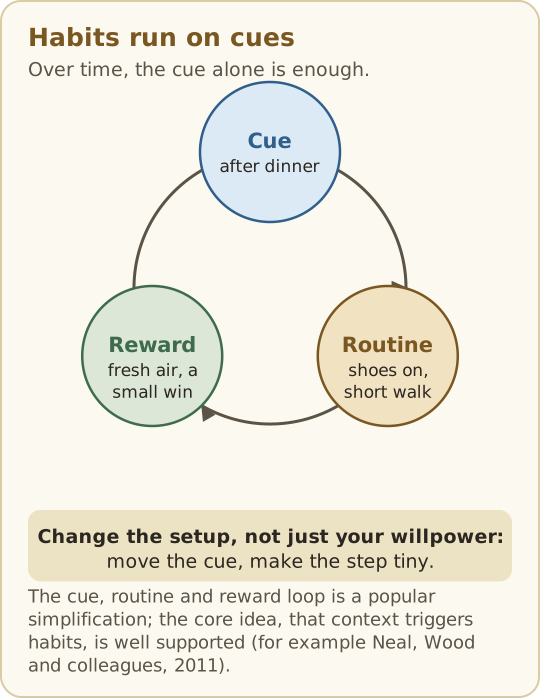
Figure 26 Habits run on cues. Over time the cue alone is enough, so change the setup, not just your willpower. -
Start smaller than feels useful.
Big goals are inspiring but easy to drop. Tiny steps feel almost silly, and that’s why they work: they’re easy enough to do on a bad day. Tie the new step to something you already do: “After I put the kettle on, I’ll...” Once it sticks, you can grow it.
For example: Two housemates want a tidier kitchen. Instead of a big weekly clean they never do, they agree: “After dinner, we each wipe one surface.” It takes two minutes, and the kitchen stays nicer.
Words you could use: “Let’s start with something tiny, and see if it sticks.” “After I ..., I will ...”
Try this: Shrink your change until it takes two minutes or less. Write it as “After I ___, I will ___.”
Dig deeper: why small steps workFilled-in example Your done list Bernie, 71, living on his own Your done list
Write down one small thing that went right, however small.
- A small win
- Went to the Thursday quiz with Rita and Joe
- Who it was with
- With a friend
This week: 4 small wins
Went to the Thursday quiz with Rita and Joe · Thu, Oct 8 · With a friend
Cleared one shelf in the spare room · Wed, Oct 7
Rang my brother back · Tue, Oct 6 · With family
Walked to the post office instead of driving · Mon, Oct 5
A made-up example. Names and details are invented. A done list is for encouragement, not proving who does more.
Fill in your own: Your done list (spreadloveandacceptance.com/
small-wins) -
Change the setup, not just your willpower.
Willpower runs low when we’re tired, hungry or stressed. Your surroundings don’t. Make the new habit easier (put it in sight, get things ready the night before) and the old one a little harder (move it out of reach, add a step). Small changes to your setup can do more than any amount of trying harder.
For example: A teenager wants to sleep better. Instead of “trying not to scroll,” he charges his phone in the kitchen. It works far better than willpower ever did.
Words you could use: (to yourself or a partner) “What could we change about the setup so this gets easier?”
Try this: Make one small change to your space today that makes the new habit easier or the old one harder.
Dig deeper: shaping your setup -
Being in two minds is normal.
Part of you wants to change. Part of you doesn’t, and that part usually has its reasons: the old habit gives comfort, saves effort, or protects you from something. Pushing harder against that part rarely works. Listening to it often does.
For example: Asif wants to drink less, but he also loves the Friday pub with his team. Instead of “never again,” he asks what Friday gives him: friends, laughing, unwinding. He keeps the Friday, and switches to alcohol-free after the first drink.
Thoughts you could try: “What does the old habit give me?” “What would make the change worth it to me, not just to others?”
Try this: Write two lists: “What I like about how things are” and “What I’d like about changing.” Both lists are allowed.
Dig deeper: readiness and mixed feelings -
Slips are part of change.
Nearly everyone who changes something slips back sometimes. One slip doesn’t undo your progress. What often does is the thought that follows: “I’ve blown it, so why bother?” Treating yourself kindly after a slip makes it more likely you’ll start again, not less.
For example: After three calm weeks, a dad shouts at his son over homework. That night he says, “I shouted, and I’m sorry. I’m working on it.” The next day he’s back on track. The slip became a repair, not a reason to give up.
Thoughts you could try: “A slip is a moment, not a verdict.” “What made today harder, and what can I plan for next time?”
Try this: Decide now what you’ll do after a slip: one kind sentence to yourself, and one small step to start again.
Dig deeper: slips and starting again -
Change sticks when it fits who you want to be.
Change done only to please others, or out of shame, is hard to keep. Change that connects to what you care about, the kind of person, parent, friend or colleague you want to be, has deeper roots. Each small action is a vote for that person.
For example: A woman who wants to “be better at keeping in touch” reframes it: “I’m someone who shows up for my friends.” Sending one voice note a week becomes part of who she is, not a chore.
Thoughts you could try: “Who am I becoming with this step?” “This matters to me because...”
Try this: Finish this sentence for your change: “I want to do this because I care about...”
Dig deeper: values and who you’re becoming -
You can support change, but not force it.
It’s natural to want people we love to change: to drink less, tidy more, look after themselves. But other people’s change belongs to them. Pressure tends to make people dig in. What helps more: saying clearly what you need, asking what would help, and noticing their small steps out loud.
For example: A coworker keeps missing deadlines. Instead of “You need to be more organised,” his teammate asks, “What would make the handover easier for you?” They set up a shared checklist, and the deadlines improve.
Words you could use: “I can’t change this for you, but I’d love to help if you want me to.” “I noticed you did that this week. That really helped.”
Try this: Notice one small positive change someone else made this week, and tell them.
Dig deeper: change with other people
Two weeks later, 7:05am
The trainers are still by the door, but the phone now charges in the kitchen overnight. The plan has shrunk too: shoes on and out to the end of the road. Some mornings that’s all. Most mornings it turns into a walk. On the day you miss, the voice says “See?” and you answer it: “A missed day is a slip, not a verdict. Tomorrow, the end of the road.”
In everyday life
- Partners: One partner wants to spend less time on phones in the evening. They agree on a basket for both phones after nine, not a rule for one person.
- Parents and children: A picture chart of the bedtime steps makes a new routine easier for a young child than reminders ever did.
- Friends: Two friends who want to move more meet for a Saturday walk. The friendship is the reward that keeps the habit going.
- Coworkers: A team that keeps forgetting actions starts ending every meeting with “Who does what by when?” It’s a tiny habit with a big effect.
- Housemates: A shared list on the fridge works better than anyone trying to remember.
- Big life changes: A move, a new baby or a new job breaks old routines. That’s disruptive, and it’s also a good moment to start new habits.
- If you have ADHD: Make the cue impossible to miss, do the step the moment it appears, and make the reward come now. Expect novelty to wear off and swap the method, rather than blaming yourself. More in the full chapter.
On your own: a kind plan for change
If you’re working on something alone, put the ideas together in one small plan:
- One change. Not five. Pick the one that would make the most difference, or the one that feels most doable.
- One cue. “After I ___, I will ___.”
- One setup tweak. Make it easier to start.
- One tired-day version. The smallest version you can still do on a bad day.
- One kind sentence for slips. Written down, ready to use.
The individual program walks through this step by step: The self path and Know yourself, next.
Common mix-ups
- “If I really wanted it, I’d just do it.” Wanting is only the start. Habits, setup, tiredness and stress all matter.
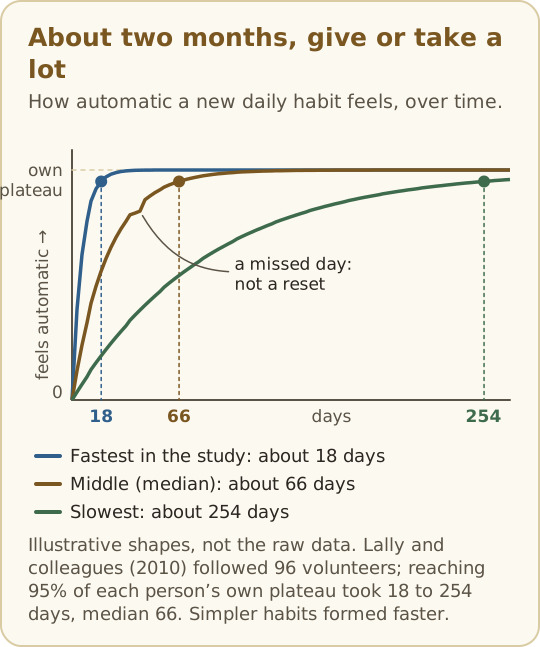
- “It takes 21 days to form a habit.” There’s no magic number. In one study, led by Phillippa Lally (2010), it took about two months on average, with a very wide range.
- “One slip means I’ve failed.” Slips are normal. Starting again is the skill.
- “Being hard on myself will keep me on track.” Harshness tends to make people give up. Kindness makes it easier to try again.
- “If I nag enough, they’ll change.” Pressure often makes people dig in. Ask, support and notice instead.
- “Routines mean being rigid.” For many people, especially autistic people, routines are what make life manageable. Change can respect that.
If you want to help someone else with this
- Ask before advising. “Would ideas help, or would you rather just talk it through?”
- Help them find their own reasons. “What would be different for you if this changed?”
- Help with the setup. Offer practical things: a lift to the gym, a shared calendar, a quieter evening.
- Notice small steps out loud. Encouragement for small wins often helps more than pointing out what’s still missing.
- Be kind about slips. “That’s okay, tomorrow’s a new go” helps more than “I knew it.”
- Look after yourself. You can care deeply and still set limits on what you’ll put up with.
Words you could use: “I’m on your side with this. What would help?” “You’ve done this three days running. That’s not nothing.”
When to get more help
- If a habit is harming your health or life, such as drinking, drugs, gambling, eating or self-harm, please talk to a doctor or a specialist service. Needing help with this is common and nothing to be ashamed of.
- If you can’t stop even though you’ve tried many times, professional support can make a real difference. It isn’t a sign of weakness.
- If change feels impossible because you’re exhausted or low most days, that may be burnout or depression. A doctor or counsellor can help.
- If someone is demanding you change in ways that frighten you, or punishing you when you don’t, that isn’t support. Not safe at home? lists free, private help.
- If you’re overwhelmed right now, start with Upset right now.
Workpapers, tools and reading on this site
Practice: pick one tiny change and try it for a week.
Reading pages to read on the site
- Know yourself, next: values, one small goal, tiny steps and if-then plans.
- Complacency: why good habits fade, and how to keep them alive.
- From the library: Habit formation · Habits and cues · If-then plans · Small wins · Stages of change · Self-compassion · Autistic inertia
More for your situation
- On my own
- New parents
- When a child has ADHD
- Neurodivergent relationships
- Gaming, phones and time together
- At work
- Coming home after time apart
- Find it by relationship
Last updated: October 2026