Part One: The most important, yourself · Next
Know yourself: next, shaping who you are becoming
You aren’t finished, and some of who you become is up to you. This part is about choosing a direction, and building small steps that still work on a tired day.
In short:
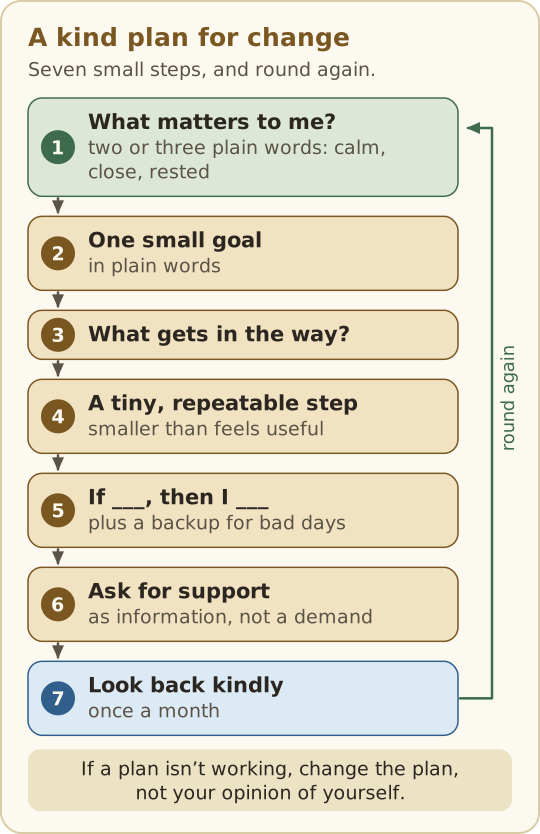
- Start with what matters to you, in two or three plain words, then pick one small goal you can do.
- Make the step tiny and decide ahead: “If it’s after dinner, then I put my shoes on.”
- Ask for support as information, and look back kindly once a month.
- A missed day is information about the plan, not a verdict on you. Change the plan.
- Set goals inside your circle, and spend your energy where it comes back.
The big ideas: This part mostly teaches “Fix the setup, not the person” and “Notice the quiet incentives”, with help from “Read your state first”. What are the five big ideas? (They are five plain ideas the whole program is built on.)
Wednesday, 9:10pm
You meant to start walking after dinner. You meant to last week, too. Tonight you’re tired, the shoes are by the door, and you tell yourself you’ll begin on Monday.
-
Start with what matters to you.
A goal built on someone else’s idea of success is hard to keep up. Before you pick anything, ask: what do I want my days to be like? Write two or three plain words, like calm, close to my family, steady or creative. They are a direction, not a score. How you connect can help you notice what fills you up and what drains you.
Dig deeper: values first -
Pick one small goal, in plain words.
Just one. Say it as something you will do, not something you hope will happen: “Walk for ten minutes after dinner,” not “get healthier.” Your own actions are up to you. How other people respond, and how things turn out, are not.
Dig deeper: one goal, in plain words -
Name what gets in the way.
Use what you learned in Then and Now. Is it your wiring (a plan that ignores how you’re built is built for someone else)? An old rule (“rest has to be earned”)? Or today’s conditions (a tired evening)? Then change the arrangement, never yourself: move the step to the morning, not the person to a better version.
Dig deeper: what gets in the way -
Make the step tiny, and repeatable.
Small enough to survive your worst week. “Put my shoes on” counts. Tie it to something you already do, and do it often. This is the same idea as the 90-second daily check-in in Chapter I of Part Two: small and often beats big and rare. Ten-minute start shows how small a whole path can be.
Dig deeper: tiny, repeatable steps -
Decide ahead with a simple if-then.
“If it’s after dinner, then I put my shoes on.” Deciding ahead means one less decision on a tired day, the same idea as the Calm-Down Kit, which you make while calm. If a plan isn’t working, that’s information about the plan, not about you. Change the plan.
Dig deeper: if-then plansFilled-in example The Calm-Down Kit, just for me Nell, on her own The Calm-Down Kit
- Your name
- Nell
- Date
- 11 October 2026
Part A: What tends to start it
What tends to start it How it shows up in my body first A long message from my sister late at night Tight chest, typing fast Plans changed with no warning Jaw, hot face Part A: My two defaults
- First default
- Walking it out
- Second, if the first isn’t available
- Asymmetric breathing (4 in, 6 out)
Part A: My pause line
- In my words
- I’m at capacity. I’m going to step away for twenty minutes, and I’ll answer properly after that.
My pause plan (yours to share, if you like)
- My pause word or signal
- “Back in a bit”
- The shortest break I take
- 20 minutes
- How I set the time to come back
- I text a time, the same day
- The first sentence when I come back
- “Thanks for waiting. I can think straight now.”
Part B: In the moment
Say your pause word or line, then do your first calming step. Nothing in this kit works by cold, pain or shock, and none of it is treatment.
Part C: Coming back
Time What I did How I feel now 9:40 pm Walking it out Still hot 10:05 pm Asymmetric breathing (4 in, 6 out) Settled enough Where that leaves you
- Next
- Settled enough: pick things back up, at the time you named. When you come back, start with one small, simple task, like putting the dishes away.
- Next small action
- Reply to my sister’s message, one line
- If you put it off: when you’ll pick it back up
- Tomorrow after lunch
✓ I’m going with this
A made-up example. Names and details are invented.
Fill in your own: The Calm-Down Kit (Just me) (spreadloveandacceptance.com/
workpapers/ fill/ wp-11) -
Ask for support, as information.
Tell one person what you’re trying and what would help: “I’m trying to walk after dinner. Could you ask me about it on Sunday?” It isn’t a demand, they can say no, and you don’t need their agreement to start. Some goals are better with a qualified professional, and asking for one is a sensible step, if and when you want that.
Dig deeper: asking for support -
Look back kindly once a month.
It mirrors Chapter V of Part Two, pointed at yourself. Once a month, take ten minutes: what went well? What kept slipping? Was the gap in the plan, in how much you have right now, or just a one-off week? You don’t add up old misses. You only ask what to try next month.
Dig deeper: a monthly look at yourself -
Kindness to yourself is part of the plan.
A plan that needs you to be harsh with yourself is built on a “second arrow”: the first arrow is the slip itself, and the second is the telling-off you give yourself afterwards, which hurts more and helps less. A missed day is information. Rest is part of the plan, not a prize for finishing. You can shrink a goal, change it or drop it. Nothing here is required, and you can stop any time.
Dig deeper: kindness as part of the plan -
Set goals inside your circle, and spend energy where it comes back.
A goal that depends on someone else changing is a wish. Shape each goal around what you can do: “I’ll ask once, kindly, by Friday,” not “They’ll start helping.” Then budget your energy like the limited thing it is. Put more into the people and plans that give back, and less into the ones that only take. That isn’t selfish. It’s how you keep going long enough to reach the goal, and still have something left to give.
Dig deeper: planning inside your circle
The ideas, one at a time
Each idea above again, with a real-life example, words you could use and one small step. Read one and stop if you like.
1. Start with what matters
For example: After their youngest leaves home, a couple each write two words. Hers are “useful, outdoors.” His are “calm, curious.” Suddenly it makes sense that she wants to volunteer and he wants the garden. See Kids grown and gone.
Words you could use: “What I want my days to feel like is ___.”
Try this: Write two plain words for what matters to you right now. Pencil is fine. You can change them.
2. One small goal, in plain words
For example: A student in a shared dorm room wants “to be less messy.” As an action, it becomes “Put my clothes in the basket before bed.” See Sharing a room.
Words you could use: “My one goal this month is ___.”
Try this: Rewrite one wish as something you will do, starting with “I will…”
3. What gets in the way
For example: A shift worker keeps missing his evening run. It isn’t laziness. His rota (his work timetable) changes every week. He ties the run to “my first day off” instead of “evenings.” See Different hours.
Words you could use: “It’s not that I don’t care. The setup doesn’t fit yet.”
Try this: Pick one thing that keeps slipping. Ask: is it my wiring, an old rule, or today’s conditions?
4. Tiny and repeatable
For example: Someone on their own after a breakup wants to “get back out there.” The tiny step: one message to one friend every Sunday. See On my own.
Words you could use: “I’m starting really small, on purpose.”
Try this: Shrink your step until it takes less than two minutes.
5. Decide ahead
For example: A separated parent wants calmer handovers. Her if-then: “If I pull up outside, then I take three slow breaths before I get out of the car.” See Co-parenting.
Words you could use: “If ___ happens, then I’ll ___.”
Try this: Write one if-then. Pick a cue that happens every day, like the kettle, the front door or brushing your teeth.
6. Ask for support
For example: A woman caring for her husband after a stroke asks her brother, “Could you sit with him on Thursday afternoons so I can swim?” Because it is specific, it is easy to say yes or no. See When one of you is ill.
Words you could use: “I’m trying ___. Would you be up for ___? It’s fine to say no.”
Try this: Name one person and one small, specific thing they could do. (If someone uses your goals to check up on you or control you, Not safe at home? has people to talk to.)
7. Look back kindly
For example: A grandmother raising her two grandchildren looks back on the month. Bedtime is working. Homework isn’t. Next month she tries homework at the kitchen table straight after a snack. See Foster and kinship families.
Words you could use: “What went well, what kept slipping, and what will I try next?”
Try this: Put ten minutes in your calendar for the first of next month.
8. Kindness is part of the plan
For example: A sixteen-year-old sets a goal to revise every night, misses three nights and says, “I’m useless.” His grandmother asks, “What would you tell your best friend?” He shrinks the goal to twenty minutes.
Words you could use: “That was a missed day, not a missed life.”
Try this: Next time you miss a step, say one sentence to yourself that you would say to a friend.
9. Inside your circle
For example: You’d like your adult sister to call more. That goal sits outside your circle. Inside it: “I’ll call on the first Sunday of each month, and tell her I’d love her to call too.” See Family rifts.
Words you could use: “I’d love it if ___. Either way, I’ll ___.”
Try this: Rewrite one goal that depends on someone else, so the next step is yours.
The first of the month
You open your notes. Of the four small things you tried, two stuck and two quietly stopped. Nothing went wrong. You just know now which two need a different setup.
You, in all your relationships
A goal for yourself often touches the people around you. Small steps work everywhere.
- With yourself: Rest, health, a hobby you dropped, a kinder inner voice.
- With partners: One small habit you offer, not one you demand. See Gaming and time together.
- With friends: One message a week. See Friends.
- With family: A regular call, a visit you can keep up, or a first step after years apart. See Reaching out.
- At work: One comment per meeting, one clear handover note.
- With money: One small saving habit you control. See Money together.
- On your own: A week that suits you. See On my own.
Find your own situation in help by relationship.
Inside you, and between you
- In you: Treat your own routines as a setup you can adjust, not a character test. Notice the defaults and cues that steer you, and let the easy path be the one you want. Pick the step for the energy you really have.
- Between you and others: Say what you’re trying and what would help, as information. Let people’s answers be theirs, and fix the setup, not the person.
In the individual program
This part goes with the end of the individual program: a gentle first week, then the Individual package, which turns your workpapers into a report written just for you.
Your next step: A gentle first week · The Individual package and your report · All six steps · The whole book on knowing yourself
The path, step by step
| Step | Where it’s at |
|---|---|
| Check your battery | Done ✓ |
| Get to know your wiring | Done ✓ |
| See where your lens came from | Done ✓ |
| Plan what settles you | Not yet |
| Find words for what you feel | Not yet |
| Practice kind ways to say no | Not yet |
Come back gently, once a week
Pick a day and a time, and add a ten-minute reminder to your own calendar. It repeats every week and just says “10 minutes for me”.
- Day
- Sunday
- Time
- 7:30 pm
What happens next
The next step is Plan what settles you: the Calm-Down Kit. Three steps done is three steps done; the rest will still be here next week.
A made-up example. Names and details are invented.
Fill in your own: The self path (spreadloveandacceptance.com/
The fields behind this part
This part draws on 6 of the author’s thirteen fields (the About page lists them all):
- Behavioural science (Notice the quiet incentives): Habits beat willpower, especially when you’re tired. Cues and defaults steer us more than intentions do.
- Psychology (Tune how you send and receive): What matters to you, and what you tell yourself when a day goes wrong.
- Philosophy (Tune how you send and receive): What Is Up to Us, and Aristotle’s idea that we become what we repeatedly do.
- Business (Fix the setup, not the person): A small, regular review catches problems while they are small.
- Economics (See the whole load): Attention is limited, so one small goal beats five big ones.
- Holistic therapies (Read your state first): Small repeated acts are rhythms, and rest is part of the rhythm.
Two fields, one idea: Philosophy + Behavioural science. Aristotle thought we become what we repeatedly do. Character, like a habit, is built by small acts, not by one big decision.
See how all the fields connect, in the full version · The polymath way
In real life
- Partners: One partner wants calmer evenings. They pick one small step, no phones at the table for ten minutes, and say so: “I’m trying this. Would you try it with me?” The other can say yes, not yet or no.
- Family: You’d like to be in touch with a sibling more. “If it’s Sunday after lunch, then I call for ten minutes” is easier to keep than “I should call more.”
- Housemates: You want the kitchen to stay clear. Your part is a setup, not willpower: “If I make a drink, then I wash the cup before I sit down.”
- Coworkers: You’d like to speak up more in meetings. One comment per meeting, written down beforehand from the agenda, is a goal you can actually do.
Common mix-ups
- “A goal has to be big to count.” Small and repeatable is what survives a bad week. Big goals are often just many small ones.
- “If I miss a day, I’ve failed.” A missed day tells you about the plan. Ask what got in the way, then adjust the setup.
- “If I know myself, I should be able to change anything.” Wiring stays. The aim is a goal that fits how you’re built, not a different you.
- “Asking for support means I couldn’t manage alone.” It’s information that helps others help. People who ask are using the setup well.
- “A monthly look-back means grading myself.” It’s a look, not a trial. It never adds up old misses.
- “I’ll start on Monday.” A fresh start can help, but today’s tiny version counts too. Put your shoes on now.
A note on care: This part is general education. It isn’t therapy, coaching or medical advice, and it can’t promise any result. Goals about your health, money, work or a hard stretch in life may deserve a qualified professional, and there’s no shame in asking for one. Nothing here is required, and nothing you write needs to be shared. If a goal ever starts to feel like a weight, you can shrink it or put it down.
Try this: Write two plain words for what matters to you right now.
Write one small goal as something you will do. Then the tiniest first step, and one if-then: “If ___, then I ___.”
Put a ten-minute look-back on the calendar for a month from now. At that look-back, ask: what went well, what kept slipping, and what will I try next?
Your self-discovery path → How you connect: the style quiz → Ten-minute start → The Calm-Down Kit → Chapter V: the monthly look-back → Part Two begins with the Preface →
Last updated: October 2026