Part One: The most important, yourself · Next
Know yourself: next, shaping who you are becoming
In short:
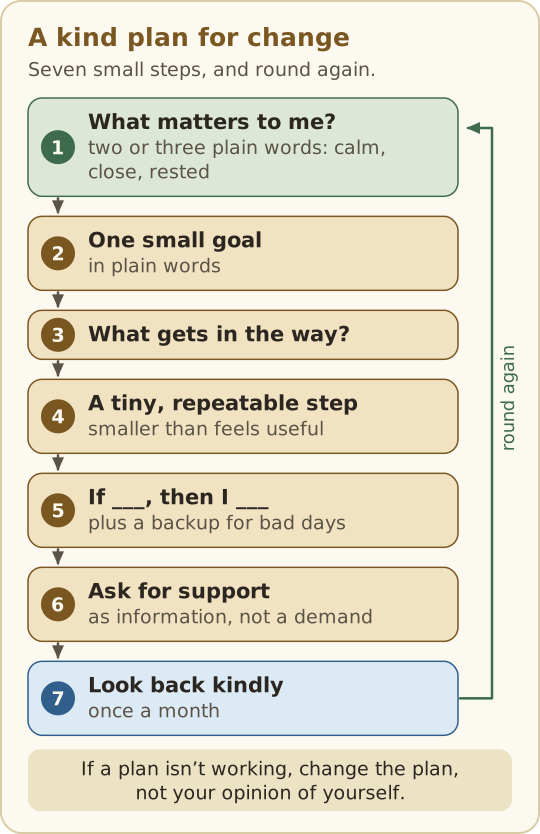
- Start with what matters to you, in two or three plain words, then pick one small goal you can do.
- Make the step tiny and decide ahead: “If it’s after dinner, then I put my shoes on.”
- Ask for support as information, and look back kindly once a month.
- A missed day is information about the plan, not a verdict on you. Change the plan.
- Set goals inside your circle, and spend your energy where it comes back.
Wednesday, 9:10pm
You meant to start walking after dinner. You meant to last week, too. Tonight you’re tired, the shoes are by the door, and you tell yourself you’ll begin on Monday.
Everything in this part is for you. Nothing is graded, nothing is shared unless you choose to, and every step can be made smaller or put down. It follows Then (where your lens came from) and Now (your wiring, your weather and your words), and it asks one question: given who you are, what would you like to grow towards?
Where this fits: the five big ideas
The whole program rests on five big ideas. This part mostly teaches “Fix the setup, not the person” and “Notice the quiet incentives”, with help from “Read your state first”.
- In you: Treat your own routines as a setup you can adjust, not a character test. Notice the defaults and cues that steer you, and let the easy path be the one you want. Pick the step for the energy you really have.
- Between you and others: Say what you’re trying and what would help, as information. Let people’s answers be theirs, and fix the setup, not the person.
Start with what matters to you
A goal built on someone else’s idea of success is hard to keep up, because nothing in you is pulling towards it. Before you pick anything, ask: what do I want my days to be like? Write two or three plain words, like calm, close to my family, steady, creative, useful, rested. They are a direction, not a score. You can’t finish “calm”, and you can’t fail at it, you can only lean towards it.
- Look at what fills you and what drains you. How you connect and Know your own wiring can help you notice. A value you keep wanting and keep skipping is worth a look in its own right.
- Borrowed goals feel heavy. If a goal comes with “I should” and a face (a parent, a boss, a feed), look for the thing under it you do want, and aim at that.
- Values can sit side by side. “Close to my family” and “time alone” are both allowed. Part of the work is making room for both.
Why values come before goals
A value is a direction you can walk in every day. A goal is one stop along the way. When a goal slips, a value is still there, so you don’t lose the whole plan with one bad week.
In different relationships
- A couple whose children have left home: After twenty-six years of school runs, Moira and Clive each write two words. Moira: “useful, outdoors.” Clive: “calm, curious.” They stop arguing about how to spend Saturdays and plan one morning for each. See Kids grown and gone.
- Someone coming out in midlife: Dominic’s old goals were built around what his parents expected. His two new words, “honest” and “close,” lead to different goals: fewer late nights at work, more dinners with friends who know him. See Coming out as an adult.
Mix-ups, and how to fix them
- “My values should match my partner’s.” They can differ. Shared plans can make room for both.
- Picking the values you think you should have. Notice what you actually reach for when nobody is watching.
If you’re the only one doing this: Values are personal by definition. You can choose yours without asking anyone.
Research note: Acceptance and Commitment Therapy, developed by Steven Hayes and colleagues, uses values as a direction rather than a finish line, and has a growing body of research. Self-determination theory (Edward Deci and Richard Ryan) found that goals people choose for their own reasons tend to be kept up longer than goals driven by pressure or guilt.
Pick one small goal, in plain words
Just one, to begin with. Say it as something you will do, not something you hope will happen: “Walk for ten minutes after dinner,” not “get healthier.” The difference matters because your own actions are up to you. How other people respond, and how things turn out in the end, are not.
- Describe the action, not the result. “Send one note to a friend on Sundays” is yours. “Have more friends” is a hope.
- Keep it kind and honest. “Be the calm one” can hide a rule that you aren’t allowed to be upset. Ask whether the goal leaves room for you to be a person.
- One at a time. Attention is limited, so one small goal that sticks beats five big ones that all wobble. Add a second when the first feels ordinary.
Why an action beats a hope
A hope depends on things you can’t control. An action depends on you. Writing a goal as an action also makes it clear when you have done it, which is quietly encouraging.
In different relationships
- Students in halls: A first-year student wants “to get on better with my flatmate.” As an action: “Ask her once a week if anything in the flat is bothering her.” See Sharing a room.
- Two partners and money: “Stop fighting about money” is a hope. “Bring the bank statement to our Sunday check-in” is an action. See Money together.
- A team leader: “Be a better boss” becomes “Thank one person by name each Friday.”
Mix-ups, and how to fix them
- Five goals at once. Pick one. Add a second when the first feels ordinary.
- A goal that is secretly a rule about feelings. “Never get annoyed” isn’t an action. “Take a breath before I answer” is.
If you’re the only one doing this: Your action is yours. It doesn’t need anyone’s agreement to start.
Research note: Goal-setting research by Edwin Locke and Gary Latham found that specific goals usually lead to better performance than vague ones like “do your best.” Later work suggests that for new or complex skills, goals about learning and doing tend to help more than goals about results.
Name what gets in the way
When a step keeps slipping, the useful question is not “what’s wrong with me?” but “what is in the way?” Use what you learned in Then and Now. It is usually one of three things:
- Your wiring. A plan that ignores how you’re built was built for someone else. If you hate mornings, a six a.m. plan is a poor fit, however good the goal.
- An old rule. “Rest has to be earned.” “Don’t make a fuss.” Rules from growing up can quietly veto a step you chose. Notice the rule, then decide whether you still want it.
- Today’s conditions. A tired evening, a hard week, a house full of noise. These change, and the plan can change with them.
Then change the arrangement, never yourself: move the step to the morning, put the shoes by the bed, shorten it to two minutes. That is “Fix the setup, not the person”, applied to you.
Why “what’s in the way” is the kind question
“What’s wrong with me?” makes you the problem. “What’s in the way?” makes the setup the problem, and setups can be changed today.
In different relationships
- A shift worker: Dwayne’s rota changes every week, so “every evening” never works. He ties his run to “my first day off” instead, and it sticks. See Different hours.
- A parent of a child with ADHD: A mum keeps planning calm mornings that fall apart. The setup: shoes, bags and coats are in three rooms. One hook by the door changes the morning. See When a child has ADHD.
Mix-ups, and how to fix them
- Blaming willpower. Willpower is the least reliable part of any plan. Change the setup first.
- Missing the old rule. If a step keeps slipping for no clear reason, ask whether some old rule is quietly saying no.
If you’re the only one doing this: You can change your own setup alone: where things are, when you do them, how big the step is.
Research note: Research by Wendy Wood and others suggests that much everyday behaviour is driven by habits cued by our surroundings, not by moment-to-moment decisions. That is why changing the surroundings often works better than trying harder.
Make the step tiny, and repeatable
Small enough to survive your worst week. “Put my shoes on” counts, and it often leads to the walk. Two ideas help:
- Tie it to something you already do. After brushing my teeth. After the kettle clicks. After I sit down for lunch. An existing habit is a handle for a new one.
- Small and often beats big and rare. This is the same idea as the 90-second daily check-in in Chapter I of Part Two. Ten-minute start shows how small a whole path can be.
Make the helpful thing the easy thing, too. Put the book on the pillow, the water on the desk, the phone in another room. These small defaults do quiet work, which is “Notice the quiet incentives” on your side.
Why tiny works
A tiny step survives bad weeks, and a habit that survives bad weeks is the one that lasts. Tiny steps also leave room to grow: two minutes often turns into ten on a good day.
In different relationships
- On your own after a breakup: Aoife wants to rebuild her social life. Her tiny step: one message to one friend every Sunday. Six weeks later she has three regular coffee dates. See On my own.
- A grandparent and a grandchild far away: A grandfather wants to be closer to his granddaughter who lives abroad. Tiny step: one photo and one line every Friday. See Long distance.
Mix-ups, and how to fix them
- “Tiny doesn’t count.” Tiny is how big things start, and it is often all a hard week allows.
- Growing the step too fast. Grow it only when the small version feels ordinary.
If you’re the only one doing this: Tiny steps are yours alone. Nobody else needs to notice them for them to work.
Research note: A study by Phillippa Lally and colleagues (2010) followed people forming a new daily habit. On average it took about two months for the habit to feel automatic, with a very wide range from person to person, and missing a single day did not undo progress. BJ Fogg’s “Tiny Habits” is a popular method built on starting very small; it is a practical approach rather than a tested treatment.
Decide ahead with a simple if-then
“If it’s after dinner, then I put my shoes on.” Deciding ahead means one less decision on a tired day. It is the same idea as the Calm-Down Kit, which you make while you are calm so that you don’t have to invent it in the middle of a hard moment.
- Write it in the plain form: “If ___, then I ___.” Pick a cue you’ll definitely meet, and an action you’ll definitely be able to do.
- Plan for the bad day, too: “If I’m too tired to walk, then I stretch for two minutes.” A smaller backup keeps the habit alive.
- If a plan isn’t working, that’s information about the plan. Change the cue, the size or the time. Don’t change your opinion of yourself.
Why deciding ahead helps
Every decision costs a little energy. An if-then makes the decision once, on a good day, so a tired you only has to follow it.
In different relationships
- Separated co-parents: Before handovers, Tanya’s if-then is: “If I pull up outside, then I take three slow breaths before I open the door.” Her son notices she seems calmer. See Co-parenting.
- An interfaith family: “If a holiday invitation comes in, then we talk about it together before either of us says yes.” It ends a year of double-booked festivals. See Two faiths or cultures.
Mix-ups, and how to fix them
- A cue that doesn’t happen every day. Choose one that does: the kettle, the front door, brushing your teeth.
- No backup plan. Add a smaller version for bad days: “If I’m too tired, then I stretch for two minutes.”
If you’re the only one doing this: An if-then lives in your head. You can set one up today without telling anyone.
Research note: A large review of many studies by Peter Gollwitzer and Paschal Sheeran (2006) found that if-then plans, which they called implementation intentions, helped people follow through on goals, on average, by a meaningful amount.
The Calm-Down Kit
- Your name
- Nell
- Date
- 11 October 2026
Part A: What tends to start it
| What tends to start it | How it shows up in my body first |
|---|---|
| A long message from my sister late at night | Tight chest, typing fast |
| Plans changed with no warning | Jaw, hot face |
Part A: My two defaults
- First default
- Walking it out
- Second, if the first isn’t available
- Asymmetric breathing (4 in, 6 out)
Part A: My pause line
- In my words
- I’m at capacity. I’m going to step away for twenty minutes, and I’ll answer properly after that.
My pause plan (yours to share, if you like)
- My pause word or signal
- “Back in a bit”
- The shortest break I take
- 20 minutes
- How I set the time to come back
- I text a time, the same day
- The first sentence when I come back
- “Thanks for waiting. I can think straight now.”
Part B: In the moment
Say your pause word or line, then do your first calming step. Nothing in this kit works by cold, pain or shock, and none of it is treatment.
Part C: Coming back
| Time | What I did | How I feel now |
|---|---|---|
| 9:40 pm | Walking it out | Still hot |
| 10:05 pm | Asymmetric breathing (4 in, 6 out) | Settled enough |
Where that leaves you
- Next
- Settled enough: pick things back up, at the time you named. When you come back, start with one small, simple task, like putting the dishes away.
- Next small action
- Reply to my sister’s message, one line
- If you put it off: when you’ll pick it back up
- Tomorrow after lunch
✓ I’m going with this
A made-up example. Names and details are invented.
Fill in your own: The Calm-Down Kit (Just me) (spreadloveandacceptance.com/
Ask for support, as information
Tell one person what you’re trying and what would help: “I’m trying to walk after dinner. Could you ask me about it on Sunday?” It isn’t a demand, they can say no, and you don’t need their agreement to start.
- Say what you want, not what they did wrong. “Could you not mention the snacks?” works better than a speech.
- Let their answer be theirs. If they say not now, you’ve learned something, and you can ask someone else or do it alone.
- Some goals are better with a professional. Health, money, a hard stretch in life, or anything that feels bigger than a small step can deserve a doctor, counsellor or coach. Asking for one is a sensible step, if and when you want it.
Why a specific ask works better
A vague “I’m trying to be healthier” leaves people unsure what to do. A specific ask (“Could you ask me on Sunday?”) gives them an easy yes or an easy no, and either answer is useful.
In different relationships
- A carer for a partner after a stroke: Maria asks her brother, “Could you sit with Bernard on Thursday afternoons so I can swim?” He says yes to every other Thursday, which is still a lot. See When one of you is ill.
- Coworkers: A new manager asks a trusted colleague, “If I talk over people in meetings, could you give me a nod?”
- Kinship carers: A grandmother raising her grandson asks the school for a short weekly note, so she isn’t guessing about homework. See Foster and kinship families.
Mix-ups, and how to fix them
- Announcing a goal to everyone. Ask one person for one specific thing instead.
- Treating a “no” as rejection. A no is information about their week, not your worth.
Words you could use: “I’m trying ___. Would you be up for ___? It’s fine to say no.”
If you’re the only one doing this: You don’t need support to start. If nobody can help right now, your tiny step and your if-then still work.
A note on safety: Support is something you ask for, not something someone takes. If a partner or family member uses your goal to watch, check or control you, for example your food, money or phone, that isn’t support. Not safe at home? has free, private help.
Research note: Studies by Peter Gollwitzer and colleagues (2009) found that publicly announcing some kinds of goals, ones about who you want to be, sometimes made people put in less effort, as if the announcement itself felt like progress. A specific request for help is different from an announcement.
Look back kindly once a month
This mirrors Chapter V, the monthly look-back in Part Two, pointed at yourself. Once a month, take ten minutes with a cup of tea and ask three questions:
- What went well? Even something small. Name it.
- What kept slipping? Without blame. Just notice.
- Was the gap in the plan, in how much I have right now, or just a one-off week? A plan gap is fixed by changing the plan. A low-energy season is fixed by shrinking the step. A one-off week needs nothing at all.
Then choose what to try next month. You don’t add up old misses, and you don’t carry a score from one month to the next. The look-back fixes the arrangement, never the person.
Why monthly, and why kindly
A month is long enough to see a pattern and short enough to change course before a small problem grows. Kindness keeps you coming back to the look-back. A look-back that feels like a trial gets skipped.
In different relationships
- Housemates: Two flatmates each do their own look-back, then share one line: “The bins went well; the bathroom kept slipping.” They swap who owns the bathroom.
- A parent and a teenager: A sixteen-year-old and her mum each look back on their own goals once a month over hot chocolate. It is never about grading each other.
Mix-ups, and how to fix them
- Counting misses from last month. Each month starts fresh.
- Only looking at what went wrong. Start with what went well. It shows what to keep.
If you’re the only one doing this: You can look back on your own goals alone, and it still works.
Research note: A review of many studies by Benjamin Harkin and colleagues (2016) found that keeping track of progress helps people reach their goals, especially when it is written down. Research by Hengchen Dai, Katherine Milkman and Jason Riis (2014) found that people are more likely to start goals at “fresh starts” like a new week or a new month, which is one reason the first of the month works well.
Kindness to yourself is part of the plan
A plan that needs you to be harsh with yourself is built on what Buddhist teachers call a “second arrow”: first something happens (you skip a day), then you add a story about what it means (you’re hopeless). The story is the part you can leave out.
- A missed day is information. It tells you something about the setup.
- Rest is part of the plan, not a prize for finishing. Small repeated acts work like rhythms, and rhythms include quiet.
- You can shrink a goal, change it or drop it. Nothing here is required, and you can stop any time.
- Be as fair to yourself as you would be to a friend who told you the same thing.
Why kindness works better than a stick
Harshness can feel like it should work, but it mostly makes people hide their misses, including from themselves. Kindness keeps the facts in view, which is what a good plan needs.
In different relationships
- A teenager and a grandmother: A sixteen-year-old misses three nights of revision and says, “I’m useless.” His grandmother asks, “What would you tell your best friend?” He shrinks the goal to twenty minutes.
- Two partners: One partner has a goal to drink less. On a slip, the other says, “One night isn’t the whole plan. What would help next time?” not “You promised.”
Mix-ups, and how to fix them
- “Being kind to myself means letting myself off.” It means telling yourself the truth gently, then choosing the next step.
- Kindness only after success. Kindness matters most after a miss.
If you’re the only one doing this: Your inner voice is the one relationship nobody else can change for you. It is a good place to practice.
Research note: Kristin Neff’s research describes self-compassion as treating yourself as you would a friend. A 2012 study by Juliana Breines and Serena Chen found that people encouraged to be self-compassionate after a failure were more motivated to improve, not less.
A worked example: the walk that kept slipping
Asha wants to feel stronger. What matters: steady and outdoors. One small goal: walk for ten minutes after dinner. After a week she has walked once. Instead of deciding she’s lazy, she asks what got in the way.
Wiring: evenings are her lowest energy. Old rule: “I don’t get to rest until the kitchen is done.” Conditions: a long week. She changes the arrangement: shoes by the front door, the walk moves to just after she gets home, and the if-then is “If I turn the key in the door, then I put my shoes back on and walk to the corner.” She tells her sister, who agrees to ask on Sunday. On the first of the month she looks back: four walks, two skipped weeks, one clear lesson. Nothing went wrong. She knows which part of the setup to change.
Two more worked examples
The handover. Tanya and her ex share their son, and handovers on Sunday evenings keep turning tense. What matters: calm and kind. One goal: be steady at handovers. What’s in the way: a long Sunday, and an old rule that says “stand your ground.” Tiny step and if-then: “If I pull up outside, then I take three breaths and say only ‘Thanks, see you Friday.’” She asks a friend to text her afterwards. At the end of the month: three calm handovers out of four. She keeps the plan.
The coworker who never speaks up. Tunde, a junior engineer, wants to share ideas in meetings. What’s in the way: wiring (he thinks best on paper) and an old rule (“children should be seen and not heard”). Tiny step: read the agenda the day before and write one comment. If-then: “If the meeting reaches my topic, then I read my note.” His manager starts asking him first, because his notes are good.
Plan inside your circle, and budget your energy
Goals stall for a simple reason: they quietly depend on someone else. “My partner will help more” is a hope. “I’ll ask once, kindly, on Sunday, and suggest one job” is a plan, because every part of it is yours to do. Rewrite each goal until the next step is something you can do whatever anyone else decides.
Outside your circle
- “They’ll appreciate me more.”
- “We won’t argue about money.”
- “My boss will notice my work.”
Inside your circle
- “I’ll name one thing I’d love thanks for, once.”
- “I’ll bring the budget to a calm Sunday check-in.”
- “I’ll send a short weekly note of what I finished.”
Budget your energy like it matters, because it does
Make a quick list of what drains you and what refills you. Then plan your week so the refills come first, not last. Spend more energy on the people and plans that give back: the friend who calls you too, the project that leaves you proud, the habit that leaves you lighter. Spend less on what only takes. That is matching energy with energy, and it’s how a plan survives a hard month.
It isn’t a reason to drop anyone in a rough season. When someone close to you can’t give right now, you match their capacity, and you choose, on purpose, to carry a little more for a while. The monthly look-back is a good time to ask: is this still a choice, and is anything refilling me?
Why a goal inside your circle is a stronger goal
A goal that depends on someone else can be ruined by them. A goal inside your circle can only be ruined by you not doing it, and you can always shrink it.
In different relationships
- Adult siblings after a rift: “My brother will forgive me” is outside your circle. “I’ll write him one short, honest letter and not chase a reply” is inside. See Reaching out and I’m not ready.
- A home with more than two partners: “They’ll all agree on a chore rota” is a hope. “I’ll bring a draft to Sunday’s house meeting” is a plan. See More than two partners at home.
Mix-ups, and how to fix them
- Rewriting other people into your plan. “I’ll ask” is yours. “They’ll say yes” isn’t.
- Treating energy-matching as revenge. It is about protecting your battery, not making a point.
If you’re the only one doing this: This whole section is about what you can do alone. Start there.
Research note: The Stoic teacher Epictetus taught that some things are up to us and some aren’t. Stress researchers Richard Lazarus and Susan Folkman described coping as a mix of acting on the parts of a problem you can change and finding ways to live with the parts you can’t. Susan Nolen-Hoeksema’s research linked going over and over a problem (rumination) with more distress.
Try this: take your one small goal and check each step. If a step needs someone else to change, rewrite it as something you can do. Then add one refill to your week before the first hard task.
You, in all your relationships
A goal for yourself almost always touches other people. These are the places it tends to show up.
- With yourself first: Rest, health, a hobby you dropped, a kinder inner voice. These are goals too, and often the ones everything else rests on.
- With a partner, or partners: One small habit you offer, not one you demand. See Gaming and time together and More than two partners at home.
- With friends: One message a week, one plan a month. See Friends.
- With family: A regular call, a visit you can keep up, or a first step after years apart. See Family rifts and For grown-up children.
- At work: One comment per meeting, one clear handover note, one “no” said kindly.
- With money: One small habit you can keep yourself. See Money together.
- After time apart: Coming home means new routines for everyone. See Coming home.
- On your own: A week built around what fills you up. See On my own.
To find help for your own situation, see help by relationship. If you guide others, see For counsellors, coaches and group leaders.
In the individual program
This part goes with the end of the individual program: a gentle first week, then the Individual package, which turns your workpapers into a report written just for you.
Your next step: A gentle first week · The Individual package and your report · All six steps · The whole book on knowing yourself
The path, step by step
| Step | Where it’s at |
|---|---|
| Check your battery | Done ✓ |
| Get to know your wiring | Done ✓ |
| See where your lens came from | Done ✓ |
| Plan what settles you | Not yet |
| Find words for what you feel | Not yet |
| Practice kind ways to say no | Not yet |
Come back gently, once a week
Pick a day and a time, and add a ten-minute reminder to your own calendar. It repeats every week and just says “10 minutes for me”.
- Day
- Sunday
- Time
- 7:30 pm
What happens next
The next step is Plan what settles you: the Calm-Down Kit. Three steps done is three steps done; the rest will still be here next week.
A made-up example. Names and details are invented.
Fill in your own: The self path (spreadloveandacceptance.com/
Where the thirteen fields meet in this part
This part draws on 6 of the author’s thirteen fields (the About page lists them all). Here is what each one brings, and which of the five big ideas it serves.
| Field | What it brings here | Big idea |
|---|---|---|
| Behavioural science | Habits beat willpower, especially when you’re tired. Cues and defaults steer us more than intentions do. | Notice the quiet incentives |
| Psychology | What matters to you, and what you tell yourself when a day goes wrong. | Tune how you send and receive |
| Philosophy | What Is Up to Us: your actions are, results aren’t. Aristotle’s idea that we become what we repeatedly do. | Tune how you send and receive |
| Business | A small, regular review catches problems while they are small. | Fix the setup, not the person |
| Economics | Attention is limited, so one small goal beats five big ones. | See the whole load |
| Holistic therapies | Small repeated acts are rhythms, and rest is part of the rhythm. | Read your state first |
How they connect
From the most obvious connection to the most abstract:
- Obvious: Behavioural science + Economics. Your attention is a limited budget, and cues and defaults decide where it goes. Spend it on one small step and arrange things so that step is the easy one.
- Hidden: Business + Holistic therapies. A short regular review and a regular rest have the same job: they catch drift early and keep the rhythm gentle.
- Abstract: Philosophy + Behavioural science. Aristotle thought we become what we repeatedly do. Character, like a habit, is built by small acts, not by one big decision. And what is up to us is the act, not the outcome.
The polymath way · Ask Professor Puddles how all thirteen connect
When it goes wrong, and when it goes right
When it goes wrong, a goal turns into a stick: a big target, a streak you’re afraid to break, a tally of every miss. Or the plan ignores how you’re built, so every day feels like failing at someone else’s plan. Or you ask someone for support and then treat their reply as a verdict.
When it goes right, you have two plain words for what matters, one small step that fits your energy, an if-then for the evenings you don’t feel like it, and a kind look-back each month. You change the setup when something slips, and you keep your opinion of yourself out of it.
Questions people often ask
Isn’t this just self-improvement with a gentler voice?
It has a different starting point. Self-improvement often begins with what’s wrong with you. This begins with who you are (Then and Now) and asks what you’d like to lean towards. Nothing needs fixing about you. The arrangement can change.
What if I don’t know what matters to me?
That’s common, and it can change with seasons. Start with what you notice yourself wanting more of, or what you envy in a quiet way. Two plain words are enough, and you can swap them any time.
How do I keep going when motivation drops?
Plan for it. Shrink the step, use the if-then, and treat low motivation as information about the day, not about you. Often the right move is to do the two-minute version.
What if my goal involves other people?
Aim your goal at your own actions (“I will ask once, calmly”) and let the other person’s response be theirs. If it is a goal you share, the chapters after Part One are about doing it together.
What if my goal is about leaving a relationship?
That is a big decision, and it deserves care and support. If you feel afraid of the other person, plan with a trained advocate rather than on your own. Not safe at home? lists free, private hotlines.
Where can I talk this through?
Professor Puddles, the site’s friendly chat host, can help you turn a vague wish into one small step.
Limits and cautions
- This part is general education. It isn’t therapy, coaching or medical advice, and it can’t promise any result.
- Goals about your health, money, work or a hard stretch in life may deserve a qualified professional. There is no shame in asking for one.
- If a goal ever starts to feel like a weight, shrink it or put it down. Nothing here is required.
- Nothing you write needs to be shared. Keep your notes private if you like.
- Research notes on this page describe well-known findings in plain words, and say where the evidence is limited. Notes marked “This site’s idea” are our own ways of putting things into practice, not established science.
- If thinking about a goal leaves you feeling hopeless or unsafe, stop and talk with a trained counsellor or a doctor.
Try this: Write two plain words for what matters to you right now. Write one small goal as something you will do, the tiniest first step, and one if-then: “If ___, then I ___.” Put a ten-minute look-back on the calendar for a month from now.
Your self-discovery path → How you connect: the style quiz → Ten-minute start → Chapter V: the monthly look-back → Part Two begins with the Preface →
Last updated: October 2026