Part One: The most important, yourself · Then
Know yourself: then, where your lens came from
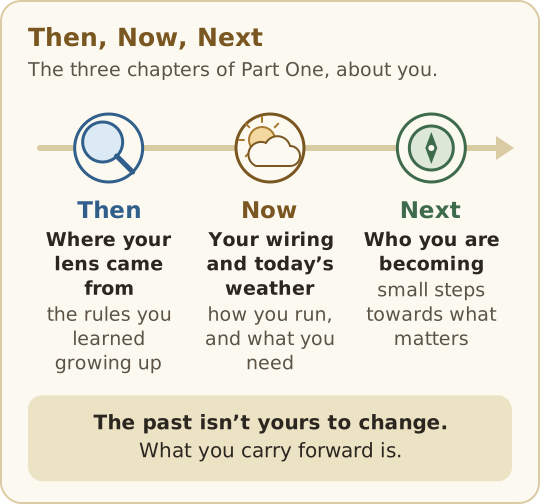
This is where the book begins. Part One (Then, Now and Next) is about you. Part Two (a Preface and Chapters I to V) is about the people you share a life with. Part Three (Chapters 1 to 17) is about how people work. Some printed copies hold only one or two of the parts; every chapter is free to read at spreadloveandacceptance.com/book, and the book at a glance there gives a one-minute tour of the whole thing.
Why you expect what you expect, and how the rules you picked up growing up still make small decisions for you today.
In short:
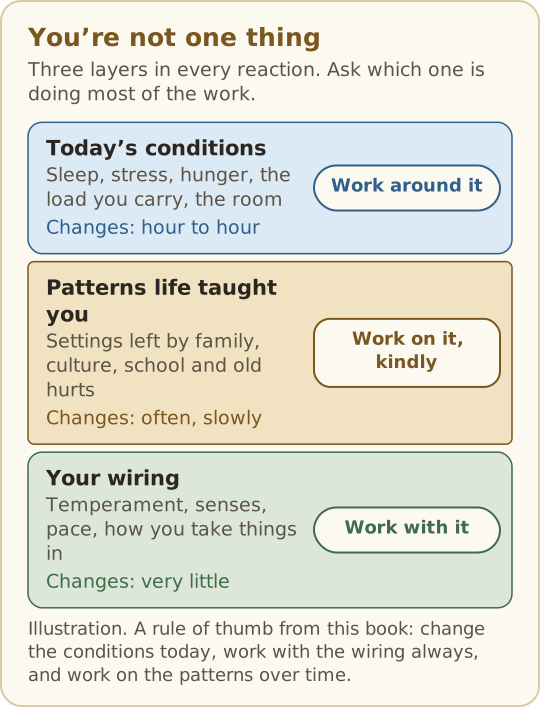
- You’re not one thing. A reaction comes from your wiring (it stays), the patterns life taught you (they can soften) and today’s conditions (they pass). This part is about the patterns.
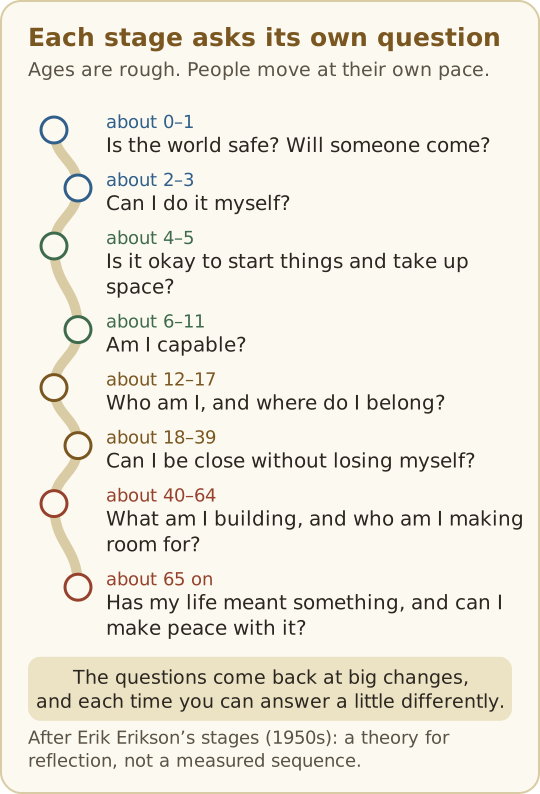
- Your lens came from somewhere: home, school, culture, money and what you lived through. Each stage of growing up asked its own question.
- Some old rules were learned without all the facts, and they can read other people for you: “Whoever notices, does it.”
- Write down the rulebook from home, then choose which rules to keep.
- The past isn’t yours to change. What you carry forward is.
The big ideas: This part mostly teaches “Read your state first” and “Notice the quiet incentives”, with help from “See the whole load” and “Fix the setup, not the person”. What are the five big ideas? (They are five plain ideas the whole program is built on.)
Sunday, 10:15am
Your partner is still in bed and the kitchen is a mess. Before you’ve had a single thought, you feel it: “Of course. It’s always me.” Nobody said that. But in the house you grew up in, whoever noticed the mess cleaned it. That old rule just made a decision for you.
Or, living alone: Since his wife died, Ray’s house is quiet and nobody will see the dishes. He still can’t sit down until every one is done. Nobody is watching. An old rule from the home he grew up in still is.
-
You’re not one thing.
A reaction usually comes from three places at once: how you’re built (your wiring, which stays), what life taught you (patterns, many of which can soften) and what kind of day you’re having (conditions, which pass). This part is about the middle one, the patterns life taught you. Now looks at the other two.
Dig deeper: the three layers -
Your lens came from somewhere.
Family, school, friends, culture, money at home and what you watched all taught you what to expect: of yourself, of other people, and of how a “good” partner, parent or friend behaves. By adulthood your lens doesn’t feel like a lens. It feels like simply seeing. Where your lens came from walks through it, and you can read one card and stop.
Dig deeper: the lens idea -
Each stage of growing up asks its own question.
Is the world safe? Can I do it myself? Am I capable? Where do I belong? Can I be close without losing myself? And later in life: What am I building? Has my life meant something? The ages are rough and people move at their own pace. The answers you landed on can become understandings you keep using as an adult.
Dig deeper: the stages -
When something happened matters.
An experience that touches the question you were answering at the time tends to go deeper. A move at 4 is mostly about routines. A move at 14, in the middle of “Where do I belong?”, can leave a longer feeling of being the outsider. Deeper isn’t permanent, though: people keep learning all their lives.
Dig deeper: why timing matters -
Some old answers were learned without all the facts.
“I’m only okay when I’m useful.” “My needs are a burden.” “Mistakes mean I’m bad.” A child often can’t know what was going on for the grown-ups. They only know how it felt. As an adult, you’re allowed to look again with the full picture. Looking again doesn’t mean deciding it was all fine, because some things really were not okay.
Dig deeper: old answers and fairer readings -
An old rule can read other people for you.
If silence at home meant anger, a partner’s quiet evening can feel like trouble is coming. And an expectation nobody said out loud can’t be agreed to, so the other person can only miss it: “If you loved me, you’d just know.” “Whoever notices, does it.” Each is somebody’s family rule, not a law of nature. Ask before you conclude: “When you went quiet, what was going on for you?”
Dig deeper: rules that read others -
Write down the rulebook from home.
Finish these six lines the way your childhood home would have: “In my family, love looked like…” “When someone was upset, we…” “The jobs were split like this…” “Resting was okay when…” “Asking for help meant…” “The unforgivable thing was…” The rulebook page has room to write them. Nothing is saved except on your own device.
Dig deeper: the six rulebook linesFilled-in example The rulebook from home Nadia, on her own Your rulebook from home
Write a few words on each line, the way the home you grew up in would have finished it. Skip any line you like. Then, for each one, ask: do I still want this rule?
- 1. In my family, love looked like…
- Doing things. Dad fixed your bike; nobody said it.
Do I still want this rule?
- Keep
- Chosen: Soften
- Drop
- 2. When someone was upset, we…
- Went quiet and waited for it to pass.
Do I still want this rule?
- Keep
- Chosen: Soften
- Drop
- 3. The jobs were split like this…
- Mum noticed, planned and remembered. Dad did the big jobs.
Do I still want this rule?
- Keep
- Soften
- Chosen: Drop
- 4. Resting was okay when…
- Everything else was done.
Do I still want this rule?
- Keep
- Soften
- Chosen: Drop
- 5. Asking for help meant…
- You hadn’t planned well enough.
Do I still want this rule?
- Keep
- Soften
- Chosen: Drop
- 6. The unforgivable thing was…
- Breaking a promise.
Do I still want this rule?
- Chosen: Keep
- Soften
- Drop
A made-up example. Names and details are invented.
Fill in your own: The rulebook from home (spreadloveandacceptance.com/
growing-up) -
You get to choose which rules to keep.
For each line, ask: do I still want this rule? When a reaction feels bigger than the moment, try the one-minute lens check once you’ve settled: Where did I learn this? How old does this feel? Is it true here, with this person, now? What would the adult me choose? Later, you can swap rulebooks with someone you trust and choose shared rules on purpose.
Dig deeper: the lens check, and choosing together -
The past isn’t yours to change. What you carry forward is.
You couldn’t control the home you grew up in, what other people did, or what you learned before you had all the facts. What is in your hands now is smaller, and stronger: which old rules you keep, how you treat yourself about them, and where you spend your energy today. That includes people. Give your time and care where they’re met with care, and let one-sided effort shrink back to what feels fair. Matching energy with energy isn’t cold. It protects what you have, so you still have something to give.
Dig deeper: your part, then and now
The ideas, one at a time
Each idea above again, with a real-life example, words you could use and one small step. Read one and stop if you like.
1. You’re not one thing
For example: A grandmother snaps when her grown-up son is late for lunch. Part is her wiring (she likes things on time). Part is an old rule (“late means you don’t care”). And part is that she slept badly.
Words you could use: “Some of this is me being tired, and some of it is an old thing. Give me a minute.”
Try this: Next time you react strongly, ask: is this mostly wiring, something I learned, or just today?
2. Your lens came from somewhere
For example: One friend grew up with big birthday parties, the other with quiet ones. A small dinner feels hurtful to one and perfect to the other.
Words you could use: “In my family this was a big deal. What was it like in yours?”
Try this: Pick one thing you think “everyone” does. Ask one person how their family did it.
3. Each stage asks its own question
For example: Someone who moved schools four times as a teen may still feel like the outsider at every new job.
Words you could use: “I think part of me is still asking whether I belong here.”
Try this: Read the questions above and notice which one still feels loud. That’s all.
4. When something happened matters
For example: Two adult siblings remember their parents’ divorce differently. One was six and remembers new routines. The other was fifteen and remembers feeling torn in half. Both are true. See Family rifts.
Words you could use: “We were different ages when it happened. It makes sense we remember it differently.”
Try this: Think of one big change from growing up. How old were you, and what were you trying to work out?
5. Some old answers were learned without all the facts
For example: A foster carer who learned that “my needs are a burden” finds it hard to ask for respite (a planned break while someone else cares), even when worn out. See Foster and kinship families.
Words you could use: “An old voice says I shouldn’t ask. The adult me thinks asking is fair.”
Try this: Write one old belief about yourself. Under it, write what you’d tell a friend who believed it.
6. An old rule can read other people for you
For example: A housemate leaves without saying goodbye. If quiet meant anger at home, you may think they’re upset. They may just be late for a shift.
Words you could use: “When you went quiet earlier, I wasn’t sure what it meant. Is everything okay?”
Try this: This week, when you catch yourself guessing what someone’s silence means, ask instead.
7. Write down the rulebook from home
For example: Two partners from different faiths both write “holidays belong to my family,” and finally see why December is hard. See Two faiths, one family.
Words you could use: “Here’s a rule I grew up with. I’m not saying it’s right. I just want you to know it’s there.”
Try this: Finish just one of the six lines today. Leave the others for another day.
8. You get to choose which rules to keep
For example: A team leader sees that “mistakes mean I’m bad” makes them hide problems. New rule: “Mistakes are information. We fix them together.”
Words you could use: “I used to think ___. Now I’m choosing ___.”
Try this: Pick one rule from your list and write the version you would like to live by.
9. What you carry forward is yours
For example: Someone living on their own always plans the meetups with one friend, who never asks back. They stop chasing, keep the door open, and see more of the friends who reply. See Always the one reaching out?
Words you could use: “I’d love to see you. Let me know when works for you.”
Try this: Name one relationship where you give far more than comes back, and give a little less this month. (If you are afraid of someone, this isn’t about managing them. Not safe at home? has people to talk to.)
Tuesday morning
Two people get the same text: “Can we talk tonight?” One thinks, “Good, I like knowing ahead.” The other feels their stomach drop, because in the home they grew up in, “we need to talk” meant trouble. Same words. Two different histories.
You, in all your relationships
Your old rules go wherever you go, starting with how you treat yourself.
- With yourself: The voice you use after a mistake is often an old one.
- With a partner, or partners: Who notices, who plans, what quiet means. More than two of you means more than two rulebooks. See More than two partners at home.
- With friends: Who reaches out first, and whether asking feels okay. See Friends.
- With family: Old roles, like the helper or the peacemaker, switch back on at the door. See For grown-up children and Family rifts.
- At work: Praised for being useful? You may say yes to everything, then resent it.
- With housemates: Two rulebooks about mess, noise and guests. See Sharing a room.
- On your own: After a breakup, old rules can get louder. See On my own.
Looking for your own situation? Help by relationship lists them all.
Inside you, and between you
- In you: Ask whether a feeling is the size of this moment or older. Notice what you were praised or scolded for as a child still pulling on you. Holding an old rule in check is real, hidden effort.
- Between you and others: A learned rule is part of the setup, not a flaw in anyone. Say your rules out loud, and choose shared ones.
In the individual program
This part goes with Step 3 of the individual program: write the rulebook from the home you grew up in, and choose one rule you’d like to change. You can do every step on your own.
Your next step: Step 3: see where your lens came from · Where your lens came from · A gentle first week · The whole book on knowing yourself
The fields behind this part
This part draws on 4 of the author’s thirteen fields (the About page lists them all):
- Psychology (Read your state first): The lens you learned, the stages of growing up and the old stories we carry.
- Neurobiology (Read your state first): An old alarm can go off before you’ve had time to think.
- Philosophy (Notice the quiet incentives): Plato’s cave: shadows that feel like the whole world. A rule you never chose can feel like simply how things are.
- Behavioural science (Notice the quiet incentives): What got praised or scolded taught you what to do, and repeating something new teaches a new rule.
Two fields, one idea: Psychology + Neurobiology. How you feel and how your nervous system is running are the same moment, seen from two sides. An old alarm is both a feeling and a body state, so noticing it is the first step.
See how all the fields connect, in the full version · The polymath way
In real life
- Partners: “Of course it’s always me.” You grew up in a house where whoever noticed, did. Naming the old rule out loud, on a calm day, turns a fight about dishes into a talk about who owns what.
- Family: A parent says, “We should talk.” You brace, because quiet meant anger in the house you grew up in. Knowing where the alarm came from, you ask first: “Is this a good talk or a worried one?”
- Housemates: One housemate grew up where help was never asked for, only given. The other grew up where nothing happened unless you asked. Neither is rude. They are using two rulebooks.
- Coworkers: Someone who was praised mostly for being useful says yes to everything, then resents it. Seeing the old rule helps them pause before the next yes.
Common mix-ups
- “Looking back means blaming my family.” It isn’t about blame. Many of the adults who raised us were working with their own lenses too, and if that doesn’t fit your story, you don’t have to make it fit.
- “If it started in childhood, I’m stuck with it.” Deeper isn’t permanent. Many old patterns soften with awareness, safety and practice, and some leave a lasting sensitivity you learn to carry and explain.
- “Every big reaction is an old wound.” Often it’s just a full tank. Sort it first: Chapter III helps tell leftover stress from this-moment stress.
- “My rulebook is normal, so theirs is wrong.” Each is somebody’s family rule. Two rulebooks in one home are a setup to talk about, not a verdict on either person.
- “I have to finish this before I go on.” You don’t. You can read one card and stop, and come back another day.
- “If they won’t look at their rules, there’s no point looking at mine.” There is. Knowing your own rules changes how you react, even if nobody else ever reads a word of this.
A note on care: This part looks back at growing up. It is general education, not a diagnosis or therapy, and it can’t tell you what anyone has. Not every home felt calm or kind, so take only what is useful. If looking back feels heavy, you can stop and come back another day, or explore it with a qualified professional, if and when you want that. Nothing here is required, and nothing you write needs to be shared.
Try this: Think of one “always” or “never” you felt this week.
Ask: whose voice does this sound like, and how old did I feel?
Then write one sentence the adult you would rather live by, and keep it somewhere you’ll see it.
Where your lens came from → Roots & Wings: find where a trait started → The rulebook from home → Know your own wiring → Next in the book: Now →
Last updated: October 2026