Part Two: Between us · Chapter III
Full tanks and different angles: stress and perspective
Why some reactions are bigger than what caused them, and why two people can see the same moment so differently.
In short:
- A full tank overflows. Stress left over from earlier makes small things feel big.
- Check your tank in a minute, and say the band out loud instead of making others guess.
- Two people can see one moment from different angles, and both views can be true.
- A full tank means “later,” not “never”: pause, name a time, and come back.
The big ideas: This chapter mostly teaches “Read your state first”, with help from “Tune how you send and receive”. What are the five big ideas?
Thursday, 5:15pm
They ask, perfectly pleasantly, whether you remembered to call the dentist. Your reaction is much bigger than the question deserved, and you can hear it happening while it happens.
-
A full tank overflows.
If you’re already tired, stretched or stressed from somewhere else, a small question can get a big reaction. That’s human. Anything decided in that moment is worth coming back to once you’ve both calmed down.
For example: A nurse gets home after a night shift. Her housemate asks, “Did you see my message?” She snaps. It wasn’t the message. It was twelve hours on her feet.
Words you could use: “Sorry. That was bigger than the question. I’m running on empty.”
Try this: Notice one moment this week when your reaction was bigger than its cause.
Dig deeper: how full your tank is -
Some stress is left over from earlier.
Ask yourself: how much of this feeling is about the thing in front of me, and how much did I bring in with me? “I’m upset about the dishes” and “I’m exhausted, and the dishes are what I noticed” are different problems.
Some of what we bring in is much older: an understanding from growing up, like “whoever notices the mess has to clean it.” If a feeling seems a lot older than the moment, Where your lens came from helps you find where it started.
For example: A teenager has a hard day at school, comes home, and explodes because a brother took the phone charger. The charger is the last drop, not the whole tank.
Words you could use: “I think I brought this in with me. Give me ten minutes.”
Try this: Before you react, ask: “How much of this is from earlier?”
Dig deeper: leftover stress -
Check your stress tank in a minute.
How much are you carrying? measures how full your stress tank is. A higher score means more stress in the tank. Score five things from 0 to 4: sleep, work elsewhere, any unsettled argument, how your body feels, and time pressure today. Add them up and divide by 20. Under 0.30 is low. From 0.30 up to 0.60 is moderate. 0.60 or more is high. If it has been high for a long time, it can start to feel normal, so a quick reading each week is worth it.
For example: A man caring for his wife after surgery scores 0.65 three days in a row. That tells him he needs help, not more effort.
Words you could use: “I checked my tank. I’m in the high band today.”
Try this: Score yourself tomorrow morning, before you look at your phone.
Dig deeper: the stress-tank score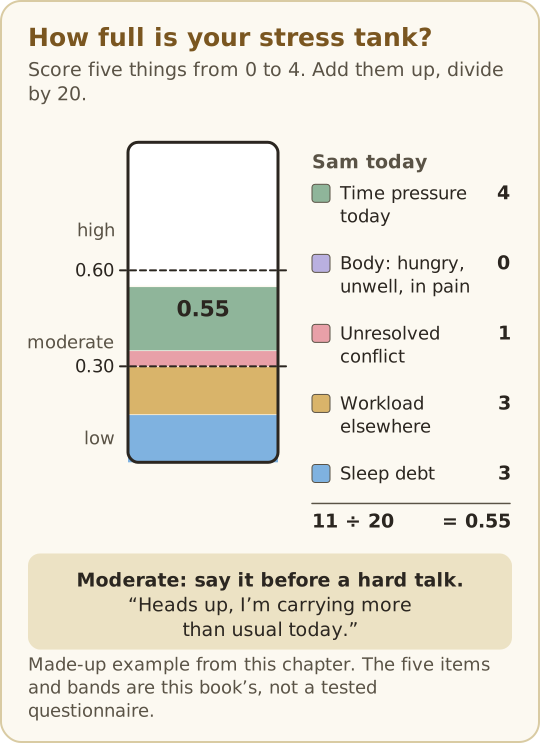
Figure 14 How full is your stress tank? Five things scored 0 to 4, added up and divided by 20. Made-up example; the items and bands are this book’s. Filled-in example How much are you carrying? Rosa, who shares her mum’s care with her brother How much are you carrying?
Fill this in on your own, about yourself only. Never fill it in for someone else.
- Your name
- Rosa
- Date
- 7 October 2026
The checklist
0 = Not at all · 4 = Very true
Sleep debt (less rested than usual)
- 0
- 1
- 2
- Chosen: 3
- 4
Workload elsewhere (job, school, caregiving)
- 0
- 1
- 2
- 3
- Chosen: 4
Recent unresolved conflict (any source)
- 0
- Chosen: 1
- 2
- 3
- 4
Physical state (hungry, sick, in pain)
- 0
- 1
- Chosen: 2
- 3
- 4
Time pressure today specifically
- 0
- 1
- 2
- Chosen: 3
- 4
Your load score
- Your load today
- High load (13 out of 20 points)
- What to do
- Put off anything that doesn’t need deciding in the next hour. If you need to settle first, the Calm-Down Kit is made for this.
- If it can’t wait
- If what you’re carrying can’t wait, like caring for someone who is ill, that’s a sign to get more help, not to try harder: ask one person for one specific thing this week, and look into respite care.
- Filled most by
- sleep debt, workload elsewhere, time pressure today. Conditions, not character.
- Load score
- 0.65 out of 1.00
Optional
✓ Some of what I’m carrying is caring for someone
- Anything you want to name before talking
- Mum’s hospital appointment moved to Thursday, and I’m the one driving.
A made-up example. Names and details are invented. Higher means more load. Rosa scores only herself; her brother fills in his own.
Fill in your own: How much are you carrying? (spreadloveandacceptance.com/
workpapers/ fill/ wp-02) -
Three everyday states.
Calm and connected. Revved up. Running on empty. Knowing which one you’re in tells you whether now is a good time to talk. The Nervous System Ladder, a thirty-second self-check, helps you make a best guess. These labels come from polyvagal theory, whose main claims are still debated by scientists. Here they are only everyday words, not a medical model.
For example: In a long-distance couple, one partner takes the video call at midnight his time. He is often running on empty. They move the hard talks to weekend mornings.
Words you could use: “I’m revved up right now. Can we talk after a walk?”
Try this: Find one body clue for each state, like a tight jaw for “revved up.”
Dig deeper: the three states -
There are seven angles on the same moment.
Tiredness, time pressure, history, what home was like growing up, your sense of fairness, how you communicate, and stress from outside. Many arguments are two people looking from different angles, each sure the other sees what they see. The “See their side” step of Rewind the talk, built on these seven angles, helps you picture how the same moment might look from the other side, with questions to ask instead of guesses.
For example: Planning the holidays, one parent sees it from family habit (“We always go to my mum’s”). The other sees it from fairness (“We went to yours last year”).
Words you could use: “Which angle are you seeing this from?”
Try this: Guess which of the seven angles you look from most often.
Dig deeper: the seven angles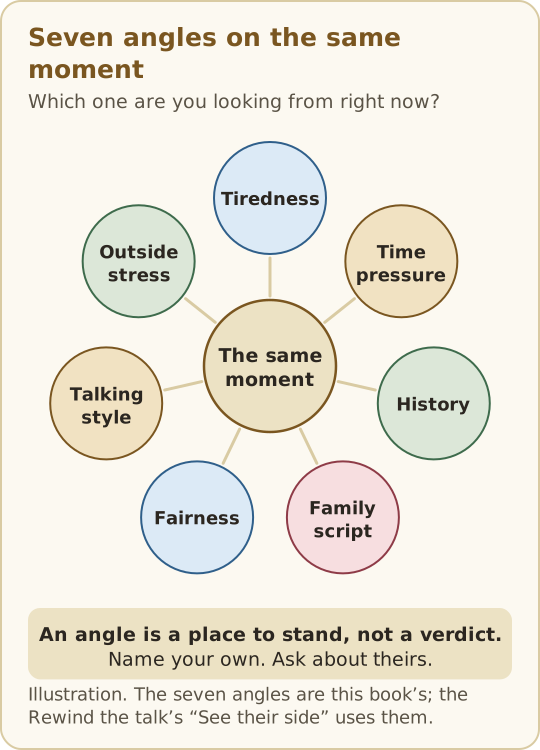
Figure 15 Seven angles on the same moment. An angle is a place to stand, not a verdict: name your own, and ask about theirs. Filled-in example Rewind the talk: see their side Hana, about her friend Lou See their side
- 1. What happened?
- I asked Lou if she was still coming to my birthday dinner, and she just replied “maybe”.
2. Who are they to you?
- Partner
- Family
- Roommate
- Chosen: Friend
- Coworker
- Co-parent
- My teen or child
- Someone else
3. What state might they have been in?
- Calm and connected
- Revved up
- Chosen: Running on empty
- I’m not sure
4. What might have been going on around them?
- A long or hard day
- Chosen: Little sleep
- Rushed or late
- Money worries
- Chosen: Caring for someone
- Not feeling their best
- A noisy or crowded place
- Other people were there
- Chosen: It was a text or message
- It was late at night
5. How are they wired?
- They notice tone a lot
- They take words literally
- Chosen: They need time to process
- They think out loud
- They’re very direct
- They hint rather than say
- They like a plan
- Noise, light or crowds get to them
- Their language or culture differs
6. What history might they carry?
- This has come up before
- They grew up with it done differently
- Chosen: It’s a sore topic for them
- They may feel it’s unfair
7. What could each of you see? They may have seen or known things you didn’t
- their whole day and workload
- Chosen: a message, call or news you didn’t see
- something they had already planned or done
- how it looked from where they stood
- a promise someone else made them
- how they were feeling inside
You may have seen or known things they didn’t
- the planning you had already done
- Chosen: the reason behind your timing
- what you actually meant
- how tired or stretched you were
- the part already done
- a deadline only you knew about
Neither of you could fully see
- Chosen: each other’s tone, in writing
- what was going on in the other’s head
- what would happen next
- what other people had said to each of you
Through their eyes
Running on empty: If they were running on empty, short replies and slow answers are what a tired body does. It can look like not caring when it’s only having nothing left.
Caring for someone: Caring for someone else uses up attention you can’t see. They may have had less to give than usual.
Questions to check, instead of guessing: “How was your day, before this came up?” “Would it help to think about it and come back to it later?”
A sentence to bridge the gap: “I think we may have been seeing this from different places. On my side, I knew about the reason behind my timing, and I’m not sure that came across. I’m wondering whether, for you, you were running on empty. Could we compare notes? I’d like to understand how it looked to you.”
A made-up example. Names and details are invented. These are possibilities to check, not facts about Lou.
Fill in your own: Rewind the talk: see their side (spreadloveandacceptance.com/
perspective-shifter) -
Both views can be true.
You can each be right about what you see and still be looking at different parts of the same thing. The question isn’t “Who’s right?” but “Which angle are you seeing this from?”
For example: Two adult brothers argue about their late mother’s house. One sees memories. The other sees bills. Both are real.
Words you could use: “You’re right about what you see. Can I tell you what I see?”
Try this: Say the other person’s view back to them before you give yours.
Dig deeper: two true views -
Say it instead of making each other guess.
Before a hard conversation, each of you says how full your stress tank is and which angle you’re seeing things from. It works best before you start, not in the middle.
For example: Two coworkers start a tense meeting with one sentence each about their tank and angle. The meeting is shorter, and calmer.
Words you could use: “Before we start: I’m about half full today, and I’m seeing this from the time angle.”
Try this: Use that one-line opener once this week.
Dig deeper: using both together -
A full tank means “later,” not “never.”
A high score is a reason to pause, never a way out of the talk. Say when you’ll come back, and the Calm-Down Kit can help in the meantime. After your calming steps, check your tank again. Under 0.50, go back at the time you said. From 0.50 to 0.59, if you still feel hot, take another round. Still 0.60 or more after two rounds? That’s okay. Pick a new time, and say when.
For example: A dad and his 14-year-old get heated about phone time. He says, “I’m too wound up. Let’s talk at seven.” At seven, he knocks on her door.
Words you could use: “I need a break. I’ll come back at seven. I promise.”
Try this: Whenever you pause, name the time you’ll come back.
Dig deeper: pausing without avoiding
Monday morning
You both look at the same pile of mail on the table. One of you sees a to-do list. The other sees proof that nobody else ever opens the mail. Same pile. Two different pictures.
Words this chapter uses
- Stress tank: how much stress you are already carrying, before this moment even starts.
- Leftover stress: the part of a feeling you brought in from somewhere else, like poor sleep or a hard day.
- This-moment stress: the part caused by what is in front of you right now.
- Angle: the point of view you are seeing a moment from, like tiredness or fairness.
- How much are you carrying?: a free one-minute worksheet that scores your stress tank.
- Calm-Down Kit: a short plan for stepping away well and coming back.
Inside you, and between you
- In you: Know how full your stress tank is, and which angle you are seeing from, before you judge a moment.
- Between you and others: Choose the timing, pause and come back. Your state shapes how the other person’s words land, so say it out loud, and ask which angle they are seeing from.
On your own: reading your own tank
A full tank makes small things feel big. On your own, the most useful habit is a one-minute reading of your battery before you react.
- Check your battery for a few mornings in a row and look for a pattern.
- Before a hard moment, ask yourself how much of this is leftover from earlier.
- Decide on a calm day what settles you, so it’s ready when you need it.
For example: Living alone after a breakup, Bryony noticed she snapped at her sister every Monday. Her mornings showed why: Sunday nights were her worst sleep of the week. See On my own.
Words you could use: “Mondays are hard for me. Can we talk on Tuesday instead?”
In the individual program: Step 1: check your battery · Step 4: plan what settles you · Part One: what settles you · The whole book on staying calm
The fields behind this chapter
This chapter draws on 6 of the author’s thirteen fields (see the Preface or the About page):
- Neurobiology (Read your state first): The autonomic nervous system runs stress and rest without asking you.
- Psychology (Tune how you send and receive): Leftover stress versus this-moment stress, family scripts and communication styles: the angles you see a moment from.
- Philosophy (Tune how you send and receive): Two true views of the same thing (the Blind Men and the Elephant), and the Second Arrow: what happened is the first arrow, and the story we add is the second.
- Holistic therapies (Read your state first): Body first, argument second.
- Behavioural science (Read your state first): Say it before the talk, with a named time to come back. Practise small routines on calm days.
- Economics (See the whole load): A tank that’s nearly full has no room to spare.
Two fields, one idea: Philosophy + Neurobiology. What happened is the first arrow. The story we add is the second. A full stress tank makes that second arrow easier to add, so say your tank and your angle out loud first.
See how all the fields connect, in the full version · The polymath way
In real life
- Partners: After a bad night’s sleep, “What’s for dinner?” sounds like “Why haven’t you taken care of dinner?”
- Family: A parent asks about your job search. They see it from the angle of worry. You see it from the angle of an old pattern: “They’ve never trusted me.”
- Roommates: Loud music at 11pm. One roommate sees it as a fairness issue. The other grew up in a noisy house and honestly didn’t notice.
- Coworkers: A late-night email. The sender was clearing their inbox. The reader, who is already stretched, feels pressure to answer right away.
- Two mums: One comes home from a hard shift to a toddler’s meltdown. Her “I can’t do this” is about the shift, not the toddler or her wife. See Different hours.
- More than two partners: In a home of three, a check-in round where everyone says their tank first stops two people guessing about the third. See More than two.
- Foster and kinship carers: After a contact visit, a child’s tank is often full. A slammed door that evening may be about the visit, not the carer. See Foster and kinship families.
- A child with ADHD: The end of a school day can leave the tank brim full. Big talks go better after food and rest. See When a child has ADHD.
- Two faiths: A festival can mean joy to one partner and pressure to the other. Same day, two angles. See Two faiths, one family.
- Coming out: A parent’s silence may be shock, not rejection. Your own tank may be full for weeks afterwards. See Coming out.
Words you could use: “I think my tank was full before you walked in. Can we start again?”
Common mix-ups
- “A big reaction means it was a big deal.” Sometimes. Often it means the tank was already full.
- “A high score is an excuse.” It’s a note to come back later, not a pass to skip the talk.
- “I can tell how full their tank is.” Only they can say. Each person scores only themselves.
- “Pausing is the same as the silent treatment.” A pause has a time to come back. The silent treatment doesn’t. Always say when.
- “If we see it differently, one of us is wrong.” You may just be standing at different angles.
- “Naming my angle means giving up my point.” It just helps the other person see where your point is coming from.
Words you could use: “I don’t think you’re wrong. I think we’re standing in different places. Can we swap for a minute?”
Two homes: co-parenting after a split
Children carry two homes, and changeover day fills their tank. Being quiet, clingy or cross for a few hours after a handover is common. It usually isn’t a sign that something is wrong at the other home.
- Landing time: a snack, something familiar, and no questions about the other home for the first hour.
- The child is never the messenger. Adult news goes adult to adult.
- Money: follow any formal arrangement. Split the extras by a ratio you agree, keep one list, and settle up once a month.
- With an ex, share the band, not the story: “I’m in a heavy week. Could we swap Wednesday?” Your private life stays yours.
- An ex who won’t cooperate but isn’t dangerous: try parallel parenting. Written messages only, short and business-like, handovers at school, and your own list for your own home.
- New partners: the parent stays the owner of anything involving the other home. A step-parent starts as a friendly adult, not the one who tells the children off.
For example (made up): Harriet gives Freya, 8, and Arlo, 5, an hour of toast and blankets when they come back from their dad’s. She stopped asking “What happened at Dad’s?” at the door. Sunday evenings got calmer.
Words you could use (a business-like message): “Hi Dylan. Freya’s school trip is on 6 November and costs £24. I’ve paid it and put it on the extras list. Thanks, Harriet.”
If you are afraid of your ex, a shared plan isn’t the right tool: see Not safe at home? Dig deeper: two homes, money and step-parents
If only one of you wants to try this
You can do all of this on your own side. Check your own tank. Name your own angle. Pause and come back on time. The other person doesn’t have to use the words for it to help. Often, when one person starts saying it out loud, the other starts to as well.
For example: A daughter visits her dad every Sunday, and every week they clash over his health. She starts each visit with “I’m a bit tired today, so if I go quiet, it’s not you.” He never scores anything. The visits still get calmer.
Words you could use: “I’ve been trying something. I just tell you how my day was before we talk about the hard stuff.”
Try this: Start your next hard talk with one sentence about your own tank, and nothing about theirs.
A note on safety: A full tank explains a reaction. It never excuses shouting, threats or hurting anyone. If someone’s “stress” often turns into fear for you, that isn’t a tank problem. These tools only work when each person feels free to say no, to ask for a pause, or to keep their own notes private. If sharing how you feel ever feels unsafe, or one of you feels you can’t say no, stop using the tools and talk with a trained counsellor on your own. When someone is afraid of their partner, counselling together isn’t advised. Not safe at home? lists free, private hotlines.
More for your situation
Friends · Grown-up children · Family rifts · Co-parenting · Coming home · When one of you is ill · Long distance · Sharing a room · Gaming and time together · For counsellors
Try this: Before your next hard conversation, check how full your own tank is.
Score the five things in How much are you carrying?, add them up and divide by 20.
Then say one sentence out loud, such as: “My stress tank’s about half full today, and I’m mostly seeing this from the time-pressure angle.”
If either of you scores 0.60 or more, put off anything that doesn’t need deciding in the next hour. Agree on a time to come back, and keep it.
My weather today, a one-minute self-check → How much are you carrying? → Rewind the talk: see their side → The Calm-Down Kit →
Last updated: October 2026