Part Two: Between us · Chapter III
Full tanks and different angles
Thursday, 5:15pm
They ask, perfectly pleasantly, whether you remembered to call the dentist. Your reaction is much bigger than the question deserved, and you can hear it happening while it happens.
Both tools in this chapter are self-report tools. That means each person fills them in about themselves. Neither one measures anything automatically, and neither should ever be filled in by one person about the other. That would turn a reflection tool into a way of watching someone, which is exactly what this book is trying to avoid.
In short:
- A full tank overflows. Stress left over from earlier makes small things feel big.
- Check your tank in a minute, and say the band out loud instead of making others guess.
- Two people can see one moment from different angles, and both views can be true.
- A full tank means “later,” not “never”: pause, name a time, and come back.
Where this fits: the five big ideas
The whole program rests on five big ideas. Each one starts inside you and then shows up between you and other people. This chapter mostly teaches “Read your state first”, with help from “Tune how you send and receive”. (Borrowed from neurobiology and psychology.)
- In you: Know how full your stress tank is, and which angle you are seeing from, before you judge a moment.
- Between you and others: Choose the timing, pause and come back. Your state shapes how the other person’s words land, so say it out loud, and ask which angle they are seeing from.
Leftover stress (how full your tank is)
Part of your nervous system runs things without you deciding: heart rate, breathing (though you can also slow it on purpose), and how alert or braced your body feels. Stress from the day collects there, like water in a sponge that can’t take any more.
So the first question in this chapter is simply: how full is your stress tank already, before this conversation even starts? When it’s nearly full, a small drop makes it overflow. That’s why a pleasant question about the dentist can get a reaction much bigger than the question deserved.
A short version lives on the site as the Nervous System Ladder, a thirty-second self-check. The fuller version is How much are you carrying?, which measures how full your stress tank is. A higher score means more stress in the tank.
Leftover stress and this-moment stress
Any strong reaction is made of two parts:
- This-moment stress: the part caused by the thing in front of you right now.
- Leftover stress: the part you carried in from somewhere else, such as a poor night’s sleep, a hard day at work, a worry about money, or an argument that never got settled.
From the outside, the two look the same. From the inside, they need very different things. “I’m upset about the dishes” is a problem about dishes. “I’m exhausted, and the dishes are what I noticed” is a problem about exhaustion. If you treat the second one as the first, you can sort out the dishes perfectly and still feel just as bad.
The Buddha’s Second Arrow fits here. The first arrow is what happened. The second is the extra hurt we add to it: the story we tell ourselves, replayed. A full tank makes that second arrow easier to add, which is one more reason to notice what you brought in with you.
Research note. Researchers call stress that travels from one part of life into another “spillover.” Studies of couples by psychologists Lisa Neff and Benjamin Karney found that when people were under more stress outside the relationship (work, money, health), they tended to react more strongly to everyday problems inside it. The everyday lesson matches this chapter: some of what you feel at home was carried in from outside.
In different homes:
- A night-shift worker and a day worker: Leon gets in at 7am after a night shift, just as his husband is leaving for work. Every small question at that hour lands on a full tank. They agree that 7am is for “hello” and “sleep well,” and plans wait for the evening. See Different hours.
- A dad and a 16-year-old: She comes home and snaps at his “How was your day?” Much of it is a hard day with friends, not him. A snack and twenty minutes before any questions changes the evening. See Teens.
- Coworkers: A manager carries a tense budget meeting into a one-to-one, and a small question about a deadline gets a sharp answer. Saying “I’ve just come out of a hard meeting” first would have changed how it landed. See At work.
Mix-ups, and how to fix them:
- “If it’s leftover, it isn’t real.” It’s real. It just needs a different fix: rest, food, a walk, or help with the outside problem.
- “My leftover stress means you have to tiptoe around me.” No. It means you name it, and you own the repair.
- “It’s all leftover, so the dishes don’t matter.” Once you’ve rested, check again. Often a smaller version of the issue is still there, and it deserves a calm talk too.
Words you could use: “Some of this is about today, and some of it I carried in. Give me a minute to work out which.”
The three everyday states
The Nervous System Ladder describes three states that most people will recognise:
| State | What it can feel like | What it’s good for |
|---|---|---|
| Calm and connected | Easy breathing. You can hear something hard without getting defensive. | Hard conversations, planning, making agreements |
| Revved up | Quick heartbeat, fast thoughts. Small things feel urgent or personal. | Getting things done. Not a good time to settle a disagreement. |
| Running on empty | Flat, foggy or far away. Words are hard to find. | Rest. Big decisions can wait. |
These labels come from polyvagal theory (ventral vagal, sympathetic and dorsal vagal), whose main claims are still debated by scientists. Here they are only everyday words, not a medical model. You never need the terms. “Running on empty” just means everyday tiredness. Any self-check is a best guess, not a reading. My weather today, a one-minute self-check, offers the same check in weather words: “clear” (calm), “gusty” (revved up) and “fogged in” (running on empty).
The reasoning. When your body is revved up, it is getting ready to deal with a threat, not to listen. Hard conversations need listening. So the state you are in shapes how the talk will go before anyone says a word. That’s why this book asks you to read your state first.
Research note. Psychologist John Gottman, who studied couples in conflict for decades, described “flooding”: some people’s heart rate and stress rise so far during an argument that they can no longer take in what is being said. His advice was a real break of at least about twenty minutes, spent doing something calming rather than rehearsing the argument. This is a separate idea from polyvagal theory, and it fits the “revved up” row above.
In different homes:
- A kinship carer and a 9-year-old: After a contact visit with his mum, a boy is either wound up or very flat. His grandmother saves homework and questions for later, and starts with a quiet routine. See Foster and kinship families.
- A parent and a child with ADHD: A meltdown is the revved-up row in full. Teaching and consequences go better later, once the child is calm. See When a child has ADHD.
- A grown-up daughter and her father: He calls at the end of her long day with advice about the baby. Running on empty, she hears criticism. She asks to call back on Saturday morning. See For grown-up children.
Mix-ups, and how to fix them:
- “I can tell which state you’re in.” You can notice signs. Only they can say. Ask, don’t tell.
- “Calm means not upset.” You can be sad or angry and still calm enough to talk. Calm is about being able to listen.
- “Running on empty means lazy.” It’s a low-power mode, not a choice. Rest is the fix, not pressure.
Words you could use: “I think I’m revved up. I want to hear you, and I can’t yet. Can I have twenty minutes?”
The stress-tank score, step by step
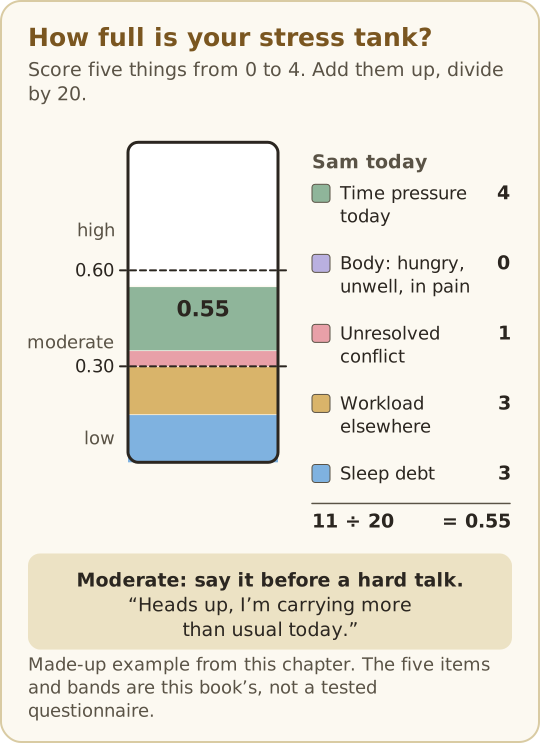
In How much are you carrying?, you score five things from 0 (not at all) to 4 (very true), thinking about the last day or two:
- Sleep debt: I’m less rested than usual.
- Workload elsewhere: work, study or caring for someone.
- Unresolved conflict: from any part of life.
- Physical state: hungry, unwell or in pain.
- Time pressure: today in particular.
Add the five scores and divide by 20. That gives a number from 0 to 1:
- Under 0.30, low load: Whatever comes up is probably about the thing itself.
- 0.30 up to 0.60, moderate: Say it out loud before a hard conversation: “Heads up, I’m carrying more than usual today.”
- 0.60 or more, high: Be gentle with yourself, and put off anything that doesn’t need deciding in the next hour.
Example. Sam slept badly (3), had a heavy week at work (3), has a small unsettled disagreement with a friend (1), feels fine physically (0), and has a lot on today (4). That’s 11. 11 ÷ 20 = 0.55, the moderate band. Alex slept okay (1), has an ordinary work week (2), no unsettled conflict (0), feels fine (0), and has a fairly normal day (2). That’s 5. 5 ÷ 20 = 0.25, the low band.
So before they talk about the dentist, Sam says, “Heads up, I’m carrying more than usual today.” That one sentence can change how Alex hears everything that follows.
In different homes:
- A partner with a long-term illness: The body item may be 3 or 4 every day. A 0.55 might be a good week. Compare with your own usual, and say so: “0.55, which is good for me.” See When one of you is ill.
- New parents: The sleep item may sit at 4 for months. Add the context, so the reading isn’t heard as a complaint about the baby or each other. See New parents.
- Coming home after time away: After deployment or months working away, the score can be high even in happy weeks. A homecoming is a big change too. See Coming home.
Mix-ups, and how to fix them:
- “They never do it, so I’ll score them.” Never. Invite them once, and score only yourself.
- “0.59 is fine and 0.61 is a crisis.” The bands are rough guides. Read the trend, not the border.
- “A high score shows whose fault it is.” It shows how full a tank is. It says nothing about blame.
If only one of you is on board: Score yourself and share only the band. You don’t need the other person to join in for this to change a conversation.
Research note. This site’s idea: the five items and the three bands were chosen for this book. They are not a tested questionnaire, like the Perceived Stress Scale that researchers use. Sleep is the first item for a reason: sleep studies have found that after a short night, people tend to react more strongly to upsetting events and find it harder to read other people’s feelings.
Words you could use: “I scored 0.55 today, mostly sleep. Just so you know, it’s not about you.”
How much are you carrying?
Fill this in on your own, about yourself only. Never fill it in for someone else.
- Your name
- Rosa
- Date
- 7 October 2026
The checklist
0 = Not at all · 4 = Very true
Sleep debt (less rested than usual)
- 0
- 1
- 2
- Chosen: 3
- 4
Workload elsewhere (job, school, caregiving)
- 0
- 1
- 2
- 3
- Chosen: 4
Recent unresolved conflict (any source)
- 0
- Chosen: 1
- 2
- 3
- 4
Physical state (hungry, sick, in pain)
- 0
- 1
- Chosen: 2
- 3
- 4
Time pressure today specifically
- 0
- 1
- 2
- Chosen: 3
- 4
Your load score
- Your load today
- High load (13 out of 20 points)
- What to do
- Put off anything that doesn’t need deciding in the next hour. If you need to settle first, the Calm-Down Kit is made for this.
- If it can’t wait
- If what you’re carrying can’t wait, like caring for someone who is ill, that’s a sign to get more help, not to try harder: ask one person for one specific thing this week, and look into respite care.
- Filled most by
- sleep debt, workload elsewhere, time pressure today. Conditions, not character.
- Load score
- 0.65 out of 1.00
Optional
✓ Some of what I’m carrying is caring for someone
- Anything you want to name before talking
- Mum’s hospital appointment moved to Thursday, and I’m the one driving.
A made-up example. Names and details are invented. Higher means more load. Rosa scores only herself; her brother fills in his own.
Fill in your own: How much are you carrying? (spreadloveandacceptance.com/
How it feeds the Chapter II check
The average of both people’s stress-tank scores is the stress input in Chapter II’s setup score. In the example above, the average is (0.55 + 0.25) ÷ 2 = 0.40. It counts against the result, as 1 − 0.40 = 0.60, which is then weighted at 25%. A way of sharing the work that only holds up when everyone is rested isn’t one that can last.
When “full” has become normal
A tank that stays full for months can start to feel like how things are. “I’m fine” may then mean “I stopped noticing.” Minds get used to whatever stays the same, including a heavy load, so a reading each week, rather than only on a bad day, can show a baseline you have adapted to. It is a quiet form of complacency with yourself. When you share a reading, add a line of context (“this has been building since March”) so the other person can tell a bad day from a long stretch.
Research note. Psychologists call getting used to a steady situation “adaptation.” It helps people cope, but it also means a heavy load can stop feeling heavy, even while it wears you down. That is why this book suggests a reading each week, not only on bad days.
In different homes:
- A long-term carer: After three years of caring for his mother, a man says “I’m fine” and means it. His weekly readings sit around 0.60 for months. See Caregivers.
- An empty nest: When the children leave, a couple find the tension they blamed on the busy house is still there, or that the quiet itself feels heavy. See Empty nest.
- A family rift: For someone who no longer sees a parent or sibling, the holidays fill the tank every year, as reliably as the calendar. Knowing that helps you plan. See Adult siblings and family rifts.
Words you could use: “This isn’t a bad day. It’s been building since spring, and I’ve only just noticed.”
What a high reading asks of you
A high reading isn’t an excuse, and it isn’t a diagnosis. It’s a note to both people: whatever gets decided in the next ten minutes should probably be looked at again later, when the tank is less full.
It means “later,” never “never.” The Calm-Down Kit helps you step away well. Say how you feel, how long you need and when you’ll be back. Use your calming steps. Then check your stress tank again. The kit’s guide is simple: under 0.50, go back at the time you said. From 0.50 to 0.59, if you still feel hot, take another round. Still 0.60 or more after two rounds? That’s okay. Pick a new time, and say when. (The 0.50 is a come-back line inside the moderate band, which runs from 0.30 to 0.60: you don’t need a light tank to come back, just one that is less than half full. The 0.60 is the same high line this book uses everywhere else.)
Why naming a time matters. The person left behind needs to know it’s a pause, not a door closing. Without a time, a pause can feel like rejection, and the one who wants to talk now tends to follow, which fills both tanks. When one of you chases and one withdraws covers that pattern.
In different homes:
- Separated co-parents: They agree no hard talks at the handover, in front of the children. Anything tricky waits for a set call on Wednesday evening. See Co-parenting.
- Business partners: A heated disagreement about hiring. “Let’s sleep on it and decide at ten tomorrow” saves the decision from two full tanks.
- Friends: A text exchange turns sharp. “I want to answer this properly. Can I call you Saturday?” beats a reply typed while revved up. See Friends.
Mix-ups, and how to fix them:
- “A pause is the same as the silent treatment.” A pause has a reason, a time and a return. The silent treatment has none of them.
- “When we come back, we pick up exactly where we left off.” Start instead with what each of you understood, and what you want now.
- “It’s always the same one of us who needs the pause.” Either person can ask. If one always does, that is worth a calm talk on its own.
If only one of you is on board: You can still pause and come back on time. If the other person follows you, say the time again, calmly, and step outside if you need to.
A note on safety: If you are afraid of what will happen when you come back, or you aren’t allowed to pause (you are blocked from leaving, followed, or punished for it), this isn’t about timing. Leaving to stay safe never needs a time to return. Not safe at home? lists free, private hotlines.
Words you could use: “I want to get this right, and I can’t right now. Can we talk at eight? I’ll come and find you.”
Seven angles on the same moment
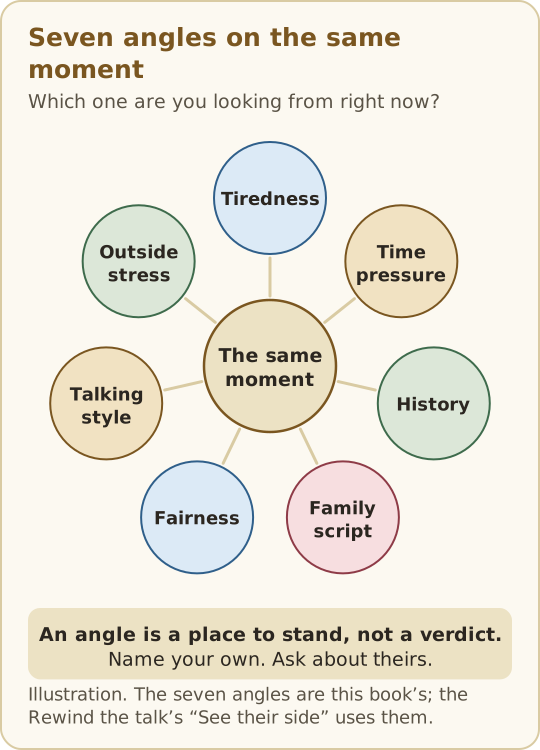
The second idea in this chapter is the angle you might be looking at a moment from. Many arguments happen because two people are each looking at the same event from a different angle, and each assumes the other sees what they see.
Here are the seven, each with a question to ask yourself. The “See their side” step of Rewind the talk, built on these seven angles, helps you picture how the same moment might look from the other side, with questions to ask instead of guesses. To learn your own usual angle, and someone else’s, the style quiz in How you connect gives each of you a four-letter Wave Code you can compare.
- Physical tiredness. How rested am I, really, right now?
- Time pressure. Whose week is genuinely fuller? Am I seeing this through a lack of time?
- History. Has this exact friction come up before? Am I reacting to today, or to the last five times?
- Family script. What did “normal” look like in the home I grew up in? Who did this job there?
- Sense of fairness. Does the split feel fair to me, whatever the hours say?
- Communication style. Do I say things directly, or do I hint and expect the other person to pick it up? Some people say exactly what they mean. Others lean on tone and context. Neither is wrong, but they often miss each other.
- Outside stress. Is money, work, health or anything outside this relationship shaping how I see this?
Research note. Psychologists Lee Ross and Andrew Ward described “naive realism”: most of us feel we see the world as it really is, so people who disagree must be missing something. Edward Jones and Richard Nisbett (1971) described how we tend to explain our own actions by the situation (“I was tired”) and other people’s by their character (“they’re careless”). Naming your angle works gently against both habits.
The angles in different homes:
- Family script, two faiths: One partner grew up with a big religious festival at home; the other didn’t. The same week is a joy to one and a pressure to the other. See Two faiths, one family.
- Fairness and outside stress, money: One person sees a purchase from the angle of security, the other from fairness. See Money together.
- Time pressure, gaming: An evening of gaming is rest to one person and absence to the other. See Gaming, phones and time together.
- Family script, coming out: A parent’s first reaction often comes from the home they grew up in, not from who you are. See Coming out.
Mix-ups, and how to fix them:
- “My angle is the right one.” An angle is a place to stand, not a verdict.
- “You’re just seeing it from your family script.” Naming someone else’s angle for them often sounds like a put-down. Fix: name your own, and ask about theirs.
Words you could use: “I think I’m seeing this from the history angle. It’s come up before. What angle are you seeing it from?”
See their side
- 1. What happened?
- I asked Lou if she was still coming to my birthday dinner, and she just replied “maybe”.
2. Who are they to you?
- Partner
- Family
- Roommate
- Chosen: Friend
- Coworker
- Co-parent
- My teen or child
- Someone else
3. What state might they have been in?
- Calm and connected
- Revved up
- Chosen: Running on empty
- I’m not sure
4. What might have been going on around them?
- A long or hard day
- Chosen: Little sleep
- Rushed or late
- Money worries
- Chosen: Caring for someone
- Not feeling their best
- A noisy or crowded place
- Other people were there
- Chosen: It was a text or message
- It was late at night
5. How are they wired?
- They notice tone a lot
- They take words literally
- Chosen: They need time to process
- They think out loud
- They’re very direct
- They hint rather than say
- They like a plan
- Noise, light or crowds get to them
- Their language or culture differs
6. What history might they carry?
- This has come up before
- They grew up with it done differently
- Chosen: It’s a sore topic for them
- They may feel it’s unfair
7. What could each of you see? They may have seen or known things you didn’t
- their whole day and workload
- Chosen: a message, call or news you didn’t see
- something they had already planned or done
- how it looked from where they stood
- a promise someone else made them
- how they were feeling inside
You may have seen or known things they didn’t
- the planning you had already done
- Chosen: the reason behind your timing
- what you actually meant
- how tired or stretched you were
- the part already done
- a deadline only you knew about
Neither of you could fully see
- Chosen: each other’s tone, in writing
- what was going on in the other’s head
- what would happen next
- what other people had said to each of you
Through their eyes
Running on empty: If they were running on empty, short replies and slow answers are what a tired body does. It can look like not caring when it’s only having nothing left.
Caring for someone: Caring for someone else uses up attention you can’t see. They may have had less to give than usual.
Questions to check, instead of guessing: “How was your day, before this came up?” “Would it help to think about it and come back to it later?”
A sentence to bridge the gap: “I think we may have been seeing this from different places. On my side, I knew about the reason behind my timing, and I’m not sure that came across. I’m wondering whether, for you, you were running on empty. Could we compare notes? I’d like to understand how it looked to you.”
A made-up example. Names and details are invented. These are possibilities to check, not facts about Lou.
Fill in your own: Rewind the talk: see their side (spreadloveandacceptance.com/
Two true views of the same thing
In the old story of the Blind Men and the Elephant, each man touches one part of an elephant and describes it honestly. One says it’s like a pillar, another like a rope. They argue, because each thinks his part is the whole animal. In one old telling, a king who can see watches the whole elephant. Each man is right about his part and wrong about the whole, and there is still only one elephant. Putting your two views side by side is how you get closer to the king’s view.
Take a pile of unopened mail on the kitchen table. One person is looking from the angle of time pressure: “This is a to-do list, and I don’t have time.” The other is looking from the angle of history and fairness: “I’m always the one who opens it.” Both are right about what they see. Naming the angles turns an argument about who is right into a talk about two real concerns.
Where “both true” stops. Both views can be true when they are two honest views of the same thing. It doesn’t apply to facts you can check (the bill was paid or it wasn’t). And it never means that harm is just a point of view. If one person is hurting or frightening another, that isn’t two angles. Not safe at home? can help.
In different homes:
- Adult siblings after a will: One sees the money from the angle of fairness. The other sees it as recognition for years of care. Both are describing something real. See Adult siblings and family rifts.
- A grandmother and her son, about the new baby: She sees helping. He sees his choices as a parent being second-guessed. See Grandparents and For grown-up children.
- Two friends: “You never call” comes from hurt. “I’m drowning with a newborn” comes from exhaustion. Neither cancels the other. See Friends.
A common mix-up: “If both views are true, we can never decide.” You still decide. You just decide with both concerns on the table.
Words you could use: “You’re right about the part you can see. Here’s the part I can see. What would cover both?”
Using both together
The stress-tank check asks, how full is each person’s stress tank? The seven angles ask, what does each person think this is really about?
Used before a conversation, not during one, they replace two people guessing at each other’s inner state with two people simply saying it. A two-minute opening might sound like this:
“Before we start: my stress tank’s at about 0.55 today, so I’m carrying more than usual, and I think I’m mostly seeing this from the time-pressure angle.”
“Thanks. I’m at about 0.25. For me it’s more the history angle. This has come up a few times.”
Now both people know that one of them is stretched and the other is tired of a repeating pattern. The conversation that follows is about both of those things, not about who raised their voice.
In different homes:
- More than two partners: A short round where each person says their tank and angle, and nobody answers until everyone has spoken. It stops two people guessing about the third. See More than two partners at home.
- A parent and a teenager: Keep it simple: a number from 1 to 10 and one word. “Seven. School.” See Teens.
- Coworkers: Green, yellow or red at the start of a meeting works as well as a number, and keeps private details private.
- A long-distance couple: Start the call with tanks, because you can’t see each other’s day. See Long distance.
If only one of you is on board: Say yours anyway, and don’t ask for theirs. One person saying it out loud already replaces some of the guessing.
A worked example: the dentist, replayed
Back to Thursday at 5:15pm. Alex asks whether Sam called the dentist. Sam snaps.
Without the tools: Alex hears the snap and thinks, “All I did was ask.” Sam feels guilty and defensive. The dentist, the snap and an old argument about who remembers things all get tangled together.
With the tools: Sam notices the reaction was too big and says, “Sorry, that was more than the question deserved. I’m carrying more than usual today.” Alex says, “Okay. Is now a bad time?” Sam says, “Can we talk at eight? I’ll have eaten by then.” At eight, Sam explains the angle: time pressure. The dentist call gets a named owner and a day. It takes five minutes.
A second worked example: after a contact visit
Jen is a foster carer. Jayden, who is 13, comes back from a visit with his birth family and slams his bedroom door.
Without the tools: Jen, tired after a long day, shouts up the stairs: “Not in this house, you don’t.” Jayden shouts back. Both tanks overflow, and the evening is about the door.
With the tools: Jen checks her own tank first: about 0.50, a long day. She doesn’t score Jayden, but she knows contact days are heavy. She knocks and says, “Rough day. I’m making toast. Come down when you’re ready.” An hour later Jayden comes down and says, “I’m like a nine out of ten.” They talk about the door at the weekend, briefly, and about the visit when he’s ready. See Foster and kinship families.
Two homes: co-parenting after a split
When parents live apart, children carry two homes, and the adults carry a new kind of shared work: handovers, school, health, money and a lot of messages. This section covers the everyday side for parents who are both safe to deal with, including when the other parent is hard work. If you are afraid of your ex, a shared list or a joint plan isn’t the right tool: see Not safe at home?
Transition days, from the child’s side
Changeover day is a big day for a child, even a happy one. They leave one parent and one bedroom, and arrive at another set of rules and routines. Many children are quiet, clingy, cross or tearful for a few hours, or a day, after a handover. That usually isn’t a sign that something is wrong in the other home. It’s the stress of the switch: a tank filling up, the idea at the heart of this chapter.
- Give landing time. A snack, a familiar programme, and no questions about the other home for the first hour.
- Keep a few things in both homes (toothbrush, pyjamas, a charger, a spare school jumper), so the bag carries only what has to travel.
- The child isn’t the messenger. Adult information goes adult to adult, never “Tell your dad…”
- Let them love both homes. Being glad to see the other parent isn’t disloyalty to you. Say so out loud.
- Give age-sized jobs. A five-year-old can own putting the comfort toy in the bag. An eight-year-old can own the reading folder and PE kit, with a checklist taped inside the bag.
- Different rules in each home are okay. Children manage different rules at school and at Grandma’s. What hurts most is adults running each other down or arguing in front of them, not a different bedtime.
Money between homes
Children cost money in both homes, and the extras (school trips, shoes, clubs, presents for friends’ parties) are where many money rows start.
- Keep formal arrangements separate. If you have a child maintenance arrangement or a court order, follow it. What follows is for the extras on top.
- Agree a ratio for the extras, such as half each, or in line with your incomes (say 60/40). Write it down once.
- Keep one shared list of costs, with a photo of each receipt, and settle up once a month. Not after every purchase, and never at handover.
- Agree a “check first” amount: “Anything over £50 for the children, we ask before buying.” Under that, each home just buys what’s needed.
- Decide about clothes. Do clothes travel, or does each home keep its own? Who replaces school uniform? Clothes are a known trouble spot.
For example (made up): Harriet and Dylan split the children’s extras 60/40, with Dylan paying the larger share because he earns more. In October, Harriet paid £84 (a school trip and shoes) and Dylan paid £36 (swimming). The extras came to £120, so Dylan’s 60% share is £72, and he sends Harriet £36. One line, once a month, by message.
What to share with an ex, and what to keep
This book often asks you to share how full your tank is, and your context. With an ex, keep the sharing to what the children’s care needs.
- Share: the children’s health, school, sleep, worries and plans; changes to times; anything the other home needs to know to look after them well.
- Share the band, not the story: “I’m in a heavy week. Could we swap Wednesday?” is enough. You don’t owe the reasons.
- Keep: your new relationship, your money beyond the children’s costs, your feelings about the split and old arguments. Those are yours.
When your ex won’t cooperate, but isn’t dangerous
Some ex-partners are slow to reply, cold, or say no to everything. That is hard, and it isn’t the same as being unsafe. For this middle ground, many families move from close co-parenting to parallel parenting: each home runs its own way, with only as much contact as the children’s care needs.
- Written contact only, through one channel (a shared email, a co-parenting app or a shared calendar), at set times, and not late at night.
- Business-like messages: short, factual, friendly and firm. One topic per message. No history, and no opinions about their parenting.
- Wait before you answer a sharp message. Unless it’s urgent for the children, reply the next day, and answer only the part about the children.
- Hand over somewhere neutral, like school or nursery, so you don’t need to meet.
- Keep your own list for your own home. If they won’t share a job list, keep one for your weeks. You can only own your side.
Words you could use (a business-like message): “Hi Dylan. Freya’s school trip is on 6 November and costs £24. I’ve paid it and put it on the extras list for this month. Thanks, Harriet.”
New partners and step-parents
When a new partner joins one home, there is a third adult on the list, and feelings on all sides.
- The parent stays the owner of the jobs that involve the other home: messages, decisions and handovers. The new partner can be a helper or a backstop, never the messenger.
- Step-parents go slowly. Closeness in stepfamilies usually builds slowly. A step-parent tends to do best starting as a friendly adult and leaving discipline to the parent at first.
- Tell the other home about big changes that affect the children, such as someone moving in, in a short, plain message.
- Children may feel torn. Liking a step-parent can feel like betraying the other parent. Tell them they don’t have to choose.
See Blended families and stepfamilies and Co-parenting for much more.
A worked example: Harriet and Dylan
Made up. Harriet and Dylan separated two years ago. Freya, 8, and Arlo, 5, spend weekdays with Harriet, and alternate weekends plus Wednesday nights with Dylan. Dylan’s partner, Imogen, has just moved in with him.
Sunday evenings were the hard part. Arlo came back tearful and wouldn’t eat; Freya was snappy. Harriet used to ask, “What happened at Dad’s?”, which made it worse. Now she gives them an hour of landing time: toast, their own blankets, one familiar programme. By bath time they’re usually themselves again.
Dylan doesn’t answer most messages for days, so Harriet stopped trying to plan everything together. They now use one shared calendar and a monthly email for the extras list, and Harriet keeps her own job list for her weeks. When Imogen started doing the Wednesday pick-ups, Dylan sent a two-line message to say so, and Harriet told the school. Imogen doesn’t tell the children off. She plays board games with them, and Arlo has started asking if she’s coming.
Harriet’s stress tank on changeover Sundays used to sit around 0.65. After two months of the new routine, it’s nearer 0.40. She hasn’t changed Dylan. She has changed her side.
Common mix-ups, and how to fix them
- “If the children are upset after a handover, something is wrong at the other house.” Usually it’s the change itself. Watch the pattern over weeks, not one Sunday, and ask gently later, not at the door.
- “Parallel parenting means giving up.” It’s a calmer way to share the children when working closely together keeps going badly. Many parents move back towards working together later.
- “Being open with my ex means sharing everything.” Share what the children need. The rest is yours.
If only one of you is on board: Run your own home well: landing time, your own job list, business-like messages and one money list. Children feel that steadiness.
Research notes
Robert Emery (1982) reviewed evidence that conflict between parents, married or divorced, is linked to children’s problems, and that the amount and kind of conflict matter. Paul Amato’s (2001) meta-analysis found that children of divorced parents did a little worse on average than children of continuously married parents, with small differences, and Mavis Hetherington and John Kelly (2002) found that most children of divorce turned out reasonably well. Eleanor Maccoby and Robert Mnookin (1992), following more than a thousand separating families, described three patterns of co-parenting: cooperative, conflicted and disengaged. Patricia Papernow (2013) describes how closeness in stepfamilies builds slowly. This site’s idea: landing time, the extras list with a monthly settle-up, and “share the band, not the story.”
Your part, and only your part
Your stress tank is the only one you can empty. You can’t calm someone else’s tank for them, and pouring yours into theirs leaves two empty tanks. Protect yours: rest, say “later,” and give energy where it’s met. When both tanks are full, the kindest thing you control is the timing.
The idea runs through the whole book: you can only do what’s in your control, and you protect your own energy by matching energy with energy, giving in proportion to what comes back, with room for seasons when someone can’t. Part One covers it in full: your circle of control, and matching energy.
When only one of you is on board
Everything in this chapter works from one side:
- Read your own tank before a hard talk.
- Name your own angle, and ask about theirs without guessing.
- Pause with a time, and come back when you said.
- Repair your own part when your reaction was bigger than the moment.
Often, once one person starts saying it out loud, the other picks it up without being asked.
Words you could use: “I’ve started telling you how my day was before we talk about hard things. You don’t have to do it too.”
On your own: reading your own tank
A full tank makes small things feel big. On your own, the most useful habit is a one-minute reading of your battery before you react.
- Check your battery for a few mornings in a row and look for a pattern.
- Before a hard moment, ask yourself how much of this is leftover from earlier.
- Decide on a calm day what settles you, so it’s ready when you need it.
For example: Living alone after a breakup, Bryony noticed she snapped at her sister on the phone every Monday. A week of morning readings showed why: Sunday nights were her worst sleep. She moved their calls to Tuesday. See On my own.
Words you could use: “Mondays are hard for me. Can we talk on Tuesday instead?”
In the individual program: Step 1: check your battery · Step 4: plan what settles you · Part One: what settles you The Individual package puts every workpaper for the path into one fillable PDF, with a report written just for you. · The whole book on staying calm
Where the thirteen fields meet in this chapter
This chapter draws on 6 of the author’s thirteen fields (see the Preface or the About page). Here is what each one brings, and which of the five big ideas it serves.
| Field | What it brings here | Big idea |
|---|---|---|
| Neurobiology | The autonomic nervous system runs stress and rest without asking you. Its three everyday states are a handy way to describe a reaction that’s much bigger than the question deserved. | Read your state first |
| Psychology | Leftover stress versus this-moment stress, family scripts and communication styles: the angles you see a moment from. | Tune how you send and receive |
| Philosophy | Two true views of the same thing. The Blind Men and the Elephant, and the Buddha’s Second Arrow: the first arrow is what happened, and the second is the extra hurt we add with the story we tell ourselves. | Tune how you send and receive |
| Holistic therapies | Body first, argument second. A full tank means “later,” and the Calm-Down Kit helps you come back. | Read your state first |
| Behavioural science | Self-report, said before the talk, with a named time to return. When we’re stressed, we tend to fall back on habits, so it helps to practise small routines on calm days. | Read your state first |
| Economics | Capacity again: a tank that’s nearly full has no room to spare, so a small drop overflows. | See the whole load |
How they connect
The word in brackets is the root the two fields share; the polymath page explains all seven. From the most obvious connection to the most abstract:
- Obvious: Neurobiology + Psychology (state and setting). Any strong reaction is part this moment and part leftover. From the outside they look the same; from the inside they need different things. Naming which is which is reading your state first. This holds up “Read your state first”.
- Hidden: Philosophy + Psychology (signal and noise). Each person describes honestly the part of the elephant they’re touching. Naming your angle turns “who’s right?” into two real concerns you can both hear. This holds up “Tune how you send and receive”.
- Abstract: Philosophy + Neurobiology (state and setting). The first arrow is what happened. The second is the extra hurt we add with the story we tell ourselves. A full tank makes that second arrow easier to add. Noticing it is part of reading your state first. This holds up “Read your state first”.
The body tells you how much stress is in the room, and the mind tells you what each person thinks this is really about.
Connect any two fields yourself · Ask Professor Puddles how all thirteen connect
When it goes wrong, and when it goes right
When it goes wrong, one person says, “You’re obviously stressed,” as a way of dismissing what the other said. Or someone uses a high score every time a hard subject comes up, so the subject never gets talked about.
When it goes right, each person names their own tank and their own angle. High scores lead to a named time to come back, and that time is kept. Over a few weeks, you both learn which angles you tend to see from, and you start to allow for them.
Questions people often ask
Isn’t this just making excuses for bad behaviour?
No. A full tank explains a reaction. It doesn’t excuse it. A kind repair, such as “That was more than the question deserved,” is still part of the job.
What if my score is high every day?
Then the load itself may need to change, which is what Chapter II and One owner per job help with. If you feel run down most days for weeks, or often feel numb, far away or panicky, it’s also worth talking to a doctor or counsellor.
Can I guess which angle the other person is using?
You can ask, gently: “Which angle are you seeing this from?” But let them answer. A guess about someone else’s angle often turns into a judgment of them.
Where can I talk this through?
Professor Puddles, the site’s friendly chat host, can help you work out your own tank and angle before a talk.
Does this work with children?
Yes, in simpler words. Young children can use weather words (“stormy,” “foggy,” “sunny”) or a number from 1 to 10. You score yourself out loud, which shows them how. See When a child has ADHD and Teens.
What if one of us is neurodivergent?
States and angles may show differently on the outside, and faces can be hard to read either way. That’s one more reason to say your tank out loud rather than guess. See Neurodivergent relationships.
Can a counsellor use this with a group?
Yes, as long as each person scores only themselves and can pass. See For counsellors and group leaders.
Limits and cautions
- The stress-tank score is a quick gut-check, not a medical test. It can’t tell you anything about your health.
- Fill it in about yourself only. Never score the other person, and never use a score to win a point.
- A high reading is a reason to pause, not a reason to end a conversation for good. Always name a time to come back.
- The seven angles are a helpful list, not a complete one. If you’re seeing something from an angle that isn’t on the list, name it anyway.
- These tools only work when each person feels free to say no, to ask for a pause, or to keep their own notes private. If sharing how you feel ever feels unsafe, or one of you feels you can’t say no, stop using the tools and talk with a trained counsellor on your own. When someone is afraid of their partner, counselling together isn’t advised. Not safe at home? lists free, private hotlines.
- The research notes in this chapter describe well-known findings in plain words. Where an idea is this site’s own, it says so. None of it is a diagnosis.
More for your situation
- Different hours and Long distance: when your tanks fill at different times of day.
- When one of you is ill and Caregivers: when one tank stays full for a long time.
- Foster and kinship families and When a child has ADHD: reading a child’s state, and your own.
- Friends, Adult siblings and family rifts and For grown-up children: two true views across a family or a friendship.
- More than two partners at home and Sharing a room: saying your tank in a group.
- Two faiths, one family, Coming out and Money together: when the angle is family, faith or money.
- Coming home, Empty nest and On my own: when a life change fills the tank.
- For counsellors and group leaders: using this chapter with others.
Last updated: October 2026