Part Three · Chapter 2
Stress and the nervous system
In short:
- Stress is your body getting ready for a demand. A little helps. Too much, for too long, wears you down.
- Three everyday states: calm and connected, revved up, and running on empty. Each one changes how you think and hear.
- Flooded means offline. When stress is very high, listening and careful thinking get much harder. Pause, settle, then come back.
- Rest is a skill. Different kinds of tired need different kinds of rest.
Why the tools work: this chapter explains the thinking behind these tools from earlier in the book.
- How much are you carrying? and the stress tank (Part Two, Chapter III) work because stress adds up from many small loads. A full tank makes small things feel big, so you check the tank before you judge the moment. Big idea: read your state first.
- The Calm-Down Kit (Part One, Now) settles the body before any words, because a flooded body can’t think or listen. Its “come back at a set time” rule stops a pause looking like walking out.
- The setup score (Part Two, Chapter II) counts stress as well as hours, because a split that looks fair on paper can still leave one person running on empty.
Monday, 7:52am
The bus is late, the kids can’t find a shoe, and your phone buzzes with a work message. Your partner says, “Have you seen my keys?” and you hear yourself snap, “I’m not your secretary!” A second later you think, “Where did that come from?” It came from a body that was already full.
Chapter 1 looked at feelings: fast signals about what matters. This chapter looks at the system that carries them, your nervous system, and what happens to it under pressure. Stress explains a lot of behaviour that otherwise looks like bad character: the snap, the shutdown, the friend who cancels, the colleague who can’t take in a simple point. Understanding it makes people, including you, easier to forgive and easier to help.
As in every chapter of Part Three, each idea is looked at through three lenses: psychology (named research, with its limits), philosophy (thinkers and traditions, in plain paraphrase) and an autistic lens (a perspective, not a deficit; not every autistic person is the same, and nothing here diagnoses anyone), with an ADHD lens where it matters most. Then the chapter pulls it together, with worked examples, exercises and questions. Where something is this site’s idea, it says so.
Stress is your body getting ready
When something needs dealing with, the body prepares. Stress hormones such as adrenaline and cortisol rise. The heart beats faster, breathing quickens, blood moves to the big muscles, digestion slows and attention narrows onto the problem. In short bursts this is useful. It is why you can catch a falling child, give a speech or hit a deadline.
The same system becomes a problem when it stays switched on. A zebra that escapes a lion calms down quickly. Humans can keep the alarm running for weeks by worrying about the lion, remembering the lion, and checking their phone for messages about the lion.
Psychology
Walter Cannon described the “fight or flight” response in the early twentieth century. Hans Selye, from the 1930s, described a general pattern of response to stress, which he saw as moving from alarm, to resistance, to exhaustion if the stress went on. Later researchers added freeze to fight and flight, and Shelley Taylor and colleagues (2000) proposed “tend and befriend”: under stress, many people, perhaps especially women, also move to protect others and seek company. Robert Sapolsky’s book Why Zebras Don’t Get Ulcers made the point about humans keeping stress going with thought and memory, which is the picture used above.
Researchers generally agree that short-term stress responses are adaptive and that long-lasting, unrelieved stress is linked with poorer physical and mental health. The details, such as exactly how much and through which pathways, are still being studied.
Philosophy
The ancient Greek philosopher Epicurus is often misread as recommending luxury. In fact he aimed at ataraxia, a calm freedom from disturbance, and thought the way there was through simple pleasures, friendship and letting go of needless fears. For him, a good life wasn’t free of all effort. It was free of unnecessary alarm.
Through an autistic lens
For many autistic people, the alarm can be set off by things others barely notice: a buzzing light, a scratchy label, an unexpected change of plan, a room full of overlapping voices. The body’s response is just as real as if the trigger were a lion. Calling it “overreacting” misses the point. The nervous system is reacting to a real load, even if that load is invisible to someone else. Taking the trigger seriously, and lowering it where you can, is often the quickest way to calm.
Thoughts you could try: “My body is getting ready. That’s its job.” “The emergency is over. I can show my body it’s over.”
Stress depends on what you have to meet it
Stress isn’t simply “a lot happening.” It grows when a demand looks bigger than what you have to meet it: time, energy, money, sleep, skills, information or help. Change either side and the stress changes. That is why support can shrink stress without changing the task, and why a small task can feel impossible on an empty day.
Psychology
Richard Lazarus and Susan Folkman’s appraisal model (1984) is still one of the most influential accounts. In a first appraisal, you judge whether something matters and whether it threatens you. In a second, you judge whether you can cope. Stress comes from the balance between the two. Work psychology has a similar idea, the job demands-resources model from Arnold Bakker and Evangelia Demerouti: high demands are more manageable when resources such as control, support and feedback are high.
Researchers including Jim Blascovich and Wendy Berry Mendes distinguish a challenge state (I can meet this) from a threat state (this may be too much). Studies by Jeremy Jamieson and colleagues suggest that telling people their racing heart can help them perform may shift them towards a challenge state and, in some studies, improve performance. These effects are real but not huge, and they don’t remove real overload.
You may also have heard of the Yerkes-Dodson law, which says performance rises with arousal up to a point and then falls. The original 1908 study was on mice. The idea that “a bit of pressure helps, too much hurts” is a useful rough picture, not a precise law.
Philosophy
The Stoic teacher Epictetus taught that people are disturbed not by things themselves, but by their judgements about things. He also taught the dichotomy of control: some things are up to us (our judgements, our choices) and some are not (other people, the weather, the past). Peace comes from putting effort where it can make a difference.
Read fairly, this isn’t “it’s all in your head.” Epictetus had been enslaved, and knew real hardship. The point is that how we read a situation is one of the few levers we always have, alongside changing the situation where we can.
Through an autistic lens
Many demands are invisible. Processing spoken words in a noisy room, filtering out background sounds, tracking unwritten social rules and keeping up a “normal” face all take energy. For many autistic people, those background demands are high every day, so less is left for everything else.
Uncertainty is a demand too. Research has linked intolerance of uncertainty with anxiety in many people, and it seems especially important for many autistic people. A clear plan, a heads-up about changes, and knowing exactly what is expected are resources: they reduce the demand side directly. Christine Miserandino’s “spoon theory” (2003), written about living with lupus and now used widely by disabled and neurodivergent people, puts it simply: each person starts the day with a certain number of spoons, and every task costs some.
Words you could use: “It’s not the task. I don’t have much left today.” “Could you tell me the plan ahead of time? It helps me a lot.”
The ladder: three everyday states
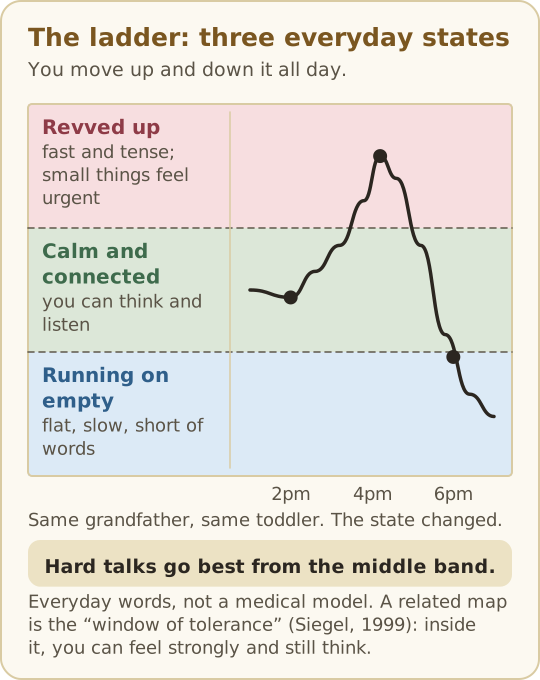
This site uses three plain words for how your body is running, on what it calls the Nervous System Ladder:
- Calm and connected: breathing is easy, you can think and listen, and hard things can be heard.
- Revved up: tense and fast. Small things feel urgent or personal. Pace speeds up and tone sharpens.
- Running on empty: flat and slow. Words are harder to find and replies get short.
Everyone moves up and down this ladder many times a day. The ladder is this site’s idea: everyday words to help you guess your state, not a medical model or a measurement.
Psychology
The three words are loosely inspired by Stephen Porges’s polyvagal theory (1994 onwards), which links calm social engagement, fight-or-flight and shutdown to different parts of the nervous system. It is popular in therapy, but many of its physiological and evolutionary claims are disputed by other researchers, including Paul Grossman. That is why this site uses the words only as everyday labels.
A related idea with fewer claims is the window of tolerance, a phrase from psychiatrist Dan Siegel (1999). Inside the window, you can handle feelings and think. Above it (hyperarousal) you are flooded and reactive. Below it (hypoarousal) you are numb or shut down. Therapists use it as a map, not a lab finding.
Philosophy
A well-known Buddhist story tells of a monk named Sona, who had been a musician. He was pushing himself so hard in practice that he was ready to give up. The Buddha asked him whether a lute plays well when its strings are too tight, or too loose. Neither, said Sona: only when they are tuned just right. Practice, the Buddha said, is the same. Aristotle’s idea of virtue as a middle point between too much and too little makes a similar point. The aim isn’t zero tension. It is the right tension for the moment.
Through an autistic lens
Many autistic people describe two ends of the ladder that others may not see clearly. At the top, a meltdown: an involuntary loss of control when overwhelm is too great. At the bottom, a shutdown: going quiet, losing speech, being unable to move or respond. A shutdown can look calm from the outside. It isn’t. Treating a quiet, frozen person as “fine” can push them further down.
There is also a long-term version of running on empty. Autistic burnout, described by Dora Raymaker and colleagues (2020) from autistic adults’ own accounts, involves long-lasting exhaustion, loss of skills and lower tolerance for sensory input, often after long periods of masking and overload. It is different from work burnout, though they can overlap, and it needs real rest and fewer demands, not more effort.
Words you could use: “I’m revved up. Give me ten minutes.” “I’m running on empty. Can this wait until the morning?” “I’ve gone quiet because I’m overloaded, not because I’m angry.”
The sky
Pick the one closest to true right now. This is a reading of you, never of anyone else.
The sky
- Clear: Calm and connected
- Gusty: Revved up
- Chosen: Fogged in: Running on empty
Who you’ll mostly be around today
- A partner
- Family
- A co-parent
- Roommates
- Coworkers
- Chosen: Someone I care for
- Friends
- Mostly on my own
The pressure
- Light
- Building
- Chosen: Heavy
Last night’s sleep
- Chosen: Barely slept
- Short night
- About enough
- Properly rested
What’s blowing in
- Work
- Money
- Chosen: Kids or caring
- Chosen: Health
- Family
- The house
- One conversation
- Something I can’t name
What would actually help in the next hour?
- Space
- Food or water
- Chosen: Rest
- To move
- To be heard
- A plan
- Company
- Quiet
- Chosen: Someone to take something off me
Your forecast
- Fogged in today
- Running on empty · Very little room today
- Talk window
- another day is kinder
You were already carrying a heavy day before this. Treat the size of your reaction as a reading on the day, not on whoever is in front of you.
Between you and the person you care for today: do the essentials kindly and let the rest go. If anyone can cover one thing today, ask them.
If you need to say something now: “I’m at the end of what I can carry today. Could you take [one thing] off me?”
A made-up example. Names and details are invented. A heavy reading is information about a day, not a failing in a person.
Fill in your own: My weather today: the sky (spreadloveandacceptance.com/
When you’re flooded, thinking goes offline
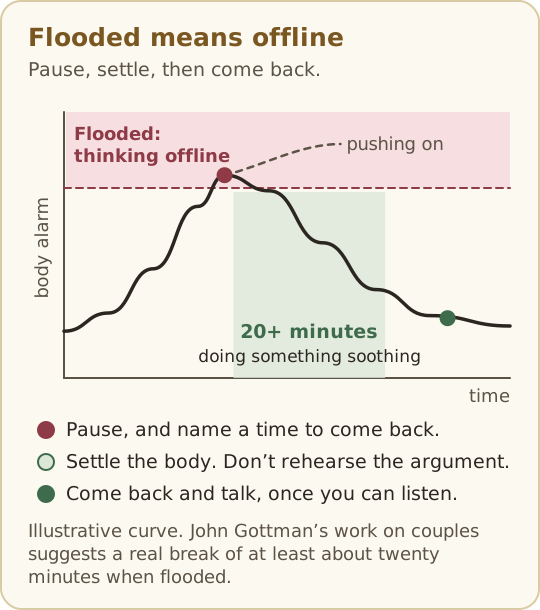
At high stress, the body goes into full alarm. Careful thinking, listening, holding two ideas at once and seeing the other side all get much harder. Many people call this being flooded. You may say things you don’t mean, repeat the same point, freeze, or just want to escape. It isn’t a failure of character. It is a body that needs to come down before the talk can go anywhere good.
Psychology
John Gottman’s research on couples described flooding: during conflict, some partners became so physically aroused, with a fast heart rate and stress hormones, that they could no longer take in what was said. His work suggested taking a real break, often at least twenty minutes, and doing something soothing rather than rehearsing the argument. Neuroscientist Amy Arnsten (2009) reviewed evidence that high stress weakens the functioning of the prefrontal cortex, the part of the brain most involved in planning and flexible thinking, while strengthening more habitual responses. Popular phrases like “amygdala hijack,” from Daniel Goleman, are simpler than the science but point at the same thing.
Philosophy
Plato, in the Phaedrus, pictured the soul as a charioteer driving two horses, one calm and one wild. When the wild horse bolts, the charioteer can’t steer until it slows. Seneca’s advice for anger was simple: delay. Give the first rush time to pass before you speak or act. Both describe what flooding feels like from the inside, centuries before anyone measured a heart rate.
Through an autistic lens
For someone in a meltdown, questions, explanations, eye contact, touch and even kind words can add to the load. What usually helps is less: less talk, less light, less noise, fewer people, and more time. Afterwards, many autistic people find it easier to talk about what happened in writing, or side by side rather than face to face. This is good advice for anyone who has been flooded: come back to the topic when calm, in the format that works for you.
Meltdowns are also not manipulation or a tantrum. They are not aimed at anyone. Responding with consequences or arguments in the moment tends to make things worse. Planning on a calm day, together, tends to make them less frequent.
Words you could use: “I’m too flooded to listen well. Can we stop for twenty minutes and come back at four?” “I’ll come back to this. I need it quiet for a bit.”
A note on safety: Anyone can call a pause, and nobody should be followed, blocked from leaving or punished for it. If a “pause” is used to punish with days of silence, or if you are afraid of what happens when someone is flooded, that is a safety issue, not a stress one. Signs to look out for.
Stress adds up, like a tank filling
Stress from different places pours into the same tank. A bad night’s sleep, a hard meeting, a crowded train, a money worry and a sharp text all add up. By evening, a tiny thing tips it over. The last drop gets the blame, but the tank was nearly full already.
Psychology
Bruce McEwen and Eliot Stellar (1993) introduced the idea of allostatic load: the wear and tear on the body from repeated or long-lasting stress responses. In a classic study, Allen Kanner, Richard Lazarus and colleagues (1981) found that everyday hassles were related to health symptoms at least as strongly as major life events. Small things count.
Stress also spills over. Rena Repetti’s studies of air traffic controllers (1989) found that after high-workload days, they tended to be more withdrawn with their families. Niall Bolger and colleagues found stress could also cross from one partner to the other. Sleep matters too: research from Matthew Walker’s lab (2007) found that after a night without sleep, the brain’s alarm centre reacted much more strongly to upsetting pictures. Part Two’s Chapter III turns this into a simple self-check.
Philosophy
There is a well-known Zen story about a professor who visits a teacher to learn about Zen, then talks without pause about his own ideas. The teacher pours him tea and keeps pouring as the cup overflows. “Like this cup,” he says, “you are full. How can I show you anything until you empty it?” The story is about opinions, but it fits stress too: a full cup can’t take in even something good.
Seneca described a habit, borrowed from the philosopher Sextius, of reviewing each day at bedtime: what went well, what went badly, what to do differently. Done gently, an evening review is a way of emptying the cup before sleep rather than carrying it into tomorrow.
Through an autistic lens
Masking, the effort of hiding autistic traits to fit in, fills the tank fast. Laura Hull and colleagues (2017) described how autistic adults experience this “camouflaging”: many said it was exhausting and left them drained afterwards. Many parents of autistic children notice that a child who seemed fine at school falls apart as soon as they get home. Some parents call this “after-school restraint collapse.” It isn’t a research term, but it describes the tank well: the child held it together all day, and home is the safe place to let it out.
The lesson for everyone: when someone falls apart over something small, ask what filled the tank, not why they’re making a fuss about the last drop.
Through an ADHD lens
Life with ADHD often adds a hidden layer to the tank: the constant effort of keeping track, the cost of lost keys and missed messages, and the low hum of worry about what you might have forgotten. So the tank can be fairly full before the day has properly started. Strong feelings can also be harder to bring back down once they rise: a review by Shaw and colleagues (2014) found this is common in ADHD at every age. Moving the remembering out of your head (a shared list, alarms with labels, one place for keys) empties part of the tank every day. Planning hard conversations for a time of day when your focus and energy are usually better helps too.
Words you could use: “My tank was full before you said a word. That wasn’t about you.” “You don’t have to explain. Want a quiet hour first?”
Settle the body first
You can’t argue a body out of alarm. You can help it come down, and the thinking tends to follow. Things that often help include slow breathing with long out-breaths, moving (a walk, stairs, shaking out your arms), cold water on the face, steady pressure, a familiar sound, and leaving a loud or crowded space. Different things work for different people, and what works on one day may not on another.
Psychology
A systematic review by Andrea Zaccaro and colleagues (2018) found that slow breathing, around six breaths a minute, was linked with signs of relaxation and calmer mood, though many studies were small. A 2023 study led by Melis Yilmaz Balban found that a few minutes a day of breathing with long out-breaths improved mood a little more than mindfulness meditation over a month; it was one study, and the differences were modest. Physical activity has a large body of research behind it for mood and stress. Progressive muscle relaxation, developed by Edmund Jacobson in the early twentieth century, teaches people to tense and release muscle groups. Dialectical behaviour therapy, developed by Marsha Linehan, includes quick body-based skills such as changing temperature and intense exercise for moments of very high distress.
None of these is a cure-all. Their value is practical: they give you something to do with your body when your mind is too loud to think.
Philosophy
The Vietnamese Zen teacher Thich Nhat Hanh taught breathing as a way of coming home to the present moment: breathing in, knowing you are breathing in; breathing out, knowing you are breathing out. He meant it as a practice anyone could use, washing dishes or walking, not only on a cushion. Taoist writing, such as the Tao Te Ching, often praises softness and stillness, like water that finds its level, over force.
Through an autistic lens
Some popular calming advice doesn’t suit everyone. For some autistic people, and others who are very aware or unaware of their body’s signals, focusing on the breath can increase anxiety rather than reduce it. Alternatives that often help include deep pressure (a weighted blanket, a firm hug if wanted, lying under cushions), rhythmic movement such as rocking or swinging, stimming, chewing, humming, a special interest, or simply cutting input with headphones, sunglasses or a dim room. Research on some of these, such as weighted blankets, is still limited, but many people find them helpful, and they are safe to try.
The underlying lesson is universal: there is no single right way to settle. The right way is the one that works for your body. Find yours on a calm day.
Thoughts you could try: “Body first, words second.” “What has helped me settle before? Can I do one of those now?”
Rest isn’t one thing
Being off work isn’t the same as recovering. Scrolling may feel like rest while keeping your brain busy. Socialising may restore one person and drain another. Real recovery comes in different kinds, and different kinds of tired need different kinds of rest.
Psychology
Sabine Sonnentag and Charlotte Fritz (2007) described four recovery experiences linked with feeling restored after work: psychological detachment (switching off from work in your head), relaxation, mastery (doing something absorbing or challenging that you enjoy, like learning a skill) and control (choosing how you spend your own time). Sleep is the foundation under all of them; a large body of research links poor sleep with worse mood and stronger stress reactions. Rachel and Stephen Kaplan’s attention restoration theory suggests time in nature can help tired attention recover, though effect sizes vary.
The idea that introverts are drained by socialising and extraverts energised is popular but simpler than the evidence. Studies that track people through the day, such as work by Sointu Leikas and Ville-Juhani Ilmarinen (2017), have found many people feel good during social time and more tired a few hours later. Your own experience is the best guide.
Philosophy
The Jewish philosopher Abraham Joshua Heschel, in The Sabbath (1951), described the weekly day of rest as something like a sanctuary built in time rather than space: a day not for producing, but for being. The Catholic philosopher Josef Pieper argued in Leisure: The Basis of Culture (1948) that true leisure isn’t just a break to make us better workers. It is an open, receptive state that makes room for wonder. Bertrand Russell, in his essay “In Praise of Idleness” (1932), argued that a society working less would be happier and kinder. Across very different traditions, rest is treated as part of a good life, not a reward for finishing it.
Through an autistic lens
Many autistic people describe monotropism: attention that tends to go deep into a few things at a time (explained in full in Chapter 9). For many autistic people, time spent deep in a special interest is one of the most restoring kinds of rest: a state of flow, not an escape. Interrupting it can be costly, so planned transitions help.
Other common forms of autistic rest include time alone, a predictable routine, low-sensory spaces, and being with someone without having to talk (sometimes called parallel play, even for adults). None of these is antisocial. They are ways of refilling the tank, and many non-autistic people need them too.
Words you could use: “I need quiet rest tonight, not people rest. It’s not about you.” “Can we be in the same room, but not talk for a bit?”
Stress is easier to carry when it’s shared
Nervous systems affect each other. A calm voice, a steady presence or a familiar person nearby can help someone else settle. A tense, rushed person can unsettle a whole room. Saying your state out loud helps others read you right, and sharing stress well is a skill: it lets someone stand beside you without making them carry it all.
Psychology
In a well-known study, James Coan, Hillary Schaefer and Richard Davidson (2006) found that women facing the threat of a mild electric shock showed less threat-related brain activity when holding their husband’s hand, especially in happier marriages. It was a small study, but it fits a wider body of research on co-regulation: people, from infancy onwards, help each other’s bodies settle. Edward Tronick’s “still face” studies (1970s onwards) showed how quickly babies become distressed when a parent’s face goes blank and unresponsive, and how they recover when connection returns.
Guy Bodenmann’s research on dyadic coping found that couples who tell each other about their stress and help each other cope tend to be more satisfied. It applies well beyond couples: friends, families and teams also cope better together than alone.
Philosophy
The Southern African idea of Ubuntu is often summed up in a Nguni saying usually translated as “a person is a person through other persons.” It holds that we become ourselves through our relationships, so care is shared, not private. Epicurus, too, ranked friendship among the greatest sources of a calm and happy life.
Through an autistic lens
Co-regulation doesn’t have to mean talking, eye contact or hugs. For many autistic people, the most calming presence is a quiet one: someone nearby, doing their own thing, not asking questions. Touch can be soothing for some and overwhelming for others, so ask. Clear, explicit signals for state, such as a colour, a number or a card on the fridge, can replace guessing for everyone in a home or team.
Going off alone to settle is also a form of regulation, not rejection. Agreeing on this ahead of time (“If I go to my room, I’m resetting, not upset with you”) can save a lot of hurt on both sides. It is the double empathy idea again: both people are reading carefully, in different ways, and plain words close the gap.
Words you could use: “I’m stressed, and it’s not about you.” “Do you want help, company or space?” “If I go quiet tonight, I’m resetting, not upset.”
Sleep and stress feed each other
Stress and sleep run in a loop. A worried mind and a revved-up body make it harder to fall asleep and stay asleep. A short or broken night then lowers the threshold for stress the next day: small things feel bigger, and patience runs out sooner. Seeing the loop is the first step to loosening it.
Psychology
In a brain-imaging study, Yoo and colleagues (2007) found that after a night without sleep, the amygdala (part of the brain’s alarm system) reacted more strongly to negative pictures and was less connected to the front of the brain, which helps keep reactions in proportion. Sleep also shapes how people get along. In a daily study, Gordon and Chen (2014) found that people reported more conflict with their partner after nights of poor sleep, and that conflicts were resolved best when both partners had slept well. In experiments by Ben Simon and Walker (2018), people who had missed a night’s sleep kept an approaching person at a greater distance and felt lonelier; the researchers also reported that rested people who briefly watched them felt lonelier themselves. These are mostly studies of one bad night or short periods; long-term sleep problems are more complicated, and are worth raising with a doctor, because effective help exists.
Practical points follow from this. Avoid hard conversations when either person is exhausted (“Can we talk after we’ve slept?”). Notice when a bad mood might be a bad night. And treat a wind-down routine (the same few calm steps before bed, in the same order) as part of stress care, not a luxury. See sleep and mood in the library.
Philosophy
In Shakespeare’s Macbeth, sleep is the thing “that knits up the ravell’d sleave of care”: the mender of a mind worn ragged by worry. Many traditions treat rest at night as part of a good life, not a reward for finishing everything. The Stoic habit of reviewing the day each evening, then setting it down, was partly a way of not carrying the day into the night.
Through an autistic lens
Many autistic and ADHD people describe long-standing sleep difficulties: a mind that won’t switch off, a body clock that runs later than other people’s, or a bedroom that is too bright, noisy or scratchy to settle in. Sensory changes (blackout blinds, earplugs, the right bedding, a weighted blanket for those who like pressure) can matter as much as any routine. A predictable wind-down can help too. If sleep problems are long-lasting, a doctor who understands neurodivergence can help look at options.
Words you could use: “I slept badly. If I’m short today, that’s why, and it’s not about you.” “Can we talk about this after we’ve both slept?”
Putting it together
Here is the chapter as a short sequence. It is this site’s idea, a way of joining the ideas above, not a tested method:
- Check the rung. Calm, revved up or running on empty? Flooded?
- Check the tank. How full was I before this? What filled it?
- Settle the body first. Use something you know works for you.
- Look at both sides of the balance. What is being asked of me, and what could add to what I have: time, help, information, rest?
- Say your state. One sentence, so the people around you don’t have to guess.
- Plan real recovery. Match the rest to the kind of tired.
The three lenses agree on the big picture. Psychology shows that stress is a body-and-mind response shaped by how we read demands and resources, that it adds up, and that it narrows thinking at the top of the curve. Philosophy, from Epictetus and the Buddha to Heschel and Ubuntu, says the aim isn’t to remove all tension, but to tune it, to put effort where it counts, to rest as part of a good life, and to carry hard things together. The autistic lens adds that many demands are invisible, that predictability and sensory comfort are real resources, that shutdown is not calm, and that there are many valid ways to settle and rest.
Worked examples
On your own: the Sunday scroll
Liam spends every Sunday on the sofa scrolling and still feels exhausted on Monday. Using the recovery types, he sees he gets almost no detachment (work emails on his phone), no mastery and no real relaxation. He moves work email off his phone for weekends and starts an hour of guitar on Sunday afternoons. Mondays feel lighter. Nothing about his job changed. His recovery did.
Partners: the snap at the door
Paula comes home from long shifts and snaps at Jonty’s first question. They agree a twenty-minute landing time: no questions, no news, just a drink and a shower. Then they check in. Jonty stops taking the snap personally, and Paula stops snapping. See Different hours.
Parent and autistic child: after school
Every day, ten-year-old Benji melts down within half an hour of getting home. His dad used to ask about his day straight away. Now there is a quiet snack, headphones and Lego for forty minutes, with no questions. The meltdowns become rarer. Benji talks about his day later, when he is ready, often at bedtime. See Neurodivergent families.
Coworkers: the flooded meeting
In a project review, Naomi’s voice speeds up and she starts repeating herself. Her colleague notices and says, “Let’s take ten and come back at half past.” After a coffee and a walk, Naomi hears the feedback and agrees with most of it. Pushing on would have cost them both an afternoon. See At work.
Friends: the cancelled plan
Tash has cancelled on Megan three times. Megan is hurt and nearly gives up. Then she sends: “No pressure at all. Would a short walk be easier than dinner?” Tash replies that she has been running on empty for weeks caring for her mum, and a walk sounds perfect. Lowering the demand kept the friendship. See Friends and Caregivers.
Housemates: the tank and the dishes
Gabe and Cal used to argue about dishes every Thursday. They realise Thursday is the day both have the longest work hours. They move the dishes job to Saturday morning. The dishes didn’t change. The tank did. See Sharing a room.
Exercises
- Find your flood signs. Think back to the last time you said something you regretted. What did your body feel like just before? Write down two or three signs to watch for.
- Map a day’s tank. At bedtime, list what filled your tank today, including small things like noise, waiting or hunger, and what emptied it.
- Build a settle list. On a calm day, list three things that help your body come down, and three that make it worse. Keep it somewhere easy to find, or build it into the Calm-Down Kit.
- Match your rest. For one week, before resting, ask: body-tired, brain-tired, people-tired or feelings-tired? Choose a rest that matches, and notice the difference.
- Agree a pause. With someone you live or work with, agree a pause word and that the person who pauses names a time to come back.
- Say your state. For three days, tell one person your state each evening in one sentence, and ask theirs.
Questions people often ask
Is some stress good for you?
Short, manageable stress that you recover from can help you rise to a challenge and grow. The problem is stress that is too big, too constant, or with no recovery.
How do I know if I’m burnt out or just tired?
Ordinary tiredness lifts after good rest. Burnout tends to last, even after a holiday, and often comes with feeling detached, cynical or ineffective. If rest isn’t helping after several weeks, it is worth talking to a doctor or counsellor.
My partner always needs to “take space.” Is that avoiding me?
Not necessarily. Many people genuinely need time to come down before they can talk well. The fair version is: take the space, and say when you’ll come back. If space is used to punish, or a promised return never comes, talk about that pattern. One wants to talk now, one needs space has more.
Breathing exercises make me more anxious. Is something wrong with me?
No. That is a common experience. Try movement, pressure, cold water, music or reducing input instead. There is no single right way to settle.
Can I help someone who is in a meltdown or shutdown?
Usually by doing less: lower the noise and light, stop asking questions, keep others away, stay nearby if they want that, and wait. Talk about it later, if they want to, in a way that suits them.
Isn’t this just making excuses for bad behaviour?
Understanding why someone snapped isn’t the same as saying it was fine. Stress explains behaviour; it doesn’t excuse harm. The point is to reduce the conditions that make harm more likely, and to repair when it happens.
When to get more help
It may be time to see a doctor, counsellor or other trained professional if you have felt exhausted, dread-filled or numb most days for several weeks, even after rest; if you can’t sleep, or never feel rested; if you have physical symptoms that worry you (always get chest pain checked straight away); if you are relying on alcohol, drugs or other habits to cope; or if you feel you can’t go on, or have thoughts of harming yourself. If you are in danger now, contact your local emergency number or a crisis line.
Stress that comes from being afraid of someone, such as what they will do, or whether you are allowed to leave or say no, isn’t ordinary stress. Not safe at home? lists free, private help. This chapter is general education, not medical advice or diagnosis.
More for your situation
- Back: How feelings work, in full · Next: How we see each other, in full · All chapters in the contents
- Part Two, Chapter III in full: full tanks and different angles
- Part One, Now: what settles you
- The Nervous System Ladder, the Calm-Down Kit and Upset right now?
- The library: Stress and the body, co-regulation, sensory load, monotropism, spoon theory, Calm and attention
- Caregivers, New parents, When one of you is ill
- Help by relationship
Last updated: October 2026