Part Three · Chapter 1
How feelings work
In short:
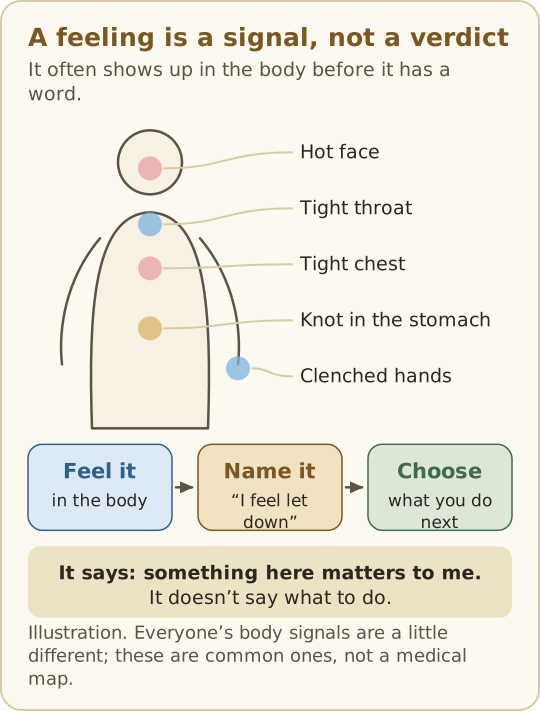
- A feeling is a signal, not a verdict. It says “something here matters to me.” It doesn’t say what to do.
- Feelings start in the body. A tight chest or a hot face often comes before the word for it.
- Naming helps. “I feel let down” is easier to hold than a big, nameless rush.
- Feeling it isn’t doing it. You can let a feeling be there and still choose what you do next.
Why the tools work: this chapter explains the thinking behind these tools from earlier in the book.
- My weather today and the daily check-in (Part One, Now; Part Two, Chapter I) ask for one word about how you are. Naming a feeling turns its volume down a little, and a daily word catches feelings while they are still small. Big idea: read your state first.
- Say it so it lands (Part Two, Chapter IV) asks for a feeling, not a verdict. “I felt let down” is easier to hear than “you never care.” Big idea: tune how you send and receive.
Thursday, 4:50pm
A message from your manager: “Got a minute tomorrow?” Your stomach drops. By the time you get home you have snapped at the cat, skipped dinner and replayed every mistake from the last month. Nobody has said anything bad. Your body heard “trouble” before you had a single clear thought.
Part Three of this book is about how people work. Not just couples, and not just homes: you on your own, your family, your friends, the people you work with and the strangers you pass. It starts with feelings, because almost everything else runs through them. How we talk, how we judge each other, how we cope with stress and how we heal all depend on what we feel and what we do with it.
The aim is education first and self-help second. Each section explains how something works, then offers a few things to try. You can read one section and stop.
How this chapter is built: three lenses
Each idea is looked at in three ways, then brought together:
- Psychology: what researchers have found, named honestly, with a note where the evidence is thin, mixed or debated.
- Philosophy: what thinkers and traditions have said about the same question, in plain paraphrase. People were thinking hard about feelings long before anyone had a brain scanner.
- Through an autistic lens: how the idea can look from an autistic point of view. This is a perspective, not a list of problems. Autistic people often notice things about feelings that everyone can learn from: the value of saying things plainly, the role of the senses, and how much a predictable day matters. Not every autistic person is the same, and nothing here is a way to diagnose anyone.
Where something is this site’s idea rather than established research, it says so.
A feeling is a signal, not a verdict
A feeling is a fast message about something that matters to you. It arrives before careful thought because, for most of human history, speed kept people alive. You didn’t have time to reason about the rustle in the grass. You had time to feel afraid and move.
Each common feeling has a rough job. Fear points at possible danger. Anger points at something in the way, or something that seems unfair. Sadness points at a loss. Disgust points at something to keep out. Guilt points at a rule you think you broke. Joy and interest point at things worth moving towards. These are rough sketches, not laws, and the same feeling can do several jobs.
A signal can be right about the theme and wrong about the details. A smoke alarm is right that there is smoke. It can’t tell burnt toast from a house fire. Feelings are like that. Jealousy can be right that a friendship matters to you and wrong that your friend is leaving.
Psychology
Charles Darwin’s The Expression of the Emotions in Man and Animals (1872) treated emotions as useful, inherited reactions shared with other animals. Later, Nico Frijda described emotions as “action readiness”: a feeling gets the body ready to do something, such as approach, avoid, fight or freeze. Many modern “appraisal” theories, including work by Richard Lazarus and Klaus Scherer, say an emotion starts with a fast, often unconscious judgement about whether something matters to your goals.
Norbert Schwarz and Gerald Clore (1983) showed something about feelings as information. People phoned on sunny days rated their lives as more satisfying than people phoned on rainy days, unless the interviewer first mentioned the weather. Once people noticed where their mood came from, they stopped using it as information about their life. Later, much larger studies found the weather effect on life satisfaction to be very small, so treat this as an illustration of the idea rather than a strong finding. The idea itself, that we use our feelings as evidence, is widely accepted.
Researchers still disagree about exactly what an emotion is. That debate comes up again in the next section.
Philosophy
The Chinese philosopher Mencius argued that people are born with “sprouts” of goodness. His example: anyone who suddenly saw a small child about to fall into a well would feel alarm and concern, before any thought of reward or reputation. For Mencius, that feeling is a signal of what we care about, and it can be grown.
The Stoics of ancient Greece and Rome were more suspicious of strong emotions, which they saw as mistaken judgements. Yet even they described “first movements”: the involuntary jolt, the flush or the start, that happens before we agree with it. Seneca wrote that even the wisest person feels these. What matters, for the Stoics, is whether we then agree with the story the jolt tells.
In our own time, Martha Nussbaum has argued that emotions are a kind of judgement about what is important to our lives. Grief, on this view, is not a malfunction. It is how we register that someone mattered.
Through an autistic lens
Many autistic people describe feelings arriving differently: sometimes later, sometimes all at once, sometimes as body sensations before they have a name. A feeling may be strong and still hard to read. Treating a feeling as a signal to check, rather than a verdict to obey, fits this well. It invites the question “What is this about?” instead of the demand “Explain yourself.”
Autistic people are also often told their feelings are wrong for the situation: too big, too small, or about the “wrong” thing, like a change of routine or a sound. Seen as signals, those feelings make sense. Distress at a sudden change is a signal that predictability matters to that person’s nervous system. It deserves to be taken seriously, not argued away.
Thoughts you could try: “This is a signal that something matters. What is it?” “Is this the fire, or the toast?”
Feelings start in the body
Very often, the body moves first: a racing heart, a hot face, a lump in the throat, a heavy chest, a churning stomach. The brain then works out what those sensations mean, using what is going on around you and what you have learned. That is why hunger can feel like irritation, a hangover can feel like dread, and a near miss in traffic can leave you snappy for an hour.
Psychology
In 1884 the psychologist and philosopher William James asked a famous question: do we run because we are afraid, or are we afraid because we run? He argued that the feeling of an emotion is, in large part, our sense of the body’s changes. Carl Lange made a similar argument around the same time. Their view was challenged by Walter Cannon and others, who pointed out that different emotions can share very similar body states.
In 1962, Stanley Schachter and Jerome Singer proposed that an emotion has two parts: body arousal, plus a label we give it based on the situation. Their famous experiment has not replicated well, but the broad idea lives on. Donald Dutton and Arthur Aron’s 1974 “wobbly bridge” study suggested that people can mistake the arousal of fear for attraction. It too is debated, and is best treated as an interesting example.
Today, the study of interoception, the sense of what is happening inside your body, is a growing field. Bud Craig and others have described how signals from the heart, gut and lungs reach brain areas such as the insula. Lisa Feldman Barrett’s theory of constructed emotion goes further. It says the brain is always predicting what the body needs, and builds emotions by making sense of body sensations with concepts it has learned. Others, in the tradition of Paul Ekman, argue for a small set of more built-in basic emotions. In a well-known study, Ekman and Friesen (1971) found that people in a remote community in Papua New Guinea, who had seen little Western media, mostly matched short emotion stories to the same facial expressions that Western people chose. The debate is real and unfinished. What both sides accept is that body and feeling are tightly linked.
Philosophy
Baruch Spinoza, writing in the 1600s, refused to split mind and body into two separate things. For him, an “affect” was a change in the body’s power to act, and at the same time the idea of that change. A feeling, on this view, is the body and the mind telling the same story.
Buddhist teaching on mindfulness lists “feelings” (in Pali, vedanā) as one of four foundations to pay attention to. Here “feeling” means the basic tone of an experience, pleasant, unpleasant or neither, noticed in the body before any story is added. The practice is simply to notice that tone, moment by moment.
Through an autistic lens
Interoception varies from person to person, and many autistic people describe it as working differently for them. Some notice hunger, thirst, pain or a racing heart very strongly. Others barely notice them until they are extreme. Research on interoception in autistic people, including work by Sarah Garfinkel, Rebecca Brewer and colleagues, has produced mixed findings, and it seems to vary a lot from person to person. If the body’s signals are muted or hard to read, a feeling may seem to arrive “out of nowhere.” If they are very loud, ordinary sensations can feel overwhelming.
Sensory load matters too. A bright, noisy supermarket can fill the body with alarm that then looks like an emotion, such as irritability or panic, when it is really sensory overload. A practical lesson for everyone: before deciding what a feeling means, check the body and the surroundings. Is it loud? Bright? Am I hungry, cold, in pain, tired?
Thoughts you could try: “Where is this in my body?” “What’s around me right now: noise, light, crowds?” “When did I last eat, drink or rest?”
Check today’s weather
The sky
- Clear: Calm and connected
- Chosen: Gusty: Revved up
- Fogged in: Running on empty
Who you’ll mostly be around today
- A partner
- Family
- A co-parent
- Roommates
- Chosen: Coworkers
- Someone I care for
- Friends
- Mostly on my own
The pressure
- Light
- Chosen: Building
- Heavy
Ground conditions
- Chosen: Haven’t eaten in a while
- Thirsty
- In pain or unwell
- Been still all day
- Too much noise or light
- Chosen: Running on caffeine
- Screens since I woke up
Last night’s sleep
- Barely slept
- Short night
- Chosen: About enough
- Properly rested
People load
- Barely any
- Chosen: A normal amount
- A lot
- Nonstop, no gaps
What’s blowing in
- Work
- Money
- Kids or caring
- Health
- Family
- The house
- Chosen: One conversation
- Something I can’t name
What would actually help in the next hour?
- Space
- Food or water
- Rest
- To move
- Chosen: To be heard
- Chosen: A plan
- Company
- Quiet
- Someone to take something off me
Your forecast
- Gusty today
- Revved up · Some room today
- Talk window
- wait about 20 minutes
It’s gusty. You’re revved up. That energy is useful for doing something physical, but it is poor weather for deciding anything about another person.
The ground underneath: you haven’t eaten in a while and you’re running on caffeine. That isn’t a side note. It’s likely a big part of why today feels the way it does, and it’s easier to change than character is.
Blowing in: one conversation. Weather from one front tends to land on whoever is nearest, often someone who had nothing to do with it. Worth saying out loud before it does.
You said what would help is a plan and to be heard. Arrange that before anything else.
If you want to send someone a line: “I don’t need it solved. I just need you to hear this for a few minutes first.”
A made-up example. Names and details are invented. Esme ate something, then rang her sister to be heard. She didn’t reply to the message until the morning.
Fill in your own: My weather today (spreadloveandacceptance.com/
Naming a feeling helps you hold it
A feeling without a name can feel like weather that fills the whole sky. Putting it into words gives it edges. Once it has edges, you can look at it, tell someone about it, and decide what to do.
Psychology
Matthew Lieberman and colleagues (2007) found that when people labelled the emotion in a picture of an angry or scared face, activity in the amygdala, a brain area involved in alarm, went down compared with other tasks. They called this affect labelling. A later review by Jared Torre and Lieberman (2018) gathered evidence that naming feelings can work as a quiet form of emotion regulation, often without people realising it is helping. In one study, led by Katharina Kircanski with Lieberman and Michelle Craske (2012), people afraid of spiders who described their fear in words while near a spider later showed less body arousal than people who had tried to talk themselves out of the fear.
James Pennebaker’s research on expressive writing, from the 1980s onwards, found that writing about difficult experiences for short sessions was linked with small benefits for some people. The effects are modest and vary, and writing about very raw trauma alone isn’t right for everyone.
A note on limits: most of these studies are done in labs, with pictures and short tasks. Naming isn’t magic, and it doesn’t make a feeling vanish. It tends to make a feeling a little more manageable.
Philosophy
Spinoza made a claim that sounds very modern. He argued that a feeling which overwhelms us loses some of its grip once we form a clear and distinct idea of it. Understanding a feeling, for him, was a kind of freedom.
Many traditions use naming in practice. Some meditation teachers suggest “noting”: quietly naming what is present, such as “worry, worry” or “hearing, hearing,” then letting it go. The aim is not to argue with the feeling, but to see it clearly.
Through an autistic lens
Alexithymia means finding it hard to identify and describe your own feelings. It is not a diagnosis, and it is found in many people, autistic or not. Reviews have found it is much more common among autistic people than in the general population, though far from universal. Geoffrey Bird and Richard Cook’s “alexithymia hypothesis” (2013) suggests that some differences in recognising emotions, which used to be blamed on autism itself, may be better explained by alexithymia.
So “just name it” isn’t always simple. But naming can take many forms. A number (“I’m at a seven”), a colour, a traffic light, a body description (“my chest is tight and my hands are buzzy”), a written note, or a chart of feeling words to point at are all real names. Writing can be easier than speaking. Taking time can be easier than answering on the spot. Many autistic people find that precise, concrete descriptions work better than broad labels, and that is a strength, not a workaround.
Words you could use: “I think what I’m feeling is…” “I don’t have the word yet, but my body feels like…” “I’m at about a six out of ten.”
More words, better tools
“Bad,” “stressed” and “fine” cover a huge range of feelings. Splitting them into finer words is like having more than one tool in the box. “Disappointed” suggests talking about hopes. “Overwhelmed” suggests taking something off the pile. “Lonely” suggests reaching out. “Ashamed” suggests self-kindness. The finer the word, the clearer the next step.
Psychology
Lisa Feldman Barrett and colleagues call this emotional granularity, or emotion differentiation. In studies where people rated their feelings several times a day, those who used finer distinctions for negative feelings tended to have more ways of coping with them. A review by Todd Kashdan, Barrett and Patrick McKnight (2015) linked low granularity with a range of difficulties, such as more binge drinking or more aggression after being hurt, in some studies. Most of this research is correlational, so it can’t prove that learning more words causes better coping. Early studies trying to teach granularity are promising but small.
Philosophy
The ancient Stoics built detailed lists of emotions. They grouped them into four families, roughly distress, fear, craving and delight, and then divided each family into many kinds, such as envy, pity, grief and worry under distress. Their aim was to understand each passion well enough to see the judgement inside it.
Aristotle took a different view of what to do with feelings, but he also valued precision. He argued that good character means feeling the right thing, towards the right person, to the right degree, at the right time. You can only aim that precisely if you can tell your feelings apart.
Through an autistic lens
Some autistic people have a very precise, detailed way of describing inner experience, even if standard emotion words don’t fit well. “I feel like the volume on everything has been turned up” or “I’m at forty percent battery” can be more exact than “I’m stressed.” That is granularity, just in a different vocabulary.
Shared, agreed words help everyone. A family or team can agree a small set of words or numbers and what each one means: “Amber means I can talk but I need it short.” Explicit, literal agreements like this reduce guessing, which is one of the biggest sources of misunderstanding between people who are wired differently.
Words you could use: “It’s less angry and more let down.” “I’m not sad exactly, I’m lonely.” “Can we agree what ‘I’m fine’ means between us?”
Feelings come in layers
The feeling on top isn’t always the first one that came. Anger often sits on top of hurt or fear, because anger feels stronger and less exposed. Irritation can sit on top of tiredness. Numbness can sit on top of something too big to feel all at once.
We also have feelings about our feelings. Being ashamed of crying. Scared of our own anger. Guilty for feeling relief. These second-layer feelings can hurt more than the first, and they often come from what we were taught growing up about which feelings were allowed.
Psychology
Leslie Greenberg’s emotion-focused therapy distinguishes primary emotions (the first, direct response, such as sadness at a loss) from secondary emotions (reactions to that first feeling, or covers for it, such as anger that hides hurt). In that approach, getting to the primary feeling is often what helps.
John Gottman, Lynn Katz and Carole Hooven (1996) studied what they called parents’ meta-emotion philosophy: how parents feel and think about emotions themselves. Parents who saw a child’s sadness or anger as a chance to connect and teach, rather than something to dismiss, tended to have children who later handled feelings more easily. See helping kids name big feelings.
Research on thought suppression, starting with Daniel Wegner’s “white bear” studies (1987), found that trying hard not to think of something can make it come back more. Acceptance-based approaches, such as acceptance and commitment therapy, build on the idea that making room for a feeling often makes it easier to live with than fighting it.
Philosophy
A Buddhist teaching called the Second Arrow says that when we are hurt, we are struck by one arrow. Then we often shoot a second arrow at ourselves: blame, worry, “why does this always happen to me?” The first arrow may be unavoidable. The second is the one we can learn to put down.
Friedrich Nietzsche, in a very different spirit, warned that feelings we are not allowed to express don’t disappear. He described how resentment, pushed down, can turn into something bitter that shapes a whole outlook. You don’t have to share his wider philosophy to find the warning useful.
Through an autistic lens
Many autistic people have spent years being told that their reactions were “too much,” or adjusting their faces and voices to seem fine. This is often called masking. Over time, it can add a heavy second layer to every feeling: not just “I’m overwhelmed,” but “I’m not allowed to be overwhelmed.” Naming that second layer, and letting the first feeling be valid, can be a big relief.
Anxiety about a possible meltdown can also become its own layer, making overload more likely. Plans made on a calm day (where to go, what to say, what helps) can take some of the fear out of the second layer. That idea is useful for anyone who dreads their own big feelings.
Thoughts you could try: “What might be under this?” “I’m allowed to feel this. I don’t need a second arrow.”
Feelings rise and pass like waves; moods are weather
An emotion usually has a shape: it rises, peaks and settles. If you keep feeding it with the same thoughts, it can keep going. If you let it run its course without adding to it, it often fades sooner than you expect.
Moods are different. They are longer, lower-level states that colour everything, often without a clear cause. A low mood makes neutral things look negative. A good mood makes the same things look fine. Many big decisions get made in moods, not facts.
Psychology
Philippe Verduyn and colleagues asked people how long their emotions lasted. Durations varied hugely. Sadness tended to last longest, and feelings like surprise, fear and shame were among the shortest. Emotions linked to something important, and emotions people kept thinking about (rumination), lasted longer. This supports a practical idea: going over and over something can keep a feeling going.
“Urge surfing,” from G. Alan Marlatt’s work on relapse prevention, teaches people to notice an urge rise and fall like a wave without acting on it. Mindfulness-based approaches use similar ideas. The evidence for mindfulness is real but more modest than its popularity suggests, and it doesn’t suit everyone.
Recovery groups often use the word HALT: hungry, angry, lonely, tired. It isn’t a research tool, but it names four states that make every feeling louder.
Philosophy
Impermanence (in Pali, anicca) is a core Buddhist teaching: everything that arises passes away, including every feeling. The Greek philosopher Heraclitus made a similar point with his image of a river you can’t step into twice. Marcus Aurelius, the Stoic emperor, often reminded himself in his private notebook how quickly things change and pass. None of these thinkers meant that feelings don’t matter. They meant that no feeling is the final word.
Through an autistic lens
Some autistic people find that feelings, especially after overload, take longer to settle, and that switching from one emotional state to another is hard, much as switching tasks can be. Recovery may need quiet, time alone, a familiar activity or a special interest, rather than more talking. Pressure to “be over it” can make it last longer.
Routines can help here. A predictable day lowers the background load, so waves are smaller and pass more easily. That is true for many people, autistic or not.
Thoughts you could try: “This is a wave. It will peak and pass.” “Is this about now, or is a mood colouring everything?” “No big decisions at the top of a wave.”
Feelings spread between people
We catch each other’s feelings: a tense voice tightens our chest, a laugh makes us smile. This is part of how people bond and stay in step. It also means stress can move through a home, a classroom or a team without anyone saying a word. Caring about someone’s feeling doesn’t mean you have to feel all of it.
Psychology
Elaine Hatfield, John Cacioppo and Richard Rapson described emotional contagion in the early 1990s: people tend to mimic each other’s faces, voices and postures, and that mimicry can shift their own feelings. Studies of moods spreading through social networks, such as work by Nicholas Christakis and James Fowler, are interesting but debated, because it is hard to separate catching a feeling from simply sharing the same surroundings.
Psychologists also separate empathy (feeling with someone) from compassion (caring about their suffering and wanting to help). Research by Tania Singer and Olga Klimecki suggests that compassion training may protect people from distress better than practising empathic feeling alone. This matters for anyone who supports others, which is the subject of a later chapter.
Philosophy
David Hume compared people to strings tuned alike: when one moves, the others move with it. Adam Smith, in The Theory of Moral Sentiments (1759), described sympathy as our ability to imagine ourselves into another person’s situation, and argued it was central to moral life. Both saw shared feeling as the glue of society, not a weakness.
Through an autistic lens
There is an old stereotype that autistic people lack empathy. Many autistic people describe the opposite: absorbing others’ feelings so strongly that it becomes overwhelming. Others say they may not read a feeling from a face or a tone, but care deeply once they know. Both are forms of caring. The double empathy problem, described by Damian Milton (2012), points out that misunderstandings between autistic and non-autistic people run in both directions. Non-autistic people often misread autistic feelings too.
A useful lesson for everyone: saying a feeling plainly (“I’m worried, not angry”) works better than hoping it is caught correctly. Contagion is fast but not precise. Words are slower and clearer.
Thoughts you could try: “Is this mine, or did I pick it up?” “I can stand beside their storm without standing in it.”
Feeling it isn’t the same as doing it
Every feeling comes with an urge. Anger wants to push. Fear wants to run or check. Shame wants to hide. Sadness wants to withdraw. The feeling itself isn’t chosen. What you do with the urge is more open, especially with practice and a calm-day plan.
There are two common traps. One is pushing feelings down so hard that they leak out sideways later. The other is acting on every urge straight away, which can hurt people and leave you with regrets. The path between them is: let the feeling be there, name it, and then choose the action.
Psychology
James Gross’s process model describes points where people can shape an emotion: choosing or changing the situation, shifting attention, rethinking what it means (reappraisal), or changing how they respond. Gross and Oliver John (2003) found that people who habitually used reappraisal tended to do better on wellbeing measures than people who habitually hid their feelings (suppression). Later work found the costs of suppression vary between cultures, so “always express” is not a universal rule.
Brad Bushman (2002) found that hitting a punching bag while thinking about the person who angered you tended to increase anger and aggression, not release it. “Venting” in that sense doesn’t seem to drain anger. Calming the body, waiting, and then talking about it tends to work better.
Philosophy
Seneca, in On Anger, argued that the best remedy for anger is delay: give the first wave time to pass before you act. Aristotle, as above, thought anger could be right, if it was felt towards the right person, for the right reason, in the right amount. Put together, they offer a balanced idea: some anger is fair, and waiting helps you find out which kind this is.
Through an autistic lens
A meltdown is not a choice or a tantrum. It is an involuntary response to overwhelm, and so is a shutdown, which can look like going quiet or “switching off.” Neither is the same as acting on an urge. They are what happens when the nervous system has had too much. What helps is less input, fewer demands and more time, not reasoning or consequences in the moment.
Many autistic people also use actions that settle the body, such as rocking, flapping, humming, pacing or holding something with a good texture. This is often called stimming. It is a healthy way of doing something with a feeling, and it deserves respect, not correction. For everyone, the lesson is that there are many safe actions between “hold it in” and “let it out on someone.”
Words you could use: “I’m feeling a lot. I’m going to take ten minutes before I reply.” “I’m not ignoring you. I’m letting this settle so I answer well.”
A note on safety: Feelings explain behaviour. They never excuse harm. “I was angry” is a reason to look at your anger, not a reason someone else has to live in fear. If you are afraid of someone’s anger, or of your own, Not safe at home? has free, private help.
When feelings weren’t talked about
Many people grew up in homes where feelings were private. “Don’t make a fuss.” “Big boys don’t cry.” “We just got on with it.” This is especially common for men, for older generations, and in some families and cultures, where keeping feelings to yourself is a sign of strength, dignity or respect. If that is you, nothing in this chapter is a criticism. You learned a way of living that made sense where you were. The question is only whether it still helps you now, especially in hard times such as illness or bereavement.
Psychology
Psychologists use the word alexithymia for difficulty identifying and describing one’s own feelings. In a review of 41 samples, Levant and colleagues (2009) found that men scored slightly higher than women on average, but the difference was small: there was far more overlap than difference. Ronald Levant has argued that much of this is learned, because many boys were taught to hide vulnerable feelings like sadness and fear, and he called the pattern “normative male alexithymia.” Culture plays a part too. In a study across 23 countries, Matsumoto, Yoo and Nakagawa (2008) found that people in cultures that placed more value on social order and hierarchy tended to report holding their feelings in more. So holding back is partly a habit a whole community shares, not just a personal quirk.
Care is not only spoken. Many people show love mainly through practical help: fixing, driving, cooking, providing, turning up. That is real care, and the people around them often know it. Words can be added to it slowly. Short, plain sentences are enough, and writing can be easier than speaking. An early experiment by Pennebaker and Beall (1986), in which students wrote privately about difficult experiences, started decades of research on writing as a way to work through feelings, and many people find writing easier than talking.
Philosophy
Many traditions have valued emotional restraint. In the Confucian Analects, Confucius praises an old poem for being joyful without excess and sorrowful without harm: feeling fully, but in proportion. The Stoics, too, admired steadiness. Neither tradition asked people to feel nothing. They asked people to hold their feelings well. Aristotle, writing about friendship, said a true friend wishes good things for the other for the other’s own sake, and acts on it. On that view, much quiet, practical care is friendship at its best.
Through an autistic lens
Many autistic people also show care mainly by doing: solving a problem, sharing useful information, remembering exact details. Some also find feelings hard to name (see Naming a feeling). An adult who was never told they were autistic may have spent a lifetime being called “cold” when they were feeling a great deal, without the words for it. Whatever the reason, the same tools help: body words, numbers, plain short sentences, and writing instead of speaking.
Words you could use, for yourself: “I wasn’t brought up to say this, but I miss her.” “I’m not good with words for this. It’s been a hard week.” “I don’t know what to call it. I just feel heavy.” “I’m not one for talking, but I wanted you to know I’m proud of you.”
Words you could use, for someone like this: “I know you show it by doing. I see it, and thank you.” “You don’t have to say much. I’m here.”
Putting it together
Here is the whole chapter as one short sequence. It is this site’s idea, a way of joining the research above into something easy to remember, not a tested method:
- Notice the body. Where is it? Hot, tight, heavy, buzzing? Check the basics: hungry, tired, in pain, overloaded?
- Name it, roughly. A word, a number, a colour. A guess is fine.
- Look underneath. Is there another feeling under this one? Am I adding a second arrow?
- Ask what it’s pointing at. What matters to me here? Is the signal about the fire, or the toast?
- Choose the next action. Wait, move, ask, explain, rest or reach out. Not every feeling needs an action at all.
The three lenses agree more than they differ. Psychology says feelings are fast, bodily, partly constructed signals that become easier to handle when named. Philosophy, from Mencius and the Stoics to Spinoza and the Buddhist teachers, says feelings tell us what we value, that understanding them gives us some freedom, and that none of them is permanent. The autistic lens adds that people sense and express feelings in different ways, that the senses and predictability matter, and that being plain and explicit about feelings helps everyone.
Worked examples
On your own: the Sunday evening dread
Bettina lives alone and feels a heavy dread every Sunday evening. She used to call it “I hate my life.” Using the sequence, she notices a tight throat and restless legs; names it as “dread, about a six”; looks underneath and finds loneliness as well as worry about Monday; and sees that it points at two things: a hard week ahead, and an empty weekend behind. Her actions: lay out Monday’s first task on Sunday afternoon, and book one call with a friend each Sunday. The dread is smaller, and it no longer says “my life.” See On my own.
Partners: the anger that was fear
Rhodri gets angry whenever Tamsin drives fast. They argue about speed limits. One evening, calm, Rhodri says: “I think under the anger I’m scared. My cousin was in a crash.” Tamsin slows down without being asked twice. The argument was never about rules. It was about a fear that had been wearing anger’s coat.
Parent and child: naming, not fixing
Seven-year-old Kian sobs because his tower fell. His mum’s first urge is “It’s only blocks.” Instead she says, “You’re so disappointed. You worked hard on that.” He nods, cries a little longer, and rebuilds it. She didn’t fix anything. She gave the feeling a name and a place. See For parents.
Coworkers: contagion in a team
A small team notices that Monday meetings always feel tense. They try one change: anyone can start by giving a number from one to five for how they are, with no explanation needed. When the manager says “two today, nothing to do with any of you,” the team stops reading her flat face as disapproval. Feelings spread less when they are named. See At work.
Autistic and non-autistic housemates
Riya, who is autistic, goes silent and leaves the room when the kitchen gets loud during a party. Her housemate Finn reads it as sulking and feels hurt. Later they agree a plain signal: Riya says or texts “too loud, back soon,” and Finn knows it is about noise, not him. Riya feels less pressure to hide her overload, and Finn feels less rejected. Both were reading each other carefully, just differently. See Neurodivergent relationships.
Friends: the second arrow
After a friend forgets her birthday, Mabel feels hurt, then ashamed of being hurt (“it’s childish to care”). The shame makes her go quiet, which the friend notices and worries about. When Mabel drops the second arrow and simply says “I was a bit hurt you forgot,” her friend apologises and they make a plan. See Friends.
Exercises
- Three body check-ins a day. At three set times, such as breakfast, lunch and dinner, ask: “What does my body feel like?” Write one line. After a week, look for patterns.
- One finer word. Each time you notice “bad,” “stressed” or “fine,” find one more exact word. Keep a list of the words that fit you best.
- Your own scale. Make a five-point scale for yourself, in words, numbers or colours, with what each point feels like in your body and what helps at that point. Share it with one person if you like.
- Under the top layer. Next time you feel angry or irritated, ask, “Is there hurt, fear or tiredness underneath?” Write the answer down, even if you share it with nobody.
- Wait before acting. Choose one urge you often act on too fast, such as a sharp text or a quick yes. For one week, wait ten minutes first and notice what changes.
- A family or team feeling word list. Agree three to five shared words or numbers and exactly what they mean, so nobody has to guess.
Questions people often ask
Isn’t it self-indulgent to focus on feelings?
Not really. Feelings drive what people do, whether we look at them or not. Understanding them usually makes people kinder and more careful with each other, not more self-absorbed.
What if I truly can’t tell what I feel?
Start with the body and with simple scales. “Something unpleasant, about a seven, in my chest” is a good answer. Some people always find naming hard, and that is a difference to work with, not a failure. A counsellor can help if it is getting in the way.
Should I always say what I feel?
No. Naming it to yourself is almost always useful. Saying it to others depends on the person, the setting and your safety. You get to choose what to share.
Can I change what I feel?
Not directly, in the moment. You can change things around a feeling: your situation, your attention, how you read what happened, and your body’s state. Over time, those changes often change the feelings too.
My partner says my feelings are “wrong.” Are they?
A feeling can be based on a misunderstanding, and it is fair to check the facts together. But a feeling itself isn’t right or wrong. If someone regularly tells you that what you feel, see or remember isn’t real, and you start to doubt yourself, take that seriously. Signs to look out for may help.
Are feelings the same in every culture?
Not exactly. Some feelings seem common across many cultures, but cultures differ in which feelings they name, which ones they encourage showing, and what the body language looks like. That is another reason to ask rather than assume.
When to get more help
Big feelings are part of life. It may be time to talk to a doctor, counsellor, psychologist or other trained professional if a low, numb, anxious or angry feeling stays most days for two weeks or more; if feelings are stopping you from sleeping, eating, working or seeing people; if you are relying on alcohol, drugs or other things to stop feeling; or if you are having thoughts of harming yourself. If you are in danger now, contact your local emergency number or a crisis line straight away.
If you feel afraid of someone you live with or are close to, that fear is an important signal. Not safe at home? lists free, private help. This chapter is general education, not diagnosis or therapy.
More for your situation
- Next in Part Three: Stress and the nervous system, in full
- Part One, Now: reading your state and Then: where your lens came from
- Wired differently: when feelings are hard to name
- Helping kids name and handle big feelings and For teens
- Upset right now? and the Calm-Down Kit
- The library: Feelings and emotions, interoception, masking, double empathy
- Philosophy stories: The Second Arrow and What is up to us
- Help by relationship
Last updated: October 2026