Part One: The most important, yourself · Then
Know yourself: then, where your lens came from
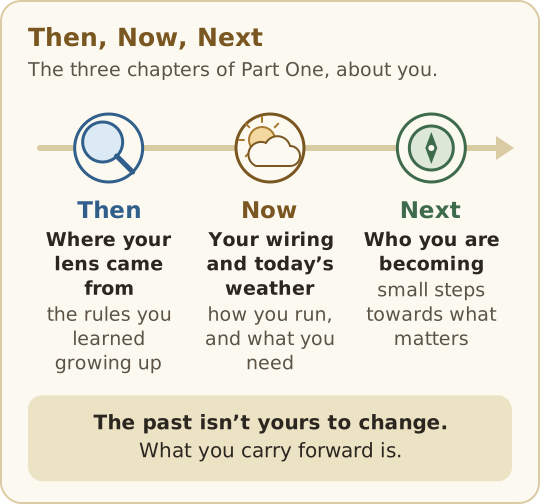
This is where the book begins. Part One (Then, Now and Next) is about you. Part Two (a Preface and Chapters I to V) is about the people you share a life with. Part Three (Chapters 1 to 17) is about how people work. Some printed copies hold only one or two of the parts; every chapter is free to read at spreadloveandacceptance.com/book, and the book at a glance there gives a one-minute tour of the whole thing.
In short:
- You’re not one thing. A reaction comes from your wiring (it stays), the patterns life taught you (they can soften) and today’s conditions (they pass). This part is about the patterns; Now covers the other two.
- Your lens came from somewhere: home, school, culture, money and what you lived through. Each stage of growing up asked its own question.
- Some old rules were learned without all the facts, and they can read other people for you: “Whoever notices, does it.”
- Write down the rulebook from home, then choose which rules to keep.
- The past isn’t yours to change. What you carry forward is.
Sunday, 10:15am
Your partner is still in bed and the kitchen is a mess. Before you’ve had a single thought, you feel it: “Of course. It’s always me.” Nobody said that. But in the house you grew up in, whoever noticed the mess cleaned it. That old rule just made a decision for you.
Or, living alone: Since his wife died, Ray’s house is quiet and nobody will see the dishes. He still can’t sit down until every one is done. Nobody is watching. An old rule from the home he grew up in still is.
Everything in this part is about you, and it is for you. Nothing is ever filled in about someone else, nothing is a test, and nothing you write needs to be shared. The chapters after Part One look at what happens between two people. This part goes back to the first person in every conversation.
This part looks back at growing up, so it goes gently. You can read one section and stop, and come back another day. Not every home felt calm or kind. If “they were doing their best” doesn’t fit your story, that’s okay. Take only what is useful to you and leave the rest.
Where this fits: the five big ideas
The whole program rests on five big ideas. Each one starts inside you and then shows up between you and other people. This part mostly teaches “Read your state first” and “Notice the quiet incentives”, with help from “See the whole load” and “Fix the setup, not the person”. (Borrowed from neurobiology, psychology, philosophy and behavioural science.)
- In you: Ask whether a feeling is the size of this moment or older. Notice what you were praised or scolded for as a child still pulling on you. Holding an old rule in check is real, hidden effort.
- Between you and others: A learned rule is part of the setup, not a flaw in anyone. Say your rules out loud, and choose shared ones.
You’re not one thing: the three layers
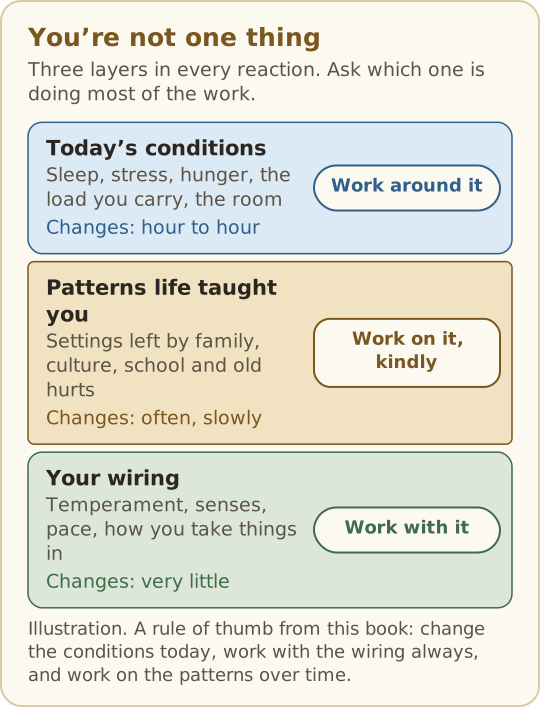
Most of us were never taught to take our own reactions apart. We just react, and then we either defend it (“That’s just how I am”) or blame ourselves (“What’s wrong with me?”). Neither helps much. A third way is to treat a reaction as a mix of three layers, and to ask which one is doing most of the work this time.
| Layer | What it is | How much it changes | The move |
|---|---|---|---|
| Your wiring | Temperament, sensory makeup, pace, how you take in words and feelings | Very little | Work with it: build a setup that suits you |
| Patterns life taught you | Settings left by family, culture, school, old relationships and hard experiences | Often, slowly | Work on it, kindly and in small steps |
| Today’s conditions | Sleep, stress, hunger, the load you’re carrying, the room, the time of day | Hour to hour | Work around it: eat first, sleep on it, talk tomorrow |
This part is about the middle layer. Now returns to the other two. Most real reactions have some of each, so the goal is not to put every feeling in exactly one box. It is to notice which layer is carrying most of the weight. The full guide is Know your own wiring.
Patterns are the layer that can soften. Family, culture, school, old relationships, past jobs and hard experiences can leave settings behind: an alarm that goes off early, a habit of pleasing people, going quiet, bracing for the worst. They made sense once. With awareness, safety and practice, and sometimes a counsellor, many of them ease over time. Some leave a lasting sensitivity that you learn to carry and explain.
Why sorting the layers matters
Each layer needs a different response. Treat a tired day as a deep wound and you spend weeks on what sleep would ease. Treat wiring as a bad habit and you try to “fix” what only needs a better setup. Treat an old pattern as a bad day and it keeps coming back.
In different relationships
- Two partners, Adrian and Felix: Adrian goes cold when Felix makes weekend plans without asking. When he sorts it, he finds a little wiring (he needs time to switch gears), a pattern (his father’s plans always overrode his) and a condition (it only blows up after his night shifts). Each part gets its own fix: a heads-up, one honest talk about the old feeling, and no plan-making on the morning after nights. Different hours has more on shift work.
- A parent and a teenager: A fifteen-year-old slams a door after being asked about homework. The parent’s first thought is “disrespect.” Sorting their own layers first (worn out from work, raised where answering back meant trouble), the parent waits an hour and asks a different question: “Rough day?”
Mix-ups, and how to fix them
- “It’s all from my childhood.” Often the biggest part is today. Check sleep, food and load first, and look further back only if it keeps happening.
- “It’s my wiring, so nothing can change.” The wiring may stay, but the setup around it can change a lot.
- Sorting someone else’s layers for them. Sort your own, then ask about theirs. A guess about another person’s layers lands as a judgment.
If you’re the only one doing this: That is enough. Sorting your own reaction changes what you bring into the room.
Research note: Researchers have long described differences in temperament that appear early in life and stay fairly steady, such as how quickly a child adapts to change. The New York Longitudinal Study, begun by Alexander Thomas and Stella Chess in the 1950s, is a well-known early example. Twin studies suggest personality is shaped by both genes and experience. Passing conditions matter too: in lab studies, people who have missed sleep react more strongly to upsetting things. This site’s idea: splitting a reaction into exactly three layers is a thinking tool, not a scientific category system.
Your lens came from somewhere
Family, school, friends, culture, money at home, what you watched and what’s on your phone all taught you what to expect: of yourself, of other people, and of how a “good” partner, parent or friend behaves. Together these make up your lens. By adulthood your lens doesn’t feel like a lens. It feels like simply seeing.
Most of what the lens taught you serves you well. Some of it was right for the child you were and is out of date for the adult you are now. The old story of the cave, where people who have only ever seen shadows take the shadows for the whole world, is a picture of something close to this. The site uses it for unseen work, but it also fits a rule you never chose, which can feel like simply how things are.
Where your lens came from covers this at the pace of a gentle page. Its full version goes further.
Why a lens isn’t a fault
A lens is how a busy brain saves effort: expectations let you predict without working everything out from scratch. Trouble starts only when an expectation from one home is used in another without checking, and someone is judged by rules they never knew.
In different relationships
- An interfaith couple: Amira grew up where love meant feeding people. Joseph grew up where love meant giving space. When Joseph’s mother is ill, Amira cooks for a week, and Joseph wonders why she won’t let his family rest. Same love, two lenses. Two faiths or cultures, one family has more.
- Two business partners: One grew up where talking about money was rude, the other where it was dinner-table talk. One seems secretive, the other pushy. A set monthly money meeting takes the guesswork out. Money together covers money styles.
Mix-ups, and how to fix them
- “My lens is just reality.” Ask, “How else could someone see this?” and try to name two other ways.
- “Their lens is the problem.” Everyone has one. Talk about yours first.
If you’re the only one doing this: You can learn your own lens alone, at your own pace. You don’t need anyone else to look at theirs for yours to become clearer.
Research note: Attachment theory, begun by John Bowlby and Mary Ainsworth, describes how early care can shape what a child comes to expect from the people who matter to them. In 1987 Cindy Hazan and Phillip Shaver applied the idea to adult love. Adult attachment patterns are best seen as tendencies, not fixed types, and they can shift with new relationships and experiences. Plato’s cave is a story, not evidence. This site’s idea: calling the whole mix a “lens.”
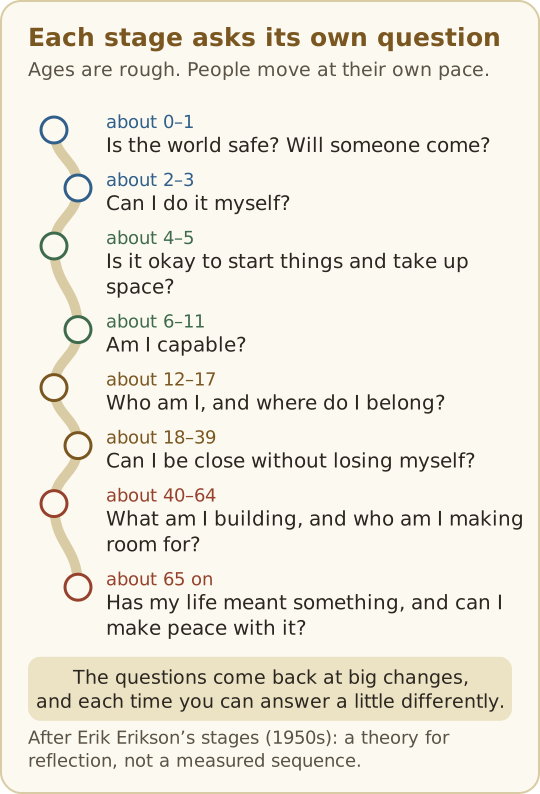
Each stage of growing up asks its own question
Researchers call these developmental stages. The ages are rough, and people move at their own pace.
| Stage (rough ages) | The big question |
|---|---|
| First years (about 0 to 1) | Is the world safe? Will someone come? |
| Toddler years (about 2 to 3) | Can I do it myself? |
| Early childhood (about 4 to 5) | Is it okay to start things and take up space? |
| School years (about 6 to 11) | Am I capable? |
| Teen years (about 12 to 17) | Who am I, and where do I belong? |
| Young adulthood (about 18 to 39) | Can I be close without losing myself? |
| Middle adulthood (about 40 to 64) | What am I building, and who am I making room for? |
| Later life (about 65 on) | Has my life meant something, and can I make peace with it? |
The answers can become understandings many people keep using as adults. We often come back to these questions at big changes, such as a move, a new job, a baby or a loss, and each time we can answer a little differently. The stages, with more detail, are on the growing-up page.
Why the questions help
Knowing the question you were busy with turns “What’s wrong with me?” into “That question never quite got answered,” which is easier to work with and blames nobody.
In different relationships
- A grandfather and his grown-up daughter: He left school at fourteen to work. When his daughter explains the new baby’s sleep plan in detail, an old “Am I capable?” stirs and he gets gruff. Once she sees it, she asks his advice on something he knows well, like fixing the cot. See For grown-up children.
- A partner who becomes ill: Illness in midlife can bring “Can I do it myself?” back at full volume. Accepting help can feel like being small again. Naming that helps both people. See When one of you is ill.
- After a partner dies, in later life: A widow of 71 finds herself going through old photos every evening. Later life’s question, “Has my life meant something?”, has come back loudly now that the person who shared it is gone. Telling one of the old stories to a grandchild each Sunday gives the question somewhere to go. See Grief.
Mix-ups, and how to fix them
- “I missed a stage, so I’m broken.” The questions come back at big changes, and you can answer them again.
- “The ages are exact.” They are rough. People move at their own pace.
If you’re the only one doing this: Map your own stages privately. Nobody else needs to agree with how you read your own childhood.
Research note: The table follows Erik Erikson’s stages of psychosocial development, published in the 1950s. His framework is widely taught and useful for reflection, but it is a theory rather than a measured sequence, and later researchers see development as more varied across people and cultures. Erikson also described stages after young adulthood, about caring for the next generation and, later, making peace with the life you have lived.
When something happened matters
An experience that touches the question you were answering at the time tends to go deeper. A move at 4 is mostly about routines. A move at 14, in the middle of “Where do I belong?”, can leave a longer feeling of being the outsider. Repetition matters too, and so does what you decided it meant about you, and whether someone helped you make sense of it.
Deeper isn’t permanent. People keep learning all their lives, and a feeling that was set early can still shift with new experience. If you want the longer version, see why timing matters.
Why timing matters, and why it isn’t the whole story
Four things shape how deep an experience goes: your age, how often it happened, what you decided it meant, and whether anyone helped you make sense of it. The last is hopeful, because you can still give that to yourself, and to the young people in your life.
In different relationships
- A grandmother raising her grandson: He was three when his mum couldn’t care for him any more. She notices he panics at goodbyes, so she builds a small goodbye ritual: the same words, the same wave, the same “I’ll be back at three.” See Foster and kinship families.
- A parent coming home: A parent back from months working away finds their twelve-year-old cool and distant. The child spent those months working out where they belong without them. Patience, and small regular time together, help more than a big welcome. See Coming home after time apart.
Mix-ups, and how to fix them
- “Deeper means permanent.” It means it may take more time and gentleness. People keep changing all their lives.
- “I don’t remember it, so it can’t matter.” Some things leave a feeling without a memory. You can work with the feeling.
If you’re the only one doing this: You don’t need the people from back then to agree on what happened. Your sense of how it felt is enough to work with.
Research note: The Adverse Childhood Experiences (ACE) study, published in 1998 by Vincent Felitti, Robert Anda and colleagues, found that hard experiences in childhood were linked, on average, with more health problems in adult life. Averages don’t decide any one person’s story, and an ACE count was never meant to predict an individual. Emmy Werner’s long study of children born on the Hawaiian island of Kauai in 1955 found that many who grew up with serious hardship were doing well as adults, and a steady, caring adult was often part of the reason.
Some old answers were learned without all the facts
Some of what you believe about yourself was learned when you were a child and didn’t have all the facts. A child often can’t know what was going on for the grown-ups. They only know how it felt. As an adult, you’re allowed to look again with the full picture. Looking again doesn’t mean deciding it was all fine. Some things that hurt really were not okay.
Here are a few common ones, with a fairer adult reading. They are examples, not rules, and only you can sort your own.
| The old understanding | Often learned when | A fairer, adult reading |
|---|---|---|
| “I’m only okay when I’m useful.” | Praise came mostly for helping | “Helping is something I do, not the price of being loved.” |
| “It’s always me.” | Whoever noticed the mess had to fix it | “Let’s give each job one owner, by choice.” |
| “If they loved me, they’d know.” | Stories and families where love meant mind-reading | “People who love me still need to be told.” |
| “Quiet means angry.” | Silence at home came before trouble | “Quiet might mean tired. I can ask.” |
In the Buddha’s story of the Second Arrow, what happened is the first arrow, and the story we add is the second. An old answer about yourself is often a second arrow that was fired long ago and is still flying.
Why children reach unfair conclusions
Young children explain the world with themselves at the centre: “If Mum is sad, I must have done something.” That is ordinary child logic. The conclusion can outlast the logic. As an adult you can add the missing facts and see it as a guess made with too little information.
In different relationships
- On your own after a divorce: “I’m too much” comes back loudly in the quiet. Looked at again: one relationship ended. That is a loss, not a verdict on the whole of you. See On my own.
- Coming out as an adult: At twelve, a boy picked up from the world around him that “people like me are a disappointment.” At thirty-four he comes out to his family. He reads the old answer again: it was a fear he absorbed, not a fact about him. See Coming out as an adult.
Mix-ups, and how to fix them
- “A fairer reading means pretending it was fine.” It doesn’t. Some things were not okay, and you can say so.
- “Once I see it, it should stop hurting.” Seeing comes first. Feelings usually follow more slowly.
- “I should replace it with something cheerful.” Aim for fair and true, not upbeat. A reading you don’t believe won’t help.
If you’re the only one doing this: This is private work by nature. You never need the people from back then to agree, explain or apologise for you to read the old answer again.
A note on safety: If an old answer came from someone who hurt you, and that person still has power over you, your safety comes first, before any looking back. Not safe at home? lists free, private hotlines.
Research note: Cognitive therapy, developed by Aaron Beck from the 1960s, works with “core beliefs”: deep, often early-learned conclusions about yourself, such as being unlovable or helpless. Delivered by trained therapists, it has good evidence for depression and anxiety. The table above borrows the habit of checking a belief against the facts; it isn’t therapy. The Second Arrow comes from an early Buddhist teaching. It is a teaching story, not a study.
An old rule can read other people for you
The lens colours how you read the people you love. If silence at home meant anger, a partner’s quiet evening can feel like trouble is on the way. We also tend to blame other people’s slips on who they are (“lazy”) and our own on our day (“I was swamped”). Ask before you conclude: “When you went quiet, what was going on for you?”
It also colours what you expect without saying so. An expectation nobody said out loud can’t be agreed to, so the other person can only miss it. “If you loved me, you’d just know.” “A good partner plans the birthdays.” “Rest is earned.” “Whoever notices, does it.” Each is somebody’s family rule, not a law of nature. When two people follow two different rulebooks, each sure theirs is normal, resentment can grow without anyone doing anything wrong.
That is why the same pile of unopened post can be a to-do list to one person and proof of unfairness to another. Chapter III, in Part Two, calls this two true views of the same thing. The family-script angle, one of the seven angles in that chapter, is the same idea seen from the other side.
Why an old rule reads people so fast
Under stress, a brain predicts with its oldest, most practised information, so an old rule can decide what someone meant before they finish. The fix isn’t to stop predicting. It is to treat the prediction as a question.
In different relationships
- Three partners sharing a home: Noa, Ren and Ali live together. Ren grew up where whoever cooked didn’t wash up. Noa grew up where the cook cleaned as they went. Ali grew up mostly eating alone. Each assumed their own rule, and a month of sighs followed. Naming all three rules at a house meeting ended it. See More than two partners at home.
- A long-distance couple: One reads a short text as cold, because in their family short replies meant someone was upset. Agreeing that “short means busy, not upset” saves a lot of worry. See Long distance.
- Separated co-parents: A father reads his ex-partner’s brief, factual messages as hostile. In her family, brief and factual was the polite way. Once he knows, the same messages read as calm. See Co-parenting.
Mix-ups, and how to fix them
- “Asking means I’m insecure.” Asking is checking. It is a skill, not a weakness.
- “If they cared, they’d know my rule.” A rule nobody said out loud can’t be kept. Say it.
- Naming their rule for them. “Your family obviously never talked” lands as an attack. Talk about your rules and ask about theirs.
If you’re the only one doing this: You can still ask the question and say your own rule out loud, even if the other person never names theirs: “I grew up where quiet meant angry, so I’m just checking.”
A note on safety: In some homes, silence or a look really does come before harm. If that is true for you now, your alarm isn’t an old rule misfiring. It is information, and it deserves to be taken seriously. Not safe at home? has people to talk to.
Research note: The habit of explaining other people’s behaviour by their character and our own by our circumstances has been studied since the 1960s and 70s, under names like the fundamental attribution error (Lee Ross) and the actor-observer bias (Edward Jones and Richard Nisbett). Later work found the effect varies with the situation and the culture, and a large review by Bertram Malle (2006) found the actor-observer difference much smaller than first thought. Treat it as a common tendency, not a law.
Write down the rulebook from home
Everyone grew up with an unwritten rulebook. Finish these six lines the way your childhood home would have:
- In my family, love looked like…
- When someone was upset, we…
- The jobs were split like this…
- Resting was okay when…
- Asking for help meant…
- The unforgivable thing was…
Then ask of each line: do I still want this rule? You can write them on the growing-up page, where they stay on your own device, or on paper. Some rules you will want to keep. Some you will want to change. Either is a fine answer.
Why writing it down helps
A rule you’ve never seen written feels like how things are. On paper it looks like what it is: something one family did.
In different relationships
- Two adult brothers: They fill in the six lines separately, then compare. Same house, different rulebooks. The older wrote “The jobs were split like this: I did everything.” The younger wrote “Mum did the jobs.” Years of tension suddenly make sense.
- A couple whose children have left home: The rules they built for raising children no longer fit a quiet house. Writing their own childhood lines again helps them see what each of them wants now. See Kids grown and gone.
Mix-ups, and how to fix them
- “I have to do all six.” One line is enough for today.
- Reading it out to your family as a charge sheet. It is for you. If you share it, share it as information about you.
If you’re the only one doing this: It works well alone. Many people never show their rulebook to anyone and still find it changes how they react.
A note on privacy and safety: What you write on the growing-up page stays on your device. If someone at home checks your phone or your things, paper you can keep somewhere private may be safer, or you can simply think the lines through. Not safe at home? has help.
Research note: Family systems thinkers, such as Murray Bowen, described how habits and roles can pass from one generation to the next. Studies of parenting across generations find some continuity, but far from total: many people raise children quite differently from how they were raised. Expressive writing studies, begun by James Pennebaker in the 1980s, found modest benefits for some people who wrote about hard experiences, though not for everyone, and if writing stirs up too much, it is fine to stop. This site’s idea: the six rulebook lines themselves.
Your rulebook from home
Write a few words on each line, the way the home you grew up in would have finished it. Skip any line you like. Then, for each one, ask: do I still want this rule?
- 1. In my family, love looked like…
- Doing things. Dad fixed your bike; nobody said it.
Do I still want this rule?
- Keep
- Chosen: Soften
- Drop
- 2. When someone was upset, we…
- Went quiet and waited for it to pass.
Do I still want this rule?
- Keep
- Chosen: Soften
- Drop
- 3. The jobs were split like this…
- Mum noticed, planned and remembered. Dad did the big jobs.
Do I still want this rule?
- Keep
- Soften
- Chosen: Drop
- 4. Resting was okay when…
- Everything else was done.
Do I still want this rule?
- Keep
- Soften
- Chosen: Drop
- 5. Asking for help meant…
- You hadn’t planned well enough.
Do I still want this rule?
- Keep
- Soften
- Chosen: Drop
- 6. The unforgivable thing was…
- Breaking a promise.
Do I still want this rule?
- Chosen: Keep
- Soften
- Drop
A made-up example. Names and details are invented.
Fill in your own: The rulebook from home (spreadloveandacceptance.com/
You get to choose which rules to keep
A one-minute lens check helps when a reaction feels bigger than the moment. Do it once you’ve settled, not in the heat of it:
- Where did I learn this?
- How old does this feel?
- Is it true here, with this person, now?
- What would the adult me choose?
Choosing a rule on purpose is different from throwing it out. Keep the ones that still fit, and update the ones that don’t. A learned rule is part of the setup, not a flaw in you, so the move is to change the setup.
When you’re ready, and only then, you can do this with someone else. On a calm day, swap rulebooks with curiosity, not correction. Then choose your own rules on purpose: who owns which job, how upset looks in each of you, and what helps. It isn’t about deciding whose family did it right. Check-ins give you a calm place to do it. When you’re ready to go on, Now turns to today: your wiring, your weather and your words.
Why choosing on purpose holds better
A rule picked on a calm day is easier to keep, because you know why you want it. And you don’t need to decide whether your family was right, only whether a rule suits your life now.
In different relationships
- A couple on different shifts: A night-shift nurse grew up with “rest has to be earned,” so sleeping at noon feels lazy. She and her wife choose a new shared rule: daytime sleep is work, and it is protected. See protected sleep.
- Two partners and a games console: One grew up where screens were for time alone, the other where playing together was family time. They choose a rule that keeps both: two evenings a week of playing together, and some time apart with no hard feelings. See Gaming and time together.
Mix-ups, and how to fix them
- “Choosing means rejecting my family.” Keep what fits. Many old rules are worth keeping.
- Running the lens check in the middle of a row. Wait until you’ve settled. The questions don’t work on a racing heart.
- “Shared rules means my rules win.” Put both lists on the table and choose from both.
If you’re the only one doing this: You can choose your own rules even if nobody swaps rulebooks with you. A new rule like “I ask before I assume” works alone.
A note on safety: Swapping rulebooks is for people who feel safe with each other. If you’re afraid of how someone will react, don’t do it with them. Talk with a counselor on your own instead. Not safe at home? lists free, private hotlines.
Research note: Research on “implementation intentions,” led by Peter Gollwitzer, found that deciding ahead what you’ll do in a given situation helps people act on their choices. Habit research also suggests new behaviour sticks best when it is repeated in the same situation. This site’s idea: the four-question lens check.
A worked example: the kitchen, replayed
Back to Sunday, 10:15am. Sam walks into the kitchen, sees the mess and thinks, “Of course. It’s always me.”
Without the tools: Sam starts cleaning, loudly. Alex wakes up to a closed face and a tight “Morning.” By lunch they are arguing about who does more, and neither can say how it began.
With the tools: Sam notices the thought and runs the lens check. Where did I learn this? At home, where whoever noticed, did. How old does it feel? About ten. Is it true here? Alex has not been asked, and has not said no. What would the adult Sam choose? To ask. Later, over coffee, Sam says, “I had an old rule go off in the kitchen: whoever notices does it. Could we look at who owns the kitchen jobs?” That is a conversation about a setup, not about Alex.
Two more worked examples
A visit home. Lena, 35, visits her parents with her girlfriend. Within an hour she is clearing plates and refilling drinks while everyone else sits. Her girlfriend asks, “Are you okay?” and Lena snaps. Later, she runs the lens check. Where did I learn this? As the eldest, I was the helper. How old does it feel? About twelve. Is it true here? Nobody asked me to. What would the adult me choose? To sit down for the main course and help with the washing-up after. On the next visit she tells her girlfriend the plan first, and it works.
Housemates and the noise. Kofi grew up in a big, loud family where noise meant life. His housemate Elif grew up in a small flat where quiet meant respect. Kofi’s music feels rude to Elif. Elif’s “Could you turn it down?” feels cold to Kofi. Each writes one rulebook line about noise and they swap. Then they choose a shared rule: music up until nine, headphones after, and a knock on the door is never a complaint. The room agreement has a fill-in for this.
What’s in your control, then and now
Part of growing up is learning, often the hard way, which things were never yours to control. The home you grew up in, other people’s moods, what happened before you had words for it: none of that was yours to run. A lot of old rules come from trying anyway. “If I’m good enough, nobody will be upset.” “Keep the peace at any cost.” “Earn your place by giving more.” They made sense to a child. They wear an adult out.
Yours
- Which old rules you keep, and which you retire
- How you talk to yourself about the past
- Your effort, your words, your limits, your rest
- Where you spend your time and care now
Not yours
- What happened, and who did what
- Whether someone from back then ever understands
- Other people’s moods, replies and choices
- Making everyone comfortable all the time
A new rule worth keeping: match energy with energy
If one of your old rules was “give more and you’ll be safe,” here is a kinder replacement: give in proportion to what comes back. Meet warmth with warmth and effort with effort. When you notice you’re the only one calling, planning, apologising or carrying, let your side shrink back to what feels fair, and see what the other person does with the space. That protects your energy, which is the thing you need to stay kind, to rest and to show up for the people who do show up for you.
Matching energy is not keeping a cold score, going silent to punish, or pulling away the moment someone has a hard week. People’s capacity changes: illness, grief, a new baby, a rough season. Then you match their capacity, not their output, and you can choose to give more for a while, on purpose. Children and people who depend on you are different again: you give what they need. If you’re afraid of someone, none of this is about managing them, and matching energy isn’t safe with a person who frightens you: Not safe at home? has people to talk to. The question is simply whether, over time, the giving runs both ways.
In different relationships
- Friends: You notice you start every conversation with an old school friend. You stop for a month, keep replying warmly, and see what comes back. See Always the one reaching out?
- A grown-up child and a parent: A mother expects a daily phone call. Her son chooses a long call on Sundays and warm texts in between, and says so kindly. See For grown-up children.
- A carer and a partner with an illness: When one partner can give very little for a while, the other matches their capacity, not their output, and finds support of their own. See When one of you is ill.
Mix-ups, and how to fix them
- “Matching energy means keeping score.” It means noticing balance over months, not counting favours this week.
- “If I give less, they’ll leave.” Maybe. That is painful, and it is information too.
- “Matching means cutting people off.” It means letting your side shrink, not slamming a door.
Research note: The split between what is and isn’t up to us comes from the Stoic teacher Epictetus, nearly two thousand years ago. Equity theory, developed by J. Stacy Adams in the 1960s and applied to close relationships by Elaine Hatfield (then Walster) and colleagues in the 1970s, found that people tend to feel uneasy in relationships that feel unbalanced, whether they give much more or receive much more. Margaret Clark and Judson Mills described how close relationships often run on care for each other’s needs rather than strict trade, which is why the idea here is balance over time, not a tally.
Try this: name three relationships. For each, jot what you give and what comes back. Where it’s badly out of balance, pick one small way to give a little less, or to ask for a little more, this month.
You, in all your relationships
Everything in this part is about you, so it goes wherever you go. The same old rules turn up, in different clothes, in every relationship you have.
- With yourself first: The voice you use after a mistake, and whether rest feels allowed. Old rules often speak loudest here, where nobody else hears them.
- With a partner, or more than one: Who notices, who plans, what quiet means. Every couple brings two rulebooks, and each extra partner adds another. See More than two partners at home.
- With friends: Who reaches out first, and how long a silence can last before it feels like an ending. See Friends.
- With family: Old roles switch back on fast: the helper clears plates, the peacemaker smooths things over. See For grown-up children, Family rifts and Grandparents.
- At work: Praised mostly for being useful? You may say yes to everything. The same lens check works at a desk.
- With housemates: Rulebooks about mess, noise, guests and borrowing meet in a small space. See Sharing a room.
- On your own: With nobody to bump into, old rules can run quietly for years. See On my own.
To find help for your own situation, see help by relationship. If you guide others through this, For counsellors, coaches and group leaders has notes for you.
In the individual program
This part goes with Step 3 of the individual program: write the rulebook from the home you grew up in, and choose one rule you’d like to change. You can do every step on your own.
Your next step: Step 3: see where your lens came from · Where your lens came from · A gentle first week · The whole book on knowing yourself
Where the thirteen fields meet in this part
This part draws on 4 of the author’s thirteen fields (the About page lists them all). Here is what each one brings, and which of the five big ideas it serves.
| Field | What it brings here | Big idea |
|---|---|---|
| Psychology | The lens you learned, the stages of growing up and the old stories we carry. Leftover patterns are easier to change once you can see them as patterns. | Read your state first |
| Neurobiology | An old alarm can go off before you’ve had time to think. That is a body doing its job, not a character flaw. | Read your state first |
| Philosophy | Plato’s cave and the Second Arrow: a rule you never chose can feel like simply how things are, and an old story about yourself can keep flying long after it was fired. | Notice the quiet incentives |
| Behavioural science | What got praised or scolded taught you what to do, and the same process works the other way: repeating something new teaches a new rule. | Notice the quiet incentives |
How they connect
The word in brackets is the root the two fields share; the polymath page explains all seven. From the most obvious connection to the most abstract:
- Obvious: Psychology + Neurobiology (state and setting). How you feel and how your nervous system is running are the same moment, seen from two sides. An old alarm is both a feeling and a body state, so noticing it is the first step. This holds up “Read your state first”.
- Hidden: Psychology + Philosophy (signal and noise). Intent isn’t impact, and an old story is a guess wearing the costume of a fact. Asking “Is it true here, with this person, now?” takes the costume off. This holds up “Notice the quiet incentives”.
- Abstract: Philosophy + Behavioural science (feedback loops). Aristotle thought we become what we repeatedly do. Old rules were learned by repetition, and new ones are learned the same way, by small acts, not by one big decision. This holds up “Notice the quiet incentives”.
The body tells you when an old rule has gone off, and the questions tell you whether it still fits.
Connect any two fields yourself · Ask Professor Puddles how all thirteen connect
When it goes wrong, and when it goes right
When it goes wrong, looking back turns into blame, either of the people who raised you or of yourself. Or every big reaction gets filed as an old wound, when it was really a full tank. Or an old rule is announced to a partner as a verdict (“You’re just like my mother”).
When it goes right, you notice the old rule, say so lightly (“an old rule went off”), check whether it fits here, and choose. Over a few weeks you both learn what rules each of you brought, and you start to write shared ones.
Questions people often ask
Do I have to remember my childhood for this to work?
No. You only need to notice the rule, not its origin. “Whoever notices, does it” can be examined without a single memory attached.
What if I had a hard childhood?
Then go gently and take only what is useful. Looking again doesn’t mean deciding it was all fine, and you never have to share it. If it feels heavy, stop and come back another day, or explore it with a qualified professional, if and when you want that.
Can I use this to explain my partner’s behaviour?
Not as a verdict. You can ask, gently, “When you went quiet, what was going on for you?” A guess about someone else’s history often turns into a judgment of them. The tools are for filling in about yourself.
What if most of my family’s rules were good ones?
Then keep them, gladly. This part isn’t looking for faults. Plenty of people find that most of their rulebook still fits, and that only one or two lines need an update.
What if the person I’d like to swap rulebooks with won’t do it?
That’s their choice. You can still write yours, choose your own rules and say one of them out loud as information: “I grew up where whoever noticed did it, so I’m working on asking instead.” It often makes it easier for the other person to join in later.
Where can I talk this through?
Professor Puddles, the site’s friendly chat host, can help you work out where a feeling came from before you decide what to say.
Limits and cautions
- This part is general education. It isn’t a diagnosis, a test or therapy, and it can’t tell you what you or anyone else has.
- The stages and their questions are a rough guide. Real lives are messier, and people move at their own pace.
- The three layers are a thinking tool, not a scientific category system. They overlap.
- Fill things in about yourself only. Never use what you learn about your own history to win a point, and never use someone else’s against them.
- Research notes on this page describe well-known findings in plain words, and say where the evidence is limited. Notes marked “This site’s idea” are our own ways of putting things into practice, not established science.
- Looking back can be heavy. Stop whenever you like. You never owe anyone your history.
- If talking about any of this with someone ever feels unsafe, or you feel you can’t say no, stop and talk with a trained counselor on your own. When someone is afraid of their partner, counseling together isn’t advised. Not safe at home? lists free, private hotlines.
Last updated: October 2026