Part Three · Chapter 3
How we see each other
In short:
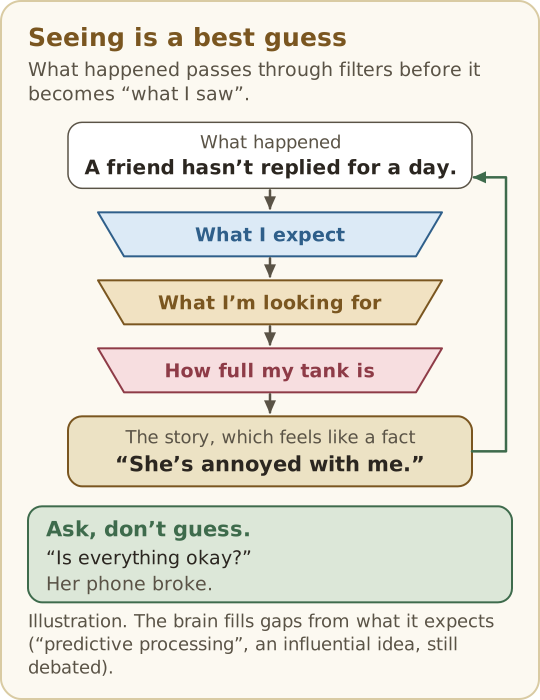
- Seeing is a best guess. Your brain fills in a lot of what you think you see and hear.
- We fill gaps with stories, and the story often feels like a fact.
- We judge ourselves by our reasons and others by their actions. That gap causes a lot of hurt.
- Ask, don’t guess. Asking is kinder and more accurate than reading minds.
Why the tools work: this chapter explains the thinking behind these tools from earlier in the book.
- Who did what (the Preface to Part Two) works because everyone sees their own effort more clearly than other people’s. Two honest guesses of “I do about 60%” can add up to more than 100%. Writing it down replaces two best guesses with one shared page. Big idea: see the whole load.
- Rewind the talk: see their side (Part Two, Chapter III) slows down a habit everyone has: judging ourselves by our reasons and other people by their actions.
- The Chat analyzer (also called the Signal Translator) follows this chapter’s last idea: ask, don’t guess.
Wednesday, 12:15pm
You wave at a coworker across the canteen. She looks straight through you and walks off. All afternoon you wonder what you did. At four, she messages: “Sorry I didn’t stop, I’d just had a call about my dad.” She never saw you. The whole story was yours.
Chapters 1 and 2 looked inward, at feelings and stress. This chapter looks outward: at how we see other people, and how they see us. Most everyday hurt between people isn’t caused by cruelty. It is caused by two honest people seeing the same moment differently, each sure they are seeing it as it is.
As in the rest of Part Three, each idea is looked at through three lenses: psychology (named research, with its limits), philosophy (thinkers and traditions, in plain paraphrase) and an autistic lens (a perspective, not a deficit; not every autistic person is the same, and nothing here diagnoses anyone), with an ADHD lens where it matters most. Then it all comes together, with worked examples, exercises and questions. Where something is this site’s idea, it says so.
Seeing is a best guess
It feels as if your eyes work like a camera and your ears like a microphone. They don’t. They take in patchy, noisy information, and the brain fills in the rest from what it expects. You have a blind spot in each eye that you never notice, because the brain paints over it. You “hear” whole words in a noisy room from fragments. Most of the time these guesses are excellent. But they mean that seeing is partly expecting, and two people with different expectations can honestly see different things.
Psychology
In the nineteenth century, Hermann von Helmholtz described perception as “unconscious inference”: the brain drawing quick conclusions from incomplete evidence. Modern predictive processing theories, associated with researchers such as Karl Friston and Andy Clark, develop this idea: the brain constantly predicts what it will sense and updates when the predictions are wrong. Anil Seth has argued that conscious perception is a kind of controlled guess, held in check by the senses. These are influential frameworks, not settled facts, and researchers argue about how much they explain.
A famous everyday example came in 2015, when a photo of a dress split the internet: some people saw it as blue and black, others as white and gold. Research by Pascal Wallisch and others suggested that people’s brains made different assumptions about the lighting in the photo. Same pixels, different guesses.
Philosophy
Immanuel Kant argued in the eighteenth century that we never know the world purely as it is in itself. We know it as it appears to us, shaped by the way our minds organise experience, such as in space, time and cause. Long before him, Plato’s allegory of the cave described prisoners who took shadows on a wall for the whole of reality. Both point to the same humility: what seems obvious to us is partly our own making.
Through an autistic lens
Some researchers, including Elizabeth Pellicano and David Burr (2012), have suggested that autistic perception may lean less on prior expectations and more on incoming detail, so that the world is experienced more “as it is.” Others, such as Rebecca Lawson, Geraint Rees and Karl Friston, have offered different versions of the idea, and the research is still debated. If something like this is true for some people, it has two sides. It can mean noticing details, patterns and changes others miss, and being less fooled by expectation. It can also mean more unfiltered input, which is tiring.
Either way, it is a useful reminder for everyone. The “normal” way of seeing is one way of seeing, with its own blind spots. Someone who sees differently may be seeing something real that you are filtering out.
Thoughts you could try: “This is what I see. It might not be all there is.” “What else could this be?”
You see what you’re looking for
Attention is like a torch in a dark room. What it lights up, you see clearly. What it misses can stay invisible, even when it is right in front of you. If you are looking for signs that someone is careless, every forgotten thing glows and every kindness stays in the dark.
Psychology
In Daniel Simons and Christopher Chabris’s well-known study (1999), people counting basketball passes in a video often failed to notice a person in a gorilla suit walking through the middle of the scene. Arien Mack and Irvin Rock called this inattentional blindness. In another study, by Simons and Daniel Levin (1998), a stranger asking for directions was swapped for a different person mid-conversation, while a door was carried between them. Many people didn’t notice the switch. This is called change blindness.
These findings don’t mean people are careless. They show that attention is limited and selective by design. We can only see a small part of what is there, and our goals and expectations choose which part.
Philosophy
William James wrote that our experience is made of what we agree to attend to. The French philosopher Simone Weil went further: she described attention, real, patient attention to another person, as one of the rarest and purest forms of generosity. In both views, where we point our attention isn’t neutral. It shapes the world we live in and the people we are able to see.
Through an autistic lens
Autistic attention often goes deep and narrow, focused strongly on a few things at a time (the theory of monotropism; see Chapter 9). A monotropic person might miss a passing facial expression while noticing a detail of the conversation that everyone else missed. A more spread-out, “polytropic” attention might catch the face and miss the detail. Neither is the correct way to attend. Each has its own gorillas.
A practical lesson: if something matters, say it plainly rather than relying on someone noticing it. And if someone is deeply focused, give them a moment to surface before expecting full attention. That helps everyone, not only autistic people.
Through an ADHD lens
ADHD is less a lack of attention than attention that is harder to steer. It tends to be pulled towards what is new, interesting or urgent, and it can also lock on hard (sometimes called hyperfocus). So a person with ADHD may truly not have seen the full bin, or heard a request made while they were absorbed in something else. Not seeing isn’t the same as not caring. Two simple habits help both sides: get attention before you ask (“Have you got a sec?”), and put requests in writing.
Thoughts you could try: “What might I be missing?” “If I were looking for the opposite, what would I see?”
We fill the gaps with stories, and memory is a retelling
When we don’t know why someone did something, the mind supplies a reason almost instantly. A late reply means anger. A short email means disapproval. A partner’s sigh means disappointment. The story arrives with the force of a fact. We rarely notice we made it up.
Memory works in a similar way. We don’t replay a recording. We rebuild the event each time, with help from what we now know and feel. That is why two honest people can remember the same evening very differently, and why “That’s not what happened!” arguments are so hard to win.
Psychology
Richard Nisbett and Timothy Wilson (1977) found that people often gave confident explanations for their own choices that didn’t match what actually influenced them. Michael Gazzaniga’s research with split-brain patients led him to describe an “interpreter” in the brain that creates explanations for actions, even when it doesn’t know their real cause.
On memory, Frederic Bartlett (1932) showed that people retelling an unfamiliar story gradually reshaped it to fit their own expectations. Elizabeth Loftus and John Palmer (1974) found that people who were asked how fast cars were going when they “smashed” into each other gave higher speed estimates, and were later more likely to falsely remember broken glass, than people asked about cars that “hit” each other. One word changed the memory.
Cognitive therapy, developed by Aaron Beck, names a common trap: mind-reading, assuming you know what others think, usually something negative about you. The researcher and writer Brené Brown popularised a simple phrase for catching it: “The story I’m telling myself is…”
Philosophy
The parable of the blind men and the elephant, told in Jain, Buddhist and Hindu traditions, describes people touching one part of an elephant each, the trunk, the leg, the ear, and each insisting the elephant is like a snake, a tree or a fan. Each has real evidence. Each is wrong about the whole. Jain philosophy built a whole teaching, anekāntavāda or “many-sidedness,” on this idea: truth has many sides, and any single view is partial.
Through an autistic lens
Many autistic people prefer to ask rather than infer, because guessing hidden meanings is tiring and often wrong. They may also give plain, story-free statements, such as “I’m not upset, I’m tired,” and expect them to be taken at face value. That is a gift to everyone: it removes the gap that stories fill.
Stories also run the other way. Non-autistic people often write stories about autistic behaviour: “He won’t look at me, so he must be hiding something.” “She didn’t say hello, so she’s rude.” Those stories feel like facts too. The kinder and more accurate move is the same in both directions: ask, and believe the answer.
Words you could use: “The story I’m telling myself is that you’re upset with me. Is that right?” “We might be remembering this differently, and that’s okay. What do you remember?”
We judge ourselves by our reasons, and others by their actions
When you snap, you know about the bad night, the pain in your back and the worrying phone call. When someone else snaps, you mostly see the snap. So it’s easy to explain your own behaviour by your situation, and other people’s by their character. “I was stressed.” “They’re rude.”
Psychology
Lee Ross (1977) named this the fundamental attribution error: the tendency to underestimate situations and overestimate personality when explaining what others do. In an early study by Edward Jones and Victor Harris (1967), people read essays supporting or opposing Fidel Castro. Even when told the writers had been assigned their side, readers still tended to think the essays reflected the writers’ true views.
Jones and Richard Nisbett (1971) proposed an actor-observer difference: we explain our own actions by situations and others’ by traits. Later, a large review by Bertram Malle (2006) found much less support for this simple version than expected, so it is best seen as a tendency in some situations rather than a rule. Michael Morris and Kaiping Peng (1994) found that newspapers in the United States and China explained the same crimes differently, with Chinese reports giving more weight to situations, a sign that culture shapes how we explain behaviour.
Philosophy
Zhuangzi’s Empty Boat: a man is furious when a boat bumps his, until he sees it is empty. With nobody to blame, his anger goes. Marcus Aurelius often reminded himself, in his private notes, that when someone behaves badly they are acting on their own idea of what is good or necessary, and that understanding this leaves less room for anger. Neither thinker said behaviour doesn’t matter. They said: look at what drove it before deciding what it means.
Through an autistic lens
Autistic people are often judged by their actions in exactly this way. Research by Noah Sasson and colleagues (2017) found that non-autistic observers formed less favourable first impressions of autistic people from brief video clips, often within seconds, even though impressions improved when observers read transcripts of what they had actually said. Flat expression, little eye contact, honesty without softening or an unusual tone can be read as coldness, rudeness or even dishonesty, when they are simply a different way of being.
The fair correction is the same one this section suggests for everyone: before deciding that someone’s behaviour reveals their character, ask what else could explain it, including how they are wired.
Thoughts you could try: “What might be going on for them that I can’t see?” “If I had done this, what would my reason be?”
Quick shortcuts can lead us astray
The brain uses shortcuts to save effort. Most are helpful: you don’t want to think hard about every face on the street. But some lead to unfair judgements, and they are hard to spot from the inside. Having them doesn’t make anyone a bad person. Ignoring them can lead to unfairness.
Psychology
Amos Tversky and Daniel Kahneman’s research on heuristics, rules of thumb for judging under uncertainty, started a large field of study. Kahneman’s book Thinking, Fast and Slow (2011) popularised the idea of a fast, intuitive mode and a slower, effortful one. Some well-known examples:
- Confirmation bias: noticing and remembering what fits what we already believe. Raymond Nickerson’s 1998 review called it one of the most common problems in human reasoning.
- Negativity bias: bad events tend to weigh more than good ones. Roy Baumeister and colleagues’ review, “Bad Is Stronger Than Good” (2001), gathered evidence across many areas of life.
- The halo effect: one good trait, such as looks or confidence, colouring how we judge everything else, first described by Edward Thorndike (1920).
- Stereotypes and implicit bias: quick associations about groups. Anthony Greenwald and colleagues’ Implicit Association Test (1998) made this famous. How well such tests predict real behaviour is strongly debated, and some studies found that changing scores on these tests didn’t reliably change behaviour. That a lot of quick judgements about groups happen without conscious choice is widely accepted.
Some famous findings in this area, especially on subtle “priming,” have not replicated well, which is a good reason to be modest about any single study.
Philosophy
Francis Bacon, in Novum Organum (1620), described four “idols” that mislead the mind. Idols of the tribe: errors common to all humans, such as seeing patterns that aren’t there. Idols of the cave: errors from our own upbringing and temperament. Idols of the marketplace: errors that come from words and how we use them. Idols of the theatre: errors from systems and dogmas we have absorbed. Four hundred years later, it is still a useful checklist for your own thinking.
Through an autistic lens
A few studies, such as work by Benedetto De Martino and colleagues (2008), have suggested that autistic people may be less swayed by how a choice is framed, making more consistent decisions whether it is described as a gain or a loss. The evidence is limited, and it doesn’t apply to every person, but it hints that some biases are less universal than they seem.
Autistic people also know a lot about being on the receiving end of stereotypes: that they lack empathy, that they are all mathematical, or that they are all like a character in a film. Those stereotypes show clearly how a shortcut about a group can hide every real person in it.
Thoughts you could try: “Am I looking for proof of what I already think?” “Would I judge this the same way if someone I like had done it?”
Everyone feels like the one who sees clearly
Most of us quietly assume that we see the world as it is. So when someone disagrees, there seem to be only three options: they don’t have the facts, they aren’t thinking clearly, or they are biased. The other person is thinking the same about us. Each person can see the other’s lens, but not their own.
Psychology
Lee Ross and Andrew Ward (1996) called this naive realism. Emily Pronin, Daniel Lin and Ross (2002) described a related bias blind spot: people readily see biases in others while rating themselves as less biased than average. A classic study by Albert Hastorf and Hadley Cantril (1954), “They Saw a Game,” asked students from two universities to watch the same rough football match. Each side saw the other team committing more fouls. They weren’t lying. They were watching different games.
Philosophy
In a famous exchange, Zhuangzi and his friend Huizi watch fish in a river. Zhuangzi says the fish are happy. Huizi asks how he can know, since he isn’t a fish. Zhuangzi replies: how do you know I don’t know, since you aren’t me? The story playfully shows how hard it is to step outside your own point of view, and how much we still manage to know about each other.
Friedrich Nietzsche argued for perspectivism: there is no view from nowhere, only views from somewhere, and seeing more means gathering more perspectives, not finding one perfect one.
Through an autistic lens
The double empathy problem, described by Damian Milton (2012), is naive realism applied to neurotypes. For a long time, autistic social differences were described only as deficits, measured against non-autistic norms. Milton pointed out that misunderstanding runs both ways: non-autistic people also struggle to read autistic people. A study led by Catherine Crompton (2020) found that information passed along a chain of people was shared about as well among autistic people as among non-autistic people, but less well in mixed chains. The problem was the mismatch, not one side.
For everyone, the lesson is that “the normal way to see it” is usually just the majority way. Majority isn’t the same as correct.
Words you could use: “I think we’re both seeing this from where we stand. Can you tell me how it looks from yours?”
“Us” and “them” changes what we see
People sort themselves into groups quickly, over big things like faith, politics or nationality, and over tiny things like which team, which shift or which side of the office. Once there is an “us” and a “them,” perception shifts. Our group looks varied and full of individuals. The other group looks “all the same.” We give our own side the benefit of the doubt and hold the other to a harder standard.
Psychology
Henri Tajfel’s minimal group experiments in the early 1970s found that people sorted into groups on trivial grounds, such as which painter they preferred, still tended to favour their own group. Tajfel and John Turner’s social identity theory (1979) explained this through how much of our sense of self comes from groups. George Quattrone and Edward Jones (1980) described the out-group homogeneity effect: seeing other groups as more alike than our own. Muzafer Sherif’s “Robbers Cave” summer camp study (1954) is often told as a story of group conflict and repair, but later research, including by Gina Perry, has raised serious questions about how it was run.
The good news is well supported. Gordon Allport’s contact hypothesis (1954) proposed that spending time with members of other groups, especially as equals, working together, with support from those in charge, reduces prejudice. A large review by Thomas Pettigrew and Linda Tropp (2006) found that contact was generally linked with less prejudice, across many kinds of groups.
Philosophy
The Stoic Hierocles pictured each person at the centre of a set of circles: self, family, neighbours, fellow citizens, all of humanity. He suggested drawing the outer circles in, treating more distant people a little more like near ones. Martin Buber distinguished seeing someone as an “It”, a type or a means, from meeting them as a “Thou”, a whole person. “Them” is almost always an It. Real meeting turns it back into a person.
Through an autistic lens
Autistic people often know what it is like to be the out-group: judged as a type, measured against someone else’s normal. The neurodiversity movement, with the term usually credited to the sociologist Judy Singer in the late 1990s, reframed autism and other differences as part of natural human variety rather than only as disorders. Autistic communities, spaces and friendships, where people share a way of communicating, are often described as a huge relief.
The out-group effect also works on autism itself. “Autistic people are all like this” is exactly the kind of judgement this section describes. The saying from autistic communities, “if you’ve met one autistic person, you’ve met one autistic person,” is a good antidote for every group.
Thoughts you could try: “Would I say this about one of ‘us’?” “Who in that group do I actually know, as a person?”
Ask, don’t guess: seeing more fairly
If perception is a guess, attention is a torch, and stories fill the gaps, what helps? Not trying harder to read minds. Asking. Curiosity is the most reliable tool we have for seeing other people as they are.
Psychology
Tal Eyal, Mary Steffel and Nicholas Epley (2018) ran a series of experiments testing whether imagining another person’s perspective made people more accurate about what that person thought or felt. It generally didn’t. What did help was perspective getting: actually asking the person and listening to the answer. Epley’s book Mindwise (2014) explores why we are less good at reading minds than we think. William Ickes, who studied empathic accuracy, found that even close partners and friends are often only modestly accurate at guessing each other’s thoughts.
Carl Rogers, a founder of person-centred therapy, emphasised listening with real curiosity and checking understanding by reflecting it back. That idea underlies many modern listening skills.
Philosophy
Socrates was known for saying, in effect, that his wisdom lay in knowing that he didn’t know. Iris Murdoch, in The Sovereignty of Good (1970), argued that moral life is mostly a matter of attention: learning to look at another person justly and lovingly, seeing them as they really are rather than through our own fears and fantasies. For Murdoch, this patient, fair looking was the heart of goodness, more than big moral choices.
Through an autistic lens
Asking directly is something many autistic people already value, and are sometimes criticised for: “Why do you ask so many questions?” Yet it is exactly what the research recommends. Plain questions, plain answers and believing what people say about themselves reduce misunderstanding for everyone.
Some autistic people find open questions (“How are you?”) harder than specific ones (“Was today busy or quiet?”). Others need time to answer, or prefer to answer in writing. Asking well includes asking in a way the other person can answer.
Words you could use: “Can I check what you meant?” “What was going on for you?” “I might have this wrong. How did it look from your side?”
Chat analyzer
Mode
- Chosen: I’m about to send this
- Someone sent me this
- Type your sentence
- You always cancel on me last minute. Can we pick a time for a call on Sunday?
- Relationship
- Friends
- Channel
- Text / chat
The read
- How it may land for most listeners
- Some words may hurt. How it may sound: sharp in places.
- What stands out
- The word “always” (words like “always” and “never” leave no room for the times it went fine).
- A clearer way to say it
- Lately it’s felt like you cancel on me last minute. Can we pick a time for a call on Sunday?
- What changed, and why
- always → lately it’s felt like. “Always” and “never” erase every exception, so the listener argues the exception.
A made-up example. Names and details are invented. The ask stayed; only the word that would start an argument changed.
Fill in your own: Chat analyzer (spreadloveandacceptance.com/
Putting it together
Here is the chapter as a short sequence for any moment when someone’s behaviour bothers you. It is this site’s idea, joining the research above, not a tested method:
- Notice the story. “The story I’m telling myself is…”
- Find two more. Think of two other explanations, at least one about their situation, not their character.
- Check your torch. What have I been looking for? What might I have missed?
- Check your state. Stress and tiredness make stories darker. See the ladder.
- Ask. A short, curious question, in a way they can answer.
- Believe the answer, and keep your own eyes open. Take what they say seriously. If a pattern of hurt keeps happening, that matters too.
The three lenses fit together. Psychology shows that perception is an active guess, attention is selective, memory is rebuilt, explanations are biased towards character, and everyone feels like the realist. Philosophy, from Plato and Kant to Zhuangzi, the Jain thinkers, Bacon and Murdoch, has long taught humility about our own view and patient attention to others. The autistic lens shows that the majority way of seeing is one way among several, that misunderstanding runs both ways, and that plain, direct asking is one of the best tools anyone has.
Worked examples
On your own: the story about yourself
After a job rejection, Omar thinks, “I always fail at interviews.” Using the sequence, he notices the story, finds two others (“that company had two hundred applicants”; “I got a second interview last time”), and sees that his torch only lights up failures. He asks for feedback. It is mostly about one missing skill, which he can learn.
Partners: the sigh
Every time Desmond sighs at dinner, Fern hears “I’m disappointed in you.” One night Fern asks. Desmond is surprised: he sighs when he’s tired and his back hurts. For two years, Fern had been answering a story Desmond never told. See Part Two, Chapter I.
Parent and teenager: the label
Carol’s daughter was “the difficult one” from age three. When Carol starts noting one cooperative thing each day, she is shocked how many she had missed. Her daughter notices the change before Carol says anything. See For teens and For parents.
Coworkers across neurotypes
A new engineer, who is autistic, answers questions very directly and rarely makes small talk. A colleague decides he is arrogant. After a project together, she learns he is warm, funny in writing, and simply prefers getting to the point. She asks how he likes feedback; he says “in writing, as plainly as you like.” Their work gets faster. See Autistic at work.
Adult siblings: two memories
Lydia and Lee remember their parents’ divorce completely differently. Each thinks the other is rewriting history. When they agree that both memories can be true, from two ages and two places in the family, the fight softens into a long, sad, honest talk. See Family rifts.
Friends: the group chat
Nia notices her old school friends have made plans without her, again. Her first story is “they’ve dropped me.” Her second and third are “they assumed I’m busy since the baby” and “nobody’s organising anything, it just happens in another chat.” She messages one friend: “I’d love to be asked, even if I can’t always come.” The friend is mortified. They had been trying not to pressure her. See Friends: after a new baby.
Community: the new neighbours
A residents’ group grumbles that “the new families don’t join in.” Someone knocks on doors with a simple question: “What would make it easier to come?” The answers are about timing and childcare, not unwillingness. The next meeting moves to Saturday morning, with a play corner.
Exercises
- Three stories. Next time someone upsets you, write the story you’re telling yourself, then two other possible stories. Notice how your feeling changes.
- The kindness log. For one week, note one kind or helpful thing a person you’re struggling with does each day. It retrains the torch.
- Explain their side. In a disagreement, explain the other person’s view until they say, “Yes, that’s it.” Only then give yours.
- Swap a guess for a question. Once a day, catch yourself guessing what someone thinks, and ask instead.
- Bacon’s idols. Pick one strong opinion you hold about a person or group. Ask: which idol might be at work here? Human nature, my own history, the words I use, or a system I absorbed?
- One person, not a group. Have one real conversation this month with someone from a group you tend to see as “them.” Ask about their life, not their opinions.
Questions people often ask
If everyone’s perception is a guess, is anything true?
Yes. Perception is a guess, but usually a very good one, and we can check it against other people, records and evidence. The point isn’t that nothing is real. It is that our certainty should come with some humility.
Isn’t giving people the benefit of the doubt naive?
Checking the story before you decide isn’t the same as believing everything. If someone keeps doing the same hurtful thing after it has been named, that is a pattern, not a misreading, and it deserves to be taken seriously.
Someone keeps telling me I’m remembering things wrong. Should I doubt myself?
Memory really is rebuilt, and honest people do remember differently. But if one person regularly tells you that what you saw, heard or remember didn’t happen, and you find yourself confused about your own mind, that can be a form of control. Keep your own notes, talk to someone you trust, and see Signs to look out for.
Can I get rid of my biases?
Probably not entirely, and there is little good evidence for quick fixes. What helps is slowing down for important judgements, asking more, seeking out different people, and setting up fair processes, like clear criteria at work, so that shortcuts matter less.
How do I ask without sounding accusing?
Start with yourself: “I might have this wrong…” Keep it short and curious. “When you left early, I wondered if something was up. Was it?” is different from “Why did you storm out?”
Is it unkind to notice that someone’s view comes from their background?
Not if you apply the same idea to yourself. “You only think that because of how you were raised” is a weapon. “We were both raised with different rules, so of course we see this differently” is an opening. The difference is whether your own lens is on the table too.
What if I ask and they won’t say?
That is their choice. You can say, “Okay. If you want to tell me later, I’m here,” and hold your story lightly in the meantime. Not knowing is uncomfortable, but it is more honest than a made-up certainty.
When to get more help
It may help to talk to a counsellor, psychologist or other trained professional if you often feel that others are against you, find it very hard to trust anyone, keep getting stuck in the same painful stories about yourself, or notice that misunderstandings are damaging important relationships again and again. These patterns are common, understandable and often change with support.
Seeing others fairly should never cost you trust in your own experience. If you feel afraid of someone, or are often told your perceptions aren’t real, Not safe at home? lists free, private help. This chapter is general education, not diagnosis or therapy.
More for your situation
- Back: Stress and the nervous system, in full · Next: How communication works, in full
- Part One, Then: where your lens came from
- Part Two, Chapter III: the seven angles
- Rewind the talk: see their side, the Chat analyzer and Wired differently, in depth
- The library: How we think, hostile attribution, false consensus, neurodiversity
- Philosophy stories: Seeing the other person
- The whole book · Help by relationship
Last updated: October 2026