Part Three · Chapter 3
How we see each other: perception, bias, and the stories we tell
Why two people can watch the same moment and come away with two different stories, and how to see others, and yourself, a little more fairly.
In short:
- Seeing is a best guess. Your brain fills in a lot of what you think you see and hear.
- We fill gaps with stories, and the story often feels like a fact.
- We judge ourselves by our reasons and others by their actions. That gap causes a lot of hurt.
- Ask, don’t guess. Asking is kinder and more accurate than reading minds.
Why the tools work: this chapter explains the thinking behind these tools from earlier in the book.
- Who did what (the Preface to Part Two) works because everyone sees their own effort more clearly than other people’s. Two honest guesses of “I do about 60%” can add up to more than 100%. Writing it down replaces two best guesses with one shared page. Big idea: see the whole load.
- Rewind the talk: see their side (Part Two, Chapter III) slows down a habit everyone has: judging ourselves by our reasons and other people by their actions.
- The Chat analyzer (also called the Signal Translator) follows this chapter’s last idea: ask, don’t guess.
Wednesday, 12:15pm
You wave at a coworker across the canteen. She looks straight through you and walks off. All afternoon you wonder what you did. At four, she messages: “Sorry I didn’t stop, I’d just had a call about my dad.” She never saw you. The whole story was yours.
The first two chapters of Part Three looked inside: feelings, and the stress that shapes them. This chapter looks outward, at how we see other people. It explains why misunderstandings are so common, even between kind and clever people, and what helps.
-
Seeing is a best guess.
Your eyes and ears take in far less than you think. Your brain fills in the rest from what it expects. Most of the time this works well and fast. But it means what you see is partly what you expected to see. Two people can watch the same moment and honestly see different things.
For example: Two parents watch their son at a football match. One sees him “giving up.” The other sees him “being careful with a sore ankle.” Same boy. Different guesses.
Thoughts you could try: “This is what I see. It might not be all there is.” “What else could this be?”
Try this: Next time you’re sure what someone meant by a look, think of two other things it could have meant.
Dig deeper: perception as a best guess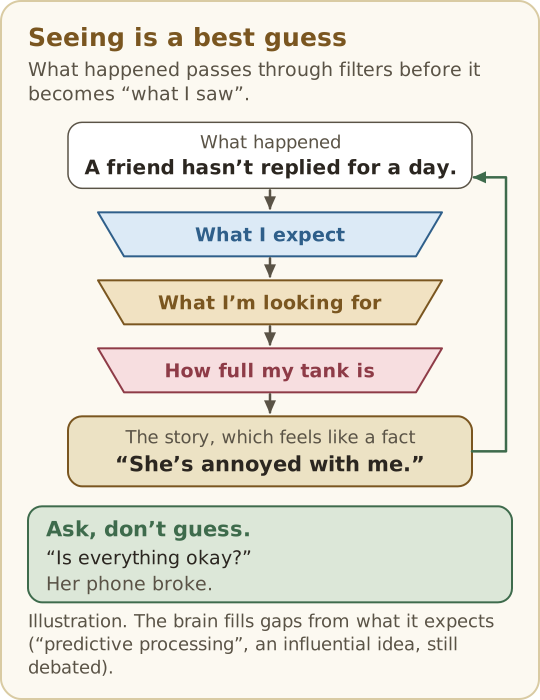
Figure 22 Seeing is a best guess. The story that comes out feels like a fact; asking is kinder and more accurate than reading minds. -
You see what you’re looking for.
Attention is like a torch in a dark room. What it lights up, you see. What it doesn’t, you can miss, even if it’s right in front of you. If you’re looking for proof that someone doesn’t care, you’ll notice every missed call and none of the little kindnesses.
For example: A woman decides her new manager “doesn’t like her.” For a month she notices every short email. She misses that he gave her the best project.
Thoughts you could try: “What might I be missing?” “If I were looking for the opposite, what would I see?”
Try this: For one week, write down one kind thing a person you’re struggling with does each day. Just notice.
Dig deeper: the torch of attention -
We fill the gaps with stories.
When we don’t know why someone did something, the mind makes up a reason, fast. A late reply becomes “they’re angry.” A closed door becomes “they don’t want me.” The story arrives feeling like a fact. Memory works this way too: each time we remember something, we rebuild it a little, so two people can honestly remember the same evening differently.
For example: A friend doesn’t reply for two days. You decide she’s fed up with you. She was on a camping trip with no signal.
Words you could use: “The story I’m telling myself is that you’re upset with me. Is that right?”
Try this: When you feel hurt by something someone did, write down the story you’re telling yourself. Then write one other possible story.
Dig deeper: stories and memory -
We judge ourselves by our reasons, and others by their actions.
When you are late, you know why: the traffic, the phone call, the child who lost a shoe. When someone else is late, you only see that they’re late, and it’s easy to think “they’re careless.” We all tend to blame other people’s character for things that are really about their situation.
For example: A driver cuts in front of you, and you think “what an idiot.” Next week, rushing to the hospital, you cut someone up yourself, and you know you’re not an idiot.
Thoughts you could try: “What might be going on for them that I can’t see?” “If I did this, what would my reason be?”
Try this: When someone annoys you today, think of one situation that would explain it without making them a bad person.
Dig deeper: actions and reasons -
Quick shortcuts can lead us astray.
The brain uses shortcuts to save time. Many are useful. Some lead to unfair judgements: a first impression that colours everything after it, a bad moment that outweighs ten good ones, or a quick guess about someone based on their age, accent, looks or group. Having these shortcuts doesn’t make you a bad person. Not noticing them can make you an unfair one.
For example: A housemate decides on day one that the new tenant is “messy” because of one box in the hall. Every bit of mess after that is “proof,” while her own mess goes unseen.
Thoughts you could try: “Am I looking for proof of what I already think?” “Would I judge this the same if someone I like did it?”
Try this: Pick one person you’ve made your mind up about. Look for one thing that doesn’t fit your view of them.
Dig deeper: shortcuts and bias -
Everyone feels like the one who sees clearly.
Most of us feel we see things as they really are, and that anyone who disagrees must be missing something, biased or not thinking straight. The other person feels exactly the same about you. Neither of you can see your own lens, only theirs.
For example: Two adult siblings argue about how their parents raised them. Each says, “I’m just being realistic.” Both are telling the truth about what they lived through.
Words you could use: “I think we’re both seeing this from where we stand. Can you tell me how it looks from yours?”
Try this: In your next disagreement, explain the other person’s view back to them until they say, “Yes, that’s it.” Then give yours.
Dig deeper: why we each feel like the realist -
“Us” and “them” changes what we see.
People quickly split into groups, even over tiny things. We tend to see our own group as varied and full of individuals, and other groups as “all the same.” We give our own side the benefit of the doubt. Spending real time with people from the other group, as equals, is one of the best ways to soften this.
For example: At work, the night shift calls the day shift “lazy,” and the day shift calls the night shift “sloppy.” After a joint team day, they start saying names instead of “them.”
Thoughts you could try: “Would I say this about one of ‘us’?” “Who in that group do I actually know?”
Try this: Have one real conversation this month with someone from a group you tend to see as “other.” Ask about their day, not their views.
Dig deeper: us and them -
Ask, don’t guess.
Imagining yourself in someone’s shoes is a kind start. But research suggests it doesn’t make us much more accurate about what they think. Asking does. A simple, curious question beats the cleverest guess. “What was that like for you?” is a better tool than “I know exactly how you feel.”
For example: A grandmother thinks her teenage grandson hates visiting because he’s on his phone. She asks. He’s messaging a friend who is having a hard time, and he likes being at her house because it’s calm.
Words you could use: “Can I check what you meant?” “What was going on for you?” “I might have this wrong. How did it look from your side?”
Try this: Once today, swap a guess for a question.
Dig deeper: seeing more fairlyFilled-in example Chat analyzer (also called the Signal Translator) Zoe, texting her oldest friend, who moved abroad Chat analyzer
Mode
- Chosen: I’m about to send this
- Someone sent me this
- Type your sentence
- You always cancel on me last minute. Can we pick a time for a call on Sunday?
- Relationship
- Friends
- Channel
- Text / chat
The read
- How it may land for most listeners
- Some words may hurt. How it may sound: sharp in places.
- What stands out
- The word “always” (words like “always” and “never” leave no room for the times it went fine).
- A clearer way to say it
- Lately it’s felt like you cancel on me last minute. Can we pick a time for a call on Sunday?
- What changed, and why
- always → lately it’s felt like. “Always” and “never” erase every exception, so the listener argues the exception.
A made-up example. Names and details are invented. The ask stayed; only the word that would start an argument changed.
Fill in your own: Chat analyzer (spreadloveandacceptance.com/
signal-translator)
Thursday, 12:20pm
You see your coworker in the canteen again. This time you go over: “How’s your dad?” She tells you. You sit together. Yesterday’s story about what you did wrong is gone. It was only ever a guess.
In everyday life
- On your own: We tell stories about ourselves too. “I always mess things up” is a story built from a few bright memories. Look for the ones it leaves out. See Know your own wiring.
- With a partner: After years together, we stop checking and start assuming. “I know what you meant” is the most dangerous sentence in a long relationship.
- With friends: A friend going quiet is rarely about you. Ask before you decide. See Friends.
- Parents and children: Children are often labelled early: “the difficult one,” “the easy one.” Labels can become lenses that only see what fits. See For parents.
- At work: Short emails, flat faces and different working styles are easy to misread. See At work.
- In your community: People from other backgrounds, faiths or generations are easiest to see as “all the same.” See Two faiths, one family.
- With ADHD: Attention is pulled by what is new or urgent, and can lock on hard. Someone may truly not have seen or heard. Not seeing isn’t the same as not caring. Get attention first, and put requests in writing. More in the full chapter.
Common mix-ups
- “I just see things as they are.” Everyone sees through a lens. Knowing that is where fairness starts.
- “Being biased means being a bad person.” Everyone uses mental shortcuts. What matters is noticing them and checking.
- “If I imagine their side hard enough, I’ll understand.” Imagining is a start. Asking is usually more accurate.
- “My memory is a recording.” Memory is rebuilt each time. Two honest people can remember the same event differently.
- “Giving the benefit of the doubt means ignoring what happened.” No. It means checking the story before deciding. If something hurtful keeps happening, that matters.
- “Their face or tone told me what they meant.” Faces and tones vary a lot between people and cultures, and between neurotypes. They are clues, not proof.
If you want to help someone else with this
- Don’t argue with their story first. Make sense of how they feel, then gently ask, “Is there any other way to see it?”
- Offer information, not verdicts. “I know she had a hard week” helps more than “You’re being unfair to her.”
- Model asking. Let people see you check your own guesses out loud: “I assumed he was annoyed. I’ll ask.”
- Be careful with labels. Labels for children, coworkers or family members stick, and then shape what everyone sees.
- Believe people about their own experience. Seeing other angles never means telling someone their experience didn’t happen.
Words you could use: “That sounds really hurtful. Do you know what was going on for them?” “It might be worth asking. Want to plan what to say?”
When to get more help
Seeing other people’s side is a strength. It should never mean doubting yourself when you know something is wrong. If someone often tells you that what you saw, heard or remember didn’t happen, that you’re “too sensitive” or “imagining it,” and you find yourself unsure of your own mind, take that seriously. It can be part of controlling behaviour. Signs to look out for and Not safe at home? can help, privately.
It may also help to talk to a counsellor or other trained professional if you notice you often feel others are against you, find it hard to trust anyone, or keep getting stuck in the same painful stories about yourself. Those patterns are common, understandable and often change with support.
This chapter is general education, not diagnosis or therapy.
Tools and reading on this site
Tools helpers you use on the site
- Rewind the talk: see their side: a free perspective-taking tool.
- Chat analyzer: how a sentence might land before you say it.
Reading pages to read on the site
- Wired differently: how different minds hear the same words.
- Philosophy stories on seeing the other person: the cave, the elephant, the fish and the empty boat.
- The library: the fundamental attribution error, confirmation bias, negativity bias, naive realism, mind-reading and how memory is rebuilt.
More for your situation
- Back: Stress and the nervous system · Next: How communication works
- Part One, Then: where your lens came from
- Part Two, Chapter III: full tanks and different angles
- Family rifts, Co-parenting and For grown-up children
- Communication between different minds
- For teens and For parents
- The whole book · Help by relationship
Last updated: October 2026