Part Three · Chapter 4
How communication works: meaning, listening, repair and messages
Talking feels simple, because we do it all day. But every message has to travel from one mind to another, and a lot can change on the way. This chapter explains how that journey works, and what helps a message arrive the way you meant it.
In short:
- Meaning is made between two people. What you say and what they hear can be different, and nobody has to be wrong.
- Every message says two things: the words, and what they seem to say about the two of you.
- Check, don’t guess. A short question saves a long misunderstanding.
- Mix-ups are normal. Repair is the skill. And small talk is allowed to be short.
Why the tools work: this chapter explains the thinking behind these tools from earlier in the book.
- Say it so it lands (Part Two, Chapter IV) uses fact, feeling and one clear ask, because every message carries the content and a second message about the relationship. Big idea: tune how you send and receive.
- The 90-second daily check-in and “go back in with a clear sentence” (Part Two, Chapter I) work because mix-ups are normal. Small, frequent repairs keep you in tune better than rare big talks.
- The Chat analyzer’s whole-conversation view (once called the Conversation Reader) shows where a written conversation lost its tone, because messages lose tone on the way.
Thursday, 8:15am
“Can you call me when you’re free?” Ana meant: no rush, I have a small question about the weekend. Her brother read it on the bus and spent the whole ride wondering who was ill. Nobody did anything wrong. The message just arrived carrying something it was never meant to carry.
This chapter explains how a message travels from one mind to another, what can change on the way, and the small habits that help it arrive: listening, checking, starting soft, repairing, and a few ready-made lines for small talk.
-
Meaning is made between two people.
Words don’t carry meaning on their own. The person speaking has a meaning in mind. The person listening builds their own meaning from the words, the tone, the timing and everything they already expect. Most of the time the two match well enough. Sometimes they don’t, and neither person can see the gap from where they stand.
For example: A manager writes “Let’s chat tomorrow” to a new coworker. She means a friendly catch-up. He spends the evening sure he is in trouble.
Words you could use: “I think what I meant and what you heard might be two different things. Can we check?”
Try this: Today, notice one moment when someone took your words differently from how you meant them. Just notice. No blame.
Dig deeper: how meaning travels -
Every message says two things.
There is what you say, and there is what it says about the two of you. “You’re late” is a fact about time. It can also say “I was worried,” or “I don’t matter to you.” People often argue about the fact when the hurt is in the second layer.
For example: Two housemates. “Did you use my pan?” is about a pan. Underneath, it may be “Do you respect my things?” Talking only about the pan won’t settle that.
Words you could use: “I don’t really mind about the pan. I think I wanted to know my stuff matters here.”
Try this: Next time a small thing stings, ask yourself: what did that seem to say about us?
Dig deeper: the two layers of a message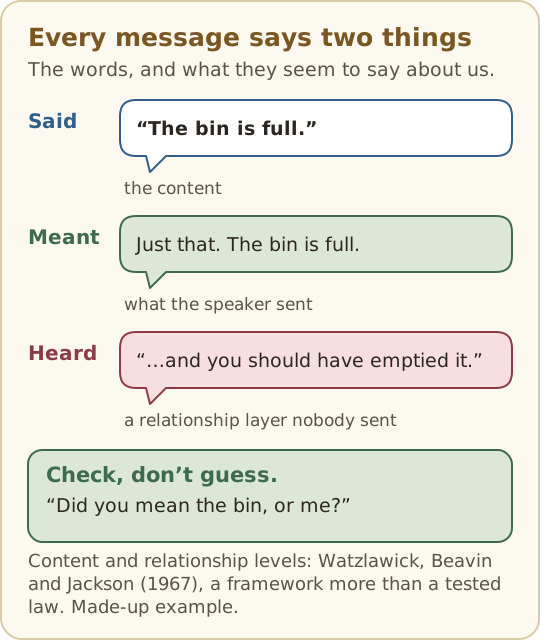
Figure 23 Every message says two things: the words, and what they seem to say about the two of you. Check, don’t guess. -
Listening is something you do, not something that happens.
Hearing is automatic. Listening is a choice. Most of us listen partly to reply: to fix, defend, advise or tell our own story. Real listening means following what the other person is trying to say, and letting them know you got it, before you add anything of your own.
For example: A teenager says school is “pointless.” Her dad starts to explain why it isn’t. She stops talking. Next time, he tries “Pointless how? Tell me about today.” She talks for twenty minutes.
Words you could use: “So what I’m hearing is... Have I got that right?” “Do you want ideas, or do you want me to just listen?”
Try this: In one conversation today, wait until the other person has finished, then say back what you heard before you reply.
Dig deeper: what good listening is -
Check, don’t guess.
Once we know something, it’s hard to imagine not knowing it. So we leave out steps, assume the other person can tell what we mean, and guess what they meant instead of asking. We do this most with people we know well. A short check costs a sentence. A wrong guess can cost a whole evening.
For example: Two friends plan “something low-key” for a birthday. One pictures a takeaway on the sofa. The other books a quiet restaurant. Both are disappointed, and both thought it was obvious.
Words you could use: “Just so I’ve got it right, you mean...?” “When you say soon, do you mean today or this week?”
Try this: Pick one person you know well and check one meaning with them today, even if you feel sure.
Dig deeper: why we guess, and how to check -
Hard things land better when they start soft.
How a hard talk begins often shapes how it ends. A complaint about one thing (“The bins weren’t taken out”) is easier to hear than a criticism of the person (“You never help”). A simple shape works for most hard things: what happened, how you feel, and what you’d like.
For example: A woman wants her elderly father to stop driving at night. Instead of “You’re not safe anymore,” she says: “You had two near-misses last month. I lie awake worrying. Could I drive us in the evenings?”
Words you could use: “What happened was... I felt... Could we...?”
Try this: Write one fact, feeling and ask sentence about something small that has been bothering you. You don’t have to send it yet.
Dig deeper: saying hard things kindly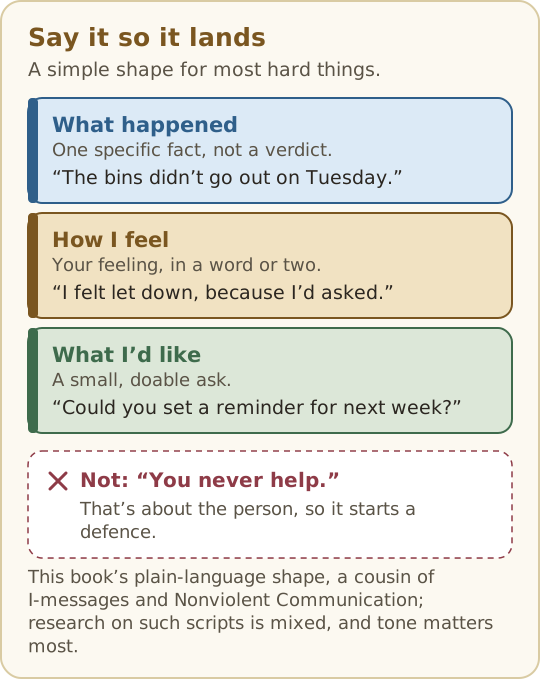
Figure 24 Say it so it lands: what happened, how I feel, what I’d like. A complaint about an action can be heard; a criticism of the person starts a defence. -
Mix-ups are normal. Repair is the skill.
Even close, kind people misunderstand each other all the time. What keeps a relationship steady isn’t never getting it wrong. It’s noticing and fixing it: “That came out wrong,” “I think I misread you,” “Can we start again?” Small repairs, made often, build trust.
For example: At the supermarket, a stranger snaps “Excuse me!” when you block the aisle. You snap back. A second later you add, “Sorry, long day.” They smile: “Me too.” A tiny repair, and the moment is gone.
Words you could use: “Can I try that again?” “I think I took that the wrong way. What did you mean?”
Try this: The next time something comes out wrong, repair it within a minute, out loud. Notice how small it can be.
Dig deeper: how repair works -
Messages lose their tone on the way.
A text or email carries the words but not your face, your voice or your timing. So the reader fills in the tone, and they fill it in with however they feel right now. A tired reader hears a tired, cross message. Short replies, missing greetings and late-night timing all get read as meaning something.
For example: A group chat for a school fundraiser. One parent replies “Fine.” to a plan. Two others decide she is annoyed. She was typing one-handed while cooking.
Words you could use: “Quick reply, not a cross one!” “This isn’t urgent. Any time this week is fine.”
Try this: Before you send your next tricky message, read it out loud in the grumpiest voice you can. If it sounds harsh, add a warm word or a time frame.
Dig deeper: texts, email and toneFilled-in example Chat analyzer: a whole conversation (once called the Conversation Reader) Dana and Raj, coworkers on the same project Chat analyzer: paste a conversation
01 Paste the conversation
Dana: Did the slides go to the client?
Raj: Not yet, still waiting on the numbers from finance
Dana: I needed them by 10. This always happens.
Raj: I can't make finance go faster.
Dana: Forget it. I'll do it myself.
02 Which one is you?
- Chosen: Dana (3 messages)
- Raj (2 messages)
03 The read
- What happened
- Ends shut down. 5 messages: 3 from you, 2 from Raj. The words don’t make it clear what it’s mostly about, so the Reader won’t guess. It starts calm. There’s no one big turn, but some tension creeps in. By the end someone has pulled back. That isn’t the same as calm: it can mean they’re overwhelmed, or hurt.
- Your part · always / never
- I said “This always happens”, and that isn’t fair: it isn’t every time. What I meant was: [one recent time, and how it felt].
04 Check your reply before you send it
- Your reply
- Sorry, that last line wasn’t fair. When the numbers weren’t in by 10, I felt worried about the client. Could you ask finance for them by 9 next time? I’ll chase them with you.
The check
✓ Says what you need or how it landed · ✓ Makes one clear ask · ✓ No verdicts, always/never, dismissals, sarcasm, jabs, comparisons or shutting the door · ✓ Stays on one topic
Nothing in the wording is likely to add heat. Read it once more as if you were them, then send it when you’re calm.
A made-up example. Names and details are invented. The Reader looks at one side’s part without blaming anyone.
Fill in your own: Chat analyzer (spreadloveandacceptance.com/
signal-translator) -
Different styles aren’t wrong styles.
Some people say exactly what they mean. Others hint and expect you to read between the lines. Some talk fast and overlap; others need a pause to think. Families, cultures and different kinds of minds all shape this. A clash between two styles is usually a translation problem, not a character flaw.
For example: An autistic employee answers “Is this report ready?” with “No, I need two more days.” Her manager hears blunt. She was simply being clear and honest. Once they talk about it, he finds her clarity a relief.
Words you could use: “I’m quite direct, so if I sound blunt, I’m not cross.” “It helps me if you say exactly what you need.”
Try this: Write one sentence about how you like to be spoken to, and share it with one person this week.
Dig deeper: styles, cultures and minds -
Small talk has a job, and it can be short.
Small talk (“Cold today, isn’t it?” “Busy weekend?”) isn’t really about the weather. Its job is to say “I see you, I’m friendly, we’re okay.” The anthropologist Bronisław Malinowski called this kind of talk “phatic communion” in 1923: talk whose main purpose is bonding, not information. Small moments like this matter more than people expect. Sandstrom and Dunn (2014) found that people who had a short, friendly exchange with a coffee-shop barista felt more belonging and a better mood than people who kept it purely efficient.
But small talk is hard work for many people, including many autistic people, shy or anxious people and people speaking a second language. The rules are unwritten, it can feel pointless, and it uses energy. A few ready-made lines, sometimes called social scripts, take the guesswork out. Keeping it short is allowed.
For example: A dad who dreads the school gate keeps three lines ready: “Morning! How’s your week going?” then “Oh, nice,” then “Right, I’d better get going. See you Friday.” He no longer dreads it, and the other parents think he’s lovely.
Words you could use: To open: “Morning! How’s your week been?” “How do you know Nico?” To keep it going: “Oh, how was that?” To close: “Lovely to see you. I’d better get on.” “I’ll let you get on. Have a good day.” To opt out kindly: “I’m not great at chit-chat, but it’s really nice to see you.”
Try this: Write your own three lines: one to open, one follow-up question, one to close. Use them once this week. If you’d rather skip ahead to a real topic, that’s fine too: “Can I ask you about something I’m actually curious about?”
Dig deeper: small talk and social scripts
Thursday, 9:02am
Ana’s brother rings the moment he’s off the bus. “Who’s ill?” Ana laughs. “Nobody! I just wanted to ask if you’re free on Saturday.” He laughs too, a bit shakily. Next time, Ana texts: “No rush and nothing’s wrong. Quick question about Saturday, call when you’re free.” Six more words. They save him a whole bus ride of worry.
In everyday life
On your own: how you talk to yourself
Communication isn’t only between people. You also send yourself messages all day: “Typical, I always mess this up,” or “That was hard, and I handled it.” The same ideas apply. Notice the tone, check whether the message is fair, and repair it when it’s harsh.
Thoughts you could try: “Is that what I actually mean, or just how it came out?” “What would I say to a friend who did this?”
Try this: Catch one harsh sentence you say to yourself today, and rewrite it in the way you’d speak to someone you like.
With other people
The same few ideas show up everywhere people talk:
- Partners: “We never go out anymore” sounds like a complaint about evenings. Underneath, it may be “I miss you.” Answering the second layer (“I miss you too, let’s plan something”) goes further than defending the calendar.
- Parent and young child: “Stop that!” tells a child what not to do, but not what to do instead. “Feet on the floor, please” is easier to follow, and easier to hear.
- Coworkers: In a meeting, silence is taken as agreement. Later, a quieter colleague says she never agreed. A round of “Anyone see it differently?” catches this.
- Housemates: A note on the fridge saying “PLEASE clean up” reads as shouting, even if it was written in a hurry. A face-to-face chat, or a kinder note, works better.
- Grown-up child and parent: “Are you eating properly?” is care in one generation’s language and checking-up in another’s. Both people can say what they mean and what they hear.
- Strangers and services: On a support call, saying “I’m frustrated, but not with you” often changes how the whole call goes.
- Feedback at work: Talk about the work, not the person, with one recent example and what good looks like. Then ask, “What’s been getting in the way?” When you’re the one receiving it, “Thanks. Can I think about it and come back tomorrow?” is a fine first answer. More, with a performance conversation.
Common mix-ups
- “If they loved me, they’d just know.” Closeness makes us check less, not understand more. Saying it clearly is a kindness, not a failure.
- “I said it clearly, so it’s their fault they got it wrong.” Meaning is built by both people. You can be clear and still be misheard.
- “Listening means agreeing.” You can fully understand someone and still see it differently. Understanding comes first; your view can come after.
- “Being direct is rude.” Directness is a style. It can be warm and direct at the same time.
- “Repairing means admitting I’m the bad one.” A repair just says “that didn’t go how I wanted.” Either person can make one.
- “Small talk is fake.” It’s a way of saying “we’re okay with each other.” You’re allowed to keep it short, or to skip to a real topic.
- “Texts are safer for hard things.” They feel safer to send, but they are easier to misread. For tender things, add warmth, or talk.
If you want to help someone else with this
Maybe a friend keeps having the same argument with their partner, or your teenager feels nobody listens. You can’t communicate for them, but you can help.
- Listen first. The most useful thing is often to be the person who really hears them, without fixing.
- Help them separate the two layers. “What was it about? And what did it seem to say about you two?”
- Offer the simple shape. What happened, how they feel, what they’d like. Let them find their own words.
- Don’t take sides on the other person’s character. You only hear one side, and they may make up next week.
- Notice if it’s more than a mix-up. If they seem afraid of the other person, gently share Not safe at home?
Words you could use: “Do you want me to just listen, or help you think about what to say?”
When to get more help
Most mix-ups can be eased with the ideas here. Some situations need more.
- When talking makes things worse every time, a couples or family counsellor can slow conversations down and help both people be heard.
- When you’re afraid of how someone will react, that isn’t a communication problem. Clearer words are not the fix, and you don’t have to keep trying. Not safe at home? lists free, private help, and signs to look out for may help you name what’s happening.
- When someone is always “misunderstanding” you in ways that make you doubt your memory or your sense of what happened, talk with someone you trust outside the relationship.
- When speaking or understanding is hard for you every day, because of anxiety, a hearing or language difference, or how your mind works, a doctor, speech and language therapist or counsellor may help. Needing support is not a failing.
- If you’re overwhelmed right now, start with Upset right now.
Workpapers, tools and reading on this site
Practice: try one tool this week, with one real conversation.
Walk through a talk that went wrong → Check the tone of a text →
Tools helpers you use on the site
- Chat analyzer: calm replies after a fight.
- Communication style quiz: a playful look at your own style.
Reading pages to read on the site
- Effective communication: the site’s complete, plain guide, from listening and timing to hard talks, repair and each kind of relationship.
- Check-ins: how to hold a hard conversation kindly.
- From the library: Active listening · Complaints versus criticism · Why tone gets lost in text · Directness and indirectness · The curse of knowledge · Intent and impact · The double empathy problem
- In the book: Chapter I: Why we get out of tune looks at the same ideas at home.
More for your situation
- At work: messages and meetings
- Friends
- For teens and for parents
- Co-parenting
- Sharing a room
- Long distance
- Two faiths or cultures, one family
- Neurodivergent relationships: communication
- Find it by relationship
Last updated: October 2026