Part Two: Between us · Chapter IV
Two kinds of fair: equal vs fair at home
Agree on what “fair” means before you argue about it, and give a comment a moment to land before you answer it.
In short:
- There are two kinds of fair: by results (did it all get done?) and by promises (did each of us do what we agreed?). Agree which one you’re using.
- Once a job has an owner, look to the owner. Covering for someone is kind when you say it out loud.
- Let a comment land before you react: notice it, name it, then decide what to say.
- Keep the two questions apart: “Was the job done?” is about a fact; “Did that comment hurt?” is about a feeling.
The big ideas: This chapter mostly teaches “Fix the setup, not the person” and “Notice the quiet incentives”, with help from “Read your state first”. What are the five big ideas?
The same argument, twice a month
One of you counts hours. The other counts who noticed the job needed doing. You’re both counting honestly, in two different currencies, and then arguing about the exchange rate.
-
There are two kinds of fair.
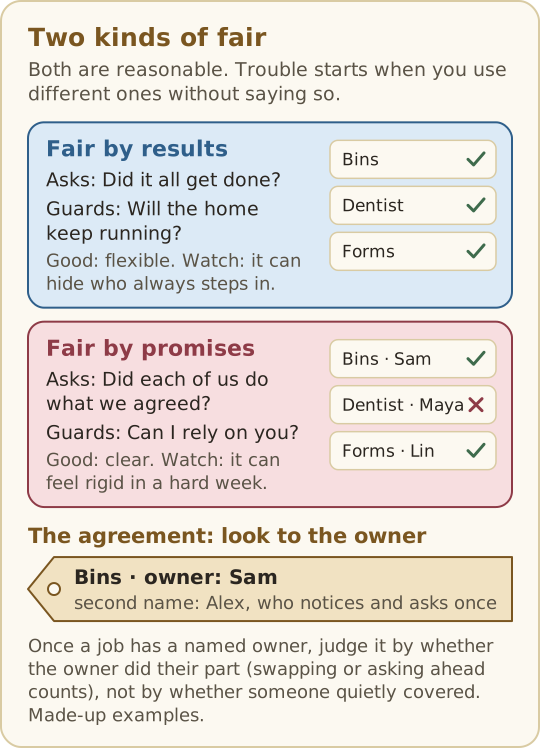
“Did everything get done?” and “Did each of us do what we said we’d do?” Both are reasonable. Friction starts when each of you is using a different one without realising.
Dig deeper: the two kinds of fair -
Fair by results.
This kind judges by outcomes: did the right things get done, by whoever had the time or energy? It’s flexible and easy-going. Done carefully, it counts the cost to whoever covered, but done carelessly, it can hide who is always stepping in.
Dig deeper: judging by resultsFilled-in example Who does what? The Money tab Grace and Ruth, a couple with different incomes Money (optional)
One line per cost. Put what each person actually paid.
- Currency
- £ (pounds)
Bill Grace paid (£) Ruth paid (£) How it’s shared Rent 1,100 700 Shared, split Power and water 160 0 Shared, split Internet and phones 0 90 Shared, split Groceries 300 250 Shared, split Money coming in Grace brings in (£) Ruth brings in (£) How it’s shared Pay 4,200 2,800 Money coming in The summary
Each person’s total: Grace £1,560; Ruth £1,040.
Coming in: £7,000 (Grace £4,200, Ruth £2,800). After shared bills: £4,400 left.
Two ways to split the shared bills. Split evenly: Ruth would put in £260 more · Split by income (60/40): it already comes out even. Pick whichever feels fair to you.
Even isn’t always the fair answer (incomes and rooms differ), so treat this as a starting point, not a verdict.
A made-up example. Names and details are invented. Money is a fair topic only where nobody controls the other’s money.
Fill in your own: Who does what? (Money tab) (spreadloveandacceptance.com/
lemonade-stand) -
Fair by promises.
This kind asks whether each person did the jobs they agreed to own. It’s clear and steady, but it can feel rigid in a week when life gets in the way.
Dig deeper: judging by promises -
Once a job has an owner, look to the owner.
The owner is the person who does the job, start to finish. A second name on the list is a backstop who notices if it slipped and gently checks in, never a supervisor. (It can be the same person.) If it’s your job, the question is whether you did it, not whether someone else quietly covered for you. That protects the person who keeps filling the gaps.
Dig deeper: agreeing which kind you’ll useFilled-in example One owner per job Dee and Mark, foster carers One owner per job: caring for a child in care
- Person A
- Dee
- Person B
- Mark
- Date of this list
- 4 October 2026
- The split you agreed (optional)
- Dee works three days; Mark works full time
Who owns each job
Job How often Roughly how long? (hours each time, optional) Owner Helper or backup (optional) Notes Social worker visits Monthly 1.5 Dee Mark Mark joins by video when he can Reviews and meetings As needed 2 Dee Mark Dee books and preps; Mark comes to the big ones Daily log and placement paperwork Daily 0.5 Dee Mark Mark writes it on Dee’s work days Contact visits and calls with their family Weekly 1.5 Mark Dee Saturday mornings School liaison (designated teacher, plans) As needed 1 Dee Being there after contact As needed 1 Mark Dee Quiet tea, no questions Health and therapy appointments As needed 1.5 Dee Training and support group Monthly 2 Mark Mark’s turn this term Does every job have an owner?
- Jobs with an owner
- 8 of 8. Every job has an owner.
- How the jobs are spread
- Counted by how often each job comes round, and by size or time where you gave it: Dee 61% · Mark 39%. You wrote down the split you agreed: “Dee works three days; Mark works full time”. Does this match it? It’s a starting point for a talk, not a scorecard.
✓ We’re agreed on this
- Who agreed (optional)
- Dee and Mark
A made-up example. Names and details are invented. “Being there after contact” is on the list because hidden work counts.
Fill in your own: One owner per job (caring for a child in care) (spreadloveandacceptance.com/
workpapers/ fill/ wp-03) -
Covering is kind. Say it out loud.
Helping out when the owner can’t is lovely. Just mention it, so the help is seen: “I put the bins out this week, since you were away.” Help that stays silent turns into unseen work, and unseen help slowly becomes expected (see Complacency).
Dig deeper: covering without resentment -
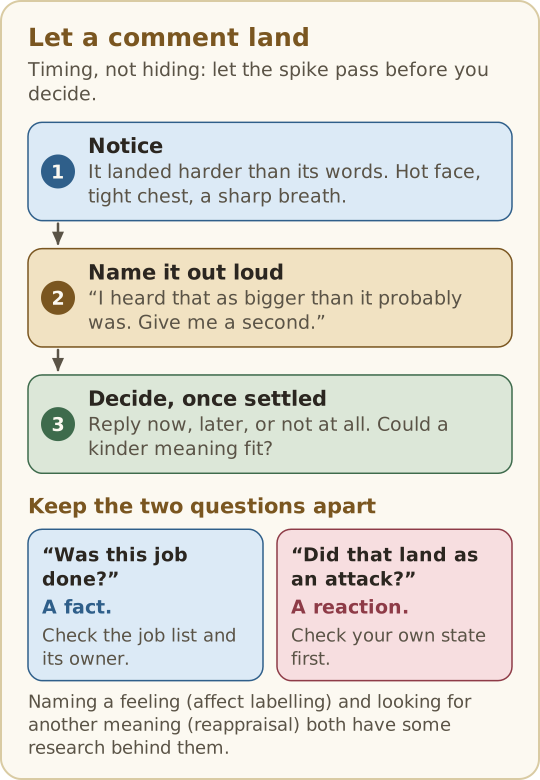
Let a comment land before you react.
When a remark hits harder than it should, say “Give me a second.” The idea is borrowed loosely from brain science, where the brain turns down sounds and sensations automatically, in a fraction of a second. This book’s pause is different: a few seconds you choose to take on purpose. Let the spike pass, then decide whether it needs an answer now, later or not at all.
Dig deeper: giving a comment time to land -
Notice, name, decide.
Notice it landed hard. Name it kindly: “That hit harder than you probably meant.” Then, once you’ve settled, decide how to reply. Say it so it lands helps with the words.
Dig deeper: the three stepsFilled-in example Say it so it lands Carla, who runs a café with her business partner Femi Say it so it lands
- Your name
- Carla
- Date
- 8 October 2026
Before you speak or send: fact, feeling, ask
Use it on one thing that actually stung.
- Raw reaction
- Great, so I’m doing the stock order on my own again.
- What’s the fact underneath this? (One sentence, no adjectives.)
- The stock order for the café wasn’t placed by Tuesday noon, and I placed it at 4.
- What’s the feeling underneath this? (Frustrated, tired, unseen, rushed…)
- I felt stretched thin, and a bit alone with it.
- What’s the actual ask? (What do you want to happen next, specifically?)
- Could you own the Tuesday stock order from next week, with me as backup when you’re at the bank?
Before you react: four quick checks
Is this about a specific, nameable task or event?
- Chosen: Yes
- No
Would I read this the same way if I weren’t already carrying a lot?
- Yes
- No
- Chosen: Not sure
Is there a neutral interpretation that also fits what was said?
- Chosen: Yes
- No
Am I responding to their words, or to a pattern from a past conversation?
- Chosen: Their words
- A past pattern
What to do next
- Ways to say it
- Quick one, no rush: could you own the Tuesday stock order from next week, with me as backup when you’re at the bank?
- Suggestions
- Your own load is part of how this reads. A few hours, or a night’s sleep, often changes how it reads. There’s a kinder reading that also fits. Try asking about it first: “Did you mean ___, or ___?”
A made-up example. Names and details are invented. The raw reaction stays on the sheet, not in the message.
Fill in your own: Say it so it lands (spreadloveandacceptance.com/
workpapers/ fill/ wp-09) -
Keep the two questions apart.
“Was the job done?” is a question about a fact. “Did that comment hurt?” is a question about a feeling. Both matter. Answer them one at a time, not in the same argument.
Dig deeper: facts and feelings, separately
Each idea in everyday life
The cards above say what each idea means. Here each one gets a real-life example, words you could say, and one small step.
1. Two kinds of fair
For example: Nisha and Kezia share a dorm room. Nisha thinks it’s fair if the room is tidy by Friday, whoever tidies. Kezia thinks it’s fair if each keeps their own half clean. See Sharing a room.
Words you could use: “When you say fair, do you mean it all gets done, or that we each do our bit?”
Try this: Each finish this sentence, then compare: “To me, a fair week is one where…”
2. Fair by results
For example: A grandmother is raising her grandchildren. Her grown-up son helps “wherever it’s needed” when he’s home. The house runs, but she is always the one who notices what’s needed. See Kinship families.
Words you could use: “I like that we’re flexible. Can we also check who ends up stepping in most?”
Try this: For one week, mark every job you picked up that wasn’t planned.
3. Fair by promises
For example: Two business partners run a café. One owns the ordering, the other the staff rota. When the rota is late, they ask the rota owner, not “the team.”
Words you could use: “It’s my job, and I can’t do it this week. Could you take it, and I’ll take the bins?”
Try this: Name one job that is “sort of everyone’s.” Agree who owns it for a month.
4. Look to the owner
For example: In a stepfamily, the 13-year-old owns feeding the dog, and his stepmum is the second name. At 7pm the bowl is empty. She says, “Dog’s dinner?” once. She doesn’t do it for him, and she doesn’t lecture.
Words you could use: “This one’s yours, start to finish. I’ll only remind you if it slips.”
Try this: Pick one job that causes friction and write two names next to it.
5. Covering out loud
For example: Two grown-up sisters take turns driving their dad to appointments. When one covers, she texts: “I took Dad Thursday since you had the late shift. Just so you know.”
Words you could use: “Thank you for covering that. How was it for you?”
Try this: Next time you cover a job, mention it in one plain sentence, the same day.
6. Let a comment land
For example: A nurse comes home from a night shift. Her husband says, “Oh, you’re up.” She hears “at last,” but says, “Give me a second, I’m very tired.” He meant he was glad to see her. See Different hours.
Words you could use: “That landed hard. Let me think before I answer.”
Try this: Agree on your “give me a second” phrase today, on a calm day.
7. Notice, name, decide
For example: A teenager tells her dad, “You never listen.” He feels his chest tighten (notice). He says, “That stings, and I want to hear you properly” (name). He decides it needs a real talk tomorrow (decide). See Teens.
Words you could use: “I want to answer that, just not this minute. Can we talk at eight?”
Try this: Put the three words somewhere you’ll see them, like the fridge.
8. Keep the two questions apart
For example: Separated parents share the kids across two homes. The bag came back without the school shoes (a fact). The text about it felt cold (a feeling). They sort the shoes first. See Co-parenting.
Words you could use: “Can we sort the shoes first, and come back to how that text felt?”
Try this: When a talk tangles, ask, “Fact or feeling?” and finish one first.
The weekly catch-up
Sam and Alex share a home. Alex owns the bins, but Alex works late on Tuesdays, and Sam has quietly taken it out three weeks running. At the catch-up, Sam mentions it. Alex says Tuesday nights aren’t realistic with the late shifts. They agree to try a swap for the rest of the month: Sam takes the bins, and Alex takes the recycling and the weekly grocery order. They’ll settle it at the monthly look-back in Chapter V.
Wednesday, 7pm
“Thanks for doing the dishes,” one of you says, a little flatly. It was meant as a thank-you. It sounded like a criticism. Before you know it, you’ve replied to the criticism, and now there really is one.
Inside you, and between you
- In you: Notice which kind of fair comes naturally to you, and notice the quiet habit of covering for others without saying so. When a comment stings, check your own state before you answer.
- Between you and others: Give each job one clear owner instead of blaming. Watch how unowned jobs slide towards one person, and keep things steady by mentioning help out loud and saying thank you.
On your own: your own kind of fair
Fair starts with knowing what fair means to you, and which jobs are truly yours.
- Write down what fair means to you, in one sentence.
- List the jobs you own, and the ones you picked up without ever agreeing.
- Practise letting a comment land before you answer, then reply with a fact, a feeling and an ask.
For example: Olu lives alone and has his kids every other weekend. His line: “Fair is not doing their jobs just because I miss them.” See On my own.
Try this: Pick one job you took on without agreeing. Keep it on purpose, or raise it on a calm day.
In the individual program: Step 5: find words for what you feel · Step 6: kind ways to say no · Part One: where your sense of fair came from · The whole book on sharing the load
The fields behind this chapter
This chapter draws on 6 of the author’s thirteen fields (see the Preface or the About page).
- Philosophy (Fix the setup, not the person): Two old ideas behind fairness: judging by outcomes (consequentialist) and judging by promises (deontological).
- Business (Fix the setup, not the person): Look to the owner.
- Economics (Notice the quiet incentives): Two people keeping score in two currencies, then arguing about the exchange rate.
- Neurobiology (Read your state first): How the brain turns down sounds and sensations, borrowed loosely. In the brain it is automatic and takes a fraction of a second; here it’s a few seconds you choose to take.
- Aromatherapy (Read your state first): For some people, a familiar scent or a calmer room is a quick cue to slow down. Where and when you talk is part of the method.
- Psychology (Notice the quiet incentives): Why a flat “thanks” can be heard as sarcasm, and why covering turns sour only when it’s silent.
Two fields, one idea: Philosophy + Business. People can mean two different things by “fair.” A job list with one owner per job makes it simple: check the job, not the person.
See how all the fields connect, in the full version · The polymath way
In real life
- Partners: One counts hours spent cleaning. The other counts all the planning that happened before anyone picked up a cloth. Both are real work, so put the planning on the list too, in minutes.
- Parents: Older kids can own age-sized jobs too, like feeding the cat or packing their own lunch. Put their name on the list, with a parent as the second name.
- Family: One sibling visits a parent every week. Another pays for extra help. Each thinks they’re doing their share, in a different currency.
- Roommates: One wants a fixed schedule. The other prefers “whoever’s free does it.” Neither is lazy. They just use different kinds of fair.
- Coworkers: One person quietly fixes everyone else’s slides before the meeting. Because it always gets done, nobody knows it was ever a problem.
- More than two partners: In a home with three adults, the one who works from home is always the one who “can.” See More than two.
- Different hours: Someone who works nights sleeps in the day. Being home isn’t being free. See Different hours.
- When one is ill: Share by energy, not hours, with a backup agreed for low days. See When one of you is ill.
- Friends: One friend always hosts, and nobody thanks them anymore. See Friends.
Words you could use: “I think we’re counting in different ways. Can we put both on the list?”
Try this: Read the example closest to your home to the other person, and ask, “Does this sound like us?”
Common mix-ups
- “If it got done, there’s no problem.” Someone may be paying for that in time and energy.
- “Holding the owner to it is being strict.” It’s just keeping the agreement you both made. That’s kinder than quiet resentment.
- “Letting a comment land means ignoring it.” It’s about timing, not about swallowing your feelings.
- “‘Give me a second’ is rude.” It’s a way of taking the other person seriously enough to answer well.
- “One kind of fair is the right one.” Both are reasonable. What matters is agreeing which one you’ll use.
- “The owner is the boss of that job.” The owner does the job. They don’t direct everyone else, and the second name isn’t a supervisor.
- “I covered for months, so now I can bring it all up.” A long list lands as a bill. Mention covering as it happens.
Words you could use: “I don’t think either of us is wrong. I think we’ve been using different rulers.”
Money between you
Money is where the two kinds of fair meet most often. Three common ways to share it:
- All shared: both incomes go into one pot.
- Separate: each keeps their own money and pays agreed bills, often half each. That’s fair by promises: the same rule for both.
- Proportional: each puts into a shared pot in line with what they earn, and keeps the rest. That’s fair by results: each is left with a similar share.
Many couples mix them: a joint account for bills and food, and some money each that nobody has to explain. The right way is the one you both chose with your eyes open. To talk about it, start with your money stories (how money worked at home when you were growing up), then the numbers, then a “talk first” amount for big buys that applies to both of you. A limit you both chose and both keep is care, not control.
For example (made up): Niamh takes home £2,600 a month and Tariq £1,900. Rent and bills will be £1,500. They split it 58/42, in line with their pay: £870 and £630.
Words you could use: “Can we each say how money worked in our families growing up?” “Would half each, or in line with our pay, feel fairer to you?”
Dig deeper: money, step by step
A couple and a housemate
A couple sharing a home with a housemate who isn’t a partner is a different shape from three equals. Keep two lists: house jobs for all three of you (bins, bathroom, bills, the landlord), and couple jobs just for the two of you. Decide house questions with all three of you there, not in bed the night before. Hear the housemate first on anything that affects them, keep couple arguments out of shared rooms, and never ask them to be the referee.
For example (made up): Ollie and Hamza share a flat with their friend Bex. They split the rent by room (the couple has the bigger one) and the bills by person. All three hold a short house meeting on the first Sunday of the month.
Words you could use: “That’s a house question. Let’s decide it when Bex is here.”
Dig deeper: two lists, and money with three
More for your situation
Each of these pages takes the ideas in this chapter into one kind of relationship. Start from your relationship lists them all.
- Friends · More than two partners · Sharing a room · Money together
- Foster and kinship families · When a child has ADHD · Grown-up children · Family rifts
- Different hours · Coming home · When one is ill · Two faiths · On my own
Try this: Agree on what counts as fair on a calm, easy day, not in the middle of a disagreement.
Start by each saying which kind of fair comes more naturally to you: results or promises.
Then pick three regular jobs and write an owner for each in the job list: the person who does it. Add a second name, someone who notices if it slips. It can be the same person.
Finally, agree on a short phrase for when something lands hard, like “Give me a second.” Agree that the other person will wait, and that the person who asked for a second will come back to it.
A note on safety
These tools only work when each person feels free to say no, to ask for a pause, or to keep their own notes private. If talking about what’s fair ever feels unsafe, or one of you feels you can’t say no, stop using the tools and talk with a trained counsellor on your own. When someone is afraid of their partner, counselling together isn’t advised. Not safe at home? lists free, private hotlines.
A promise is something both people chose and either can ask to change. Rules one person sets for the other, with checking, punishment or money held back, are control, and that is not your fault. See normal limits and control.
Words you could use, with someone you trust: “Things at home don’t feel fair, and I’m scared to bring it up. Can I talk it through with you?”
Last updated: October 2026