Part Three · Chapter 10
Values, meaning and a good life: what philosophy offers everyday life
What matters to you, how to find it, what to do when two good things pull against each other, and what a few very old ideas can offer an ordinary, busy week.
In short:
- Values are directions, not finish lines. You never “complete” kindness. You keep turning towards it.
- Strong feelings point to what you value. Anger often guards fairness; hurt often guards closeness.
- Meaning comes from ordinary places. People, care and everyday work give most of us most of our meaning.
- Values live in small acts. One small thing this week, done because it matters, counts.
Why the tools work: this chapter explains the thinking behind these tools from earlier in the book.
- “Two kinds of fair” (Part Two, Chapter IV) works because people value different good things. Agreeing which kind of fair you mean stops two good values fighting. Big idea: notice the quiet incentives.
- “Start with what matters to you” (Part One, Next) turns a value into one small goal, because values are directions, not finish lines.
Sunday, 9pm
The week ahead is full, and none of it feels like yours. You’re not sad, exactly. You just can’t remember the last time you did something because it mattered to you, and not because it was next on the list.
This chapter is about values: the things you care about, the direction you want your life to face, and what makes a life feel good and worth living. It borrows from psychology, and from philosophy, which has been asking “how should I live?” for more than two thousand years. You don’t need to have read any of it. Everything here is in plain words.
-
Values are directions, not finish lines.
A goal is something you can tick off: run a 5k, paint the hall, pass the test. A value is a direction you keep walking in: looking after your health, making your home feel cared for, being a fair friend. You never “finish” kindness. That’s why values still work on the days when goals fall apart.
For example (on your own): Bethan planned to go to the gym three times this week and went once. She felt like a failure. Then she asked what the goal was for: “looking after my body, so I have energy for my kids.” She walked for twenty minutes at lunch. The goal slipped. The direction didn’t.
Thoughts you could try: “What is this goal for? What do I care about underneath it?” “I can’t do the big thing today. What’s one small step in the same direction?”
Try this: Pick one goal you have. Ask “what is this for?” three times in a row, and write down where you end up.
Dig deeper: goals and values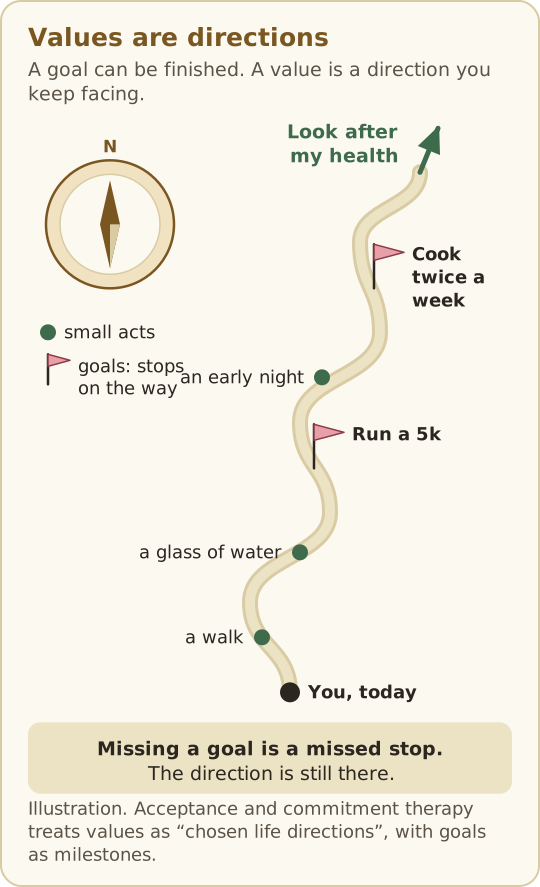
Figure 31 Values are directions, not finish lines. Goals are stops on the way; missing one doesn’t change the direction. -
Your strong feelings point to what you value.
You don’t have to invent your values from nothing. They show up in your strongest reactions. Anger often means something you care about has been stepped on. Envy can point to something you want for yourself. Sadness often shows what you love. A feeling is a signal, and a value is often what it’s pointing at.
For example (a coworker): Sacha is furious when a colleague takes credit for the team’s work. Under the anger is a value: fairness, and seeing people’s effort. Once Sacha names it, he can talk about fairness in the next meeting, instead of just being angry at one person.
Words you could use: “I think I’m upset because fairness really matters to me. It isn’t about wanting to win.”
Try this: Think of the last time you felt strongly, good or bad. Finish this sentence: “That mattered to me because I care about…”
Dig deeper: finding your values -
Two good things can pull in different directions.
Most hard choices aren’t good against bad. They are good against good: honesty and kindness, freedom and safety, family and rest. Feeling torn doesn’t mean you’re confused or weak. It means you care about more than one thing. Even when you choose well, it’s normal to feel a little sad about the side you didn’t choose.
For example (a parent and child): A mum cares about being honest and about protecting her eight-year-old. When the family dog is very ill, she doesn’t pick one. She tells the truth, gently, in words a child can hold: “Biscuit is very poorly. The vet is helping, and we’ll look after him together.”
Thoughts you could try: “Which two good things are pulling at me here?” “Can I honour some of both, even if I can’t have all of either?”
Try this: Name a choice you feel stuck on. Write the good thing on each side. Notice how it feels to see that you’re torn between two goods, not between right and wrong.
Dig deeper: when values clash -
Put your effort where it can land.
About two thousand years ago, a teacher called Epictetus, who had been born into slavery, taught that some things are up to us and some aren’t. Your own choices, effort and how you treat people are up to you. Other people’s choices, the weather and the past are not. Worry often goes to the second pile. Values live in the first.
For example (a partner): Ingrid wants her partner to enjoy Christmas with her family. She can’t make him enjoy it. She can plan a shorter visit, include a walk he’ll like, and be warm herself. That’s her part, and it’s enough.
Words you could use: “I can’t make this go well. I can choose how I show up.”
Try this: Write one worry in two columns: the parts that are up to you, and the parts that aren’t. Pick one small thing from the first column and do it.
Dig deeper: what is up to us -
A good life is more than a good mood.
Feeling good matters. But many thinkers, from the Greek philosopher Aristotle to psychologists today, describe a second kind of wellbeing: growing, using your strengths, being a good friend, and doing things that matter even when they’re hard. Aristotle called it flourishing. He thought we build it the way we build any skill: by practice, a little at a time.
For example (a friend): Jade spent a month helping a friend move out of a bad flat. It was tiring and not much fun. But looking back, she says it was one of the best months of her year. It wasn’t pleasant. It was worthwhile.
Thoughts you could try: “Was today a good day, or a worthwhile day? Both count.”
Try this: Tonight, write down one thing that felt good today and one thing that felt worthwhile. Notice whether they are the same thing.
Dig deeper: happiness and flourishing -
Meaning comes from ordinary places.
Researchers who study meaning often describe three parts. Your life makes some sense to you. You are heading somewhere. And your life matters to someone. Most meaning doesn’t come from big moments. It comes from people, from work done with care, and from small roles that others count on.
For example (in the community): Walter is retired and lives alone since his wife died. His days went quiet. Now he reads to children at the library one morning a week. It gives him a reason to iron a shirt, and people who notice when he isn’t there.
Thoughts you could try: “Who would notice if I didn’t show up? Who do I show up for?”
Try this: List three roles you play, big or small: neighbour, sister, the one who waters the office plants. Next to each, write who it matters to.
Dig deeper: where meaning comes fromFilled-in example Keep your little rituals alive Lachlan and Sunita, who lead a hybrid team of nine together Keep your little rituals alive
- Person A
- Lachlan
- Person B
- Sunita
- Date
- 2 October 2026
Part A: Our rituals, big and small
Ritual or habit How often How it’s doing What it gives us, or what got in the way Monday coffee call, cameras optional Weekly Fading Half the team stopped coming when it moved to 8:30 Friday “one good thing” round in the team chat Weekly Alive Five minutes; people notice each other’s work A card and lunch when someone leaves Now and then Alive People leave feeling thanked Office day with lunch together Monthly Stopped Stopped when the office moved; the three who work from home felt like guests Hello and goodbye in the chat, start and end of day Daily New idea So nobody wonders who’s around Part B: Where your rituals stand
- Your rituals
- 5 rituals listed. Alive: 2 · Fading: 1 · Stopped: 1 · New idea: 1.
- Fading or stopped
- Monday coffee call, cameras optional, Office day with lunch together.
- New ideas
- Hello and goodbye in the chat, start and end of day.
Rituals lapse for ordinary reasons: a new job, a baby, a move, an illness, a hard year. A stopped one isn’t a failure. Pick one to restart below, or let it go on purpose.
Part C: One to restart, or start
- The ritual
- Monday coffee call
- The smallest version that still counts
- Ten minutes at 9:15, no work talk, cameras optional
- The first time: when, and who will suggest it
- Next Monday; Sunita sends the invite
- What would make it easy to skip, and how we’ll protect it (optional)
- A busy week. We keep it then too, just shorter.
Part D (optional): One to let go, with thanks
- The ritual
- Office day with lunch together
- What it gave us
- A day all together, back when we all lived near the office
A made-up example. Names and details are invented. The sheet is written for couples and families, and it works for a team: the rituals are what make a group feel like one.
Fill in your own: Keep your little rituals alive (spreadloveandacceptance.com/
workpapers/ fill/ wp-15) -
Different values aren’t wrong values.
Two people can share a home, a family or a team and still put the same good things in a different order. One puts safety first; another puts adventure first. The philosopher Isaiah Berlin argued that there are many real goods in life, and they can’t all be ranked on one scale. That leaves room to disagree without either person being bad.
For example (housemates): Jasper values a calm, tidy home. His housemate Darnell values an open door and friends dropping by. For months it was “messy” against “uptight.” Once they named the values, it became a plan: open house on Fridays, quiet Sundays.
Words you could use: “I think we care about different good things here. Can we each say what matters to us about it?”
Try this: In your next disagreement, ask: “What matters to you about this?” Listen for the value, not just the position.
Dig deeper: living with different values -
Values live in small, everyday acts.
A good life is built mostly from small things done again and again: how you greet people, whether you keep small promises, how you talk about someone who isn’t in the room. The Chinese teacher Confucius taught that small, everyday courtesies shape who we become. Later thinkers who wrote about care said that being good starts with paying attention to the person in front of you.
For example (a stranger): At the supermarket, an older man is struggling with the card machine. You wait without sighing, and say “No rush.” It costs forty seconds. It might be the kindest moment of his day.
Thoughts you could try: “What would the person I want to be do in the next five minutes?” “When I drift from my values, I don’t need to punish myself. I just turn back.”
Try this: Pick one value. Choose one tiny act that shows it, and do it each day this week.
Dig deeper: everyday ethics
Sunday, 9:20pm
You write three words on the back of an envelope: “people, health, making things.” Then one small thing for this week under each: call Gran, walk on Wednesday, finish the shelf. The week is still full. But now some of it is yours.
In everyday life
- On your own: Three words on an envelope can be enough. Look at them on Sunday and pick one small thing for each. See Part One, Next.
- With a partner: You may rank the same values differently, like security and adventure. Say what each of you is protecting before you argue about the plan.
- Family: Two generations can both value “family” and mean different things by it: being close by, or being free to go. Ask what it means to them.
- Friends: Friendships often rest on one shared value, like loyalty or fun. Naming it can help when life pulls you apart. See Friends.
- At work: When a job keeps asking you to act against a value, the strain shows up as tiredness or cynicism. Naming the clash is a first step. See At work.
- In your community: Volunteering, a faith group or a club can be a place to act on a value with other people.
Common mix-ups
- “Values are rules.” Rules say what you must do. Values say what you care about. Rules can be handed to you. Values have to be yours to work.
- “If I really valued it, I’d never fail at it.” Everyone drifts from their values. The value is the direction you turn back to, not proof that you never wandered.
- “Meaning has to be something big.” For most people, most meaning comes from small, steady things: people, care, ordinary work.
- “Happiness is the point of life.” Feeling good matters. So does doing things that matter. A worthwhile day can be a tiring one.
- “My values should match my partner’s, or my family’s.” Close people often share some values and rank others differently. That’s normal, and it can be talked about.
- “Philosophy is only for clever people.” The old questions are everyone’s questions: what matters, what’s fair, what’s up to me. You’re already asking them.
If you want to help someone else with this
- Ask, don’t tell. “What matters most to you about this?” helps more than “Here’s what you should care about.”
- Notice values out loud. “You stayed late to help your friend. Loyalty really matters to you, doesn’t it?” People often see their values for the first time in someone else’s words.
- With children, name the value when you see it: “You shared, even though you wanted it. That was generous.” It teaches more than a lecture.
- Don’t use values as a weapon. “I thought you valued family” is a guilt trip, not a question. Ask what family means to them instead.
- Respect a different order. You can disagree with someone’s choice and still see the good thing they were reaching for.
Words you could use: “What would a good outcome look like to you?” “What do you want to be able to say about how you handled this, a year from now?”
When to get more help
Feeling a bit lost or flat for a while is part of being human. But some signs mean it’s worth talking to someone trained:
- Life has felt empty or pointless for more than two weeks, and things you used to enjoy don’t reach you. That can be depression, which is common and treatable. A doctor or counsellor is a good first step.
- You have thoughts of not wanting to be alive. Please talk to someone today. In the US and Canada, call or text 988. In the UK and Ireland, call Samaritans free on 116 123. In Australia, call Lifeline on 13 11 14. In New Zealand, call or text 1737. Anywhere else, findahelpline.com lists free helplines. If you are in danger now, call your local emergency number.
- Someone in your life is pushing you to give up what matters to you, cutting you off from friends, or making you afraid to disagree. That’s about control, not values. The page When it’s more than a rough patch can help you think it through.
Some therapies, such as acceptance and commitment therapy (ACT), work directly with values. A counsellor can help you find yours when everything feels foggy.
Tools and reading on this site
Tools helpers you use on the site
- Your self-discovery path, step by step, and Professor Puddles, the site’s chat host, if you want to think out loud.
Reading pages to read on the site
- Part One, Next: start with what matters: a short values step from the self-discovery part of the book.
- Library: values, what matters most and self-determination theory.
- Library: why new things stop feeling new and comparing yourself to others.
- Stories from philosophy: What is up to us, Three kinds of friendship and The circles of Hierocles.
More for your situation
- On your own after a big change: On my own · Empty nest · A new chapter after loss
- Couples with different priorities: Money together · The Frequency Framework
- Families with different beliefs: Two faiths, one family · Coming out as an adult
- Friends and work: Friends · At work
- Teens working out who they are: For teens · Growing up
- Find your own starting point: Help by relationship.
More in Part Three
← Chapter 9: Minds that work differently · Chapter 11: Healing after hurt → · All chapters in the contents
A limit to keep in mind: This chapter shares ideas to think with, not answers to follow. Your values are yours to find, and it’s fine if they change as your life does.
Last updated: October 2026