Part Three · Chapter 10
Values, meaning and a good life
In short:
- Values are directions, not finish lines. You never “complete” kindness. You keep turning towards it.
- Strong feelings point to what you value. Anger often guards fairness; hurt often guards closeness.
- Meaning comes from ordinary places. People, care and everyday work give most of us most of our meaning.
- Values live in small acts. One small thing this week, done because it matters, counts.
Why the tools work: this chapter explains the thinking behind these tools from earlier in the book.
- “Two kinds of fair” (Part Two, Chapter IV) works because people value different good things. Agreeing which kind of fair you mean stops two good values fighting. Big idea: notice the quiet incentives.
- “Start with what matters to you” (Part One, Next) turns a value into one small goal, because values are directions, not finish lines.
Sunday, 9pm
The week ahead is full, and none of it feels like yours. You’re not sad, exactly. You just can’t remember the last time you did something because it mattered to you, and not because it was next on the list.
This chapter is about values, meaning and what makes a life good. Those sound like big, abstract words, but they show up in small, concrete places: which message you answer first, whether you go to the party or stay home, what you say when a friend asks for your honest opinion, how you feel at 9pm on a Sunday.
Each idea is looked at through three lenses. Psychology asks what research has found, and where it hasn’t found much. Philosophy brings in thinkers and traditions that have asked “how should I live?” for a very long time, retold in plain words, in paraphrase rather than quotation. Through an autistic lens offers a perspective from autistic experience: not a list of problems, but a different and often very clear way of seeing the same idea. It is written about autistic people in general, and no single autistic person will match all of it. After the lenses, each idea comes back to everyday life.
The site’s own ideas are marked This site’s idea, so you can tell them apart from research and from the philosophers.
Values are directions, not finish lines
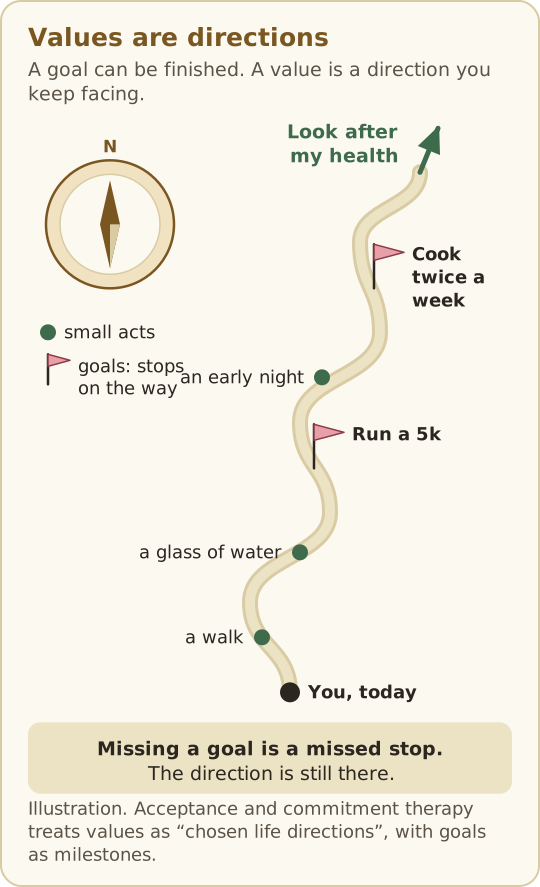
A goal can be finished. A value can’t. “Run a 5k” is done the day you cross the line. “Look after my health” is never done; it’s a direction you keep facing. That difference sounds small, but it changes how failure feels. If your goal is your only target, missing it means you lost. If the goal is one step in a direction you care about, missing it just means you take another step.
Psychology
Acceptance and commitment therapy (ACT), developed by Steven Hayes, Kirk Strosahl and Kelly Wilson (their main book appeared in 1999), puts values at its centre. In ACT, values are “chosen life directions”: qualities you want your actions to have, like being caring, curious or brave. Goals are the milestones along the way. Reviews of many trials have found ACT helps with a range of problems, including anxiety, depression and chronic pain, roughly as much as other well-established therapies. That doesn’t prove that the values part on its own does the work; ACT has several parts, and studies that pull them apart are fewer.
Research from self-determination theory (Edward Deci and Richard Ryan, from the 1980s on) adds something useful. Goals we pursue because they fit what we care about (sometimes called “self-concordant” goals, a term from Kennon Sheldon’s work) tend to be kept up longer, and reaching them tends to feel better, than goals pursued because we feel we “should” or to please someone else.
Philosophy
Aristotle, writing in Athens in the 4th century BCE, said that every action aims at some good, and that most goods are wanted for the sake of something else. You want money for security, security for peace of mind, and so on. He thought there must be something wanted for its own sake, and he called it eudaimonia, often translated as flourishing. Asking “what is this for?” three times is a homely version of his method: you follow the chain of reasons until you reach something you care about for itself.
The Stoics used the picture of an archer. The archer’s job is to aim well and shoot well. Whether the arrow hits also depends on the wind. For the Stoics, the aiming was the part that counted. Values work the same way: they are about the aim, which is yours, more than the hit, which partly isn’t.
Through an autistic lens
Many autistic people say they find stated, explicit principles easier to steer by than vague social expectations. “Be nice” is hard to act on. “I tell people the truth, and I try to tell it gently” is something you can check yourself against. Writing values down, plainly, can be a real tool here, not a school exercise.
Routines can also be values in action. A fixed morning, the same lunch, a set time for an interest: from the outside these can look rigid. From the inside they often protect energy for what matters, like work done well or time with people. Seeing a routine as “how I look after my values” rather than “a habit I should grow out of” can be a kinder and more accurate reading.
Putting it into everyday life
When a goal fails, follow it back to its value and take one smaller step in that direction. When you are choosing between two goals, ask which value each one serves. And if you’re someone who likes clear rules, it’s fine to write your values as plain sentences you can check against.
Thoughts you could try: “The goal was a step. The value is the direction. I can still take a step today.”
Your strong feelings point to what you value
Many people, asked “what are your values?”, go blank. The question is too big. It helps to look somewhere else: at your feelings, and at your life as you are already living it.
Psychology
Appraisal theories of emotion, developed by Richard Lazarus and others from the 1960s on, describe emotions as the result of quick judgements about what something means for you and the things you care about. Nico Frijda used the word “concerns” for the things our emotions protect. You don’t get angry about something you don’t care about at all. So a strong feeling is a clue that something you value is involved: anger often signals a sense of unfairness or a blocked goal; fear, a threat to something important; sadness, a loss of something loved; envy, a want.
Shalom Schwartz’s theory of basic human values (1992), tested in surveys across many countries, describes about ten broad values arranged in a circle, such as security, tradition, kindness to people close to you (which he called benevolence), concern for everyone and nature (universalism), achievement, enjoyment, stimulation and self-direction. Values next to each other on the circle tend to go together; values opposite each other tend to pull against each other, like openness to change and keeping things stable. It’s a useful map, as long as you remember that a survey describes groups, not you.
Philosophy
The Scottish philosopher David Hume argued in the 18th century that reason alone doesn’t move us; feeling does. Reason can tell you how to get something, but caring about it in the first place comes from what he called the passions. You don’t have to agree with all of Hume to take the practical point: your feelings aren’t the enemy of your values. They are often where your values first show up.
Socrates, as Plato tells it, said the unexamined life isn’t worth living for a human being. That can sound harsh. A kinder reading is that it’s worth stopping, now and then, to ask why you do what you do. Examining a feeling (“why did that bother me so much?”) is a small version of that.
Through an autistic lens
Not everyone reads their feelings easily. Alexithymia, difficulty noticing and naming your own emotions, is more common among autistic people than in the general population, though plenty of autistic people don’t have it. Some autistic people also describe interoception differently: the body’s inner signals can be louder, quieter or harder to decode.
If feelings are hard to read, there are other clues to values. What do you spend time on without being asked? What do you research, collect or return to? What injustice can you not let go of? Many autistic people describe a strong, steady sense of fairness and honesty. These are values, and they show up in behaviour even when the feeling is hard to put into words. The question “what do I keep doing?” can work as well as “what do I feel?”
Putting it into everyday life
After a strong reaction, finish the sentence “That mattered to me because I care about…”. Once a week, look at your calendar and your spending and ask what values they show. If the answer surprises you, that’s useful too: it shows where your life and your values have drifted apart.
Words you could use: “I reacted strongly there. I think it’s because honesty really matters to me.”
When two good things pull in different directions
Real dilemmas are rarely good against bad. They are usually good against good. Being honest and being kind. Being free and being safe. Being there for family and getting rest. Seeing this is a relief, because it means feeling torn is a sign of care, not of confusion.
Psychology
Schwartz’s value circle (above) predicts that some values often pull against each other. Research on “sacred values” by Philip Tetlock and colleagues found that people get upset when asked to trade a deeply held value for money or convenience, and sometimes refuse even to think about it. That helps explain why some arguments feel so hot: they aren’t about the dishes, they’re about loyalty or respect.
Studies of decision-making also suggest that when two options are close, choosing between them can feel harder, not easier. That fits everyday life: the hardest choices are often between two good things of similar weight. There isn’t strong research on the best way to make value-laden choices, so treat the steps below as sensible, not proven.
Philosophy
The English philosopher Bernard Williams argued that when you face a real conflict between two obligations, choosing one doesn’t make the other vanish. Something is left over, a kind of regret, even when you chose rightly. Feeling bad about the side you didn’t choose isn’t a sign you chose wrong. It’s a sign the other side mattered.
Three big Western traditions give three different questions to ask about a hard choice. Virtue ethics, going back to Aristotle, asks: what would a good person, the person I want to be, do here? Duty-based ethics, associated with Immanuel Kant, asks: what do I owe, and am I treating everyone as a person who matters, never merely as a means to an end? Consequence-based ethics, associated with Jeremy Bentham and John Stuart Mill, asks: what will happen to everyone affected? Philosophers still argue about which question is most basic. In everyday life, asking all three can show you something one alone would miss.
This site’s idea: the “three questions” check. Before a hard choice, ask: “Who do I want to be here? What do I owe the people involved? What is likely to happen to each of them?” If all three point the same way, you can move with confidence. If they don’t, you’ve found the real dilemma, and you can talk about it honestly.
Through an autistic lens
For many autistic people, honesty is a core value, and saying something untrue, even a small social “white lie,” can feel genuinely wrong rather than merely awkward. The double empathy idea (Damian Milton, 2012) helps here: the expectation that people will say “I love it!” about a gift they dislike is a social convention of one group, not a universal moral truth. Neither way is broken. They rank honesty and smoothness differently.
A path that often works for everyone is to choose which true things to say, rather than saying untrue ones. “Thank you for thinking of me” is honest and kind. Some autistic people say that knowing this option exists, written down as a rule, takes a lot of stress out of social situations. It’s also worth saying: an honest friend is a gift. People who always tell you the truth are people you can trust.
Putting it into everyday life
Name the two goods. Look for a way to honour some of both. If you can’t, choose, and let yourself feel the loss of the other side without calling it a mistake. In a disagreement, it can help to say: “I think we’re weighing the same two things differently,” which turns an argument into a conversation about values.
Words you could use: “I care about being honest with you, and I care about not hurting you. Let me try to do both.”
Put your effort where it can land
A great deal of suffering comes from pushing on things that won’t move: other people’s choices, the past, luck. A great deal of peace comes from finding the part you can move, however small, and moving it.
Psychology
Richard Lazarus and Susan Folkman’s work on stress and coping (1984) separates problem-focused coping (changing the situation) from emotion-focused coping (changing how you relate to it). Researchers have suggested that problem-solving tends to suit things you can change, and accepting or reframing tends to suit things you can’t. The evidence for this “matching” is mixed, but it’s a sensible rule of thumb.
Julian Rotter’s idea of “locus of control” (1966) described how much people believe outcomes depend on their own actions. Seeing yourself as having some control is linked with better coping in many studies. But too much belief in personal control can also lead to self-blame when things go wrong for reasons you couldn’t help. The healthy middle is: “I control my part, not the whole result.”
Philosophy
Epictetus was a Greek Stoic teacher, born into slavery in the first century. The handbook of his teachings, written down by his student Arrian, opens with this division: some things are up to us, such as our judgements, our aims and our actions; and some things are not, such as our bodies’ health, our reputation and what others do. He argued that peace comes from caring about the first kind and accepting the second. The site retells it as What is up to us.
The same idea appears elsewhere. A well-known prayer associated with the American theologian Reinhold Niebuhr asks for calm to accept what can’t be changed, courage to change what can, and wisdom to know which is which. Buddhist teaching on the “second arrow” makes a related point: the first arrow is the pain that happens to you; the second is the suffering you add by fighting what already is.
Through an autistic lens
Uncertainty is hard for most people. Research suggests that “intolerance of uncertainty” is often higher in autistic people, and linked to anxiety. The control columns can help, because they turn a big fog of “what if” into two lists. Many autistic people find that planning, routines and knowing what will happen are not luxuries but real needs, and that meeting them is a sensible use of the “up to me” column.
Sensory environments also sit across both columns. You may not control the lights in the office, but you may control headphones, a seat by the window, or asking for a quieter room. Naming that part as yours, and asking for it plainly, is a values move: it protects your energy for what matters.
Putting it into everyday life
When you notice yourself stuck in worry, make two columns. Do one small thing from the “up to me” column. For the other column, try a sentence of acceptance (“I don’t control how she reacts”) and let the rest wait. Part One of the book covers this in full: your circle of control, and matching energy.
Thoughts you could try: “Up to me: what I say and how I say it. Not up to me: how it’s received. I’ll do my part well.”
A good life is more than a good mood
There are, roughly, two answers to “what makes life good?” One says: feeling good, as often as possible. The other says: living well, which includes growing, connecting and doing things that matter, even when they don’t feel good at the time. Most thinkers end up saying you need some of both.
Psychology
Richard Ryan and Edward Deci (2001) described two traditions in wellbeing research: “hedonic” wellbeing (pleasure, satisfaction, good moods) and “eudaimonic” wellbeing (meaning, growth, living by your values). Carol Ryff (1989) proposed six parts of psychological wellbeing: self-acceptance, good relationships, independence, being able to manage your surroundings, purpose in life, and personal growth. Corey Keyes later used the word “flourishing” for people high in both feeling good and functioning well.
One long-running piece of research often cited here is the Harvard Study of Adult Development, which has followed groups of men (and later their families) since 1938. Its directors, including Robert Waldinger today, report that close relationships were among the strongest predictors of health and happiness in later life. It’s an observational study, so it can’t prove cause, but it fits much other research.
Studies by Tim Kasser and colleagues have found that people who put most weight on money, image and status tend to report lower wellbeing than people who put more weight on relationships, growth and community. These are mostly correlations, and the direction of cause isn’t settled. We also get used to good things quickly, which researchers call hedonic adaptation, so chasing feelings alone tends to be a treadmill.
Philosophy
Aristotle thought flourishing comes from living well over a whole life, not from a passing feeling. He described virtues, like courage, generosity and honesty, as good habits of character built through practice: you become brave by doing brave things, a little at a time. Many virtues, he thought, sit in a middle place: courage between recklessness and cowardice, generosity between wastefulness and stinginess.
Epicurus, often misread as a fan of luxury, actually taught that the most pleasant life is a simple one: friends, enough food, freedom from fear, and time to think. He valued friendship above almost everything. So even the philosopher of pleasure ended up close to the philosopher of flourishing: a good life is shared, modest and calm.
Through an autistic lens
Flourishing can look different from the outside than it feels from the inside. For many autistic people, deep interests are a major source of joy and energy. Autistic attention often goes deep into a few things at a time (see Chapter 9). Time spent in that kind of focus can be close to what psychologists call “flow”: absorbed, satisfying and restoring.
A flourishing life might also include fewer, deeper friendships, quiet weekends, or a job that suits a particular way of thinking. The neurodiversity view says these are different shapes of a good life, not smaller ones. Measuring a life by how “normal” it looks misses the point Aristotle was making: flourishing is about living well as the kind of being you are.
Putting it into everyday life
Keep a short note of good moments and worthwhile moments. Both count. If your week has plenty of one and almost none of the other, that’s worth noticing. Also notice that small virtues are built by small practice. You don’t become patient by deciding to; you become patient by being patient for ten seconds longer, many times.
Thoughts you could try: “Today wasn’t fun, but it was worthwhile. That counts.”
Meaning comes from ordinary places
“What is the meaning of life?” is a famous question nobody can answer for you. “What makes my life feel meaningful?” is a smaller question, and most people can answer it, given time.
Psychology
Michael Steger and colleagues developed a widely used questionnaire on meaning in life (2006), which separates having meaning from searching for it. Frank Martela and Steger (2016) described three parts of meaning: coherence (life makes sense), purpose (you’re heading somewhere you care about) and significance (your life matters). Other researchers, such as Login George and Crystal Park, use the word “mattering” for that third part: the sense that your life counts for something, often because it counts for someone.
Roy Baumeister, Kathleen Vohs, Jennifer Aaker and Emily Garbinsky (2013) surveyed several hundred American adults and found that happiness and meaningfulness overlapped but differed. Meaning was more linked with giving to others, thinking about the past and future, and even some stress and worry. Happiness was more linked with having needs met and with the present. It was a single correlational study, but it fits a common experience: the most meaningful parts of life aren’t always the easiest.
Philosophy
Viktor Frankl, an Austrian psychiatrist who survived the Nazi concentration camps, wrote in Man’s Search for Meaning (1946) that meaning can be found in three ways: in creating something or doing a deed, in experiencing something or loving someone, and in the attitude we take towards suffering we cannot avoid. It is a book of testimony, not a study, and it has helped many people.
Albert Camus, in The Myth of Sisyphus (1942), took the opposite starting point. He said the universe doesn’t hand us a meaning, and called that gap “the absurd.” His answer wasn’t despair. He pictured Sisyphus, forever pushing his rock uphill, finding a kind of contentment in the effort itself. The American philosopher Susan Wolf offers a middle path: meaning arises when you are drawn to something that is genuinely worth being drawn to, like people, craft, nature or learning.
The Japanese word ikigai is often translated as “a reason to get up in the morning.” In Japan it can be small and daily: a garden, a grandchild, a morning walk. (The four-circle diagram you may have seen online, with money and the world’s needs, is a later Western addition.) And the Southern African idea of ubuntu, often summed up as “a person is a person through other people,” locates meaning in our ties to each other.
Through an autistic lens
Deep interests can give strong coherence and purpose: a world that makes sense, and work worth doing. Sharing what you know can also be a way to matter to others. Many autistic people describe expertise, accuracy and helping things work properly as a big part of what makes life feel meaningful.
Significance, the sense that you matter, can be harder when you have been misunderstood or left out a lot. Many autistic adults say that finding other autistic people, online or in person, gave them a sense of belonging they hadn’t had before. That’s a reminder for everyone: meaning often grows where we’re understood.
Putting it into everyday life
List your roles, however small, and who each one matters to. Notice where meaning already is, before looking for more. If your life feels short of meaning, look first at connection and contribution, which research and the philosophers both point to, rather than at a grand plan.
Thoughts you could try: “My life matters to the people who count on me, even in small ways.”
Keep your little rituals alive
- Person A
- Lachlan
- Person B
- Sunita
- Date
- 2 October 2026
Part A: Our rituals, big and small
| Ritual or habit | How often | How it’s doing | What it gives us, or what got in the way |
|---|---|---|---|
| Monday coffee call, cameras optional | Weekly | Fading | Half the team stopped coming when it moved to 8:30 |
| Friday “one good thing” round in the team chat | Weekly | Alive | Five minutes; people notice each other’s work |
| A card and lunch when someone leaves | Now and then | Alive | People leave feeling thanked |
| Office day with lunch together | Monthly | Stopped | Stopped when the office moved; the three who work from home felt like guests |
| Hello and goodbye in the chat, start and end of day | Daily | New idea | So nobody wonders who’s around |
Part B: Where your rituals stand
- Your rituals
- 5 rituals listed. Alive: 2 · Fading: 1 · Stopped: 1 · New idea: 1.
- Fading or stopped
- Monday coffee call, cameras optional, Office day with lunch together.
- New ideas
- Hello and goodbye in the chat, start and end of day.
Rituals lapse for ordinary reasons: a new job, a baby, a move, an illness, a hard year. A stopped one isn’t a failure. Pick one to restart below, or let it go on purpose.
Part C: One to restart, or start
- The ritual
- Monday coffee call
- The smallest version that still counts
- Ten minutes at 9:15, no work talk, cameras optional
- The first time: when, and who will suggest it
- Next Monday; Sunita sends the invite
- What would make it easy to skip, and how we’ll protect it (optional)
- A busy week. We keep it then too, just shorter.
Part D (optional): One to let go, with thanks
- The ritual
- Office day with lunch together
- What it gave us
- A day all together, back when we all lived near the office
A made-up example. Names and details are invented. The sheet is written for couples and families, and it works for a team: the rituals are what make a group feel like one.
Fill in your own: Keep your little rituals alive (spreadloveandacceptance.com/
Different values aren’t wrong values
Many conflicts between good people aren’t about facts at all. They’re about which good thing comes first. Recognising that makes it possible to disagree without deciding the other person is selfish, careless or cold.
Psychology
Schwartz’s research found that people across many countries recognise the same broad values but rank them differently. Hazel Markus and Shinobu Kitayama (1991) described how some cultures emphasise an independent sense of self and others an interdependent one, which changes what “being a good person” looks like. Jonathan Haidt and colleagues’ moral foundations theory suggests people draw on several moral intuitions, like care, fairness, loyalty, authority and purity, in different amounts. That theory is debated, especially how it’s measured, but its main point is useful: people can be moral in different ways.
Research on “naive realism” (Lee Ross and colleagues) found that we tend to assume we see the world as it is, and that anyone who disagrees must be uninformed or biased. Knowing about that tendency makes it easier to stay curious. The site’s library covers it: naive realism.
Philosophy
Isaiah Berlin, a 20th-century British philosopher, argued for value pluralism: there are many real goods, like freedom, equality, safety and mercy, and they can’t all be fully had at once or ranked on one scale. He thought this was a reason for tolerance and humility, not for “anything goes.” Some things are still wrong. But many disagreements are between two people each holding a real good.
The Indian parable of the blind men and the elephant, retold on this site as The Blind Men and the Elephant, makes a related point: each person touches a different part and is sure they know the whole.
Through an autistic lens
The double empathy problem describes misunderstandings between autistic and non-autistic people as two-way, not one person’s failure. Values can work the same way. One person may value directness and see hinting as dishonest. Another may value tact and see directness as rude. Both are trying to be good. In mixed-neurotype homes, friendships and teams, simply saying values out loud (“For me, being told straight is a kindness”) can clear up years of misreading.
Some autistic people also describe being told their values are “too rigid” when they’re simply held firmly and stated clearly. Holding a value firmly isn’t the same as being unable to listen. It can help to say both: “This matters a lot to me, and I want to hear what matters to you.”
Putting it into everyday life
Ask “what matters to you about this?” before you argue about what to do. Look for the overlap: two people who argue about money often both value security and freedom, and just weigh them differently. Then plan in a way that gives each value some room. See also Money together and Two faiths, one family.
Words you could use: “I don’t think you’re wrong. I think we put the same two things in a different order.”
Values live in small, everyday acts
It’s tempting to think a good life is decided in big moments. Most of it is decided in small ones: a greeting, a kept promise, a patient pause, an honest sentence.
Psychology
Research on habits suggests that small, repeated actions tied to a cue become more automatic over time; a study led by Phillippa Lally (2010) found this took about two months on average, with a wide range. Studies of kindness interventions, such as those by Sonja Lyubomirsky and colleagues, and a 2018 review by Oliver Scott Curry and colleagues, found that doing small acts of kindness tends to raise the doer’s wellbeing a little. The effects in the review were modest and the studies varied, so think of it as a gentle nudge, not a cure.
Research on implementation intentions (Peter Gollwitzer) found that “if-then” plans, like “if I get home, then I’ll text Mum,” make it more likely we follow through. That’s a practical bridge from a value to a daily act. See Part One, Next: if-then plans.
Philosophy
Confucius, teaching in China around 500 BCE, put great weight on ren (often translated as humaneness or benevolence) and li (the rituals and courtesies of daily life). He thought that small courtesies, practiced sincerely, shape character over time. His teaching on reciprocity is often summed up as: don’t do to others what you wouldn’t want done to you.
The philosopher and novelist Iris Murdoch argued that moral life happens mostly in the quality of our attention, in how we look at other people, long before any big decision. Care ethics, developed by Carol Gilligan and Nel Noddings in the 1980s, says that being good starts with attending to the particular person in front of you and responding to what they need. All three point the same way: ethics is ordinary.
Through an autistic lens
Care shows up in many forms. Many autistic people show care in practical, specific ways: fixing something, sharing information that might help, remembering exact details about what someone likes, sending a link to something the other person would enjoy. Some autistic people call that last one “penguin pebbling,” after penguins that offer pebbles. These are real acts of care, even if they look different from small talk and hugs.
It’s also true that small social acts can cost more for some people. If greeting everyone in the office means masking all morning, the value (kindness) may be better served in another form, like a written thank-you or a helpful message. Choosing the form that fits you is not doing less. It’s doing it in a way you can keep up.
Putting it into everyday life
Pick one value and one tiny act. Tie it to a cue. Notice how it feels after a week. And when you drift from your values, as everyone does, turn back without punishing yourself; Chapter 7 covers self-compassion in depth.
Thoughts you could try: “What would the person I want to be do in the next five minutes?”
Putting it together
Here is the chapter in one paragraph. Values are the directions you care about. You can find them in your strong feelings and in what you already do. Hard choices are often between two goods, and it’s normal to feel the loss of the one you didn’t choose. Put your effort into the part that’s up to you. A good life includes feeling good and doing what matters, and meaning usually comes from people, care and contribution. Other people may rank the same goods differently, and that doesn’t make them bad. And the whole thing is lived out in small acts, every day.
The three lenses agree more than you might expect. Psychology finds that values-based goals last longer and that relationships matter a great deal. Philosophy, from Aristotle and Confucius to the care ethicists, says goodness is built through practice and attention. The autistic lens adds clarity: write values down plainly, notice care in its many forms, and don’t mistake a different shape of life for a lesser one.
This site’s idea: a simple loop. Notice (what did that feeling point to?), name (which value is it?), step (one small act in that direction), and return (when you drift, turn back kindly).
Worked examples
- On your own, a career choice: Farah is offered a promotion with more money and much longer hours. She lists her values: security, family, learning. The promotion serves security and learning but costs family. She asks for a four-day version of the role. The answer is no, and she decides to stay where she is for another year, with a plan to learn a new skill. She feels some regret, and lets that be normal.
- Partners with different money values: One partner saves every spare dollar; the other wants a holiday. Both value security and both value joy, in a different order. They set a savings amount first, then a small holiday fund, so each value gets something. See Money together.
- A parent and a teenager: A 16-year-old wants to go to a concert in the city. The parent values safety; the teen values freedom and friendship. Instead of yes or no, they agree a plan: go with two friends, share locations, a set pickup time. Both values are honoured, and the teen sees the parent’s value as care, not control. See For teens.
- A friend asks for an honest opinion: Your friend asks whether you like her new business plan. You value honesty and you value her. You say what you genuinely like about it, then one real worry, gently: “I love the idea. I’m worried about the cost of the shop rent. Can we look at it together?”
- At work: A manager asks you to “tidy up” numbers in a report in a way that feels misleading. Your values (honesty, and keeping your job) clash. You ask a clarifying question in writing, suggest an honest alternative, and, if pressure continues, look for your workplace’s formal reporting route or outside advice. See At work.
- Housemates: One housemate values quiet; another values a sociable home. They agree on specific quiet hours and open-house evenings. Neither has to change who they are. See Sharing a room.
- An autistic adult and a non-autistic sibling: At family dinners, the autistic sister answers questions honestly and directly; her brother thinks she’s rude. After a talk about values, he sees her honesty as respect, and she agrees on a shared signal when a topic is tender. Both values (honesty and tact) get room.
- In the community: After retiring, Walter feels his days lack meaning. He tries three things for a month each: a choir, volunteering at the library, and helping a neighbour with her garden. The library sticks, because people count on him. Meaning came from being needed, not from being busy.
Exercises
1. A short values sort
Read this list slowly and mark the five that matter most to you right now: honesty, kindness, fairness, family, friendship, health, learning, creativity, adventure, safety, freedom, faith or spirituality, nature, humour, loyalty, independence, community, achievement, calm, beauty, justice, courage, patience, play, craft, generosity. Then ask, for each of your five, “What’s one small way this shows up in my week?” This site’s idea, based on common values exercises used in therapy and coaching.
2. The “what is this for?” chain
Take a goal or a worry. Ask “what is this for?” or “why does this matter?” up to five times. Write each answer down. Stop when you reach something you care about for its own sake.
3. Feelings as signposts
For one week, each evening, note one strong feeling from the day and finish: “That mattered to me because I care about…”. At the end of the week, look for patterns.
4. The two columns
For one current worry, draw two columns: “up to me” and “not up to me.” Do one thing from the first column today. For the second, write one sentence you can say to yourself when the worry returns.
5. Good and worthwhile
For one week, write down one moment that felt good and one that felt worthwhile each day. Notice which ones overlap, and which kind your week is short of.
6. A values talk for two
With a partner, friend, housemate or family member, on a calm day, each answer: “What are three things that really matter to you in how we live, or work, together?” Listen without arguing. Then find one value you share and one you rank differently. Plan one small thing that honours each.
7. The future look-back
Imagine a friend describing you, kindly and truthfully, years from now. What would you like them to be able to say about how you treated people and what you cared about? This kind of exercise is common in ACT. If it feels heavy, keep it light: “what would I like my best friend to say about me at my next birthday?”
Questions people often ask
What if I don’t know what my values are?
That’s very common. Start with the feelings exercise, or the values sort, or simply look at what you already make time for. Values often become clearer through doing, not just thinking.
Isn’t this just religion, or just philosophy?
Religions and philosophies have a lot to say about values, and many people find their values there. This chapter doesn’t ask you to adopt any belief. It offers tools from several traditions and from research, and you can use what helps.
What if my values are different from my family’s?
That’s part of growing into your own person. You can respect where your family’s values come from and still live by yours. If it causes conflict, For grown-up children, Coming out as an adult and Two faiths, one family may help.
Can values be bad?
Some ways of acting on a value can harm people. Loyalty can turn into covering for someone who hurts others. Most of the time the value itself is good, and the question is how to act on it fairly. If “my values” is ever used to control, frighten or shame someone, that’s not a values difference. See Not safe at home?
Is meaning the same as happiness?
No. They overlap, but research and experience both suggest that meaningful things are sometimes hard. A good life usually has some of both.
Can children have values?
Yes. Children often care intensely about fairness, kindness and honesty. Notice and name their values when you see them, and they’ll learn to see them too.
Do I need to read philosophy for any of this?
Not at all. If you’d like to, the site’s stories from philosophy are a gentle start, with a list of the original books at the end.
Limits and when to get more help
- The research on values and meaning is mostly correlational, and many studies are from Western countries. Treat it as a guide, not a law.
- The philosophers named here are retold in plain words. Their ideas are richer and more debated than a few sentences can show.
- The autistic lens is a perspective, not a description of every autistic person, and it isn’t a way to diagnose anyone.
- If life has felt empty or hopeless for weeks, or you have thoughts of not wanting to be alive, please talk to a doctor, a counsellor or a crisis line today. In the US and Canada, call or text 988. In the UK and Ireland, call Samaritans free on 116 123. In Australia, call Lifeline on 13 11 14. In New Zealand, call or text 1737. Anywhere else, findahelpline.com lists free helplines.
- If someone uses “values” to control what you think, who you see or what you do, that’s about control, not values. When it’s more than a rough patch.
Next: Chapter 11, Healing after hurt. Before: Chapter 9, Minds that work differently. For the self-discovery side of values, see Part One, Next: values first. All chapters are in the contents.
Last updated: October 2026