Part Three · Chapter 7
Self-worth, shame and self-compassion
In short:
- Your worth isn’t a score. It doesn’t rise and fall with each day’s results.
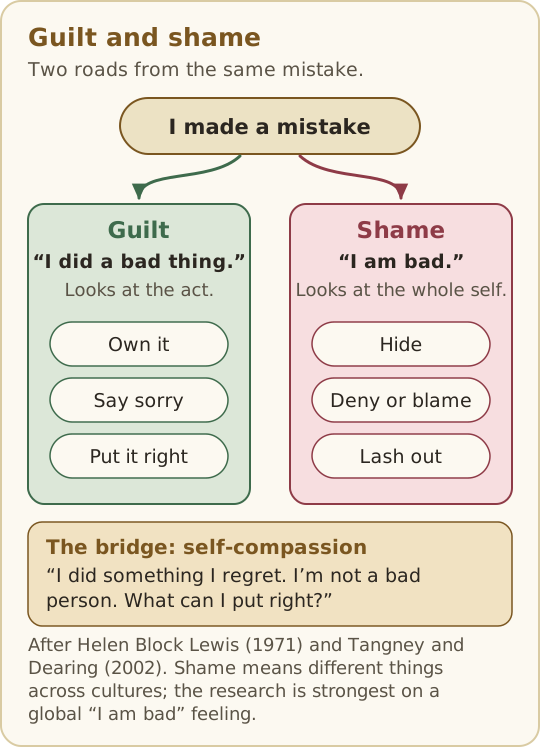
- Guilt and shame are different. Guilt says “I did a bad thing.” Shame says “I am bad.” Guilt is easier to put right.
- Self-compassion isn’t letting yourself off. Being kind to yourself after a mistake makes it easier to own it and grow.
- Worth is something we can give. How we treat each other teaches people what they are worth.
Why the tools work: this chapter explains the thinking behind these tools from earlier in the book.
- “Writing it down isn’t keeping score” (the Preface to Part Two) and “It judges the setup, never a person” (Part Two, Chapter II) matter because shame makes people hide and defend. Tools that measure the setup, not anyone’s worth, keep shame out of the room. Big idea: fix the setup, not the person.
- “Covering is kind. Say it out loud” (Part Two, Chapter IV) is the everyday version of owning a slip without drowning in it.
Thursday, 11:20pm
You sent the wrong file to the whole team. Someone noticed, fixed it, and said “no worries.” Hours later you are still awake, replaying it. The voice in your head isn’t saying “that was a mistake.” It’s saying “you’re useless. They all know it now.”
Why does one small mistake feel like a verdict on your whole self? Why do some people hear every comment as an attack, while others shrug it off? And why does being kind to yourself sound, to so many of us, like an excuse? This chapter takes those questions slowly.
How to read this chapter
Each section looks at one idea through three lenses, then brings them together:
- Psychology: what researchers have found, named honestly, with a note where the evidence is thin or debated.
- Philosophy: what thinkers and traditions have said about the same question, paraphrased fairly. These are ways of seeing, not proof.
- Through an autistic lens: how the idea can look from an autistic point of view. This is a perspective, not a deficit, and not a rule about any one person. Autistic people differ from each other as much as anyone.
Where something is the site’s own way of putting ideas into practice, rather than established research, it is marked This site’s idea. Nothing here diagnoses anyone.
Worth that doesn’t have to be earned
Self-worth is the background sense that you matter and are acceptable as a person. It’s different from confidence (believing you can do a task) and from pride in something you achieved. Many people never notice their sense of worth until it’s shaken: by a job loss, a breakup, an illness or a public mistake.
Often, without ever deciding it, we tie our worth to conditions. “I’m okay when I’m useful.” “I’m okay when I’m liked.” “I’m okay when I’m thin, top, busy, calm, needed or never a bother.” Each condition works until it doesn’t. Then the drop feels like a drop in the whole self.
Psychology
Carl Rogers, one of the founders of humanistic psychology, wrote in the 1950s about “conditions of worth”: the sense, learned in childhood, that you are only lovable when you behave in certain ways. He argued that people grow best with “unconditional positive regard,” being valued as a person even when their behaviour isn’t approved of.
Later research by Jennifer Crocker and Connie Wolfe (2001) described “contingencies of self-worth”: the areas where people stake their self-esteem, such as appearance, approval from others, academic success, or being a good person. Their studies suggest that the more someone’s worth depends on an area, the more their mood and self-esteem swing with each success or setback there. The research doesn’t say you should stop caring about anything. It suggests that worth staked on outcomes you can’t fully control is fragile.
Philosophy
Immanuel Kant drew a line between things that have a price, which can be swapped for something of equal value, and persons, who have dignity, a worth beyond any price. On this view, your worth isn’t something you earn by being useful; it belongs to you because you are a person. You don’t have to agree with all of Kant’s system to find this a steadying idea.
Many religious and spiritual traditions say something similar in their own language: that each person is valued before they do anything at all. The Southern African idea often summed up as ubuntu, roughly “a person is a person through other people,” adds a twist: worth isn’t only a private possession. It is recognised and held between people.
Through an autistic lens
Many autistic people grow up being corrected for how they naturally move, speak, play and feel: “look at me,” “stop flapping,” “don’t be so blunt,” “why can’t you just…?” Each correction may be well meant. Together they can teach a child a condition of worth: “I’m acceptable when I seem less like myself.”
A study by Eilidh Cage, Jessica Di Monaco and Victoria Newell (2018) found that autistic adults who felt more accepted by others, and who accepted their own autism more, tended to report fewer symptoms of depression. It was one study, measured at one time, so it can’t prove cause. But it fits what many autistic writers say: being accepted as you are is not a luxury; it is protective.
Thoughts you could try: “I can want to do well without needing to do well to matter.” “My worth was here before today, and it’s still here.”
Guilt, shame and repair
Guilt and shame are both “self-conscious” feelings: they come from looking at yourself through someone else’s eyes. But they point in different directions. Guilt says “I did a bad thing.” Shame says “I am bad.”
Psychology
Psychologist Helen Block Lewis (1971) first described this difference carefully, from listening to therapy sessions. June Tangney and Ronda Dearing’s book Shame and Guilt (2002) summarises years of studies that followed. In general, people who tend towards guilt are more likely to feel empathy, apologise and try to make things right. People who tend towards shame are more likely to hide, deny, blame others or feel angry.
The limits matter. Some researchers question whether the questionnaires fully separate the two feelings. And shame has different meanings across cultures: in some, a sense of shame is mainly a healthy concern for the group and for one’s family name, not only a private wound. The research is strongest on shame as a global “I am bad” feeling that people can’t see a way out of.
Philosophy
The Chinese philosopher Mencius taught that every person has “sprouts” of goodness, and one of them is a sense of shame at doing wrong. For him, shame wasn’t poison; it was the start of a moral sense, something to grow into good judgement. That is a useful balance to the modern view. A small, specific shame (“I shouldn’t have said that”) can guide us. What hurts is shame that spreads to the whole self and has nowhere to go.
Many ethical traditions build in a path back: confession and forgiveness, making amends, restorative practices in communities. They share a practical idea: a wrong should lead somewhere, towards repair, rather than to a permanent label on a person.
Through an autistic lens
Some autistic people describe a strong sense of fairness and honesty, and a matching strength of guilt when they think they’ve broken a rule. Others are told they “don’t seem sorry,” because their face or voice doesn’t show remorse in the expected way. Then shame gets added on top: not just “I did something wrong,” but “I’m wrong for how I feel it.” That is the double empathy problem at work: two people reading each other with different maps, and each missing what the other means. Clear, explicit repair helps both sides: “I’m sorry. Here’s exactly what I’ll do differently.”
Thoughts you could try: “Is this guilt, about one thing I did, or shame, about all of me?” “If it’s about one thing, what would make it right?”
How shame works in the body
Shame is fast. Before you have a thought, the body has often already reacted: face hot, eyes down, shoulders curled, a drop in the stomach, an urge to vanish. Some people go blank and can’t think. Others feel a rush of anger.
Psychology
Researchers who study emotions across species have suggested that the shame posture (head down, body smaller, gaze away) resembles the appeasement signals some animals show after losing a status contest. It may have evolved as a way of saying “I’m no threat, don’t throw me out.” That is a theory, but it helps explain why shame feels so urgent: being cast out of the group was once dangerous.
Helen Block Lewis also noticed what she called “shame-rage”: a quick turn from feeling small to lashing out, because anger feels more powerful than shame. Tangney’s research linked shame-proneness with more blaming and anger in conflicts. Psychologist and author Brené Brown, whose research on shame is mostly interview-based rather than experimental, describes the same pattern in everyday life: shame thrives on secrecy and silence, and loses some of its grip when it is spoken to someone who responds with empathy.
Philosophy
The French philosopher Jean-Paul Sartre gave a famous example: someone peeping through a keyhole suddenly hears footsteps behind them, and in that instant feels themselves seen as an object, judged and fixed. Shame, for Sartre, is the feeling of being caught in another person’s gaze. That captures why shame makes us want to hide: we want to step out of the gaze.
Through an autistic lens
Some autistic people find direct eye contact uncomfortable, or say it makes listening harder. Being told to “look at me when I’m talking to you” during a telling-off can add shame to shame. Some autistic people also have alexithymia, finding it hard to name feelings, so shame may show up first as a body state (“I feel sick,” “I need to leave”) rather than as a word. Noticing the body sign is a valid way in. A meltdown or shutdown after a shaming moment is not manipulation. It is a nervous system at its limit.
Words you could use: “I think I felt embarrassed and it came out as anger. That wasn’t fair to you.” “I need a few minutes. I’m not ignoring you; I’m overwhelmed.”
The critic and the soothing system
Most people have an inner voice that comments on what they do. For some, it’s mostly fair. For others, it’s a relentless critic: “idiot,” “you always,” “who do you think you are?”
Psychology
Psychologist Paul Gilbert developed compassion-focused therapy for people with high shame and self-criticism. He describes three broad emotion systems, as a simple model: a threat system (alert, anxious, defensive), a drive system (wanting, striving, achieving) and a soothing system (safe, calm, connected). In his view, harsh self-criticism keeps the threat system switched on, while many people have had little practice in using the soothing system on themselves. The model is a simplification of a complex brain, and research on compassion-focused therapy is still growing, but early trials are encouraging.
Many therapists also note that the critic often has a protective job: to stop you being rejected by getting there first, or to push you to work harder. Seeing it that way can make it easier to talk back to it calmly rather than fight it.
Philosophy
The Stoic Epictetus taught that we are disturbed not by events but by our judgements about them. Applied here: the mistake is an event; “I’m useless” is a judgement, and judgements can be examined. Stoics practiced writing down and questioning their own thoughts each evening. Marcus Aurelius’s private notebook, now called the Meditations, is full of him reminding himself, gently and firmly, to begin again.
Buddhist traditions offer loving-kindness practice (metta), where you wish yourself and others well in simple phrases. It is meant as training, not as a feeling you must already have.
Through an autistic lens
Some autistic people find vague comfort (“be gentle with yourself”) hard to act on. What does gentle mean, exactly? Concrete, literal versions can work better: “I will eat something, then sit somewhere quiet for ten minutes, then decide.” Others find their inner voice is a recording of years of other people’s corrections. Writing the critic’s words down, word for word, and checking each one against facts can suit a mind that likes precision.
Thoughts you could try: “That’s the critic. It’s trying to protect me. What do I actually need?” “Is that true, or just loud?”
Flip it
- What’s on your mind?
- I got the figures wrong in the client report and my manager had to fix it. I’m hopeless at this job.
What kind is it?
- A complaint about someone
- A worry
- Chosen: Being hard on myself
- Anger
The flip
- What a good friend might say
- “That sounds like a hard moment. One mistake is not the whole of you. You’re not hopeless. You’re a person having a hard day.”
- Kinder words for yourself
- “I had a hard moment. I’m human. Next time I’ll [one thing].”
- One next step
- [one small thing, like a short sorry, a reminder on your phone, or some rest]
Talking to yourself the way you’d talk to a friend is a simple form of self-compassion. Being harsh rarely makes the next try easier. This is a starting point. Change any words you like.
- Hamish’s own words, after changing the flip
- I got two figures wrong and it was caught before the client saw it. I’m human. Next time I’ll ask a colleague to check the numbers before it goes out.
- His next step
- Send my manager a two-line sorry and the checking plan, today, then go home on time.
A made-up example. Names and details are invented. The flip is a starting point: Hamish changed the words until they were true and sounded like him.
Fill in your own: Flip it (spreadloveandacceptance.com/
What self-compassion is, and isn’t
Self-compassion means meeting your own pain the way you’d meet a friend’s: with warmth, not attack. It isn’t pretending things are fine, or excusing harm you did.
Psychology
Kristin Neff (2003) defined self-compassion with three parts:
- Self-kindness instead of harsh judgement.
- Common humanity: remembering that suffering and failure are part of being human, instead of feeling it’s “only me.”
- Mindfulness: noticing painful feelings clearly, without ignoring them or being swept away.
In a set of experiments, Juliana Breines and Serena Chen (2012) found that people encouraged to be self-compassionate after a failure or a moral mistake were more motivated to improve, such as studying longer for a retest, than people encouraged to boost their self-esteem. Many studies link self-compassion with lower anxiety and depression. Most of this research is correlational, and much of it uses one questionnaire, which some researchers have debated. So it’s fair to say: promising and widely studied, not settled.
Philosophy
Neff drew on Buddhist teachings, where compassion for all beings includes yourself. Aristotle offers another angle: he thought a good person is a friend to themselves, someone who wishes themselves well and enjoys their own company, which is different from selfishness. Albert Ellis, who founded rational emotive behaviour therapy and thought much like a philosopher, argued for “unconditional self-acceptance”: rate your actions, not your whole self.
Through an autistic lens
For autistic people who have spent years working hard to fit in, self-compassion can include something specific: permission to stop forcing yourself through situations that hurt. Choosing headphones, leaving early, eating the same lunch, or scripting a hard phone call isn’t weakness. It’s meeting your needs. Common humanity can also mean finding your people: autistic communities, online and offline, where your way of being is ordinary.
Thoughts you could try: “This is hard. Other people struggle with this too. What would help me right now?” (These three lines follow Neff’s three parts.)
Comparison and steady self-worth
We work out how we’re doing partly by looking at others. That’s normal. But it makes worth slippery: there will always be someone richer, calmer, more talented or more loved.
Psychology
Leon Festinger’s social comparison theory (1954) proposed that people evaluate themselves by comparing with others, especially when there’s no clear standard. Comparing upward can inspire or deflate; comparing downward can comfort or make us smug.
A major review by Roy Baumeister and colleagues (2003) found that high self-esteem didn’t reliably cause better performance or relationships, and that efforts to simply boost self-esteem didn’t deliver what had been hoped. Kristin Neff and Roos Vonk (2009) found that self-compassion was linked to a steadier sense of self-worth over time, and less dependent on comparison and approval, than self-esteem. Self-esteem asks “am I good enough?” Self-compassion asks “what do I need?”
Philosophy
Jean-Jacques Rousseau distinguished two kinds of self-love. Amour de soi is the natural care for your own wellbeing. Amour-propre is self-regard that depends on how others see you and how you rank among them. He thought much unhappiness in society came from the second. Many contemplative traditions also warn against measuring yourself by others, and teach gratitude for what is actually in your life.
Through an autistic lens
Comparison can be especially unfair when the yardstick was built for a different kind of mind. An autistic adult who compares their social life to a non-autistic friend’s may be measuring by a standard that doesn’t fit them. Many autistic people describe deep satisfaction from a focused interest, a small number of close friends, or long time alone. Those aren’t lesser versions of someone else’s life. They are a different life, measured by its own needs.
Thoughts you could try: “Is this a fair comparison, or a different race?” “What does a good day look like for me, not for them?”
Two common shields: perfectionism and people-pleasing
When worth feels conditional, people often build a shield. Two of the most common are perfectionism (“if I’m flawless, I can’t be criticised”) and people-pleasing (“if everyone is happy with me, I can’t be rejected”). Both can look like strengths from the outside. Both are often exhausting from the inside.
Psychology
Researchers such as Paul Hewitt and Gordon Flett have studied perfectionism for decades. They distinguish between high standards you set for yourself, which can be healthy, and the sense that others demand perfection from you, or that any mistake means failure. That second kind is the one more consistently linked with anxiety, depression and burnout. A review by Thomas Curran and Andrew Hill (2019) suggested that perfectionism, especially the sense that others expect perfection, has risen among young people in several Western countries since the late 1980s. That finding is based on questionnaires and doesn’t explain why, but it matches what many teachers and parents notice.
People-pleasing isn’t a formal diagnosis. Therapists use the term for a pattern: putting others’ wishes first so reliably that your own needs disappear, often driven by fear of conflict or rejection. It overlaps with what researchers call “sociotropy” and with the “fawn” idea used by some trauma therapists, though that word is a clinical description, not a tested category.
Philosophy
The ancient Greeks had a word, hubris, for overreaching pride. Perfectionism can be its quiet cousin: a belief that you, alone among humans, must never fall short. Many traditions treat humility not as thinking less of yourself, but as accepting that you are a limited, ordinary human being, which is a relief as much as a discipline. Japanese aesthetics, through ideas like wabi-sabi, find beauty in what is imperfect and unfinished.
Through an autistic lens
Many autistic people value precision and get real joy from doing something exactly right. That’s not a problem in itself. It becomes painful when precision turns into a fear that any error will expose you, often after years of being corrected. People-pleasing can also be a form of masking: copying what others want, agreeing to avoid trouble, rehearsing the “right” face. It can work in the short term and cost a great deal of energy over time. Clear, kind boundaries (“I can do Tuesday, not Thursday”) are a way of letting your real self take up a little more space.
Thoughts you could try: “Good enough is good enough for this one.” “Someone being a little disappointed in me is survivable.”
Owning it, repairing it, letting it rest
When worth feels safe, owning a mistake gets easier. You can look at what happened without feeling that everything you are is on trial.
Psychology
Studies on apology suggest that people value apologies that acknowledge responsibility and offer repair. Over-apologising, or turning an apology into a long account of how terrible you feel, can shift the focus onto your feelings and leave the other person comforting you. Research linking guilt to repair suggests that a specific, action-focused apology is easier to give, and easier to receive.
After a reasonable repair, rumination (going over and over it) tends to keep distress going without adding anything useful. Studies on rumination, especially Susan Nolen-Hoeksema’s work, link it with longer and deeper low moods.
This site’s idea: a three-part ownership sentence (what I did, its effect, what I’m doing now), followed by a deliberate “letting it rest” step, like closing a file.
Philosophy
Aristotle thought character is built by practice: we become honest by doing honest things, again and again. A single act doesn’t define you; a pattern shapes you, and patterns can change. The Jewish practice of teshuvah, often translated as “return,” describes a path after wrongdoing: recognising it, making amends, and choosing differently next time. It treats people as able to return, not as fixed.
Through an autistic lens
Some autistic people find it hard to let a mistake rest, because the mind keeps returning to it in detail. This isn’t self-indulgence. A mind that focuses deeply on one thing at a time (see Chapter 9) can get pulled into a loop. Concrete closing rituals can help: writing the apology, sending it, then writing “done” and putting the note away. Clear feedback (“Thank you, we’re okay now”) from the other person can help too, so you aren’t left guessing.
Words you could use: “I did this. I can see it affected you like this. Here’s what I’m doing about it.” And afterwards: “Are we okay? It helps me to hear it plainly.”
How worth is given and learned
Self-worth isn’t built alone. Children learn it from carers, teachers and peers. Adults keep learning it from partners, friends, bosses and communities. The good news: this means we can each help others feel they matter.
Psychology
Claudia Mueller and Carol Dweck (1998) found that children praised for being “smart” after a task were more likely to avoid challenges and to struggle after setbacks than children praised for their effort. The wider “growth mindset” research has had mixed results when scaled into school programs, so it’s fair not to overstate it. But the basic point is gentle and useful: praise people for what they do and how they try, and show them they are valued even when they fail.
Research on criticism in couples and families, such as John Gottman’s, suggests that criticism aimed at character (“you’re so selfish”) does more harm than a complaint about a specific behaviour (“you didn’t call when you said you would”).
Philosophy
The philosopher Axel Honneth argues that people need recognition from others in three forms: love (being cared for), respect (being treated as an equal with rights), and esteem (being valued for what you contribute). When any is denied, people feel the injury as an injury to the self. That fits everyday experience: being ignored at work, overlooked in a family, or treated as less than equal in a community all chip at worth.
Through an autistic lens
For autistic children and adults, being given worth often looks like being believed: believed about sensory pain, about what is hard, about what helps. It looks like adjustments offered without making the person beg for them. It also looks like interest in their interests. Many autistic people say that a parent, teacher or friend who simply listened to them talk about their favourite subject taught them, more than any praise, that they were worth listening to.
Words you could use: “That didn’t go well. You’re still welcome here.” “Tell me more about that. I want to know what you like about it.”
Putting it together
Here is the chapter in one line: your worth is not on trial, so you can look honestly at what you do. When worth depends on scores, every setback becomes shame, and shame makes us hide or attack. When worth is steady, mistakes become guilt-sized: specific, fixable, and finished.
The three lenses meet at a few points:
- Psychology shows that shame tends to block repair, while guilt and self-compassion tend to help it.
- Philosophy offers reasons to see worth as given rather than earned: dignity, recognition, friendship with oneself.
- The autistic lens shows how much shame can come from being judged by someone else’s map, and how much acceptance protects.
This site’s idea: a simple order for hard moments: notice, name, need, next. Notice the body sign. Name it (“that’s shame”). Ask what you need (food, a break, a kind word). Then choose one next step (repair, rest, or let it go).
Your part, and only your part
You can’t control how other people judge you, or what you were taught about your worth as a child. You can control how you speak to yourself now, whether you repair what you can, and who you spend your time with. Give your energy to people who treat you as someone who matters, and let one-sided relationships shrink back to what feels fair. That isn’t cold. It protects the part of you that is still learning it’s worth something. Part One covers this in full: your circle of control, and matching energy.
Worked examples
On your own. Effie, between jobs, spends mornings scrolling old classmates’ news and feeling worse. She notices her condition of worth: “I matter when I’m employed.” She keeps applying, and also writes three lines each evening: one thing she did, one thing she noticed, one way she was kind. On a bad day, “I got dressed” counts.
Partners. Arjun forgets their anniversary dinner booking. His partner is hurt. Arjun’s first reaction is a shame spiral: “I’m a terrible partner.” That makes his partner end up comforting him. Next time, Arjun tries the three-part sentence: “I forgot the booking. You were looking forward to it, and that hurt. I’ve booked Saturday, and I’ve put our dates in my calendar for the year.”
Parent and child. Ten-year-old Archie spills paint across the table and freezes. His mum notices the freeze and says, calmly, “Accidents happen. Let’s get the cloths.” Later she says, “Thanks for helping clean up.” Archie learns that a mistake leads to repair, not exile.
Coworkers. In a team meeting, Trudy’s report has a wrong figure. Her manager says, “Let’s fix the number. Good catch on the trend, though.” Afterwards, Trudy writes down the step she missed and adds a check. The team learns that errors can be raised early.
Friends. Ibrahim, who is autistic, told a friend her new haircut “looks shorter on one side.” She was hurt. He hadn’t meant it as criticism; it was a fact he noticed. They talk: she explains she felt self-conscious; he explains he wasn’t judging. They agree that he’ll ask “do you want my opinion?” first, and she’ll know honesty from him is never meant as a dig.
Housemates. Aled keeps forgetting the recycling and feels like the bad housemate. Instead of avoiding the kitchen, Aled suggests a reminder on the fridge and swaps recycling for a job that fits Aled’s schedule better. The problem was the setup, not the person.
Community. At a volunteer group, a new member makes a mistake at the food bank and is mocked. A longtime volunteer says, “I did the same thing my first week. Here’s the trick.” Shame shrinks when someone stands beside you.
Exercises
1. Find your scores
Finish “I feel okay about myself when I…” five times. Circle the ones that depend on things you can’t fully control. For each, write one sentence of worth that doesn’t depend on it: “I matter when I’m not needed.”
2. Guilt or shame?
Think of something you still feel bad about. Write it as shame (“I’m…”), then rewrite it as guilt (“I did…”). Then add one thing that would repair it, or one reason it’s already been repaired.
3. The friend letter
Write a short letter to yourself about a struggle, as if from a wise and kind friend who knows everything about you. Keep it plain and specific. Read it once, out loud if you can.
4. The critic’s script
Write your critic’s most common sentence, word for word. Ask: whose voice does this sound like? Is it true? What would I say to a friend? Write a reply in one sentence, and keep it on your phone.
5. Recognition, given
For one week, tell one person a day something you value about them that isn’t a result: their patience, their humour, their honesty. Notice how it feels to give worth away.
Questions people often ask
Isn’t some shame healthy?
A small, specific sense of shame (“I shouldn’t have said that”) can guide us, as many traditions teach. The kind that harms is global shame, “I am bad,” with no way back. The aim isn’t to feel nothing; it’s to turn shame into something you can act on.
What if I really did something seriously wrong?
Then guilt is fitting, and repair matters. Self-compassion doesn’t erase responsibility. It gives you the steadiness to face it: to apologise properly, accept consequences and change. Shame alone tends to make people avoid all of that.
I’ve tried being kind to myself and it feels fake. Why?
That’s common, especially if you’ve been criticised a lot. Paul Gilbert calls it a “fear of compassion”: kindness can feel unfamiliar or even threatening at first. Start small and concrete: a meal, a rest, one gentler sentence. Feelings often follow actions.
Is self-esteem bad, then?
No. Feeling good about yourself is pleasant and often helpful. The research suggests that chasing it, or needing to be better than others to feel okay, makes it fragile. Self-compassion gives a steadier floor underneath.
How do I help a child with low self-worth?
Separate the child from the behaviour, praise effort and kindness, repair after your own mistakes in front of them, and show interest in what they love. If low self-worth is lasting, or they talk about hurting themselves, speak to their doctor or school counsellor.
I’m autistic (or think I might be). Is my shame about that?
It might be part of it, and only you can say. Many autistic adults describe years of feeling “wrong” before they understood why. Learning about autism, and meeting other autistic people, helps many of them see old shame differently: not “I failed at being normal,” but “I was using the wrong map.” Minds that work differently goes further.
What about shame at work, when the culture blames people?
You can practice owning your own part clearly, and treating others’ mistakes as fixable, even if the wider culture doesn’t. If you lead a team, the way you respond to the first mistake someone admits teaches everyone whether it’s safe to speak up. At work has more.
Can I talk this through with someone first?
Yes. Professor Puddles, the site’s chat host, can help you find a kinder sentence. For anything lasting or heavy, a counsellor or therapist is the right next step.
Limits, safety and when to get more help
- This chapter teaches ideas. It isn’t therapy, and it can’t tell you what is going on for you.
- If harsh thoughts about yourself are there most days, or get in the way of eating, sleeping, working or seeing people, please talk to a doctor, counsellor or therapist. Compassion-focused therapy, cognitive behavioural therapy and other talking therapies can help.
- If you are having thoughts of hurting yourself or not wanting to be here, please tell someone today. In the US and Canada, call or text 988. In the UK and Ireland, call Samaritans free on 116 123. In Australia, call Lifeline on 13 11 14. In New Zealand, call or text 1737. Anywhere else, findahelpline.com lists free helplines. If you are in danger right now, call your local emergency number.
- If someone close to you keeps telling you you’re worthless, or that nobody else would want you, that is not your self-esteem failing. It can be part of controlling behaviour. Signs to look out for and Not safe at home? have free, private help.
Research notes for this chapter live in the site’s library: shame and guilt, self-compassion, self-esteem, perfectionism, rumination and masking. For where an old inner voice may have started, see Part One: where you came from. For the next chapters, see Loss, grief and big life changes and Minds that work differently.
Last updated: October 2026