Part Three · Chapter 9
Minds that work differently
In short:
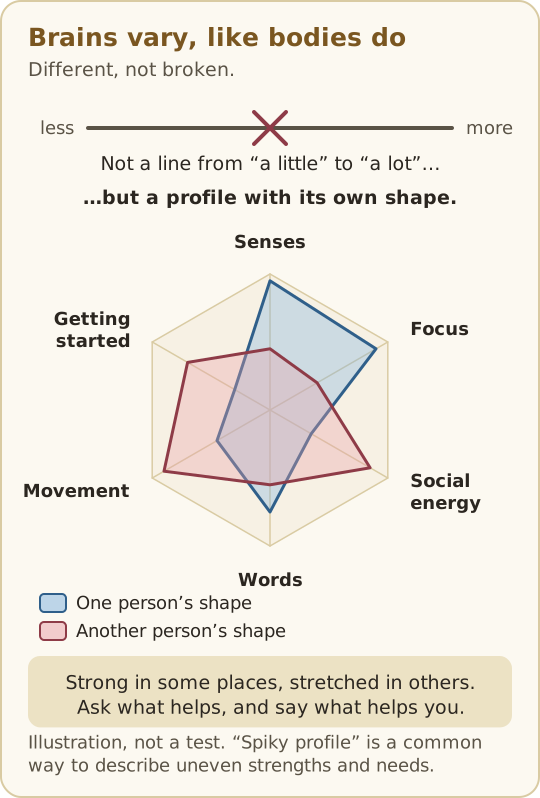
- Brains vary, like bodies do. Different isn’t broken, and differences can still be disabling in a world built for one kind of mind.
- Overload isn’t a choice. Meltdowns, shutdowns and burnout are what happens when a nervous system has had too much.
- Some things help a lot: less masking, room to stim, time for deep interests, and real rest.
- Meet in the middle, out loud. Ask what helps, say what helps you, and use the words each person chooses.
Why the tools work: this chapter explains the thinking behind these tools from earlier in the book.
- The “How to talk to me” card and “know how you like to be spoken to” (Part One, Now) work because different minds need different input. Saying things plainly is an adjustment that helps almost everyone. Big idea: tune how you send and receive.
- One owner per job and the written job list (Part Two, Chapter IV) move memory out of anyone’s head and onto paper. That helps ADHD and autistic minds most, and everyone a little. Big idea: fix the setup, not the person.
Monday, 8:15am
“Can you just put your shoes on?” For the third time. Your child is lying on the hall floor, hands over his ears, because the new socks “feel wrong.” You’re late. He’s not being difficult. To him, the sock seam feels like sandpaper, and the alarm clock is still ringing in his head.
Most of us grow up assuming other people’s minds work roughly like our own. When someone reacts differently, we reach for explanations about character: rude, lazy, dramatic, cold. Often the real explanation is that their brain takes in and handles the world in a different way. This chapter explains what is known about autism, ADHD, sensory differences and learning differences, how philosophers have thought about difference and disability, and how all of this looks through an autistic lens. Then it turns to how different minds can live, learn and work well together.
How to read this chapter
Most sections look at one idea through up to three lenses, then bring them together. Where a lens doesn’t add much, it is left out, and a few sections add a practical one instead.
- Psychology: what researchers have found, named honestly, with a note where the evidence is thin, changing or debated. Research in this area is moving fast, and some older ideas have been overturned.
- Philosophy: how thinkers have approached difference, normality and disability, paraphrased fairly.
- Through an autistic lens: how the idea looks from an autistic point of view, drawing on what autistic people have written and said. It is a perspective, not a deficit, and not a rule about any one person.
Where something is the site’s own way of putting ideas into practice, it is marked This site’s idea. Nothing here can diagnose you or anyone else.
Neurodiversity and disability
Human brains vary, just as heights, voices and immune systems do. “Neurodiversity” names that variety. “Neurotypical” is often used for people whose minds work in the ways society treats as standard, and “neurodivergent” for those whose minds work differently, for example autistic people, people with ADHD, dyslexia, dyspraxia or Tourette syndrome, and others.
Psychology
Modern research describes autism, ADHD and learning differences as neurodevelopmental: differences in how the brain develops, present from early life and usually lifelong. Twin and family studies suggest that genes play a large part in autism and ADHD, alongside many other factors. There is no single “autism gene” or “ADHD gene,” and no evidence that parenting styles cause either. The once-popular claim linking autism to vaccines has been thoroughly investigated and is not supported by the evidence.
Conditions often overlap. Many autistic people also have ADHD (sometimes called AuDHD), and dyslexia, dyspraxia, anxiety and sleep differences are common alongside both. Diagnostic manuals describe these as separate categories, but real people are often a blend.
Philosophy
The word “neurodiversity” is usually credited to the Australian sociologist Judy Singer, who used it in the late 1990s, drawing on ideas already alive in autistic online communities. Writer and scholar Nick Walker later described the “neurodiversity paradigm”: the view that neurological variety is natural and valuable, and that the idea of one “normal” brain is a cultural construction, much like the idea of one normal race or gender.
The social model of disability, developed by disabled activists and named by sociologist Mike Oliver in the early 1980s, separates impairment (a difference in the body or mind) from disability (the barriers society puts in the way). A wheelchair user is disabled by stairs more than by their legs. Philosopher Elizabeth Barnes, in The Minority Body (2016), argued that being disabled is, in many cases, a way of being a minority rather than simply being worse off. Others argue that some impairments bring real suffering whatever society does. A fair reading holds both: many difficulties come from a poor fit with the world, and some needs are real and deserve support in their own right.
Through an autistic lens
Many autistic people describe the neurodiversity view as life-changing: it moves the story from “what is wrong with me?” to “what do I need, and what gets in my way?” Many also say autism is disabling for them in real ways, and that support, not just acceptance, matters. Both can be true. The phrase from the disability rights movement, “nothing about us without us,” sums up a widely shared request: that research, services and policies about neurodivergent people include neurodivergent people in shaping them.
Thoughts you could try: “This is hard for me. Is it me, or the setup?” “Different isn’t less, and different can still need support.”
Autism and the double empathy problem
Autism is described in diagnostic manuals by differences in social communication and interaction, along with focused interests, repetitive behaviours, a preference for routine, and sensory differences. Autistic people often describe it more simply: a different way of sensing, thinking and connecting.
Psychology
For decades, a common theory said autistic people lacked a “theory of mind,” the ability to understand others’ thoughts and feelings. That view has been widely challenged. In 2012, autistic researcher Damian Milton described the double empathy problem: when autistic and non-autistic people misunderstand each other, the gap runs both ways. Non-autistic people often find autistic people hard to read, too.
Research since then supports this. A study led by Catherine Crompton (2020) found that information passed along a chain of autistic people was shared as accurately as along a chain of non-autistic people, but accuracy dropped in mixed chains. Noah Sasson and colleagues (2017) found that non-autistic observers formed less favourable first impressions of autistic people from brief video clips, but not when they read only what was said. In other words, part of the “social difficulty” lives in how others react to autistic people’s style, not only in autistic people themselves.
Many autistic people also experience alexithymia, difficulty identifying and describing their own feelings. Research by Geoffrey Bird and Richard Cook (2013) suggested that some empathy differences once blamed on autism may be linked to alexithymia instead, which also occurs in many non-autistic people.
Philosophy
In a famous 1974 essay, philosopher Thomas Nagel asked what it is like to be a bat. His point was that we can know facts about a bat’s echolocation, yet still not know what that experience is like from the inside. Something similar happens between different human minds. A non-autistic person can learn facts about sensory overload without knowing what it is like, and the reverse is true too. That humility, recognising the limits of your own imagination, is a good starting point for empathy that runs both ways.
Through an autistic lens
Many autistic people value directness and honesty, and find hints, white lies and unspoken rules confusing or exhausting. Saying exactly what you mean is, for many, a form of respect: it trusts the other person with the truth. Autistic people often connect deeply around shared interests (“parallel play” and “info-dumping” are terms some use with affection), rather than through small talk. Many describe feeling others’ distress intensely, sometimes to the point of overwhelm, while not showing it in expected ways. The picture of the cold, uncaring autistic person is a stereotype that many autistic people find painful and untrue.
Words you could use: “When I say something plainly, I’m not being rude. I’m trying to be clear.” “Could you tell me directly? I miss hints.”
ADHD, time and motivation
Attention deficit hyperactivity disorder is diagnosed by persistent patterns of inattention, hyperactivity and impulsivity that affect daily life. The name is a little misleading. Many people with ADHD describe not a shortage of attention but difficulty steering it.
Psychology
Psychologist Russell Barkley has described ADHD mainly as a difference in executive function, the brain’s self-management system: planning, starting tasks, holding information in mind, managing time and regulating emotions. He has also emphasised “time blindness”: difficulty sensing the passage of time and acting for future rewards. Many people with ADHD also hyperfocus, becoming absorbed for hours in something that interests them. Research on brain reward systems suggests that interest, novelty, urgency and challenge play a larger role in switching attention on for people with ADHD.
ADHD often continues into adulthood, though it may look different: less running around, more inner restlessness, disorganisation or emotional ups and downs. Girls and women have historically been under-diagnosed, partly because they are more often inattentive than visibly hyperactive. Emotional intensity is common in ADHD. “Rejection sensitive dysphoria” is a term used by some clinicians for intense pain at perceived rejection; it isn’t a formal diagnosis, and research on it is limited, but many people with ADHD say it describes their experience.
Medication, coaching, therapy and environmental changes can all help. Research supports medication as effective for many people, with benefits and side effects that vary person to person.
Philosophy
William James, the philosopher and psychologist, wrote in the 1890s that what we pay attention to shapes our experience and, over time, our lives. He also saw attention as partly voluntary and partly drawn by interest. ADHD can be seen as a mind where interest has much more say. The French philosopher Simone Weil described attention as a rare and pure form of generosity. That is worth remembering when someone with ADHD gives their full, absorbed attention to something they love, or to someone they love.
Through an autistic lens
Autism and ADHD often occur together, and they can pull in different directions: one part wanting routine and sameness, another craving novelty and stimulation. Many AuDHD people describe this as a constant negotiation. Both autistic and ADHD minds can be “interest-led,” and both can find switching tasks hard. Where they differ, an autistic person may need predictability to feel safe, while an ADHD person may need variety to stay engaged. A home or workplace that offers both, steady routines with room for novelty, can suit many.
Words you could use: “I’m not ignoring you. I didn’t hear you because I was locked into this. Can you tap my shoulder next time?”
Senses, overload and needs
We usually think of five senses, but our brains also process balance, body position (proprioception) and signals from inside the body like hunger, heartbeat and needing the toilet (interoception). People differ a great deal in how strongly they register each one.
Psychology
Occupational therapist Winnie Dunn developed a widely used model (1997) describing how people differ in their sensory “thresholds” and in how they respond. Some people notice everything and are easily overwhelmed (sensitive or avoiding). Others need more input to register it, and either seek it out or miss it (seeking or low registration). Most people have a mix across different senses.
Psychologists Elaine and Arthur Aron (1997) described “sensory processing sensitivity,” a temperament trait found in many people, autistic or not, in which people process sensory and emotional information deeply. Sensory differences are now part of the formal description of autism, and are common in ADHD too. Many autistic people report differences in interoception, such as noticing hunger, thirst or pain late or very strongly, though research findings here are mixed.
Philosophy
The phenomenologist Maurice Merleau-Ponty argued that we don’t experience the world as minds floating above bodies; we experience it through the body. Perception isn’t a camera; it’s an active, bodily engagement. That makes sensory differences more than a detail. If your body meets the world differently, your world is, in a real sense, different.
Through an autistic lens
Many autistic people describe sensory overload as one of the most disabling parts of daily life: fluorescent lights that flicker, clothes that scratch, crowds, overlapping conversations, strong smells. Overload can lead to meltdowns (an outward loss of control) or shutdowns (going quiet and withdrawn). Neither is a tantrum or a choice. Many autistic people also describe great sensory joy: the texture of a favourite fabric, the pattern of light on water, a piece of music played again and again. Stimming, repetitive movements or sounds such as rocking, flapping or humming, is often a way of regulating and expressing feeling. Unless it causes harm, there’s usually no reason to stop it.
Words you could use: “I need to step outside for five minutes. It’s the noise, not the company.” “Is the music too loud for you? We can turn it down.”
Spiky profiles and learning tools
Learning differences are specific: they affect particular skills, such as reading, writing, number sense or coordination, while leaving others untouched or even strong.
Psychology
Dyslexia mainly affects reading and spelling. Much research, including work associated with Sally Shaywitz, links it to differences in processing the sounds of language (phonological processing). It is not a problem with vision or intelligence. Structured, phonics-based teaching helps many dyslexic readers. Dyscalculia affects number sense and arithmetic. Dyspraxia, also called developmental coordination disorder, affects planning and coordinating movement, and often organisation. Developmental language disorder affects understanding and using language. All are common, and all are under-recognised, especially in adults.
A “spiky profile” describes the uneven pattern many neurodivergent people have: very strong in some areas, very challenged in others. This is why someone can be gifted and struggling at once, and why intelligence tests that give one score can hide a lot.
Philosophy
Philosopher Martha Nussbaum, with economist Amartya Sen, developed the capabilities approach: the idea that justice is about what people are actually able to do and be, not just what resources they nominally have. A library full of books doesn’t give a dyslexic child the capability to read, unless it also offers audiobooks and good teaching. Fairness, on this view, isn’t treating everyone identically. It’s making sure everyone can actually reach what matters.
Through an autistic lens
Many autistic people have spiky profiles too: perhaps reading early and fluently, yet finding handwriting or spoken instructions very hard. Some are hyperlexic, reading well beyond their age. Many learn best from clear, written, structured information, and struggle with group work, noisy classrooms or vague instructions like “just have a go.” Autistic learners often do best when they can follow their interests deeply. Using a special interest as a doorway into other subjects can be one of the most effective teaching tools there is.
Words you could use: “Can you write that down for me? I take it in better written.” “I learn best when I can see the whole plan first.”
Masking, energy and burnout
Masking, sometimes called camouflaging, means hiding or compensating for neurodivergent traits to fit in. It can be deliberate or so practiced it becomes automatic.
Psychology
Laura Hull and colleagues (2017) interviewed autistic adults about camouflaging and described it as a mix of masking (hiding traits), compensating (using learned strategies like scripts and rules for eye contact) and assimilating (trying to blend in). People described it as exhausting and said it could leave them unsure of who they really were. Later studies have linked high camouflaging with more anxiety and depression, though cause and effect are hard to untangle.
Dora Raymaker and colleagues (2020), in research led by autistic and non-autistic researchers together, described autistic burnout: long-term exhaustion, loss of skills and reduced tolerance to stimulation, resulting from chronic life stress and a mismatch between expectations and abilities without enough support. It is different from work burnout, though they can overlap. People described recovery as needing rest, reduced demands and the chance to unmask.
Christine Miserandino’s “spoon theory” (2003) came from living with lupus, not neurodivergence, but many neurodivergent people use it: each day starts with a limited number of “spoons” of energy, and every task uses some. Masking uses a lot.
Philosophy
The sociologist Erving Goffman described everyday life as a kind of performance, with a “front stage,” where we present ourselves to others, and a “backstage,” where we can relax. Everyone does some of this. For people who mask, the front stage is bigger and more effortful, and the backstage may be very small. Philosophers of authenticity, from Jean-Jacques Rousseau to the existentialists, have asked what it means to be true to oneself. For many neurodivergent people this isn’t abstract: it’s a daily trade-off between safety and selfhood.
Through an autistic lens
Many autistic people, especially those diagnosed late, say they had masked for so long that they didn’t know which parts were really them. Unmasking is often gradual, and safe only in some places. It isn’t a duty, and masking isn’t lying. It’s often a survival strategy in places where being openly different has had costs. What helps is having somewhere, and someone, where the mask can come off. Recovery time after social events isn’t antisocial; it’s maintenance.
Words you could use: “I can do the party, and I’ll need a quiet Sunday after.” “With you, I don’t have to perform. That means a lot.”
Monotropism, flow and transitions
Some minds spread attention across many things at once. Others focus deeply on a few. Neither is better. They suit different tasks.
Psychology
Monotropism is a theory developed by Dinah Murray, Wenn Lawson and Mike Lesser (published in 2005), with autistic researchers among its authors. It suggests that autistic minds tend to focus attention intensely on a small number of interests at a time, while non-autistic minds tend to spread attention more widely (“polytropism”). Monotropism may explain several autistic experiences at once: deep expertise and joy in interests, difficulty switching tasks, missing things outside the focus, and distress when interrupted. It is a theory, increasingly studied but not yet fully tested, and many autistic people find it fits their experience well.
Psychologist Mihaly Csikszentmihalyi described flow, the state of being completely absorbed in a challenging, meaningful task. Many neurodivergent people describe flow as easy to fall into on their own terms and hard to leave.
“Autistic inertia” is a term many autistic people use for difficulty starting, stopping or switching activities, even ones they want to do. Research on it is still early.
Philosophy
Aristotle thought the best kind of life involved activity done for its own sake, especially contemplation, which he saw as the most absorbing and self-sufficient of activities. Many traditions honour deep, single-minded focus: the craftsperson, the scholar, the monk. A monotropic mind can be seen in that light, not as narrow, but as capable of a depth that busy, scattered attention rarely reaches.
Through an autistic lens
Interruptions can feel like being yanked out of a warm bath into cold air. Clear warnings help: “in ten minutes,” then “in five,” then a gentle cue. So do visual timers, predictable routines and transition objects or rituals. Many autistic people also need a wind-down after deep focus, like a diver coming up slowly. Respecting focus, and planning around it, is one of the simplest ways to reduce conflict at home and at work.
Words you could use: “Can you give me a ten-minute warning before we leave?” “I’m deep in something. Can I get back to you at four?”
Adjustments that help everyone
When people with different minds share a home, a classroom or a workplace, good things come from adjusting on both sides, clearly and without blame.
Psychology
Research on workplace and classroom adjustments suggests many are low-cost and effective: written instructions, quiet spaces, flexible hours, noise-cancelling headphones, regular check-ins, clear deadlines and remote options. In many countries the law requires reasonable adjustments for disabled people, which can include neurodivergent people. The evidence for specific adjustments varies, but asking the person what helps them, and then reviewing it, is a widely recommended starting point.
The curb-cut effect, a phrase popularised by Angela Glover Blackwell (2017), describes how changes made for one group, like dropped curbs for wheelchair users, often help many others too: people with prams, suitcases or bicycles. Universal design for learning applies the same idea to teaching: build in options from the start, so fewer people need special arrangements.
Philosophy
John Rawls proposed imagining a “veil of ignorance”: designing society without knowing which person you’ll be in it. If you didn’t know whether you’d be autistic, dyslexic or neurotypical, what kind of school, workplace or family rules would you choose? Probably ones that worked for many kinds of mind. Eva Feder Kittay, a philosopher and the mother of a disabled daughter, argues that dependency and care are part of every human life, not a special case, so a fair society builds care in rather than treating it as charity.
Through an autistic lens
Many autistic people say the single most helpful adjustment is clear, explicit communication: say what you mean, say what you expect, say when. It costs very little, and it helps many non-autistic people too. Another is predictability: knowing plans in advance, and being told about changes as early as possible. A third is being allowed to meet needs without explaining them every time. The double empathy idea is a reminder that adjustment is two-way: autistic people also adapt constantly, and it is fair to ask the non-autistic side to meet them partway.
This site’s idea: a one-page “how I work best” card, like the site’s wiring card, that anyone can fill in and share: how I like to be told things, what drains me, what helps me settle, and what I need before a change.
Words you could use: “Here’s how I work best. What about you?” “Could we agree that plans change only with a day’s notice, unless it’s an emergency?”
Your card
Who it’s for
- A partner
- Family
- A friend
- Chosen: Work (a manager or coworker)
- Name on the card, optional
- Tom
WIRING CARD · NOT A DIAGNOSIS
- How I receive things best
- A written list.
- I take words
- Literally.
- Give me time to answer
- Write it down so I can answer later.
- Please avoid
- A hard topic with no warning. Correcting me in public.
- A request lands best as
- “Could you ___ by ___?”
- Also good to know about me
- If I go quiet, I’m processing, not upset. Tell me the plan, and tell me if it changes. Noise, light or touch can wear me out.
- Sensory needs
- Short breaks in long talks.
Sent with one line: “Here’s a short card about how I work best. It’s not a request for anything big; it just helps us avoid crossed wires.”
A made-up example. Names and details are invented. Sharing a card is always the person’s own choice.
Fill in your own: “How to talk to me” card (spreadloveandacceptance.com/
Diagnosis, identity and words
Labels can open doors to understanding, support and community. They can also be misused, as insults or as limits. How they are used matters as much as whether they are used.
Psychology
Many adults, especially women and people of colour, receive autism or ADHD diagnoses later in life, after years of being misunderstood. Research and personal accounts suggest that adult diagnosis often brings relief and self-understanding, along with grief for earlier struggles. Access to assessment varies widely by country and income, and waiting lists can be long. Some people identify as neurodivergent without a formal diagnosis. Many autistic communities accept self-identification, while noting that formal diagnosis can be needed for legal protection and services.
On language, a UK study by Lorcan Kenny and colleagues (2016) found that “autistic” and “on the autism spectrum” were preferred by many autistic adults, while professionals more often used “person with autism.” Preferences differ between people and countries. The safest approach is to ask, and to follow the person’s own choice.
Philosophy
Philosopher Ian Hacking described the looping effect of human categories: when people are classified, the classification changes how they see themselves and how others treat them, which in turn changes the category. Autism and ADHD are good examples: definitions have shifted many times, partly because of how people with these labels have responded to and reshaped them. That doesn’t make the differences unreal. It reminds us that labels are human tools, and their meaning is still being written, increasingly by neurodivergent people themselves.
Through an autistic lens
Many autistic people describe their diagnosis as the moment their life made sense. Others feel it was used against them. Most agree on one thing: a label should open understanding, never close it. “You’re so autistic” said in an argument, or “everyone has a bit of ADHD” said to dismiss real struggles, hurts. Asking “what does this mean for you?” respects the person behind the word.
Words you could use: “What does being autistic mean for you, day to day?” “I’d rather you didn’t use my diagnosis to win an argument. Can we talk about what actually happened?”
Autistic burnout, rest and recovery
Burnout is a word everyone uses. Autistic burnout is something more specific, and often more serious, than being worn out by a busy month.
Psychology
Working with autistic adults as co-researchers, Raymaker and colleagues (2020) defined autistic burnout as a syndrome of long-term exhaustion, loss of function (skills such as speech, planning, memory or self-care can drop away) and reduced tolerance of sensory input. It arises from chronic life stress and a mismatch between what is expected of someone and what they can do, without enough support. It usually lasts a long time, often months, and the study concluded that it appears to be different from work burnout and from clinical depression, though people can have more than one at once. What autistic people commonly describe as helping is the opposite of “trying harder”: fewer demands, less masking, more time alone and with their interests, a calmer sensory environment, and understanding from the people around them.
Philosophy
The philosopher Byung-Chul Han, in The Burnout Society (2010), argued that modern life pushes people to keep performing and optimising themselves until they are exhausted. His argument was about society in general, but it fits autistic burnout closely: for many autistic people, the performance is not only at work, but in every conversation, shop and corridor.
Through an autistic lens
Autistic burnout is often mistaken for laziness, depression or “not coping.” Losing skills you used to have can be frightening, and people may not believe it. Many autistic people say recovery began only when they stopped pushing and gave themselves permission to do less. Recovery is often slow, and it helps to plan ahead to avoid the next one: knowing your early signs, and the demands you can drop.
Words you could use: “I’m in burnout. I need fewer demands for a while, not encouragement to push through.” “I used to be able to do this. I can’t right now, and that’s part of burnout.”
Meltdowns and shutdowns
When overwhelm becomes too much, some people melt down and some shut down. Both are involuntary. Neither is a tantrum.
Psychology
In interviews with autistic children and young people, Phung and colleagues (2021) explored burnout, inertia, meltdown and shutdown as separate experiences, building on earlier work with autistic adults. A meltdown is an outward loss of control, such as crying, shouting, running or lashing out. A shutdown is an inward one: going still and quiet, losing speech, being unable to respond or move. A tantrum, by contrast, usually has a goal and stops when the goal is met. A meltdown has no goal and stops when the overwhelm passes. What helps in the moment is reducing input (noise, light, words, questions, touch) and keeping everyone safe. Afterwards, many people are exhausted and need rest, not a long talk.
Philosophy
Aristotle distinguished actions done voluntarily from those done under compulsion, and thought praise and blame belong to the voluntary ones. A meltdown or shutdown is closer to something that happens to a person than something they do. Responding with blame misreads it. Responding with care, and with planning on calmer days, fits it.
Through an autistic lens
Many autistic adults carry shame from being punished for meltdowns as children. It helps to know that a meltdown is a nervous system at its limit, not a moral failure. Planning on calm days makes a difference: knowing your build-up signs, having a way to leave, and agreeing a signal with the people you’re with. For a shutdown, it helps others to know that silence isn’t sulking, and that pressure to speak makes it longer.
Words you could use: (to someone else) “You’re safe. I’m right here. No need to talk.” (for yourself) “I’m close to overload. I need to leave for twenty minutes.”
Stimming
Stimming, short for self-stimulatory behaviour, means repeated movements, sounds or actions: rocking, flapping, tapping, humming, pacing, spinning something, rubbing a texture. Most people stim a little. For many autistic people, it matters a great deal.
Psychology
In interviews and focus groups with autistic adults, Kapp and colleagues (2019) found that stimming was described as a way to regulate overwhelming emotions and sensations, and also to express feelings, including joy. Participants described coming to accept their own stimming through understanding it, and objected to efforts to stop stims that harm nobody. Stims that cause injury are different, and are best handled with care and support rather than punishment, often by finding a safer stim that does the same job.
Philosophy
The philosopher Maurice Merleau-Ponty argued that we understand and live in the world through our bodies, not just our minds. Stimming fits that view: it is the body helping the mind to stay steady, to think and to feel. Seen that way, it is less a strange habit than a sensible one.
Through an autistic lens
Many autistic people were told as children to “stop flapping” or keep “quiet hands,” and learned to hide their stims. Unlearning that can be a relief. Others can help simply by not commenting, and by saying, if it’s needed, “You don’t have to stop on my account.”
Words you could use: “Rocking helps me think. It doesn’t mean anything’s wrong.” “You don’t need to stop. It’s fine with me.”
Special interests and wellbeing
Many autistic people have deep, intense, long-lasting interests. They are often called special interests, though some people prefer “passions” or just “interests.”
Psychology
Monotropism (see the focus section above) helps explain why interests can matter so much. In a survey of autistic adults in the Netherlands, Grove and colleagues (2018) found that about two-thirds reported a special interest. Among them, being more motivated by their interest was linked to higher wellbeing, while very intense engagement was linked to lower wellbeing. Interests can be a source of rest, joy, skill, work and friendship.
Philosophy
Bertrand Russell, in The Conquest of Happiness (1930), argued that happiness comes from taking a lively interest in things outside yourself. He recommended wide interests. Many autistic people find their happiness in deep ones instead. Both share the idea that losing yourself in something you love is good for you.
Through an autistic lens
Sharing an interest in detail, sometimes called info-dumping, is for many autistic people a way of offering friendship: “Here is something wonderful; I want you to have it too.” Listening with real interest is one of the warmest things another person can do. Interests can also be a way to recover from burnout and a bridge to other people who share them.
Words you could use: “Can I tell you about this for five minutes? It’s how I unwind.” “Tell me more. What’s the best bit?”
Diagnosis later in life
More and more people are learning they are autistic, or have ADHD, as adults, sometimes in their fifties, sixties or seventies. Many were missed as children, particularly women, people who masked well, and people whose families or schools had little awareness of neurodivergence.
Psychology
In interviews with women diagnosed as autistic at forty or older, Leedham and colleagues (2020) described how exhausting it had been to go through life without an explanation for feeling different, and how much the diagnosis changed the way they understood their lives. Adults diagnosed late may feel relief, grief for the support they missed, anger, joy and confusion, sometimes all at once. Many people identify as autistic before, or without, a formal assessment; waiting lists can be long, and both routes are common.
Philosophy
The philosopher Ian Hacking wrote about “looping effects”: when people learn a name for a kind of person, it can change how they understand themselves, and that in turn changes the category. A late diagnosis is a looping effect in a single life. The past doesn’t change, but its meaning does.
Through an autistic lens
Many late-diagnosed adults describe rereading their whole lives: friendships, jobs, relationships, burnouts. It can help to go slowly, to find autistic-led communities, and to remember that a diagnosis adds understanding; it doesn’t take away who you have been. Partners, family and friends may need time to adjust too, and it helps to share what the diagnosis means for you in plain terms.
Words you could use: “I’ve just found out I’m autistic. I’m still working out what it means.” “That explains so much about my life.”
Executive function in daily life
Executive function is the name for the brain’s self-management skills: planning, getting started, switching between tasks, holding things in mind while you use them, keeping track of time, and stopping yourself acting on the first impulse. Most daily life runs on them, from getting out of the door to paying a bill.
Psychology
Barkley (1997) described ADHD mainly as a difference in self-regulation and executive function (see ADHD, time and motivation above). In autism, a review of 235 studies by Demetriou and colleagues (2018) found that autistic people, on average, scored lower than non-autistic people across a range of executive function tasks, but with wide variation and mixed results across ages. In other words, these differences are common but not universal, and lab tests don’t capture everything. Many people describe the real-world version as “I know exactly what to do, and I can’t make myself start,” or a sudden loss of everything they were holding in mind when interrupted. For autistic people, this can overlap with what is sometimes called autistic inertia: difficulty starting, stopping or changing activity.
What tends to help is moving the managing outside the head: lists, visual timers, alarms, checklists by the door, breaking tasks into very small first steps, body doubling (working alongside someone), and building routines so fewer decisions are needed. None of these are crutches. Glasses aren’t a crutch either.
In practice
At home and at work, the kindest adjustment is often simple: write it down, give one step at a time, agree deadlines rather than assuming them, and warn before changes. For children, see When a child has ADHD, which has ideas for routines and forgetting that work for adults too. Wired differently covers how executive function differences show up in relationships.
Words you could use: “Could you send me that as a list? Spoken steps fall out of my head.” “I’m not ignoring it. Starting is the hard part for me. Could we do the first bit together?”
If you have ADHD: the chore tools, made lighter
Part Two’s tools ask for steady record-keeping: a week of jobs in minutes, a weekly tally, a monthly look-back. For many people with ADHD, the log itself becomes one more job that slips, and then one more source of guilt. The tools are there to help you see and share the load. They work fine in a lighter form:
- Log less, not never. Log three days instead of seven, or only the five jobs that cause the most friction. A rough week is enough to see a pattern.
- Log the easy way. A tally on a sheet on the fridge, a photo of the done job, or a ten-second voice note counts. Minutes are optional; “small, medium, big” works.
- Let the chat replace the list. The 90-second daily check-in, said out loud at dinner, can stand in for a written log on a hard week.
- Own fewer jobs, whole. It is often easier to own three jobs completely, including the noticing, than to help a bit with ten. Pick jobs with a built-in cue: bins on bin night, the dishwasher when it beeps.
- Give each owned job a reminder, set up once: a repeating alarm with the job’s name, or a note where the job happens. Forgetting a job you own is a setup problem to fix together, not proof you don’t care.
- Agree a backstop. Decide ahead who picks up a job if it slips, and how they’ll say so kindly. That is different from being quietly “covered for”, which can leave the other person resentful and you feeling managed.
If you live with someone with ADHD and feel like their manager, that is worth naming too, gently. The aim is to hand over whole jobs with their cues, so you can stop reminding. Reminding and checking is invisible work, and it counts as load. Many people with ADHD also feel criticism very sharply, so a flat “thanks” or a sigh can land harder than you meant. Specific thanks helps: “Thank you for doing the bins without me asking.”
A made-up example. Thandi has ADHD and kept abandoning the week-long log by Wednesday. She and her partner switch to a tally sheet on the fridge for three days and spot the problem at once: she was “helping” with ten jobs and owning none. She takes over the bins, the plants and the online shop, each with a labelled alarm. Her partner stops reminding. After a month, the reminding is what they both notice has gone.
Words you could use: “A full week’s log won’t happen for me. Can we do three days with a tally?” “I’d rather own three jobs completely than half-do ten.” “If I forget, can you say ‘bins’ once, and then leave it with me?”
Demand avoidance, carefully
Some people experience everyday demands, including ones they want to meet, as a strong threat. Being asked, expected or even reminded can trigger intense anxiety and a need to avoid, which may look like refusal, negotiating, distraction, humour, withdrawal or meltdown.
Psychology
The psychologist Elizabeth Newson described this pattern in children in the 1980s, and Newson and colleagues (2003) proposed “pathological demand avoidance syndrome” (PDA) as a separate condition within the autism spectrum. The idea has been widely taken up by families and some clinicians, especially in the UK. It is also contested. It is not in the main diagnostic manuals. A systematic review by Kildahl and colleagues (2021) found 13 studies, nearly all drawing on Newson’s original descriptions, mostly relying on parent reports, rarely considering other explanations such as anxiety, and none asking people with the profile about their own experience. Some researchers see demand avoidance as a feature that can occur in autism and other conditions, often driven by anxiety and a need for control, rather than a separate syndrome.
So it is best described as a profile some people strongly recognise, not a settled diagnosis. Many autistic people who identify with it prefer “persistent drive for autonomy” (or “pervasive drive for autonomy”), which describes the experience from the inside rather than as a disorder. Whatever the name, approaches families and adults describe as helpful are consistent: reduce pressure, offer real choices, phrase requests indirectly or as invitations, pick battles, build trust, and plan for lower-demand days.
Through an autistic lens
For the person, demand avoidance is usually not defiance. It can feel like the body refusing even when the mind is willing, and it can extend to things they love. Being called stubborn or manipulative adds shame to anxiety. Being given choice and control, and having that need respected, often brings more cooperation than any amount of firmness.
Words you could use: “I wonder if we could…” “Which would you rather?” “No rush.” (for yourself) “Being told makes it harder. Can I choose when?”
Face blindness
Most people recognise faces so automatically that it’s hard to imagine not doing it. For some people, faces are much harder: they may not recognise a colleague in the supermarket, a friend with a new haircut, or a character in a film after a scene change.
Psychology
Prosopagnosia, or face blindness, is a difficulty recognising faces. It can be acquired after a brain injury or stroke, but most often it is developmental: present from childhood, with no injury, and it can run in families. The NHS notes that there is no treatment, but that strategies help, such as recognising people by voice, hair, walk or clothes, and telling people in advance. Face recognition is also, on average, harder for autistic people. In a review of behavioural studies, Weigelt and colleagues (2012) found autistic people tended to be less accurate at recognising and remembering face identity, especially when memory was involved, though it was unclear whether the difficulty was specific to faces. Not every autistic person has this, and many people with face blindness are not autistic.
In practice
Face blindness is often mistaken for rudeness, coldness or not caring. It helps to say it early (“I’m terrible with faces, it’s not you”), and for others to make it easy: say your name when you greet someone out of context, wear a familiar item at a meet-up, or agree where to meet. Name badges at events help everyone.
Words you could use: “I’m bad with faces, so please say who you are when you say hi.” “Hi, it’s Jo from next door.”
Non-speaking people and AAC
Some autistic people don’t use speech, use it only some of the time, or lose it under stress. Being non-speaking, or minimally speaking, is not the same as having nothing to say, and it says nothing on its own about intelligence.
Psychology
Augmentative and alternative communication (AAC) covers any way of communicating besides speech: sign, gesture, picture cards, letter boards, typing and speech-generating apps. A common worry is that AAC will stop speech developing. In a review of studies of people with developmental disabilities, Millar, Light and Schlosser (2006) found that AAC did not hold back speech, and in many cases speech increased, though most studies were small and not tightly controlled. Choosing the right system and making it always available matters a lot.
Honesty also matters here. Methods in which a helper physically supports the person’s hand or arm while they point or type, known as facilitated communication, have been tested many times, and the messages were found to come from the helper rather than the person. The American Speech-Language-Hearing Association (2018) advises that it should not be used, and has raised similar concerns about related methods. That is different from AAC that the person controls themselves, which has broad support.
Philosophy
The special education researcher Anne Donnellan (1984) proposed “the criterion of the least dangerous assumption”: when we don’t know what someone understands, we should act on the assumption that would do the least harm if we were wrong. Assuming someone understands, and being wrong, costs little. Assuming they don’t, and being wrong, can mean years of being talked over, talked about and left out. This is the root of the phrase “presume competence.”
Through an autistic lens
Many non-speaking and part-time-speaking autistic people describe being spoken about in front of them as one of the most painful parts of daily life. Simple habits help: talk to the person, not about them; wait longer for a reply; accept every form of communication as real; and don’t demand speech when someone has said, in whatever way, that they can’t right now.
Words you could use: “Take your time. I’ll wait.” “Would you rather type, point or sign?” (for yourself) “I can’t talk right now. I can type.”
Disclosure in friendships and dating
Telling someone you are autistic, or have ADHD, is a personal choice, and it can be made a little at a time. There is no rule that you must, and no rule that you mustn’t.
Psychology
Research suggests telling can help, and also carries risk. In an experiment by Sasson and Morrison (2019), observers watched short videos of autistic and non-autistic adults. Their first impressions of the autistic adults were more favourable when they were told the person was autistic, and more favourable still among observers who knew more about autism. But real responses vary. In interviews with adults diagnosed late, Au-Yeung and colleagues (2025) found that telling people helped some get support and be more themselves, while many had not been believed, which made them more cautious next time.
In practice
Many people find it easiest to start with needs rather than labels (“I’m very direct, and I find loud bars hard”), then share the diagnosis when trust is there. In dating, some prefer to say early, to filter out people who won’t accept them; others wait until they know the person. Both are reasonable. If someone tells you, the best response is simple: thank them, ask what helps, and don’t share it with others without permission. For telling an employer, see Autistic at work.
Words you could use: “I’m autistic. For me that means…” “I won’t always pick up hints, so please just tell me.” (if someone tells you) “Thanks for telling me. What helps?”
Autistic community and identity
For many people, being autistic is not only a diagnosis but an identity, a culture and a community, with its own language, humour, history and ways of being together.
Psychology
Social identity research (see Chapter 17) suggests that belonging to a valued group can protect wellbeing, especially for people who face stigma. In a study of over 500 people, Cooper, Smith and Russell (2017) found that autistic people who identified more strongly with other autistic people had higher self-esteem, and through that, lower anxiety and depression. Botha and Frost (2020) found that everyday discrimination, internalised stigma and hiding being autistic were linked to poorer mental health in autistic adults, even after accounting for general stress. Together, these suggest that some of the extra mental health difficulties autistic people face come from how they are treated, and that community and acceptance can help.
Through an autistic lens
Many autistic people describe autistic spaces, online or in person, as places where they don’t have to translate themselves: where info-dumping is welcome, stimming is normal, and directness isn’t rude. Some prefer identity-first language (“autistic person”), others person-first; Kenny and colleagues (2016) found a range of preferences, and asking is always fine. Community doesn’t mean everyone agrees, and nobody has to join anything. It simply means that, for many people, finding others like them is part of finding themselves.
Thoughts you could try: “There are people who work like me.” “I can belong somewhere without masking.”
Putting it together
Minds differ, and much of the pain around those differences comes from misreading them as character. Psychology now describes many differences in two-way terms: the double empathy problem, sensory profiles, spiky skill sets. Philosophy offers ways to think about fairness for different minds: the social model, capabilities, the veil of ignorance. The autistic lens, and the lens of other neurodivergent people, reminds us that understanding starts with listening to people describe their own experience.
The threads that run through the chapter:
- Behaviour is information. A meltdown, a forgotten task or a blunt remark often has a reason worth finding.
- Energy is limited. Masking, overload and switching all use it. Rest and quiet are part of the plan.
- Clear is kind. Saying what you mean, giving times and writing things down helps nearly everyone.
- Adjust both ways. Different minds meet in the middle when both move.
Your part, and only your part
You can’t rewire your brain or anyone else’s. You can learn how yours works, say what helps, ask what helps others, and choose environments and people that fit you. If you’re always the one adjusting, it’s fair to say so, and fair to spend more time where you can be yourself. Part One covers this in full: your circle of control, and matching energy.
Worked examples
On your own. At 34, Aisha reads about ADHD in women and recognises herself: the lost keys, the half-finished projects, the hyperfocus, the shame. She writes down what she’s noticed and books an appointment. While she waits, she starts using alarms, a launch pad by the door, and body doubling (working alongside a friend on video). She feels less broken and more curious.
Partners. Ben is autistic; his partner Chloe isn’t. Chloe says “we should go out sometime,” meaning “I miss you.” Ben hears a vague future plan. Chloe feels unheard; Ben feels confused. They agree to say the feeling and the ask plainly: “I miss you. Could we go out on Friday?” Ben puts it in the calendar right away, and Chloe learns that’s his way of saying yes, warmly.
Parent and child. The sock-seam morning from the opening becomes a routine: seamless socks, clothes laid out the night before, a five-minute warning before shoes, and the alarm clock moved out of the hall. The mornings aren’t perfect, but the shouting stops.
Coworkers. Dmitri, who is dyslexic, struggles with long emails. His manager starts sending bullet points and a short voice note for anything complex. Dmitri’s work improves, and so does everyone else’s inbox.
Friends. Hannah, who has ADHD, often cancels at the last minute when overwhelmed. Her friend Lily, who is autistic, finds last-minute changes very hard. They talk it through: Hannah will check in the morning of a plan, and if she needs to cancel, she’ll do it by noon. Lily keeps a backup plan she enjoys alone, so a cancellation doesn’t wreck her day.
Housemates. Three students share a flat. One needs quiet to sleep, one needs music to focus, one needs the kitchen tidy to feel calm. They write a short house agreement covering quiet hours, headphones, and a five-minute tidy after cooking. See Sharing a room.
Community. A local library adds a “quiet hour” with dimmed lights and no announcements. It was suggested by autistic families. Older visitors, people with migraines and tired parents all start coming too.
Exercises
1. Your sensory map
For each sense (sound, light, touch, smell, taste, movement, inside-body signals), write one thing that drains you and one that calms you. Pick one small change for your home or workspace.
2. Your “how I work best” card
Write four lines: how I like to be told things; what drains me; what helps me settle; what I need before a change. Share it with one person, and ask for theirs. The wiring card can help.
3. The energy budget
For one week, mark each activity as draining, neutral or restoring. Notice where masking or overload happens. Plan one recovery block after the most draining part of your week.
4. The plain-words swap
Think of one hint you often give (“the bins are full”). Rewrite it as a clear request with a time (“could you take the bins out tonight?”). Try it this week.
5. The transition plan
For one daily switch that causes friction (leaving the house, stopping a game, starting work), design a warning, a cue and a small reward or ritual. Try it for five days.
Questions people often ask
Can I be autistic or have ADHD without knowing?
Yes. Many adults find out later in life. If you recognise yourself in this chapter, it may be worth reading more and talking to a doctor. Only a qualified professional can diagnose, but your own observations are a valid place to start.
Isn’t everyone a little bit autistic, or a little bit ADHD?
Everyone has some of the traits sometimes. A diagnosis describes a lasting pattern, present across life and affecting daily living. The phrase can make real struggles sound small, so it’s kinder to avoid it.
Should I tell my employer or school?
That’s your choice. Telling can open the way to adjustments and legal protection in many countries; some people prefer to ask for specific adjustments without naming a diagnosis. At work has more.
My partner is neurodivergent and I feel I do all the adjusting. Is that fair?
Meeting in the middle should be two-way. It’s fair to name your own needs, too. Neurodivergent relationships has ideas for both sides, including when one person feels like the “manager.”
Are meltdowns just tantrums?
No. A tantrum is usually aimed at getting something and can stop when that happens. A meltdown is an overwhelmed nervous system losing control, and it needs safety, quiet and time, not consequences.
How do I support a neurodivergent child without making them feel different?
Talk about differences openly and positively, as part of how all people vary. Build on their strengths and interests, give clear routines, and let them meet other neurodivergent people. When a child has ADHD has more.
Limits, safety and when to get more help
- This chapter teaches ideas. It can’t diagnose you or anyone else, and it isn’t a substitute for assessment or support from qualified professionals.
- If you, your child or someone you care for has ongoing difficulties, a doctor, school special educational needs staff or a psychologist can talk you through an assessment.
- Burnout, depression and anxiety are more common in neurodivergent people. If you’re exhausted most days, losing skills, or feeling hopeless, please talk to a doctor. If you are having thoughts of hurting yourself, please tell someone today. In the US and Canada, call or text 988. In the UK and Ireland, call Samaritans free on 116 123. In Australia, call Lifeline on 13 11 14. In New Zealand, call or text 1737. Anywhere else, findahelpline.com lists free helplines.
- A difference never excuses harm, and it never makes someone deserve harm. Neurodivergent people face higher risks of being taken advantage of. If someone uses your differences to control or belittle you, Not safe at home? has free, private help, including signs to look out for.
More on the site: Wired differently, Neurodivergent relationships, Know your own wiring, and research notes on neurodiversity, double empathy, autism, ADHD, monotropism, masking, stimming, autistic inertia and spoon theory. Earlier in this part: Self-worth, shame and self-compassion and Loss, grief and big life changes.
Last updated: October 2026