Part Three · Chapter 14
Personality, temperament and change across life
In short:
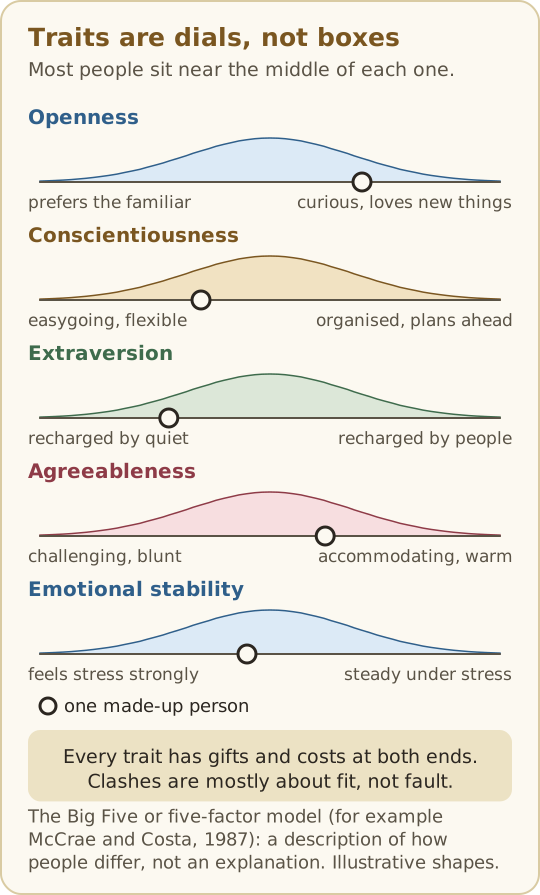
- Traits are dials, not boxes. Everyone sits somewhere along each one, and most people are near the middle.
- Temperament is a starting point. Babies already differ in how active, cautious or easily upset they are. What happens next matters too.
- People keep changing. On average, people grow steadier and more organised as they get older, and you can change on purpose, slowly.
- Different isn’t wrong. Most clashes between personalities are about fit, not fault.
Why the tools work: this chapter explains the thinking behind these tools from earlier in the book.
- The “How to talk to me” card and the style quiz (Part One, Now) describe how you lean on a few dials, not which box you are in. Most clashes are about fit, not fault.
- One owner per job (Part Two, Chapter IV) lets people with different temperaments share a home or team without changing who they are: you arrange the jobs around the differences. Big idea: fix the setup, not the person.
Saturday, 3:00pm
It’s your aunt’s seventieth birthday. You’re standing quietly by the cake when she says, loud enough for everyone: “Oh, you were always the shy one!” Everyone laughs. You smile, but something stings. You’re forty-two. You teach thirty children every day. Are you still “the shy one”? Were you ever?
What is personality, really? How much of it are we born with, and how much is shaped by life? Do people change, or do they just get more like themselves? And how do people with very different personalities share a home, a family or a job without driving each other mad? This chapter looks at personality and temperament in full, without putting anyone in a box.
Each section looks at one idea through three lenses. Psychology tells us what researchers have found, and where the evidence is limited. Philosophy shows how thinkers from many traditions have understood the same questions. Through an autistic lens looks at each idea from the point of view of autistic people. It is a perspective, not a diagnosis.
Ideas marked This site’s idea: are our own ways of putting things into practice, not established science.
Traits are dials, not boxes
Personality is the word we use for a person’s usual patterns of thinking, feeling and behaving: the things that make them recognisably themselves across many days and places. Describing it well is harder than it sounds.
Psychology
Over the twentieth century, researchers looked for the broad dimensions that best describe how people differ. A five-part picture, often called the Big Five or five-factor model, became the most widely used. The five are usually named openness to experience, conscientiousness, extraversion, agreeableness and neuroticism (the opposite end is often called emotional stability). In one important study, McCrae and Costa (1987) found the same five factors whether people rated themselves or were rated by peers who knew them well, and found moderate agreement between those views.
Two things matter most for everyday life. First, each trait is a dimension: people are spread along it, and most cluster near the middle. Very few people are at the far end of anything. Second, the model is a description, not an explanation. Saying someone is “high in conscientiousness” describes what they tend to do. It doesn’t say why, or whether they could do otherwise. See the Big Five in the library.
Philosophy
People have tried to sort personality for a very long time. Around the fourth century BCE, Theophrastus, a student of Aristotle, wrote Characters: short, funny sketches of types such as the flatterer and the chatterbox. Ancient Greek and Roman medicine, from Hippocrates to Galen, described four temperaments (sanguine, choleric, melancholic and phlegmatic), linked to the balance of bodily fluids. The fluids were wrong, but the wish to sort people into a few types has stayed with us, in star signs, colour quizzes and four-letter codes. Modern research mostly suggests that dials describe people better than boxes.
Through an autistic lens
Being autistic is not a personality type. Autistic people have the full range of personalities: outgoing and reserved, organised and chaotic, gentle and fiery. Personality questionnaires can also be tricky for literal readers. A question like “Do you enjoy parties?” may get the answer “It depends which party, how loud, and for how long,” which is a more accurate answer than a number on a scale. If a test result doesn’t feel like you, trust your own knowledge of yourself.
Thoughts you could try: “I’m more of this than that, much of the time.” “A score is a summary, not a sentence.”
A note on this site’s style quiz. The style quiz in How you connect gives you a four-letter “Wave Code” and a nickname, which can look like exactly the kind of type this section says to be careful with. It is meant as four preferences, each a lean along a dial: Pace (Quick Spark or Slow Simmer), Lens (Forest or Trees), Sending (Direct or Nuanced) and Receiving (Explicit or Attuned). The tool says whether you lean or lean strongly, and most people are near the middle on some of them. The letters are shorthand, the nickname is a conversation starter, and your answers can change with the day, the setting and who you’re with. It isn’t a validated personality test, and it doesn’t tell you who you are.
Temperament is the starting point
Anyone who has spent time with babies knows they are not blank slates. From the first months, some are busy and loud, some calm and watchful; some settle into routines easily, others protest every change. This early, largely inborn style is usually called temperament.
Psychology
In the New York Longitudinal Study, which followed children from infancy, Alexander Thomas and Stella Chess described differences in activity level, regularity, adaptability, mood, intensity and how children approached new things. In Thomas and Chess (1977), they described three broad groups that many children fell into: “easy,” “difficult” and “slow to warm up,” with many children not fitting any one group. Their most lasting idea was goodness of fit: problems tend to arise not from a child’s temperament alone, but from a poor match between that temperament and what the people and places around them expect.
Temperament is a starting point, not a script. Genes play a part in personality, and so do relationships, experiences, culture and chance. The same cautious toddler can become a careful, thoughtful adult or an anxious one, depending partly on how that caution was met.
Philosophy
Aristotle wrote that good character is neither simply given by nature nor against nature. We are born able to develop it, and it is completed by habit. On that view, temperament is like the raw material, and what we repeatedly do shapes what it becomes. It is a hopeful idea for parents and for adults: what you were given isn’t the whole story.
Through an autistic lens
Babies and children who are very sensitive to noise, touch or change are sometimes described as “difficult.” For autistic children, these may be sensory and processing differences, not a difficult nature. The goodness-of-fit idea is especially useful here: a quieter room, a warning before change, or clothes without scratchy labels can turn a “difficult” child into a settled one. Many autistic adults look back and recognise that they were labelled for needs that nobody understood at the time.
Words you could use: “You like to watch first. Join in when you’re ready.” (to yourself) “I was a sensitive child. That wasn’t a flaw. It needed a different setup.”
Situations matter too
If personality were everything, people would act the same everywhere. They don’t. The life and soul of the family party may be silent in meetings; the calm nurse may be impatient in traffic.
Psychology
In his 1968 book Personality and Assessment, Walter Mischel pointed out that how a person behaves in one situation often predicts their behaviour in another quite weakly. This started a long “person versus situation” debate. The broad answer most researchers came to is that both matter. Traits describe what someone tends to do across many situations, on average. Situations shape what they do in any single moment. Mischel later suggested thinking of personality as stable “if… then…” patterns: if criticised by a boss, then goes quiet; if criticised by a sibling, then argues back.
Philosophy
Some philosophers, such as John Doris in Lack of Character (2002), have used this research to question whether people have stable character traits at all, or whether situations do most of the work. Others reply that character shows exactly in how we handle different situations. Confucian thought offers another angle: we are always someone’s child, friend, colleague or neighbour, and good character means acting well in each of those roles, which may look different in each.
Through an autistic lens
Many autistic people seem very different in different places, often because of masking: hiding autistic traits to fit in. In interviews by Hull and colleagues (2017), autistic adults described camouflaging to fit in and connect, often followed by exhaustion. Someone who seems “outgoing” at work may be using a great deal of energy to appear so, and be very quiet at home. When people say “You’re not like that at work,” it’s worth knowing which version costs more.
Thoughts you could try: “I’ve only seen them in one setting.” “Where am I most myself?”
Introvert and extravert: energy, not liking people
Introversion and extraversion are perhaps the best-known personality words, and among the most misunderstood.
Psychology
Carl Jung brought the words into wide use in Psychological Types (1921). In the modern trait view, extraversion includes sociability, assertiveness, liveliness and a tendency to feel positive emotions strongly. People lower in extraversion (more introverted) aren’t necessarily shy or unfriendly. Many enjoy people a great deal, but prefer smaller groups, quieter settings and more time to recover afterwards. Shyness, which involves worry about being judged, is a different thing: there are shy extraverts and confident introverts. Most people sit in the middle and shift with mood, setting and how tired they are. See introversion in the library.
Philosophy
The French thinker Blaise Pascal wrote in the 1600s that many of humanity’s troubles come from not being able to sit quietly alone in a room. Some cultures and traditions prize quiet reflection; others prize lively company. Neither is the “right” way to be human. Many traditions hold room for both, like the hermit and the host, the monastery and the market.
Through an autistic lens
Autistic people can be introverted or extraverted. An autistic extravert may love people and still find social time tiring because of sensory load, unwritten rules and masking. That tiredness isn’t the same as introversion, and it helps to know the difference: an introvert may need quiet; an autistic person may need a quieter, clearer, more predictable kind of company. Many autistic people describe enjoying “parallel play”: being with someone while each does their own thing.
Words you could use: “I loved this, and my social battery (my energy for people) is flat. It’s not about you.” “Could we hang out somewhere quieter?”
People change across life
It is often said that people don’t change. The research says something more interesting: people change slowly, in fairly predictable directions, all through life, while also staying recognisably themselves.
Psychology
Researchers look at two kinds of stability. Rank-order stability asks whether people keep their place compared with others (does the most outgoing ten-year-old become one of the more outgoing adults?). Mean-level change asks whether people on average shift as they age. Both happen. People’s place compared with others becomes more stable from childhood into adulthood, but it never becomes fixed. And on average, people change. A large review of longitudinal studies by Roberts, Walton and Viechtbauer (2006) found that people tend to become more socially confident, more conscientious and more emotionally stable as they move through adulthood, with much of the change in young adulthood, between about 20 and 40. A newer review by Bleidorn and colleagues (2022), using studies published after 2005, found that emotional stability kept increasing across the whole lifespan, and found less evidence that people “set” at a particular age.
Researchers sometimes call this the “maturity principle”: people tend to grow into the traits that adult roles like work, partnership, caring and community ask of them. These are averages. Individuals vary a great deal, and big life events, relationships and illness can all shift personality in either direction.
Philosophy
The psychologist and philosopher William James wrote in The Principles of Psychology (1890) that by around thirty, character has “set like plaster.” The research above suggests he was partly wrong: personality keeps moving long after thirty. Older traditions said it differently. The Greek thinker Heraclitus is often quoted as saying you cannot step into the same river twice. Buddhist teaching on impermanence holds that everything, including the self, is always changing.
Through an autistic lens
For many autistic adults, one of the biggest changes in how they see themselves comes from a late diagnosis. In interviews by Leedham and colleagues (2020), women diagnosed in middle or later life described the process of making sense of themselves anew. Traits they had been told were character flaws (being “difficult,” “too sensitive” or “rigid”) could be understood differently. Personality didn’t change overnight, but the story about it did.
Thoughts you could try: “Who I was at fifteen isn’t who I have to be now.” “The people I knew years ago have probably changed too.”
Changing on purpose
If personality changes anyway, can people change it on purpose? Increasingly, the research says yes, slowly, and mostly through action.
Psychology
In a sixteen-week study, Hudson and Fraley (2015) asked people which traits they wanted to change. Those who set goals to increase a trait tended to show increases in that trait, in how they described themselves and in their daily behaviour, over the weeks that followed. A review of 207 studies by Roberts and colleagues (2017) found that personality traits changed during interventions such as therapy, most of all emotional stability, and that the changes tended to last after the intervention ended.
The common thread is behaviour. People don’t usually change by deciding to “be more confident.” They change by repeatedly doing small, specific things (saying one thing in a meeting, replying to messages the same day) until those things feel normal. Chapter 6 explains how habits form.
Philosophy
Aristotle made this argument more than two thousand years ago: we become just by doing just acts, brave by doing brave acts, and generous by giving. Character, for him, was built through practice, the way a builder becomes a builder by building. The Stoics added that small daily practices matter: reviewing the day each evening, preparing in the morning for what might go wrong.
Through an autistic lens
There is an important difference between change you choose and change forced on you to fit in. Many autistic people have spent years trying to make themselves more “normal”: more chatty, more flexible, less intense. Often that has meant masking, at real cost. Chosen change, towards the life you want, is a different thing. It can also mean changing your surroundings rather than yourself: a quieter job, fewer social events, more time with your interests.
Thoughts you could try: “I don’t have to become a different person. I can practise one different thing.” “Is this a change I want, or one I’ve been told to make?”
Every trait has gifts and costs
It is tempting to think some personalities are simply better. A closer look shows that every trait helps in some settings and gets in the way in others.
Psychology
Each of the Big Five has upsides and downsides. Higher conscientiousness tends to go with reliability and getting things done, and can also bring rigidity and difficulty resting. Higher agreeableness brings warmth and cooperation, and can make saying no hard. Higher neuroticism means feeling worry and sadness more strongly, which is painful, but also means noticing risks others miss. Higher openness brings curiosity and creativity, and can bring restlessness with routine. Higher extraversion brings energy and connection, and can bring risk-taking. There is no single “best” profile. A trait’s value depends on the job, the relationship and the moment.
Philosophy
Aristotle’s “golden mean” describes each virtue as sitting between two extremes: courage between cowardice and recklessness, generosity between meanness and wastefulness. The same quality, turned up too high or too low, becomes a problem. Many traditions share a version of this: the strength and the weakness are often the same thing, seen from different sides.
Through an autistic lens
Autistic traits that are often described only as problems can carry real gifts. Deep, focused interests can bring expertise and joy. In a survey of autistic adults, Grove and colleagues (2018) found that people who were more motivated by their special interests reported higher wellbeing, though a very high intensity of engagement was linked to lower wellbeing. Directness can mean honesty and reliability. Love of routine can mean consistency. The same traits can be hard in some settings. That is true of everyone’s traits.
Thoughts you could try: “What is the gift in this trait, and what is the cost?” “What annoys me in them might be the flip side of something I value.”
Fit, not fault
When people with different personalities live or work closely together, friction is normal. The question isn’t “Who is wrong?” but “How do we fit?”
Psychology
Thomas and Chess’s idea of goodness of fit applies to adults too. A highly organised person and a relaxed one, a planner and a spontaneous person, a talker and a quiet one, can each be fine on their own and clash together. What helps is naming the difference, without blame, and agreeing on arrangements that work for both: dividing tasks to suit strengths, scheduling some things and leaving others free, building in time alone and time together. Personality differences are also different from neurodivergence and from mental health conditions; sometimes what looks like a clash of personalities is a mismatch in needs. See Chapter 9.
This site’s idea: The “I like, you like, we’ll try” sentence: “I like ___. You like ___. Let’s try ___.” It names both sides as reasonable before looking for an arrangement.
Philosophy
Michel de Montaigne, writing in the 1500s about his close friendship with Étienne de La Boétie, said that if pressed to say why he loved him, he could only answer: “because it was he, because it was I.” Some fits can’t be fully explained. But Montaigne also wrote with great curiosity about how different people are from one another, and how much we can learn from people unlike ourselves.
Through an autistic lens
The double empathy idea suggests that misunderstandings between autistic and non-autistic people run both ways: each finds the other harder to read. Fit, here, means both people adjusting a little: the non-autistic person being more explicit, the autistic person explaining what helps. In mixed homes and teams, small adjustments like written plans, warnings before changes and quiet spaces often help everyone. See Neurodivergent relationships.
Words you could use: “I think we’re just made differently here. What would work for both of us?” “I like ___. You like ___. Let’s try ___.”
The style quiz: just my Wave Code
Twelve quick either/or taps, about two minutes.
- Your first name (optional)
- Mo
Someone asks you a big question. You…
- Answer right away and figure it out as I talk
- Chosen: Need a moment, or a day, to think first
A sudden change of plans feels…
- Chosen: Fine, maybe even fun
- Jarring. I need a heads-up or a transition
Starting something new, you want…
- Chosen: The why and the big vision
- The first concrete step
When something bothers you, you usually…
- Say it plainly so we can fix it
- Chosen: Hint at it, or wait for the right moment
Someone says “I’m fine.” You…
- Believe them. Fine means fine
- Chosen: Check their tone to see if they really are
…and seven more like these.
Mo’s four leanings (his Wave Code: S F N A)
- What each letter means
- Pace: leans Slow Simmer (S, not Quick Spark) · Lens: leans Forest (F, not Trees) · Sending: leans Nuanced (N, not Direct) · Receiving: strongly Attuned (A, not Explicit)
- The nickname the tool gives it: the Willow
- Reflective and soft-spoken. Feels the undercurrents of every room.
- Watch for
- agreeing in the moment just to fill the silence; your real needs getting lost in the cushioning.
Mo’s style-quiz statement: “About how I’m wired: I think first and talk second, I tend to hint rather than say it straight, I see the big picture first, and I like to take my time.”
A made-up example. Names and details are invented. A Wave Code is shorthand for four preferences, each a lean along a dial, not a type or a box. “Leans” means near the middle. Answers can change with the day, the setting and the person you’re with.
Fill in your own: How you connect (spreadloveandacceptance.com/
Putting it together
Personality is best described with dials, not boxes. Temperament gives us a starting point, which then meets the people, places and events of our lives. Situations shape what we do in any moment; traits describe our patterns across many. People change across the whole of life, on average growing steadier and more organised, and can change on purpose, slowly, through small actions repeated. Every trait has gifts and costs. And when different personalities share a life, the most useful question is about fit, not fault.
- Describe, don’t define. Traits summarise patterns. They don’t sum up a person.
- Leave room for change. In yourself and in others, especially people you knew long ago.
- Change by doing. Small actions, repeated, shape who you become.
- Look for the gift. And plan for the cost.
- Fit, not fault. Name differences without blame, then arrange around them.
Worked examples
Family: “the shy one”
Back to the birthday. Later, you sit next to your aunt. “I was the shy one, wasn’t I. I still like quiet. These days I stand in front of thirty children every morning.” She laughs: “I was a terror at your age, and look at me now, doing flower arranging.” You were never only “the shy one.” Neither of you is who you were at ten.
Housemates: the tidy one and the relaxed one
Polly likes the kitchen spotless; Ned doesn’t notice mess. Instead of nagging and sulking, they use “I like, you like”: “I like a clear counter at night. You like to leave washing-up till morning.” They agree: counters clear by 10pm, washing-up by noon. See Sharing a room.
Parent and child: the slow-to-warm-up son
Seven-year-old Stanley hides at every birthday party. His dad used to push him in. Now they arrive early, before it gets loud, and Stanley helps put out cups. By the time guests arrive, he feels at home. Same boy, better fit.
At work: the quiet new hire
A team thinks their new analyst is unfriendly. Her manager asks how she likes to work. She says she prefers written questions and hates being put on the spot in meetings. With agendas sent in advance, she becomes one of the team’s most valued contributors.
Partners: the planner and the wanderer
One partner wants every holiday hour planned; the other wants to wander. They agree on one booked thing per day and the rest free. Both enjoy the holiday more, and neither feels they gave in.
On your own: “I’m just not a people person”
After a divorce, Keith tells himself he’s “not a people person.” A friend asks when he last enjoyed company. He remembers his old five-a-side team. He joins a walking football group. He’s still quieter than most, and he has three new friends. The label was too small for him.
An autistic adult, diagnosed at 51
For decades, June was told she was rigid and over-sensitive. After her diagnosis, she rereads her life. Her love of routine kept her family running through hard years. Her sensitivity made her a careful, gentle nurse. She stops trying to be someone else and starts arranging her life to suit who she is.
Exercises
- Your five dials. Mark where you sit on each of the five, from one to ten. Ask someone who knows you well to mark you too. Talk about the differences.
- Then and now. Write three words that described you at fifteen, and three that describe you now. What changed? What helped?
- Where am I most myself? List the places and people where you feel most like yourself, and least. What’s different?
- One practice. Choose one small action that fits who you’d like to be more of. Do it three times a week for a month.
- Gift and cost. Pick a trait people sometimes criticise in you. Write one time it helped, and one small plan for its cost.
- I like, you like. With someone you clash with, try: “I like ___. You like ___. Let’s try ___.” (This site’s idea)
- Retire an old label. Think of someone you still describe as they were years ago. Look for one way they have changed, and tell them.
When it goes wrong, and when it goes right
When it goes wrong, people get stuck in labels: “the difficult one,” “the lazy one,” “the shy one.” Differences are treated as faults, and each person tries to change the other. Quizzes are used as verdicts. People mask to fit in and burn out. Old family roles follow people for decades.
When it goes right, people describe their patterns with curiosity, not judgement. They leave room for each other to grow. They name differences and arrange around them. They notice growth and say it out loud. Each person gets to be more fully themselves, and the home, family or team works better for it.
Helping someone else
If someone you care about feels stuck in a label, or is struggling to fit somewhere that doesn’t suit them, the most useful thing is often to see them as they are now. Notice changes and name them. Ask what helps them work, rest and connect, rather than assuming. Avoid using personality as an insult (“You’re so uptight,” “You’re so lazy”); describe the action instead. And if they want to change something, offer to help with one small practice, not a personality overhaul.
Words you could use: “You’ve really changed in how you handle stress. I’ve noticed.” “What would make this easier for you, given how you like to work?”
Questions people often ask
Are personality tests accurate?
Well-made questionnaires based on the Big Five are reasonably reliable for describing broad patterns. Many popular online tests sort people into types, which is less accurate than placing them along dimensions. Any test is a snapshot. Use results for curiosity and conversation, not as a label.
Is personality genetic?
Partly. Genes play a part, and so do relationships, experiences, culture and chance. Neither genes nor upbringing fix who you become.
Can someone’s personality change after something big happens?
Yes. Big life events, like becoming a parent, a serious illness, a loss or a new role, can shift personality, sometimes in lasting ways. Changes after a head injury or with some illnesses are worth talking to a doctor about.
Are introverts better listeners?
Not necessarily. Listening is a skill anyone can learn. See Chapter 4.
Should couples or friends have similar personalities?
There’s no rule. Some people do well with someone similar, others with someone different. What seems to matter more is how they handle their differences: with curiosity and fair arrangements, or with criticism.
What is a personality disorder?
It is a clinical term for long-lasting patterns that cause significant distress or difficulty, diagnosed only by a qualified professional after careful assessment. It isn’t something to apply to yourself or anyone else from online reading, and it should never be used as an insult.
I’m in my seventies. Is it too late to change?
No. Reviews such as Bleidorn and colleagues (2022) found personality keeps changing across the whole of life, and many older people describe becoming calmer and more themselves. Small practices work at any age.
Limits, safety and more help
- This chapter is general education. It isn’t a personality assessment, a diagnosis or therapy.
- If patterns in how you feel, think or relate to people are causing real distress across many parts of your life, a doctor, counsellor or psychologist can help.
- Please don’t diagnose yourself or others with a “personality disorder” from what you read online.
- A personality trait never excuses controlling, frightening or hurtful behaviour. If you’re afraid of someone close to you, Not safe at home? lists free, private help.
- If you’re feeling hopeless or having thoughts of harming yourself, please reach out today. Upset right now? can help you take the first step.
The library’s wiring page has more on the Big Five, introversion and sensitivity.
Last updated: October 2026