Part Three · Chapter 15
Closeness and love
In short:
- Love comes in many forms. Friends, family, partners, chosen family and the love you give yourself are all real love.
- Closeness grows from being known. You share something real, and the other person responds with understanding and care.
- Love changes over time. Early excitement often settles, and long love can stay warm, close and even exciting.
- Love is something you do, in small ways, every day. It never includes fear or control.
Why the tools work: this chapter explains the thinking behind these tools from earlier in the book.
- The 90-second daily check-in (Part Two, Chapter I) has an appreciation line, because closeness grows from small, frequent moments of being seen and known.
- Who did what (the Preface to Part Two) matters for love too: work one person never sees slowly wears closeness down. Big idea: see the whole load.
Friday, 10:30pm
You and Charlie have shared a home for eleven years. Tonight you’re both on the sofa, both on your phones. You realise you can’t remember the last time you talked about anything except bills, the boiler and whose turn it is to cook. You love Charlie. You just feel, oddly, a little alone in the same room.
What is love? What does it mean to be close to someone? Why can two people who love each other end up feeling far apart, and how do they find their way back? This chapter looks at closeness and love in full: in friendship, family, partnership and every other form, at every age, and for people on their own. It builds on Chapter 5, which covers attachment and trust. It is not a guide to sex, though one section looks briefly at different levels of desire. Where physical closeness comes up, it is about comfort, consent and care.
Each section looks at one idea through three lenses. Psychology tells us what researchers have found, and where the evidence is limited. Philosophy shows how thinkers from many traditions have understood the same questions. Through an autistic lens looks at each idea from the point of view of autistic people. It is a perspective, not a diagnosis.
Ideas marked This site’s idea: are our own ways of putting things into practice, not established science.
Love comes in many forms
When people say “love,” they often mean romance. But most of the love in most lives is something else: the love of friends, parents, children, siblings, grandparents, chosen family, neighbours and communities.
Psychology
Baumeister and Leary (1995) argued that the need to belong is a basic human motivation: people need frequent, caring contact within a few stable relationships. Nothing in that need says the relationships must be romantic. Friendships, family bonds and close community ties can meet it. People love in many arrangements: partners of any gender, people with more than one partner by agreement, long-distance relationships, people who are asexual (feeling little or no sexual attraction) or aromantic (feeling little or no romantic attraction) and who build deep, committed closeness in other ways, and people who live alone and are richly connected. Research on close relationships has historically focused on young, heterosexual, married couples, so it has a lot less to say about many of these, and that is a limit to keep in mind.
Philosophy
The ancient Greeks had several words that are often translated as love: storge (family affection), philia (friendship), eros (desire and romantic love) and agape (selfless love, later central in Christian thought). C. S. Lewis built his book The Four Loves (1960) around them. Aristotle gave friendship a large part of his Nicomachean Ethics, describing friendships of usefulness, of pleasure, and the deepest kind, between people who love each other for who they are. He called such a friend “another self.”
Through an autistic lens
Many autistic people show love in ways that are easy to miss: sharing a deep interest in detail (sometimes called info-dumping), sending a link or a picture of something the other person would like (some autistic people call this “penguin pebbling,” after penguins who give pebbles), doing practical things, or simply being in the same room while each does their own thing. These are real expressions of love. Recognising them can prevent a lot of hurt on both sides.
Thoughts you could try: “Who do I love, in all the forms it takes?” “How does each person I love show it, in their own way?”
Closeness grows from being known
Intimacy is often used to mean physical closeness. In psychology, it means something broader: the experience of being known, and accepted, by another person.
Psychology
Harry Reis and Phillip Shaver described intimacy as an interpersonal process. One person shares something personal (a thought, feeling or piece of their life). The other responds. If that response leaves the first person feeling understood, accepted and cared for, closeness grows, and the roles can swap. In a diary study, Laurenceau, Barrett and Pietromonaco (1998) asked people to record their everyday social interactions, and found that both sharing feelings and feeling that the other person really responded contributed to how intimate the interactions felt. Disclosure alone isn’t enough; the response matters as much.
Philosophy
The philosopher Martin Buber, in I and Thou (1923), distinguished two ways of relating. In an “I–It” relation, we treat the other as an object: useful, interesting, in the way. In an “I–Thou” relation, we meet the other as a whole person, fully present. Buber thought real life happens in those moments of meeting. Most of daily life is I–It, and that’s fine. Intimacy is the moments when it becomes I–Thou.
Through an autistic lens
For many autistic people, being truly known means being able to stop masking: to stim, to talk at length about an interest, to say what they mean without translating. A relationship in which that is safe can feel like a huge relief. Honesty also matters greatly to many autistic people, so being known includes being told the truth kindly, rather than being protected with vague or polite answers.
Words you could use: “Can I tell you something I haven’t said out loud before?” “Thank you for telling me. That makes sense to me.”
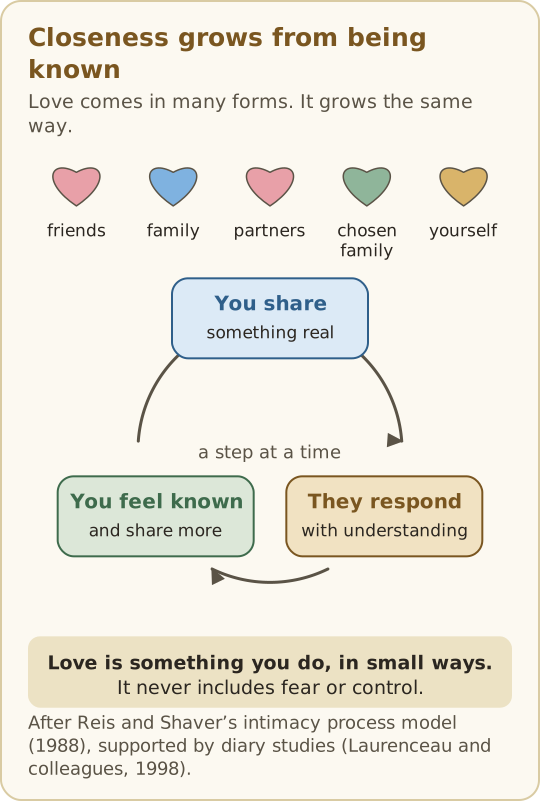
Closeness is built a step at a time
Closeness rarely arrives all at once. It tends to grow through a series of small risks: sharing a little more, and seeing what happens.
Psychology
Irwin Altman and Dalmas Taylor’s social penetration theory compared getting to know someone to peeling layers of an onion: from public facts, to opinions, to private hopes and fears. In a well-known study, Aron and colleagues (1997) paired up strangers and gave them a list of questions that became gradually more personal (now often called the “36 questions”). After about 45 minutes, these pairs felt closer than pairs who spent the time on small talk. The authors were clear that this created a temporary feeling of closeness in a lab, not a lasting relationship. But the principle, small, matched steps of sharing, applies to friendships and long relationships too.
Philosophy
Aristotle noted that the wish for friendship can come quickly, but friendship itself does not. He quoted a saying that people cannot know each other until they have “eaten salt together”: shared many meals, over a long time. Trust and closeness need time to be tested.
Through an autistic lens
For many autistic people, small talk is the hardest part of getting close: it feels pointless, tiring and full of hidden rules. Some find it easier to skip straight to a real topic, or to connect through a shared interest or activity. That can be a strength: deeper questions often build closeness faster. It helps to say what works: “I’m not great at small talk. Can I ask you about something I’m actually curious about?” See small talk and social scripts in Chapter 4.
Words you could use: “What’s something you’re looking forward to?” “What’s been on your mind lately?” “What was the best part of your week?”
Feeling understood matters most
What makes people feel loved? Often not grand gestures, but the steady sense that the other person sees them, gets them, and cares.
Psychology
Reis, Clark and Holmes (2004) proposed that perceived partner responsiveness, the sense that the other person understands, values and cares for you, sits at the heart of intimacy and closeness. It shows in small moments. Gable and colleagues (2004) found that when people shared good news, responses that were active and enthusiastic (“That’s amazing, tell me everything!”) were linked to more intimacy and satisfaction, while responses that were distracted, flat or deflating were not. Algoe, Gable and Maisel (2010) found that in couples, feeling grateful for a partner’s thoughtful act predicted feeling more connected the next day. See responsiveness and sharing good news in the library.
Philosophy
The French philosopher Simone Weil wrote in a letter that attention is the rarest and purest form of generosity. To really attend to another person, setting aside our own concerns for a moment to take in theirs, is one of the most loving things we can do. Many contemplative traditions treat this kind of attention as a practice that can be learned.
Through an autistic lens
Responsiveness doesn’t have to look a particular way. An autistic friend or partner may listen best without eye contact, while walking or doing something with their hands, and may show care by remembering every detail of what you said. Equally, an autistic person may need others to respond in clear words rather than looks or hints. Asking “How can I show you I’m listening?” helps both sides.
Words you could use: “Tell me everything!” “That sounds like it really mattered to you.” “How can I show you I’m listening?”
Old maps show up in love
The expectations we learned early about closeness, from Chapter 5, often come out most strongly with the people we love most.
Psychology
Hazan and Shaver (1987) proposed that adult romantic love uses the same attachment system as the bond between children and caregivers: we seek closeness, feel distress at separation, and use the other as a safe haven and a secure base. Later research, such as Fraley and colleagues (2015), suggests adult attachment is best described along two dimensions, anxiety about being left and discomfort with closeness, rather than as fixed types. The same patterns can appear in close friendships and family relationships. When someone higher in anxiety and someone higher in avoidance love each other, a common cycle is pursue and withdraw: one reaches harder, the other pulls further back. See When one talks and one goes quiet.
Philosophy
In Plato’s Symposium, the comic poet Aristophanes tells a myth: humans were once double beings, split in two by the gods, and love is the search for our missing half. It is a moving story, and it captures how complete a loved one can make us feel. Attachment research suggests a gentler version: we aren’t half-people, but we do feel safest, and most able to explore, when someone has our back.
Through an autistic lens
Some autistic behaviour is easily mistaken for attachment anxiety or avoidance. Checking plans may be about needing certainty, not fear of being left. Needing time alone after a busy day may be recovery from sensory or social load, not avoiding closeness. Saying what the behaviour is for (“I’m checking because certainty helps me relax,” “I need an hour to recharge, then I’m all yours”) can stop a misunderstanding before it starts.
Words you could use: “I’m feeling unsure of us. Can you tell me we’re okay?” “I need some space, and I’m coming back. Let’s talk at eight.”
Love changes over time
Early romantic love can be intense, all-consuming and full of longing. Many people fear that when this fades, love is ending. Often, it is only changing.
Psychology
A review by Acevedo and Aron (2009) looked at whether long-term relationships kill romantic love. They distinguished romantic love (intensity, engagement, desire) from the obsessive, anxious edge often found in new love. They concluded that romantic love without obsession can exist in long-term relationships, and that it was linked to greater satisfaction and wellbeing. Aron and Aron (1986) proposed the self-expansion model: people are drawn to relationships that help them grow, and closeness can fade when life together feels stale. In experiments by Aron and colleagues (2000), couples who did a new, mildly challenging activity together reported higher relationship quality afterwards than couples given a dull task. The same is likely true of friendships: shared new experiences keep them alive.
Philosophy
The psychoanalyst and social philosopher Erich Fromm, in The Art of Loving (1956), argued that love is an art that needs knowledge and practice, like any other. He contrasted the experience of “falling” in love with the lasting state of “standing” in love. Falling happens to us. Standing is something we keep choosing.
Through an autistic lens
For many autistic people, routine and predictability are a form of love: the same Sunday walk, the same goodnight message, the same café. Novelty can be stressful rather than exciting. Keeping love lively doesn’t have to mean big surprises. It can mean small new things chosen together, within a familiar frame: a new walk on the usual day, a new recipe at the usual dinner.
Thoughts you could try: “Calm isn’t the same as cold.” “What small new thing could we try, together?”
When you want different amounts of desire or closeness
In long relationships, it is very common for one person to want sex, or physical closeness in general, more often than the other. Desire goes up and down with stress, sleep, illness, pain, medicines, pregnancy and new babies, menopause, grief and age. Different levels of desire are a common reason couples look for help. Neither person is the problem. Wanting more isn’t greedy, and wanting less isn’t cold or broken.
A common trap looks like the pursue–withdraw pattern in Chapter 5. One person reaches out more and feels rejected. The other starts avoiding even a hug, in case it leads to pressure. Both end up lonely. What tends to help:
- Talk about it at a calm time, not in bed and not straight after a “no”. Start with what you both want: to feel close and wanted.
- Widen what counts as closeness. Touch that doesn’t have to lead anywhere, time alone together, and affection in words can ease the pressure on both sides.
- A kind “no” is not a rejection of the person, and a “yes” only counts if it is freely given. Nobody owes anybody sex. Pressure, guilt or sulking to get it does harm, even between people who love each other.
- Check the body. Pain, a sudden change, or problems with arousal are worth taking to a doctor first. Some medicines, including some antidepressants, can lower desire, and there are often other options.
- Get skilled help early. A qualified sex therapist or couples therapist works with exactly this, in a respectful, practical way. In the UK, COSRT (the College of Sexual and Relationship Therapists) lists accredited therapists, and Relate offers sex therapy. In the US, AASECT lists certified sex therapists. Elsewhere, a doctor can usually point you to one.
A made-up example. Orla and Rufus have two children under four. Rufus feels turned away most nights; Orla feels that every hug is a question. On a Sunday walk they each say one sentence about what they miss. They agree that hugs and a ten-minute sit-down after the children are asleep are just that, with nothing expected after. A month later, Orla says she feels less hunted and more like reaching out. They also book a few sessions with a couples therapist, to keep talking without it turning into a fight.
Words you could use: “I miss being close to you, and I don’t want you to feel pressured.” “Can we have hugs that don’t have to lead anywhere?” “I’m not saying no to you. I’m saying not tonight.”
If you are asexual, or one of you is, differences in desire can still be talked about and worked with. The FAQ below has more. This section is general education, not therapy or medical advice.
Love at every age
Love is part of every stage of life, and it looks different at each one.
Psychology
Laura Carstensen’s socioemotional selectivity theory, set out in Carstensen, Isaacowitz and Charles (1999), proposes that how much time we feel we have left shapes our goals. When the future feels wide open, as for many young people, we seek new information and new people. When time feels more limited, as for many older people (or anyone facing illness), we focus on fewer, more emotionally meaningful relationships. This helps explain why many older people have smaller social circles and say they are content with them. Love in later life is common and real: long marriages and friendships, new partners after loss, deep bonds with grandchildren. So is love in youth: first loves can be intense and formative, and deserve to be taken seriously.
Philosophy
The Roman statesman Cicero wrote two short works late in life, On Old Age and On Friendship. In the first, he argued that old age brings its own pleasures, including conversation and the company of friends. In the second, he described friendship as one of the greatest gifts life offers. Both were written as he faced loss and danger, and both are still read for comfort.
Through an autistic lens
For autistic adults diagnosed later in life, the diagnosis can change how they see past relationships: why some friendships were exhausting, why some partners misunderstood them, why they always loved in their own particular way. That can bring grief for what was missed, and also relief, and a clearer sense of what kind of closeness suits them now. It is never too late to build relationships that fit.
Thoughts you could try: “It’s never too late to be close to someone.” “Missing someone is a form of love too.”
Love is something you do
Feelings of love come and go, even in the strongest relationships. The actions of love can be steady.
Psychology
John Gottman’s research on “bids for connection” (small reaches like a comment, a question or a touch) found that partners who more often turned towards each other’s bids tended to feel more positive with each other, even in later disagreements, as in work by Driver and Gottman (2004). Small, ordinary acts add up: thank-yous, kept promises, remembering what matters to someone, asking about their day and listening to the answer. See Turning towards.
Physical closeness is part of love for many people: hugs, holding hands, sitting close, and for some relationships, sex. People differ a great deal in how much physical closeness they want, and that can change with age, health, stress and life stage. Neither more nor less is the right amount. What matters is that both people feel comfortable, free to say yes or no, and able to talk about it. Consent is always part of love.
Philosophy
The writer bell hooks, in All About Love (2000), argued that love is best understood as an action, not just a feeling, drawing on the psychiatrist M. Scott Peck’s definition of love as the will to extend oneself to nurture one’s own or another’s spiritual growth. She insisted that love and abuse cannot coexist. Fromm, too, described love as including care, responsibility, respect and knowledge: all things we do, not only things we feel.
Through an autistic lens
Touch can be complicated for autistic people: some love deep pressure hugs, some find light touch unpleasant, some need warning before being touched. Preferences can change from day to day depending on sensory load. Asking (“Hug?” “Is this okay?”) and offering choices (a hand on the shoulder or a wave) is caring for everyone, not only autistic people. Love that respects someone’s body is love that lasts.
Words you could use: “What makes you feel most loved by me?” “Hug, or not today?” “Is this okay for you?”
Our time-together deal
- Your name
- Jamal
- Their name
- Tess
- Game nights (or long phone time)
- Tuesday and Friday evenings, plus Sunday afternoon
- Heads-up rule
- Say before a session over an hour, and roughly when it ends.
- When one of us asks for time
- Finish this match, then I’m yours. No new one.
- Our protected evening
- Wednesday, from 7: we cook together
- Phone-free times
- Dinner, and the first 20 minutes in bed
- Chores before the session
- Dishes and our own jobs for the day are done first.
Your deal, ready to send
Our time-together deal (Jamal and Tess), with each line above. A link holds the deal as it is right now: if either of you changes something, send a new link.
A made-up example. Names and details are invented.
Fill in your own: Our time-together deal (spreadloveandacceptance.com/
Putting it together
Love takes many forms, and all of them count. Closeness grows from being known: sharing something real and meeting a response that leaves you feeling understood, accepted and cared for. It is built a step at a time, and kept alive by small, steady acts: attention, enthusiasm for each other’s good news, kept promises, new things tried together. Our old maps of closeness show up most with the people we love most. Love changes over time and across a life, and can deepen rather than fade. And love, whatever its form, never includes fear or control.
- Every kind of love counts. Friendship, family, partnership and chosen family.
- Be known, and let others be known. Share a little, and respond well.
- Attention is a gift. Put the phone down. Ask the second question.
- Calm isn’t cold. Long love changes. It doesn’t have to fade.
- Love is safe. If you’re afraid, it isn’t love that’s missing on your side. Get help.
Worked examples
Partners: alone on the same sofa
Back to the opening. The next Friday you leave both phones in the kitchen, make two cups of tea and ask: “What’s something you’ve been thinking about lately that you haven’t told me?” Charlie talks about their dad getting older and how scared they are of the phone ringing. You share a worry about work. It’s midnight before you notice. Nothing was fixed. You both feel known again. You agree to make it a Friday habit.
Friends: thirty years of Sundays
Two friends in their sixties have spoken every Sunday for thirty years. When one moves abroad, they keep the call, adjusting for time zones. “She knows me better than anyone,” one says. That is a great love, and it has never been romantic.
Siblings: the drive to the care home
Two brothers who mostly talk about football drive to visit their dad. One says, “I find these visits really hard.” The other says, “Me too.” They’ve never said anything like it before. On the way home, they stop for chips and talk for an hour.
Teenagers: a first relationship, and a first breakup
Ines is 16 and has been going out with someone from her year for five months. They message from the moment they wake up, and she has started to feel anxious when a reply takes an hour. Then, on a Tuesday night, it ends by message: “I think we should just be friends.” She cries until two in the morning. The next day, an adult says, “You’re young, you’ll get over it.” It doesn’t help. First heartbreak can hurt as much as any loss, because it is the first.
What helps her is ordinary and slow. She tells her older cousin, who listens without giving advice. She mutes their chats instead of reading them over and over, and makes one rule for herself: no checking their profile after ten at night. She doesn’t post about it. A few weeks later she notices she has gone a whole day without thinking about it. That is how it usually goes: in waves, getting further apart.
Words you could use, as a teenager: “I’m really sad about it. I don’t need advice, I just need to tell someone.” “Can we not talk about them for a bit?” If you’re the one ending it: “I don’t want to go out any more. I’m sorry. It isn’t about something you did wrong.”
In any relationship, at any age, you get to say no to things you don’t want to do or share, and so do they. Needing an instant reply all day can make love feel like a test. It’s fine to agree “we reply when we can”.
Later life: love after loss
Arthur, 78, meets Winifred at his walking group, three years after his wife died. His children are uneasy. He tells them, “I loved your mother for fifty years. I still do. And I’m allowed to be happy now.” Winifred comes to Sunday lunch. Slowly, the family makes room.
More than two partners: time for each
Petra has two partners, Ilan and Keiko. When life gets busy, Petra notices she’s been giving Keiko only tired evenings. They agree on one unhurried evening a week each, and one where all three cook together. See More than two.
On your own: love in many places
Nia, 45, has never wanted a partner. Her life is full of love: her nieces, her book group, her best friend, her dog. When people ask if she’s lonely, she sometimes is, like anyone. Mostly, she’s not. She keeps tending the loves she has.
An autistic couple: pebbles and routines
Two autistic partners rarely say “I love you.” Instead, one sends the other photos of interesting bridges every day, and the other keeps a perfect, quiet routine on Sunday mornings so they can both rest. Each knows exactly what the other’s pebbles mean.
Exercises
- Your map of love. Draw yourself in the middle of a page. Add everyone you love, in any form, with how each of you shows it.
- One true thing. Share one small, true thing with someone this week: a worry, a hope or a happy moment. Notice how it feels.
- The second question. When someone tells you something, ask a second, curious question before you share your own.
- Celebrate good news. For a week, respond to every bit of good news with real enthusiasm and a follow-up question.
- Something new together. Plan one small new thing with someone you love: new to both of you.
- Ask about care. Ask someone: “What’s one small thing that makes you feel cared for?” Then do it.
- The Friday question. Once a week, phones away, ask: “What’s on your mind that you haven’t told me?” (This site’s idea)
When it goes wrong, and when it goes right
When it goes wrong, people drift into talking only about jobs and logistics. Bids for attention are missed. Good news meets a flat “nice.” One person reaches harder while the other pulls away. Early excitement fades and both decide love has gone. Sometimes, “love” is used to excuse jealousy, checking and control.
When it goes right, people keep turning towards each other in small ways. They share a little of themselves and respond with care. They celebrate each other’s good news. They name their patterns and agree what helps. They try new things together. Love takes many forms in their lives, and every form is treated as real. And everyone feels safe.
Helping someone else
If someone you care about feels lonely, unloved or distant from the people they love, the most useful things are often simple. Be a person they can tell things to, and respond with warmth. Don’t assume everyone wants a partner, or one kind of relationship. After a breakup or a loss, keep showing up, especially after the first few weeks, when many people drift away. If you’re worried that their relationship is controlling or frightening, stay close and kind, avoid criticising their partner, and gently share Not safe at home?
Words you could use: “I’m always glad to hear from you.” “You don’t have to explain your relationship to me. I just want you to be happy and safe.”
Questions people often ask
Is it normal for the spark to fade?
Yes, the early, anxious intensity of new love usually settles. That doesn’t mean love is ending. Acevedo and Aron (2009) found that strong romantic love without the obsessive edge can last in long relationships. Shared new experiences and steady attention help.
Can you love someone and not like them very much at the moment?
Yes. Love and liking can come apart for a while, especially in families and long relationships, and during stress. If it lasts, or you feel unsafe, it’s worth talking to someone.
I’m asexual. Can I have a deep relationship?
Yes. Deep, committed, loving relationships don’t need sex. Many asexual people have close partners, friendships and families. What matters is that the relationship suits everyone in it.
Are the 36 questions a way to make someone fall in love?
Not really. Aron and colleagues (1997) used them to create a temporary feeling of closeness between strangers in a lab. They can be a lovely way to get to know someone better, but they aren’t a love spell.
We want different amounts of closeness. Is that a problem?
It’s very common. It helps to talk about it without blame, notice what each of you needs (time, words, touch, space), and look for arrangements that suit you both. A counsellor can help if you feel stuck. For differences in sexual desire, see When you want different amounts of desire or closeness.
Is jealousy a sign of love?
Feeling jealous sometimes is human, and asking for something out of care for the relationship, like not flirting with an ex, is not control. But checking someone’s phone without agreement, controlling who they see or punishing them for time apart is not love. Those take away someone’s freedom. See signs to look out for.
I’m older and lonely. Is it too late?
No. People find friendship and love at every age. Small steps, like a regular group, class or volunteering, often lead to the closest connections. See Grief and later life and On my own.
Limits, safety and more help
- This chapter is general education. It isn’t couples therapy, sex therapy or a diagnosis.
- Much research on love has focused on young, heterosexual, Western couples. Love looks different across cultures, ages and relationship types.
- If you feel lonely or low most days for two weeks or more, please talk to a doctor or counsellor.
- If someone you love controls you, frightens you, checks on you, cuts you off from others or pressures you into anything you don’t want, that isn’t love. Not safe at home? lists free, private help.
- If you’re in danger now, call your local emergency number. Upset right now? can help you take the first step.
The library’s relationships and connection pages have more on each idea.
Last updated: October 2026