Part Three · Chapter 15
Closeness and love: being known, at every age
How closeness grows, what it means to feel truly known, how love changes over the years, and how it looks in every kind of relationship, at every age, including for people on their own.
In short:
- Love comes in many forms. Friends, family, partners, chosen family and the love you give yourself are all real love.
- Closeness grows from being known. You share something real, and the other person responds with understanding and care.
- Love changes over time. Early excitement often settles, and long love can stay warm, close and even exciting.
- Love is something you do, in small ways, every day. It never includes fear or control.
Why the tools work: this chapter explains the thinking behind these tools from earlier in the book.
- The 90-second daily check-in (Part Two, Chapter I) has an appreciation line, because closeness grows from small, frequent moments of being seen and known.
- Who did what (the Preface to Part Two) matters for love too: work one person never sees slowly wears closeness down. Big idea: see the whole load.
Friday, 10:30pm
You and Charlie have shared a home for eleven years. Tonight you’re both on the sofa, both on your phones. You realise you can’t remember the last time you talked about anything except bills, the boiler and whose turn it is to cook. You love Charlie. You just feel, oddly, a little alone in the same room.
This chapter isn’t only about romance. It’s about closeness in all its forms: what helps people feel near to each other, why it can fade, and how it can grow again. It builds on Chapter 5, on attachment and trust.
-
Love comes in many forms.
The ancient Greeks had several words for love: for friends, for family, for romantic partners and for strangers. Today people love in many ways too: lifelong friendships, partners of any gender, people with more than one partner, chosen family, people who are asexual or aromantic and build deep closeness without romance or sex, and people on their own who pour love into friends, family, pets, work and community. No form is the “real” one. A life can be full of love without a partner in it.
For example: A woman in her fifties who has never wanted a partner says her closest relationship is with her best friend of thirty years. They’ve been through two house moves, one cancer scare and countless Sunday phone calls. “That’s my great love story,” she says.
Thoughts you could try: “Who are the people I love, in all the forms it takes?” “The love I have counts, even if it doesn’t look like a film.”
Try this: Write down three people (or more) you love, of any kind. Next to each, write one way you show it.
Dig deeper: the many forms of love -
Closeness grows from being known.
Intimacy isn’t only about touch or romance. At its heart is being known. Psychologists Reis and Shaver described it as a back-and-forth: one person shares something real about themselves, and the other responds in a way that leaves them feeling understood, accepted and cared for. In a diary study by Laurenceau, Barrett and Pietromonaco (1998), feeling that the other person really responded was a big part of what made everyday conversations feel intimate.
For example: Two brothers who talk mainly about football are driving to their dad’s care home. One says, “I find these visits really hard.” The other says, “Me too. I always feel guilty on the way home.” They’ve never felt closer.
Words you could use: “Can I tell you something I haven’t said out loud before?” “Thank you for telling me. That makes sense.”
Try this: Share one small, true thing with someone you care about: a worry, a hope, or something that made you happy this week. Then notice how they respond.
Dig deeper: intimacy as being known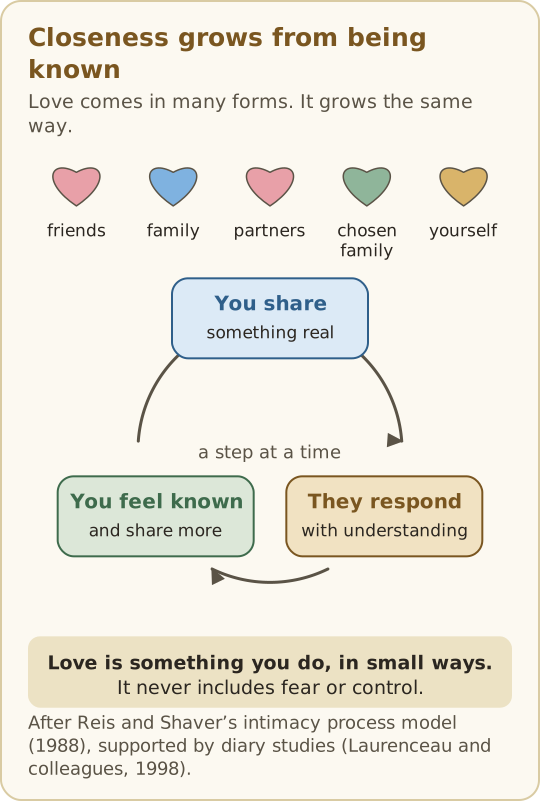
Figure 36 Closeness grows from being known: you share something real, the other person responds with understanding, and you share a little more. -
Closeness is built a step at a time.
People usually get close by sharing a little more, and a little more, when it feels safe. In a well-known study by Aron and colleagues (1997), pairs of strangers who took turns asking gradually more personal questions (now known as the “36 questions”) felt closer after 45 minutes than pairs who made small talk. The same idea works in friendships and long relationships: closeness grows when both people take small, matched steps.
For example: Two new neighbours start with weather and parking. Over a few months, it becomes “How’s your mum doing?” and later, “Can I tell you what’s really been going on?” Neither rushed it.
Words you could use: “What’s something you’re looking forward to?” “What’s been on your mind lately?” “What was the best part of your week?”
Try this: Ask someone one question a little deeper than usual. If they answer, share something of your own back.
Dig deeper: building closeness step by step -
Feeling understood matters most.
What makes someone feel loved is often less about grand gestures and more about feeling understood. Researchers call this responsiveness: noticing, understanding and caring about what matters to the other person. It shows in small moments, like how you react to good news. Gable and colleagues (2004) found that people whose partners usually met their good news with real interest and warmth felt closer and more satisfied together.
For example: A teenager says, “I got picked for the band!” Her grandad stops what he’s doing, smiles, and asks, “What instrument? When’s the first concert?” She talks for twenty minutes.
Words you could use: “Tell me everything!” “That sounds like it really mattered to you.” “What was that like?”
Try this: The next time someone shares good news, put your phone down and ask two follow-up questions.
Dig deeper: responsiveness -
Old maps show up in love.
The patterns from Chapter 5 often come out most strongly with the people we love most. Hazan and Shaver (1987) suggested that adult love uses the same attachment system as childhood bonds. When closeness feels shaky, some people reach harder for reassurance; others pull back to feel safe. Neither is bad. Both are ways of protecting something precious.
For example: When his partner goes quiet, Leo texts five times in an hour. His partner, who goes quiet to calm down, feels crowded. They agree: “I need an hour, and I’ll message you at eight.” Leo can wait for a known time.
Words you could use: “I’m feeling unsure of us right now. Can you tell me we’re okay?” “I need some space, and I’m coming back. Let’s talk at eight.”
Try this: Notice what you do when closeness feels shaky: reach out, pull back, or both. Tell someone you trust what helps you feel safe again.
Dig deeper: attachment in adult love -
Love changes over time.
Early love is often intense, with racing thoughts and a lot of longing. Over years, it usually settles into something calmer and deeper. That isn’t failure. A review by Acevedo and Aron (2009) found that some people in long relationships still report strong romantic love, without the anxious, obsessive edge of early love, and that this was linked to being happier together.
In experiments by Aron and colleagues (2000), couples who tried a new, mildly challenging activity together felt better about their relationship afterwards than couples given a dull task.
For example: After twenty-five years, a couple take a pottery class. They’re both terrible at it and laugh all evening. On the way home, one says, “I feel like we’re on a date.”
Thoughts you could try: “Calm isn’t the same as cold.” “What could we try that’s new for both of us?”
Try this: Plan one small new thing with someone you love: a new walk, a new recipe, a new place. New for both of you matters more than big.
Dig deeper: how love changes -
Love at every age.
Love looks different across a life. Teenagers’ first loves can be huge and real. Adults juggle love with work, children and caring for parents. Many older people choose to spend their time with fewer, closer people. Carstensen and colleagues (1999) linked this to feeling that time is more limited, which makes the most meaningful relationships matter more. People find new love at seventy and eighty. People lose great loves and carry them always. All of it counts.
For example: A widower of seventy-eight meets a woman at his walking group. His children are surprised. He says, “I loved your mother for fifty years. I still do. And I’m allowed to be happy now.”
Thoughts you could try: “It’s never too late to be close to someone.” “Missing someone is a form of love too.”
Try this: Reach out to someone from another generation this week: an older relative, a younger neighbour or a colleague. Ask them about love in their life, if it feels right.
Dig deeper: love across the lifespan -
Love is something you do.
Feelings of love come and go. The actions of love can be steady: turning towards someone when they speak, keeping small promises, saying thank you, saying sorry, making room for who they are. Physical closeness, like a hug or holding hands, matters a lot to some people and less to others, and sex is part of closeness for some relationships and not others. What matters is that both people feel comfortable and free to say yes or no. Love never includes fear, threats or control.
For example: A friend notices her friend has been quiet since his divorce. She doesn’t say “I love you,” but every Thursday she texts, “Walk?” and turns up. That is love too.
Words you could use: “What makes you feel most loved by me?” “Is this okay for you?” “I noticed you’ve been quiet. I’m here.”
Try this: Ask someone you love, “What’s one small thing that makes you feel cared for?” Then do it this week.
Dig deeper: love as actionFilled-in example Our time-together deal Jamal and Tess, a couple; Jamal games most evenings Our time-together deal
- Your name
- Jamal
- Their name
- Tess
- Game nights (or long phone time)
- Tuesday and Friday evenings, plus Sunday afternoon
- Heads-up rule
- Say before a session over an hour, and roughly when it ends.
- When one of us asks for time
- Finish this match, then I’m yours. No new one.
- Our protected evening
- Wednesday, from 7: we cook together
- Phone-free times
- Dinner, and the first 20 minutes in bed
- Chores before the session
- Dishes and our own jobs for the day are done first.
Your deal, ready to send
Our time-together deal (Jamal and Tess), with each line above. A link holds the deal as it is right now: if either of you changes something, send a new link.
A made-up example. Names and details are invented.
Fill in your own: Our time-together deal (spreadloveandacceptance.com/
gaming-and-time-together)
The next Friday, 10:30pm
This time you leave both phones in the kitchen. You make two cups of tea and ask, “What’s something you’ve been thinking about lately that you haven’t told me?” Charlie is quiet for a moment, then talks about their dad getting older, and how scared they are of the phone ringing. You listen, and share your own worry about work. It’s midnight before you notice the time. Nothing big was fixed. But you both feel known again.
If you’re a teenager
First love can be huge and real. So can a first breakup. A made-up example: Ines, 16, is dumped by message on a Tuesday night and cries until 2am. “You’ll get over it” from an adult doesn’t help. What does: telling her cousin, who just listens; muting the chat instead of rereading it; and a rule of no checking their profile after ten. Weeks later she notices a whole day without thinking about it.
Words you could use: “I don’t need advice, I just need to tell someone.” “Can we reply when we can, not all day?” If you’re ending it: “I don’t want to go out any more. I’m sorry. It isn’t about something you did wrong.”
Dig deeper: more worked examplesIn everyday life
On your own
Being single, widowed, divorced or happily alone doesn’t mean a life without love. Friendships, family, community and the way you treat yourself are all places where love lives. If you want a partner and don’t have one, that longing is real and worth being gentle with. See On my own and Grief and later life.
- Partners: Most partners drift into talking only about jobs and bills. One real question a week can bring you back. See Turning towards and Check-ins.
- More than two partners: Closeness with each person needs its own time and attention. See More than two.
- Friends: Friendship is love too, and it needs tending like any other. See Friends.
- Family: Parents, children, siblings and grandparents often love each other deeply and say it rarely. A short “I’m glad you’re my sister” can mean a lot.
- Long distance: Being known can still happen across miles, through small, regular check-ins. See Long distance.
- Different levels of desire: Very common in long relationships, and nobody’s fault. Talk at a calm time, keep some affection that doesn’t have to lead anywhere, and remember a kind “no” isn’t a rejection of the person. A qualified sex therapist or couples therapist can help. More in the full chapter.
Common mix-ups
- “Real love means a romantic partner.” Friendship, family and chosen family are real love.
- “If the spark fades, love is over.” Early intensity usually settles. Many long relationships stay warm, close and lively.
- “If they loved me, they’d just know what I need.” Nobody reads minds. Saying what helps is a gift, not a failure.
- “Jealousy proves love.” Feeling jealous is human, and asking for something out of care for the relationship is not control. Checking up without agreement, cutting someone off or punishing them is not love. See signs to look out for.
- “Intimacy means sex.” Intimacy means being known. It can include physical closeness, or not.
- “Love should be effortless.” Love usually takes small, steady effort, and that effort is part of what love is.
If you want to help someone else with this
- Respect their kind of love. Don’t assume everyone wants a partner, children or one kind of relationship.
- Be a safe person to tell things to. Listen without judging, and keep what they share private.
- After a loss or breakup, keep showing up. Many people get lots of support for two weeks and then very little.
- If you’re worried about someone’s relationship, stay close and kind rather than criticising their partner. If they seem afraid, gently share Not safe at home?
Words you could use: “I’m always glad to hear from you.” “You don’t have to explain your relationship to me. I just want you to be happy and safe.”
When to get more help
- If you feel very lonely or low most days for two weeks or more, talk to a doctor or counsellor.
- If closeness feels frightening, or you keep ending up in relationships that hurt you, a counsellor or therapist can help you understand why.
- Couples, family or relationship counselling can help when you feel stuck, distant or keep having the same fight.
- If someone you love controls you, frightens you, checks your phone, cuts you off from friends or pressures you into anything you don’t want, that isn’t love. Not safe at home? lists free, private help.
- If you’re in danger now, call your local emergency number. Upset right now? can help you take the first step.
This chapter is general education, not therapy.
Reading on this site
Reading pages to read on the site
- Bonding: how closeness grows: what research says about closeness, with small ideas for partners, kids, friends, family and you.
- Turning towards: small daily moments of connection.
- The languages of connection: the different ways people show care.
- Complacency: why good things fade, and how to keep them alive.
- The library: responsiveness, love maps, self-expansion, adult attachment and sharing good news.
More for your situation
- Part Three, Chapter 5: Attachment, trust and belonging
- Friends · More than two · Long distance
- Coming out as an adult
- On my own · Grief and later life
- Retired together · Empty nest
- Help by relationship: find the pages for your situation.
Last updated: October 2026