Part Three · Chapter 14
Personality, temperament and change across life
What personality is, where temperament comes in, how people change across their lives, and how to live and work with people who are made differently from you, without putting anyone in a box.
In short:
- Traits are dials, not boxes. Everyone sits somewhere along each one, and most people are near the middle.
- Temperament is a starting point. Babies already differ in how active, cautious or easily upset they are. What happens next matters too.
- People keep changing. On average, people grow steadier and more organised as they get older, and you can change on purpose, slowly.
- Different isn’t wrong. Most clashes between personalities are about fit, not fault.
Why the tools work: this chapter explains the thinking behind these tools from earlier in the book.
- The “How to talk to me” card and the style quiz (Part One, Now) describe how you lean on a few dials, not which box you are in. Most clashes are about fit, not fault.
- One owner per job (Part Two, Chapter IV) lets people with different temperaments share a home or team without changing who they are: you arrange the jobs around the differences. Big idea: fix the setup, not the person.
Saturday, 3:00pm
It’s your aunt’s seventieth birthday. You’re standing quietly by the cake when she says, loud enough for everyone: “Oh, you were always the shy one!” Everyone laughs. You smile, but something stings. You’re forty-two. You teach thirty children every day. Are you still “the shy one”? Were you ever?
We all describe people by their personality: “She’s so laid-back,” “He’s a worrier,” “They’re the organised one.” Descriptions like these can turn into boxes. This chapter looks at how personality actually works, what stays the same, and what changes.
-
Traits are dials, not boxes.
Personality is your usual pattern of thinking, feeling and acting. Many psychologists describe it with five broad traits, often called the “Big Five”: openness (curious about new ideas and experiences), conscientiousness (organised and careful), extraversion (drawn to people and busy places), agreeableness (warm and cooperative) and emotional stability (how steady your moods are).
The same five turned up in work such as McCrae and Costa (1987), whether people rated themselves or were rated by people who knew them. Each one is a dial, not a switch. Most people sit somewhere in the middle of most dials.
For example: Two friends take a quiz. One gets “introvert,” the other “extravert.” When they look at their actual scores, they are only a few points apart, both near the middle.
Thoughts you could try: “I’m more of this than that, some of the time.” “A label is a summary, not a whole person.”
Try this: For each of the five dials, mark where you think you sit, from one to ten. Then ask: where would a close friend put you?
Dig deeper: the five dials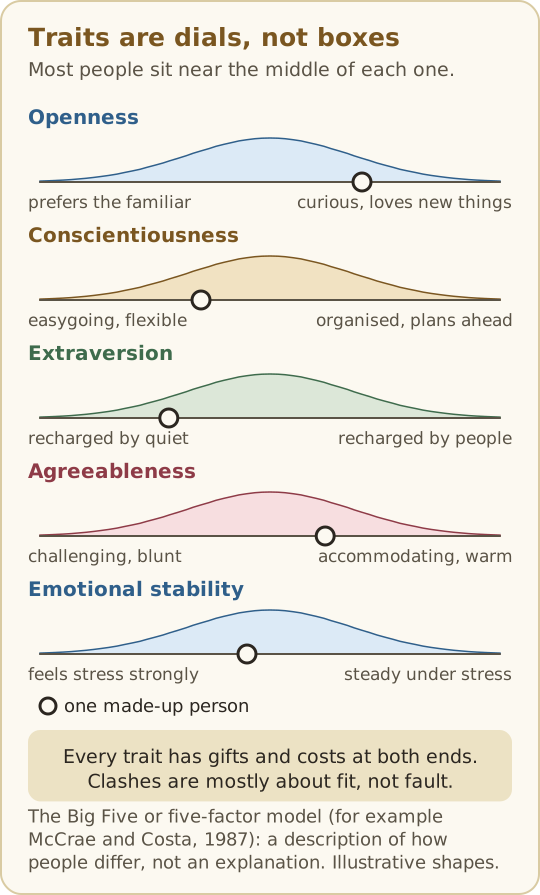
Figure 35 Traits are dials, not boxes: most people sit near the middle of each. Illustrative shapes. -
Temperament is the starting point.
Temperament is the part of personality we can see from very early on. Some babies are very active, some calm; some settle easily into new routines, others take time; some react strongly to noise or change. In their long-running study, Thomas and Chess (1977) described these early differences, and the idea of “goodness of fit”: how well a child’s temperament fits what the people and places around them expect.
For example: A slow-to-warm-up toddler cries at every new playgroup. Her mum stops pushing her to join in straight away and lets her watch from her lap for ten minutes first. By the third week, she joins in on her own.
Words you could use: “You like to watch first. That’s fine. Join in when you’re ready.” (to yourself) “I need time to warm up. That’s how I’m made, not a flaw.”
Try this: Think about what you were like as a small child, from what family say or what you remember. What seems the same now? What seems different?
Dig deeper: temperament and fit -
Situations matter too.
Personality is a pattern, not a rule. The same person can be loud with family and quiet at work, organised in their job and messy at home, patient with children and short with call centres. A trait tells you what someone tends to do across many situations, not what they will do in this one.
For example: A manager thinks a new colleague is “cold.” At the team’s charity football match, the same colleague is chatty, funny and warm. The office was the thing that was quiet, not him.
Thoughts you could try: “I’ve only seen them in one setting.” “Where am I most myself, and where am I least?”
Try this: Before deciding what someone is “like,” try to see them in one different setting, or ask them about one.
Dig deeper: person and situation -
Introvert and extravert is about energy, not liking people.
People who are more introverted often enjoy people very much, but find busy, noisy social time uses up energy, and need quiet to recover. People who are more extraverted often feel energised by company and busy places. Most of us are a mix (sometimes called ambivert). Neither is better. They just need different things to feel at their best.
For example: After a wedding, one partner wants to go on to the after-party; the other wants bed and silence. They agree: one goes for an hour, the other goes home, and they have breakfast together.
Words you could use: “I loved tonight, and I’m out of social energy. It’s not about you.” “Shall we go together, and I’ll head home at ten?”
Try this: Notice what refills you after a busy week: company, quiet, or a bit of both. Plan one of those this weekend.
Dig deeper: introversion and extraversion -
People change across life.
Personality is fairly stable, but it isn’t fixed. A large review by Roberts, Walton and Viechtbauer (2006) found that, on average, people become more organised, more emotionally steady and more confident with others as they move through adult life, with much of the change between 20 and 40. A later review by Bleidorn and colleagues (2022) found that emotional steadiness kept growing right across the lifespan. Big life events, roles and relationships all play a part.
For example: A man who was a nervous, disorganised student becomes a calm, steady nurse in his forties. His friends from school barely recognise him. He says, “Life kept asking me to cope, and slowly I learned how.”
Thoughts you could try: “Who I was at fifteen isn’t who I have to be now.” “People I knew years ago may have changed too.”
Try this: Write down one way you have changed in the last ten years. What helped it happen?
Dig deeper: how personality changes with age -
You can change on purpose, a little at a time.
People who want to change a trait can, slowly, mostly by acting differently in small ways, again and again. In a study by Hudson and Fraley (2015), people who set goals to change one of their traits tended, over sixteen weeks, to change in the direction they wanted. A review by Roberts and colleagues (2017) found that therapy was often linked to lasting change too, especially towards more emotional steadiness.
For example: A woman who wants to be less shy at work makes one small plan: say one thing in each team meeting. After two months, speaking up feels ordinary.
Thoughts you could try: “I don’t have to become a different person. I can practise one different thing.”
Try this: Pick one small action that fits who you’d like to be more of, like “reply to messages the same day” or “say hello first.” Do it three times this week. See Chapter 6 on habits.
Dig deeper: changing on purpose -
Every trait has gifts and costs.
There isn’t a “good” personality. Each trait helps in some places and gets in the way in others. Very agreeable people are kind and easy to be with, and may find it hard to say no. Very conscientious people are reliable, and may struggle to rest. People high in openness love new things, and may get bored with routine. Knowing your mix helps you use the gifts and plan for the costs.
For example: A highly organised woman feels irritated by her relaxed housemate. Then the boiler breaks, and the housemate is the one who stays calm and finds a plumber at 10pm. She starts to see his calm as a strength.
Thoughts you could try: “What is the gift in this trait, and what is the cost?” “What they do that annoys me might be the flip side of something I value.”
Try this: Pick one trait of yours that people sometimes complain about. Write down one time it helped.
Dig deeper: gifts and costs -
Differences are about fit, not fault.
When two people with different personalities share a home, a family or a job, friction is normal. A tidy person and a relaxed one, a planner and someone spontaneous, a talker and someone who needs quiet: neither is wrong. What helps is naming the difference and agreeing how to live with it. Personality is also different from neurodivergence and from mental health conditions. If something feels bigger than personality, Chapter 9 may help.
For example: A couple fight about holidays: one wants every hour planned, the other wants to wander. They agree on one plan for the morning and a free afternoon. They both enjoy it more.
Words you could use: “I think we’re just made differently here. What would work for both of us?” “I’m a planner and you’re not. Can we plan half and leave half?”
Try this: Think of one person you clash with. Name the difference without blame: “I like ___; they like ___.” Then think of one small arrangement that would suit you both.
Dig deeper: fit, not faultFilled-in example How you connect: the style quiz Mo, before moving in with his friend Callum The style quiz: just my Wave Code
Twelve quick either/or taps, about two minutes.
- Your first name (optional)
- Mo
Someone asks you a big question. You…
- Answer right away and figure it out as I talk
- Chosen: Need a moment, or a day, to think first
A sudden change of plans feels…
- Chosen: Fine, maybe even fun
- Jarring. I need a heads-up or a transition
Starting something new, you want…
- Chosen: The why and the big vision
- The first concrete step
When something bothers you, you usually…
- Say it plainly so we can fix it
- Chosen: Hint at it, or wait for the right moment
Someone says “I’m fine.” You…
- Believe them. Fine means fine
- Chosen: Check their tone to see if they really are
…and seven more like these.
Mo’s four leanings (his Wave Code: S F N A)
- What each letter means
- Pace: leans Slow Simmer (S, not Quick Spark) · Lens: leans Forest (F, not Trees) · Sending: leans Nuanced (N, not Direct) · Receiving: strongly Attuned (A, not Explicit)
- The nickname the tool gives it: the Willow
- Reflective and soft-spoken. Feels the undercurrents of every room.
- Watch for
- agreeing in the moment just to fill the silence; your real needs getting lost in the cushioning.
Mo’s style-quiz statement: “About how I’m wired: I think first and talk second, I tend to hint rather than say it straight, I see the big picture first, and I like to take my time.”
A made-up example. Names and details are invented. A Wave Code is shorthand for four preferences, each a lean along a dial, not a type or a box. “Leans” means near the middle. Answers can change with the day, the setting and the person you’re with.
Fill in your own: How you connect (spreadloveandacceptance.com/
wavelength)
Saturday, 5:30pm
Later, as people are leaving, you sit down next to your aunt. “I was the shy one, wasn’t I,” you say. “I still like quiet. These days I stand in front of thirty children every morning.” She laughs. “Well, I was a terror at your age, and look at me now: I do flower arranging.” You both laugh. You were never just “the shy one.” Neither of you is who you were at ten, and that’s fine.
In everyday life
On your own
Knowing your own mix helps you plan a life that suits you: how much company, how much quiet, how much routine, how much new. “I’m just not a people person” might be true, or an old label worth testing.
- With a partner: Different traits are normal. A shared plan (“I’ll handle bills; you handle holidays”) often works better than trying to change each other. See When we keep having the same fight.
- With friends: A quiet friend who doesn’t text much may still care a great deal. Ask what kind of contact suits them. See Friends.
- Parents and children: A child’s temperament isn’t a sign of good or bad parenting. Adjusting to fit them is a skill, not giving in. See For parents.
- Family: Family roles (“the clever one,” “the difficult one”) can stick long after they stop fitting. You’re allowed to grow out of them.
- At work: Teams need a mix. Ask “How do you like to work?” rather than guessing from a quiz. See At work.
Common mix-ups
- “You’re either an introvert or an extravert.” Most people are somewhere in the middle, and it can shift with setting and mood.
- “Personality is set by adulthood.” It keeps changing, slowly, across the whole of life.
- “Some personalities are better.” Every trait has gifts and costs. What matters is fit and how you use it.
- “Online type quizzes tell you who you are.” Many popular quizzes sort people into a handful of types. Real people are spread along each dial, not sorted into groups. Use quizzes for fun and conversation, not as a label. That includes this site’s own Wave Code: four leanings on four dials, not a box.
- “They’re just difficult.” “Difficult” often means “different from me.” It can also hide stress, illness or a need nobody has asked about.
- “Changing would mean being fake.” Practising something new feels unnatural at first. Over time, it becomes part of you.
If you want to help someone else with this
- Drop the old labels. Notice if you still describe someone the way they were years ago, and look for who they are now.
- Ask, don’t type. “What helps you recharge?” or “How do you like to plan things?” beats guessing from their personality.
- Notice growth out loud. “You handled that so calmly” can help someone see a change they hadn’t noticed.
- Don’t use personality as a weapon. “You’re so uptight” or “You’re just lazy” closes doors. Describe the action, not the person.
Words you could use: “I used to think of you as the shy one. I don’t think that fits any more.” “What do you need to be at your best this week?”
When to get more help
Personality differences are normal and don’t need fixing. It may be worth talking to a doctor, counsellor or psychologist if:
- a pattern in how you feel, think or relate to people keeps causing you or others real distress, across many parts of life;
- you feel very unsure who you are, or your moods swing so much it’s hard to cope;
- worry, low mood or fear of people is stopping you from living the life you want.
Please don’t diagnose yourself or anyone else with a “personality disorder” from what you read online. Those are clinical terms that only a qualified professional can use, after a proper assessment.
A personality trait never excuses controlling, frightening or hurtful behaviour. If you’re afraid of someone close to you, Not safe at home? lists free, private help.
This chapter is general education, not a diagnosis or therapy.
Tools and reading on this site
Tools helpers you use on the site
- How you connect: four quick dials for how you think, talk and listen. Its four-letter Wave Code is shorthand for four preferences, not a type.
- Communication style quiz.
Reading pages to read on the site
- Know your own wiring: how you tend to feel, react and recharge.
- The library: the Big Five, introversion, morning and evening people and highly sensitive people.
More for your situation
- Part One, Now: your wiring, your weather and your words
- Part Three, Chapter 6: Habits and change
- Part Three, Chapter 9: Minds that work differently
- For parents · For teens · For grandparents
- Sharing a room · At work
- Help by relationship: find the pages for your situation.
Last updated: October 2026