Part Three · Chapter 9
Minds that work differently
How autistic, ADHD, sensory and learning differences work, why they are differences and not character flaws, and how people with different minds can meet in the middle.
In short:
- Brains vary, like bodies do. Different isn’t broken, and differences can still be disabling in a world built for one kind of mind.
- Overload isn’t a choice. Meltdowns, shutdowns and burnout are what happens when a nervous system has had too much.
- Some things help a lot: less masking, room to stim, time for deep interests, and real rest.
- Meet in the middle, out loud. Ask what helps, say what helps you, and use the words each person chooses.
Why the tools work: this chapter explains the thinking behind these tools from earlier in the book.
- The “How to talk to me” card and “know how you like to be spoken to” (Part One, Now) work because different minds need different input. Saying things plainly is an adjustment that helps almost everyone. Big idea: tune how you send and receive.
- One owner per job and the written job list (Part Two, Chapter IV) move memory out of anyone’s head and onto paper. That helps ADHD and autistic minds most, and everyone a little. Big idea: fix the setup, not the person.
Monday, 8:15am
“Can you just put your shoes on?” For the third time. Your child is lying on the hall floor, hands over his ears, because the new socks “feel wrong.” You’re late. He’s not being difficult. To him, the sock seam feels like sandpaper, and the alarm clock is still ringing in his head.
This chapter is for anyone: neurodivergent people, diagnosed or not, and the people who live, work and learn with them. It explains how these minds work first, then what helps. It can’t diagnose anyone, and only you get to choose the labels you use for yourself.
-
Brains vary, like bodies do.
People’s brains differ in how they take in the world, focus, move, read, remember and connect with others. “Neurodiversity” is the idea that this variety is natural. “Neurodivergent” describes people whose minds work differently from what is treated as typical. Different isn’t broken. And at the same time, differences can be disabling, especially when the world is built for one kind of mind.
For example: A man who struggled all through school finds out at 40 that he is dyslexic. He’s relieved: he was never lazy or stupid. His brain just processes written words differently.
Thoughts you could try: “Maybe this isn’t a flaw. Maybe it’s a difference that needs a different setup.”
Try this: Think of one thing that’s hard for you that’s easy for others. Ask: is it effort, or is it a different kind of brain?
Dig deeper: neurodiversity and disability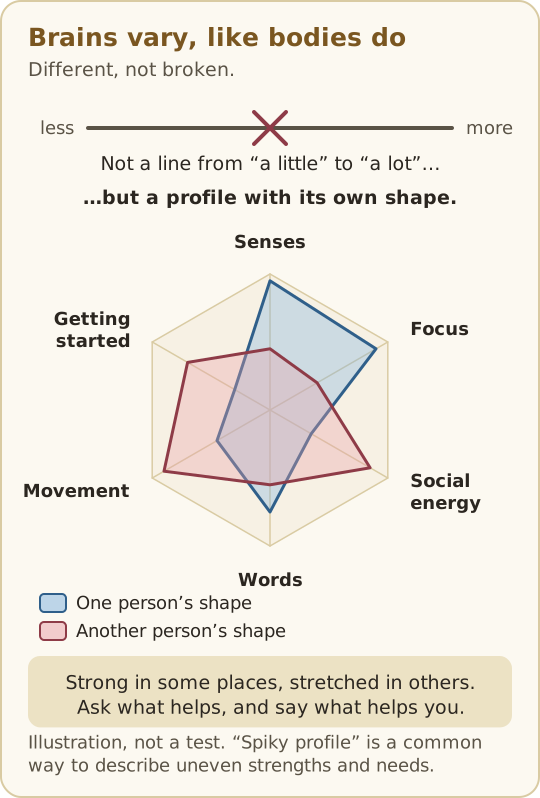
Figure 30 Brains vary, like bodies do. A mind has a profile with its own shape, not a place on a line from “a little” to “a lot”. Different, not broken. -
Autism is a different way of sensing and connecting.
Autistic people often communicate more directly and literally, have deep and focused interests, feel senses more (or less) intensely, and find predictability calming. Autism isn’t a line from “mild” to “severe.” Each autistic person has their own mix of strengths and needs, which can change day to day. Misunderstandings between autistic and non-autistic people usually run both ways.
For example: An autistic coworker says, “Your slides have three typos.” She means it as help. Her colleague hears criticism. Neither is wrong; they’re using different rules for what kind means.
Words you could use: “I like it when people say exactly what they mean. You can be direct with me.” “Do you want my honest view, or just support right now?”
Try this: In one conversation today, say exactly what you mean, with no hints. Notice whether it makes things easier.
Dig deeper: autism and the double empathy problem -
ADHD is about steering attention, not lacking it.
People with ADHD often have plenty of attention, but find it hard to point it where they choose. Boring tasks can feel impossible; interesting ones can swallow hours. Time can feel slippery (“now” and “not now”), and feelings can come fast and big. It’s a real difference in how the brain manages itself, not a lack of effort or care.
For example: A woman with ADHD forgets her friend’s birthday, then spends six hours making her an amazing handmade card. The forgetting and the focus come from the same brain.
Words you could use: “I care about this. My brain drops things. A reminder really helps, and it doesn’t annoy me.”
Try this: Move one thing you keep forgetting out of your head and into the world: an alarm, a note on the door, or a basket by the exit.
Dig deeper: ADHD, time and motivation -
Everyone has a sensory profile.
We all take in sound, light, touch, smell, taste, movement and signals from inside the body. Some people feel these strongly and get overloaded by noise or scratchy clothes. Others need more input: movement, strong flavours, pressure. Overload isn’t being fussy. It’s a body at its limit.
For example: Two housemates argue about the kitchen radio. One finds silence eerie; the other finds the radio painful. A rule helps: radio on mornings, headphones in the evening.
Words you could use: “It’s not you. The noise in here is too much for me right now. Can we move somewhere quieter?”
Try this: Notice one sound, light or texture that drains you, and one that calms you. Make one small change today.
Dig deeper: senses, overload and needs -
Learning differences aren’t about intelligence.
Dyslexia (reading and spelling), dyscalculia (numbers), dyspraxia (coordination and planning movement) and language disorders are specific differences, not a measure of how clever someone is. Many people have a “spiky” profile: very strong in some areas, struggling in others. The right tools, like audiobooks, spoken notes or extra time, can level the ground.
For example: A teenager with dyspraxia is called clumsy at football. In drama, he writes and directs the school play. Same boy, different task.
Words you could use: “I learn better when I can listen than when I read. Could you send a voice note instead?”
Try this: Ask someone you live or work with: “What’s the easiest way for you to take in information?” Then use it.
Dig deeper: spiky profiles and learning tools -
Masking costs energy.
Many neurodivergent people learn to hide their differences: copying others, forcing eye contact, holding back movements, rehearsing small talk. This is called masking. It can help someone get through a day, but it uses a lot of energy, and over years it can lead to exhaustion, anxiety and burnout.
For example: A student seems fine all day at college, then comes home and can’t speak for an hour. She’s not being rude. She’s recovering from a day of performing.
Words you could use: “I need some quiet time after work. It’s how I recharge, not a sign I’m upset with you.”
Try this: Notice one place where you can drop the mask a little, and one person you can be fully yourself with. Spend a bit more time there.
Dig deeper: masking, energy and burnout -
Autistic burnout is more than being tired.
Autistic burnout is a deep, long-lasting exhaustion. Working with autistic adults, Raymaker and colleagues (2020) described it as long-term exhaustion, loss of skills (like speech, planning or self-care) and lower tolerance of noise, light and other input. It comes from long stress without enough support, and often lasts months. Rest, fewer demands and less masking help. Pushing harder usually makes it worse.
Words you could use: “I’m in burnout. I need fewer demands for a while, not a pep talk.” “I can’t do phone calls at the moment. Can we message instead?”
Try this: If you think you might be in burnout, list three demands you could drop, delay or share for a month. If it goes on, or you feel hopeless, talk to a doctor.
Dig deeper: burnout, rest and recovery -
Meltdowns and shutdowns aren’t choices.
A meltdown is an involuntary loss of control when overwhelm gets too much: crying, shouting, running off or lashing out. A shutdown is the quiet version: going still, losing speech, not being able to respond. Neither is a tantrum. In interviews by Phung and colleagues (2021), autistic young people described meltdowns and shutdowns as separate experiences, both linked to overload. What helps is less: less noise, fewer words, fewer questions, more space and safety. Talking can wait.
Words you could use: (to someone else) “You’re safe. I’m right here. No need to talk.” (for yourself) “I’m overloaded. I need quiet for twenty minutes.”
Try this: On a calm day, agree a simple signal for “I’m overloaded” and a quiet place to go.
Dig deeper: meltdowns and shutdowns -
Stimming helps, so let it be.
Stimming means repeated movements or sounds, like rocking, flapping, tapping, humming, pacing or fiddling with something. Most people stim a little (think of a jiggling foot). For many autistic people it matters a lot. In interviews by Kapp and colleagues (2019), autistic adults described stimming as a way to cope with overwhelming emotions and sensations, and objected to efforts to stop harmless stimming. If it isn’t hurting anyone, it doesn’t need stopping.
Words you could use: “Rocking helps me think. It doesn’t mean anything’s wrong.” “You don’t need to stop. It’s fine with me.”
Try this: Notice what your own hands or body do when you’re stressed, focused or happy. That’s your stim.
Dig deeper: stimming -
Deep focus makes switching hard.
Some minds, often autistic and ADHD ones, focus deeply on one thing at a time. That focus can be a gift: real expertise, flow and joy. It also makes switching tasks hard, so being interrupted can feel like being pulled out of water. Warnings before a change, and routines, help a lot.
For example: A dad calls his daughter to dinner three times and gets more frustrated each time. Then he tries a ten-minute warning, and a five. She comes to the table calm.
Words you could use: “Dinner is in ten minutes. I’ll come and get you at five to.” “Can you give me a warning before we switch?”
Try this: Before you interrupt someone who’s focused, give a heads-up and a time. See if it goes more smoothly.
Dig deeper: monotropism, flow and transitions -
Deep interests are a source of joy and rest.
Many autistic people have deep, intense interests, often called special interests. The theory of monotropism (Murray, Lesser and Lawson, 2005) describes autistic attention as pulled strongly into a few things at a time. In a survey of autistic adults by Grove and colleagues (2018), people who were more motivated by and engaged with their special interests reported higher wellbeing, though very intense engagement went with lower wellbeing.
Words you could use: “Can I tell you about this for five minutes? It’s how I unwind.” “Tell me more. What’s the best bit?”
Try this: Ask someone about their favourite subject, and let them talk for five minutes without steering.
Dig deeper: special interests and wellbeing -
Meet in the middle, out loud.
When two kinds of mind live or work together, neither should have to do all the adjusting. Clear, explicit words help everyone: say what you mean, give times, write things down, ask what helps. Changes made for one person, like quiet spaces, written agendas or flexible hours, often help many others too.
For example: A team starts sending meeting agendas a day early. It was for one autistic colleague. Soon everyone says meetings are shorter and better.
Words you could use: “What would make this easier for you?” “Here’s what helps me. What helps you?”
Try this: Swap one “how I work best” fact with someone today: one thing that helps you, and ask for one that helps them.
Dig deeper: adjustments that help everyoneFilled-in example “How to talk to me” card, for work Tom, autistic, for his new manager Your card
Who it’s for
- A partner
- Family
- A friend
- Chosen: Work (a manager or coworker)
- Name on the card, optional
- Tom
WIRING CARD · NOT A DIAGNOSIS
- How I receive things best
- A written list.
- I take words
- Literally.
- Give me time to answer
- Write it down so I can answer later.
- Please avoid
- A hard topic with no warning. Correcting me in public.
- A request lands best as
- “Could you ___ by ___?”
- Also good to know about me
- If I go quiet, I’m processing, not upset. Tell me the plan, and tell me if it changes. Noise, light or touch can wear me out.
- Sensory needs
- Short breaks in long talks.
Sent with one line: “Here’s a short card about how I work best. It’s not a request for anything big; it just helps us avoid crossed wires.”
A made-up example. Names and details are invented. Sharing a card is always the person’s own choice.
Fill in your own: “How to talk to me” card (spreadloveandacceptance.com/
wiring-card) -
Labels are tools, and they belong to the person.
A diagnosis can bring understanding, support and community. Some people find their way to a label through self-discovery first. Many autistic adults prefer “autistic person”; others prefer “person with autism.” The kindest rule is simple: ask, and use the words the person chooses. And never try to diagnose someone else, especially in an argument.
For example: During a row, a partner says, “You’re so autistic.” It lands as an insult and ends the talk. Later, he apologises and asks what his partner actually needs.
Words you could use: “How do you like to describe yourself?” “I’m wondering if I might be neurodivergent. I’d like to find out more.”
Try this: If you’ve wondered about yourself, write down what you’ve noticed, and decide one small next step: reading, talking to someone, or asking a doctor.
Dig deeper: diagnosis, identity and words -
Finding out later in life.
More and more adults are finding out they are autistic, or have ADHD, in their thirties, fifties or seventies. Many were missed as children, especially women. In interviews by Leedham and colleagues (2020), women diagnosed at forty or older described how exhausting it had been to go so long without an explanation, and how much the diagnosis changed how they understood their lives. Relief, grief and joy can all come together.
Words you could use: “I’ve just found out I’m autistic. I’m still working out what it means.” “That explains so much about my life.”
Try this: If you’ve found out later in life, look for one autistic-led group, book or online space, and give yourself time to make sense of it.
Dig deeper: diagnosis later in life -
Getting things started and finished is a skill of its own.
Planning, starting, switching, remembering what you were doing and keeping track of time are called executive function. Many autistic and ADHD people find some of these harder, on some days more than others. A review of 235 studies by Demetriou and colleagues (2018) found differences in executive function in autism on average, with a lot of variation between people. It isn’t laziness. It’s the brain’s self-management system working differently, and it often helps to move the managing out of your head and into the world.
For example: A woman can write a brilliant report but can’t get herself to post a parcel. Putting the parcel by the door, with a sticky note and a phone alarm, gets it done.
Words you could use: “Could you send me that as a list? Spoken steps fall out of my head.” “I’m not ignoring it. Starting is the hard bit for me.”
Try this: Pick one task that keeps not happening. Make the first step tiny and visible: a note, an alarm, or the thing left where you’ll trip over it. See routines that help and Wired differently.
Dig deeper: executive function in daily life -
When demands feel like a threat.
Some people, often autistic, feel strong anxiety when asked or expected to do things, even things they want to do. Avoiding the demand can look like refusing, joking, distracting or a meltdown. The profile was first described as “pathological demand avoidance,” or PDA, by Newson and colleagues (2003).
It is not in the main diagnostic manuals, and researchers disagree about it: a review by Kildahl and colleagues (2021) found the evidence limited and mostly based on parent reports. Many people who identify with it prefer the phrase “persistent drive for autonomy.” Whatever it is called, what helps tends to be the same: less pressure, more choice, and requests that feel like invitations.
For example: A boy who refuses “Put your coat on now” happily puts it on when his dad says, “It’s cold out. Coat or jumper, your choice.”
Words you could use: “I wonder if we could…” “No rush. Which would you rather?” (for yourself) “Being told makes it harder. Can I choose when?”
Try this: Turn one daily instruction into a choice or an invitation this week, and see what changes.
Dig deeper: demand avoidance, carefully -
Not recognising faces isn’t rudeness.
Prosopagnosia, or face blindness, means finding it hard to recognise people’s faces, sometimes even close friends out of context. It can be something you’re born with, and it often runs in families (NHS). Many autistic people also find remembering faces harder, as a review by Weigelt and colleagues (2012) found. People who don’t recognise you may be relying on voices, hair, clothes or where they usually see you.
For example: A man walks past his neighbour in the supermarket without a word. She feels snubbed. Later he explains he didn’t recognise her without her dog. Now she says hello first, with her name.
Words you could use: “I’m bad with faces, so please say who you are when you say hi.” (to someone else) “Hi, it’s Jo from next door.”
Try this: If faces are hard for you, tell one or two people you see often. If not, try saying your name when you greet someone out of context.
Dig deeper: face blindness -
Not speaking isn’t the same as having nothing to say.
Some autistic people speak rarely, sometimes, or not at all, and some lose speech when stressed. Many communicate through AAC (augmentative and alternative communication): typing, letter boards, picture cards, apps or sign. Using AAC doesn’t stop speech developing; a review by Millar, Light and Schlosser (2006) found it did not hold speech back, and may help it. The safest starting point is to presume competence: assume the person understands and has something to say, and give them the time and tools to say it.
For example: At a family meal, a non-speaking teenager types on her tablet. Her uncle used to talk about her in front of her. Now he waits, reads her reply, and answers her directly.
Words you could use: “Take your time. I’ll wait.” “Would you rather type or point?” (for yourself) “I can’t talk right now. I can type.”
Try this: Talk to the person, not about them. Wait longer than feels natural for an answer.
Dig deeper: non-speaking people and AAC -
Telling friends and dates is your choice.
Whether to tell someone you’re autistic or ADHD, and when, is up to you. Telling can bring understanding: in a study by Sasson and Morrison (2019), people formed better first impressions of autistic adults when they knew they were autistic, especially if they knew more about autism.
But people don’t always respond well, and interviews by Au-Yeung and colleagues (2025) describe autistic adults weighing hope for support against fear of not being believed. Many people share a little at a time, starting with what helps rather than a label.
For example: On a second date, a woman says, “I’m autistic, so I’m pretty direct, and I’d rather walk than sit in a loud bar.” Her date says, “Honestly, same.”
Words you could use: “I’m autistic. For me that means…” “I won’t always pick up hints, so please just tell me.” (if someone shares with you) “Thanks for telling me. What helps?”
Try this: Write one sentence about what helps you, without a label. Practise it. You can add the label later if and when you want to.
Dig deeper: disclosure in friendships and dating -
Finding your people.
Many autistic people describe finding other autistic people as a turning point: not having to translate, explain or mask. Research backs this up. Cooper, Smith and Russell (2017) found that autistic people who felt more connected to other autistic people had higher self-esteem, and through that, less anxiety and depression. Being autistic can be an identity and a community, not only a diagnosis.
For example: After a late diagnosis, a man joins an online group for autistic adults who love maps. For the first time, a conversation doesn’t tire him out.
Thoughts you could try: “There are people who work like me.” “I can belong somewhere without masking.”
Try this: Look for one autistic-led group, book, podcast or online space about something you love.
Dig deeper: autistic community and identity
Monday, 8:30am
You stop asking. You sit on the hall floor next to him and say quietly, “Socks feel wrong?” He nods. You switch off the alarm clock that’s still beeping in the bedroom and fetch the old seamless pair. Two minutes later his shoes are on. You’re ten minutes late, and nobody shouted. That evening you order three more pairs of the seamless socks, and he chooses the colours.
In everyday life
On your own
Knowing how your mind works helps you build a life that fits it, and spot burnout early. See Get to know your wiring.
- With a partner: Swap “how I work best” notes: how you like plans, messages, touch and time alone. See Neurodivergent relationships.
- Parents and children: Behaviour often has a sensory or overload reason. Ask “What’s too much right now?” before “Why are you doing this?”
- With friends: A friend who cancels at the last minute may be out of energy, not out of care. Offer easy options, like a walk or a message.
- At work: Written agendas, clear deadlines and quiet spaces help many people, not only neurodivergent ones. See Neurodiversity at work.
- If you have ADHD and share a home: Make the chore tools lighter. Log three days, not seven, with a tally on the fridge. Own a few jobs completely, each with a labelled alarm, instead of helping a bit with everything. Forgetting is a setup problem to fix together. More in the full chapter.
Common mix-ups
- “Everyone’s a bit autistic.” Everyone has some traits in common, but autism is a whole pattern, present across life. The phrase can make real needs sound small.
- “ADHD just means you can’t sit still.” Many people with ADHD, especially girls and women, are mostly inattentive or restless on the inside.
- “They seem fine to me.” Masking can hide a lot. Seeming fine isn’t the same as being fine.
- “Adjustments are special treatment.” They remove barriers so people can do what’s expected. Glasses aren’t special treatment either.
- “Autistic people lack empathy.” Many feel others’ feelings strongly. Differences in how empathy is shown run both ways.
If you want to help someone else with this
- Believe them about what’s hard, what hurts and what helps, even if it’s different for you.
- Be clear. Say what you mean, give times, and write down anything important.
- Ask, don’t assume. Every neurodivergent person is different. “What helps you?” beats any list.
- Protect their energy. Quiet time, warnings before changes and a way out of loud places aren’t extras.
- Enjoy their interests. Listening to someone talk about what they love is one of the warmest things you can do.
Words you could use: “Is there anything about this place, or this plan, that would make it hard for you?” “You don’t have to explain. Just tell me what you need.”
When to get more help
If you wonder whether a difference is part of ongoing difficulties at school, work or home, for you or someone you care for, a doctor, school support staff or a psychologist can talk you through an assessment. Waiting lists can be long, so start early and write down what you notice.
Burnout, depression and anxiety are more common among neurodivergent people, often because of the stress of living in a world that doesn’t fit. If you’re exhausted most days, losing skills you used to have, or feeling hopeless, please talk to a doctor. If you are having thoughts of hurting yourself, please tell someone today.
In the US and Canada, call or text 988. In the UK and Ireland, call Samaritans free on 116 123. In Australia, call Lifeline on 13 11 14. In New Zealand, call or text 1737. Anywhere else, findahelpline.com lists free helplines.
A difference never excuses harm, and it never makes someone deserve harm. If someone uses your differences to control or belittle you, Not safe at home? has free, private help.
Tools and reading on this site
Tools helpers you use on the site
- Communication style quiz for a friendly look at how you send and receive words
Reading pages to read on the site
- The wiring card: a one-page “how I communicate” card to share
- Wired differently: neurodiversity and communication, including the double empathy problem
- Know your own wiring
- Research notes: autism, ADHD, monotropism, masking, sensory profiles and sensory load
More for your situation
- Couples: Neurodivergent relationships
- Parents and grandparents: When a child has ADHD · Neurodivergent families
- At work: Neurodiversity at work · Autistic at work
- Teens: For teens
- Sharing a home: Sharing a room
- On your own: Get to know your wiring · Part One: who you are today
- More in Part Three: Self-worth, shame and self-compassion · Loss, grief and big life changes
Find your own starting point: Help by relationship.
Last updated: October 2026