Part Three · Chapter 8
Loss, grief and big life changes
What grief is, why it comes in waves, how it shows up in the body, and how to carry a loss, or a big change, without having to “get over it.”
In short:
- Grief is love with nowhere to go. It hurts because the person, place or life mattered.
- It comes in waves, not stages. A good week and then a bad day is normal, not going backwards.
- You don’t have to let go. Many people keep a bond with the person they lost, and that’s healthy.
- Most people find a way through. Support helps, and some losses need more help. Both are normal.
Why the tools work: this chapter explains the thinking behind these tools from earlier in the book.
- Who did what and the setup score (the Preface to Part Two; Part Two, Chapter II) help after a death, an illness, a move or a new baby, because a big change quietly moves jobs from one person to another. Looking at the month again lets you share the new load on purpose. Big idea: see the whole load.
- “A full tank means later, not never” (Part Two, Chapter III) fits grief: grief fills the tank, so some talks wait for a better day, with a time named.
- Where your lens came from (Part One, Then) looks at older losses that still shape how you react today.
Saturday, 9:05am
Six months on, you’re doing fine. Then, in the supermarket, you see the cereal your dad always bought, and you have to leave your trolley in the aisle and sit in the car. Nobody around you knows. It feels like day one again.
This chapter is for anyone who has lost someone or something: a person, a pet, a marriage, a friendship, health, a home, a job, a country or a future you had pictured. It explains how grief works first, then what can help. There is no right way to grieve, and nothing here is a timetable.
-
Grief is love with nowhere to go.
Grief is what we feel when something we were attached to is gone. It isn’t only for deaths. A divorce, a miscarriage, a diagnosis, a move, a friend who drifted, or children leaving home can all bring real grief. The size of the grief usually matches the size of the bond, not what other people think the loss “should” mean.
For example: A man is surprised how hard he takes his dog’s death. His friends say “it was just a dog.” But that dog walked with him every morning for twelve years.
Thoughts you could try: “This hurts because it mattered.” “My grief doesn’t need anyone’s permission.”
Try this: Name one loss you’ve been carrying that you haven’t called grief. Say it to yourself: “I’m grieving…”
Dig deeper: what grief is, and what counts -
Grief comes in waves, not neat stages.
You may have heard of five stages: denial, anger, bargaining, depression, acceptance. They came from listening to dying patients, and were never meant as steps everyone follows in order. Most people swing back and forth: some hours deep in the loss, some hours getting on with life. That back-and-forth is healthy. Laughing at a funeral, or having a good day, doesn’t mean you’ve stopped caring.
For example: A widow feels guilty that she enjoyed lunch with her sister. Then she cries all evening. Both were grief doing its work.
Thoughts you could try: “A good hour isn’t a betrayal.” “This is a wave. Waves pass.”
Try this: Let yourself have one small break from grief today, without guilt: a walk, a show, a meal with a friend.
Dig deeper: waves, and the swing between loss and life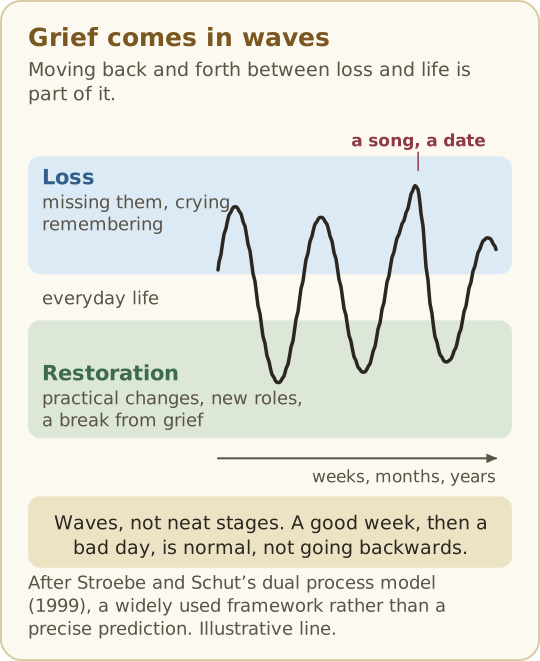
Figure 29 Grief comes in waves, not neat stages. Moving back and forth between loss and everyday life is part of healthy grieving. -
Grief lives in the body, too.
Grief can bring tiredness, poor sleep, no appetite or extra appetite, aches, a tight chest, forgetfulness and a foggy head. Your brain is slowly learning that someone or something it expected to be there isn’t. That takes time, and it uses energy.
For example: A teacher whose mother died keeps losing her keys and forgetting meetings. She worries something is wrong with her memory. It’s grief fog, and it eases as the months pass.
Words you could use: “I’m grieving, so I’m slower than usual. Could you send me a reminder?”
Try this: Pick three basics to protect this week: one regular meal, a set bedtime, and a short walk outside.
Dig deeper: the grieving body and brain -
Some losses nobody sees.
Some losses are hard to explain. Someone is still alive but changed, through dementia, addiction or illness. Someone is gone but not dead, like an estranged parent or a missing relative. Some losses aren’t recognised by others: an ex-partner’s death, a pregnancy loss, a friend you met online. Grief without a ceremony, or without other people noticing, can feel very lonely.
For example: A woman’s father has dementia. He’s still here, and she still visits, but the dad who knew her is fading. She’s grieving someone who hasn’t died.
Words you could use: “I’m grieving something people might not see as a loss. It is one for me.”
Try this: If a loss of yours had no ceremony, make a small one: light a candle, write a letter, plant something, visit a place.
Dig deeper: ambiguous and unrecognised grief -
People grieve in different ways.
Some people grieve by talking and crying. Others grieve by doing: fixing, organising, working, building something. Neither is more loving. Families often clash because one person thinks the other “isn’t grieving” when they are just grieving differently. Culture, faith, age and how your mind works all shape it, too.
For example: After their son’s death, one parent wants to talk about him every evening. The other spends weekends restoring his old bike. Each feels the other is getting it wrong. Both are grieving him.
Words you could use: “I think we grieve differently. Can you tell me what helps you, and I’ll tell you what helps me?”
Try this: Ask someone who shares your loss: “What has helped you most, even a little?” Listen without correcting.
Dig deeper: grieving styles and familiesFilled-in example Write it through Edith, 74, seven months after her husband died, writing to her son and daughter Write it, wait, then send
Who is it to?
- Partner
- Co-parent or ex
- Chosen: Family
- Friend
- Housemate
- Coworker
- More than one person
- Someone else
- Their name (optional)
- Malcolm and Fiona
- Your name (optional)
- Mum
What kind of message?
- Raise something
- Reply to something
- Chosen: Make a plan
- Say sorry
- I need a pause
- What we need to plan (one thing)
- How often we ring and visit. Since your dad died in March, I’ve had a call every evening at seven and a visit every Sunday.
How I feel about it
- Chosen: tired
- rushed
- frustrated
- unseen
- taken for granted
- overwhelmed
- stretched thin
- worried
- hurt
- disappointed
- left out
- alone with it
- confused
- embarrassed
- annoyed
- sad
- on edge
- hopeful
- Chosen: grateful
- What I suggest (one clear suggestion)
- Could we change to a call on Wednesdays and Sundays, and I’ll ring you if I need you in between?
- What I’m NOT saying (optional, but it helps)
- I’m not pushing you away. I love hearing from you, and I miss your dad too.
When I’d like a reply
- Today
- Tomorrow
- Chosen: By the weekend
- No rush
A gentle check
House rules: ✓ One topic · ✓ Facts, not verdicts · ✓ No always or never · ✓ No sarcasm or ALL CAPS · ✓ No “you” accusations · ✓ Says what you’re asking for · ✓ A reply-by time
No sharp words found. It reads as calm and clear.
A made-up example. Names and details are invented. Fiona rang the same evening: “Of course. Will you still tell us on a bad day?” Edith said she would.
Fill in your own: Write it through (spreadloveandacceptance.com/
write-it-through) -
You don’t have to let go.
An older idea said healthy grief meant “moving on” and cutting ties. Many grief researchers now see it differently: people often keep a bond with who they lost, in memories, rituals, conversations in their head, and values they carry forward. The relationship changes shape. It doesn’t have to end.
For example: A teenager wears her grandfather’s watch to exams. She doesn’t believe in luck. It just feels like he’s with her.
Thoughts you could try: “What would they say about this?” “I carry this part of them with me.”
Try this: Choose one way to keep a bond: cook their recipe, tell a story about them, or keep one of their habits.
Dig deeper: continuing bonds -
Big changes are losses too, even the good ones.
A new baby, a promotion, retirement, moving country, a child starting school, coming out, or getting well after a long illness can all bring grief for the old life. Change often has three parts: an ending, a confusing in-between time, and a new beginning. The middle part is the hardest, and the easiest to rush.
For example: A couple moves to a new city for a great job. Six months in, one of them feels low and guilty: “We wanted this.” They also lost friends, a favourite café and a whole way of life.
Thoughts you could try: “I can be glad about this and still miss what came before.” “I’m in the in-between. It’s supposed to feel unsettled.”
Try this: For one change you’re going through, write: what ended, what feels unclear, and one small thing that’s new and good.
Dig deeper: endings, the in-between, beginnings -
Most people find a way through, and support helps.
Research suggests that many people, over time, find they can live with a loss and still feel joy, even though they never forget. Being with people who let you talk, or not talk, helps. For some, though, grief stays stuck at full strength for a long time and makes daily life very hard.
Doctors call this prolonged grief: a strong longing for the person, or being taken over by the loss, most days, still going many months after the death (usually a year or more for adults) and getting in the way of life. That isn’t weakness, and there is specific help for it.
For example: A year after his wife died, a man still can’t go into their bedroom or see friends. His doctor refers him to a grief counsellor. Slowly, things begin to move.
Words you could use: “It’s been a long time and it isn’t getting any easier. I think I need more help.”
Try this: Write down two people you could text on a hard day, and one place you could call if those people aren’t enough.
Dig deeper: resilience, support and stuck grief
Saturday, 9:40am
You sit in the car for ten minutes and let the wave come. Then you go back in, and you buy the cereal. At home you text your sister: “Saw Dad’s cereal in the shop and cried in the car park.” She replies straight away: “Same thing happened to me with his aftershave. Call tonight?” The wave doesn’t mean you’re back at day one. It means he’s still part of your Saturdays.
Losing a partner in later life
After a long marriage, the loss is in everything: the empty chair, the jobs that were always theirs, the paperwork done alone, the first birthday and anniversary without them. Do one small thing at a time. One drawer counts. Ask someone to sit with you for the forms.
Your grown-up children have lost a parent, and you have lost a partner. You may grieve on different timetables. If they start checking on you every day, that comes from love and worry, not control. You can still say what helps: “I love that you ring. Could we make it two evenings a week, and I’ll ring you if I need you?”
Dig deeper: the first year, and grown-up childrenIn everyday life
- Partners: After a miscarriage, one partner wants to talk and the other goes quiet. Each worries the other doesn’t care.
- Parents and children: A child laughs and plays the day after a funeral, then cries at bedtime. Both are grief.
- Friends: A friend stops calling after your diagnosis, not from coldness but because they don’t know what to say.
- Work: A colleague returns after a death and everyone avoids the subject. She feels her loss has been erased.
- Community: A neighbourhood loses its library, or a town loses its factory, and many people grieve the same thing together.
On your own: carrying it gently
Grief can be lonely, even with people around. Some things help when you’re carrying it alone:
- Give the day a small shape: one meal, one walk, one person you message.
- Expect harder days around dates, and plan something gentle for them.
- Write to who you lost, or about what you lost. Nobody else needs to read it.
Thoughts you could try: “I don’t have to do this fast.” “Today I only need to get to tonight.”
If someone close to you has died: Grief and later life goes further, with family after a loss, coming back to people, and a new chapter on your own. On a heavy night, try For a hard evening.
Common mix-ups
- “There are five stages, in order.” Most people go back and forth. There is no correct order.
- “After a year you should be over it.” Grief changes over time, but there’s no deadline. Anniversaries and birthdays often bring it back.
- “If I’m not crying, I’m not grieving.” Some people grieve by doing, thinking or staying busy. That counts.
- “Moving on means forgetting.” You can build a new life and keep a bond with who you lost.
- “Good changes shouldn’t make me sad.” Every change ends something. Missing the old life is normal.
- “I shouldn’t mention their name, it’ll upset them.” Many grieving people say hearing the name is a comfort. Ask.
If you want to help someone else with this
- Show up, and keep showing up. Support often floods in for two weeks and then stops. A text at three months, or on a birthday, can mean a great deal.
- Offer something specific. “Can I drop off dinner on Thursday?” is easier to say yes to than “let me know if you need anything.”
- Say the name. Share a memory. Let them talk, or not.
- Don’t fix or explain. Skip “everything happens for a reason” and “at least…”. Try “I’m so sorry. I’m here.”
- Comfort in, vent out. If you’re upset too, lean on people further from the loss, not on those closest to it.
Words you could use: “I don’t know what to say, but I’m here.” “I was thinking about your mum today. I remember her laugh.” “I’m going to the shop, what can I bring you?”
When to get more help
Grief is not an illness. But it’s worth talking to a doctor or a grief counsellor if, after many months, the pain isn’t easing at all, you can’t manage daily life, you feel life has no meaning without the person, or you are drinking or using other things to get through. Many hospices, faith communities and charities offer free bereavement support, including for children.
If you are having thoughts of not wanting to be here, please tell someone today. In the US and Canada, call or text 988. In the UK and Ireland, call Samaritans free on 116 123. In Australia, call Lifeline on 13 11 14. In New Zealand, call or text 1737. Anywhere else, findahelpline.com lists free helplines. If you are in danger right now, call your local emergency number.
If a loss involved violence, or you are grieving a relationship you left because you weren’t safe, Not safe at home? has free, private help, including after you separate.
Tools and reading on this site
Tools helpers you use on the site
- Upset right now? for a wave that feels too big
Reading pages to read on the site
- Calm sounds for a quiet few minutes
- Grief and later life: loss, family and a new chapter, with a page for a hard evening
- Grief and change and ambiguous loss, in the site’s library of research notes
- Moving and life transitions and writing about hard things
- After a loss, in your self-discovery path
More for your situation
- After a breakup or divorce: On my own
- Families after a loss: Grief and family · Family rifts after a loss or a will
- Children and teens: Helping children grieve · For teens
- Big changes: Empty nest · Retired together · Coming home after time apart · New parent
- Illness and caring: When one of you is ill · Caring for someone you love
- Friendships: When a friendship drifts
- More in Part Three: Self-worth, shame and self-compassion · Minds that work differently
Find your own starting point: Help by relationship.
Last updated: October 2026