Part Three · Chapter 5
Attachment, trust and belonging
Why we need each other, how the bonds we had early on shape what we expect today, and how trust and belonging are built, lost and rebuilt, one small moment at a time.
In short:
- Belonging is a basic need. Feeling lonely or left out is a signal, like hunger, not a flaw.
- Early bonds set expectations, not a sentence. What we learned about being cared for can soften and change.
- Trust grows in small moments. Doing what you said, again and again, matters more than big gestures.
- You can start small. One friendly exchange, one kept promise, one kind word to yourself.
Why the tools work: this chapter explains the thinking behind these tools from earlier in the book.
- One owner per job (Part Two, Chapter IV) works because trust is built from small promises kept. A named owner turns a vague hope (“someone will do it”) into a promise others can rely on. Big idea: fix the setup, not the person.
- The monthly look-back (Part Two, Chapter V) is “not a review of either person”. Feeling safe with someone is what lets people say what went wrong without bracing for blame.
Sunday, 9:30pm
Kai sent a long message to a friend at lunchtime. It’s been read, but there’s no reply. By evening, Kai has gone from “she’s busy” to “she’s annoyed with me” to “nobody really likes me.” The friend, meanwhile, is at her nephew’s birthday, phone in a coat pocket. One silence, two very different nights.
-
Belonging is a basic need.
People need to feel connected, the way we need food and sleep. When we feel left out, it can hurt in a way that feels almost physical (Naomi Eisenberger and colleagues, 2003). That isn’t weakness. It’s a signal, like hunger, telling us to reach for connection.
For example: Rhea moves to a new city for work. She’s busy and doing well, but by the third month she feels flat and teary on Sundays. Nothing is wrong with her. She’s lonely, and loneliness is a real need asking to be met.
Thoughts you could try: “Feeling lonely doesn’t mean I’m unlikeable. It means I need connection, like anyone.”
Try this: This week, reach out to one person, even with a short “thinking of you” message.
Dig deeper: why we need each other -
Early bonds teach us what to expect.
As children, we learn from the people who cared for us whether others will come when we need them. If help usually came, we tend to expect it. If it came sometimes, or rarely, we may learn to cling harder or to stop asking. These lessons are a starting point, not a life sentence. This is the idea of attachment, first described by John Bowlby (1969) and studied by Mary Ainsworth and colleagues (1978).
For example: A toddler at the park runs off to explore, then runs back to check his grandmother is still on the bench, then runs off again. She is his safe base. Knowing she’s there makes him brave enough to explore.
Words you could use: (to a child) “I’m right here. Go and look, and come back whenever you want.”
Try this: Think of one person who was a safe base for you, at any age. What did they do that helped?
Dig deeper: what attachment is -
Patterns, not boxes.
As adults, some of us worry a lot about being left, and reach out more when we feel unsure. Some of us pull back when things get close, and need more space. Many of us feel mostly secure, and most of us mix all three.
These are patterns that can soften and change, especially in steady, kind relationships. Cindy Hazan and Phillip Shaver (1987) first described them in adults, and later work, such as R. Chris Fraley and colleagues (2015), suggests they are sliding scales, not boxes.
For example: When things feel tense, Ronan wants to talk it through right now. His wife Clara needs to go quiet first. He reads her quiet as “she’s leaving.” She reads his questions as pressure. Once they see the pattern, they agree: Clara says “I need an hour, and I’m coming back,” and Ronan waits.
Words you could use: “I’m not going anywhere. I just need some quiet. Let’s talk at eight.”
Try this: Notice what you do when you feel unsure of someone: reach out more, or pull back? No judgement, just notice.
Dig deeper: anxious, avoidant and secure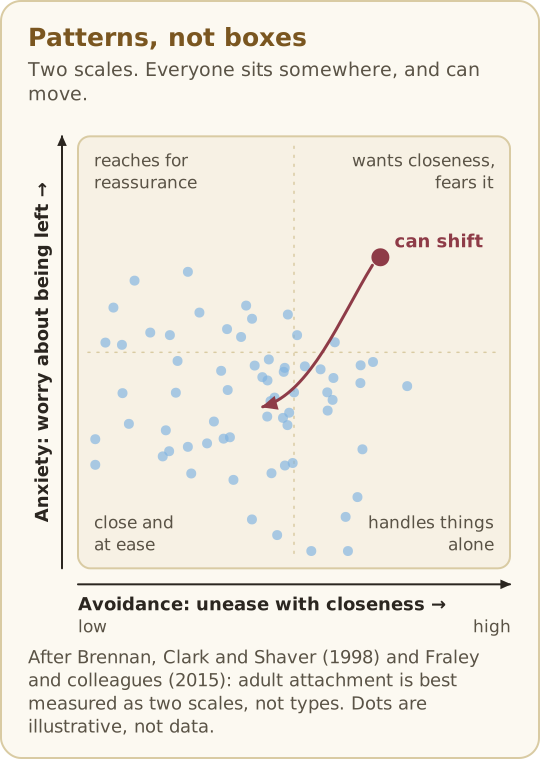
Figure 25 Attachment as two scales, not four boxes: worry about being left, and unease with closeness. Everyone sits somewhere, and can move. Dots are illustrative. Filled-in example Our pause plan Imani and Kwame, married ten years Our pause plan
Fill this in together on a calm day, or fill it in yourself and send it to your partner to change.
- Our pause word or sentence
- “Pause. I’ll be back at …”, with a hand on the heart
- Shortest break, so our bodies can settle
- 30 minutes
- Whoever pauses names a clock time to come back, no later than
- the same evening
- If one of us can’t come back on time
- Send one text with a new time. No silence.
- The first sentence when we come back
- “I’m back. You first: what do you most want me to hear?”
Your plan, ready to send
Our pause plan
Pause word: “Pause. I’ll be back at …”, with a hand on the heart
Shortest break: 30 minutes
Return time: whoever pauses names a clock time, no later than the same evening
If one of us can’t come back on time: Send one text with a new time. No silence.
When we come back, we start with: “I’m back. You first: what do you most want me to hear?”
A made-up example. Names and details are invented. For relationships where everyone feels safe.
Fill in your own: Our pause plan (spreadloveandacceptance.com/
pursue-withdraw) -
Trust is built in small moments.
Trust doesn’t usually come from big gestures. It grows from small, ordinary things done again and again: doing what you said, turning towards someone when they reach out, being the same person on a hard day as on a good one.
For example: A new team member says she’ll send the figures by Thursday, and she does. The next week, she flags early that something will be late. By the third month, her manager trusts her completely, not because of one big moment, but dozens of small ones.
Words you could use: “I said I’d do it by Friday. I’m running late, so here’s where it’s at.”
Try this: Keep one small promise today, and notice how it feels to be someone who does what they said.
Dig deeper: how trust grows -
Feeling safe with someone calms the body.
Being with someone we trust can settle our nervous system. In one study, holding a trusted partner’s hand calmed the brain’s response to threat (James Coan and colleagues, 2006). A calm voice, a hand to hold, or just someone nearby can make a hard moment easier to bear. This works both ways: we can be that safe presence for others too, often without saying much.
For example: After a panic attack, Kieran’s friend doesn’t try to fix anything. He sits next to him on the step and says, “Take your time. I’m here.” Kieran’s breathing slows.
Words you could use: “You don’t have to talk. I’ll just sit with you.” “What would help right now: company, quiet, or both?”
Try this: Notice who helps you feel calmer. Tell them, simply: “I always feel better after seeing you.”
Dig deeper: a safe haven -
Fitting in isn’t the same as belonging.
Fitting in means changing yourself to be accepted. Belonging means being accepted as you are. Groups like teams, families, clubs and communities can offer both. Being left out of a group hurts, even when the group doesn’t matter much to us. Real belonging grows where people feel safe to be themselves and to speak up.
For example: At a new job, Ola laughs at jokes she doesn’t find funny and hides that she doesn’t drink. She’s fitting in, and she’s exhausted. At a book club, she says what she really thinks and people ask her to say more. That’s belonging.
Words you could use: (in a group) “I see it a bit differently. Is it okay if I say why?” “Has everyone had a chance to say something?”
Try this: Think of one place where you can be fully yourself. How could you spend a little more time there?
Dig deeper: groups, work and community -
When trust breaks, rebuilding takes time.
When someone lets us down badly, trust doesn’t come back with one apology. It returns slowly, as words are matched by actions over time. The person who broke trust can own what happened and be patient. The person who was hurt can decide, at their own pace, whether and how much to trust again.
For example: Two adult sisters fall out after one shares a private story at a family dinner. The apology is a start. What rebuilds trust is the months afterwards, when the story never comes up again and the sister checks before sharing anything.
Words you could use: “I know sorry isn’t enough. I’ll show you, and you can take whatever time you need.”
Try this: If you’ve broken someone’s trust, name one specific thing you’ll do differently, and do it.
Dig deeper: rebuilding trust -
You can start building connection from wherever you are.
If you feel alone right now, big friendships can feel out of reach. But belonging starts small: a chat with a neighbour, a regular class, an online group about something you love, a kind word to yourself. Even small, light contact with people we barely know can lift our mood (Gillian Sandstrom and Elizabeth Dunn, 2014).
For example: After his divorce, Martin starts saying more than “thanks” to the man at the coffee stall. A few weeks later they talk football every morning. It isn’t a deep friendship, but it makes Mondays easier, and it reminds him he can still connect.
Words you could use: “I’m new around here. Is there anything you’d recommend?” “I loved what you said in the group. Would you like to get a coffee sometime?”
Try this: Have one small, friendly exchange with someone you don’t know well this week.
Dig deeper: building connection
Monday, 8:10am
Kai’s phone buzzes. “Sorry! Phone was in my coat all day at my nephew’s party. Loved your message. Coffee Thursday?” Kai notices how far last night’s story had run: from “she’s busy” all the way to “nobody likes me.” Next time a reply is slow, Kai decides to send a light “No rush, just thinking of you,” and let the silence be just a silence.
If you’re a teenager
A made-up example. Ezra, 16, sees a photo of his three closest friends at the cinema, and finds out there’s a group chat he isn’t in. It hurts like a punch. Being left out really does register a bit like pain. Instead of posting something sharp, he messages one friend: “Bit gutted not to be asked. Did I do something?” It turns out they thought he’d be at football. One friendship really is drifting, though, and that’s allowed to hurt too.
Words you could use: “Bit gutted not to be asked. Did something happen?” “I’d like to come next time, even if I can’t always make it.” “I miss how we used to be. Are we okay?”
Dig deeper: more worked examplesIn everyday life
- Partners: One partner texts a lot when apart; the other forgets. Agreeing on one goodnight message keeps both feeling connected.
- Parents and children: A child who acts up at pick-up may simply be releasing a long day with the safest person they know.
- Friends: A friend who always cancels may be overwhelmed, not uncaring. Asking “Is it easier if we do something short?” keeps the door open.
- Coworkers: A team where mistakes can be admitted without blame builds trust faster than one where everyone hides them.
- Housemates: A weekly shared meal, even a simple one, can turn people who share a kitchen into people who look out for each other.
- Community: A neighbour who waves every morning is a small, real part of feeling at home.
On your own: belonging with yourself
Belonging isn’t only about other people. It also includes how you treat yourself. If you’re kind to yourself on a bad day, you carry a little safe base wherever you go. People who learn to comfort themselves often find it easier to let others in, too, because they’re less afraid of being let down.
Thoughts you could try: “I’m allowed to need people.” “Today was lonely. That’s hard, and it won’t always be like this.”
More for people on their own: On my own.
Common mix-ups
- “Needing people means I’m needy.” Needing connection is human. Everyone has this need, even those who hide it well.
- “My attachment style is fixed for life.” Patterns can change, especially through steady, kind relationships and reflection.
- “An ‘anxious’ or ‘avoidant’ label explains everything.” Labels can help you notice patterns, but people are more than a type. Use them for curiosity, not judgement.
- “Jealousy and checking up show how much they love me.” Reaching for reassurance is human, and so is asking for something out of care for the relationship. Controlling who someone sees, or checking their phone without agreement, is not love and is not an attachment style. See signs to look out for.
- “If I forgive, I have to trust again straight away.” Forgiving and trusting are different. Trust can return slowly, or not at all, and that’s your call.
- “Belonging means everyone likes me.” Belonging usually means a few people who know you as you are. That’s enough.
If you want to help someone else with this
- Be a steady presence. Reliability matters more than big gestures. Turn up when you said you would.
- Take loneliness seriously. If someone says they feel alone, don’t rush to “But you have so many friends!” Listen first.
- Invite, and keep inviting. People who feel left out may say no a few times. A warm, no-pressure invitation still matters.
- Make room in groups. Notice who is on the edge, and ask their view.
- Don’t diagnose. Avoid telling someone they’re “so avoidant” or “so clingy.” Ask what would help instead.
Words you could use: “I’m here, and I’m not going anywhere.” “We’re having a few people over on Friday. No pressure, but I’d love you to come.”
When to get more help
- If loneliness has lasted a long time, or comes with low mood, hopelessness or thoughts of not wanting to be here, please talk to a doctor or a mental health service. If you are in danger right now, call your local emergency number or see Upset right now.
- If fear of being left, or of getting close, keeps hurting your relationships, a counsellor or therapist can help you understand where it comes from and how to change it.
- If someone uses your need for them against you, by cutting you off from friends, checking where you are, or threatening to leave to get their way, that is not about attachment. Not safe at home? lists free, private help.
- If trust was broken in a way that frightened you, you don’t owe anyone a second chance. Your safety comes first.
Reading on this site
Practice: pick one small way to turn towards someone this week.
Turning towards: small moments of connection → When one talks and one goes quiet → How to apologise so it counts →
Reading pages to read on the site
- Bonding: how closeness grows: what research says about closeness, with small ideas for partners, kids, friends, family, coworkers and you.
- Friends: when a friendship drifts, and how to reach out.
- The languages of connection: the different ways people show care.
- Complacency: why good things fade, and how to keep them alive.
- From the library: Attachment theory · Adult attachment · Trust · Bids for connection · Loneliness · Weak ties · Psychological safety · Masking
More for your situation
- On my own after a breakup
- Friends
- Parents and foster, adoptive and kinship families
- Long distance
- Family rifts
- Coming out as an adult
- At work
- Grief and later life
- Find it by relationship
Last updated: October 2026