Part Three · Chapter 5
Attachment, trust and belonging
In short:
- Belonging is a basic need. Feeling lonely or left out is a signal, like hunger, not a flaw.
- Early bonds set expectations, not a sentence. What we learned about being cared for can soften and change.
- Trust grows in small moments. Doing what you said, again and again, matters more than big gestures.
- You can start small. One friendly exchange, one kept promise, one kind word to yourself.
Why the tools work: this chapter explains the thinking behind these tools from earlier in the book.
- One owner per job (Part Two, Chapter IV) works because trust is built from small promises kept. A named owner turns a vague hope (“someone will do it”) into a promise others can rely on. Big idea: fix the setup, not the person.
- The monthly look-back (Part Two, Chapter V) is “not a review of either person”. Feeling safe with someone is what lets people say what went wrong without bracing for blame.
Sunday, 9:30pm
Kai sent a long message to a friend at lunchtime. It’s been read, but there’s no reply. By evening, Kai has gone from “she’s busy” to “she’s annoyed with me” to “nobody really likes me.” The friend, meanwhile, is at her nephew’s birthday, phone in a coat pocket. One silence, two very different nights.
Why can one unanswered message ruin an evening? Why do some people reach for closeness when they’re scared, while others pull away? Why does trust take years to build and moments to break? This chapter is about the deep human need to belong: where it comes from, how it shapes the way we love and work and live together, and what helps when it hurts.
Each section looks at one idea through three lenses. Psychology tells us what researchers have found, and where the evidence is limited. Philosophy shows how thinkers from many traditions have understood the same questions. Through an autistic lens looks at each idea from the point of view of autistic people. It is a perspective, not a diagnosis, and it often shows that “normal” ways of belonging are only one way among several.
Ideas marked This site’s idea: are our own ways of putting things into practice, not established science.
Belonging is a basic need
We are not built to be alone. For most of human history, being cut off from the group was dangerous. It makes sense, then, that being left out still feels alarming, and that connection feels like relief. Loneliness is not a character flaw. It is a signal, like hunger or thirst, pointing at a need.
Psychology
Roy Baumeister and Mark Leary (1995) reviewed a large body of research and argued that the “need to belong” is a fundamental human motivation: people need frequent, pleasant contact with a few others, inside relationships that feel stable and caring. John Cacioppo, who studied loneliness for decades, described it as a biological alarm, like hunger, that tells us our social connections are running low.
Connection also matters for health. A large review by Julianne Holt-Lunstad, Timothy Smith and Bradley Layton (2010) found that people with stronger social relationships were more likely to survive over the years the studies followed them. Studies like these show links, not proof that one causes the other, but the pattern is strong and has been found many times. Research on exclusion by Kipling Williams and colleagues (2000) found that even being left out of a simple online ball-tossing game by strangers lowered people’s mood and sense of belonging. We are sensitive to exclusion, even when it shouldn’t matter.
Philosophy
Aristotle described human beings as naturally social and political animals. In the Politics, he suggested that someone who truly needs no community would have to be either a beast or a god. Many African philosophies express a related idea through ubuntu, often summed up in a Nguni saying usually translated as “a person is a person through other persons.” On this view, we don’t first become ourselves and then join others. We become ourselves through others.
Through an autistic lens
Autistic people need belonging too, though it may look different. Some prefer a few deep friendships to a wide circle. Some connect best through shared interests, or by being in the same room doing different things (“parallel company”). Social time can use a lot of energy, so needing to recharge alone is not the same as not wanting people. A common myth says autistic people don’t want connection. Many autistic adults describe the opposite: wanting it very much, and being hurt by repeated exclusion. Loneliness, here, is often about a lack of acceptance, not a lack of desire.
Thoughts you could try: “My loneliness is a signal, not a verdict.” “I can want people and also need time alone.”
Early bonds teach us what to expect
From our earliest days, we learn from the people who care for us. Do they come when I cry? Can I explore and come back? Is it safe to need someone? The answers become quiet expectations we carry into later relationships: a kind of map of how people tend to respond.
Psychology
The psychiatrist John Bowlby developed attachment theory from the 1950s onwards. He argued that babies are born with a drive to stay close to a caregiver, who serves as a safe haven when they’re frightened and a secure base from which to explore. Mary Ainsworth studied this in her “Strange Situation” research, watching how toddlers reacted when a parent left a room and came back. She described secure patterns, where children were upset but easily comforted, and insecure ones, where children clung anxiously or seemed not to seek comfort. Later, Mary Main and Judith Solomon (1990) added a “disorganised” pattern seen when children seemed frightened or confused about the caregiver.
Attachment theory is one of the best-studied ideas in psychology, but it has limits. Much of the early research came from Western, middle-class families. Researchers such as Heidi Keller have pointed out that in many cultures children are raised by several caregivers, and “good” care looks different. Early patterns also predict later relationships only moderately. They are an influence, not a destiny.
Philosophy
Philosophers in the tradition known as the ethics of care, such as Nel Noddings, Virginia Held and Eva Feder Kittay, start from a fact many older theories ignored: every human being begins life completely dependent on others, and most of us will be dependent again, through illness or old age. Kittay reminds us that everyone is “some mother’s child,” cared for by someone. On this view, dependence isn’t a weakness to grow out of. It’s the ground of human life, and caring well for each other is one of the most important things we do.
Through an autistic lens
Autistic children form deep attachments to their caregivers. A review by Anna Rutgers and colleagues (2004) found that in the studies using the Strange Situation, about half of the autistic children were securely attached to their parents. On average they were secure less often than other children, but that difference disappeared among children without an additional intellectual disability. Attachment may simply be shown differently: a child may seek comfort through a favourite object, a routine or a parent’s familiar presence, rather than through hugs or eye contact. Tests built around typical behaviours can miss this. For autistic adults looking back, it can help to know that feeling “different” as a child, or misunderstood, can shape expectations as much as how loving a family was. Both can be true at once.
Words you could use: (to a child) “Whenever you need me, I’ll come.” (to yourself) “I learned to expect this as a child. I can learn something new now.”
Patterns, not boxes
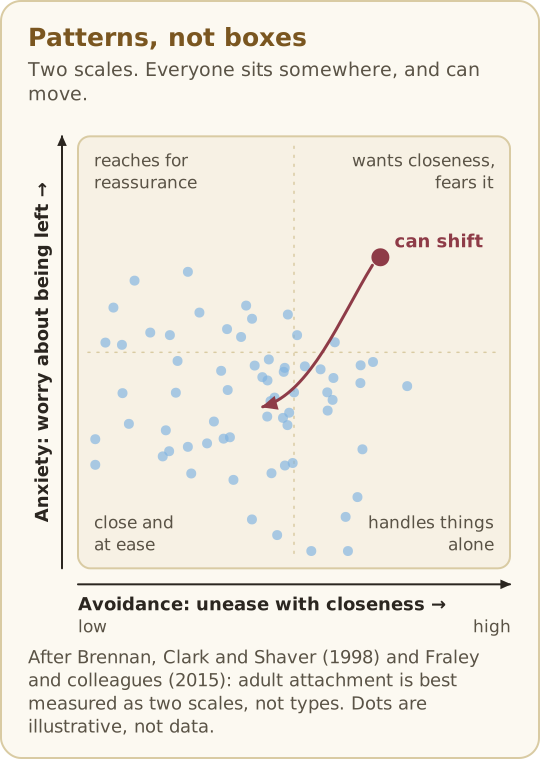
As adults, we bring our maps into friendships, partnerships and even work. Under stress, some of us reach harder for closeness and reassurance. Some of us pull back and handle things alone. Most of us do a mix, depending on the person and the day.
Psychology
Cindy Hazan and Phillip Shaver (1987) suggested that adult romantic relationships draw on the same attachment system as childhood bonds. Later research, such as work by Kelly Brennan, Catherine Clark and Shaver (1998), found that adult attachment is best described along two dimensions: anxiety (worry about being rejected or left) and avoidance (discomfort with closeness and depending on others). Studies by R. Chris Fraley and colleagues suggest these are scales, not separate types: people sit somewhere along each one, rather than fitting neatly into “anxious,” “avoidant” or “secure.”
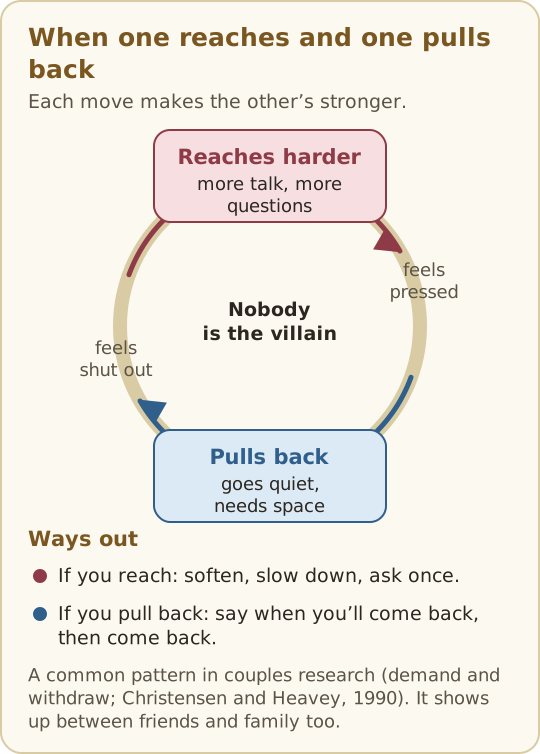
These patterns can change. Researchers talk about “earned security”: adults who had difficult early relationships but became more secure through supportive relationships, therapy or reflection. When an anxious and an avoidant pattern meet, a common cycle forms: one pursues, the other withdraws, and each move makes the other’s stronger. See When one talks and one goes quiet.
Philosophy
Arthur Schopenhauer told a parable about porcupines on a cold day. They huddle together for warmth, but their quills prick each other, so they move apart, get cold, and come together again, until they find a distance where they are warm enough and hurt little. Every relationship is a search for that distance, and two people’s comfortable distances may differ. See The porcupines in the site’s stories from philosophy.
It is worth noting that Buddhist teaching about “attachment” means something different from attachment theory. In Buddhism, the problem is clinging: grasping at things to stay the same when everything changes. That is not the same as loving someone or depending on them. You can love deeply while holding the relationship with open hands.
Through an autistic lens
It is easy to misread autistic behaviour as attachment insecurity. Repeated checking (“Are we still meeting at six?”) may come from a need for certainty and clear plans, not fear of being left. Going quiet after a busy day may be recovering from sensory or social overload, not avoiding closeness. Before applying a label, it helps to ask what the behaviour is for. A partner who says “I need certainty about plans” or “I need a quiet hour to recharge” is giving useful information, not showing an insecure style. See Intolerance of uncertainty in the library.
Words you could use: “When I go quiet, I’m recharging, not leaving. I’ll come back by eight.” “When I check plans, I’m not doubting you. Certainty just helps me relax.”
Our pause plan
Fill this in together on a calm day, or fill it in yourself and send it to your partner to change.
- Our pause word or sentence
- “Pause. I’ll be back at …”, with a hand on the heart
- Shortest break, so our bodies can settle
- 30 minutes
- Whoever pauses names a clock time to come back, no later than
- the same evening
- If one of us can’t come back on time
- Send one text with a new time. No silence.
- The first sentence when we come back
- “I’m back. You first: what do you most want me to hear?”
Your plan, ready to send
Our pause plan
Pause word: “Pause. I’ll be back at …”, with a hand on the heart
Shortest break: 30 minutes
Return time: whoever pauses names a clock time, no later than the same evening
If one of us can’t come back on time: Send one text with a new time. No silence.
When we come back, we start with: “I’m back. You first: what do you most want me to hear?”
A made-up example. Names and details are invented. For relationships where everyone feels safe.
Fill in your own: Our pause plan (spreadloveandacceptance.com/
Trust is built in small moments
Trust is the belief that someone will act with care towards you, especially when you’re vulnerable. It isn’t usually built by grand gestures, but by small, ordinary moments that add up: a promise kept, a message answered, a secret held.
Psychology
John Rempel, John Holmes and Mark Zanna (1985) described trust in close relationships as growing in stages: first predictability (I can tell what you’ll do), then dependability (I can rely on you), and finally faith (I feel secure in your care, even when I can’t be sure). John Gottman’s research describes “bids for connection”: small reaches like a comment, a question or a touch. Partners who more often “turned towards” these bids, rather than away from them, tended to stay together and feel happier. Gottman calls the small choices “sliding door moments”: each one is tiny, but together they build trust or wear it down. See Bids for connection and Turning towards.
At work, Amy Edmondson’s research on psychological safety (1999) found that teams learned and improved more when people felt safe to admit mistakes and speak up. That kind of trust is built the same way: by how leaders and teammates respond, again and again, to small risks.
Philosophy
The philosopher Annette Baier (1986) described trust as accepting that we are vulnerable to someone else’s goodwill. When we trust, we let someone hold something we care about, and we rely on them not to harm it. That’s why betrayal hurts so much: it isn’t just a broken plan, it’s a misused vulnerability. Onora O’Neill, in her 2002 Reith Lectures, argued that the goal shouldn’t be simply “more trust.” It should be trust placed wisely, in people and institutions that show themselves to be trustworthy. The question isn’t “Do I trust?” but “Is this person showing they can be trusted?”
Through an autistic lens
For many autistic people, trust is closely tied to honesty and predictability. Saying what you mean and doing what you said can matter more than warmth of manner. Vague promises (“We’ll see,” “Maybe later”) can feel unsettling, while clear ones (“I’ll call on Thursday at seven”) build security. Many autistic people are also very honest, sometimes to their own cost, and can find it hard to understand white lies or hidden agendas. Being trustworthy to an autistic friend, partner or colleague often simply means being clear, being consistent, and telling the truth kindly.
This site’s idea: “Say it, do it, show it”: say what you’ll do, do it, and if you can’t, show where it’s at before the deadline. That last step, flagging early, builds as much trust as doing the thing.
Words you could use: “I’m going to be late with this. Here’s where it’s at, and here’s when you’ll have it.” “I’ll call you on Thursday at seven.”
Feeling safe with someone calms the body
When we’re stressed, the presence of someone we trust can calm our body as well as our mind. This is one of the deepest gifts of close relationships, and it’s something we can offer others too.
Psychology
In a well-known study, James Coan, Hillary Schaefer and Richard Davidson (2006) asked married women to lie in a brain scanner while facing the threat of a mild electric shock. When they held their husband’s hand, brain areas linked to threat responded less than when they held a stranger’s hand or no hand, and the effect was stronger for women in happier marriages. It was a small study, but it fits a wider idea Coan calls social baseline theory: our brains expect to have trusted others nearby, and they work harder when we’re alone.
Researchers also describe co-regulation: people settling each other’s stress through voice, presence and touch. It starts between parents and babies and continues all through life. One calm person can help a whole room calm down. See Co-regulation in the library.
Philosophy
The ancient Greek philosopher Epicurus thought friendship was one of the greatest goods of a happy life. He made a striking point: we don’t so much need our friends’ help as the confidence that their help is there if we need it. That’s the secure base in a single thought. Knowing someone will come is often enough to let us face hard things alone.
Through an autistic lens
Co-regulation looks different for different people. For some autistic people, a hug when they’re overwhelmed is the last thing that helps; touch, eye contact or talking can add to an overload. A quiet, calm person nearby, dimmer lights, fewer words, or simply sending a message (“I’m here when you’re ready”) can be the safe haven instead. “Body doubling,” doing tasks alongside someone, is another form of company many autistic and ADHD people find steadying. The question is never “What would help me?” but “What helps you?”
Words you could use: “Do you want company, quiet, or both?” “Would a hug help, or would you rather I just sat here?”
Fitting in isn’t belonging
We belong to more than one person. We belong to families, friendship groups, teams, faiths, neighbourhoods, online communities. Groups can give us identity, support and purpose. They can also pressure us to hide who we are.
Psychology
Henri Tajfel and John Turner’s social identity theory (1979) describes how part of our sense of self comes from the groups we belong to, and how easily we favour “us” over “them,” even when groups are formed on trivial grounds. That can bring warmth and loyalty, and also exclusion. The researcher Brené Brown, drawing on her interview studies, made a distinction many people find useful: fitting in means changing yourself to be accepted, while belonging means being accepted as you are. Her research is qualitative rather than experimental, but the distinction rings true for many.
Edmondson’s psychological safety research shows that groups where people can speak up, ask questions and admit mistakes tend to work better and learn more. Belonging, in this sense, isn’t only a nice feeling. It helps groups think.
Philosophy
The ubuntu tradition sees community as the setting in which people become fully human, but it also asks a lot of communities: to include, to share, and to repair harm rather than cast people out. Many religious and philosophical traditions hold a similar tension between belonging to a group and staying true to yourself. Simone Weil, in The Need for Roots (1949), argued that having roots in a community is one of the most important and least recognised needs of the human soul.
Through an autistic lens
Many autistic people describe masking or camouflaging: hiding autistic traits to fit in, such as forcing eye contact, rehearsing small talk or suppressing stimming. Research by Laura Hull and colleagues (2017) and others has found that long-term masking is often exhausting and linked with poorer wellbeing. In other words, fitting in can come at a real cost. By contrast, studies of autistic people spending time with other autistic people, such as interviews by Catherine Crompton and colleagues (2020), describe a sense of ease, of not having to translate. Belonging, for anyone, grows where it’s safe to stop pretending. Groups can help by making differences normal: offering quiet spaces, written agendas and several ways to take part. See Masking and neurodiversity at work.
Words you could use: “Is there a way to join in that suits you better?” “You don’t have to do small talk with me.”
Rebuilding broken trust
Trust can break in big ways (an affair, a betrayed secret, a lie about money) or through a slow pile-up of small let-downs. Either way, it rarely comes back with one conversation. It returns, if it returns, through words that are matched by actions over time.
Psychology
Roy Lewicki, Beth Polin and Robert Lount (2016) studied which parts of an apology people found most effective. Acknowledging responsibility came first, followed by an offer to repair the harm. Explaining, expressing regret and promising to change helped less on their own. Research on forgiveness, by Everett Worthington and others, distinguishes forgiveness (letting go of resentment, which can happen inside one person) from reconciliation (rebuilding the relationship, which needs both people and safety). You can forgive without trusting again.
Couple therapists, including the Gottmans, describe rebuilding trust after a serious betrayal in stages: taking full responsibility, rebuilding understanding, and then slowly restoring closeness. Evidence for specific programmes is still limited, but most approaches agree on one thing: the person who broke trust carries the work of being consistent, and the person who was hurt sets the pace.
Philosophy
The Jewish tradition of teshuvah, often translated as “return” or “repentance,” describes a path of recognising the harm, feeling real regret, putting things right with the person hurt, and changing. The medieval philosopher Maimonides wrote that complete teshuvah is shown when a person faces the same situation again and chooses differently. That is a useful test for any apology: not how sorry it sounds, but what happens next time.
Through an autistic lens
Explicit, specific repair often works best: “Here’s exactly what I did. Here’s exactly what I’ll do differently. Here’s how you’ll know.” Vague apologies (“Sorry if you were upset”) can feel especially hollow to someone who values honesty. Some autistic people find it easier to apologise, or to receive an apology, in writing, with time to process. On the other side, an autistic person who has been hurt may need to know precisely what will change before they can trust again. That isn’t unforgiving. It’s needing the information that makes trust possible.
Words you could use: “I did this. It hurt you. Here’s what I’ll do from now on. Take all the time you need.” See How to apologise so it counts.
Building connection from where you are
If you feel alone, advice like “put yourself out there” can feel impossible. But connection isn’t one big leap. It grows from small, repeated contact, and some of the smallest forms of contact matter more than we think.
Psychology
Nicholas Epley and Juliana Schroeder (2014) asked commuters to talk to a stranger on their train or to sit in silence. People expected talking to be unpleasant, but those who talked reported a more positive journey. Gillian Sandstrom and Elizabeth Dunn (2014) found that people who had a brief friendly exchange with a barista felt more connected and in a better mood than those who kept it purely efficient. These “weak ties” (acquaintances, neighbours, regulars) add up to a real sense of belonging. See Weak ties.
Friendships take time. Jeffrey Hall (2019) found that moving from acquaintance to friend, and from friend to close friend, takes many hours spent together. That’s encouraging in a way: if you don’t have close friends yet, it may simply be that you haven’t yet had the hours, not that something is wrong with you.
Philosophy
Aristotle described three kinds of friendship: those based on usefulness, those based on pleasure, and those based on caring about each other’s good character. He thought the third kind was rarest and best, and that it takes time; people must, as he put it, eat salt together. But he didn’t dismiss the other two. Friendly colleagues and fun acquaintances are real goods too. See Aristotle on friendship.
Through an autistic lens
Connection doesn’t have to come from parties or small talk. Many autistic people find their people through shared interests: a hobby group, a game, an online forum, a volunteer role. Sharing a deep interest (“info-dumping”) is, for many autistic people, a way of offering friendship. Online friendships are real friendships. Autistic-led communities, which have grown since the early 1990s, have given many people their first experience of being understood without translating. If mainstream social life has felt hard, it may be that you haven’t yet found the right setting, not that you can’t connect.
This site’s idea: The “three circles” check: once a week, notice one contact in each circle: someone close, someone friendly, and someone you barely know. If one circle is empty, make it your small step for next week.
Words you could use: “I’d love to hear more about that.” “Would you like to come along next week?” “I’m better at messaging than calling. Can we keep in touch that way?”
Putting it together
Belonging is a need, not a luxury. We learn our first lessons about it from the people who cared for us, and those lessons become maps we carry into later life. Under stress, our maps may tell us to reach harder or to pull away. Trust grows from small moments, kept promises and turning towards each other. Feeling safe with someone calms the body. Groups can offer belonging, or only ask us to fit in. And when trust breaks, it can sometimes be rebuilt, slowly, with actions that match words.
A few threads run through all of it:
- Your patterns made sense once. Reaching harder, or pulling away, were ways of coping. You can keep what helps and update what doesn’t.
- Small and steady beats big and rare. Trust and belonging are built from ordinary moments.
- Ask what it’s for. Before labelling someone’s behaviour, ask what it does for them: reassurance, rest, certainty, safety.
- Belonging, not fitting in. Look for places where you, and others, can stop pretending.
- Safety comes first. Attachment never excuses control. Trust should go to people who show themselves trustworthy.
Worked examples
On your own: the unanswered message
Back to Kai. Kai notices the spiral: “busy” to “annoyed” to “nobody likes me.” Kai recognises the old map (“people leave if I’m too much”) and tries a different reading: “She’s probably busy. I can check tomorrow.” Kai texts a different friend about a film and goes to bed. The next morning, the first friend replies: “Sorry! Nephew’s party. Loved your message.”
Partners: the pursue-withdraw dance
When Sara is worried, she wants to talk. When Ade is worried, he goes quiet. Each reaction makes the other stronger. They learn to name it: “I’m pursuing.” “I’m withdrawing.” Ade agrees to say when he’ll come back. Sara agrees to wait. Over months, the dance gets shorter. See When one talks and one goes quiet.
Parent and child: the new school
Seven-year-old Noor is clingy at the school gate after a move. Her dad resists the urge to say “Don’t be silly.” He says, “New places feel scary. I’ll be right here at three.” He’s there at three every day. By week three, she runs in. A secure base makes exploring possible.
Coworkers: the new manager
A new manager wants to build trust fast. Instead of a big speech, she does three small things: she answers every message within a day, she says “I don’t know, let me find out” when she doesn’t know, and she thanks people for raising problems. Six months later, her team brings her issues early. See At work.
Friends: the friend who always cancels
Elliot feels hurt when his friend cancels a third time. Instead of drifting, he asks: “Is something making it hard to meet? I miss you.” His friend admits she’s exhausted from caring for her mum. They switch to short walks near her home. The friendship survives. See Friends.
Teenagers: left out of the group chat
Ezra is 16. On Saturday he sees a photo: his three closest friends at the cinema. Then he realises there is a group chat he isn’t in. His stomach drops, and for the rest of the day he feels sick and stupid. That reaction isn’t an overreaction. In a brain-scan study by Eisenberger, Lieberman and Williams (2003), being left out of a simple online ball game raised activity in a brain area also involved in the distress of physical pain. And in online studies by Williams and colleagues (2000), being ignored even by strangers on a screen lowered people’s sense of belonging.
His first urge is to post something sharp under the photo. He doesn’t. He waits until Monday and messages the one friend he is closest to: “Saw the cinema pic. Bit gutted not to be asked. Did I do something?” The answer surprises him: “No! You’ve been at football every weekend, we thought you’d say no.” That part was a misunderstanding, and it gets fixed. Another part isn’t. One of the three has been drifting for months, and that friendship is quietly ending. That is a real loss too, and it’s allowed to hurt.
Words you could use, as a teenager: “Bit gutted not to be asked. Did something happen?” “I’d like to come next time, even if I can’t always make it.” “I miss how we used to be. Are we okay?”
Not every friendship lasts, and many change most between 13 and 18. If being left out is happening on purpose, again and again, or comes with put-downs, that is being picked on, not drifting apart. Chapter 17 has more on group chats and being picked on.
Housemates and community: the newcomer
A student from overseas, Lin, feels invisible in her shared house. A housemate starts a Sunday “everyone brings one thing” dinner. Lin brings dumplings and teaches two housemates to fold them. Belonging grew from one shared, repeated ritual.
An autistic adult finding their people
For years, Lowri masked at work and felt lonely at parties. She joins an online group about trains, her lifelong interest, then a local meetup. “It’s the first time I’ve not had to translate myself,” she says. She still finds parties hard. She no longer thinks the problem is her.
Exercises
- Your safe base. Write about one person who was a safe base for you at any age. What did they do? Is there anyone you could be that person for?
- Your pattern under stress. Think of the last time you felt unsure of someone. Did you reach out, pull back, or both? What were you hoping would happen?
- Turn towards three bids. For a week, notice small reaches from others (a comment, a look, a message) and turn towards three of them each day.
- Keep three small promises. Make three small, specific promises this week, and keep them. Notice how it feels.
- The three circles. Each week, have one contact with someone close, someone friendly and someone you barely know. (This site’s idea)
- Where can you be yourself? List the places and people where you can stop pretending. How could you spend more time there?
- Ask what helps. Ask one person you care about: “When you’re stressed, what helps most: company, quiet, words, or something else?”
When it goes wrong, and when it goes right
When it goes wrong, an old map takes over. One person reaches harder for reassurance; the other feels crowded and pulls further away. Small let-downs are never named, so trust wears thin without anyone noticing. In groups, people mask and hide mistakes. Loneliness grows quietly, and each person decides the problem is them.
When it goes right, people notice their patterns and say them out loud. Promises are small and kept. When trust slips, it’s repaired early and specifically. Groups make room for different ways of joining in. Someone who feels lonely takes one small step, and someone else notices and opens the door a little wider.
Helping someone else with belonging
If someone you care about feels lonely, left out or unable to trust, the most useful things are often the quietest. Be reliable: turn up when you said, reply when you can, and say when you can’t. Keep inviting without pressure, because people who feel on the edge may need several invitations before they can say yes. Listen to their experience of loneliness before offering solutions, and resist the urge to label them (“you’re so avoidant”). In groups, notice who is on the edge and make one small opening for them: ask their view, sit next to them, explain the in-jokes. And if their loneliness comes with hopelessness, gently encourage them to talk to a doctor or counsellor, and stay with them while they do.
Words you could use: “I’m glad you told me.” “No pressure at all, but there’s a seat for you on Friday.”
Questions people often ask
Can my attachment style really change?
Yes. Research on “earned security” shows that people who started with insecure patterns can become more secure, especially through steady relationships, reflection and sometimes therapy. Change is usually gradual.
Should I take an attachment style quiz?
Quizzes can be a starting point for reflection, but they’re snapshots, and many online ones aren’t based on research. Use them for curiosity, not as a label. Remember that patterns vary between relationships.
My partner is very jealous. Is that just anxious attachment?
Feeling insecure is human, and so is asking for reassurance, or for something out of care for the relationship. That is not control. But checking your phone without agreement, controlling who you see or punishing you for time apart isn’t explained away by attachment. Those take away your freedom, and that is control. See signs to look out for and Not safe at home?
I’m autistic and I don’t want lots of friends. Is something wrong?
No. Many people, autistic or not, are content with a few close connections. What matters is whether your need for connection is met in a way that suits you, not how many people you know.
How long does it take to rebuild trust?
There’s no set time. It depends on how deep the hurt was, how consistent the other person is, and your own pace. If you feel pressured to “be over it,” that pressure is itself worth talking about.
Can you feel lonely even with people around you?
Yes, and it’s very common. Loneliness is about the gap between the connection you have and the connection you need, not the number of people nearby. You can feel lonely in a busy office, a full family home or a long relationship, often because you don’t feel truly seen. Naming that gently to one person (“I’ve been feeling a bit far from you lately”) is often the first step back.
What if I’ve never felt like I belong anywhere?
That is painful, and more common than people say. It may help to look for smaller, interest-based groups, or to talk with a counsellor. And it’s worth remembering: not having found your place yet is not proof that there isn’t one.
Limits, safety and more help
- This chapter is general education. It isn’t therapy, and attachment ideas shouldn’t be used to diagnose yourself or anyone else.
- Much attachment research comes from particular cultures and family types. Caring well looks different around the world.
- Attachment patterns never excuse controlling, frightening or hurtful behaviour. If you’re afraid of someone close to you, Not safe at home? lists free, private help.
- If loneliness comes with hopelessness or thoughts of not wanting to live, please reach out to a doctor, a crisis line or emergency services now. Upset right now can help you take the first step.
- A counsellor or therapist can help if fear of closeness or of being left keeps hurting your relationships.
The library’s relationships and connection pages have more on each idea.
Last updated: October 2026