Part Three · Chapter 4
How communication works
In short:
- Meaning is made between two people. What you say and what they hear can be different, and nobody has to be wrong.
- Every message says two things: the words, and what they seem to say about the two of you.
- Check, don’t guess. A short question saves a long misunderstanding.
- Mix-ups are normal. Repair is the skill. And small talk is allowed to be short.
Why the tools work: this chapter explains the thinking behind these tools from earlier in the book.
- Say it so it lands (Part Two, Chapter IV) uses fact, feeling and one clear ask, because every message carries the content and a second message about the relationship. Big idea: tune how you send and receive.
- The 90-second daily check-in and “go back in with a clear sentence” (Part Two, Chapter I) work because mix-ups are normal. Small, frequent repairs keep you in tune better than rare big talks.
- The Chat analyzer’s whole-conversation view (once called the Conversation Reader) shows where a written conversation lost its tone, because messages lose tone on the way.
Thursday, 8:15am
“Can you call me when you’re free?” Ana meant: no rush, I have a small question about the weekend. Her brother read it on the bus and spent the whole ride wondering who was ill. Nobody did anything wrong. The message just arrived carrying something it was never meant to carry.
We talk so much that it feels like the easiest thing we do. Yet most of the hurt between people, at home, with friends, at work and with strangers, travels through words, tone and silence. This chapter looks at how communication actually works: how a meaning gets from one mind to another, where it gets bent on the way, and what helps it arrive.
Each section looks at one idea through three lenses. Psychology tells us what researchers have found, and where the evidence is thin. Philosophy shows how thinkers across many traditions have wrestled with the same questions. Through an autistic lens looks at each idea from the point of view of autistic people, whose experience often makes the hidden rules of communication easier to see. It is offered as a perspective, not a diagnosis, and every autistic person is different.
Ideas marked This site’s idea: are our own ways of putting things into practice, not established science.
Meaning is made between two people
It is tempting to think of a message like a parcel: I pack my meaning into words, send them, and you unpack the same meaning at your end. Real communication is more like a sketch passed between two people. I draw the outline. You fill in the colours, using your own mood, memories, expectations and what you know about me. If our paints are similar, the picture matches. If they aren’t, we can end up looking at two different pictures and both feel sure we are right.
Psychology
In 1948 the engineer Claude Shannon described communication as a sender, a channel and a receiver, with “noise” that can scramble the signal on the way. It was a model for telephone lines, not people, but it gave later researchers a useful picture: something can be lost between sending and receiving, even when both ends work perfectly.
Human communication adds a lot more noise than a phone line. Thomas Gilovich, Kenneth Savitsky and Victoria Medvec (1998) described the illusion of transparency: we tend to believe our feelings and intentions are more visible to others than they really are. So the sender assumes the warmth was obvious, and the receiver never saw it. Communication researchers often sum this up as the difference between intent (what I meant) and impact (how it landed). Both are real, and neither cancels the other.
Philosophy
The philosopher Paul Grice (in lectures from 1967, published in 1975) noticed that we mean far more than we say. If I ask “Is there a petrol station near here?” and you reply “There’s one round the corner,” I assume it’s open, because I assume you’re being helpful. Grice called this the cooperative principle: listeners expect speakers to say enough, say what’s true, stay relevant and be clear, and they read hidden meanings (he called them implicatures) by assuming all that. Much of everyday meaning lives in this unspoken layer.
Ludwig Wittgenstein, in his later work, argued that the meaning of a word is found in how it is used, inside a shared way of life, rather than in a fixed dictionary definition. Two people from different families, workplaces or cultures may be playing slightly different “language games” with the same words. Neither is wrong. They just learned the game in different places.
Through an autistic lens
Many autistic people describe communicating more literally and explicitly: saying what they mean and taking words at face value. From this angle, the hidden layer Grice described is not always “obvious.” It is a set of unwritten rules that many people learn without noticing. Autistic experience makes those rules visible, and it raises a fair question: why do we expect each other to decode meanings nobody actually said?
Explicit communication is not a lesser form. It can be clearer, kinder and fairer, because it doesn’t ask the listener to guess. Many non-autistic people find they communicate better with everyone when they borrow a little of this clarity.
Words you could use: “I want to say this plainly, so nothing gets lost: ...” “What did you take from what I just said?”
Every message says two things
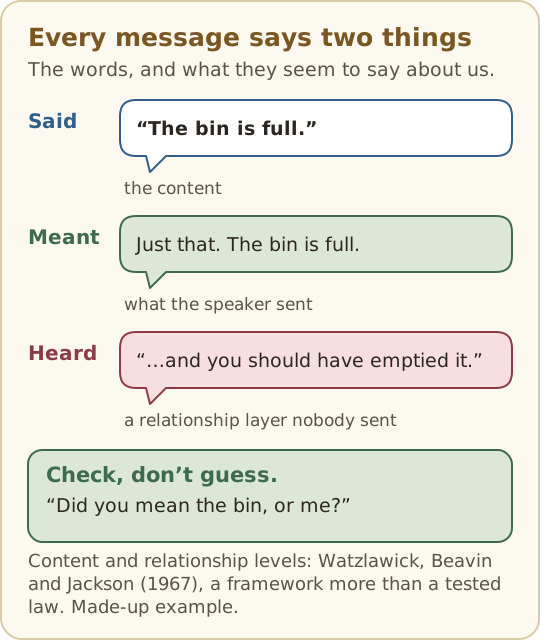
Every message carries some content (a fact, a request, a question) and also says something about the relationship: how I see you, how I see us, what I think I’m owed. “Have you called your mother?” is a question. It can also say “I’m checking up on you,” or “I care about your family,” depending on the history between the two people.
Psychology
Paul Watzlawick, Janet Beavin Bavelas and Don Jackson, in Pragmatics of Human Communication (1967), put this into two well-known ideas. First, “one cannot not communicate”: even silence or looking away sends a message. Second, every message has a content level and a relationship level, and the relationship level tells the listener how to read the content. Their work came from studying families in therapy and is a framework more than a tested law, but it has shaped family therapy and communication teaching for decades.
The German psychologist Friedemann Schulz von Thun (1981) took this further with his “four sides” of a message: the facts, what the speaker reveals about themselves, what it says about the relationship, and what the speaker wants the listener to do. He suggested listeners also have “four ears,” and many of us habitually listen with one ear more than the others. Someone who listens mainly with the relationship ear may hear criticism in a simple fact.
John Gottman’s research on couples describes “perpetual problems”: many repeated arguments are not really about the topic but about deeper needs such as respect, freedom or security. The dishes are the content. Feeling taken for granted is the relationship layer.
Philosophy
The philosopher J. L. Austin, in How to Do Things with Words (1962), pointed out that many sentences don’t just describe the world, they do something: promise, warn, apologise, invite. “I’ll be home by six” is a small promise, and breaking it is felt as a broken promise, not a wrong fact. Seeing what a sentence is doing helps explain why a “neutral” remark can feel like a blow.
Through an autistic lens
An autistic person may mean only the content layer: “The bin is full” means the bin is full. If the listener hears “and you should have emptied it,” a clash follows that the speaker never intended. The reverse also happens: an autistic listener may answer the content (“Yes, I called her”) and miss that the question was really about worry. Naming both layers out loud helps everyone. It turns a hidden layer into something you can simply talk about.
Words you could use: “I’m only talking about the bin, not about you.” “I don’t think this is really about the dishes. I think I’ve been feeling taken for granted.”
Listening is something you do
Hearing happens to you. Listening is work you choose to do: following what someone means, noticing the feeling under it, and showing them you got it. It is harder than it sounds, because a part of us is always getting ready to answer.
Psychology
Carl Rogers believed people grow when they feel deeply understood. With Richard Farson he wrote the essay Active Listening (1957), describing listening for the whole meaning (content and feeling), reflecting it back, and holding back judgement. Later studies give a mixed but encouraging picture. Harry Weger and colleagues (2014) found that people felt more understood when their listener used active listening responses, though other effects were small. Gottman’s research with newly married couples (1998) found that formal paraphrasing was rare in real arguments and didn’t predict how marriages went, which suggests that the attitude of interest matters more than a fixed technique.
Researchers on social support also describe a common mismatch: one person wants comfort and the other offers solutions. Neither is bad. But advice given before someone feels heard is often experienced as “you’re not listening.”
Philosophy
The French philosopher Simone Weil wrote that attention is one of the rarest and purest forms of generosity. For her, real attention meant setting yourself aside for a moment so that the other person can be fully present to you. Martin Buber made a related distinction in I and Thou (1923): we can relate to someone as an “It,” a thing to be handled, or as a “Thou,” a whole person met in the moment. Listening to reply often treats the speaker as an It. See I and Thou in the site’s stories from philosophy.
Through an autistic lens
Listening doesn’t always look the way people expect. Many autistic people find eye contact uncomfortable or distracting, and listen better while looking away, walking side by side, doodling or fidgeting. Some need a little more time to process before replying, so a pause is thinking, not ignoring. Some ask more clarifying questions because they want to get it exactly right. None of this is poor listening. The useful question is not “Does it look like listening?” but “Does the other person end up feeling understood?”
Words you could use: “I listen better if I’m not looking at you. I’m still with you.” “Do you want me to help solve it, or just hear it?”
Check, don’t guess
Once you know something, it is surprisingly hard to imagine not knowing it. So we leave out steps, assume the other person can see what we see, and fill gaps in what they say with our own guesses. Checking feels slow. Guessing feels efficient, until it goes wrong.
Psychology
Economists Colin Camerer, George Loewenstein and Martin Weber (1989) coined the term curse of knowledge for this difficulty. In a well-known study, Elizabeth Newton (1990) asked people to tap the rhythm of a famous song on a table while a listener tried to name it. The tappers, who could “hear” the tune in their heads, expected listeners to get far more right than they did. The tune was obvious to the tapper and almost invisible to the listener.
Kenneth Savitsky, Boaz Keysar, Nicholas Epley and colleagues (2011) found a closeness-communication bias: people overestimated how well they understood friends and spouses, and in some tests did no better with them than with strangers. Closeness makes us feel understood, and that feeling makes us check less. Psychologists also describe “mind reading” as a common thinking trap: being sure you know what someone thinks without asking. See Mind reading in the library.
Philosophy
Socrates was famous for asking simple questions about things everyone thought they already understood, and for admitting what he did not know. That stance, “I may not understand this yet,” is the heart of checking. Hans-Georg Gadamer, in Truth and Method (1960), described understanding as a “fusion of horizons”: each person sees from their own horizon, and understanding happens when the two are brought together through conversation, not when one simply absorbs the other.
Through an autistic lens
Asking direct questions is sometimes treated as awkward, as if a socially skilled person would “just know.” Many autistic people ask because they don’t want to guess wrong, and that is a strength. Explicit questions leave less room for hidden hurt. At home and at work, it helps to make checking normal for everyone, so nobody has to feel singled out for asking. A team that says “Let’s confirm who’s doing what by when” is borrowing an autistic-friendly habit that helps every mind.
This site’s idea: Three quick checks cover most mix-ups: What do you mean? When do you mean? And how much does it matter? The second and third are where many crossed wires hide.
Words you could use: “Before I answer, can I check what you mean?” “Is this a today thing or a this-month thing?” “On a scale of ‘nice to have’ to ‘really matters,’ where is this?”
Saying hard things kindly
Hard conversations are where communication matters most and where it is most likely to go wrong. Our bodies get tense, our words come out sharper, and the other person braces. How the talk starts often decides how it goes.
Psychology
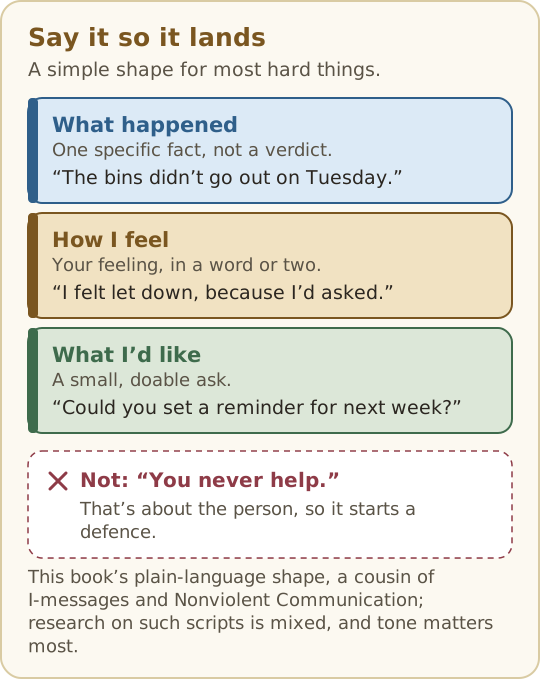
Sybil Carrère and John Gottman (1999) found that the way a couple’s conflict conversation began, especially whether it opened harshly, was closely linked to how the rest of it went. Gottman distinguishes a complaint (about a specific action) from criticism (an attack on the person’s character). “The bins weren’t taken out” is a complaint. “You never help” is a criticism. Complaints can be heard. Criticism tends to start defence, and defence tends to start more criticism. See Complaints versus criticism.
Thomas Gordon’s “I-messages” (1970) and Marshall Rosenberg’s Nonviolent Communication (observations, feelings, needs, requests) offer gentle structures. Research on both is limited and mixed: some studies find I-statements are heard as less hostile, others find tone and context matter more than the pronoun. They are best seen as helpful scaffolding rather than magic words.
State matters too. When people are very upset, their heart rate rises and listening gets much harder. Gottman called this “flooding.” A short break to calm down, with a clear time to return, often helps more than pushing on.
Philosophy
Aristotle, in the Nicomachean Ethics, wrote that anyone can get angry, but being angry with the right person, to the right degree, at the right time, for the right reason and in the right way is not easy. He did not ask us to have no anger. He asked us to use it well. Buddhist teaching on “right speech” asks similar questions before speaking: is it true, is it helpful, is it kind, and is this the right time? You don’t need to be Buddhist to find those four questions useful before a hard talk.
Through an autistic lens
Many autistic people prefer to raise hard things directly and specifically, which can work beautifully with the complaint-not-criticism idea. Clashes come when directness is heard as harshness, or when the other person hints and the autistic person misses it. Scripts and written notes can help someone plan a hard talk in advance, especially when speaking under stress is difficult. Some people find it easier to start a hard topic in writing and then talk once both have read it. That isn’t avoidance. It’s choosing the channel where you communicate best.
This site’s idea: A simple shape for most hard things: what happened, how I feel, what I’d like. It is a plain-language cousin of the structures above, and it’s in Say it so it lands.
Words you could use: “There’s something I’d like to talk about. Is now okay, or later today?” “What happened was... I felt... Could we...?”
Giving and receiving feedback
Feedback is a hard thing said on purpose, often between people of unequal power. Done well, it helps. Done badly, it can make things worse. In a large review of feedback studies, Kluger and DeNisi (1996) found that feedback improved performance on average, but in more than a third of cases it made performance worse, especially when it drew attention to the person rather than the task.
Giving it
- Talk about the work, not the person. “The report had three figures wrong” helps. “You’re careless” doesn’t.
- Be specific, and recent. One example from this week beats a list from the past year.
- Say what good looks like, and ask what would help them get there.
- Ask before you assume. “What got in the way?” often finds a setup problem: unclear deadlines, two people owning the same job, too much at once.
- Don’t save it up. Small, regular feedback is easier to hear than one big annual verdict. Praise counts as feedback too.
Receiving it
- Expect the body to react. A hot face or a sinking stomach is normal. You don’t have to answer straight away: “Thank you. Can I think about this and come back to you tomorrow?”
- Separate what you heard from what it meant. “The figures were wrong” is a fact to check. “I’m useless” is a story you added. Chapter 7 has a filled-in example of turning that story round.
- Ask for one example and one next step. Vague feedback is hard to act on.
A performance conversation
A made-up example. Rowan manages Celeste, whose project updates have been late three weeks running. He books twenty minutes, not five at the end of a meeting, and starts with the facts: “The last three Friday updates came on Monday. That left the client chasing me.” Then he asks, “What’s been getting in the way?” Celeste, who had been bracing for a telling-off, explains she has been covering a colleague’s accounts since he went off sick. Rowan hadn’t known. They agree she hands two accounts back, the update moves to Monday mornings, and they check in a month. Rowan writes it down and sends it to her the same day, so they both remember the same thing.
Words you could use: Giving: “Can I give you some feedback on the report? I want it to be useful, so stop me if it isn’t clear.” Receiving: “Thanks for telling me. Can you give me one example, so I know exactly what to change?”
If feedback is regularly used to humiliate someone, or a performance process is being used to push someone out unfairly, that isn’t a communication problem to fix with better phrasing. Keep notes, and talk to HR, a union or an employment adviser.
Mix-ups are normal; repair is the skill
If you watch real conversations closely, they are full of small breakdowns: a word misheard, a joke that doesn’t land, a pause read the wrong way. Good communicators aren’t people who never miss. They are people who notice and mend quickly.
Psychology
Researchers who study recorded conversations, such as Emanuel Schegloff, Gail Jefferson and Harvey Sacks (1977), found that “repair” is built into ordinary talk. People constantly correct themselves (“on Tuesday, sorry, Wednesday”) and each other (“You mean the blue one?”), and speakers usually prefer to fix their own slips when given a moment.
Ed Tronick’s research on parents and babies, including his famous “still face” studies, suggests that even loving parent and baby pairs drift in and out of sync often, and that the repeated experience of mismatch followed by repair helps babies learn that relationships can survive disruption. In couples, Gottman describes “repair attempts” (a joke, a touch, “Can we start over?”) and found that whether these are made, and accepted, matters a great deal in how conflicts go. See Repair attempts.
Philosophy
Hannah Arendt, in The Human Condition (1958), noted that we can’t undo what we’ve done or said. She saw two human powers that make living together possible anyway: forgiveness, which releases us from the past, and promising, which gives some stability to the future. A small repair (“I’m sorry, that came out wrong; I’ll try again”) uses both in miniature. The Japanese craft of kintsugi, mending broken pottery with gold, is often used as a picture of the same thought: a mended thing can carry its history with dignity.
Through an autistic lens
Repair is easier when it’s explicit. “Wait, I think I misunderstood” is clear and easy to accept. Hints, like a cool tone that’s meant to signal “you upset me,” can be hard for some autistic people to read, so the repair never starts. Many autistic people also describe masking: hiding confusion to seem socially smooth, which makes it hard to say “I didn’t follow.” Shutdowns and meltdowns are not a refusal to repair; they are an overloaded nervous system. Repair can come later, in writing, after rest. A home or team where anyone can say “I lost the thread” without embarrassment is safer for everyone.
Words you could use: “I think I got that wrong. Can I try again?” “I’m too overloaded to talk now. Can I message you tonight?”
Messages lose their tone
Much of life now runs on texts, chats and email. They’re quick and easy to send, and they lose most of what helps meaning travel: a face, a voice, a pause, a smile.
Psychology
Justin Kruger, Nicholas Epley and colleagues (2005) found that people writing emails were too confident that their tone, such as sarcasm or seriousness, would be read correctly. Readers often got it wrong, while the writers could “hear” their own tone clearly. Richard Daft and Robert Lengel’s media richness theory (1986) suggested that richer channels (face to face, then voice, then text) suit messages that are complicated or emotionally loaded. Research on it is mixed, but the everyday advice holds up: the more tender or complex the message, the richer the channel it may need.
Small details carry meaning in text. One study by Danielle Gunraj and colleagues (2016) found that one-word text replies ending in a full stop were rated as slightly less sincere than the same replies without one. Conventions like this vary by age, group and culture, which is exactly why they get misread.
Philosophy
In Plato’s Phaedrus, Socrates worries about writing. A written text, he says, can’t answer when you question it; it keeps saying the same thing, and when it’s misunderstood it can’t defend itself. Two thousand years later, anyone who has watched a short message be misread knows the feeling. The answer isn’t to stop writing. It’s to remember that a written message can’t explain itself, so you may need to explain it.
Through an autistic lens
Many autistic people prefer text. It gives time to process and to think about a reply, it removes the need to read faces and voices in real time, and it leaves a record to check later. That can make text the clearest, calmest channel for them, not the weakest. At the same time, vague or very short messages (“We need to talk”) can cause a lot of worry. Agreeing on simple conventions helps: say whether a message is urgent, say when you need a reply, and say if a short reply is just short.
This site’s idea: The “grumpy voice” check: before sending something tricky, read it out loud in the grumpiest voice you can. If it can sound harsh, add a warm word, a reason or a time frame. The Chat analyzer does a similar check on your device.
Words you could use: “Not urgent, reply whenever.” “I’m short on time, so this is brief, not cross.” “Can we talk about this on the phone? Text isn’t doing it justice.”
Chat analyzer: paste a conversation
01 Paste the conversation
Dana: Did the slides go to the client?
Raj: Not yet, still waiting on the numbers from finance
Dana: I needed them by 10. This always happens.
Raj: I can't make finance go faster.
Dana: Forget it. I'll do it myself.
02 Which one is you?
- Chosen: Dana (3 messages)
- Raj (2 messages)
03 The read
- What happened
- Ends shut down. 5 messages: 3 from you, 2 from Raj. The words don’t make it clear what it’s mostly about, so the Reader won’t guess. It starts calm. There’s no one big turn, but some tension creeps in. By the end someone has pulled back. That isn’t the same as calm: it can mean they’re overwhelmed, or hurt.
- Your part · always / never
- I said “This always happens”, and that isn’t fair: it isn’t every time. What I meant was: [one recent time, and how it felt].
04 Check your reply before you send it
- Your reply
- Sorry, that last line wasn’t fair. When the numbers weren’t in by 10, I felt worried about the client. Could you ask finance for them by 9 next time? I’ll chase them with you.
The check
✓ Says what you need or how it landed · ✓ Makes one clear ask · ✓ No verdicts, always/never, dismissals, sarcasm, jabs, comparisons or shutting the door · ✓ Stays on one topic
Nothing in the wording is likely to add heat. Read it once more as if you were them, then send it when you’re calm.
A made-up example. Names and details are invented. The Reader looks at one side’s part without blaming anyone.
Fill in your own: Chat analyzer (spreadloveandacceptance.com/
Different styles aren’t wrong styles
People differ in how direct they are, how fast they talk, whether they overlap or wait their turn, how much they say with words and how much with silence. These styles come from families, cultures, languages and different kinds of minds. A clash between two styles usually feels like a clash between two people. Often it’s a translation problem.
Psychology
The anthropologist Edward T. Hall (1976) described high-context and low-context communication. In high-context settings, much of the meaning is in the relationship, tone and setting. In low-context settings, more of it is in the exact words. Linguist Deborah Tannen studied conversations among friends (1984) and described styles she called “high-involvement” (fast, overlapping, enthusiastic) and “high-considerateness” (slower, with more space). What feels warm and engaged to one style can feel like being interrupted to the other. These are broad patterns, not boxes: individuals vary a lot within any culture or family.
Damian Milton (2012) described the double empathy problem: when autistic and non-autistic people misunderstand each other, the difficulty runs both ways, rather than being an autistic deficit. Research supports this. Catherine Crompton and colleagues (2020) found that information passed along chains of autistic people was shared as well as along chains of non-autistic people, with more loss in mixed chains. Elizabeth Sheppard and colleagues (2016) found that non-autistic observers had more trouble reading the facial reactions of autistic people than those of other non-autistic people. See The double empathy problem.
Philosophy
Wittgenstein’s idea that language lives inside “forms of life” fits here: each family, workplace and culture has its own ways of speaking, and none is the one true way. The Confucian tradition put great weight on fitting your words to the relationship and the situation, while many modern Western settings prize plain speaking. Both carry wisdom. Learning a second style doesn’t mean giving up your first.
Through an autistic lens
Autistic communication is a style, with its own strengths: honesty, clarity, deep focus on a topic, and less interest in hidden games. Problems often arise not because the style is wrong, but because only one style is treated as normal. The fairest approach is two-way: each person says how they communicate best, and each meets the other partway. A “How to talk to me” card (one page on how you communicate) can make this easier to share, at home or at work.
Words you could use: “I’m quite direct. If I sound blunt, please ask before assuming I’m cross.” “I take things literally, so please say exactly what you need.” “In my family we talk over each other. Tell me if I’m doing it.”
Small talk and social scripts
Small talk is the light, everyday talk about the weather, the weekend, the traffic or the queue. Some people find it easy and pleasant. Many find it baffling or exhausting. Knowing what it is for, and having a few ready-made lines, can make it much easier, and keeping it short is allowed.
Psychology
In 1923 the anthropologist Bronisław Malinowski coined the phrase “phatic communion” for talk whose main job is social rather than informational: “Lovely day” doesn’t tell anyone about the weather, it says “I see you, and we’re on friendly terms.” Small exchanges like this matter more than people expect. Sandstrom and Dunn (2014) found that people who had a short, friendly chat with a coffee-shop barista felt more belonging and a better mood than people who kept the exchange purely efficient. Epley and Schroeder (2014) asked commuters to talk to a stranger, or to keep to themselves; the talkers reported a more pleasant journey, even though most people had predicted the opposite.
Small talk also drains many people, and for understandable reasons. Its rules are unwritten (how long, which topics, how to end), so it involves a lot of guessing. For people who are anxious, shy, speaking a second language or autistic, that guessing uses real energy. Ready-made lines, often called social scripts, take some of the guesswork out: one line to open, one follow-up question, one line to close. And small talk is not the only road to connection. Kardas, Kumar and Epley (2022) found that people expected deeper conversations with strangers to be more awkward than they turned out to be; people generally enjoyed them, and felt more connected, more than they predicted.
This site’s idea: Open, one more, close. Have one line ready for each step. Open: “Morning! How’s your week been?” One more: “Oh, how was that?” Close: “Lovely to see you, I’d better get on.” Three lines are enough for most school gates, lifts, kitchens and queues.
Philosophy
The sociologist Erving Goffman, in Interaction Ritual (1967), described everyday exchanges as small rituals that help people protect each other’s “face”: their sense of being respected. A greeting, a “How are you?”, a goodbye are ritual moves that keep the social world running smoothly. Confucian thought, much earlier, valued li, ritual propriety: the small, shared forms of courtesy that express respect and hold communities together. On both views, small talk isn’t meaningless. Its meaning is in the doing, not the words.
Through an autistic lens
Many autistic people describe small talk as confusing, pointless or tiring: why ask “How are you?” if you don’t want to know? Many prefer to talk about something real, or to share an interest in depth (sometimes called info-dumping), which can be a warm way of connecting. Scripts can be a useful tool, used where they help and dropped where they don’t. It is fair to say what suits you: “I’m not great at chit-chat, but I’d love to hear about your garden.” Others can help by asking clear questions and by not reading a short reply as rudeness. Using scripts all day to seem “normal” can become a form of masking, which is tiring (see Chapter 9), so it’s worth finding places where you don’t need them.
Words you could use: To open: “Morning! How’s your week been?” To keep going: “Oh, how was that?” To close: “I’ll let you get on. Have a good day.” To opt out kindly: “I’m not great at chit-chat, but it’s really nice to see you.”
Putting it together
Seen together, these ideas tell one story. A meaning starts in one mind. It is packed into words, tone and timing. It travels through a channel that may strip some of that away. It arrives in another mind that is tired or calm, hopeful or braced, and that mind builds its own meaning from what arrives. The message carries content and something about the relationship. Each person brings their own style, culture and wiring.
With that many steps, mix-ups are not a sign that something is broken. They are what communication is like. The skills that help are humble ones:
- Send clearly: say what you mean, when you mean it and how much it matters.
- Receive generously: listen to understand before replying, and assume a mix-up before assuming bad intent.
- Check often: especially with the people you know best.
- Repair quickly: small, early, out loud.
- Choose the channel: text for facts, voice or face to face for feelings, writing first if that’s how someone communicates best.
- Translate, don’t rank: different styles are different, not worse.
And one thing these skills can’t do: they can’t make a relationship safe if someone is using words to control or frighten you. That isn’t a communication gap, and better phrasing is not the answer. See Limits, safety and more help.
Worked examples
On your own: the voice in your head
Gus drops a glass and hears himself think, “Useless. Can’t do anything right.” He notices the two layers: the content is “I dropped a glass.” The relationship layer, with himself, is harsh. He tries a repair: “I dropped a glass. I’m tired. I’ll sweep it up.” It sounds small, but the way we talk to ourselves sets the tone for how we hear others.
Partners: the late dinner
Mira texts “Dinner’s cold.” Jon reads anger and replies defensively. Mira meant “I’m sad we didn’t eat together.” When they talk that evening, Jon asks, “Was that about the food or about us?” Mira says, “About us. I miss our dinners.” They agree that late-running days get a message by five, and that Mira will say the feeling, not just the fact.
Parent and teenager: “Whatever”
Every time Barry asks his son about school, he gets “Whatever.” He tries listening instead of asking: sitting in the car, eyes on the road, no questions. After a few trips his son starts talking. Side-by-side, low-pressure settings often help teenagers (and many autistic people) talk more easily than face-to-face questions.
Coworkers: the quiet objection
In a team meeting, Roshni stays silent while a plan is agreed. Afterwards she messages her manager saying she has concerns. He feels blindsided. They agree that he’ll ask “What could go wrong with this?” before decisions, and that she can send thoughts in writing after the meeting. Her style isn’t wrong; the meeting just didn’t have a door for it. See At work.
Housemates: the fridge note
A note says “WHOSE IS THIS???” on a mouldy container. The housemate who owns it feels shamed. In the house meeting, they agree on a kinder system: a “use soon” shelf and a weekly clear-out. The content got sorted, and so did the relationship layer. See Sharing a room.
Friends across styles
Jess, who is autistic, tells her friend Mel, “I didn’t enjoy the party. It was too loud.” Mel hears rejection of her party. Later Jess explains: “I meant the noise, not you. I loved that you invited me.” Mel says, “Next time I’ll tell you if it’s a big one, and we can do coffee instead.” Both styles got translated, and the friendship got stronger. See Friends.
A stranger on the phone
On a long call to an energy company, Dolores feels her voice getting sharp. She says, “I’m frustrated with the situation, not with you.” The call handler softens, and the problem is fixed faster. Separating the content (the bill) from the relationship (this person, today) works with strangers too.
Exercises
- Two layers. Think of a recent small argument. Write down what it was about (content) and what it seemed to say about the relationship. Which layer was the real sticking point?
- Say it back. In three conversations this week, say back what you heard before you reply. Notice what changes, in them and in you.
- Check one meaning a day. For a week, ask one “what do you mean by...?” or “by when?” question each day, ideally with someone you know well.
- Draft before you need it. Write a what-happened, how-I-feel, what-I’d-like sentence about something small. Practising on small things makes the shape easier to use on big ones.
- The grumpy voice test. Before sending three tricky messages, read them aloud in a grumpy voice. Adjust one word each time. (This site’s idea)
- Your style sentence. Finish this: “I communicate best when...” Share it with one person, and ask for theirs. A “How to talk to me” card can help.
- Notice a repair. Each day, notice one repair, yours or someone else’s: “Sorry, I meant...,” “Let me try again.” Repairs are everywhere once you look.
When it goes wrong, and when it goes right
When it goes wrong, each person is sure their meaning was obvious. One hears criticism in a fact; the other hears an overreaction in a feeling. Both defend what they meant instead of asking what was heard. The talk moves to texts, where tone gets thinner, and by the end both people are arguing about the argument. Next time the topic comes up, both are already braced.
When it goes right, someone notices early: “I think we’ve got crossed wires.” One person says back what they heard. The other corrects it gently. Someone names the relationship layer (“I think this is about feeling left out, not the calendar”). If it’s getting heated, they pause and agree a time to come back. Afterwards, one of them sends a short, warm message. Nobody had to be perfect. They just kept repairing.
Most real conversations sit somewhere in between, and that’s fine. Every small check or repair you make shifts the next conversation a little towards the second picture.
Questions people often ask
Isn’t it exhausting to check everything?
You don’t need to check everything, only the things that matter or that have gone wrong before. Over time, checking becomes quick and natural, and it saves far more time than it costs.
What if the other person won’t listen?
You can only do your part: say it clearly, listen well, repair when you can. If someone never listens, it may be worth asking why, at a calm moment, or getting help from a counsellor. If refusing to listen is part of a pattern of control, see Not safe at home?
Is it okay to prefer text for hard conversations?
Yes, for many people it’s the clearest channel, especially autistic people and anyone who needs time to think. Agree on it together, keep messages kind and specific, and move to a call if two messages in a row go badly.
I’m autistic and people say I’m rude. What can I do?
Being direct isn’t rude, but it can be heard that way by people who expect hints. It can help to tell people your style up front, and to add a warm word where it costs you little. You shouldn’t have to mask all the time. Communication is two-way, and the other person can learn your style too. See Wired Differently.
What if we speak different first languages?
Then checking matters even more, and humour, idioms and indirect requests are easy to miss. Keep sentences simple, check meanings kindly, and assume good intent first. Two faiths or cultures, one family has more.
Why do I communicate well at work but badly at home?
At work, roles and expectations are clearer, and we’re often on our best behaviour. At home we’re tired, the history is longer, and the relationship layer is louder, because these people matter most. The closeness-communication bias also means we check less with those we love. Bringing a little “work clarity” home (clear asks, clear times) can help.
Can I talk it through with someone first?
Yes. Professor Puddles, the site’s friendly chat host, can help you find a calm first sentence. For bigger or long-running problems, a counsellor can help too.
Limits, safety and more help
- This chapter is general education about how people tend to communicate. It isn’t therapy, and it can’t know your situation.
- Research on communication is often based on particular groups (many studies use couples or students in a few countries), and some popular methods have a thin evidence base. Where we know that, we’ve said so.
- Better communication can’t fix a relationship where one person is controlling, frightening or hurting the other. If you’re afraid, you don’t owe anyone a perfectly phrased conversation. Not safe at home? lists free, private help, and signs to look out for may help.
- If speaking, hearing or understanding is hard for you every day, a doctor, speech and language therapist, audiologist or counsellor can help. If you’re struggling right now, start with Upset right now.
To practise, try Rewind the talk on one conversation that went wrong, or Say it so it lands for the sentence you go back in with. The library’s talking and listening page has more on each idea.
Last updated: October 2026