Part Two: Between us · Chapter I
Why we get out of tune
Tuesday, 6:40pm
“I said I’d do it.” “I know, I’m just asking when.” Four sentences later, nobody is talking about the bins any more, and neither of you can point to the moment it turned.
A picture, not a measurement. Nothing in this chapter records, analyses or scores anyone’s real voice. It borrows an image from radio to explain why calm, kind people can sound harsh to each other when they’re under stress.
This chapter looks at everyday clashes in a different way: not as one person attacking the other, but as two signals that are slightly out of tune, like two radios on nearly the same station.
In short:
- A clash often isn’t about the words. Pace, tone and urgency can be out of step even when both of you mean well.
- Nobody has to be wrong. Name it (“we’re out of tune”), pause with a time to come back, and slow down.
- Go back in with one clear sentence: a fact, a feeling and an ask.
- A 90-second daily check-in keeps small drifts small.
Where this fits: the five big ideas
The whole program rests on five big ideas. Each one starts inside you and then shows up between you and other people. This chapter mostly teaches “Tune how you send and receive”, with help from “Read your state first”. (Drawn from psychology and neurobiology, with a picture borrowed from radio.)
- In you: Know your own pace, your usual tone and what “soon” means to you. Notice when stress speeds you up or slows you down.
- Between you and others: When a clash starts, treat it as a tuning problem, not a moral failing. Retune together, then translate what you meant into words the other person can hear.
The radio whistle
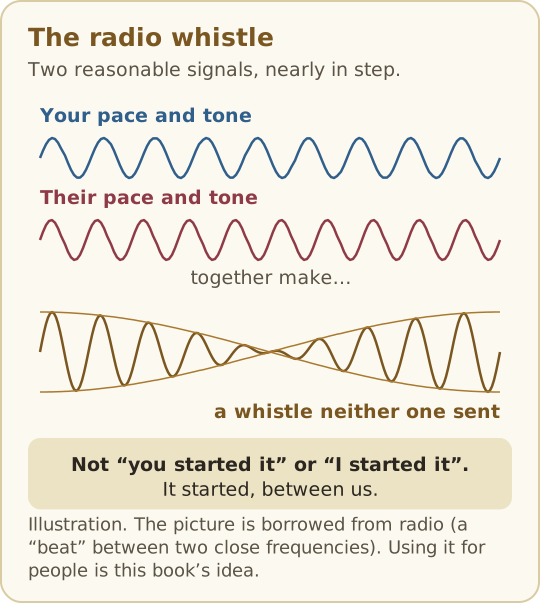
Tune two radios to stations that are close but not the same, and you don’t get silence. You get a whistle. The two signals overlap just enough to interfere, and they make a third, uglier sound that neither radio was sending. Engineers call this a heterodyne, or a “beat”: the extra tone that appears when two signals are almost, but not quite, in step.
This book borrows that picture for a familiar moment. Two people each say something reasonable. Each one’s tone is shaped by their own tiredness, hurry or stress. Together they get an argument that neither of them meant to start. The words weren’t the problem. The mismatch was.
The reasoning. If you think the other person attacked you, you defend. If you think two signals crossed, you check. The picture of a whistle gives you a third option between “you started it” and “I started it”: it started, between us.
Worked examples
- Two mums at breakfast: “Have you seen my keys?” (rushed) meets “Where you left them, I expect” (tired). Neither line is cruel, but together they sound like a row. A laugh and “Sorry, that came out wrong” clears it.
- A coworker pair: “Can you send that over?” in a team chat, with no greeting, lands as cold. The sender was typing on a phone in a lift. See At work.
Common mix-ups, and how to fix them
- “The words were fine, so it’s their problem.” The words may be fine. The clash lives in the mix, so both of you can help clear it.
- Arguing about the exact words. “I said ‘can you’, not ‘you should’” rarely helps. Talk about how it came across instead.
If only one of you is on board: You can still notice the whistle and lower your own pace and volume. One radio moving closer to the other already cuts the static.
Words you could use: “That came out sharper than I meant.” “I think we just crossed wires.”
Research notes
The whistle is real physics: two close frequencies combine into a “beat” at the difference between them. Using it for people is this site’s idea, a picture, not a measurement. Psychologists Thomas Gilovich, Kenneth Savitsky and Victoria Medvec (1998) described the “illusion of transparency”: we tend to think our inner states and intentions are more obvious to others than they really are. So the sender often assumes the kindness was clear.
Why being nearly in step is the noisy part
The pitch of that radio whistle depends on the gap between the two stations. When the gap shrinks to nothing, the whistle disappears. When two stations are very far apart, the two signals don’t mix into anything you can hear.
People can work the same way. Strangers who barely interact rarely clash. People who share a home, a family or a job are close enough to overlap all day. That closeness is a good thing, and it also means small differences in pace or tone rub against each other again and again. A clash between two close people usually doesn’t mean they are badly matched. Often it means they are nearly matched, and just slightly off. Research also suggests we check our meaning less with people we know well, because we assume they already understand us.
The reasoning. This flips a painful thought. “We clash, so we must be wrong for each other” becomes “We clash because we are close, and we skip the checking.” The fix isn’t distance. It’s a little more checking.
Worked examples
- Best friends since school: They finish each other’s sentences, so they never check. One says “Let’s do something for your birthday,” meaning a meal; the other expects a weekend away. See Friends.
- A grandparent and a grown-up child: A father says, “I’ll have the kids Saturday, as usual.” His daughter had planned a family day and feels her plans were taken over. They are so used to each other that nobody asked. See For grown-up children.
- A couple together for decades: With the children gone, they are home together more, and small differences in pace rub more often. See Empty nest and Retired together.
Common mix-ups, and how to fix them
- “If they really knew me, I wouldn’t have to explain.” Knowing someone well makes us explain less, which is exactly when misreadings creep in. Explaining is care, not a sign of distance.
- “We used to be in sync, so something is broken.” Lives change: new jobs, new babies, new hours. Drift is normal. Retune to the new life.
If only one of you is on board: Check your own meaning out loud more often, especially with the people closest to you. It costs a sentence and saves an evening.
Words you could use: “I know we usually just get each other, but let me check: did you mean…?”
Research notes
Kenneth Savitsky, Boaz Keysar, Nicholas Epley and colleagues (2011) found what they called the “closeness-communication bias”: people overestimated how well they communicated with friends and spouses, in some tests not doing better than with strangers. That is the finding behind this section.
What sets the frequency
Three things tend to shift how someone comes across, often without them noticing:
- Pace. How fast you talk, how quickly you reply, and how long a pause feels. Someone who is tense may talk faster, jump in sooner, and read an ordinary pause as the silent treatment.
- Tone. A comment meant as a simple update (“the sink’s full again”) can be sent, or heard, as a complaint. It depends on the tone underneath it.
- Urgency. One person’s “when you get a chance” can mean tonight. Another person’s can mean next week. Neither is wrong, but they aren’t the same.
Here is how the same sentence can be sent one way and heard another:
| What was said | What was meant | What was heard | Which one slipped |
|---|---|---|---|
| “The sink’s full again.” | A simple update | “You never do the dishes.” | Tone |
| “Can we talk about the holiday?” | Some time this week | Right now | Urgency |
| “Mm.” (after a pause) | “I’m thinking.” | “I don’t care.” | Pace |
| “I’ll do it later.” | This evening | Maybe never | Urgency |
The Frequency Framework takes this further, into the longer rhythms each of you runs on: money, rest, decisions, talking and values.
The reasoning. Pace, tone and urgency are the parts of a message that aren’t in the words, so they’re the parts most likely to differ. Naming them gives you three quick questions to check, instead of one big, vague “Why are you being like this?”
Worked examples
- Interfaith or cross-cultural families: In Amal’s family, people talk over each other to show they care. In Lukas’s family, interrupting is rude. At Sunday lunch, Lukas hears a fight and Amal hears a lively chat. Neither family is wrong; their pace is set differently. See Two faiths, one family.
- Gaming and screen time: “Coming!” from a teenager in the middle of an online match means “when the round ends,” which might be ten minutes. To the parent at the table, it meant now. Agreeing what “coming” means ends a nightly fight. See Gaming and time together.
- Shift workers: A text sent at 3am by a night-shift nurse (“Can we sort the bins?”) arrives to a partner just waking up, and feels urgent. It wasn’t. A rule helps: “Non-urgent texts go in one morning message.” See Different hours.
Common mix-ups, and how to fix them
- “My tone was fine.” Maybe it was, to you. Ask how it landed rather than defending how it was sent.
- “‘When you get a chance’ is obvious.” It isn’t. Add a time.
- “Texting is safer.” Texts are calmer to send but easier to misread. For anything tender, add a feeling word, or call.
If only one of you is on board: Fix your own sending first. Add a time to your requests, say “this is just an update” before updates, and slow your own pace. One clearer signal already cuts the noise.
Words you could use: “Is this a now thing, a today thing, or a this-week thing?” “I’m not upset, I’m just in a hurry.”
Research notes
Justin Kruger, Nicholas Epley and colleagues (2005) found that people sending emails were too confident their tone (such as sarcasm or seriousness) would be read correctly. Anthropologist Edward T. Hall described “high-context” and “low-context” communication styles (1976): in some families and cultures, much of the meaning is in tone and setting; in others, it is in the exact words. This site’s idea: the three dials of pace, tone and urgency.
How stress changes your frequency
How your body feels changes how you sound and how you hear. The site describes three everyday states, on what it calls the Nervous System Ladder, a thirty-second self-check. It gives you a best guess, not a reading:
- Calm and connected. Breathing is easy. You can hear something hard without getting defensive.
- Revved up. You feel tense and fast. Your heart is quicker and thoughts move fast. Small things feel urgent or personal. Pace speeds up, and tone gets sharper.
- Running on empty. You feel tired and flat, and words are harder to find. Replies get slower and shorter, which the other person may read as not caring.
These labels come from polyvagal theory, whose main claims are still debated by scientists. Here they are only everyday words, not a medical model. “Running on empty” just means ordinary, everyday tiredness. The point is simple: when you are revved up or running on empty, you are more likely to send and hear signals off-key. Chapter III goes deeper into how much stress you bring into a conversation from elsewhere.
The reasoning. The same words can be easy on a calm day and impossible on a tired one. If you check your state first, you can choose to wait, to warn (“I’m low, so I’ll be brief”), or to go ahead. If you skip it, your state chooses for you.
Worked examples
- A partner with a long-term illness: On high-pain days, Lorna’s replies get short. Her partner learned to read short replies as “pain,” not “cross,” and to ask, “Is this a low day?” See When one of you is ill.
- A foster carer and a child: A child who has been through a lot may jump straight to “revved up” at a raised voice. The carer lowers their own voice and slows down first, before any talk about the broken plate. See Foster, adoptive and kinship families.
- A parent and a child with ADHD: At 5pm, after a long school day, both are running on empty. They move homework talk to after a snack and ten minutes outside. See When a child has ADHD.
Common mix-ups, and how to fix them
- “You’re revved up” as a put-down. The ladder is for checking yourself. Don’t use it to label someone else.
- “I’m always running on empty, so I can never talk.” If that’s true for weeks, it’s a sign to rest and get support, not to stop talking forever. Talk briefly, at your best time of day.
- “Calm means I’m not allowed to be upset.” Calm and connected doesn’t mean happy. You can be calm and sad, or calm and firm.
If only one of you is on board: Check your own state and say it out loud. “I’m running on empty, so I’ll keep this short” changes how your words land, even if the other person never uses the ladder.
Words you could use: “I’m revved up right now. Give me ten minutes and I’ll be easier to talk to.”
A note on safety: If you are tense because you are afraid of how someone will react, that is not just stress. Your body may be warning you. Not safe at home? has free, private help.
Research notes
Sleep researchers in Matthew Walker’s lab (2007) found that after a night without sleep, the brain’s alarm centre (the amygdala) reacted much more strongly to upsetting pictures. John Gottman’s research on couples described “flooding”: feeling so overwhelmed in a conflict that listening becomes very hard. As noted above, the three labels here are everyday words, not a medical model.
Nobody has to be wrong
None of this needs either person to be at fault. Two radios that both work perfectly will still whistle if they are slightly off. No amount of arguing about who’s “really” to blame fixes the interference. Retuning does.
Zhuangzi’s Empty Boat makes the same point. A man in a boat is angry when another boat bumps into his, until he sees that it is empty. With no one to blame, his anger goes. Much of the time, the bump was no one’s plan. That doesn’t mean a bump never matters. It means starting with curiosity instead of blame.
People are also wired differently. Some notice every shift in tone. Others take words very literally. Wired Differently explains how a mix-up between two differently wired people usually runs both ways.
The reasoning. Blame narrows attention to one person. “No fault” widens it to the setup: the time of day, the tiredness, the unclear words. Once the setup is in view, there is usually something easy to change.
Worked examples
- A neurodivergent and a neurotypical partner: One partner says exactly what they mean. The other listens for hints. “It’s fine” means “it’s fine” to one, and “it’s not fine” to the other. Both are reading carefully, just in different ways. See Wired Differently.
- Separated co-parents: A message about pickup times turns into a row about the past. They agree that pickup messages are facts only, and feelings go in a separate monthly call. See Co-parenting.
- Someone coming out to family: After Leah comes out, her mother asks, “Are you sure?” Leah hears doubt; her mother meant fear for her. Naming that both were scared helps them start again. See Coming out as an adult.
Common mix-ups, and how to fix them
- “No fault means nothing matters.” It means start with curiosity. If something hurtful keeps happening after it’s been named, that matters, and it is fair to say so.
- “If I don’t blame them, I must blame me.” No. Neither. Look at the setup.
If only one of you is on board: You can drop blame on your side, even if the other person doesn’t. “I don’t think you meant that the way I heard it” often softens things quickly.
Words you could use: “I don’t think you meant that the way I heard it. Can you tell me what you meant?”
A note on safety: “Nobody has to be wrong” is for ordinary clashes. It never means excusing threats, put-downs or fear. If someone frightens you, it is not a tuning problem. Not safe at home?
Research notes
Psychologist Lee Ross named the “fundamental attribution error” (1977): we tend to blame someone’s character for what was really caused by their situation. Damian Milton (2012) described the “double empathy problem”: when autistic and non-autistic people misunderstand each other, the gap runs both ways. Zhuangzi’s Empty Boat is a story, not a study.
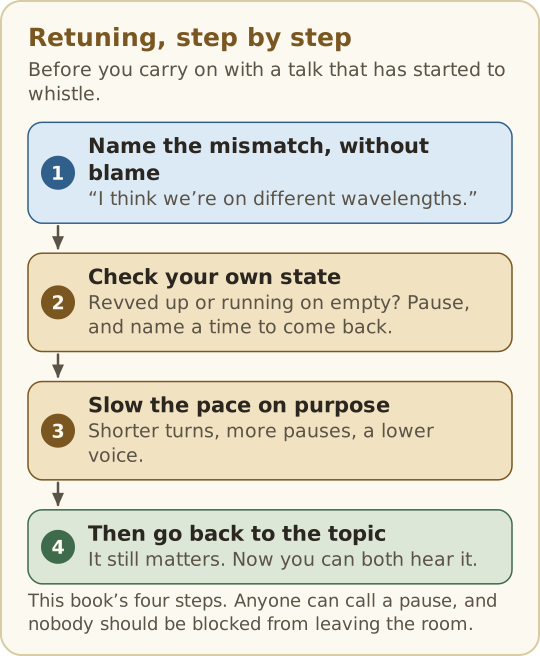
Retuning, step by step
Before you carry on with a conversation that has started to whistle:
- Name the mismatch out loud, without blame. “I think we’re on different wavelengths right now.” This turns “you against me” into “us against the static.”
- Check your own state on the Nervous System Ladder. It’s hard to retune while you are revved up or running on empty. If you are, the Calm-Down Kit, a simple plan for heated moments, comes first. Either of you can call a pause, and the person who paused names a time to come back.
- Slow the pace on purpose. Take shorter turns. Leave more pauses. Lower your voice. Keep going like this until the static clears.
- Only then, go back to the topic. The topic still matters. You are just coming back to it when you can both hear properly.
The reasoning. Each step does one job. Naming it stops the spiral. Checking your state tells you whether you can go on. Slowing down lowers the heat. Going back to the topic keeps retuning from turning into avoiding.
Worked examples
- Housemates: A row about noise at midnight. One says, “We’re both tired. Can we talk about this at breakfast?” At breakfast, it takes five minutes. See Sharing a room.
- Three partners: When a talk gets heated, the third partner gently says, “Static,” and all three take a pause. They agreed the word on a calm day, and anyone can use it. See More than two partners at home.
- Long-distance partners: A video call drops mid-argument and each assumes the other hung up. Now they have a rule: if the line drops in a hard talk, text “line dropped, still here” and call back after ten minutes. See Long distance.
Common mix-ups, and how to fix them
- Pausing without a time to return. That feels like being shut out. Always name a time.
- Coming back too soon. If you’re still revved up, take longer. A few minutes is often not enough.
- Retuning only when you are losing. Use the pause early, when you notice the static, not as an escape hatch.
If only one of you is on board: You can still pause yourself: “I need a few minutes so I can listen properly. I’ll be back at eight.” Then come back at eight.
Words you could use: “I want to hear you properly, and I can’t right now. Can we pick this up at eight?”
A note on safety: Anyone can call a pause, and nobody should be blocked from leaving the room. If you are followed, blocked or punished for pausing, that is a safety issue, not a tuning one. Signs to look out for.
Research notes
John Gottman’s work on couples suggests taking a real break when flooded, often at least twenty minutes, and doing something soothing rather than rehearsing the argument. Matthew Lieberman and colleagues (2007) found that putting feelings into words (“affect labelling”) can lower the brain’s alarm response, which may be part of why naming the mismatch helps. This site’s idea: the four steps in this order.
A worked example: the bins, replayed
Here’s the Tuesday scene again, slowed down.
Alex is tired and has a late shift tonight. Sam is tired and worried because the bins go out first thing tomorrow. Sam asks, “Are you putting the bins out?” The words are fine. But Sam’s urgency is set to “tonight,” and Alex’s is set to “before bed.” Sam is revved up, so the question comes out quickly. Alex hears the speed as nagging and says, “I said I’d do it.” Sam hears the snap and says, “I’m just asking when.” Now both are defending themselves, and the bins are forgotten.
Now the retuned version. After Alex’s snap, Sam pauses and says, “I think we’re out of tune. I’m a bit tense about tomorrow.” Alex takes a breath: “Me too, long day.” They slow down. Sam goes back in with one clear sentence: “The bins need to be out by 7am tomorrow. I’ll feel calmer if I know it’s out tonight. Could you take it out before bed?” Alex says yes, and names a time. The whole thing takes under a minute.
Two more replays
Adult siblings planning a parent’s birthday: Anjali messages her brother, “We need to decide about Mum’s party.” Arun, who lives far away and feels left out of decisions, hears “you’re late again.” He replies, “Do whatever you want.” Retuned: Anjali calls instead. “I think the message came out wrong. I really want your ideas. Could we decide by Sunday?” Arun says he’d love to do the cake. See Family rifts.
Two dads and a toddler at bedtime: Rob (revved up, late for a call) says, “Can you just do bath tonight?” Malik (running on empty) hears “you never do bath.” Malik snaps. Retuned: Rob says, “Sorry, I’m rushing. I’ve got a call at seven. Could you do bath, and I’ll do the morning?” A fact, a reason, an offer. Malik says yes.
Going back in: say it so it lands
When you return to the topic, it helps to have one clear sentence ready. Say it so it lands sorts what you want to say into three parts:
- The fact: one sentence, with no blame words. “The bins weren’t out before collection.”
- The feeling: what’s underneath. “I felt a bit on my own with it.”
- The ask: what you would like to happen next. “Could we pick a fixed night for it?”
If your sentence starts with “you always” or “you never,” pause and swap it for one fact and one ask. The Chat analyzer can show you how a sentence might land before you say it.
The reasoning. After a clash, both people are still a bit raw. A clear sentence gives them something solid to hold: one fact to agree on, one feeling to understand, one ask to say yes or no to.
Worked examples
- Business partners: “The invoice to Patel & Co went out three weeks late. I felt worried about cash flow. Could we set a reminder for the 1st of each month?”
- A teen to a parent: “You read my messages on Tuesday. I felt really embarrassed. Could you ask me first next time?” See For teens.
- A grown-up child to a parent: “You gave the baby sweets after I said no. I felt overruled. Could you check with me about food?” See For grown-up children.
Common mix-ups, and how to fix them
- Packing in three facts and two asks. One of each. Save the rest for another day.
- A feeling that is really a blame (“I feel you don’t care”). Use a feeling word about you: worried, alone, rushed, hurt.
- An ask that is really a rule (“You will…”). An ask can get a no. If it can’t, it isn’t an ask.
If only one of you is on board: A clear sentence works even if the other person doesn’t know the method. You don’t have to explain it. Just say it.
Words you could use: “Here’s what happened, how I felt, and what would help.”
Research notes
Sybil Carrère and John Gottman (1999) found that the first few minutes of a couple’s conflict conversation, gentle or harsh, predicted a lot about how things went for them later. The fact, feeling, ask pattern is close to well-known methods such as “I-statements” (from Thomas Gordon’s work in the 1970s) and Marshall Rosenberg’s Nonviolent Communication, which uses observation, feeling, need and request.
Staying in tune: small and often
Radios drift. So do people. Habit research suggests that small routines tied to a regular cue, like the same time each day, are easier to keep than big efforts made rarely. That hasn’t been proven for couples, but it is a sensible way to stay in tune: tiny corrections often, instead of one big correction after weeks of drift.
The quiet stretches drift most. When things have been fine for a long time, nobody listens for the whistle, and a small offset can grow for months without a sound. That is complacency: nothing breaks on the day the checking stops. A tiny, regular correction is the cure, and it works best when each of you can add a little context about your own signal (how the day went for you), so a flat reply is read as “tired,” not “cold.”
That’s the idea behind the 90-second daily check-in. The idea comes from electronics, where a small circuit keeps one signal in step with another by making tiny, constant corrections. Once a day, each of you says how much you were carrying today, one thing you appreciated, and, if you like, one small thing from your day that didn’t feel great (about the day, not about each other) and one thing that would help tomorrow. Either of you can pass, any day. You just listen. Nothing gets solved there.
If you want to see whether retuning is becoming a habit, the full chore-split calculator has a “retuning frequency”: the number of moments that got retuned, divided by the number of moments that landed badly. For example, if five things landed badly this week and you retuned three of them before answering, that’s 3 ÷ 5 = 0.60. It isn’t a grade. It only shows whether repair is happening more often over time. If nothing landed badly this week, leave it blank. With numbers this small, watch the trend over several weeks, not any one week.
The reasoning. Big talks are hard to schedule and easy to dread. A tiny daily one costs almost nothing, and it catches drift while it’s still small enough to fix with one sentence.
Worked examples
- Parents on opposite shifts: They leave a 90-second voice note at handover: how full their tank is, and one thing the other should know. See Different hours.
- Friends who live far apart: A Sunday “rose and thorn” message: one good thing, one hard thing from the week.
- Someone returning home after time away: For the first two weeks back, a short evening check-in helps them learn the new rhythm of the house. See Coming home.
Common mix-ups, and how to fix them
- Turning the check-in into a problem-solving session. Just listen. Save fixes for the weekly catch-up.
- Dropping it when things are good. The good stretches are when drift starts. Keep it tiny so it survives.
- Making it a duty. Either person can pass, any day, no questions asked.
If only one of you is on board: Do a check-in with yourself: how full is my tank, what did I appreciate, what would help tomorrow. You can also simply share your own line each day and let the other person join in if they like.
Words you could use: “Quick check-in? Mine: medium tank today, and I liked that you made coffee.”
Research notes
A 2010 study led by Phillippa Lally found that new daily habits took, on average, around two months to feel automatic, with a wide range from person to person, and that missing a single day didn’t undo progress. Gottman’s research on “bids” (small moments of reaching out) and turning towards them is linked to how couples stay close. See Turning towards.
The 90-second daily check-in
- Person A
- Priya
- Person B
- Dev
- Week beginning
- 5 October 2026
Each day
| Day | Person | Load | One thing I appreciated today | One small thing that didn’t feel great | One thing that would help tomorrow |
|---|---|---|---|---|---|
| Mon | Priya | High | You left soup in the fridge before my night shift | Woke up to the washing still in the machine | A text when you’re leaving work |
| Mon | Dev | Medium | Your note on the kettle | Bins out before I go at six | |
| Tue | Priya | High | You kept the house quiet till noon | Ten minutes together at the shift change | |
| Tue | Dev | Low | You booked the car in | Missed you at dinner again | |
| Wed | Priya | Medium | Breakfast together at 8 | Early night | |
| Wed | Dev | Medium | You remembered my mum’s call |
Load this week
- Priya
- 2 high, 1 medium, 0 low
- Dev
- 0 high, 2 medium, 1 low
The weekly catch-up
| Sore spot that keeps coming up | Times this week | Move to |
|---|---|---|
| Washing left in the machine | 2 | One owner per job |
| Missing each other at dinner | 2 | Keep watching |
A made-up example. Names and details are invented. One sentence each, then just listen: no debating, no solving.
Fill in your own: The 90-second daily check-in (spreadloveandacceptance.com/
Faith, culture and family voices
This chapter borrows its pictures from radio. For many readers, though, the oldest words about getting back in tune come from their faith. If you share a faith, the tools here can sit inside it, not against it. And whatever you believe, culture shapes how you speak: how fast, how directly, and who may say what to whom.
If you share a faith
- Prayer or worship as a shared rhythm. A few minutes of prayer together at night, or the walk home after worship, can do the job of the daily check-in: a small, steady moment to say how the day was and one thing you’re thankful for.
- A pause with a purpose. Retuning asks you to pause and name a time to come back. Some couples spend the pause in prayer, each on their own, and come back softer. The pause still needs a time: “Let’s pray on it and talk at eight.”
- Your own tradition’s words about speech. Many faiths say a lot about how to speak. Proverbs says, “A gentle answer turns away wrath.” The Qur’an asks believers to “say that which is best.” Jewish families speak of shalom bayit, peace in the home. Words you already hold dear can make a fact, feeling and ask sentence feel like your own.
- Your community and its leaders. A pastor, imam, rabbi, priest or trusted elder often knows you both and can be a good first person to talk to. Some offer marriage preparation or a couples group. For problems that need more, many faith communities can suggest a trained counsellor who shares or respects your faith.
The reasoning. Tools work best when they fit the life you already live. A habit tied to something you already do every week, like worship or a family meal, is easier to keep than a brand-new one.
Worked examples
- A same-faith married couple (made up): Emeka and Ngozi are Nigerian-British Christians, married 26 years. Their youngest has just left home, and the house is quiet in a new way. They start doing their monthly look-back on a Sunday after church, over lunch. When a talk about money gets heated, Ngozi says, “Let’s pray on it and come back at eight.” Each prays alone, and at eight Emeka starts with one clear sentence. Their pastor runs a marriage group, and they join it for a term. See Empty nest.
- A Muslim couple (made up): Bilal and Samira pray Maghrib together, then sit for ten minutes with tea. That is their daily check-in. When Bilal’s family suggests they talk to the imam about an old disagreement, they go together, and later choose a Muslim counsellor the imam recommends.
Elders, in-laws and family far away
In many families and cultures, respect for elders is a deep value, and it shapes who can speak plainly to whom. A son may be able to say no to his mother in a way his wife can’t without causing hurt. The southern African word ubuntu, often put as “I am because we are,” says it well: in many families, a couple’s choices are never only their own.
That closeness is a strength, and it brings work, much of it unseen: the calls home, keeping both families up to date, remembering who expects what at a festival, deciding how much money to send to family abroad. Put that work on your list like any other job.
- Speak to your own family. Many couples find this helps: each of you speaks to your own parents and relatives, after you’ve agreed the message together. Neither of you has to carry a hard message to the other’s family.
- Agree before you answer. When an elder asks for something big (a visit, a long stay, money, a say in a decision), say, “Let us talk about it and come back to you,” and then decide together.
- Money for family is a shared decision. Sending money to parents or relatives is common, and often a duty of love. Decide together how much and how often, and put it in your money plan (Chapter IV), so it doesn’t become a quiet worry for one of you.
- A no can be respectful. Thank them, give the reason in one sentence, offer what you can, and keep the door open.
For example (made up): Ngozi’s mother, in Enugu, would like the couple to fly home for Christmas and to send money for her roof. Ngozi phones her, after she and Emeka have agreed what they can do: “Mama, we love you. We can’t come at Christmas this year, but we’ll come in the summer. We’ll send half for the roof now and half in March.” Emeka talks to his own brothers about their father’s care. Neither of them carries the other’s family alone.
Common mix-ups, and how to fix them
- “Using a book like this means our faith isn’t enough.” It doesn’t. Many people use practical tools alongside prayer, the way they’d see a doctor and also pray for healing.
- “A faith leader can sort out anything.” They are often a wonderful first support. For some problems, like long-running conflict, depression or a crisis, also see someone trained in that, and ask your faith leader to help you find them.
- “Respecting elders means never saying no.” Respect lives in how you say it. A clear, kind no, with an offer, is respectful.
If only one of you is on board: You can still bring your faith to your own part: pray before a hard talk, ask your community for support, and go back in with one gentle sentence.
Words you could use: “Can we pray about this and talk again tonight?” “Let us talk about it together and come back to you.” “We love you, and this year we can’t. Here’s what we can do.”
If you come from two different faiths or cultures, Two faiths or cultures, one family has more, including a way to plan the festival year together.
Research notes
Annette Mahoney (2010) reviewed ten years of studies on religion in family life, “for better and worse”: faith can strengthen a marriage, for example through shared practices and seeing the marriage as sacred, and it can also be a source of strain. Nathaniel Lambert, Frank Fincham and colleagues (2010) found, in small studies of students, that people asked to pray for a partner or a friend became more willing to forgive them. Chalandra Bryant, Rand Conger and Jennifer Meehan (2001) found that conflict with in-laws predicted later declines in how well marriages went, which is one reason the in-law work deserves a place on the list. This site’s idea: treating prayer as a pause with a time to come back, and “speak to your own family” as a shared job.
Your part, and only your part
You control what you send, whether you check how it landed, and whether you step out to retune. You don’t control how it’s heard or how fast the other person settles. Matching energy here means matching care and effort, never volume: if someone gets louder, you don’t have to follow. Stay at your level, and give the conversation the energy it gives back.
The idea runs through the whole book: you can only do what’s in your control, and you protect your own energy by matching energy with energy, giving in proportion to what comes back, with room for seasons when someone can’t. Part One covers it in full: your circle of control, and matching energy.
On your own: your side of the tuning
Getting out of tune takes two, but retuning can start with one. You can learn your own pace, tone and urgency, so you notice when you’re the one running fast or slow.
- Learn your early signs of drifting: a tight chest, a clipped reply, wanting to win.
- Learn how you take words in best, and say it once: “I hear things better in writing.”
- When you drift, step out, settle and come back. You don’t need anyone’s permission to retune yourself.
In the individual program: Step 2: get to know your wiring · Step 4: plan what settles you · Part One: who you are today The Individual package puts every workpaper for the path into one fillable PDF, with a report written just for you. · The whole book on talking it through
Where the thirteen fields meet in this chapter
This chapter draws on 5 of the author’s thirteen fields (see the Preface or the About page). Here is what each one brings, and which of the five big ideas it serves.
| Field | What it brings here | Big idea |
|---|---|---|
| Psychology | The gap between intent and impact: why a clear, kind sentence can still land as an attack, once pace, tone or urgency slips. | Tune how you send and receive |
| Neurobiology | How stress changes your frequency. Calm, revved up and running on empty are everyday labels for how you feel, and each one changes how you sound and how you hear. | Read your state first |
| Philosophy | Nobody has to be wrong. Zhuangzi’s Empty Boat: a man is angry at the boat that bumped him, until he sees it is empty. Much of the time, the bump was no one’s plan. | Fix the setup, not the person |
| Behavioural science | Small and often. Habit research suggests a small routine tied to a regular cue is easier to keep than a big one done rarely. The 90-second daily check-in is built to be too small to skip. | Tune how you send and receive |
| Holistic therapies | Body first, argument second. When you’re very tense, clear thinking gets harder, so retuning starts with settling your own state, often with the Calm-Down Kit. | Read your state first |
How they connect
The fields don’t just sit side by side. They meet, and each meeting point is where a tool comes from. The word in brackets is the root the two fields share; the polymath page explains all seven. From the most obvious connection to the most abstract:
- Obvious: Psychology + Neurobiology (state and setting). The same four words can be heard three ways, depending on the state the listener’s body is in. That’s why the chapter checks your state before it fixes your sentence: read your state first, then tune the signal. This holds up “Read your state first”.
- Hidden: Philosophy + Psychology (signal and noise). If two working radios can still whistle, then a clash doesn’t prove anyone is to blame. The Empty Boat adds a habit: before deciding someone steered into you, check whether you’ve imagined someone in the boat. Naming it as “us against the static” moves the problem from the person to the setup. This holds up “Fix the setup, not the person”.
- Abstract: Behavioural science + Psychology (feedback loops). In electronics, a small circuit keeps one signal in step with another through tiny, constant corrections. A short daily habit can do the same for two people: a little listening each day, before small misreadings pile up. Together they become the 90-second daily check-in. This holds up “Tune how you send and receive”.
Connect any two fields yourself · Ask Professor Puddles how all thirteen connect
When it goes wrong, and when it goes right
When it goes wrong, both people push on. Each tries to be understood before trying to understand. Voices rise, the topic changes three times, and later neither can remember how it started. The next time the same topic comes up, both already feel tense.
When it goes right, one person notices the static early and names it kindly. Both slow down. The topic comes back a few minutes later, or at a time you agree on, with one clear sentence. Next time, the phrase “we’re out of tune” works a little faster, because you both know what it means.
Questions people often ask
Isn’t “we’re out of sync” just a way of avoiding the subject?
It can be, if it’s used to end every hard talk. That’s why the retuning steps always finish by going back to the topic, and why a pause always comes with a time to return.
What if only one of us wants to retune?
You can still retune yourself. Slow your own pace, lower your own voice, and say your own sentence clearly. One radio moving closer to the other already cuts the static.
What if we keep getting out of tune about the same thing?
Then it’s probably not just a tuning problem. Repeated clashes about one job often mean it has no clear owner: one person who does it, start to finish. Chapter IV and One owner per job help with that, and Chapter V shows how to spot the pattern.
Does this work over text?
Partly. Text strips out tone, so it is easy to drift. Keep texts for facts and times, add a feeling word if something is tender, and move to a call or a face-to-face talk if two messages in a row land badly.
What about with my teenager, or a child?
Children and teens drift faster when they’re tired, hungry or worried, and they rely on you to settle first. Lower your own voice, shorten your sentences, and come back to the topic after a snack or some sleep. For teens and When a child has ADHD have more.
What if we speak different first languages?
Then pace and tone differ even more, and so do words like “soon.” Check meanings often and kindly, and assume good intent first. Two faiths, one family has ideas for mixed families.
Can I talk it through with someone first?
Yes. Professor Puddles, the site’s friendly chat host, can help you find a calm sentence to go back in with.
Limits and cautions
- This is a picture to think with. It doesn’t measure anyone’s voice, and it can’t prove who said what.
- Retuning helps with ordinary clashes. It isn’t meant to hide a real disagreement. Once you’re back in tune, the disagreement still deserves a proper talk.
- Use it on yourself first. “You’re out of tune” said as an accusation is just another off-key signal. “I think we’re out of tune” works better.
- These tools only work when each person feels free to say no, to ask for a pause, or to keep their own notes private. If talking things through ever feels unsafe, or one of you feels you can’t say no, stop using the tools and talk with a trained counsellor on your own. When someone is afraid of their partner, counselling together isn’t advised. Not safe at home? lists free, private hotlines.
To practise, walk through one conversation with Rewind the talk, a guide to one moment that went off-key, and use Say it so it lands for the sentence you go back in with.
Last updated: October 2026