Part One: The most important, yourself · Now
Know yourself: now, your wiring, your weather and your words
In short:
- Today has two layers you can work with: your wiring, which stays (work with it), and today’s conditions, which pass (work around them).
- Check your state before a hard talk. Weather, the three states, the load and the battery are different words for the same thing; “One state, many words” below shows how they line up.
- If a feeling is hard to name, start with the body. For many people that is the normal way in, and it has a name: alexithymia.
- Your needs and limits are information. Plan what settles you on a calm day, and say what helps in one short sentence.
- Different isn’t wrong. A mix-up between two different minds runs both ways (the double empathy problem), so both of you adjust a little.
Sunday, 7:50pm
A friend asks, “Are you okay?” You say, “Fine.” The truth is you can’t tell whether you’re fine, tired or quietly bothered, and you couldn’t explain it to yourself, let alone to them.
Everything in this part is about you, and it is for you. Nothing is ever filled in about someone else, nothing is a test, and nothing you try needs to be shared. This part is about today: how you are built, what kind of day you are having and what you can say about both.
Where this fits: the five big ideas
The whole program rests on five big ideas. Each one starts inside you and then shows up between you and other people. This part mostly teaches “Read your state first” and “Tune how you send and receive”, with help from “See the whole load” and “Fix the setup, not the person”. (Borrowed from neurobiology, psychology and philosophy.)
- In you: Check your state and know your wiring before you judge a reaction. Count the hidden effort, like masking (hiding or toning down how you naturally are, to fit in) or holding an old alarm down, as real load.
- Between you and others: Change the setup, not the person. Tell people what helps, tune how you send and receive, and treat a mismatch as tuning, not a moral failing.
Today is made of two layers you can work with
A reaction has three layers: wiring, patterns life taught you and today’s conditions. Then covered the middle layer, the patterns. This part is about the other two.
| Layer | What it is | The move |
|---|---|---|
| Your wiring | Temperament, pace, sensory makeup, how you process words and feelings. It stays. | Work with it: written plans, quiet time after work, a heads-up before changes, a visible calendar |
| Today’s conditions | Sleep, stress, hunger, the load you’re carrying, the room, the time of day. They pass. | Work around it: eat first, sleep on it, say “low-battery day,” move the talk to tomorrow |
Conditions amplify the other layers. A mild wiring need (“I prefer a heads-up”) becomes a hard limit when you’re exhausted, and an old alarm that stays quiet on good days can go off at full volume on bad ones. Because conditions change fastest, they are the easiest layer to adjust, and the first place to look.
A lot of frustration comes from using the wrong move. Trying to force your wiring to change tends to wear you out. Treating a bad day as your permanent self makes a passing storm feel like the climate. A kind rule of thumb: change the conditions today, work with the wiring always, and work on the patterns over time.
The full guide, with a sorting table of common reactions, is Know your own wiring. It also covers work on it, work with it, work around it in more detail.
Why the two layers need different moves
Wiring is the climate and conditions are the weather. You dress for the climate every day, and you check the weather each morning. Expecting your climate to change wears you out, and treating a stormy afternoon as your climate makes you think less of yourself than you should.
In different relationships
- Two partners on different shifts: Ruby works nights and Ottilie works days. Their worst arguments happen at 7am, when Ruby is ending a twelve-hour shift and Ottilie is starting her day. Neither is an angry person. They move anything important to Saturday lunch, when both are rested. See Different hours.
- A grandparent minding grandchildren: A grandfather who loves his grandchildren finds himself short-tempered by four o’clock on minding days. His wiring likes quiet. His conditions are a long day and no lunch break. A sandwich at noon and a half-hour of cartoons at three change the whole afternoon. See Grandparents.
Mix-ups, and how to fix them
- “If I’m tired, my feelings don’t count.” They count. Tiredness turns the volume up; it doesn’t make the feeling false. Look at it again once rested.
- “My wiring is an excuse.” Wiring explains, and a good setup is your part. “I need a heads-up” comes with “and I’ll tell you early when plans don’t suit me.”
If you’re the only one doing this: Change your own conditions first: sleep, food, when you raise things. You don’t need anyone’s agreement to eat before a hard talk.
Research note: In lab studies, people who have missed a night’s sleep show stronger reactions to upsetting images, and studies of couples have linked a poor night’s sleep with more conflict the next day. Temperament research describes lasting differences in things like sensitivity and pace from early childhood. This site’s idea: the “work with it, work around it” moves.
Your wiring, and how you like to be spoken to
Wiring isn’t a flaw to fix. It is the lasting part of how you take in the world: your temperament, your sensory makeup, your pace, and how you handle words and feelings. You can understand it, plan around it and get support for it, through routines, tools, a better setup and, if you choose, help from a qualified professional.
Two free pages help you put it into words:
- How you connect asks a few short questions and gives you a four-letter Wave Code. Pace is Quick Spark or Slow Simmer, lens is Forest or Trees, sending is Direct or Nuanced, and receiving is Explicit or Attuned. It is a fun way to describe your preferences, not a test that measures you, and everyone uses both ends of each line sometimes. The wiring step is optional, it is self-identified, and it isn’t a diagnosis.
- The “How to talk to me” card turns how you actually take in words into one page: what helps, what silence means for you, how a request is best phrased. A card is a simple note, not a label, and not permission to criticise. It tells someone how to send a request so it gets through. It doesn’t make them responsible for managing you, and it doesn’t mean you have to be available no matter how you feel.
When you share either one, pick a calm moment and offer it as information: “I wrote this so you don’t have to guess. Would you read it?” Invite theirs, and put the two side by side. The places where you differ are not problems. They are the best places for a short talk. Update yours when life changes, because what you need changes too.
Why it helps to describe your wiring
Most mix-ups between kind people come from mismatched settings, not from bad intent. When you can say how you take in words, other people stop guessing, and you stop being misread. A description you write yourself is also kinder than a label someone else gives you.
In different relationships
- Housemates: One housemate says what they mean in a single line. The other reads short messages as cross. After swapping “How to talk to me” cards, the first adds a smiley face to notes, and the second stops reading tone into them. See Sharing a room.
- A parent and a grown-up son: She likes long talks with every detail. He likes the headline first. On calls, he asks, “Headline or the whole story?” and she laughs and gives him the headline first.
- Business partners: One is a Quick Spark who decides in the meeting. The other is a Slow Simmer who decides overnight. They agree that big decisions always get a night’s sleep.
Mix-ups, and how to fix them
- “My Wave Code says I’m Direct, so people should cope.” A code describes a preference. It doesn’t excuse unkindness, and it goes both ways.
- Handing over a card in the middle of a row. Share it on a calm day, as information, and invite theirs.
If you’re the only one doing this: Write your card anyway, and use it yourself: it helps you notice what you need before a hard day. You can share one line of it when the moment is right.
A note on safety: A “How to talk to me” card is never something to fill in for someone else, or to check up on them with. If someone uses what you shared to control or mock you, that isn’t a communication mix-up. Not safe at home? has people to talk to.
Research note: Well-studied personality research uses five broad traits (often called the Big Five), measured on scales rather than types. Type-based quizzes are less reliable as measurement. The Wave Code is not a personality test. This site’s idea: the Wave Code and the “How to talk to me” card, as conversation starters.
Your card
Pick what is usually true for you. Add a few words where the buttons are not enough. Leave a line blank if it does not apply.
Who it’s for
- A partner
- Family
- Chosen: A friend
- Work (a manager or coworker)
- Name on the card, optional
- Ife
WIRING CARD · NOT A DIAGNOSIS
- How I receive things best
- In writing. One thing at a time.
- I take words
- Literally when it matters, tone when it is light.
- Give me time to answer
- A few minutes.
- If I go quiet, it means
- I’m thinking.
- Please avoid
- Long texts or many topics at once.
- A request lands best as
- The ask in the first sentence.
Applies more strictly when I am running low. Not a contract, and not a label. Change it when it stops being true.
A made-up example. Names and details are invented.
Fill in your own: “How to talk to me” card (spreadloveandacceptance.com/
Know your load and your state before you speak
Every conversation passes through your own state first. Chapter III, in Part Two, is the full chapter on this, with leftover stress and this-moment stress, the three everyday states, the stress-tank score and why a full tank means “later,” not “never.” This part does not repeat them. It adds the habit of taking a reading on your own, on ordinary days, so that it is familiar by the time you need it.
- My weather today, a one-minute reading of your own conditions in weather words.
- How much are you carrying?, five quick questions about what you’re already carrying.
One state, many words
The book and its tools use several everyday pictures for one thing: how much room you have today. If you take words literally, they can look like five different measures. They aren’t. They are five ways of describing the same state, and you only ever need one of them.
| The picture | Where you meet it | What it says | Which way is heavier |
|---|---|---|---|
| The three states (Part Three calls them the ladder) | Part Three, Chapter 2; the ladder check on the site | Calm and connected · revved up · running on empty | Further along the list |
| My weather today: the sky | The one-minute self-check | Clear · gusty · fogged in: the same three states in sky words | Fogged in |
| My weather today: the pressure | The same check | Light · building · heavy: how much you were already carrying. Behind the forecast sits a rough tally from 0 to 100 that you only see if you ask for the numbers. | Heavier, or a higher tally |
| The load (also called the stress tank) | How much are you carrying?; Part Two, Chapter III | Five answers from 0 to 4, added up and divided by 20: a score from 0 to 1 | A higher score |
| The battery | The self path, Step 1; everyday speech (“a low-battery day”) | The energy you have left: the other side of the load | A lower battery |
So one person at four o’clock can be gusty, revved up, carrying a load of 0.55 and on a low battery, and all four describe the same afternoon. Two more words sit beside these. Flooded isn’t a fourth state: it means so wound up that listening stops working for a while, at the far end of revved up. Leftover stress is the part of the load you brought in from earlier, before this moment started. Use whichever words suit you. Plain words are enough; the load score is only there for people who like numbers, and the book never asks you to track them all.
Because a reading is quick, it is easy to do a few mornings in a row. Patterns tend to show within a week. A tank that has stayed full for a long time can start to feel normal, and “I’m fine” can come to mean “I stopped noticing,” as Chapter III describes.
Why a reading on ordinary days helps
A reading you have practised on calm days is there when you need it on a hard one. And a reading over a week shows patterns a single day can’t, like the fact that every Thursday is gusty.
In different relationships
- A long-distance couple: Both take a one-word weather reading before their evening call. “Fogged in” means a light, short call. “Clear” means time for the big topics. See Long distance.
- A carer and a partner with an illness: The carer notices his readings have been gusty or fogged in for three weeks. That tells him he needs respite, not just a better attitude. See When one of you is ill and Caregivers.
Mix-ups, and how to fix them
- “A reading is a mood score for others to judge.” It is for you. Share it only if it helps.
- “If my tank is full, I can’t talk at all.” A full tank means later, not never. Name a time and keep it.
If you’re the only one doing this: A reading only needs you. You don’t have to share it, and it still changes what you decide to say and when.
Research note: Studies on “affect labelling” (Matthew Lieberman and colleagues, 2007) found that putting a feeling into words reduced activity in the brain’s alarm areas in the lab. Lisa Feldman Barrett’s work on “emotional granularity” suggests people who can describe feelings in finer detail tend to cope with them better. Both are early, lab-based findings, not proof that a word cures a feeling.
Check today’s weather
The sky
- Clear: Calm and connected
- Chosen: Gusty: Revved up
- Fogged in: Running on empty
Who you’ll mostly be around today
- A partner
- Family
- A co-parent
- Roommates
- Coworkers
- Someone I care for
- Friends
- Chosen: Mostly on my own
The pressure
- Light
- Chosen: Building
- Heavy
Ground conditions
- Chosen: Haven’t eaten in a while
- Thirsty
- In pain or unwell
- Been still all day
- Too much noise or light
- Running on caffeine
- Screens since I woke up
Last night’s sleep
- Barely slept
- Chosen: Short night
- About enough
- Properly rested
People load
- Barely any
- A normal amount
- Chosen: A lot
- Nonstop, no gaps
What’s blowing in
- Chosen: Work
- Money
- Kids or caring
- Health
- Family
- The house
- One conversation
- Something I can’t name
What would actually help in the next hour?
- Space
- Chosen: Food or water
- Rest
- Chosen: To move
- To be heard
- A plan
- Company
- Quiet
- Someone to take something off me
Your forecast
- Gusty today
- Revved up · Some room today
- Pace
- go gently, settle first
It’s gusty. You’re revved up. That energy is useful for doing something physical, but it is poor weather for big decisions.
You said what would help is food or water and to move. Arrange that before anything else.
Overall: some room today. There is less room than usual, so spend it carefully.
If you want to send someone a line: “I’m a bit wound up today, so I’ll keep replies short. It isn’t about you.”
A made-up example. Names and details are invented.
Fill in your own: My weather today (spreadloveandacceptance.com/
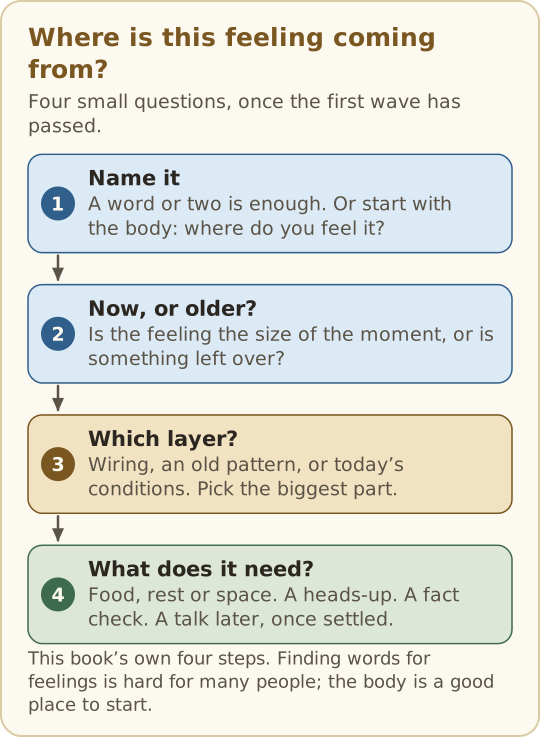
Where is this feeling coming from? A four-step self-check
When a feeling is bigger than you expected, here is a short way to sort it out. It works best once the first wave has passed a little.
- Name it. A word or two is enough, even a rough one: “tight and annoyed,” “flat,” “jumpy.” If words are hard to find, that’s common. Start with the body instead: where do you feel it?
- Is it about now, or does it feel older? Ask whether this is the size of the moment. A small thing that brings a big feeling often has something left over in it, either from earlier today or from much longer ago.
- Which layer is it? Wiring (“this always bothers me”), a pattern (“this reminds me of something”) or conditions (“I’d probably shrug this off after a good night’s sleep”). Usually it is a mix, so pick the biggest part.
- What does it need? Food, rest or space. A heads-up or a written plan. A fact check, or a slower try at a new response. Sometimes it needs a real conversation, later, when you’re both settled.
Feelings often reach the body before they reach words. A hot face and fast breathing, tight shoulders, or a heavy, foggy feeling are everyday clues about your state. Everyone’s are a little different, and they are not a medical reading of anything.
When feelings are hard to name
For some people, “What are you feeling?” is a hard question most of the time, not just on bad days. They notice a racing heart or a heavy stomach but can’t tell whether it is worry, anger, hunger or excitement. Or they simply draw a blank, and “Fine” is the honest answer to a question they can’t answer. Psychologists call this alexithymia, from the Greek for “no words for feelings”. The psychiatrist Peter Sifneos named it in the 1970s.
- It is a trait, not an illness. Like most traits it runs from a little to a lot. It is not a diagnosis, and you don’t need a name for it to use anything here.
- It is common, and more common in some people. A review that pooled 15 studies found high alexithymia in about half of the autistic people studied, compared with about 1 in 20 people in the comparison groups. Plenty of people who are not autistic have it too, and plenty of autistic people don’t.
- It is often about the body’s signals. Sensing what is going on inside your body, such as a fast heart, a tight throat or hunger, is called interoception. When those signals are faint, or hard to tell apart, the feeling behind them is harder to name. Part Three, Chapter 1 explains how feelings start in the body.
- It isn’t a lack of feeling, or of caring. The feelings are there; the words come slowly, or not at all. Someone with alexithymia can love deeply and still answer “I don’t know” when asked how they feel.
What helps:
- Start with the body and the facts. “Tight chest, short night, skipped lunch” is a useful reading on its own.
- Choose between two, not from fifty. “More tired or more annoyed? Space or company?”
- Use a picture or a number instead of a feeling word. The sky words in My weather today, the three states, or “about a 6 out of 10” all work.
- Give it time. Many people can name a feeling an hour or a day later. “I’ll tell you tomorrow” is a real answer.
- Write it, or type it. For some people, words come more easily on a screen or on paper than out loud.
If someone close to you finds feelings hard to name: ask either-or questions, take “I don’t know” as true rather than as a brush-off, and ask what would help rather than what they feel. “Do you want company or quiet?” is easier to answer than “How are you feeling about it?”
Why four small steps beat one big question
“What’s wrong with me?” has no useful answer. Four small questions each do have one. They slow you down just enough for the thinking part of you to catch up with the feeling part.
In different relationships
- Friends: A friend cancels lunch for the second time. Name it: hurt, a bit rejected. Now or older? Older; you were often left out at school. Layer: pattern. Need: a fact check. You reply, “No worries. Is everything okay with you?” and learn her child has been ill. See Friends.
- A foster carer: A foster child shouts, “You’re not my real mum!” Name it: stung. Now or older? Mostly now, and tired. Need: to stay steady and talk later. The carer says, “I’m here, and I’m not going anywhere.” See Foster and kinship families.
Mix-ups, and how to fix them
- Doing the check at the peak of a feeling. Let the first wave pass. Breathe, walk, drink water, then ask.
- “I couldn’t name it, so I failed.” Start with the body. “Tight chest” is a perfectly good first answer.
If you’re the only one doing this: All four steps happen inside you. Nobody else has to do anything for them to work.
Research note: Peter Sifneos (1973) coined the word alexithymia in a small clinical study. Elizabeth Kinnaird and colleagues (2019) pooled 15 studies and found high alexithymia in about half of autistic participants and about 5% of comparison participants, measured mostly by questionnaires people fill in about themselves. That is a reason to start with the body or a simple choice of words, not a sign the check isn’t for you. This site’s idea: the four-step self-check.
Plan what settles you on a calm day
The Calm-Down Kit is a plan for heated moments that you make while you are calm. On an ordinary day, write down what tends to set you off and where you feel it first. Pick two calming steps. Agree with yourself on one sentence to say when you step away: how you feel, how long, and when you’ll be back. In the moment, you just follow the plan.
The kit is for you, never for them. One person uses it about themselves, and it is never something to hand to the other person. Your line always includes a time you’ll return, so a break is never mistaken for walking out. Chapter III says how to check your tank again and go back.
Why you plan it while calm
In a heated moment, the part of you that plans is the part that goes offline first. A plan made on a calm day is like a note left by a wiser you. In the moment, you only have to follow it.
In different relationships
- Separated co-parents: A mum knows handover days make her tense. Her kit: a short walk before the handover, a scripted “Thanks, see you Sunday,” and a call to her sister afterwards. See Co-parenting.
- A teen and a parent: A fourteen-year-old and his dad each make their own kit. Both agree that “I need ten minutes” means ten minutes, not “I’m leaving.”
- Coworkers: A nurse keeps one line ready for a heated shift: “Let me check that and come back to you in five minutes.”
Mix-ups, and how to fix them
- Using your kit as a weapon: “Go and use your calm-down plan.” The kit is only ever for yourself.
- Stepping away without a return time. Always add when you’ll be back, and come back on time.
If you’re the only one doing this: Make your own kit. It works whether or not anyone else has one, and it makes the moment safer for both of you.
A note on safety: A break is for calming down, not for escaping consequences or punishing someone with silence. If someone blocks you from leaving a heated room, or punishes you for stepping away, that is about safety, not technique. Not safe at home? lists free, private hotlines.
Research note: Research on “implementation intentions” (Peter Gollwitzer and Paschal Sheeran) found that deciding ahead what you’ll do in a given situation helps people follow through. John Gottman’s work with couples describes “flooding,” when the body is too stirred up to listen, and suggests breaks long enough for the body to settle, often twenty minutes or more.
Your needs, what matters to you, and what’s fair to you
A need is information. “I do better with a heads-up,” “I need an hour of quiet after work,” “I can’t take on another job this week.” These are facts about you, not demands and not complaints. Said kindly and early, they let other people plan, instead of guessing and getting it wrong.
It helps to know them before you’re asked. Knowing what matters to you (quiet, time with family, being on time, honesty, rest) also helps you tell a real limit from a passing mood. A limit that is fair to you can be stated without a fight, in three parts:
- What is true for you. “I’m low on battery this week.”
- What you can do. “I can do the groceries.”
- What you can offer instead, and when. “Could we look at the school forms on Sunday?”
| What you notice in yourself | A kind way to say it |
|---|---|
| You like to know plans ahead | “A text a few hours before really helps me. It isn’t about you.” |
| You’re low today | “I’m low on battery. Can we talk about this tomorrow at eight?” |
| You’re at your limit on a job | “I can’t take that one on this week. I can do this one instead.” |
| You need time to think | “Let me think and come back to you tonight.” |
Two workpapers help. Who did what (Part B) has ready-made, kind ways to say no. Say it so it lands, turns a raw reaction into a fact, a feeling and an ask before you say or send anything.
This is also where the book’s later chapters meet this part. Chapter II asks whether the way you share the work can last, and what you have left is part of that answer. Chapter IV asks what “fair” means to each of you. Both are easier to talk about when you already know your own side, and a limit that is fair to you is not a score against anyone else.
Why needs said early go further
A need said early and plainly gives other people a chance to plan. A need held in until it bursts out tends to arrive as a complaint, and gets heard as one.
In different relationships
- Three partners at home: Ren needs Sunday mornings alone. Said as a fact (“Sunday mornings are my reset”) it fits into the week. Before, it came out as snapping. See More than two partners at home.
- An adult child and an elderly parent: A son who visits his mother every day says, “I can come four days a week, and I’ll call on the other three.” It is honest, and it keeps him going for years instead of months.
Mix-ups, and how to fix them
- “A limit is a punishment.” A limit is a fact about your capacity. Say it warmly and offer what you can.
- Saying a need as a complaint about the other person. “You never give me notice” becomes “A heads-up helps me.”
Words you could use: “This is true for me right now: ___. I can ___. Could we ___ instead?”
If you’re the only one doing this: You can state a need even if the other person doesn’t state theirs. Just be ready to hear theirs when they do.
A note on safety: If stating a simple need leads to anger, threats or punishment, the problem isn’t how you said it. Not safe at home? has people to talk to.
Research note: Marshall Rosenberg’s Nonviolent Communication teaches saying an observation, a feeling, a need and a request. It is a widely used practice framework rather than a well-tested therapy. Assertiveness, saying what you want clearly while respecting others, has long been taught in skills training. This site’s idea: the three-part limit.
Being wired differently is not being wrong
Some people take in words, noise, change and feelings differently from what most social customs were designed around. That includes people who are autistic, have ADHD, are dyslexic or are highly sensitive, and many who are not sure. Nothing about that makes someone wrong. A setup that doesn’t suit you is a setup problem, so the question is how to build one that does.
- It often has a hidden cost. Holding an old alarm down, masking, rehearsing what to say, or getting through a loud room all use real energy. This book counts it as part of your load, even when nobody sees it.
- A mix-up usually runs both ways. When two differently wired people misread each other, each is decoding with a receiver built for their own kind of signal. The next section explains this. On the site, Wired Differently is a full guide to fourteen kinds of wiring.
- Don’t label anyone. This includes you. You can describe what helps without a name for it, and a name is not needed to use anything here. If you want to understand yourself more deeply, a doctor or psychologist can help, if and when you want that.
The same goes the other way. When you meet someone else’s difference, ask “What was that like for you?” and let them answer. Never fill in a “How to talk to me” card or a Wave Code for another person. That would turn a reflection tool into a way of watching someone.
A mix-up runs both ways: the double empathy problem
For a long time, research described autistic people as short on empathy or “social skills”, as if every misunderstanding between an autistic and a non-autistic person was the autistic person’s doing. In 2012 the autistic researcher Damian Milton gave a name to a different view: the double empathy problem. Empathy, he argued, runs in two directions. When two people have very different ways of communicating and of making sense of the world, each finds the other hard to read. The non-autistic person struggles to read the autistic person just as much as the other way round. It is noticed less, because most social customs were built around the non-autistic way.
There is some evidence for it. In a 2020 study, Catherine Crompton and colleagues passed a story along chains of eight people. Chains made up only of autistic people passed on as much detail as chains made up only of non-autistic people. Mixed chains lost detail faster, and the people in them reported feeling less at ease with each other. It is one careful study of one task, so it is a strong hint rather than the last word.
What it changes in practice:
- Nobody is the broken one. In a mix-up between different minds, ask “Where did we lose each other?” rather than “What’s wrong with you?” or “What’s wrong with me?”
- Both people adjust, a little each. The direct speaker adds a softener when it matters. The hint-reader asks “Did you mean exactly that?” before deciding what it meant.
- Easy company is information. Many autistic people find talking with other autistic people easier. That isn’t a lack of social skill; it is a shared way of talking.
- The idea reaches further. The same two-way gap shows up between cultures, generations, or a fast talker and a slow thinker. Part Two, Chapter I calls this being out of tune: nobody has to be wrong.
Why “different, not wrong” matters
If you believe your wiring is a defect, you spend energy hiding it. If you see it as a difference, you can spend that energy on a setup that works. The same goes for the people around you.
In different relationships
- A parent and a child with ADHD: A dad who has ADHD himself realises his daughter isn’t ignoring him; she needs one instruction at a time. He tries one instruction, then a thumbs up. See When a child has ADHD.
- An autistic friend and a non-autistic friend: One friend says exactly what she means. The other hears hints in everything. They agree: “If I want something, I’ll ask it straight. You can take what I say at face value.”
Mix-ups, and how to fix them
- “If I need adjustments, I’m being difficult.” Glasses aren’t difficult. Neither is a quiet room.
- Deciding someone else is “probably autistic.” Ask what helps them instead. Labels are theirs to choose.
If you’re the only one doing this: You can build your own setup without anyone else changing: headphones, written lists, a quiet half hour.
Research note: The “double empathy problem,” described by Damian Milton in 2012, suggests that misunderstandings between autistic and non-autistic people run both ways. Studies of autistic adults (for example, Laura Hull and colleagues, 2017) describe “camouflaging,” or masking, as tiring and linked with stress. Elaine Aron’s research on “sensory processing sensitivity” describes people who take in their surroundings more deeply.
Explain yourself without over-sharing
You never owe anyone your history. Share the part that helps them help you, and keep the rest. Three short sentences cover most moments:
- “This is how I’m wired. It won’t change, but here’s what helps.”
- “This is an old alarm. I’m working on it, and here’s what helps in the moment.”
- “Today’s a low-battery day.”
Offer them as information, not as rules, and ask about theirs. When you want a bit more, Know your own wiring has scripts and a guide to how much to share. And when someone else shares, ask questions, not labels.
Why less can be more
A short, clear sentence about what helps is easier to remember than a long story about why. It also protects you: your history is yours to share when you choose, with people who have earned it.
In different relationships
- Coming out at work: A woman who has just come out to her family isn’t ready to share at work yet. When a colleague asks why she seems tired, she says, “It’s been a big month at home. I’m okay, thanks for asking.” See Coming out as an adult.
- An interfaith couple at a family dinner: A husband who doesn’t drink for religious reasons says to his in-laws, “I don’t drink, but I’d love a lemonade.” No lecture needed. See Two faiths or cultures.
Mix-ups, and how to fix them
- “Being open means telling everything.” Being open means being honest about what you share, not sharing it all.
- Explaining as a way to win. “It’s how I’m wired” starts a conversation. It doesn’t end one.
If you’re the only one doing this: Your sentences are yours to use whether or not anyone else explains themselves.
Research note: Research on self-disclosure, going back to Irwin Altman and Dalmas Taylor in the 1970s, describes closeness growing through gradual, two-way sharing. That fits the advice here: share a little, see how it is received, and share more with people who respond with care.
A worked example: the surprise dinner, replayed
Friday, 6:40pm. Alex says, “Surprise! I booked us dinner with my cousins tonight.” They meant it as a gift. Sam feels their chest tighten and hears themselves say “Great” in a flat voice.
Without the tools: Sam goes to the dinner, stays quiet and gets through it. Alex senses something is wrong and asks. Sam says, “It’s nothing,” and thinks, “What’s wrong with me?” Both end the evening unsure what happened.
With the tools: The next morning, Sam takes a minute. Name it: tight, a bit cornered. Now or older? Bigger than the moment. Which layer? Mostly wiring, a need to know plans ahead, plus a long week. What does it need? A heads-up next time, and a rested Sam. That evening Sam says, “Thank you for thinking of me. I do better with a heads-up, it’s how I’m wired. Could a text a few hours before work for both of us?” Alex says, “Easy. I didn’t know.” They try it, and agree to look again at the end of the month.
Two more worked examples
The housemate and the hoover. Tomás comes home after a twelve-hour shift and his housemate is vacuuming. He snaps, “Seriously, now?” Later, he runs the four steps. Name it: raw, prickly. Now or older? Mostly now. Layer: conditions (exhausted) and wiring (noise always bothers him). Need: quiet when he first gets in. He says, “Sorry I snapped. After long shifts I need half an hour of quiet. Could the hoover wait until seven?” His housemate says yes, and asks him to text when he is on his way home.
A grandmother and the phone. Agnes, 72, feels hurt that her grandson only sends short texts. She takes a reading. Layer: mostly wiring; she likes voices, he likes typing. She says, “I love hearing your voice. Could we have a ten-minute call on Sundays? Texts are lovely the rest of the week.” He agrees, and starts sending her voice notes too.
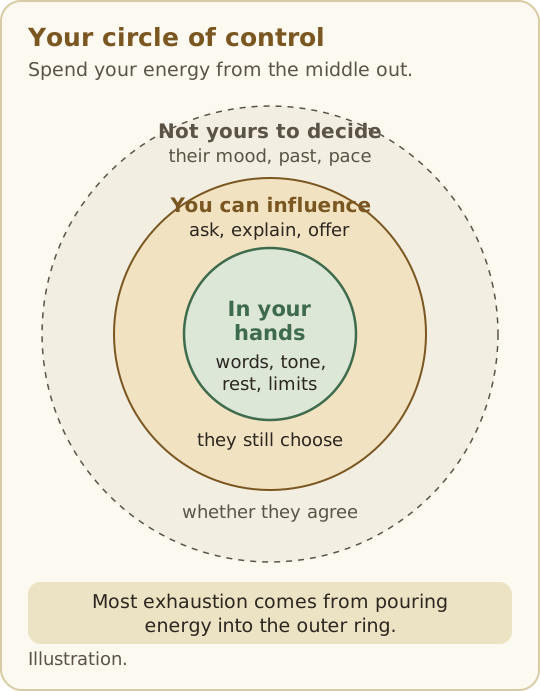
Your circle of control, and matching energy
Every moment has three rings. In the middle is what you control: your words, your effort, your tone, your rest, your limits and what you ask for. Around it is what you can influence but not decide: you can ask, explain, invite and offer, and the other person still chooses. Outside is what isn’t yours at all: their mood, their past, their pace, whether they agree. Most exhaustion comes from pouring energy into the outer ring.
In your hands
- What you say, and how and when you say it
- Doing your own jobs well
- Saying yes, no or “not today”
- Resting before you’re empty
- Asking clearly for what would help
Theirs to decide
- How your words land
- Whether they change
- How fast they calm down
- What they think of you
- Whether they say yes
Your energy is a budget
Your battery (How much are you carrying?) only holds so much. Signs you’re over-giving: quiet resentment, a silent scorecard, feeling invisible, being tired before the day starts. Those aren’t character flaws. They’re a budget running in the red.
How to match energy, kindly
- Notice. “I’m usually the one who plans, texts first or apologises.”
- Name it once, without blame. “I’ve noticed I’m often the one who starts our plans. I’d love it if you started the next one.”
- Adjust your side. Give the effort that’s being given: a warm reply to a warm message, a lighter touch where little comes back.
- See what comes back. Some people step up once there’s space. Some don’t, and that’s information too.
Matching energy means matching care and effort, never volume or meanness. If someone gets loud, you don’t have to get loud. If someone is going through something, you match their capacity, not their output, and you can choose to give more for a season, as long as it’s a choice and something refills you. With children and anyone who depends on you, you give what they need. If you’re afraid of someone, none of this is about managing them, and matching energy isn’t safe with a person who frightens you: Not safe at home? has people to talk to.
Words you could use: “I want to keep showing up for this, and I need it to go both ways.” “I can do my part. That one is yours.” “I’m low today, so I’m keeping my energy for the essentials.”
Why the circle helps
When you sort a worry into “mine” or “not mine,” you stop spending energy where it can’t do anything. That energy comes back to you for the things you can change.
In different relationships
- A business partner: You can make sure your half of the accounts is clear and on time. You can’t make your partner do theirs. You ask once, put it in writing, and then decide what you will do if it doesn’t happen.
- A parent of a teen: You can’t make your sixteen-year-old talk. You can be in the kitchen at the same time every evening with a snack and no questions. Many teens talk more when no one is asking.
- Friends: You notice you always start the chat. You reply warmly but stop starting for a month. See Always the one reaching out?
Mix-ups, and how to fix them
- “Not my circle” means “not my problem.” You can still care, offer and ask. You just stop trying to decide for them.
- Matching energy as a cold tally. It is balance over time. In a hard season, you match capacity, not output.
If you’re the only one doing this: This section is, by its nature, something you do alone. Your circle is the part only you can act on.
Research note: The split between what is and isn’t up to us comes from the Stoic teacher Epictetus. Equity theory, from J. Stacy Adams in the 1960s and applied to close relationships by Elaine Hatfield (then Walster) and colleagues in the 1970s, found that people tend to feel uneasy when a relationship feels unbalanced either way. Studies of family carers generally link having practical and emotional support with lower strain.
You, in all your relationships
Your wiring and your weather come with you into every room. Here is where they tend to show up.
- With yourself first: Noticing “I’m low today” before you decide “I’m failing,” and planning your week to suit how you’re built.
- With a partner, or partners: A heads-up, a quiet hour, and a better time for big talks. In a home with more than two partners, each person’s wiring adds to the mix. See More than two partners at home.
- With friends: How you like to keep in touch, and how much you can give right now. See Friends.
- With family: Visits that run long, noise, old roles and big gatherings. A rest planned ahead turns a retreat into a plan. See For grown-up children.
- At work: An agenda ahead, a minute before you answer, a written follow-up.
- With housemates: Light, noise and quiet time. See Sharing a room.
- On different hours: Sleep at odd times is still sleep. See Different hours.
- On your own: No one to adjust around but you, which is a chance to build a week that truly fits. See On my own.
To find help for your own situation, see help by relationship. If you guide others, see For counsellors, coaches and group leaders.
In the individual program
This part goes with Steps 1, 2, 4 and 5 of the individual program: check your battery, get to know your wiring, plan what settles you, and find words for what you feel.
Your next step: Step 1: check your battery · Step 2: your wiring · Step 4: what settles you · Step 5: find the words · The whole book on knowing yourself
Where the thirteen fields meet in this part
This part draws on 6 of the author’s thirteen fields (the About page lists them all). Here is what each one brings, and which of the five big ideas it serves.
| Field | What it brings here | Big idea |
|---|---|---|
| Psychology | How you take words in and send them out, and what helps you feel understood. | Tune how you send and receive |
| Neurobiology | Your nervous system’s state comes before your words, and wiring is part of how you are built. Both are things to understand, not things to be ashamed of. | Read your state first |
| Philosophy | What Is Up to Us: your honesty, your ask and your tone are yours, and the other person’s answer is theirs. | Tune how you send and receive |
| Behavioural science | Small routines, tried on calm days, are the ones that survive a hard one: a one-minute reading, and a sentence you keep ready. | Read your state first |
| Holistic therapies | Body first, words second. Decide on a calm day what settles you, and treat that as care, not as an extra. | Read your state first |
| Economics | Capacity again: managing yourself costs attention and energy that nobody sees, and a limit is a true statement about a limited supply. | See the whole load |
How they connect
The word in brackets is the root the two fields share; the polymath page explains all seven. From the most obvious connection to the most abstract:
- Obvious: Psychology + Holistic therapies (state and setting). Calm the body before the conversation. Words land better, and come out better, once the body has settled. This holds up “Read your state first”.
- Hidden: Behavioural science + Neurobiology (limited capacity). A tired body makes good habits harder, so the habits in this book are tiny. They have to survive the worst day of the week, which is why you practice them on a calm one. This holds up “Read your state first”.
- Abstract: Philosophy + Neurobiology (state and setting). If getting revved up or shutting down is a body doing its job, it isn’t a character flaw. That changes what blame means, including the blame you aim at yourself. This holds up “Fix the setup, not the person”.
The body tells you what state you’re in, and the story you tell about it decides what you do next.
Connect any two fields yourself · Ask Professor Puddles how all thirteen connect
When it goes wrong, and when it goes right
When it goes wrong, “This is just how I am” becomes a way to end every conversation. Or self-knowledge turns into self-criticism: a long list of what’s wrong with you. Or someone uses a label as a weapon (“You’re obviously just anxious”) and calls it understanding.
When it goes right, you take your own reading, quietly, and say one clear sentence about what helps. You ask about theirs. Over a few weeks you both learn what each of you needs, and you start to allow for it before the hard moment, not in the middle of it.
Questions people often ask
Isn’t focusing on myself selfish?
Every conversation runs through your own state first. Knowing it makes you easier to talk with and easier to hear. The other person’s side matters just as much, and the chapters after Part One are about that.
Do I need a diagnosis to use any of this?
No. Nothing here needs one and nothing here gives one. The wiring step in How you connect is self-identified. If you would like a formal assessment, a doctor or psychologist can do one.
What if I can’t tell what I’m feeling?
That is common, and some people are wired that way (see When feelings are hard to name, above). Start with the body, or with a choice between two simple words, like “more tired or more annoyed? Space or company?” My weather today uses weather words for the same reason.
Can I use this to understand someone else?
Not as a verdict. You can ask, gently, what something was like for them, and then let them answer. A guess about someone else’s wiring often turns into a judgment of them. The tools are for filling in about yourself.
What if the people around me don’t care how I’m wired?
You can still build your own setup and say one clear sentence about what helps. Some people need to hear it more than once. If someone mocks or punishes you for a simple need, that is about them, and Not safe at home? has help if you feel afraid.
Where can I talk this through?
Professor Puddles, the site’s friendly chat host, can help you work out where a feeling came from before you decide what to say.
Limits and cautions
- This part is general education. It isn’t a diagnosis, a test or treatment, and it can’t tell you what you or anyone else has.
- The layers are a thinking tool, not a scientific category system. Real people are messier, and the layers overlap.
- A Wave Code is a fun description of preferences, not a test that measures you. Everyone uses both ends of every line sometimes.
- Fill things in about yourself only. Never sort, score or label another person, and never use what you learned about yourself to win a point.
- Research notes on this page describe well-known findings in plain words, and say where the evidence is limited. Notes marked “This site’s idea” are our own ways of putting things into practice, not established science.
- “That’s just how I am” explains a reaction. It doesn’t excuse it, and it doesn’t replace a kind repair.
- These tools only work when each person feels free to say no, to ask for a pause, or to keep their own notes private. If talking about any of this ever feels unsafe, or you feel you can’t say no, stop and talk with a trained counselor on your own. When someone is afraid of their partner, counseling together isn’t advised. Not safe at home? lists free, private hotlines.
Last updated: October 2026