Part Two: Between us · Chapter IV
Two kinds of fair
The same argument, twice a month
One of you counts hours. The other counts who noticed the job needed doing. You’re both counting honestly, in two different currencies, and then arguing about the exchange rate.
This chapter has two halves. The first is about agreeing what “fair” means in your home. The second is about the few seconds after a comment lands, before you reply. They belong together, because many arguments about chores mix up both: a question about a job, and a reaction to how it was said.
In short:
- There are two kinds of fair: by results (did it all get done?) and by promises (did each of us do what we agreed?). Agree which one you’re using.
- Once a job has an owner, look to the owner. Covering for someone is kind when you say it out loud.
- Let a comment land before you react: notice it, name it, then decide what to say.
- Keep the two questions apart: “Was the job done?” is about a fact; “Did that comment hurt?” is about a feeling.
Where this fits: the five big ideas
The whole program rests on five big ideas. Each one starts inside you and then shows up between you and other people. This chapter mostly teaches “Fix the setup, not the person” and “Notice the quiet incentives”, with help from “Read your state first”. (Borrowed from business, economics and neurobiology.)
- In you: Notice which kind of fair comes naturally to you, and notice the quiet habit of covering for others without saying so. When a comment stings, check your own state before you answer.
- Between you and others: Give each job one clear owner instead of blaming. Watch how unowned jobs slide towards one person, and keep things steady by mentioning help out loud and saying thank you.
The two kinds of fair
Many arguments about what fairness means come dressed up as an argument about chores. Philosophers have argued about this for centuries, and two of their big ideas are useful here:
- Fair by results. Philosophers call this consequentialist, from “consequences”: you judge by outcomes, by how things turned out. It asks: did the right things get done, by whoever had the time or energy? Done carefully, it counts the cost to whoever covered, too.
- Fair by promises. Philosophers call this deontological, from the Greek word for “duty.” It asks: did each person do the specific things they agreed to own, whatever kind of week it was?
Both are reasonable. The friction starts when one person is judging the week by results (“It all got done, so we’re fine”) and the other is judging it by promises (“You said you’d handle the bins, and you didn’t, again”). Neither view is wrong. But a household needs to agree which one it is using, just as a contract needs to say which state’s laws apply.
Why the two kinds clash
Each kind of fair answers a different worry. Fair by results answers “Will the home keep running?” Fair by promises answers “Can I rely on you?” Both worries are real. When one person’s worry is met and the other’s isn’t, the first feels things are fine and the second feels let down, in the same week, about the same jobs. Naming which worry you each carry turns a fight about the bins into a conversation about trust and flexibility.
Three homes, one clash
- Two mums, two kids. Maya judges the week by results: the kids were fed, school forms went in, so it was a good week. Lin judges by promises: Maya said she’d book the dentist and didn’t. When they name it (“You’re counting the week, I’m counting the dentist”), the argument shrinks to one booking and one owner.
- Three adult siblings and their mum. One says, “Mum’s fine, isn’t she?” (results). Another keeps a rota and feels it’s ignored (promises). The third lives far away and pays for a cleaner, in a different currency again. A short call that names all three kinds of help stops each one feeling unseen. See Family rifts when old hurts are part of it.
- Four housemates. The group chat fills with “who left the bins?” Two of them want a rota. Two want “whoever’s around.” They agree: a rota for bins and bathroom, results for everything else. See Sharing a room for a written agreement.
Common mix-ups, and how to fix them
- “Results people are lazy, promise people are controlling.” Neither is true. Fix: talk about the kind of fair, never the kind of person. “You lean results, I lean promises” is a description, not a charge.
- “We have to pick one kind forever.” Most homes use both. Fix: decide by type of job, as in Choosing your kind of fair below.
- “Fair means fifty-fifty.” Equal hours are one way to be fair, not the only one. Fix: ask whether the split feels fair to both of you, given work hours, health and season.
If only one of you is on board
You can still name your own ruler: “I’ve realised I count promises. That’s why a missed job gets to me, even when it all works out.” This often lowers the heat on its own, because the other person now knows what the upset is about. You can’t make them choose a kind of fair. You can choose to say yours once, kindly, and see what comes back.
Honest research notes
- Research: Researchers who study fairness describe several rules people use: equality (the same for each), equity (in proportion to what each puts in) and need (according to what each requires). Disagreements often come from using different rules without saying so. More in the Library.
- Research: Studies of couples and housework keep finding that whether both people feel the split is fair matters more for satisfaction than an exact fifty-fifty. More in the Library.
- Research: When partners each estimate their share of household work, their estimates often add up to more than 100 percent. We remember our own effort more easily than other people’s (Ross and Sicoly, 1979). More in the Library.
- This site’s idea: Calling the two kinds “results” and “promises,” after two old schools of philosophy, is a teaching picture. Researchers don’t sort households this way.
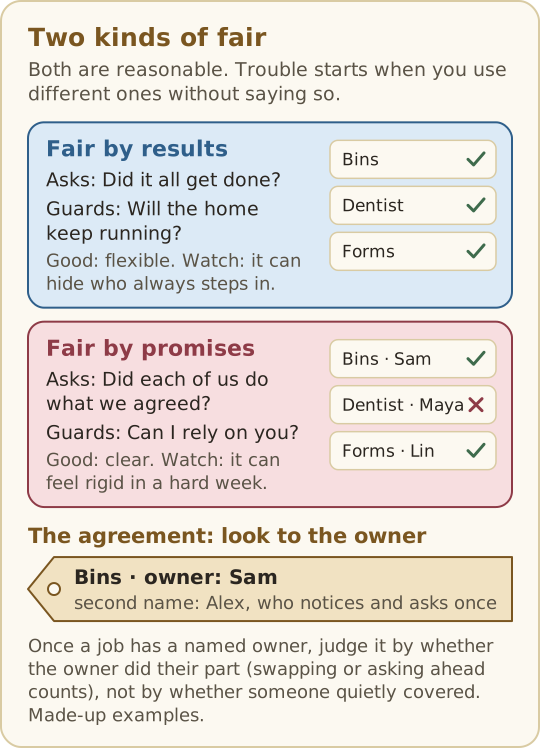
Judging by results
What it’s good at: it’s flexible. In a week when one person is sick or away, the other simply picks things up, and nobody has to negotiate.
Where it goes wrong: it can hide a pattern. If the same person always steps in, the results look fine, and the stepping-in becomes invisible. Over time, that is how unbilled debt builds up.
Fair by results, in three homes
- Separated co-parents. “Whoever is nearer picks her up when she’s sick” works well, until one parent works from home and is always nearer. Results-fair has quietly made them the default. See Co-parenting.
- A home with three partners. “Whoever’s free cooks” sounds relaxed. After two months, the partner on the shortest hours has cooked almost every night. See More than two.
- Coming home after time away. While one partner was deployed, the other did everything by results, because there was no one else. When the first comes home, “whoever can” means the one who already knows how. See Coming home.
The fix in each case is the same: keep the flexibility, and add a quick monthly look at who stepped in. If it’s nearly always one person, that job moves onto the owned list.
Words you could use: “I like how flexible we are. I just noticed it’s nearly always me who’s free. Can we look at that?”
If only one of you is on board: keep your own simple tally of unplanned jobs for two weeks. Facts on paper are easier to share than a feeling, and gentler than a list of complaints.
Money (optional)
One line per cost. Put what each person actually paid.
- Currency
- £ (pounds)
| Bill | Grace paid (£) | Ruth paid (£) | How it’s shared |
|---|---|---|---|
| Rent | 1,100 | 700 | Shared, split |
| Power and water | 160 | 0 | Shared, split |
| Internet and phones | 0 | 90 | Shared, split |
| Groceries | 300 | 250 | Shared, split |
| Grace brings in (£) | Ruth brings in (£) | How it’s shared | |
|---|---|---|---|
| Pay | 4,200 | 2,800 | Money coming in |
The summary
Each person’s total: Grace £1,560; Ruth £1,040.
Coming in: £7,000 (Grace £4,200, Ruth £2,800). After shared bills: £4,400 left.
Two ways to split the shared bills. Split evenly: Ruth would put in £260 more · Split by income (60/40): it already comes out even. Pick whichever feels fair to you.
Even isn’t always the fair answer (incomes and rooms differ), so treat this as a starting point, not a verdict.
A made-up example. Names and details are invented. Money is a fair topic only where nobody controls the other’s money.
Fill in your own: Who does what? (Money tab) (spreadloveandacceptance.com/
Judging by promises
What it’s good at: it’s clear. Everyone knows what they own, so nobody has to keep deciding who does what, and nobody gets left with jobs by default.
Where it goes wrong: it can feel rigid. Life doesn’t always cooperate. Holding someone to the letter of an agreement in a week when their parent was in the hospital isn’t fairness. It’s missing the point. Even thinkers who put promises first allow that some promises give way.
Fair by promises, in three homes
- Business partners. One owns invoices, one owns suppliers. When invoices run late, nobody argues about who works harder. They ask the invoice owner what got in the way.
- A teen and a parent. A 15-year-old owns his laundry. One week he has exams. Fair by promises doesn’t mean “tough luck.” It means he asks ahead: “Can you do my wash this week? I’ll do the dishes all weekend.”
- A couple when one is ill. A partner with a long-term illness owns the online shopping and bills, which can be done from bed. On a bad day, the agreement already says who covers. See When one of you is ill.
Common mix-up: “A promise is a promise, whatever happens.” Fix: build the exceptions in. Illness, grief, exams and work crunches are reasons to swap or pause a job, said ahead of time where you can.
Words you could use: “I can’t keep this one this week. Can we swap, and I’ll take it back on Monday?”
A note on safety: Fair by promises is about promises both people chose, and either can ask to change. A list of rules one person sets for the other, with checking, punishment, or money and freedom held back, is not a promise. It is control. If that sounds like your home, it isn’t your fault, and the tools in this book are not the right place to start. See Not safe at home? and normal limits and control.
The agreement: look to the owner
This book calls the agreement being fair by promises, and it’s simple: once a job has a named owner in the job list (One owner per job), you judge it by whether the owner did their part. You don’t judge it by whether things happened to work out because someone else quietly covered.
In this book, the owner is the person who does the job, start to finish. The job list has room for a second name: a backstop who notices if it slipped and gently checks in, never a supervisor. They can be the same person, though a second name gives the job a gentle check. Older kids can own age-sized jobs too, like feeding the cat or packing their own lunch, with a parent as the second name.
This protects the person who keeps filling the gaps. Without it, their help gets used as proof that the gap doesn’t matter: “Well, it got done, didn’t it?”
It doesn’t mean the owner has to do everything personally. Swapping, asking for help or saying “not this week” in advance all count as looking after your job. The Who-did-what log also has kind scripts for saying “not right now”: you’re already carrying a lot, someone else is better placed, or you’ll do it later at a named time. What this rules out is the job silently falling to someone else.
Why one name works better than “we”
A job that belongs to everyone tends to belong to no one. Each person assumes someone else will notice, and the one who notices first ends up doing it, every time. A single name ends the guessing. It also changes the conversation when a job slips: instead of “Why does nobody ever…?”, you can ask one person one question, kindly.
What about “Both (decide together)”? The job list lets you mark a row that way. Keep it for decisions that need both voices, like a school choice or a big purchase; the list counts those as owned, because a decision made together is a real arrangement. For a job that needs doing, write one name. In the filled-in example below, Dee owns the reviews and meetings, and Mark comes to the big ones as her second name.
One owner, in three homes
- Foster carers. Two carers and a social worker can all assume someone else phoned the school. The carers agree one of them owns school contact and the other is the second name. Some decisions belong to the agency or the care plan, and that goes on the list too. See Foster, adoptive and kinship families.
- A parent and a child with ADHD. Owning “clean your room” is too big. Owning “put the dirty clothes in the basket before bed,” with a picture on the door, is something a child can really own. See When a child has ADHD.
- Coworkers with a shared inbox. Customer emails sat for days because four people could answer them. One owner per weekday fixed it in a week.
Common mix-ups, and how to fix them
- “The owner has to do it alone.” Owning a job means making sure it happens. Asking for help or swapping counts.
- “The second name is the supervisor.” The second name notices and asks once. They don’t inspect, redo or comment on how.
- “My way is the right way.” If the old owner redoes the new owner’s work, the new owner soon stops trying. Researchers call this gatekeeping. Fix: agree what “done” means, then let the owner do it their way. More on gatekeeping.
If only one of you is on board
Own your own jobs clearly and out loud: “I own the bins and the car. Which ones would you like?” Offering a choice is easier to say yes to than being handed a list. If nothing comes back, keep owning yours, and stop silently picking up the rest. That is where your part ends.
Honest research notes
- Research: When responsibility is shared among several people, each feels less responsible. John Darley and Bibb Latané called this diffusion of responsibility. More in the Library.
- Research: Studies of workplaces link unclear roles (role ambiguity) with stress and conflict. Whether it works the same at home is less studied, but it seems likely. More in the Library.
- This site’s idea: The owner and second name are a home-sized version of the charts project managers use to show who does a task and who is kept in the loop. More in the Library.
One owner per job: caring for a child in care
- Person A
- Dee
- Person B
- Mark
- Date of this list
- 4 October 2026
- The split you agreed (optional)
- Dee works three days; Mark works full time
Who owns each job
| Job | How often | Roughly how long? (hours each time, optional) | Owner | Helper or backup (optional) | Notes |
|---|---|---|---|---|---|
| Social worker visits | Monthly | 1.5 | Dee | Mark | Mark joins by video when he can |
| Reviews and meetings | As needed | 2 | Dee | Mark | Dee books and preps; Mark comes to the big ones |
| Daily log and placement paperwork | Daily | 0.5 | Dee | Mark | Mark writes it on Dee’s work days |
| Contact visits and calls with their family | Weekly | 1.5 | Mark | Dee | Saturday mornings |
| School liaison (designated teacher, plans) | As needed | 1 | Dee | ||
| Being there after contact | As needed | 1 | Mark | Dee | Quiet tea, no questions |
| Health and therapy appointments | As needed | 1.5 | Dee | ||
| Training and support group | Monthly | 2 | Mark | Mark’s turn this term |
Does every job have an owner?
- Jobs with an owner
- 8 of 8. Every job has an owner.
- How the jobs are spread
- Counted by how often each job comes round, and by size or time where you gave it: Dee 61% · Mark 39%. You wrote down the split you agreed: “Dee works three days; Mark works full time”. Does this match it? It’s a starting point for a talk, not a scorecard.
✓ We’re agreed on this
- Who agreed (optional)
- Dee and Mark
A made-up example. Names and details are invented. “Being there after contact” is on the list because hidden work counts.
Fill in your own: One owner per job (caring for a child in care) (spreadloveandacceptance.com/
Choosing your kind of fair
Most homes end up with a mix, and that’s fine, as long as it’s agreed. One simple way:
- Owned jobs (on the One owner per job list, with names) are judged by promises.
- Shared or one-off jobs (a flat tyre, a sick child, a surprise visitor) are judged by results. Whoever can, does.
- If a shared job keeps coming up, it moves onto the owned list at the next weekly catch-up.
Agree on this on a calm, easy day, not in the middle of a disagreement. Write it at the top of your One owner per job sheet so you can both see it.
A third disagreement: what counts. Sometimes the argument isn’t results against promises at all. One of you counts doing, and the other counts noticing and planning. Go back to the Preface: put the planning and noticing on the list too, in minutes, so both currencies are counted.
Fair also needs re-agreeing. What counted as fair last year (before a new job, a baby or an illness) may not be fair now, and an old agreement nobody has revisited slowly stops being an agreement and becomes a habit. Put a review date on it. At the review, each person says what has changed for them, then you decide together. See Complacency.
Agreeing, in three homes
- Two faiths, one family. Two festival seasons, two sets of relatives. They agree each person owns the preparations for their own tradition, and the other is the second name and a willing helper. See Two faiths.
- Different hours. One partner works nights. They agree that daytime sleep counts as work, so day jobs aren’t judged by who is “home.” See Different hours.
- Long distance. A couple in two cities share planning, not chores. They agree that the person who suggests a visit owns booking it. See Long distance.
Common mix-up: “Once we’ve agreed, it’s settled.” Fix: call it a trial. A month is long enough to learn something and short enough that nobody feels trapped.
Words you could use: “Can we try this for a month and then look again? Nothing has to be forever.”
If only one of you is on board: suggest one small trial, about one job, not a whole system. A small yes is still a yes.
- Research: People accept decisions more readily when the process felt fair: they had a say, the same rules applied to everyone, and they could see how the decision was made. This is often called procedural justice. More in the Library.
- Research: Trying a small change, looking at what happened and adjusting comes from quality improvement (the plan–do–study–act cycle linked with W. Edwards Deming). More in the Library.
Covering without resentment
Stepping in for someone is kind. It only turns sour when it’s silent. Four habits keep it kind:
- Say it simply, without a sting. “I put the bins out this week, since you were away.” Not a complaint, just a note.
- Log it. In your week’s Who did what log, write the job under your name, with a note that you covered it.
- Let the cover be thanked, and asked about. Covering that nobody mentions gradually becomes expected, which is how complacency starts. Thank the person who covered, and let them say what it has been like for them. Their context is part of the picture.
- Watch for repeats. Covering once is kindness. Covering every week is a sign the job needs a new owner or a conversation about capacity. The monthly look-back in Chapter V is built to catch this.
Why silent covering goes sour
Silent covering sends two wrong messages at once. To the person covered for, it says “there was no gap.” To the person covering, it says “nobody noticed.” The first person carries on as before, and the second starts to keep a quiet list. Saying it out loud fixes both messages in one sentence.
Covering, in three relationships
- Friends. One friend always hosts and plans. Nobody asked, so nobody thinks to thank. One honest line (“I love hosting, and I’d love someone else to pick the place next time”) changes the pattern. See Friends.
- A grown-up child and parents. One adult son quietly handles his parents’ paperwork because his sister lives far away. Saying it to her, without blame, lets her offer what she can from a distance. See Grown-up children.
- Coworkers. One person fixes everyone’s slides before meetings. Once they mention it at a team check-in, the team adds a slide checklist, and the fixing stops being invisible.
Common mix-up: “If I mention it, it sounds like I want a medal.” Fix: say it as information, the same day, in one sentence. A same-day note sounds like news. A list a month later sounds like a bill.
If only one of you is on board: if you mention covering and nothing changes, cover less, and say so kindly: “I’m going to leave the recycling this week, since it’s yours.” That isn’t punishment. It’s letting the job go back to its owner.
A note on safety: If you cover jobs because you’re afraid of what will happen if they aren’t done, that isn’t covering by choice. See Not safe at home? for free, private support.
- Research: Equity theory, from J. Stacy Adams in the 1960s, suggests that feeling under-benefited tends to bring resentment, and feeling over-benefited can bring guilt. More in the Library.
- Research: Feeling that your contributions are seen is closely linked with feeling that things are fair, and specific thanks tends to land better than general praise. More in the Library.
A worked example: the bins, three weeks running
On the job list, Alex owns the bins. For three weeks, Alex has been working late on Tuesdays, and Sam has put the bins out each time without saying anything.
Judged by results: the bins went out every week. No problem. Except Sam is getting quietly resentful, and Alex has no idea.
Judged by promises: the bins are Alex’s job, and Alex didn’t do it. That isn’t a judgment of Alex as a person. It’s a fact about the job. And it points to a real question: can Alex still own the bins with the new work hours?
At the weekly catch-up, Sam says, “I’ve put the bins out the last three weeks. Is Tuesday night still working for you?” Alex says, “Honestly, no. Tuesday nights aren’t realistic with the late shifts. Could we try a swap for the rest of the month? You take the bins, and I’ll take the recycling and the weekly grocery order.” They write the trial into the job list and agree to settle it at the monthly look-back in Chapter V. Nobody had to be the bad guy.
Letting a comment land before you react
The idea is borrowed loosely from brain science, which describes how the brain turns down repeated or unimportant sounds and sensations, so they don’t all demand attention at once. In the brain that happens automatically, in a fraction of a second. This book’s pause is different: a few seconds you choose to take on purpose. It’s a practical habit, not a medical claim: not every comment needs your full reaction the moment it’s said.
When you’re tense or running on empty (see the Nervous System Ladder, a quick check of how calm or stirred up you feel, and Chapter III), even a neutral comment can arrive at full volume and seem to demand an instant reply. The pause gives it a moment to settle first.
A comment landing hard, in three relationships
- Long distance. A one-word text, “fine,” arrives at midnight. It reads as cold. A pause, then “Fine good or fine tired?” saves a whole evening. See Long distance.
- A grandparent and a grown-up child. “Is she still not sleeping through?” sounds like criticism of the parenting. A breath, and the parent hears a worried grandmother instead. See Grandparents.
- A carer and a partner in pain. A sharp word on a bad pain day is often about the pain. The pause lets the carer answer the day, not the words. See Caregivers.
Common mix-up: “If I pause, I’m letting them get away with it.” Fix: the pause is about timing. You can still raise it later, calmly, if it still matters.
A note on safety: The pause is for ordinary stings between people who mean each other well. It is not a way to absorb put-downs, threats or insults that keep happening. If what you keep pausing over is someone frightening you, see Not safe at home?
- Research: Under stress, people are more likely to read an unclear remark as hostile. Psychologists call this hostile attribution. More in the Library.
- Research: Studies of email found that writers tend to overestimate how clearly their tone, such as sarcasm or humour, comes across (Kruger and colleagues, 2005). Text messages have the same problem.
- Research: Sensory gating, where the brain filters repeated sounds, is a real and studied process. Using it here is only a picture. The pause in this chapter is a habit, not a brain treatment.
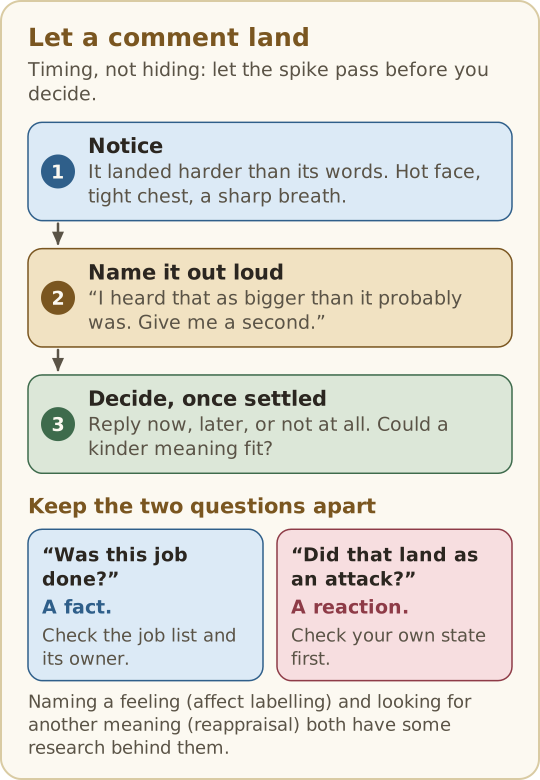
The three steps: notice, name, decide
- Notice that the comment landed harder than its words probably deserved. Often you feel it in your body first: a hot face, a tight chest, a sharp breath.
- Name it out loud, instead of reacting from the spike: “I heard that as bigger than it probably was. Give me a second.”
- Decide, once you’ve settled, whether it needs a reply now, later or not at all. Asking yourself whether a kinder meaning could fit is what psychologists call reappraisal, and it has some good research behind it.
This isn’t hiding your feelings. The aim isn’t to shut everything out for good. It’s timing: letting the spike pass before deciding how much weight a comment really deserves. The Calm-Down Kit helps the spike pass, and Say it so it lands helps with the reply once it has.
The Say it so it lands worksheet also offers four quick questions for weighing what you heard. Was it about a specific task? Would it sound the same if you weren’t already stretched? Could a neutral meaning fit? Are you answering their words, or an old argument?
If only one of you is on board
You can use all three steps alone. Noticing and naming lower your own temperature, even if the other person never learns the words. Saying “Give me a second” still works when they don’t know the plan, as long as you come back.
Common mix-up: “Naming it means saying what they meant.” Fix: name your reaction, not their intent. “That landed hard for me” invites a reply. “You’re being nasty” invites a fight.
Words you could use: “That landed harder than you probably meant. Give me a second.” “I needed a minute. I’m back. Can I ask what you meant?”
- Research: Putting a feeling into words, such as “I’m feeling stung,” can reduce its intensity a little. Researchers call this affect labelling (Lieberman and colleagues, 2007). More in the Library.
- Research: Changing how you read a situation (reappraisal) is generally linked with better outcomes than hiding a feeling (suppression), in work by James Gross and others. More in the Library.
- Research: John Gottman’s research on couples describes “flooding,” when the body is too stirred up to listen. He suggests breaks of at least twenty minutes. More in the Library.
Say it so it lands
- Your name
- Carla
- Date
- 8 October 2026
Before you speak or send: fact, feeling, ask
Use it on one thing that actually stung.
- Raw reaction
- Great, so I’m doing the stock order on my own again.
- What’s the fact underneath this? (One sentence, no adjectives.)
- The stock order for the café wasn’t placed by Tuesday noon, and I placed it at 4.
- What’s the feeling underneath this? (Frustrated, tired, unseen, rushed…)
- I felt stretched thin, and a bit alone with it.
- What’s the actual ask? (What do you want to happen next, specifically?)
- Could you own the Tuesday stock order from next week, with me as backup when you’re at the bank?
Before you react: four quick checks
Is this about a specific, nameable task or event?
- Chosen: Yes
- No
Would I read this the same way if I weren’t already carrying a lot?
- Yes
- No
- Chosen: Not sure
Is there a neutral interpretation that also fits what was said?
- Chosen: Yes
- No
Am I responding to their words, or to a pattern from a past conversation?
- Chosen: Their words
- A past pattern
What to do next
- Ways to say it
- Quick one, no rush: could you own the Tuesday stock order from next week, with me as backup when you’re at the bank?
- Suggestions
- Your own load is part of how this reads. A few hours, or a night’s sleep, often changes how it reads. There’s a kinder reading that also fits. Try asking about it first: “Did you mean ___, or ___?”
A made-up example. Names and details are invented. The raw reaction stays on the sheet, not in the message.
Fill in your own: Say it so it lands (spreadloveandacceptance.com/
Keep the two questions apart
Put the two halves of this chapter together, and you can separate two things that usually get tangled:
| The question | What kind of question | What it’s checked against |
|---|---|---|
| “Was this job done?” | A fact | The agreed owner on the job list |
| “Did that land as an attack?” | A reaction | Your own state right now |
Both questions matter. They just need different answers, and they go better one at a time. Take the fact to the job list. Take the reaction to a quiet moment and the Say it so it lands worksheet.
Two questions, in three relationships
- Business partners. “The invoice went out late” is a fact. “You always drop the ball” is a feeling dressed as a fact. They fix the invoice date first, then talk about the frustration on Friday.
- Adult siblings after a loss. “Who is clearing Dad’s flat on Saturday?” is a fact. “You were never there for him” is years of feeling. Mixing them guarantees a row. See Family rifts.
- A couple coming out to family. “Who tells your parents, and when?” is a planning question. “I’m scared they’ll reject us” deserves its own gentle talk first. See Coming out as an adult.
If only one of you is on board: split them on your side. Answer the fact, then add, “And I’d like to come back to how that felt, maybe tonight.”
- Research: The authors of Difficult Conversations (Stone, Patton and Heen, 1999) describe how a hard talk often holds a “what happened” conversation and a feelings conversation at once. What someone meant and how it landed can both be true. More in the Library.
A worked example: the flat thank-you
Wednesday, 7pm. Sam says, “Thanks for doing the dishes,” in a flat voice. Alex hears sarcasm and feels a flash of anger.
Without the pause: Alex snaps back, “You don’t have to say it like that.” Sam, who was only tired, feels attacked. Now there’s an argument about tone, and nobody remembers it started with a thank-you.
With the pause: Alex notices the flash and says, “That landed a bit oddly for me. Give me a second.” After a breath: “Did you mean that as a thank-you?” Sam says, “Yes, sorry, I’m just exhausted.” It can be over in seconds.
Money between you
Money is where the two kinds of fair meet most often, and where many couples clash. In one study of couples’ home diaries, money arguments weren’t the most frequent kind, but they were more likely to come back and to stay unsolved (Lauren Papp and colleagues, 2009). Talking about money early, in a planned way, takes much of the heat out.
Three common ways to share money
| Way | How it works | Often suits |
|---|---|---|
| All shared | Both incomes go into one pot, and everything comes out of it. | Couples who see money as “ours,” often married or long settled |
| Separate | Each keeps their own money and pays agreed bills, often half each. | New couples, similar incomes, people who value independence |
| Proportional | Each puts into a shared pot in line with what they earn (say 60/40), and keeps the rest. | Different incomes, where half each would squeeze one person |
Many couples mix them: a joint account for shared bills and food, plus some money each that nobody has to explain. None of these is the right one. The right one is the one you both chose with your eyes open, and look at again when life changes.
Which kind of fair? “Half each” is fair by promises: the same rule for both of you. “In line with income” is fair by results: it aims to leave each of you with a similar share of what you earn. The Grace and Ruth example earlier in this chapter shows both side by side.
How to talk about it
- Start with your money stories, not the numbers. Each of you says how money worked in the home you grew up in, and one feeling money gives you: safe, anxious, free, ashamed. People carry strong beliefs about money, and savers and spenders often end up together. Knowing each other’s story turns “you’re tight” or “you’re careless” into “that’s how you learned it.”
- Put everything on the table: income, regular bills, debts, savings, and money you send to family. Debts in particular are easier to share early than to discover later.
- Agree the shared bills and how you’ll split them. The “Who does what?” page’s Money tab shows both splits side by side.
- Agree some money each, no questions asked, even a small amount. It often stops small purchases turning into arguments.
- Agree a “talk first” amount for big buys, the same for both of you: “Anything over £200, we talk first.” A limit you both chose, and both keep, is care, not control.
- Set a short monthly money chat: fifteen minutes on what’s coming up and anything that felt unfair, with the same kind rules as the monthly look-back in Chapter V.
For example (made up): Niamh and Tariq are about to move in together. Niamh takes home £2,600 a month and Tariq £1,900. Rent and bills will be £1,500. Half each would leave Niamh with £1,850 and Tariq with £1,150. They choose proportional instead: Niamh pays 58% (£870) and Tariq 42% (£630), which leaves them £1,730 and £1,270. They open a joint account for rent, bills and food, keep the rest separate, and agree to talk first about anything over £200. Tariq sends £100 a month to his mum. It’s on the list from day one, so it never becomes a surprise.
Common mix-ups, and how to fix them
- “Talking about money is unromantic.” Not talking about it tends to be less romantic later. Keep the first talk short and kind.
- “Whoever earns more should decide.” Both people’s say counts the same, whoever earns what. Unpaid work at home is work too.
- “Agreeing to check in about big buys is controlling.” Not if you both chose it and it applies to both of you. Care is not control. It’s different when one person holds all the money, checks every penny, or leaves the other with none of their own. Normal limits and control explains the difference.
If only one of you is on board: Write down your own money story and your own numbers. Then ask for one small thing, like a monthly money chat, rather than a whole system.
Words you could use: “Can we each say how money worked in our families growing up? I think it explains a lot about us.” “Would half each, or in line with our pay, feel fairer to you?”
More: Money together, including moving in.
Research notes
Lauren Papp, E. Mark Cummings and Marcie Goeke-Morey (2009) found in couples’ home diaries that money conflicts were more pervasive and recurrent than other conflicts, and more likely to stay unresolved. Jeffrey Dew, Sonya Britt and Sandra Huston (2012) found, in US survey data, that money disagreements were the strongest of the disagreement types in predicting later divorce. Scott Rick, Deborah Small and Eli Finkel (2011) found that tightwads and spendthrifts tend to marry each other, and that bigger differences went with more money conflict. Brad Klontz and colleagues (2011) described common “money scripts”: beliefs about money that people carry, often from growing up. This site’s idea: matching the two kinds of fair to the two common splits, and a “talk first” amount that applies to both people.
A couple and a housemate
A couple sharing a home with a housemate who isn’t a partner is a different shape from three equals. Two of you share a bond the third doesn’t, and that can tilt things without anyone meaning it.
Two lists: house jobs and couple jobs
- House jobs belong to everyone who lives there: bins, bathroom, shared shopping, the landlord, the bills. They go on one list for all three of you, each with one owner.
- Couple jobs belong to the two of you: your room, your plans, each other’s families, your own money. Keep them on a separate list, so the housemate isn’t pulled into couple business and the house list doesn’t quietly become the couple’s list.
Avoiding two against one
- One person, one voice on house decisions. The couple doesn’t agree things the night before and announce them at breakfast. House questions get decided with all three of you there.
- Hear the housemate first on anything that affects them, so they aren’t answering a decision that’s already been made.
- Keep couple arguments out of shared rooms, and never ask the housemate to take sides or be the referee.
- Watch the quiet tilt. Who chooses the TV, the heating, when guests come? If it’s always the couple, say so and change it.
- Count the housemate in fully. They log their own week, own their own jobs and score their own tank, like everyone else.
Money with three
Money can tilt fairness too, especially if one name is on the lease or the housemate pays rent to the couple. Be clear, and write it down: what the rent covers, how the bills split, and what happens if someone moves out.
For example (made up): Ollie and Hamza share a two-bedroom flat with their friend Bex. They split the rent by room, because the couple has the bigger bedroom, and the bills by person, because all three use the heating and the internet. A small house kitty pays for loo roll, washing-up liquid and bin bags. Bex owns the kitty; she likes being the one who restocks.
| Each month | Ollie | Hamza | Bex | How it’s shared |
|---|---|---|---|---|
| Rent, £1,500 | £450 | £450 | £600 | By room: the couple’s room counts as £900 |
| Bills, £240 | £80 | £80 | £80 | By person |
| House kitty, £30 | £10 | £10 | £10 | By person |
| Total | £540 | £540 | £690 | Bex pays more than either of them, and has a room to herself |
All three agreed it, and they’ll look at it again when the rent goes up. They hold a short house meeting on the first Sunday of the month, all three of them, and Ollie and Hamza keep their couple check-in for their own evenings.
Common mix-ups, and how to fix them
- “We’re two, so we get two votes.” On house questions, each person has one voice, and you aim for something all three can live with.
- “The housemate should fit in with us.” It’s their home too. The setup should work for all three.
- “One shared list is simpler.” Until the housemate finds couple jobs on it, or the couple’s arguments spill onto it. Two short lists are kinder.
Words you could use: “That’s a house question. Let’s decide it when Bex is here.” “Is there anything about how we run the house that doesn’t work for you?”
More: Sharing a room and More than two. This site’s idea: the two lists, and one voice each on house questions.
Your part, and only your part
You control whether, when and how you bring something up, and whether you cover a job out loud. How the other person responds is theirs. If you cover again and again with no thanks and no change, match the energy: cover less, and say so kindly. Fair by promises only works when both people keep theirs.
The idea runs through the whole book: you can only do what’s in your control, and you protect your own energy by matching energy with energy, giving in proportion to what comes back, with room for seasons when someone can’t. Part One covers it in full: your circle of control, and matching energy.
On your own: your own kind of fair
Fair starts with knowing what fair means to you, and which jobs are truly yours.
- Write down what fair means to you, in one sentence.
- List the jobs you own, and the ones you picked up without ever agreeing.
- Practise letting a comment land before you answer, then reply with a fact, a feeling and an ask.
In the individual program: Step 5: find words for what you feel · Step 6: kind ways to say no · Part One: where your sense of fair came from The Individual package puts every workpaper for the path into one fillable PDF, with a report written just for you. · The whole book on sharing the load
More for your situation
Fair looks a little different in each kind of relationship. These pages take this chapter into one situation each. Start from your relationship lists them all.
- Couples and partners: More than two partners · Money together · Gaming, phones and time together · Different hours · Coming home after time apart · When one of you is ill
- Families: Foster, adoptive and kinship families · When a child has ADHD · Grown-up children · Adult siblings and family rifts · Kids grown and gone · Two faiths, one family
- Friends, housemates and work: Friends · Sharing a room · Coming out as an adult
- On your own, or helping others: On my own · For counsellors, coaches and group leaders
Where the thirteen fields meet in this chapter
This chapter draws on 6 of the author’s thirteen fields (see the Preface or the About page). Here is what each one brings, and which of the five big ideas it serves.
| Field | What it brings here | Big idea |
|---|---|---|
| Philosophy | Two old ideas behind fairness: judging by outcomes (consequentialist) and judging by promises (deontological). Neither is wrong; a home needs to agree which it’s using. | Fix the setup, not the person |
| Business | Look to the owner. A clear job list, like a contract that says which state’s laws apply, settles “was this done?” without blame. | Fix the setup, not the person |
| Economics | Two people keeping score in two currencies, then arguing about the exchange rate. Silent covering is rewarded by “it got done,” and that’s how unbilled debt grows. | Notice the quiet incentives |
| Neurobiology | How the brain turns down sounds and sensations, borrowed loosely. In the brain it is automatic and takes a fraction of a second. Here it’s only a picture for a pause of a few seconds that you choose to take. | Read your state first |
| Aromatherapy | For some people, a familiar scent or a calmer room is a quick cue to slow down. Where and when you talk is part of the method. | Read your state first |
| Psychology | Why a flat “thanks” can be heard as sarcasm, especially when things are already tense, and why covering turns sour only when it’s silent. | Notice the quiet incentives |
How they connect
The fields don’t just sit side by side. They meet, and each meeting point is where a tool comes from. From the most obvious connection to the most abstract:
The word in brackets is the root the two fields share; the polymath page explains all seven.
- Obvious: Philosophy + Business (ownership and structure). Fair by promises only works when the promises are written down. The job list turns an old philosophical question into a practical one: does this job have an owner, and did the owner do it? This holds up “Fix the setup, not the person”.
- Hidden: Economics + Psychology (quiet incentives). When “it all got done,” the person who covered becomes invisible, and the setup quietly rewards them for carrying more. Saying it and logging it is how the incentive stops. This holds up “Notice the quiet incentives”.
- Abstract: Philosophy + Neurobiology (state and setting). Keep the two questions apart. “Was this job done?” is checked against the agreement; “Did that land as an attack?” is checked against your own state. Ethics and the body each answer their own question, one at a time. This holds up “Fix the setup, not the person”.
Six of the thirteen fields meet in this chapter. Its two halves look different, fairness and a few seconds of calm, but they share one root: separate the fact from the reaction, and each gets the answer it needs.
Connect any two fields yourself · Ask Professor Puddles how all thirteen connect
When it goes wrong, and when it goes right
When it goes wrong, each person keeps using their own kind of fair without saying so. The one who judges by results thinks everything’s fine. The one who judges by promises feels let down over and over. Every comment about a chore gets answered at full volume.
When it goes right, you both know which jobs are owned and which are shared. Covering gets mentioned and logged. When a comment stings, one of you says, “Give me a second,” the other waits, and the one who paused comes back to it.
Questions people often ask
What if we can’t agree on which kind of fair to use?
Use the mix above: owned jobs by promises, shared jobs by results. Try it for a month, then look again together.
Isn’t it petty to hold someone to a small job?
Not if you both agreed to it. What feels petty is usually the build-up of unspoken covering. Saying it early and kindly is the opposite of petty.
What if “give me a second” turns into an hour?
That’s fine, as long as you say so and name a time to come back. If a second isn’t enough, take a proper break; twenty minutes or more often works better than a quick one. Pausing is for timing, not for avoiding the talk.
Where can I get help finding the words?
Professor Puddles, the site’s friendly chat host, can help you phrase a request or a reply.
Limits and cautions
- Fair by promises is a tool for jobs, not for judging people. “You didn’t do your job” is a fact about a task. It never means “you’re a bad partner, parent or roommate.”
- Be flexible when life is hard. Illness, grief and big changes are exactly when agreements should be looked at again, not enforced.
- Letting a comment land is not the same as swallowing it. If something that was said still hurts after you’ve settled, it deserves a calm conversation.
- These tools only work when each person feels free to say no, to ask for a pause, or to keep their own notes private. If talking about what’s fair ever feels unsafe, or one of you feels you can’t say no, stop using the tools and talk with a trained counsellor on your own. When someone is afraid of their partner, counselling together isn’t advised. Not safe at home? lists free, private hotlines.
Last updated: October 2026