Part Three · Chapter 11
Healing after hurt
In short:
- Hurt is real, and healing takes time. Replaying it doesn’t mean you’re weak. It means it mattered.
- Repair is what counts. Every close relationship has breaks. A real apology names it, owns it and mends it.
- Forgiveness isn’t going back. You can forgive without forgetting, excusing or letting someone back in.
- Safety comes first. You can heal even if they never say sorry, and you never owe anyone a risk to your safety.
Why the tools work: this chapter explains the thinking behind these tools from earlier in the book.
- “Get back in tune before you carry on” and “go back in with a clear sentence” (Part Two, Chapter I) are repair in small: breaks are normal, and coming back is the skill. Big idea: tune how you send and receive.
- The monthly look-back (Part Two, Chapter V) includes “look back even when nothing is slipping”, because small hurts repaired early don’t harden into resentment.
Thursday, 2am
It was one sentence, three weeks ago. They’ve probably forgotten it. You haven’t. It plays again, word for word, and you think of all the things you could have said back. You’re tired of carrying it, and you don’t know how to put it down.
This chapter is about what happens after people hurt each other, and how hurt heals. It covers small hurts, like a sharp word or a broken promise, and gives some guidance on bigger ones. It’s written for the person who was hurt and for the person who did the hurting, because most of us are both at different times.
Each idea is looked at through three lenses. Psychology shares what research has found, and says where the evidence is thin. Philosophy brings in thinkers and traditions, from ancient Rome to modern South Africa, retold in plain words rather than quoted. Through an autistic lens offers a perspective from autistic experience: honest about real differences, never a list of deficits, and never a way to diagnose anyone. Then each idea comes back to everyday life. Ideas that are this site’s own are marked This site’s idea.
Before you start: nothing in this chapter asks you to repair a relationship with someone who frightens, controls or harms you. If that’s your situation, the healing step is safety. Not safe at home? has free, private help.
Hurt is real, and healing takes time
A hurt from someone close can feel strangely physical: a punch in the stomach, a lump in the throat. And it can last far longer than the moment that caused it. Understanding why helps you be patient with yourself.
Psychology
Mark Leary and colleagues (1998) studied hurt feelings and found they are closely tied to “relational devaluation”: the sense that someone doesn’t value the relationship, or you, as much as you hoped. That’s why a small comment from a close friend can hurt more than a big insult from a stranger. It isn’t the words; it’s what they seem to say about where you stand.
Brain imaging work by Naomi Eisenberger, Matthew Lieberman and Kipling Williams (2003) suggested that being left out activates some of the same brain areas as physical pain. Later research has debated how close the overlap really is, so it’s best read as “social pain is real pain” in a loose sense, not as proof that the two are identical.
Emotional memories tend to be stored more strongly than neutral ones, which helps explain why hurts replay. Susan Nolen-Hoeksema’s research on rumination found that going over and over a hurt, without moving towards understanding or action, tends to keep low mood going rather than easing it. Replaying isn’t a character flaw; the mind is trying to solve something. But it often needs a gentler way to finish. See rumination in the library.
Philosophy
The Roman Stoic Seneca wrote a whole book, On Anger, about how hurt turns to rage. One of his main remedies was delay: wait before you act, because the first rush of feeling exaggerates. The Buddhist image of the second arrow says something similar: the first arrow is the hurt itself; the second is everything we add by replaying and fighting it.
The 17th-century Dutch philosopher Baruch Spinoza argued that a painful feeling loses some of its power over us once we form a clear understanding of it. That’s an old version of something psychology has also found: naming and understanding a feeling can soften it (see affect labelling).
Through an autistic lens
Many autistic people describe processing social events later, sometimes much later. A hurt may not land until hours or days afterwards, when there is time and quiet to go back over it. That’s a different timing, not a lack of feeling. It’s also worth knowing for people close to them: “you seemed fine at the time” doesn’t mean the hurt wasn’t real.
Deep, single-track attention (see Chapter 9) can make replaying a hurt very intense. Some autistic people find it helps to give the loop somewhere to go: writing the event down in order, as facts, then feelings, then questions. Research has also found that autistic children and adults experience bullying and exclusion more often than their peers, so many arrive at adult life carrying a lot of old hurt. That deserves care, not a “just get over it.”
Putting it into everyday life
Name the replay when it comes (“there’s that memory”). Ask what it’s trying to solve. If there is something to do, like a conversation or a limit, plan it. If there isn’t, write it down and set it aside for now. Expect feelings to return on anniversaries and reminders, and treat each return as part of healing, not a step back.
Thoughts you could try: “This hurts because I care where I stand with them. That makes sense.”
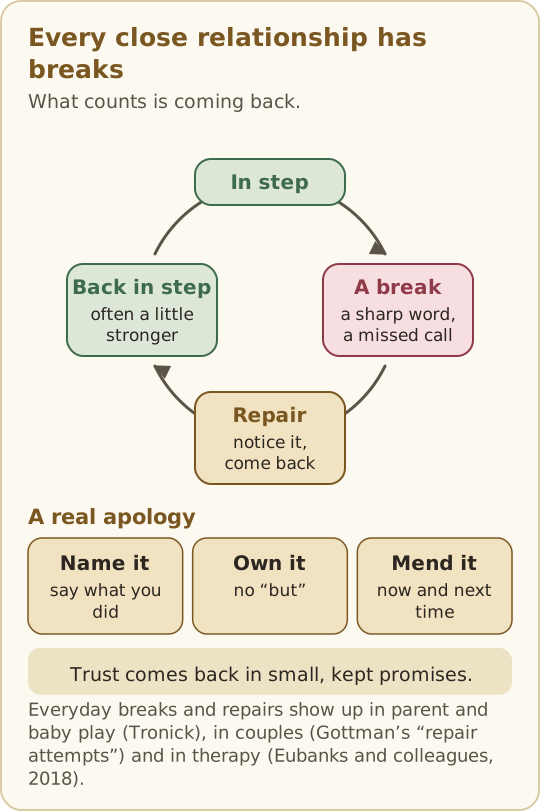
Every close relationship has breaks. Repair is what counts.
It can be a relief to learn that close relationships are full of small breaks, and that this isn’t a sign something is wrong. What seems to matter is what happens next.
Psychology
Edward Tronick’s “still face” studies (from 1978) showed how upset babies become when a parent’s face suddenly goes blank, and how quickly they recover when the parent re-engages. Tronick’s later research described ordinary parent and baby play as moving constantly between being in sync, falling out of sync, and repairing. He argued that these everyday repairs teach children that breaks can be mended.
In couples, John Gottman described “repair attempts”: any word or gesture that stops a conflict from escalating, like a joke, a touch or “Can we start again?”. In his research, whether repair attempts worked was one of the things linked to how relationships fared. In therapy, Jeremy Safran and Christopher Muran studied “ruptures” between therapist and client; a review by Catherine Eubanks and colleagues (2018) found that repairing these ruptures was linked with better results. Three very different settings, one shared message: breaks are normal, and repair matters.
Philosophy
Kintsugi, a Japanese tradition of mending broken pottery with lacquer mixed with gold, is often used as a picture of repair. The cracks aren’t hidden; they become part of the object’s history. It’s a craft tradition, not a philosophy of relationships, but many people find it a helpful image: a mended bond isn’t a lesser bond.
Confucius is reported in the Analects as saying, in effect, that the real fault is having a fault and not correcting it. The mistake isn’t the break. It’s leaving it unmended.
Through an autistic lens
In mixed autistic and non-autistic relationships, one person may notice a break that the other didn’t register at all. The double empathy idea (Damian Milton, 2012) suggests both sides can miss each other’s signals. So repair works better when it is explicit: “I think something went wrong between us earlier. Did it?” rather than waiting for the other person to pick up hints.
Timing matters too. After a meltdown or shutdown, many autistic people need quiet and recovery before any repair talk; trying to repair too soon can feel like more pressure. A simple “I want to talk about earlier when you’re ready, no rush” leaves the door open. Some people also find repair easier in writing, where there’s time to choose words.
Putting it into everyday life
Go back after small breaks. Keep it short. Name what happened and how you’d like it to be. With children, repair is one of the most powerful things a parent can model. With adults, agree on a phrase that means “let’s restart,” so either of you can use it.
Words you could use: “I want to go back to earlier. I didn’t like how that went, and I care about us.”
Telling someone they hurt you
Many hurts are never mended because the other person doesn’t know about them. Saying so is brave. It also gives the relationship a chance.
Psychology
Sybil Carrère and John Gottman (1999) found that how a conflict conversation starts, gently or harshly, predicted a lot about how it went. Gottman distinguished a complaint (about a specific event) from criticism (about the person’s character). Complaints can be heard; criticism tends to bring defensiveness. Methods like “I-statements” and Marshall Rosenberg’s Nonviolent Communication use the same pattern: what happened, how I felt, what I’d like. There’s good reason to think this helps, though direct trials of exact wordings are limited.
Research on the gap between intent and impact also matters here. People who caused a hurt often see it as smaller and more understandable than the person who was hurt. Roy Baumeister and colleagues (1990) asked people to write about times they had angered someone and times someone had angered them; the stories were told very differently. Knowing this can make it easier to explain, rather than assume the other person already knows.
Philosophy
Aristotle thought anger isn’t always wrong. He wrote that the good person is angry at the right things, with the right people, in the right way, at the right time, and for the right length of time. That’s a high bar, but it’s a useful one: the goal isn’t no anger; it’s anger used well.
The American poet and essayist Audre Lorde, in a 1981 talk on anger, argued that anger in the face of real injustice carries information and energy, and that what matters is turning it towards clear, honest speech rather than swallowing it. Telling someone “that hurt” is a small, personal version of that idea.
Through an autistic lens
Plain, specific statements tend to work best for everyone, and especially between people with different communication styles. Many autistic people say they would much rather be told directly that they hurt someone, and how, than be given hints or a cold shoulder they can’t decode. If you are telling an autistic person they hurt you, be specific: what was said or done, and what you’d like instead.
The other way round, many autistic people have been told they’re “rude” or “hurtful” without being told what they actually did. That is confusing and painful. It’s fair to ask: “Can you tell me exactly what I said that hurt? I want to understand.” And telling someone in writing is a completely valid choice.
Putting it into everyday life
Write your sentence first: what happened, how you felt, what you’d like. Choose a calm time. Say why you’re telling them (“because I want us to be okay”). Then listen to their side, which may surprise you. Say it so it lands helps you shape the sentence.
Words you could use: “I need to tell you something that’s been on my mind. When you…, I felt… I’d like… Can we talk about it?”
Write it, wait, then send
Who is it to?
- Partner
- Co-parent or ex
- Chosen: Family
- Friend
- Housemate
- Coworker
- More than one person
- Someone else
- Their name (optional)
- Owen
- Your name (optional)
- Carys
What kind of message?
- Chosen: Raise something
- Reply to something
- Make a plan
- Say sorry
- I need a pause
- What happened (facts only, one thing)
- At Dad’s 70th on Saturday, you said to everyone at the table that I don’t visit. I visited three times in September.
How it landed for me
- tired
- rushed
- frustrated
- unseen
- taken for granted
- overwhelmed
- stretched thin
- worried
- Chosen: hurt
- disappointed
- left out
- alone with it
- confused
- Chosen: embarrassed
- annoyed
- sad
- on edge
- hopeful
- grateful
- What I’m asking for (one clear ask)
- Could we talk on the phone this week about how we share the visits?
- What I’m NOT saying (optional, but it helps)
- I’m not angry with you as a person.
When I’d like a reply
- Today
- Tomorrow
- Chosen: By the weekend
- No rush
A gentle check
House rules: ✓ One topic · ✓ Facts, not verdicts · ✓ No always or never · ✓ No sarcasm or ALL CAPS · ✓ No “you” accusations · ✓ Says what you’re asking for · ✓ A reply-by time
No sharp words found. It reads as calm and clear.
A made-up example. Names and details are invented. Then the tool asks her to wait before she sends it.
Fill in your own: Write it through (spreadloveandacceptance.com/
A real apology names it, owns it, and mends it
Everyone has heard an apology that made things worse. “I’m sorry you feel that way.” “Sorry, but…”. A good apology is a skill, and it can be learned.
Psychology
Roy Lewicki, Beth Polin and Robert Lount (2016) tested six parts of an apology: expressing regret, explaining what went wrong, acknowledging responsibility, saying you’ll do better, offering to repair, and asking for forgiveness. More parts generally worked better, and the two that mattered most were acknowledging responsibility and offering repair. Asking for forgiveness mattered least.
Karina Schumann’s research found that people often hold back on apologies or make them defensive, and that defensive elements, like excuses or blaming the other person, make apologies less effective. Peter Kim, Donald Ferrin and colleagues (2004) found that apologies tend to help more after mistakes of skill (“I got it wrong”) than after breaches of honesty (“I lied”), where actions matter more than words. The site has more in what research says about apologies.
Philosophy
The philosopher Nick Smith, in I Was Wrong (2008), described what he called a “categorical” apology: naming exactly what you did, accepting blame, recognising the harm and the value that was broken, showing regret, and committing to change and to repair. He argued that many public apologies fall short because they leave out one or more of these.
The Jewish idea of teshuvah, often translated as repentance or “returning,” was set out by the medieval philosopher Moses Maimonides in steps: recognising the wrong, regretting it, saying it out loud, and resolving not to repeat it. He wrote that the fullest repentance is shown when you face the same situation again and choose differently. He also taught that wrongs against another person need to be put right with that person, not only privately.
Through an autistic lens
Many autistic people value precise apologies. “Sorry if anything I did upset you” can feel meaningless, or even dishonest, because it doesn’t say what happened. “I interrupted you three times in the meeting, and that wasn’t fair” is clear and believable.
Facial expression and tone can differ in autistic people, and an apology may be judged as “not sincere” because the face doesn’t look sorry enough. That’s a misreading. Words and actions are better evidence than faces. Some autistic people also apologise very often, out of years of being told they got things wrong. If that’s you, it’s worth saving “sorry” for things that were actually your doing, and using “thank you for waiting” instead of “sorry” for the rest.
Putting it into everyday life
Use four parts: what I did, it was mine, how it affected you, what I’ll do now. Leave out “but” and “if.” Don’t ask to be forgiven straight away; let the other person have their response. Then keep your word, because that’s what makes the apology real. Apology languages has more.
Words you could use: “I said… That was my doing, not yours. I can see it hurt. From now on I’ll… Is there anything else that would help?”
Forgiveness isn’t forgetting, excusing or going back
Forgiveness is one of the most misunderstood words in the language. People feel pressured to forgive, or afraid that forgiving means giving in. Separating out what it is, and isn’t, often makes it easier to think about.
Psychology
Researchers usually define forgiveness as a change inside the person who was hurt: less resentment and wish for revenge, and sometimes more goodwill. Michael McCullough and colleagues measured it as a drop in “avoidance” and “revenge” motivations over time. Everett Worthington distinguished “decisional” forgiveness (deciding not to seek revenge) from “emotional” forgiveness (the feelings actually changing), which often comes later.
Robert Enright developed a process model of forgiveness used in therapy, and Worthington developed a shorter method called REACH. A review by Nathaniel Wade, Worthington and colleagues (2014) found that forgiveness programs helped people forgive more than no program, and modestly reduced depression and anxiety. But forgiveness isn’t always good for you. James McNulty’s research (2008, 2011) found that in some marriages, being very forgiving of a partner who kept behaving badly was linked with the bad behaviour continuing. Forgiveness works best alongside limits, not instead of them.
Philosophy
Hannah Arendt, in The Human Condition (1958), argued that forgiveness is what makes it possible to live with the fact that actions can’t be undone. Without it, she thought, we would be stuck forever with the consequences of a single deed. She paired it with promising, which helps us live with an unpredictable future. Forgiveness releases the past; promises steady what comes next.
Archbishop Desmond Tutu, who chaired South Africa’s Truth and Reconciliation Commission, wrote in No Future Without Forgiveness (1999) that forgiveness doesn’t mean pretending or forgetting, and that it goes together with telling the truth about what happened. The philosopher Martha Nussbaum, in Anger and Forgiveness (2016), questioned forgiveness that works like a transaction, where the wrongdoer must grovel first, and argued for moving on to generosity and to what will make things better. And the writer Jean Améry, a survivor of torture in the Holocaust, defended the right to resentment, as a refusal to let a terrible wrong be smoothed over. These views don’t fully agree, and that’s useful: there is more than one honest way to respond to being wronged.
Many religious traditions have their own teaching on forgiveness, including Christianity, Islam, Judaism and Buddhism, often with great depth. If your faith matters to you, it can be a rich source here; and nobody should use faith to push you to forgive before you’re ready.
Through an autistic lens
For many autistic people, a strong sense of justice is part of who they are. Forgiveness can feel like saying something unfair was fair. Separating the two helps: you can say “that was wrong” clearly and permanently, and still let go of the wish to get even.
Some autistic people also describe very vivid long-term memory for events, which can make it harder to “just forget.” That’s fine: forgiveness has never required forgetting. Nor does it require pretending to feel fine, which for many autistic people is another kind of masking. Honest forgiveness might sound like: “I’m not angry at you anymore. I still remember, and I still need you not to do it again.”
Putting it into everyday life
Write what forgiveness would mean, and what it wouldn’t. Consider decisional forgiveness (“I won’t seek revenge”) as a first step, and let the feelings follow when they’re ready. Keep your limits. And remember that you’re allowed not to forgive yet, or ever, for some things. See forgiveness in the library.
Thoughts you could try: “I can let go of the wish to get even without saying it was okay.”
You can heal even if they never say sorry
Some apologies never come. The person has died, moved on, can’t understand, or won’t. Healing can still happen.
Psychology
James Pennebaker’s research, starting in the 1980s, found that writing about difficult experiences for fifteen to twenty minutes on a few days in a row was linked, on average, with small improvements in wellbeing and even health. Later reviews, such as one by Joanne Frattaroli (2006), found the effects real but modest, and not for everyone. Writing seems to help most when it moves towards understanding: making a story with a beginning, middle and end.
Crystal Park’s work on meaning-making (2010) describes how people recover after painful events by finding a way to fit what happened into their understanding of life. Leslie Greenberg and colleagues have studied “unfinished business” in emotion-focused therapy, where clients speak to an imagined person they couldn’t speak to in life; studies suggest it can help resolve lingering hurt, with a trained therapist. See expressive writing in the library.
Philosophy
Epictetus taught that it isn’t things themselves that disturb us so much as our judgements about them. That can sound cold when someone has truly wronged you, and it doesn’t mean the wrong didn’t matter. But it points to a place where you have some power: the meaning you give to what happened, and the story you tell about yourself afterwards.
The French philosopher Paul Ricoeur wrote about “narrative identity”: we understand ourselves partly through the stories we tell about our lives. Healing often involves rewriting a chapter, not erasing it. “The time I was betrayed” can slowly become “the time I learned what I need from people.”
Through an autistic lens
Many autistic people find writing an easier way to process than talking, so letters, journals and notes can be especially helpful tools. Writing facts in order first, then feelings, can bring structure to a confusing event.
Because deep focus can turn into long loops, it may help to set limits: fifteen minutes of writing, then a planned switch to something restoring, like a favourite interest, music or time outdoors. Many autistic adults also find that autistic-led communities and peer support help them make sense of past hurts, especially hurts from being misunderstood for years.
Putting it into everyday life
Write an unsent letter. Tell the story to someone safe. Ask, “What do I want this to mean for me now?” If writing makes you feel much worse, stop, and talk to someone instead; for some experiences, especially trauma, it’s better done with a professional.
Thoughts you could try: “My healing doesn’t need their permission or their understanding.”
Trust comes back in small, kept promises
Trust breaks fast and mends slowly. That isn’t unfair. It’s how trust works: it’s a prediction, and predictions need evidence.
Psychology
John Rempel, John Holmes and Mark Zanna (1985) described trust in close relationships as built from predictability (you can anticipate what they’ll do), dependability (you can count on them when it matters) and faith (a deeper confidence about the future). Predictability and dependability come from repeated experience, which is why small, kept promises matter so much.
Gottman’s later work, in The Science of Trust (2011), argued that trust is built in many small moments where one person chooses to turn towards the other’s needs. For serious breaches like affairs, Donald Baucom, Kristina Coop Gordon and Douglas Snyder developed a couples approach that moves through three stages: dealing with the impact, understanding how it happened, and deciding how to move forward. Early studies were encouraging, though small.
Philosophy
The philosopher Annette Baier (1986) described trust as accepting that you are vulnerable to someone else’s goodwill. That explains why betrayal hurts so much: you lowered your guard, and it was used against you. Rebuilding trust means asking someone to lower it again, which they’re entitled to do slowly.
Onora O’Neill, in her 2002 Reith Lectures, argued that the aim should be trustworthiness, not just trust. We should trust people who show they’re worthy of it, and check the evidence. That’s a fair stance after a hurt: watch what someone does over time.
Through an autistic lens
Predictability is often at the heart of trust for autistic people. Saying what you will do, and then doing it, builds trust. Vague promises (“we should get coffee sometime”) can erode it, especially if taken literally. Many autistic people say they trust people who are consistent and clear, even if they’re not especially warm on the surface.
Some autistic people have learned, painfully, that taking people at their word left them open to being used. If that’s your history, it’s sensible to rebuild trust step by step, with small tests first. That’s not paranoia. It’s O’Neill’s point about checking trustworthiness, applied to your own life.
Putting it into everyday life
If you broke trust: offer openness before you’re asked, keep small promises, and don’t set a deadline for the other person to “be over it.” If you were let down: say what would help you feel safer, and notice whether it happens. Trust can come back, but it comes back by evidence.
Words you could use: “I can’t undo it. I can be someone you can count on from now on, and I know that will take time.”
Going back is a choice. Safety comes first.
After a hurt, there are more than two options. You can repair and continue, change the shape of the relationship, take some distance, or end it. Each can be right in different situations.
Psychology
McNulty’s research (above) suggests that forgiving and carrying on as before can backfire when the other person keeps doing harm. Evan Stark’s work on coercive control (2007) describes patterns of controlling, isolating and frightening behaviour that are not ordinary conflict, and where couple-based “repair” is not appropriate. Guidance from domestic abuse services is clear that couples counselling isn’t advised when one partner fears the other.
Family estrangement is more common than many people think. Karl Pillemer’s large survey research in the United States, described in Fault Lines (2020), found that many people have cut off contact with a relative, and that some later reconnect. Estrangement isn’t automatically a failure, and reconnection isn’t automatically right; both can be healthy choices. See Family rifts.
Philosophy
Immanuel Kant argued that we have duties to ourselves as well as to others, including keeping our own dignity. The philosopher Thomas Hill (1973) built on this, arguing that letting yourself be treated as less than an equal can itself be a moral failing, which he called servility. Protecting yourself isn’t selfish. It’s respect for a person who also matters: you.
Arthur Schopenhauer’s parable of the porcupines, who huddle for warmth but prick each other when too close, suggests that some relationships work best at a particular distance. Finding that distance isn’t rejection. It can be what makes the relationship possible.
Through an autistic lens
Many autistic people find limits easiest to keep when they’re stated plainly and in advance: “I won’t lend money again.” “If voices are raised, I will leave the room and come back later.” Clear limits are easier for everyone to understand.
Research suggests some autistic people are more vulnerable to being taken advantage of, often because they are honest and take people at their word. Years of masking and trying to please can also make it hard to say no. If that sounds familiar, written scripts for saying no, and a trusted person to check things with, can help. None of this is a weakness; it’s a reason to build in support.
Putting it into everyday life
Ask: Is it safe? Has the hurt stopped? Do I want this person in my life, and in what shape? If you choose distance, you can still wish them well. If you choose to repair, you can keep limits. If you feel afraid, put safety first and reach out: free, private people to talk to.
Words you could use: “I’ve forgiven you, and I’m keeping some distance for now. That’s what I need.”
After an affair
Finding out about an affair is one of the most painful things that can happen in a relationship. Many people describe it like a shock: they can’t sleep, replay every detail, swing between rage and numbness, and ask the same questions again and again. That is a normal reaction to a big hurt, not a sign of going mad. The partner who had the affair often feels shame, fear and grief too, and may want to “move on” long before the hurt partner can.
Couples can and do recover from affairs, and some decide to part. Both can be done well. In a small study of six couples by Gordon, Baucom and Snyder (2004), a structured couples therapy that moved through the three stages described in the trust section above (the impact, understanding how it happened, deciding how to move on) left most couples less distressed and the hurt partners more forgiving. It was a small study, so treat it as a hopeful sign, not a promise.
- If you had the affair: end it clearly and say so. Answer questions honestly, without pushing graphic detail on someone who hasn’t asked for it. Expect the same questions more than once. Trust comes back through kept promises over months, not one big apology, and you can’t set the pace.
- If you were hurt: you don’t have to decide anything yet. Look after your body: sleep, food, a walk. Choose one or two people to talk to, rather than everyone. Understanding why it happened can help, and understanding is not the same as excusing.
- Both of you: a couples therapist with experience of affair recovery can hold the conversation when it is too hot to have alone. A few sessions can also help you decide whether to try at all.
A made-up example. Hattie finds messages on Benedict’s phone. For three weeks they barely sleep. Benedict ends the affair, tells Hattie he has, and stops asking her to “just get past it”. They agree one evening a week for her questions, so the questions don’t take over every evening. They see a couples therapist for six months. A year on, Hattie says it is not the marriage they had, but a more honest one. Other couples, with the same care, decide to part, and that is a real outcome too.
Words you could use: “I need to ask you things, and I need true answers, even when they hurt.” “I know I can’t set how long this takes. I’m not going anywhere while you decide.” “I don’t know yet if I can stay. I need time, and I need you to give it.”
If you decide to separate, doing it kindly
Sometimes the healing step is an ending. Deciding to separate isn’t a failure of effort or of love; sometimes two people have honestly grown in different directions. How you part still matters a great deal, especially to children and to the years of contact that may follow.
- If one of you is unsure, a few sessions with a counsellor, aimed at deciding rather than fixing, can help you both feel you made the choice with care.
- Tell children together if you safely can, in simple words, without blame: what is changing, what is staying the same, and that it isn’t their fault. Never ask a child to choose, carry messages or keep secrets between homes. Co-parenting has more.
- Write decisions down: money, the home, the children’s weeks. Family mediation is often calmer and cheaper than going to court, where it is safe to use.
- Agree one short sentence for family and friends, so neither of you has to defend yourself at every gathering.
- Grieve it. Even a kind, mutual ending is a loss. Chapter 8 applies here too.
A made-up example. Isla and Magnus have been unhappy for years and finally agree to separate. They sit their two children down together and say, “We’re going to live in two homes. We both love you, that won’t change, and this isn’t because of anything you did.” They agree the children’s weeks with a mediator, and a rule that they never discuss money in front of the children. It is still sad. It is also calmer than the last three years were.
If you are afraid of your partner, or a separation is being used to frighten or control you, the safety section above comes first. Mediation and joint conversations are not the right tools when one person is afraid.
Look after the hurt part of you
Hurt isn’t only a thought. It’s carried in sleep, appetite, muscles and energy. Healing goes better when the body is looked after too.
Psychology
Kristin Neff’s research on self-compassion describes three parts: kindness towards yourself, remembering that suffering is part of being human, and mindful awareness of your feelings. Mark Leary and colleagues (2007) found that people higher in self-compassion tended to react less harshly to unpleasant events. Sheldon Cohen and Thomas Wills (1985) described how social support can buffer the effects of stress. Sleep matters too: lack of sleep makes emotional reactions stronger.
George Bonanno’s research (2004) found that many people show resilience after loss or trauma: they have a hard time, but keep functioning and recover more than expected. Richard Tedeschi and Lawrence Calhoun (1996) described “post-traumatic growth,” positive changes some people report after struggle. But research by Patricia Frazier and others (2009) found that people’s reports of growth didn’t always match measured change. Growth can happen; it isn’t guaranteed, and you’re not failing if it doesn’t.
Philosophy
Buddhist practice includes metta, loving-kindness, which is traditionally offered to yourself as well as to others. Seneca wrote letters of consolation to grieving friends, mixing gentle comfort with reminders that pain eases with time. Epicurus thought that friendship was one of the greatest protections against suffering.
There’s a famous saying, often traced to Nietzsche, that what doesn’t destroy us makes us stronger. Philosophy and research both suggest a gentler version: what doesn’t destroy us sometimes teaches us something, and sometimes just hurts, and both are allowed.
Through an autistic lens
For many autistic people, sensory care is a central part of healing: quiet, dim light, familiar food, soft clothes, a weighted blanket, movement or stimming. These aren’t extras; they help the nervous system settle. After a long period of strain, many autistic adults describe autistic burnout, and research by Dora Raymaker and colleagues (2020), done with autistic co-researchers, found that recovery usually needs real rest and fewer demands, not just a weekend off.
If you’re looking for therapy after a serious hurt, it can help to find a therapist who understands autism. Many therapies can be adapted with clearer language, written summaries, and a predictable structure.
Putting it into everyday life
Pick one act of care each day. Talk to yourself the way you’d talk to a friend. Notice your body’s needs, and meet one of them. If the hurt is affecting sleep, work or daily life for weeks, or there are signs of trauma, get help (see below). Upset right now? and the Nervous System Ladder can help in the moment.
Thoughts you could try: “Anyone would be shaken by this. I’m going to look after myself the way I’d look after a friend.”
Putting it together
Hurt is real, and it lingers because something mattered. Breaks happen in every close relationship, and repair is what builds safety. Telling someone they hurt you gives them a chance to mend it. A real apology names what happened, owns it and offers repair. Forgiveness is an inner letting-go that doesn’t require forgetting, excusing or going back. You can heal without the other person. Trust comes back by evidence, in small kept promises. Going back is a choice, and safety comes first. And all of it goes better when you look after your body and your heart.
The three lenses fit together. Psychology shows that repair and self-compassion help, and warns that forgiveness without limits can backfire. Philosophy offers many honest responses to wrong, from Arendt’s forgiveness to Améry’s resentment, and reminds us that self-respect is a duty too. The autistic lens asks for clarity: specific apologies, plain limits, explicit repair, and patience with different timing.
This site’s idea: the healing path has four separate doors, and you choose which to open, in any order: understand it (what happened and what it meant), tell it (to them, or to someone safe), release it (let go of revenge, when you’re ready), and decide (repair, reshape, distance or end). You don’t need to go through all four, and nobody else gets to choose for you.
Worked examples
- Partners after a hurtful remark: In an argument, Gavin mocks Rosie’s family. The next morning he says: “What I said about your mum was cruel and untrue. I was angry and I aimed to hurt. I’m sorry. I won’t bring your family into our arguments again.” Rosie says she needs a day. He gives it, without sulking.
- Friends after a missed event: Abena didn’t come to her best friend’s birthday, with no message. Her friend says: “I was hurt you didn’t come or text. I’d like to understand.” Abena explains she was overwhelmed and ashamed, and apologises for not saying anything. They agree that a one-word text, “can’t,” is always better than silence. See Friends.
- A parent and a teenager: A mum reads her 15-year-old’s messages without asking. Her son is furious. She apologises specifically, explains her worry, and agrees a new rule: she will ask before looking, except if she believes he is in danger, and she’ll tell him if she ever does. Trust comes back slowly over the next months. See For teens.
- Coworkers: A manager criticises a colleague in front of the team. The colleague asks for a private conversation: “When I was corrected in front of everyone, I felt embarrassed. I’d like feedback one-to-one.” The manager agrees and apologises in the next team meeting. See At work.
- Adult siblings after a will: Two brothers haven’t spoken since their mother’s will divided things unevenly. One writes: “I miss you more than I care about the money. Could we meet for coffee, and not talk about the will yet?” The other isn’t ready, and says so. The door stays open. See Family rifts.
- An autistic and a non-autistic friend: After a group dinner, Saffron (autistic) learns that her honest comment about a friend’s cooking stung. She asks exactly what hurt, then says: “I told the truth about the sauce, but I said it in front of everyone. That was the bit that wasn’t kind. Next time I’ll tell you privately.” Her friend says it helps to know her honesty is meant as respect.
- On your own, after a long-ago hurt: Lennox was bullied at school. Twenty years later, a smell or a sound can still take him back. He writes the story down, reads it to a counsellor, and starts to see the boy he was with kindness. The bullies never apologised. His healing went ahead anyway.
- When going back isn’t safe: After a breakup, Lia’s ex keeps messaging, alternating apologies with threats. Lia doesn’t reply, saves the messages, and calls a helpline for advice. Here, healing means safety and support, not repair. See After a separation.
Exercises
1. The three-line message
For a hurt you want to raise, write three lines: what happened (facts only), how you felt (one or two feeling words), what you’d like. Read it aloud. Remove any word that describes the other person’s character.
2. The apology check
Next time you apologise, check for four parts: what I did, it was mine, how it affected you, what I’ll do now. Then check for two things to leave out: “if” and “but.”
3. What forgiveness would and wouldn’t mean
Make two lists for one hurt. “If I forgave, it would mean…” and “It would not mean…”. Notice whether forgiving now feels more possible, or whether you need more time. Both are fine.
4. The unsent letter
Write to the person who hurt you, saying everything. Don’t send it. Put it away for a week, then read it and notice what has changed in you. If it stirs up too much, stop, and talk to someone instead.
5. The trust ledger, the kind way
If you’re rebuilding trust, choose one small, specific promise each week, such as “I’ll text if I’m running late.” Keep it. At the end of a month, notice together what has changed. This site’s idea: the point is evidence, not a score.
6. The three questions
For a relationship after a hurt, ask: Is it safe? Has the hurt stopped? Do I want this person in my life, and in what shape? Write your honest answers, and let them guide your next step.
7. One kind act for the hurt part
Each day for a week, do one small act of care for yourself, and say one kind sentence to yourself, like “That was hard, and I’m getting through it.”
Questions people often ask
Do I have to forgive to heal?
No. Many people find forgiveness helps them heal, and many heal without forgiving some things. Healing is about you being able to live well again. Forgiveness is one possible path, not a requirement.
They apologised. Why do I still feel hurt?
An apology opens the door, but feelings take time to catch up, and trust needs evidence. It’s normal to still feel hurt for a while. If you keep feeling hurt because the same thing keeps happening, that’s important information.
How do I apologise when I don’t think I did anything wrong?
Don’t apologise for something you don’t believe was wrong; it won’t sound real. You can say: “I didn’t mean to hurt you, and I can see that I did. Can you help me understand?” Often, after listening, you find a part you can honestly own.
What if I keep apologising for the same thing?
Then the apology isn’t the problem; the pattern is. Look at what gets in the way of changing, and get help if you need it. Chapter 6 covers how change works.
Should I tell someone they hurt me if they might get angry?
If you fear anger in the ordinary sense, it may still be worth trying, gently and at a calm time. If you fear the person, as in being frightened of what they might do, put your safety first and talk to someone you trust or a helpline. Not safe at home?
Can a relationship be better after a break?
Often, yes. Many people say that a well-repaired break made them trust each other more, because they learned they could get through it. But it isn’t guaranteed, and it isn’t the measure of whether you did it “right.”
How do I help a child heal after being hurt by another child?
Listen first, take it seriously, and help them name what happened and how they felt. Help them plan what to do next time, and tell the school or adults in charge if it continues. Show them repair in your own life, too.
Limits and when to get more help
- The research here is real but has limits: many studies are small, and many are from Western countries. Treat it as a guide.
- The philosophers and traditions are retold in plain words, and their ideas are fuller and more debated than a few sentences can show.
- The autistic lens is a perspective, not a description of every autistic person, and not a way to diagnose anyone.
- This chapter isn’t therapy. If, a month or more after a frightening event, you have flashbacks, nightmares, feel constantly on edge or avoid reminders, talk to a doctor. Trauma-focused therapies, such as trauma-focused cognitive behavioural therapy and EMDR, are recommended in major clinical guidelines.
- If you’re thinking about hurting yourself or someone else, please reach out today. In the US and Canada, call or text 988. In the UK and Ireland, call Samaritans free on 116 123. In Australia, call Lifeline on 13 11 14. In New Zealand, call or text 1737. Anywhere else, findahelpline.com lists free helplines. If anyone is in danger now, call your local emergency number.
- Repair is for relationships where both people are safe. If you’re afraid of someone, the right step is safety and support, not repair. Not safe at home?
Next: Chapter 12, Helping others well. Before: Chapter 10, Values, meaning and a good life. All chapters are in the contents.
Last updated: October 2026