Part Three · Chapter 8
Loss, grief and big life changes
In short:
- Grief is love with nowhere to go. It hurts because the person, place or life mattered.
- It comes in waves, not stages. A good week and then a bad day is normal, not going backwards.
- You don’t have to let go. Many people keep a bond with the person they lost, and that’s healthy.
- Most people find a way through. Support helps, and some losses need more help. Both are normal.
Why the tools work: this chapter explains the thinking behind these tools from earlier in the book.
- Who did what and the setup score (the Preface to Part Two; Part Two, Chapter II) help after a death, an illness, a move or a new baby, because a big change quietly moves jobs from one person to another. Looking at the month again lets you share the new load on purpose. Big idea: see the whole load.
- “A full tank means later, not never” (Part Two, Chapter III) fits grief: grief fills the tank, so some talks wait for a better day, with a time named.
- Where your lens came from (Part One, Then) looks at older losses that still shape how you react today.
Saturday, 9:05am
Six months on, you’re doing fine. Then, in the supermarket, you see the cereal your dad always bought, and you have to leave your trolley in the aisle and sit in the car. Nobody around you knows. It feels like day one again.
Every life includes loss. People die, relationships end, bodies change, homes are left, and futures we pictured don’t arrive. Grief is the natural response, and yet many of us learn very little about it until we are in it. This chapter explains what is known about grief and big life changes, what thinkers across history have said, and how loss can look through an autistic lens. Then it turns to what helps.
How to read this chapter
Each section looks at one idea through three lenses, then brings them together:
- Psychology: what researchers have found, named honestly, with a note where the evidence is thin or debated.
- Philosophy: what thinkers and traditions have said, paraphrased fairly. Traditions around death are deeply personal; they are offered here with respect, not as a recommendation.
- Through an autistic lens: how loss and change can look from an autistic point of view. This is a perspective, not a deficit, and not a rule about any one person.
Where something is the site’s own way of putting ideas into practice, it is marked This site’s idea. If you are grieving right now, you don’t need to read it all. Read one section and stop.
What grief is, and what counts
Grief is the whole response to losing something you were attached to: feelings, thoughts, body changes and changes in behaviour. It is not a problem to be solved. It is what love and attachment look like when what they were attached to is gone.
Psychology
Attachment researchers, starting with John Bowlby in the mid-twentieth century, saw grief as an extension of the distress we feel when separated from someone we’re bonded to. Bowlby observed that bereaved adults showed searching and yearning much like young children separated from a parent. Seen this way, grief isn’t strange. It’s the attachment system still reaching for someone who can’t be reached.
Loss also comes in many forms. Psychologists studying “life events,” such as Thomas Holmes and Richard Rahe (1967), listed divorce, job loss, moving house, illness and retirement alongside bereavement as major stressors. Their scale is dated and rough, but the basic point holds: many changes involve losing something, and the mind responds to them as losses.
Philosophy
Saint Augustine, writing in his Confessions about the death of a close friend in his youth, described how everything he looked at reminded him of his friend, and how his hometown became painful to him. He later reflected that he had loved a mortal person as if they would never die. Whatever you make of his religious conclusions, his account is one of the oldest detailed descriptions of grief in Western writing, and it still feels familiar.
Montaigne, after the death of his friend Étienne de La Boétie, wrote that if pressed to say why he loved him, he could only answer: because it was him, because it was me. Grief, on this view, is the shadow of a particular bond that can’t be replaced, which is why “you can always get another dog” or “you’ll find someone else” misses the point.
Through an autistic lens
Autistic people may form very strong bonds with particular people, animals, places, objects or routines. The loss of a pet, a trusted teacher, a house, a favourite shop, or a discontinued food can bring grief as deep as other kinds, even if others don’t understand it. A special interest that has to stop (because of illness, cost or a change of circumstances) can be a real loss too. Treating these griefs as real, rather than as overreactions, is a simple kindness.
Thoughts you could try: “This hurts because it mattered to me. That’s enough reason.”
Waves, and the swing between loss and life
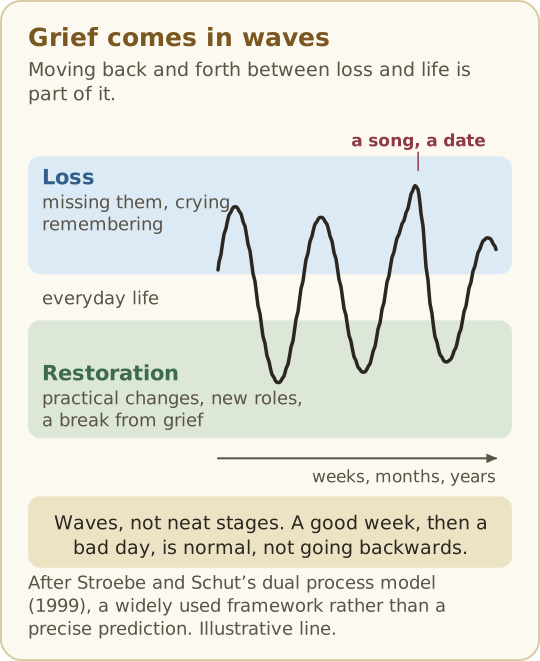
Many people expect grief to move in a straight line, from devastation to recovery. It rarely does. It comes in waves: sudden, strong, then easing, then returning, often set off by a song, a smell, a date or a place.
Psychology
Elisabeth Kübler-Ross described five stages (denial, anger, bargaining, depression and acceptance) in On Death and Dying (1969), from her work with people who were dying. The stages became famous, but research on bereaved people hasn’t found that most move through them in order, and Kübler-Ross herself later said they weren’t meant as a neat sequence. They are better treated as some of the feelings people may have, in any order, or not at all.
Margaret Stroebe and Henk Schut (1999) proposed the “dual process model.” It describes healthy grieving as moving back and forth between two kinds of focus: loss-oriented (missing the person, crying, remembering) and restoration-oriented (dealing with practical changes, new roles, taking breaks from grief). They suggested this swinging, which they call oscillation, is helpful: too much of either can wear people down. The model is widely used by grief counsellors, and research supports parts of it, though it’s a framework rather than a precise prediction.
Philosophy
The Roman Stoic Seneca wrote letters of consolation, including one to a mother named Marcia, still grieving her son years after his death. He accepted that grief is natural, but argued against letting it become a permanent identity, and encouraged her to remember her son with gladness rather than only pain. Some readers find his tone firm; others find it bracing and kind. Either way, the idea that grief and ordinary life can sit side by side is an old one.
In Japanese aesthetics, mono no aware names a gentle awareness that things pass, a sadness that also deepens appreciation. Cherry blossom viewing is often given as an example: the blossoms are loved partly because they fall so soon.
Through an autistic lens
Some autistic people describe grief that is delayed: they cope practically at first, then feel it strongly weeks or months later when the routine settles. Others describe grief coming out through the body, as exhaustion, sensory overwhelm or shutdown, rather than through tears. A mind that focuses deeply on one thing at a time (see Chapter 9) may find it hard to switch between “loss” and “life” mode quickly. Having planned, predictable breaks from grief (a set time for a favourite show, a walk on the same route) can make the swing between the two feel safer.
Thoughts you could try: “This is a wave. It came, and it will ease.” “Taking a break from grief is part of grieving.”
The grieving body and brain
Grief isn’t only emotional. It changes sleep, appetite, energy, attention and memory. Some people feel physical pain, like a heavy chest or aching limbs.
Psychology
Neuroscientist and psychologist Mary-Frances O’Connor, in The Grieving Brain (2022), describes grief partly as a learning problem. The brain built a map of the world in which your person (or home, or job) was always there. After a loss, it keeps expecting them, and has to slowly update that map. That may be why it’s so common to reach for the phone to call someone who has died, and why the reality of the loss can hit again and again.
Studies have also linked bereavement with short-term increases in stress hormones, poorer sleep and changes in immune function, and with a higher risk of some health problems, especially in the early months. These are averages across many people, not predictions for you. But they are a good reason to treat sleep, food and medical check-ups as part of grieving, not distractions from it.
Philosophy
C. S. Lewis, in A Grief Observed (1961), written after the death of his wife, noticed how much grief felt like fear: the restlessness, the fluttering in the stomach, the inability to settle. He also described a kind of laziness and invisible blanket between himself and the world. His notebook is valued because it doesn’t tidy grief up. Joan Didion’s The Year of Magical Thinking (2005) describes how, after her husband died, part of her mind kept acting as if he might come back, keeping his shoes because he would need them. Both writers describe, in their own words, what O’Connor later explained in brain terms.
Through an autistic lens
Grief can lower anyone’s capacity to cope with noise, light, crowds and small talk. For autistic people who already work hard to manage sensory input, a funeral, a busy family home, or a stream of visitors can push them past their limit. Planning a quiet space, ear defenders, a way to leave early, or a role with a clear task (handing out programs, managing the playlist) can make it possible to be present. Some autistic people need very clear information about what happened, in plain words, before their body can begin to settle. Euphemisms like “we lost him” or “she passed” can be confusing, especially for children. Many child bereavement services recommend using the words “died” and “dead” with all children for the same reason.
Words you could use: “I want to be at the funeral, and I’ll need a quiet room and a way to leave early. Can you help me plan that?”
Ambiguous and unrecognised grief
Some losses don’t fit the usual shape. There’s no death certificate, no funeral, no casseroles on the doorstep. And yet the grief is real.
Psychology
Family therapist Pauline Boss named “ambiguous loss” (her book of that name came out in 1999). She described two kinds: someone physically gone but psychologically present (a missing person, an estranged family member, a parent who left), and someone physically present but psychologically gone or changed (dementia, serious brain injury, addiction). Ambiguous loss is hard partly because there’s no clear ending to grieve. Boss suggests learning to hold “both/and” thinking: “He is here, and he is gone.”
Kenneth Doka (1989) named “disenfranchised grief”: grief that isn’t openly recognised or supported by others. Examples include the death of an ex-partner, a pregnancy loss, the death of a pet, a loss by suicide or overdose that people avoid talking about, or the death of someone in a relationship others didn’t know about or approve of. Without recognition, people may grieve alone and feel they don’t have the right to.
Philosophy
Rituals in many cultures do something important: they publicly mark a loss, so the community can share it. Jewish mourning practices such as sitting shiva bring people to the mourners’ home for a set time. Mexican Día de Muertos makes space each year to welcome and remember the dead. Where a loss has no ritual, the philosopher’s question becomes a practical one: what would honour this? People can create their own small rituals, and many find that doing so makes the loss feel real and allowed.
Through an autistic lens
Autistic people sometimes experience losses others don’t notice: a friendship that ended without explanation, a support worker who left, a school or job where they finally felt understood. Late diagnosis can bring its own ambiguous grief, for the younger self who struggled without knowing why, alongside relief. These griefs deserve recognition too. An explicit ritual, with a clear beginning and end, can help: writing a letter, choosing a day to visit a place, or making a page of memories.
Words you could use: “I know this might not seem like a big loss to others. It is to me, and I’d like you to know.”
Grieving styles and families
People in the same family, grieving the same person, can grieve in very different ways. This is one of the most common sources of hurt after a loss.
Psychology
Terry Martin and Kenneth Doka (2000) described two broad grieving styles on a spectrum. Intuitive grievers tend to feel and express grief through emotion: crying, talking, sharing. Instrumental grievers tend to experience grief more through thinking and doing: solving problems, taking action, staying busy, creating something. Most people are a blend. Neither style is healthier. They noted that the instrumental style is often misread as “not grieving.”
Culture, faith, gender expectations and age shape how grief is shown. Children often grieve in short bursts: sad one minute, playing the next. Some bereavement charities describe this as “puddle jumping.” It doesn’t mean they don’t care; it’s how young minds manage big feelings.
Philosophy
Confucian tradition placed great weight on mourning rites for parents, including long periods of observance, partly as a way of expressing gratitude and continuing respect. Other traditions keep grief more private. Comparing them shows that there isn’t one natural way to grieve; there are many forms, and each family blends its own. That can free people from judging each other’s grief by their own family’s rules.
Through an autistic lens
Autistic grief is sometimes misread as coldness: a flat face, a focus on practical details, questions that seem blunt (“What happens to his car?”), or wanting to go to work the next day. These can all be ways of coping with something overwhelming. This is the double empathy problem again: the meaning gets lost between different ways of expressing the same feeling. It runs both ways. An autistic person may also misread a non-autistic relative’s need to talk about feelings as pressure. Saying it plainly helps everyone: “I’m sad. It just doesn’t show on my face.”
Words you could use: “You’re grieving in your way and I’m grieving in mine. Neither of us loves him less.”
Write it, wait, then send
Who is it to?
- Partner
- Co-parent or ex
- Chosen: Family
- Friend
- Housemate
- Coworker
- More than one person
- Someone else
- Their name (optional)
- Malcolm and Fiona
- Your name (optional)
- Mum
What kind of message?
- Raise something
- Reply to something
- Chosen: Make a plan
- Say sorry
- I need a pause
- What we need to plan (one thing)
- How often we ring and visit. Since your dad died in March, I’ve had a call every evening at seven and a visit every Sunday.
How I feel about it
- Chosen: tired
- rushed
- frustrated
- unseen
- taken for granted
- overwhelmed
- stretched thin
- worried
- hurt
- disappointed
- left out
- alone with it
- confused
- embarrassed
- annoyed
- sad
- on edge
- hopeful
- Chosen: grateful
- What I suggest (one clear suggestion)
- Could we change to a call on Wednesdays and Sundays, and I’ll ring you if I need you in between?
- What I’m NOT saying (optional, but it helps)
- I’m not pushing you away. I love hearing from you, and I miss your dad too.
When I’d like a reply
- Today
- Tomorrow
- Chosen: By the weekend
- No rush
A gentle check
House rules: ✓ One topic · ✓ Facts, not verdicts · ✓ No always or never · ✓ No sarcasm or ALL CAPS · ✓ No “you” accusations · ✓ Says what you’re asking for · ✓ A reply-by time
No sharp words found. It reads as calm and clear.
A made-up example. Names and details are invented. Fiona rang the same evening: “Of course. Will you still tell us on a bad day?” Edith said she would.
Fill in your own: Write it through (spreadloveandacceptance.com/
Continuing bonds
For much of the twentieth century, a common idea in Western psychology was that healthy grief meant “letting go” and investing in new relationships. Many grieving people never found that fit their experience.
Psychology
Dennis Klass, Phyllis Silverman and Steven Nickman, in Continuing Bonds (1996), argued that many bereaved people keep an ongoing inner relationship with the person who died, and that this is often healthy. People talk to them, sense their presence, follow their example, keep their belongings, and mark their birthdays. Later research suggests continuing bonds can be comforting or distressing, depending on the person and how the bond is held. Bonds that help a person carry the relationship into a changed life seem helpful. Bonds that keep someone from accepting that the death happened may be harder.
Philosophy
Many traditions honour continuing bonds: ancestor veneration in parts of East Asia and Africa, saints’ days, memorial prayers on anniversaries, and family altars. Philosophers in many times have also written that the dead live on in the lives they shaped, in the habits, values and kindnesses passed on. You don’t need any particular belief about an afterlife to find meaning in carrying someone’s influence forward.
Through an autistic lens
Continuing bonds can fit naturally with autistic strengths: keeping detailed memories, collecting meaningful objects, maintaining a ritual exactly as it was. Continuing a shared routine (the Sunday walk, the same tea) can be grounding. It can also be painful to have routines suddenly lose their partner. Some autistic people find it helps to adapt a routine on purpose (“I’ll still walk on Sundays, and I’ll take his old route”) rather than trying to keep it identical or drop it completely.
Thoughts you could try: “What part of them do I want to carry forward?” “I can change my life and still keep them with me.”
Endings, the in-between, beginnings
Not every loss is a death. Moving, retiring, a new baby, an empty nest, a diagnosis, a breakup, leaving a faith, or coming out can all bring grief, even when the change is wanted.
Psychology
William Bridges, in Transitions (1980), distinguished between change (the outside event) and transition (the inner process of adjusting). He described three phases: an ending (letting go of the old identity or situation), a neutral zone (an unsettled in-between, where the old way is gone but the new one doesn’t feel real yet), and a new beginning. His work comes from coaching and organizational practice, not controlled studies, but many people find it describes their experience well. The neutral zone is often the most uncomfortable, and the most important not to rush.
Research on the transition to parenthood, retirement and migration finds that even welcome changes can bring a drop in wellbeing for a time, along with loss of routines, roles and relationships.
Philosophy
The Greek philosopher Heraclitus is remembered for the idea that you can’t step into the same river twice, because the river and you are always changing. Buddhist teaching calls this impermanence (anicca), and treats it not as a tragedy but as the nature of things, which, accepted, can bring a certain peace. A well-known Buddhist story tells of Kisa Gotami, a mother who brought her dead child to the Buddha asking for medicine. He asked her to fetch a mustard seed from a house where no one had ever died. She went from door to door and found no such house, and in that search she understood that loss touches every family.
Through an autistic lens
For many autistic people, change itself has a real cost, even when the change is good. Routines, familiar places and predictable people are often how an autistic nervous system stays regulated. A new job, a house move or a new baby can bring a long period of sensory and social overload. That isn’t inflexibility. Planning for transitions helps: visiting the new place first, keeping some routines constant, getting clear information early, and expecting the in-between to be hard. Some autistic people describe needing more recovery time after change than others expect, and burnout can follow a big transition if that time isn’t given.
Words you could use: “This change is good, and it’s also a lot. I need some things to stay the same for a while.”
Losing a partner in later life
After a long marriage or partnership, the loss is everywhere at once: in the empty chair, the second cup you nearly make, his side of the bed, the jobs that were always hers. Many people say the practical side of the first year surprised them as much as the grief did.
The first year
- The firsts: the first birthday, wedding anniversary, Christmas or Eid, and the anniversary of the death. The days before can be harder than the day itself. Plan something small and kind for each one, even if the plan is to stay in.
- Belongings: there is no right time to sort clothes and things. Some people do it in the first month; others wait years. You don’t have to do it alone, and you don’t have to do it all at once. One drawer counts.
- The paperwork: bank accounts, pensions, bills in their name, passwords nobody wrote down. It is tiring and often comes just when you have least energy. Ask one person to sit with you while you do it, and keep a simple list of what is done.
- The jobs that were theirs: the finances, the garden, the car, remembering birthdays. Learning them is a second loss on top of the first. It is fine to ask for help, to pay for help, or to let some of them go.
- The quiet: evenings and weekends are often the hardest. A small routine (a walk at the same time, a weekly call, a class) gives the week some shape.
Grown-up children, from the parent’s side
Your children have lost a parent, and you have lost a partner. It is the same person and a different loss, so you may grieve on different timetables and in different ways. One of you may want to talk about them all the time while another can’t yet. Neither way is wrong.
Many widowed parents also find they are suddenly being checked on: daily calls, questions about eating and sleeping, advice about selling the house. That checking almost always comes from love and fear of losing you too. It isn’t control. It can still feel like being treated as fragile, or as if you can’t run your own life. Saying what helps, and what doesn’t, is kinder than going quiet. A good time to say it is a calm one, and it often helps to start with thanks.
Words you could use: “I love that you ring. Could we make it two evenings a week, and I’ll ring you if I need you?” “I’m sad, and that’s normal. If I’m not coping, I promise I’ll tell you.” “I’m not ready to decide about the house. I’ll know when I am.” “Tell me about your dad. I like hearing what you remember.”
And if you are the grown-up child: ask what helps, rather than deciding. “Would you like me to ring every day, or is that too much?” leaves your parent in charge of their own life.
Resilience, support and stuck grief
How do most people get through a major loss? And when should we worry?
Psychology
George Bonanno’s research (summarised in his 2004 paper on loss and resilience, and his book The Other Side of Sadness, 2009) found that many bereaved people show resilience: they feel deep sadness, but continue to function and gradually regain a sense of wellbeing. That doesn’t mean they didn’t love the person, or that they won’t have hard days. It means that coping is the most common outcome, not the exception. Social support, feeling able to express or not express grief as needed, and some flexibility in coping are often linked to better outcomes.
For a smaller group of people, grief stays intense and disabling for a long time. Since 2022, “prolonged grief disorder” has been recognised in both the World Health Organization’s ICD-11 and the American Psychiatric Association’s DSM-5-TR. It describes intense yearning or preoccupation with the person who died, with other symptoms such as feeling part of oneself died, difficulty re-engaging with life, or feeling life is meaningless, lasting well beyond what is expected in the person’s culture and getting in the way of daily life. Including it as a diagnosis was debated, because some feared it might label normal grief. Supporters argue it helps people who are stuck get specific treatment, and there are therapies designed for it.
James Pennebaker’s research on expressive writing (starting in the 1980s) found that writing about upsetting experiences for a few short sessions was linked with modest benefits for some people. Results vary across studies, but it’s a low-cost thing to try.
Philosophy
The Stoic Epictetus advised never saying “I have lost it,” but “I have given it back”: to treat what we love as on loan. Many people find that cold when grieving, and it’s fair to say so. But some find a gentle version helpful: gratitude for the time they had, rather than only pain at its ending. Iris Murdoch, writing about moral attention, suggested that looking justly and lovingly at reality, including painful reality, is itself a kind of goodness. In grief, that might mean letting ourselves see the loss clearly, and also seeing the love clearly.
Through an autistic lens
Support works best when it fits. Many autistic people find “call me anytime” hard to use: it’s vague, and phone calls can be draining. Clear, specific offers work better: “I’ll text on Sunday evenings. Reply with a number from 1 to 5 for how you are, if you like.” Text-based support groups, written grief resources and structured counselling can suit people who find open-ended talk hard. If you support an autistic person who is grieving, believe what they tell you about what helps, even if it’s different from what would help you.
Words you could use: “I’d like support, and I find calls hard. Could we text instead?” “It’s been a long time, and it isn’t easing. I want to talk to someone about it.”
Guilt, regret and “if only”
Almost every grieving person asks “what if?” What if I’d called the doctor sooner, visited more, said sorry, noticed the signs? This is so common that many grief counsellors treat it as part of grief itself, not a sign that you did something wrong.
Psychologists call these “counterfactual thoughts”: imagining how things might have gone differently. They are the mind’s way of searching for control in a situation that felt out of control. Sometimes there is a real regret to face, and the ideas in Chapter 7 on owning a mistake can help: name it, make what repair is possible (a letter, a changed habit, a kindness to someone else), and let it rest. Often, though, “if only” assumes you knew then what you know now. You didn’t. Hindsight makes the road look clearer than it was.
From an autistic point of view, a mind that likes to work things through in detail may replay events many times, looking for the exact point where it went wrong. That can be a way of making sense of things, and it can also become a loop. Setting a time limit (“I’ll go over it for twenty minutes, then do something with my hands”) or writing out the facts once, fully, can help close the loop.
Thoughts you could try: “I’m judging my past self with information they didn’t have.” “I did what I could with what I knew.”
Your part, and only your part
You can’t control the loss, how long grief lasts, or how other people respond to it. You can control small, kind things: what you eat, whether you rest, who you tell, and what you say no to for now. In a hard season, that is enough. Give your energy to people who make the grief lighter, and let anyone who makes it heavier take up less room for a while. Part One covers this in full: your circle of control, and matching energy.
Putting it together
Grief is love meeting reality. Psychology shows it is common, varied, physical and slow, and that most people find a way to carry it. Philosophy and tradition offer ways to mark it, share it and find meaning alongside it. The autistic lens shows how much grief can be misread when it looks different, and how much change itself can cost.
Some threads run through all three:
- There is no single right way. Waves, not stages. Doing as well as feeling. Many cultures, many rituals.
- Bonds can continue. You don’t have to let go to go on.
- Change is loss, too. Even good change asks something of us, and the in-between is hard.
- Support helps when it fits. Specific, steady and on the grieving person’s terms.
This site’s idea: a “grief week plan” for heavy seasons: three basics (food, sleep, daylight), one person to check in with, one small ritual, and one thing you’re allowed to say no to.
Worked examples
On your own. After her divorce, Brenda lives alone for the first time in fifteen years. She’s relieved and grieving at once. She notices the hardest time is Sunday evening, when the house used to be busy. She plans one thing for Sunday evenings: a phone call with her sister, a class, or a long bath with music. The grief is still there, but Sundays now have a shape.
Partners. Mateo and Lucia lose a pregnancy at eleven weeks. Lucia wants to talk about it; Mateo goes quiet and throws himself into work. Lucia thinks he doesn’t care. When they talk, Mateo explains that he can’t find words and is terrified of making it worse. They agree on a small ritual together, planting a tree, and Lucia also joins a support group of people who’ve been through it.
Parent and child. Seven-year-old Pippa’s grandmother dies. Her dad uses plain words: “Grandma died. Her body stopped working and it can’t start again.” Pippa plays happily, then cries at bedtime, then asks if she can still have Grandma’s birthday cake recipe. Her dad answers each question simply, and they bake it together.
Friends. When Lyle’s best friend dies, a group of friends set up a monthly dinner on the date. Two years later, they still meet. They don’t always talk about him, but they always toast him.
Coworkers. When a colleague’s husband dies, the team quietly takes over her deadlines for a month. Her manager checks in privately: “Would you prefer we mention it, or not?” She asks them not to make a fuss, but to keep including her in lunch. They do.
Autistic adult. Jamie, who is autistic, loses the café where he has worked happily for eight years when it closes. Friends say he’ll find another job. He’s grieving: the routine, the regulars, the exact way the morning went. He writes a goodbye letter to the café, keeps his apron, and asks for a week before starting to look for work. His support worker helps him visit new places slowly.
Community. After a flood destroys homes in a small town, neighbours grieve houses, photos, gardens and a sense of safety. A local group organises a memory board where people pin photos of what was lost. It doesn’t replace anything, but it gives the grief a place.
Exercises
1. Your loss map
Draw a circle for a loss you’re carrying. Around it, write the smaller losses that came with it: routines, roles, plans, people, places. Each one may need its own bit of grief.
2. Loss time, life time
For one week, notice when you’re in “loss” mode and when you’re in “getting on with life” mode. If you’re stuck in one, plan a little of the other: a planned time to remember, or a planned break.
3. A letter
Write a letter to who or what you lost. Say what you miss, what you’re grateful for, what you wish you’d said, and what you’ll carry forward. Keep it, share it or burn it, as you choose.
4. Your support list
Write down two people for practical help, two for listening, and one professional or helpline. Next to each, write how you prefer to be contacted.
5. The transition map
For a big change, write three headings: what ended, what feels unclear now, what is beginning. Add one small thing that could make the in-between easier.
Questions people often ask
How long does grief last?
There’s no set time. The sharpest grief often eases over months, but many people feel waves for years, especially at anniversaries. Most say grief doesn’t disappear; it becomes something they carry more easily.
Is it normal to feel relief?
Yes. After a long illness, a hard relationship or a period of caring, relief is common and doesn’t mean you didn’t love the person. Relief and grief often come together.
Should I take children to the funeral?
Many bereavement services suggest offering children the choice, after explaining clearly what will happen, and having a trusted adult with them who can step out if needed. Plain, honest words help more than shielding them completely.
Why am I grieving someone I was estranged from?
Because you may be grieving more than the person: the relationship you hoped for, the chance to repair, or a childhood that wasn’t what you needed. That is ambiguous grief, and it’s real. Family rifts has more.
I’m autistic and people think I didn’t care. What can I say?
You might say: “I grieve differently. I’m very sad, even though it doesn’t show the way you expect.” If you can, tell people one thing that would help, like “a text is better than a visit.”
What do I say to someone who is grieving?
Simple words are best: “I’m so sorry. I’m thinking of you.” Avoid explaining the loss (“it was meant to be”) or comparing it (“at least…”). Offer something specific, like a meal or a lift, and keep in touch after the first few weeks, when support often fades. Mentioning the person by name, and sharing a memory, is usually welcome. Psychologist Susan Silk and mediator Barry Goldman, in a 2013 newspaper article, offered a simple rule some people find helpful: comfort flows in towards the person closest to the loss, and venting flows out, away from them.
When should I see a professional?
If after many months the pain isn’t easing at all, daily life feels impossible, you can’t accept that the death happened, or you feel life has no point, talk to a doctor or a grief counsellor. If you have thoughts of not wanting to be here, please reach out today (see below).
Limits, safety and when to get more help
- This chapter teaches ideas. It can’t tell you how your grief should go, and it isn’t a substitute for bereavement counselling or medical care.
- Hospices, faith communities, bereavement charities and doctors can often connect you with free support, including specialist help for children and for people bereaved by suicide.
- If you are having thoughts of not wanting to be here, please tell someone today. In the US and Canada, call or text 988. In the UK and Ireland, call Samaritans free on 116 123. In Australia, call Lifeline on 13 11 14. In New Zealand, call or text 1737. Anywhere else, findahelpline.com lists free helplines. If you are in danger right now, call your local emergency number.
- If you are grieving a relationship you left because you weren’t safe, or the loss involved violence, Not safe at home? has free, private help, including after you separate.
More on the site: Grief and later life, with a page for a hard evening; research notes on grief and change, ambiguous loss, moving and life transitions and expressive writing; and the next chapter, Minds that work differently. The chapter before this one, Self-worth, shame and self-compassion, may help with the guilt that often comes with grief.
Last updated: October 2026