Part Three · Chapter 12
Helping others well
In short:
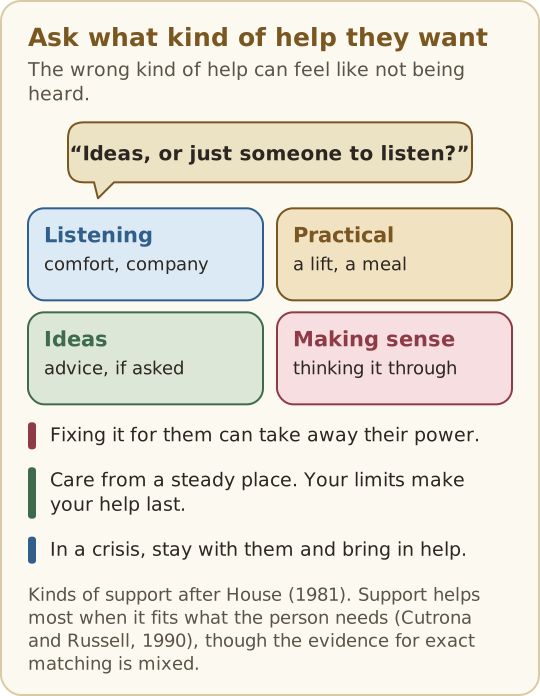
- Ask what kind of help they want. “Ideas, or just someone to listen?” saves a lot of misfires.
- Listening is help. Fixing it for someone can take away their power.
- Your limits make your help last. Caring from a steady place helps more than drowning in their feelings.
- In a crisis, stay and bring in help. It’s okay to ask directly about suicide, and to call for help.
Why the tools work: this chapter explains the thinking behind these tools from earlier in the book.
- One owner per job: sharing the care (Part Two, Chapter IV) works because help lasts when it is shared and named. Carers burn out when everything is “just helping” and nobody else owns a job. Big idea: see the whole load.
- How much are you carrying? (Part Two, Chapter III) helps you notice when you are running on empty before you snap or stop.
Wednesday, 7:15pm
Your friend is telling you about her awful week. You have five good ideas before she’s finished her first sentence. You share them all. She goes quiet, then says, “Yeah, maybe.” You both hang up feeling a bit worse, and you’re not sure why.
This chapter is about helping other people well. It covers everyday help, like supporting a friend through a bad week, and harder help, like caring for someone who is ill or being there for someone in crisis. Its main message is simple: the best help usually starts with asking, listens before it acts, respects the other person’s choices, and comes from a helper who is looking after themselves too.
Each idea is looked at through three lenses. Psychology shares what research has found, and where it’s uncertain. Philosophy brings in thinkers and traditions on care, duty and kindness, retold in plain words, in paraphrase rather than quotation. Through an autistic lens offers a perspective from autistic experience: real differences, described as differences, without stereotypes and without diagnosing anyone. Where it matters most, an ADHD lens does the same. Then each idea comes back to everyday life. Ideas that are this site’s own are marked This site’s idea.
Ask what kind of help they want
“Help” sounds like one thing. It’s actually several, and the mismatch between what’s offered and what’s wanted causes a surprising amount of hurt between people who care about each other.
Psychology
Researchers often sort support into a few kinds. James House (1981) described emotional support (care, comfort), instrumental support (practical help, like money or a lift), informational support (advice, facts) and appraisal support (helping someone make sense of things). Carolyn Cutrona and Daniel Russell proposed an “optimal matching” idea (1990): support helps most when it fits what the situation and the person need. The evidence for exact matching is mixed, but the everyday lesson holds up: the wrong kind of help can feel like not being heard.
Research on advice, including work by Erina MacGeorge and colleagues, suggests that advice tends to be received better when it was asked for, when the person giving it is seen as caring, and when it doesn’t imply the other person is incapable. Unwanted advice can come across as criticism, even when it’s meant as love.
Philosophy
The political philosopher Joan Tronto, in Moral Boundaries (1993), described care as having several phases: noticing that someone needs care, taking responsibility for it, actually giving the care, and then checking how the care was received. That last phase is easy to skip. Asking “did that help?” is part of caring, not an extra.
The disability rights movement popularised the phrase “Nothing about us without us”: decisions about people should involve those people. It began in politics and public policy, but it fits everyday help too. The person being helped is the expert on what they need.
Through an autistic lens
Many autistic people say that explicit questions are a relief: “Do you want ideas or just to vent?” takes the guesswork out, for both the helper and the person being helped. It’s a clear example of how a practice that suits many autistic people turns out to help almost everyone.
It also works the other way. Some autistic people show support mostly through information and solutions, because that’s how they would want to be helped. When this is misread as cold, it helps to say the intention aloud: “I’m giving you ideas because I care. Tell me if you’d rather I just listen.”
Putting it into everyday life
Ask before helping. Offer a short menu: ideas, listening, practical help, company. Afterwards, check how it landed. And if you need help yourself, tell people which kind you’d like; it makes their job much easier.
Words you could use: “Do you want ideas, a listening ear, or a hand with something?” “Was that helpful, or would something else be better?”
Listening is a kind of help
Many helpers feel they haven’t really helped unless they did something. But being truly listened to can change how a person feels, how clearly they think, and what they decide.
Psychology
The psychologist Carl Rogers argued, from the 1940s on, that people tend to grow and find their own way when they experience empathy (being understood), unconditional positive regard (being accepted) and genuineness from the person helping them. Reflective listening, saying back what you heard, comes from his work. Motivational interviewing, developed by William Miller and Stephen Rollnick, names the “righting reflex”: the helper’s urge to fix and correct, which often makes people defend the very thing they’re unsure about.
Research by Guy Itzchakov, Avraham Kluger and colleagues found that people who were listened to well felt less anxious and defensive, and thought about their own views in a more balanced way. Marsha Linehan, who developed dialectical behaviour therapy, described levels of validation, from simply paying attention up to communicating that someone’s reaction makes sense given their situation. Validating a feeling doesn’t mean agreeing with every action. The library covers active listening and validation.
Philosophy
The French philosopher Simone Weil wrote that real attention to someone who is suffering is rare and precious, a kind of generosity. Iris Murdoch similarly saw attention as the heart of moral life. Both suggest that listening isn’t a lesser form of help. It may be the purest one.
The Jewish philosopher Martin Buber described two ways of relating: “I-It,” where we treat others as objects or problems, and “I-Thou,” where we meet them as whole persons. Listening fully is a way of meeting someone as a “Thou.” The site retells it in I and Thou.
Through an autistic lens
Listening doesn’t have to look a certain way. Many autistic people listen best without eye contact, or while moving, doodling or fidgeting. It can be helpful to say: “I’m listening, even though I’m not looking at you.” For the person being listened to, what matters is being understood, not the look of the listener.
Many autistic people also show they’ve understood by sharing a related experience of their own. This is sometimes misread as making it about themselves, when it’s often meant as “I get it; this happened to me too.” Saying so helps: “I’m telling you this because I think I understand. Tell me more about yours.”
Putting it into everyday life
Listen for longer than feels natural. Sum up what you heard and check it. Name the feeling if you can (“that sounds so frustrating”). Hold your advice until it’s asked for, or ask whether it’s wanted. The Check-ins guide has more on tender conversations.
Words you could use: “Let me check I’ve got it. You’re saying… and you feel… Is that right?”
Fixing it for them can take away their power
When someone we love is struggling, taking over can feel like the most loving thing to do. Sometimes it is. But often, helping someone do it themselves is the deeper kind of help.
Psychology
Niall Bolger, Adam Zuckerman and Ronald Kessler (2000) studied couples where one partner was preparing for a very stressful exam. Support that the stressed person noticed was sometimes linked with feeling worse, perhaps because it reminded them they needed help. Support that the partner gave without it being noticed (“invisible support”) was linked with feeling better. This is one study type among many, and visible support is often welcome, but it shows that help can carry a hidden message about competence.
Self-determination theory (Deci and Ryan) finds that people do better when they feel autonomy: that their choices are their own. Help that supports someone’s own choices tends to work better than help that controls. Research on “overparenting,” such as work by Chris Segrin and colleagues, has linked very hands-on parenting of young adults with lower confidence in coping on their own. In the 1960s, Stephen Karpman described a “drama triangle” of persecutor, victim and rescuer; it’s a model from transactional analysis rather than a tested finding, but many people recognise the rescuer trap in it.
Philosophy
Maimonides, the medieval Jewish philosopher, described eight levels of giving. He placed at the top helping someone become self-sufficient, such as through a loan, a partnership or a job, so they no longer need charity. The highest help, in this view, is the help that leaves someone stronger.
John Stuart Mill, in On Liberty (1859), argued that adults should be free to make their own choices about their own lives, even ones others think unwise, as long as they don’t harm others. Immanuel Kant argued that we have a duty to help others, but also a duty to respect them as people who set their own goals. A line often given from the Tao Te Ching says, in spirit, that the best leaders are barely noticed, and when the work is done the people say “we did it ourselves.”
Through an autistic lens
Many autistic people have had a lot of help that wasn’t asked for: being spoken for, having decisions made for them, being “managed.” That history makes autonomy especially important. Asking, rather than assuming, is respectful: “Do you want me to make that call, or would you like me to sit with you while you do?”
At the same time, some tasks really are harder for some autistic people, such as phone calls, forms or noisy shops. Practical help with those isn’t taking power away when it’s asked for. The question isn’t “help or no help.” It’s “whose choice is it?”. Body doubling, where someone simply works alongside you, is one kind of help many autistic and ADHD people find useful, precisely because it supports rather than replaces.
Putting it into everyday life
Before you act, ask: “Would you like me to do that, or help you do it?” Offer a scaffold rather than a rescue: a checklist, a second pair of eyes, company while they do it. Let people make choices you wouldn’t make, when it’s their life. And if someone asks you to take over something, that’s their choice too.
Thoughts you could try: “The goal is for them to feel more able, not for me to feel more useful.”
Care without drowning in their feelings
Some people feel others’ pain so strongly that helping becomes exhausting. Understanding the difference between empathy and compassion can make caring sustainable.
Psychology
Tania Singer and Olga Klimecki (2014) described two different responses to someone else’s suffering. In “empathic distress,” you feel their pain as if it were yours, which can be overwhelming and make you want to withdraw. In “compassion,” you feel warmth and concern and want to help, from a steadier place. In their brain-imaging studies, the two engaged different networks, and short compassion training seemed to increase positive feelings and reduce distress. These are lab studies, so real life may be messier.
Charles Figley wrote about “compassion fatigue” in helping professions (1995). The psychologist Paul Bloom, in Against Empathy (2016), argued that empathy works like a spotlight: intense, but narrow and biased towards people like us. He argued for what he called rational compassion. Not everyone agrees with Bloom, but the distinction is useful. See empathic distress and compassion in the library.
Philosophy
Buddhist teaching describes four qualities often practiced together: loving-kindness, compassion, joy in others’ happiness, and equanimity. Equanimity isn’t indifference. It’s the steadiness that lets compassion last without being swept away. The four are meant to balance each other.
The Scottish philosopher Adam Smith, in The Theory of Moral Sentiments (1759), noted that we can never directly feel what another person feels; we imagine ourselves in their place. That’s a humble reminder: you don’t need to feel exactly what they feel to care well, and you can’t anyway.
Through an autistic lens
There’s an old stereotype that autistic people lack empathy. Research doesn’t support it as a general rule. Studies distinguish “cognitive empathy” (working out what someone feels) from “affective empathy” (feeling for them). Many autistic people describe strong, even overwhelming, feelings for others, alongside difficulty reading unfamiliar signals. Geoffrey Bird and colleagues (2010) found that lower empathy scores were linked with alexithymia, which some autistic people have and many don’t, rather than with autism itself. And research on the double empathy problem has found that non-autistic people are often poor at reading autistic people, too.
For autistic people who feel others’ distress intensely, the compassion skills here can be especially useful: noticing when empathy tips into overwhelm, and stepping back to steady yourself, perhaps with sensory regulation, before stepping back in.
Putting it into everyday life
Notice when you’re taking on someone’s feelings as your own: you can’t sleep, you feel their dread. Shift towards compassion: “I care about you, and I’m steady.” Build in recovery after heavy conversations. If you work in a helping job, look for supervision or peer support, which many professions offer for exactly this reason.
Thoughts you could try: “This is their pain. I can be warm and steady beside it without making it mine.”
Your limits make your help last
Helping without limits often ends in exhaustion or resentment, and then in not helping at all. Limits are what make long-term care possible.
Psychology
Vicki Helgeson and Heidi Fritz described “unmitigated communion” (1998): focusing on others to the point of neglecting yourself. In their research it was linked with more distress, unlike healthy care for others, which was linked with wellbeing. The difference wasn’t how much people cared. It was whether they also cared for themselves.
Research on stress and resources, such as Stevan Hobfoll’s conservation of resources theory (1989), suggests that people under strain try to protect their remaining energy, time and support, and that losing resources tends to lead to more losses. That fits a common experience: once a helper is depleted, things fall apart faster. See boundaries and saying no in the library.
Philosophy
Kant described the duty to help others as an “imperfect” duty: a real duty, but one with room to choose when, how and whom to help. You’re not required to help everyone all the time. That’s not a loophole; it recognises that you are a person with your own life too.
Aristotle described generosity as a middle path between stinginess and wastefulness: giving the right amount, to the right people, in the right way. Giving everything away until you have nothing isn’t the highest generosity in his view. It’s a different kind of mistake.
Through an autistic lens
Many autistic people use energy accounting to manage their days. One well-known picture is “spoon theory,” created by Christine Miserandino (2003) to explain life with chronic illness and adopted by many disabled and autistic people: you have a limited number of spoons each day, and each task costs some. Social and sensory demands can cost a lot. Knowing your budget makes limits easier to set and explain.
Plainly stated limits often work best: “I can talk until 8, then I need quiet.” Some autistic people have spent years over-giving in order to be accepted. If that’s you, scripts can help: “I can’t do that, but I can do this.” A clear no is often kinder than a reluctant yes.
Putting it into everyday life
Decide your limits before you’re asked, when you’re calm. Offer a smaller, sustainable version rather than a flat no. Notice resentment: it’s often a sign a limit has been crossed. And remember that a helper who lasts is worth more than one who burns bright and burns out.
Words you could use: “I can’t do every night. I can do Tuesdays, and I’ll be fully there.”
Notice when you’re running on empty
Burnout isn’t a personal failing. It’s what tends to happen when demands stay high, resources stay low, and recovery doesn’t come.
Psychology
Christina Maslach’s research describes burnout as three things: exhaustion, cynicism or distance from the people you serve, and a sense of not achieving anything. The World Health Organization includes burnout in its classification of diseases as an occupational phenomenon, not a medical condition. Family carers face similar strain. Reviews by Martin Pinquart and Silvia Sörensen (2003) found that caregivers reported more stress and depression than non-caregivers, with dementia care especially hard. Respite care, practical help and support groups can ease the load, though effects vary.
The site’s library covers burnout and caregiver strain. The Nervous System Ladder can help you check where you are today.
Philosophy
Seneca, in On the Shortness of Life, argued that people give their time away carelessly and guard their money closely, when time is the more precious of the two. Many religious traditions build rest into life, like the Jewish Sabbath; the rabbi and philosopher Abraham Joshua Heschel described it (1951) as a kind of palace built in time: a day when we stop making things and simply live.
Audre Lorde, writing while living with cancer, described caring for herself as an act of survival, not selfishness. It’s often quoted in a shortened form, but the original point was serious: for people carrying heavy loads, rest is part of being able to keep going.
Through an autistic lens
Autistic burnout, as described in research by Dora Raymaker and colleagues (2020) with autistic co-researchers, is a long-lasting exhaustion with loss of skills and lower tolerance for stimulation, often linked to years of masking and life demands that exceed capacity. It overlaps with work burnout but isn’t the same. Many autistic people are also carers, including autistic parents of autistic children, which can double the load.
For autistic helpers, protecting recovery time, reducing sensory load and dropping masking where it’s safe can be essential, not optional. Support groups run by and for autistic carers can also help.
Through an ADHD lens
Many helpers with ADHD say yes fast, because helping is interesting, urgent and kind, and only later see how full the week already was. Then the crash comes all at once. A default sentence buys time without saying no: “I’d like to help. Let me check my week and come back to you tonight.” The other side matters too: people with ADHD often need practical help (a reminder, someone to sit with them while they do the forms) and feel ashamed to ask. Asking for that kind of help is a skill, not a failure.
Putting it into everyday life
Check your energy daily. Learn your early warning signs: snapping, numbness, dread, getting ill. Ask for one specific kind of help. Take small breaks before you need big ones. If you’re a carer, contact a carers’ organisation; Caring for someone you love has more.
Thoughts you could try: “Rest is part of the job. I can’t pour from an empty cup, and I don’t have to.”
In a crisis, stay with them and bring in help
Being with someone in crisis is frightening. You don’t need to be an expert. You need to stay calm enough, ask clearly, and connect them to trained help.
Psychology
A review by Teresa Dazzi and colleagues (2014) found that asking people about suicide doesn’t increase suicidal thoughts, and may reduce them. Thomas Joiner’s interpersonal theory of suicide suggests that feeling like a burden and feeling you don’t belong are important warning signs, which is why a sentence like “everyone would be better off without me” deserves a gentle, direct response. Research on “means safety” has found that putting time and distance between a person in crisis and ways to harm themselves can save lives.
Mental Health First Aid, a training course developed by Betty Kitchener and Anthony Jorm in Australia, teaches ordinary people to respond to mental health crises. Studies show it improves knowledge and confidence; evidence that it improves outcomes for the people helped is less clear. Formal training can still be worth doing.
Philosophy
The philosopher Emmanuel Levinas described the face of another person as a call to responsibility: before any theory, the other’s vulnerability asks something of us. In Albert Camus’s novel The Plague, Dr Rieux keeps working through an epidemic not as a hero but because it’s simply what decency requires. Both point to a plain kind of courage: showing up.
Through an autistic lens
Not every crisis looks the same. Autistic meltdowns and shutdowns are responses to overload, not tantrums or bad behaviour. Helpful responses usually mean less: fewer words, lower light and noise, space, no touching without consent, and time. Asking “Do you want me to stay, or give you space?” and accepting the answer is often the best help.
Research has found that autistic adults are at higher risk of suicide than the general population, which makes kind, direct asking especially important. Some autistic people find text-based crisis support easier than phone calls; 988 in the US and Canada and 1737 in New Zealand take texts, as do services in many other countries.
Putting it into everyday life
Save a crisis number in your phone today. If you’re worried, ask directly: “Are you thinking about suicide?” Listen without arguing. Don’t promise to keep it secret if their life is at risk. Help them contact a crisis line, doctor or emergency services, and stay with them while they do. Afterwards, look after yourself too; it’s a lot to carry. See free, private people to talk to.
Words you could use: “I’ve noticed you’ve seemed really low. Are you thinking about ending your life?” “Thank you for telling me. Let’s get you some support right now. I’ll stay with you.”
Don’t wait for someone else to step in
In public, it’s easy to assume someone else will help. Knowing why that happens makes it easier to be the one who does.
Psychology
John Darley and Bibb Latané’s experiments (1968) found that people were less likely to help when they believed others were also present: responsibility spreads thin. A review by Peter Fischer and colleagues (2011) found the effect is real but weaker in clearly dangerous emergencies. A 2020 study by Richard Philpot and colleagues, using real CCTV footage of public conflicts in three countries, found that in most cases at least one bystander did step in, and the more bystanders there were, the more likely someone helped. So people help more than the old story suggests, and you can be one of them.
Bystander training often teaches “the five Ds,” from the organisation Right To Be: distract, delegate (get someone else, like staff), document (if safe, and give the record to the person affected), delay (check in afterwards) and direct (speak up, if safe). These give options that don’t require confrontation.
Philosophy
The philosopher Peter Singer (1972) asked whether you would wade into a shallow pond to save a drowning child, even if it ruined your clothes. Almost everyone says yes. He argued that when we can prevent something bad at small cost to ourselves, we ought to. People debate how far that argument reaches, but in everyday life the point is plain: small help matters.
The Stoic Hierocles pictured each of us at the centre of circles, with family, neighbours, fellow citizens and all of humanity further out, and urged us to draw the circles inward. The site retells it as The circles of Hierocles. The Russian thinker Peter Kropotkin argued in Mutual Aid (1902) that cooperation, not just competition, is a major force in nature and human life.
Through an autistic lens
Unclear public situations can be hard to read for anyone, and some autistic people find it especially hard to know whether, and how, to step in. Having a plan in advance, like one of the five Ds, turns a confusing moment into a known script. Delegating (“I’ll get the driver”) or checking in afterwards are good options for people who find confrontation overwhelming.
Autistic people can also be on the receiving end of public hostility for looking or acting differently. Being a quiet ally, like sitting nearby or asking “Are you okay?”, can make a big difference.
Putting it into everyday life
Decide now which of the five Ds you’d be most comfortable using. Safety first: you don’t need to put yourself at risk. Even small acts, like asking “Are you okay?” or getting help, break the bystander effect for everyone around you.
Words you could use: “Hey, are you okay?” “You in the blue coat, can you call for help? I’ll stay here.”
Let other people help you too
Many good helpers are poor receivers. They feel awkward, indebted or weak when others help them. But giving and receiving are two halves of the same thing.
Psychology
The sociologist Alvin Gouldner (1960) described the “norm of reciprocity”: across cultures, people tend to feel they should return help. Relationships where help flows only one way can start to feel uneven. Francis Flynn and Vanessa Bohns (2008) found that people asking for help greatly underestimated how many others would say yes. In other words, people are more willing to help than we think.
Research by Elizabeth Dunn, Lara Aknin and Michael Norton (2008) found that spending money on others was linked with more happiness than spending it on yourself. Studies of volunteering and giving support, such as work by Stephanie Brown and colleagues (2003), have linked giving with better wellbeing and health, though these are mostly correlations. The upshot: letting someone help you often gives them something good too.
Philosophy
The philosopher Alasdair MacIntyre, in Dependent Rational Animals (1999), argued that dependence on others is a normal part of every human life, from infancy to old age, illness and disability, and that we need “virtues of acknowledged dependence”: being able to receive help gracefully as well as give it. Aristotle thought the best friendships were mutual, each person wishing good for the other. The Southern African idea of ubuntu, often summed up as “a person is a person through other people,” sees help as the fabric of community, not a debt.
Through an autistic lens
Asking for help can be especially hard if past requests were dismissed, or if you were told you were “too much.” Many autistic people find it easier to ask in writing, and to ask for something specific: “Could you make the phone call to the dentist for me?” Reasonable adjustments at work or school are a form of help too, and asking for them is a right in many places, not a favour.
The disability rights idea of interdependence fits here: nobody is fully independent, and needing support isn’t a failure. It’s how people live.
Putting it into everyday life
Say yes to small offers. Ask for specific help. Thank people, and let that be enough, without rushing to repay. Notice how it feels to let someone in. And when you’re the helper again, remember how it felt to receive.
Words you could use: “Yes, please. That would really help.” “I’m not good at asking, but could you help me with one thing?”
One owner per job: sharing the care
- Person A
- Margaret
- Person B
- Alan
- Person C
- Sue
- Date of this list
- 6 October 2026
Who owns each job
| Job | How often | Roughly how long? (hours each time, optional) | Owner | Helper or backup (optional) | Notes |
|---|---|---|---|---|---|
| Medicines and the pill box (as the care team directs) | Weekly | 0.5 | Margaret | Sue | Sue checks it on Sundays |
| Book and go along to medical appointments | As needed | 3 | Sue | Margaret | Sue drives; Mum comes too |
| Insurance and paperwork | Monthly | 1 | Alan | Sue | Dad can do this from his chair |
| Night care and night-time calls | Daily | 1 | Margaret | Ask the nurse about a night sitter | |
| Sunday call with the family | Weekly | 0.5 | Alan | ||
| Book respite: a break for the main carer | Monthly | 0.5 | Sue | Mum’s Thursday afternoon off | |
| Groceries and meals | Weekly | 2 | Sue | Margaret | Online shop, Sue orders |
Does every job have an owner?
- Jobs with an owner
- 7 of 7. Every job has an owner.
- Who’s carrying more right now
- Margaret 63% · Alan 9% · Sue 28%. Does this match what you agreed? If it doesn’t match, ask which job could move first. It’s a starting point for a talk, not a scorecard.
Changes to the list
| Date | What changed | Who |
|---|---|---|
| 6 Oct 2026 | Sue takes Tuesday nights from next week, so Margaret gets one full night’s sleep. | Margaret, Alan and Sue |
A made-up example. Names and details are invented. This is about who owns each job, not medical advice.
Fill in your own: One owner per job (sharing the care) (spreadloveandacceptance.com/
Putting it together
Good help starts by asking what kind is wanted. Listening is help in itself. Helping someone do it often beats doing it for them. Compassion lasts longer than empathic distress. Limits make help sustainable. Burnout is a signal to get help, not a failure. In a crisis, ask directly, stay, and bring in trained support. In public, small acts break the bystander effect. And receiving help is part of the same circle as giving it.
The three lenses agree. Psychology shows that matched, autonomy-respecting support works best and that helpers need care too. Philosophy, from Maimonides to Tronto to MacIntyre, sees the best help as the kind that leaves people stronger and acknowledges that we all depend on each other. The autistic lens asks for explicit questions, respect for autonomy, and recognition that care has many forms.
This site’s idea: before helping, run through ASK: Ask what kind of help they want; Support their choice rather than replacing it; Keep yourself going, with limits and rest. Then check afterwards how it landed.
Worked examples
- A friend after a breakup: Beatrix asks, “Ideas or venting?” Her friend says venting. Beatrix listens, sums up, and at the end offers one practical thing: “Want me to come with you to get your stuff from his place?” See Friends.
- Partners with a stressful job: When Ravi has a hard day, his partner sometimes gives “invisible” support: quietly making dinner and taking the dog out, without making a fuss. On other days, Ravi asks to talk, and gets full attention.
- A parent and a teenager with exam stress: Instead of making a revision timetable for her daughter, a mum asks: “Would a timetable help? Want to make one together?” The daughter makes her own, and sticks to it better.
- Adult children caring for a parent: Three siblings share care for their dad. One does appointments, one does shopping, one does weekend visits. They meet monthly to check how everyone’s coping, including themselves. See Caring for someone you love.
- A coworker in distress: A colleague mentions she hasn’t slept in days and feels hopeless. Her teammate asks gently whether she’s thinking about harming herself. She says no, but she’s struggling. They look up the workplace’s employee assistance line together, and the teammate checks in the next day. See At work.
- Housemates: When one housemate’s mother dies, the others make a simple rota for meals and leave a note: “No need to reply. We’re here.” They ask her what would help with the funeral, rather than deciding for her. See Grief.
- An autistic adult helping a friend: When a friend is upset, Alys’s instinct is to send articles and solutions. She has learned to ask first: “Do you want links, or just company?” Her friend sometimes says “links please,” and loves them.
- A stranger in trouble: An older man falls in a supermarket. Several people look. Imran says: “You in the red jacket, can you get a staff member? I’ll stay with him.” Within a minute, three people are helping.
- On your own, receiving help: After surgery, Hazel finally accepts a neighbour’s offer to walk her dog. The neighbour loves it. Six months later, Hazel walks the neighbour’s dog when he’s ill.
Exercises
1. The help menu
Write four kinds of help on a card or in your phone: ideas, listening, practical help, company. Next time someone shares a problem, offer the menu.
2. Two minutes of listening
In one conversation, listen for two minutes without advice or stories of your own. Then sum up what you heard and ask if you got it right. Notice what happens.
3. Do it, or help them do it?
For one week, each time you feel the urge to fix something for someone, ask yourself, and then them, “Would you like me to do this, or help you do it?”
4. Your helping budget
List the people you help regularly and roughly how much time and energy each takes. Mark which feel sustainable and which don’t. For one that doesn’t, plan a smaller, kinder version. This site’s idea.
5. Your early warning signs
Write down three signs that you’re heading towards burnout, like snapping, numbness or dread. Share them with someone you trust, and ask them to tell you if they notice.
6. Your crisis plan
Save a crisis line in your phone. Write down the words you’d use to ask someone about suicide. Knowing them in advance makes them easier to say.
7. Your bystander plan
Choose which of the five Ds (distract, delegate, document, delay, direct) you’d feel safest using. Imagine using it in a specific place you often go, like a bus or a shop.
8. Say yes
Accept the next offer of help, or ask for one small, specific thing. Notice how it feels, and how the other person responds.
Questions people often ask
What if they don’t know what kind of help they want?
That’s common, especially when someone is overwhelmed. Offer one small, concrete option: “Can I make you a cup of tea and just sit with you?” You can adjust from there.
What if I can see they’re making a mistake?
You can say so once, kindly, if you think it matters: “Can I share a worry?” Then respect their choice. Adults have the right to make choices you wouldn’t, as long as nobody is in danger.
How do I help someone who won’t accept help?
Keep the door open without pushing. “I’m here if you change your mind” matters. If they’re in danger, bring in professional help even if they’re reluctant.
Is it selfish to set limits on helping?
No. Limits are what let you keep helping. A helper who burns out can’t help anyone.
What if I say the wrong thing to someone in crisis?
Most people worry about this. What matters most is that you showed up, listened and helped them reach support. If you’re unsure what to say, “I’m here, and I want to help you get support” is enough.
I’m a professional helper. Does this apply to me?
Yes. Professional helpers face the same risks of empathic distress and burnout. Supervision, peer support and real time off are part of good practice. For counsellors, coaches and group leaders has more.
How do I help a child learn to help others?
Show them: let them see you ask, listen, help and accept help. Notice and name it when they help someone. And teach them to ask “Do you want help?” first.
Limits and when to get more help
- Much of the research here is from Western countries, and some of it is correlational. Treat it as a guide.
- The philosophers and traditions are retold in plain words. Their ideas are fuller and more debated than a few sentences can show.
- The autistic lens is a perspective, not a description of every autistic person, and not a way to diagnose anyone.
- This chapter isn’t crisis training. If someone is in danger, call your local emergency number. If someone talks about suicide, contact a crisis line together. In the US and Canada, call or text 988. In the UK and Ireland, call Samaritans free on 116 123. In Australia, call Lifeline on 13 11 14. In New Zealand, call or text 1737. Anywhere else, findahelpline.com lists free helplines.
- If someone tells you they’re being hurt or controlled, believe them, don’t confront the other person yourself, and share Not safe at home?
- If helping is wearing you down, talk to a doctor, a carers’ organisation or a counsellor. You deserve support too.
Before: Chapter 11, Healing after hurt. Next: Chapter 13, Anger. All chapters are in the book’s contents.
Last updated: October 2026