Part Three · Chapter 13
Anger: what it’s for and what to do with it
In short:
- Anger is a signal that something seems unfair, blocked or threatening. The feeling is allowed. What you do with it is the part you choose.
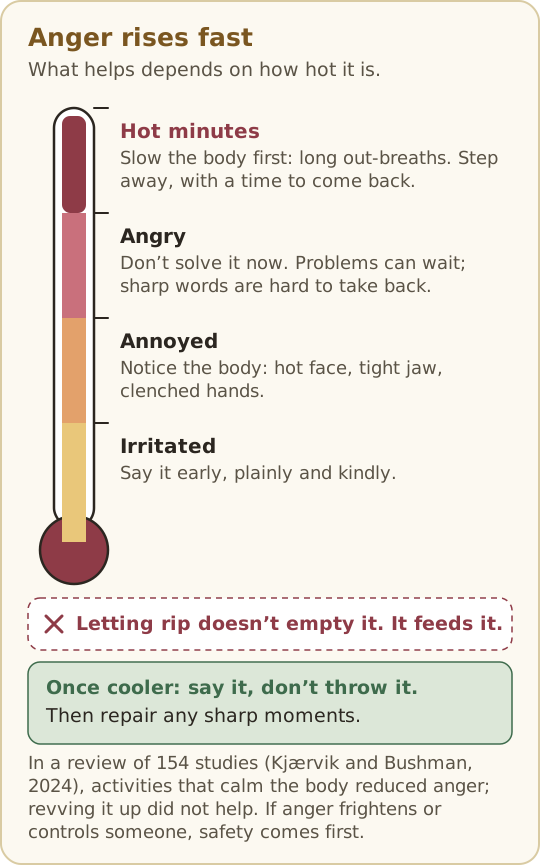
- The first minutes are about the body. Slow down, breathe out long, and step away with a time to come back.
- Letting rip doesn’t empty anger. Shouting tends to feed it. Calming the body, then putting it into words and repairing any sharp moments, helps more.
- Anger that frightens, controls or hurts someone has become harm. That needs more help, and safety comes first.
Why the tools work: this chapter explains the thinking behind these tools from earlier in the book.
- The Calm-Down Kit (Part One, Now) works because anger rises in the body first. Slowing the body is what makes the words possible. Big idea: read your state first.
- “Let a comment land before you react” and “Notice, name, decide” (Part Two, Chapter IV) are the step back this chapter describes: look from the outside, then choose.
Tuesday, 6:10pm
Your brother texts: “Can’t take Mum to the hospital on Thursday after all. Sorry!!” It’s the third time this month. Your jaw sets and your thumbs start typing fast: “TYPICAL. You never…” Your heart is pounding, your face is hot, and the message is nearly sent.
Why does anger arrive so fast, and feel so right in the moment? Why do we get angriest with the people we love most? Is it better to let it out or hold it in? And when does anger stop being a feeling and start being harm? This chapter looks at anger in full: what it is for, what it does in the body and the mind, what helps in the moment and afterwards, and where the line is.
Each section looks at one idea through three lenses. Psychology tells us what researchers have found, and where the evidence is limited. Philosophy shows how thinkers from many traditions have understood the same questions. Through an autistic lens looks at each idea from the point of view of autistic people. It is a perspective, not a diagnosis, and it often shows that the usual advice needs adjusting. Where it matters most, an ADHD lens does the same.
Ideas marked This site’s idea: are our own ways of putting things into practice, not established science.
Anger is a signal about something that matters
Anger is one of the most common feelings people have. It tends to show up when something seems unfair, when a goal is blocked, when a line has been crossed, or when something we care about seems under threat. Like other feelings, it is a fast message: “Pay attention. Something here matters.”
Psychology
Many feelings push us away from a problem: fear makes us want to escape, sadness makes us want to withdraw. Anger is different. In a major review, Carver and Harmon-Jones (2009) brought together evidence that anger is an “approach” feeling: it pushes us towards the thing in the way, to change it or remove it. That is why anger can be useful: it gives energy to stand up for yourself or for someone else. It is also why it can go wrong, because the push can land on the wrong target, or be far bigger than the problem.
Anger is also shaped by how we read a situation. The same event (a friend arriving late) can feel annoying or completely fine depending on whether we think they didn’t care, or that the bus broke down. Psychologists call these readings appraisals. We return to them in Step back.
Philosophy
Aristotle did not think anger was simply bad. In the Nicomachean Ethics, he wrote that anyone can become angry, and that is easy; but to be angry with the right person, to the right degree, at the right time, for the right reason and in the right way is not easy. He thought someone who never got angry, even at real wrongs, was missing something too. Much later, the poet and essayist Audre Lorde, in her 1981 talk “The Uses of Anger,” described anger at injustice as full of information and energy, and argued that it should be listened to rather than silenced.
Through an autistic lens
Many autistic people describe a strong sense of fairness and of rules being kept. When rules are broken, promises are changed without warning or someone is treated unjustly, the anger can be strong and long-lasting. That isn’t over-reacting. It often reflects real values: honesty, consistency and fairness. It can help to name the value (“I’m angry because the plan changed and nobody told me, and being told matters to me”), so others hear the reason rather than only the heat.
Thoughts you could try: “What is this anger trying to protect?” “Is this the right person, the right size and the right moment?”
Anger often guards a softer feeling
Anger often arrives first, and loudest. Underneath it, there may be hurt, fear, shame, embarrassment, grief or plain exhaustion. Anger can feel safer than those feelings, because it feels strong rather than exposed.
Psychology
Emotion researchers sometimes distinguish a “primary” feeling (the first reaction) from a “secondary” one (a reaction to the first). Anger is often secondary: we feel hurt, and then angry that we were hurt. Tiredness, hunger, pain and stress also make anger more likely, because they lower the threshold for any strong feeling. Chapter 2 calls this the tank: when it is already full, a small thing makes it overflow. Sleep matters here too. In a daily study, Gordon and Chen (2014) found that people reported more conflict with their partner after nights of poor sleep.
Philosophy
Buddhist teaching names aversion or hatred as one of the “three poisons,” alongside greed and confusion. But many Buddhist teachers also stress gentleness towards our own anger. The Vietnamese monk Thich Nhat Hanh, in his book Anger (2001), compared it to a crying baby: not something to fight or throw away, but something to hold, calm and listen to until we understand what it needs.
Through an autistic lens
Many autistic people find it hard to tell feelings apart, or to know what they are feeling until it is very strong. This is sometimes called alexithymia. A review by Kinnaird and colleagues (2019) found it in about half of autistic participants, compared with a much smaller share of non-autistic people, though it is not universal. If you can’t easily find the hurt or fear under anger, that isn’t a failing. Body clues (“my chest is tight,” “I’m very hot”) and simple scales (“I’m at seven out of ten”) can work better than feeling words.
Words you could use: “I’m angry, and I think underneath I’m scared.” “I don’t know what’s under it yet. I just know I’m at an eight.”
Anger rises in the body fast
Anger is a whole-body event. The heart speeds up, breathing quickens, muscles tense, the face may flush and the voice gets louder. This is the body preparing to act. It can happen within seconds, often before we have had a clear thought.
Psychology
When the stress system is highly activated, careful thinking, listening and seeing another point of view all get harder. Chapter 2 calls this being flooded. In this state, people say things they don’t mean and hear things that weren’t said. That is why trying to win an argument while flooded rarely works: the parts of us that would help are temporarily turned down. Learning your own early signs (a clenched jaw, a hot neck, talking faster) gives you a few seconds of warning before you’re fully flooded.
Anger matters for physical health too. In a review of long-term studies, Chida and Steptoe (2009) found that anger and hostility were linked with a higher risk of later heart disease, though the link weakened in studies that took account of habits such as smoking. And in a review of studies by Mostofsky, Penner and Mittleman (2014), the risk of a heart attack or stroke was higher in the two hours after an outburst of anger, especially for people already at risk. These are links, not proof that anger alone causes heart disease, but they are one more reason to learn to settle the body.
Philosophy
William James (1884) argued that the body comes first: we notice our body’s changes, and that noticing is the feeling. Later research suggests it is more of a two-way street, with the mind interpreting what the body is doing. Either way, his insight is useful for anger: if the body is part of the feeling, then changing what the body is doing (breathing, posture, moving away) can change the feeling too.
Through an autistic lens
For some autistic people, sensory overload (noise, light, crowds, an unexpected touch) feels a lot like anger: hot, urgent and hard to think through. What looks like a “temper” may be a body that has had too much input. Turning down the input (a quiet room, headphones, dimmer light, fewer words) often helps more than talking it through. Noticing body signals can also be harder for some autistic people, which makes building a few clear outside cues (“when I start pacing, I need a break”) especially useful.
Through an ADHD lens
Many people with ADHD describe anger that arrives fast and big, then drops away just as fast, sometimes leaving them puzzled that everyone else is still upset. A review by Shaw and colleagues (2014) found that trouble bringing strong feelings back down is common in ADHD at every age. It isn’t a choice or a flaw in character, and it isn’t a free pass either.
What helps is planning for the speed: a pause line short enough to say in three words (“Back in ten”), a rule to wait before sending anything, and fewer sparks in the setup. A forgotten job is a common spark, so a written list with one owner per job takes a lot of heat out of a home. If you live with someone with ADHD, talk on a calm day about how a flash that is over in a minute can feel very different to the person on the receiving end.
Thoughts you could try: “My body is ready for a fight. I don’t have to have one.” “Is this anger, or is it too much noise?”
In the hot minutes: slow the body first
When anger is high, the most useful thing is usually not to solve the problem, but to settle the body enough to think. Problems wait. Sharp words are hard to take back.
Psychology
A large review of 154 studies by Kjærvik and Bushman (2024) compared activities people use to manage anger. Those that calm the body (such as slow breathing, muscle relaxation, mindfulness and yoga) reduced anger and aggression. Those that rev the body up showed little or no benefit for anger. Slow breathing with a longer out-breath, unclenching hands, lowering the shoulders and moving to a quieter place are all simple versions of the same thing.
Taking a break also works best when it isn’t a walk-out. A break with a time to come back (“I’ll come back at eight”) tells the other person you aren’t abandoning the conversation. See time-outs in the library.
This site’s idea: The Stop, Out, Back plan. Stop talking or typing. Breathe out, long and slow, and step out of the room if you can. Say when you’ll be back. Write your own version on a calm day, with your early sign and your exact words, and keep it somewhere you’ll see it. The Calm-Down Kit can help.
Philosophy
The Roman Stoic Seneca wrote a whole work, On Anger, in the first century. Unlike Aristotle, he thought anger was almost always harmful and should not be trusted. One of his most practical pieces of advice was that the greatest remedy for anger is delay: wait, and the first rush passes. Many traditions share the advice to count, breathe or sleep on it before acting.
Through an autistic lens
An autistic meltdown is not the same as an angry outburst, although from outside they can look alike. A meltdown is an overwhelming loss of control, often after a build-up of stress, sensory load or change. It isn’t chosen and it isn’t manipulation. In the moment, reasoning, questions and touch usually make it worse. What helps is fewer words, less noise and light, space, and safety for everyone. Talking can come later. A shutdown, where someone goes quiet, still and unable to respond, is another form of overwhelm, and needs the same patience. See Chapter 9.
Words you could use: “I’m too angry to talk well. I’ll come back at eight.” (to someone in a meltdown) “You’re safe. I’ll be right here. No need to talk.”
The Calm-Down Kit
- Whose kit is this? (your name)
- Pat (Nan)
- Date
- 4 October 2026
Part A: What tends to start it
| What tends to start it | How it shows up in my body first |
|---|---|
| Door slammed after a call with his mum | Shoulders up by my ears |
| Being shouted at in front of the neighbours | Hot face, can’t find words |
Part A: My two defaults
- First default
- Gating (lower the lights, step out)
- Second, if the first isn’t available
- Low, steady sound
Part A: My pause line
- In my words
- I’m too wound up to listen well. I’m putting the kettle on for twenty minutes. I’ll come and find you at half past.
Our pause plan (agree it together, and share it)
- Our pause word or signal
- “Kettle time”
- The shortest break we take
- 20 minutes
- How we set the time to come back
- Whoever pauses says a time before they go
- The first sentence when we come back
- “I’m back. Let’s start again, slower.”
Part B: In the moment
Say your pause word or line, then do your first calming step. Nothing in this kit works by cold, pain or shock, and none of it is treatment.
Part C: Coming back
| Time | What I did | How I feel now |
|---|---|---|
| 5:10 pm | Gating (lower the lights, step out) | Settled enough |
Where that leaves you
- Next
- Settled enough: go back to the conversation, at the time you named. When you come back, start with one small, simple task, like putting the dishes away.
- Next small action
- Sit with Jay and agree one screen-time rule
- If you put the conversation off: when you’ll pick it back up
- After tea, at 6
✓ I’m going with this
A made-up example. Names and details are invented. Jay agreed the pause plan with her on a calm Sunday. “Gating”, one of the kit’s calming steps, means cutting down what comes in through the senses: lower the lights, turn the sound down, or step out of the room.
Fill in your own: The Calm-Down Kit (spreadloveandacceptance.com/
Letting rip doesn’t empty it
A very old idea says anger builds up like steam, and you have to let it out or it will burst. It is a popular idea, and it feels true in the moment. But when researchers have tested it, it hasn’t held up well.
Psychology
In a well-known experiment by Bushman (2002), people who had been made angry were asked to hit a punching bag while thinking about the person who had annoyed them. Afterwards, they felt angrier and acted more aggressively than people who were distracted or simply sat quietly. Going over and over what happened, sometimes called rumination, has a similar effect: it keeps anger switched on long after the moment has passed. In studies by Bushman and colleagues (2005), people who were made to dwell on a provocation for a while were later more aggressive towards someone who only mildly annoyed them, a pattern called displaced aggression. That doesn’t mean anger should be swallowed. Pushing a feeling down and pretending it isn’t there has its own costs: in research by Gross and John (2003), people who habitually held their feelings in tended to do worse in their relationships and wellbeing than people who habitually rethought what had happened. The middle path is to calm the body, then think and talk about it, when you can do that without re-heating it.
Philosophy
The Stoic teacher Epictetus said that it is not things themselves that disturb us, but our judgements about them. Rumination is, in a sense, re-making the judgement again and again: “How dare they… how dare they…” Each time, the anger is fed. Stepping out of the loop doesn’t mean deciding the event didn’t matter. It means not letting one moment take over the whole day.
Through an autistic lens
Many autistic people use stimming (repeated movements or sounds, like rocking, flapping or humming) to settle strong feelings. In interviews by Kapp and colleagues (2019), autistic adults described stimming as a way of managing overwhelming emotions and sensations. That is very different from venting at a person: stimming calms the body, rather than rehearsing the anger. It deserves to be allowed, not stopped. Some autistic people also find their thoughts “loop” on an injustice for a long time. A clear, written plan for what will happen next can help the loop close.
Thoughts you could try: “Going over this again is feeding it.” “I’ll come back to this tomorrow, at a set time.”
Step back and look from the outside
Once the body has settled a little, it helps to see the moment from further away. Not to excuse what happened, but to see it more completely.
Psychology
In experiments by Mischkowski, Kross and Bushman (2012), people were provoked by a rude partner and then asked to think about it in one of two ways: by reliving it through their own eyes, or by imagining watching it from a distance, “like a fly on the wall.” The fly-on-the-wall group felt less angry and acted less aggressively. This built on earlier work by Kross, Ayduk and Mischel (2005), who asked people to recall a time they had been angry: asking “why” from a distanced point of view helped people make sense of it without stirring the anger up again, while reliving it through their own eyes did not. Rethinking what happened (“Maybe she was rushed, not rude”) also helps. Gross (1998) described this kind of rethinking, called reappraisal, as a way of changing a feeling early, before it has fully taken hold. Gross and John (2003) found that people who often rethink upsetting moments in this way tend to do better in relationships and wellbeing.
Seeing the other side matters because anger stories tend to be one-sided. When Baumeister, Stillwell and Wotman (1990) asked people to write about a time they made someone angry and a time someone made them angry, the stories differed in a telling way. As the angry person, people described the harm as more serious and longer-lasting; as the one who caused it, they described it as more understandable and more finished. Both sides are usually leaving something out.
Philosophy
The Roman emperor Marcus Aurelius, in his private Meditations, often reminded himself that when someone wronged him, he should ask what that person believed was good or bad, and that this would usually bring understanding rather than anger. He also reminded himself how short life is, and how small most quarrels look from far enough away.
Through an autistic lens
Much anger between autistic and non-autistic people comes from misreading, in both directions. A direct comment may be heard as rude when it was meant as help. A hint may be missed and then taken as being ignored. Research such as Crompton and colleagues (2020) suggests that communication can flow well between people who share a way of communicating, and break down more easily across different styles. When you step back, it helps to ask: “Did we just read each other differently?”
Thoughts you could try: “If I were watching this from across the room, what would I see?” “How would they tell this story?”
Say it, don’t throw it
Anger usually carries a message worth hearing. The trouble is the delivery. When we’re calmer, we can keep the message and drop the blow.
Psychology
Communication researchers and counsellors have long suggested putting a hard feeling into a simple shape: what happened, how it affected you, and what you’re asking for. Thomas Gordon (1970) called these “I-messages”; Marshall Rosenberg’s Nonviolent Communication uses a similar pattern of observation, feeling, need and request. Starting gently matters too. A complaint about one event (“You cancelled again”) is easier to hear than a criticism of the whole person (“You always let everyone down”). See Chapter 4 and I-statements in the library.
Being assertive is different from being aggressive. Assertive means saying clearly what you think and need while respecting the other person. Aggressive means pushing your needs at someone else’s expense. Holding everything in, then exploding, is often a mix of the two.
Philosophy
The philosopher Martha Nussbaum, in Anger and Forgiveness (2016), argues that ordinary anger often contains a wish for payback: for the other person to suffer. She suggests a better kind, which she calls “Transition-Anger”: outrage that quickly turns forward, to “What can be done about this?” rather than “How can they be made to pay?” That forward turn is what a calm, clear request does.
Through an autistic lens
Autistic people are sometimes told they sound angry when they aren’t: a flat tone, a direct sentence or a lack of smiling can be misread. It can help both sides to say it plainly: “I’m not angry, I’m just being direct.” And for autistic people who are angry, a written message, sent after a pause, can be easier than a face-to-face talk. That is a fair choice, not avoidance.
Words you could use: “When ___ happened, I felt ___. What I’m asking for is ___.” “I’m not angry, I’m being direct. Can I say it plainly?”
After anger, repair
Everyone gets angry, and most people sometimes say or do things in anger that they regret. What happens next matters a great deal.
Psychology
Conflict itself is normal in close relationships. Couples researchers such as John Gottman have long stressed what they call repair: coming back after a rupture and mending it (see repair attempts in the library). A good repair after anger is short and specific. It names what you did, without “but,” acknowledges how it landed, and says what you will do differently. If the anger had a fair point in it, you can still make that point, separately and later. Chapter 11 looks at apologies and repair in detail.
For children, repair after a parent’s anger is especially important. It shows them that strong feelings can be survived, that relationships can be mended, and that the anger wasn’t their fault. See Repair after you’ve scared a child.
Philosophy
In Jewish tradition, teshuvah (often translated as “return” or “repentance”) is a path for making amends. As the medieval philosopher Maimonides set it out, it includes recognising the wrong, regretting it, resolving not to repeat it and, where another person was harmed, going to them to make things right. Many other traditions have similar steps. They share one idea: saying sorry is not the end of repair, but the start.
Through an autistic lens
Clear, specific apologies tend to work well for autistic people: what happened, that it was wrong, and what will happen next time. Vague apologies (“Sorry if you were upset”) can feel confusing or unfair. Autistic people may also need time before they are ready to talk about a conflict. Asking “Would now or later be better to talk about earlier?” respects that.
Words you could use: “I was sharp with you earlier. That wasn’t fair, and I’m sorry. Next time I’ll take a break before I answer.”
When anger becomes harm
Anger is a feeling. Some things done in anger are harm, whatever the feeling behind them. It is important to be clear about the difference, because “I was just angry” can be used to excuse things that should not be excused.
Psychology
Signs that anger has become harmful include: hitting, pushing, grabbing or restraining; throwing or breaking things, especially near people; threats; shouting that leaves others frightened; and using anger, or the fear of it, to control what someone does, wears, spends or who they see. A household where people “walk on eggshells” is a warning sign even if nobody has been hit. Abuse is not only anger: much of it is about control, and some controlling people seem calm. If you are frightened of someone, that fear matters more than whether they look angry.
For people who want to change their own anger, help works for many. In a review of 96 studies, Saini (2009) found that psychological treatments for anger, such as cognitive-behavioural therapy and skills training, were generally effective, though results varied. An earlier review by Del Vecchio and O’Leary (2004), of 23 controlled studies with adults, found medium to large benefits across different anger treatments, with cognitive approaches helping long-standing anger and relaxation helping in-the-moment anger. Talking to a doctor, a counsellor or an anger management course is a strong and responsible step.
Philosophy
John Stuart Mill, in On Liberty (1859), argued that the only good reason to limit someone’s freedom is to prevent harm to others. Our feelings, including anger, are our own business. Our actions, when they harm or frighten other people, are not. That is a simple line, and it holds in homes as well as in societies.
Through an autistic lens
A meltdown is overwhelm, not a choice, and an autistic person in meltdown deserves understanding and safety. At the same time, being autistic never makes harm to others acceptable, and plans can be made on calm days to keep everyone safe (a quiet space, a signal, someone to call). Autistic people can also be on the receiving end of other people’s anger and control, and their reports deserve to be believed. Difference never makes someone deserve harm.
Words you could use: “I think my anger is scaring people I love. I want help.” “I’m frightened of how they get. I need to talk to someone.”
Putting it together
Anger is a fast, physical signal that something matters: fairness, a goal, a boundary, safety. It often guards softer feelings, and it is made more likely by tiredness, stress and too much input. In the hot minutes, the body comes first: slow it, step away with a time to come back. Letting rip and going over it tend to feed anger; calming down, stepping back and seeing the other side tend to ease it. When we’re calmer, we can say what made us angry in words, and repair any harm we did. And when anger frightens, controls or hurts someone, it has become harm, and needs more help.
- Feel it, don’t follow it. The feeling is allowed. The action is a choice.
- Body first, words second. Settle, then speak.
- Keep the message, drop the blow. What happened, how it felt, what you’re asking for.
- Repair is normal. It’s not a defeat. It’s what keeps relationships going.
- Safety first, always. If anyone is frightened, getting safe comes before working it out.
Worked examples
Siblings: the cancelled hospital trip
Back to the opening. You put the phone face down and walk round the block, breathing out long. You notice what’s under the anger: you’re exhausted, and scared about Mum. Back home you write: “I’m really frustrated. This is the third time and I feel alone with Mum’s care. Can we talk tonight and make a plan?” Your brother rings within ten minutes. His shifts have changed and he’s been too embarrassed to say. You agree he’ll take the Saturday appointments and you’ll do weekdays. The anger was right that something needed to change. It needed words, not capitals.
Partners: the same fight about money
Selin and Rhona have the same fight every month about spending. This time, when Selin feels her face getting hot, she says their agreed phrase: “I’m flooding. Back in twenty.” She walks round the garden. When she comes back, she says, “I think I’m scared we won’t manage, not angry at you.” They sit down with the bank statements together. See Money together.
Parent and child: the slammed door
A twelve-year-old slams his bedroom door after being told to stop gaming. His mum’s first urge is to shout. She waits ten minutes, then knocks: “You were really angry. I get it, stopping is hard. Slamming doors isn’t okay, though. What would help next time?” He suggests a ten-minute warning. It works most days.
A teenager and a parent: the phone at night
Maisie is 16. The rule at home is phones in the kitchen at ten. Tonight her dad takes hers in the middle of a chat with her friends, who will think she just left. She is furious. It feels like being treated as a child, and like not being trusted. She shouts “You don’t trust me!” and slams the door.
In her room, once her heart stops pounding, she notices what is under the anger: embarrassment, and feeling not trusted. The next morning, when they are both calm and he isn’t rushing, she says: “Last night I was really angry. I was mid-conversation, and it felt like you didn’t trust me. Sorry for slamming the door. Could I have ten minutes’ warning, and keep it till half ten on Fridays?” Her dad hadn’t thought about the warning. He says yes to that, and “let’s try it for a month” to Fridays.
Words you could use, as a teenager: “I’m too angry to talk properly right now. Can we talk tomorrow?” “It’s not the rule I mind, it’s how it happened.” “Could we try it for two weeks and then check?”
Being angry with a parent is normal. In a review of many studies, Laursen, Coy and Collins (1998) found that arguments between parents and teenagers get less frequent as the teenage years go on, but feel more intense in the middle teens. That is growing up, not a broken family. A rule given out of care isn’t control, even when it feels unfair, and a calm “can we change it?” works more often than a slammed door.
At work: the credit-taker
A colleague presents Usman’s work as his own in a meeting. Usman is furious, and says nothing at the time. That afternoon, calmer, he emails: “In this morning’s meeting, the analysis was presented without mentioning it was mine. I’d like that corrected with the team.” His colleague apologises and sends a note. Usman’s anger was useful: it helped him act. The calm gave it a shape that worked.
At work: two teammates, and a manager in the middle
Yusra and Bronwen share a project and have stopped speaking except by email. Each has been to their manager, Cormac, to complain about the other. His first urge is to decide who is right. Instead he meets each of them alone for twenty minutes and asks the same three questions: “What happened, as facts? What did it make hard for you? What would you need to work well together?” He listens, and doesn’t promise either of them anything.
Then he meets them together, with one ground rule: talk about what happened, not about what kind of person the other one is. It turns out the fight is about the setup. Both thought they owned the client updates, so each saw the other as interfering. Cormac gives the updates one owner and a backup, writes it down, and books a ten-minute check in two weeks. They don’t become friends. They do start working together again.
Words you could use, as a manager: “I’m not here to decide who’s right. I want to understand what’s making this hard.” “Let’s talk about what happened, not about each other.” “What would each of you need for the next month to work?”
If one person is frightened of the other, or there is harassment or discrimination, that isn’t a clash to mediate. Follow your workplace’s formal process and involve HR.
Friends: the joke that hurt
At a dinner, a friend makes a joke about Daisy’s weight. She laughs along and goes home furious. The next day, she texts: “That joke last night really hurt. I didn’t say anything at the time, but I wanted you to know.” Her friend replies: “I’m so sorry. That was thoughtless. It won’t happen again.” They’re still close.
On your own: angry at yourself
Ivan forgets an important deadline and spends the evening calling himself an idiot. He notices it’s anger turned inward, and that it isn’t helping. He writes what happened as if to a friend, makes a plan for tomorrow, and goes for a walk. He still feels bad, but he sleeps. See Chapter 7 on self-compassion.
An autistic adult and a changed plan
Kit, who is autistic, finds out at the last minute that a family lunch has moved to a busy restaurant. She feels a surge of anger and starts to shake. Instead of arguing, she says, “I need fifteen minutes,” puts on headphones and walks. Then she texts her sister: “Changes without notice are really hard for me. Can you tell me as soon as plans change?” Her sister agrees, and saves her a seat by the window.
Exercises
- Your anger map. Write down three things that often make you angry. For each, what does it protect: fairness, a plan, a boundary, safety?
- Your early signs. List two or three body signs that come before you lose your temper. Ask someone you trust what they notice too.
- Stop, Out, Back. Write your own calm-down plan: your early sign, your exact words, where you’ll go, and when you’ll come back. (This site’s idea)
- The fly on the wall. Next time you replay an argument, write two lines about it using your own name instead of “I.”
- Rewrite the message. Take an angry message you once sent, or nearly sent. Rewrite it as what happened, how you felt and what you’re asking for.
- One repair. Think of a recent moment when your anger landed on someone. Make one short, specific repair this week.
- What’s underneath? After your next angry moment, when calm, ask: was there hurt, fear, tiredness or too much noise under it?
When it goes wrong, and when it goes right
When it goes wrong, anger takes over in seconds. Words are said that can’t be unsaid. One person shouts and the other freezes or shouts back. Nothing is repaired, so the next fight starts from where the last one left off. Or anger is swallowed for years, until it comes out as coldness or a sudden explosion. In the worst cases, people around the angry person become afraid.
When it goes right, people notice anger early and say so. They take a break and come back at the time they said. They talk about what was underneath. The fair point in the anger gets heard and acted on. Sharp moments are repaired quickly and specifically. Over time, everyone in the home or team learns that anger can be felt, said and survived, and that nobody needs to be afraid.
Helping someone else
If someone you care about is angry, your own safety comes first. If you feel frightened, leave, and get help if you need it. You don’t have to stay and calm someone down. When it is safe, the most helpful things are often small: speak slowly and quietly, use few words, don’t argue the point while they’re flooded, and offer space. Later, when they’re calmer, you can ask what was going on, listen for the fair point underneath, and also say clearly if the way they spoke wasn’t okay. If someone tells you they want help with their anger, take it seriously: that is a brave thing to say. Help them find a doctor, a counsellor or a course.
Words you could use: “I want to hear this, and I can’t while we’re both shouting. Let’s try again at seven.” “I think there’s something fair in what you’re saying. The shouting makes it hard to hear.”
Questions people often ask
Why do I get angriest with the people I love most?
Many people notice this. Close relationships involve the most contact, the most expectations and the most at stake, and we often feel safest letting our guard down with the people closest to us. That doesn’t make it fair on them. Knowing the pattern can help you take more care at home, not less.
Is it better to let anger out or keep it in?
Neither extreme. Venting by shouting or hitting things tends to keep anger going. Swallowing it and pretending it isn’t there has costs too. What usually helps most is calming the body first, then saying what made you angry in words, at a time when you can.
Is it okay to be angry with someone who has died?
Yes. Anger is a common part of grief: at the person, at doctors, at life, at yourself. It doesn’t mean you didn’t love them. See Chapter 8 and Grief and later life.
My partner says I’m angry when I’m not. What do I do?
Tone, faces and directness can be read very differently. Say what you notice (“I’m not angry, I’m tired and being blunt”), and ask what they heard. It can help to agree on a quick check: “Are you cross with me, or just busy?”
Does anger management actually work?
For many people, yes. A review by Saini (2009) found that psychological treatments for anger were generally effective, though results varied between approaches and programmes. A good course or therapist will teach practical skills and help you understand your own pattern.
What about anger in children and teenagers?
Children’s anger is often about feelings they don’t yet have words for, or about tiredness, hunger and too much input. Staying calm yourself, naming the feeling, and helping them settle their body teaches more than any punishment. See For parents and For teens.
I was brought up in a home with a lot of anger. Will I be the same?
Not necessarily. Growing up around anger can shape what feels normal, but many people learn very different ways. Noticing your patterns, getting support and practising new ones all make a difference. That you are asking the question is a good sign.
Limits, safety and more help
- This chapter is general education. It isn’t therapy, and it can’t assess anyone’s safety.
- If your anger feels out of control, if people around you are afraid, or if you have hurt or threatened anyone, please talk to a doctor, a counsellor or an anger management service. Help with your own anger has first steps.
- If you are afraid of someone else’s anger or control, that fear is an important signal. Not safe at home? lists free, private help. If anyone is in danger now, call your local emergency number.
- If anger comes with very low mood, hopelessness or thoughts of harming yourself, please reach out today. Upset right now? can help you take the first step.
- Anger linked to alcohol or drugs, head injury, pain or other health problems is worth raising with a doctor.
The library’s anger, rumination and flooding entries have more on each idea.
Last updated: October 2026