Part Three · Chapter 2
Stress and the nervous system: the ladder, flooding, rest and recovery
What stress does to your body and your mind, why kind people say things they don’t mean when they are flooded, and the kinds of rest that actually help you recover.
In short:
- Stress is your body getting ready for a demand. A little helps. Too much, for too long, wears you down.
- Three everyday states: calm and connected, revved up, and running on empty. Each one changes how you think and hear.
- Flooded means offline. When stress is very high, listening and careful thinking get much harder. Pause, settle, then come back.
- Rest is a skill. Different kinds of tired need different kinds of rest.
Why the tools work: this chapter explains the thinking behind these tools from earlier in the book.
- How much are you carrying? and the stress tank (Part Two, Chapter III) work because stress adds up from many small loads. A full tank makes small things feel big, so you check the tank before you judge the moment. Big idea: read your state first.
- The Calm-Down Kit (Part One, Now) settles the body before any words, because a flooded body can’t think or listen. Its “come back at a set time” rule stops a pause looking like walking out.
- The setup score (Part Two, Chapter II) counts stress as well as hours, because a split that looks fair on paper can still leave one person running on empty.
Monday, 7:52am
The bus is late, the kids can’t find a shoe, and your phone buzzes with a work message. Your partner says, “Have you seen my keys?” and you hear yourself snap, “I’m not your secretary!” A second later you think, “Where did that come from?” It came from a body that was already full.
The last chapter looked at feelings. This one looks at the system underneath them: your nervous system, and what happens to it under pressure. Understanding stress won’t make life less busy. It can make your reactions, and other people’s, a lot less mysterious.
-
Stress is your body getting ready.
When something needs dealing with, your body gears up: the heart speeds, breathing quickens, muscles tense and stress hormones rise. This is useful. It helps you catch a falling glass, meet a deadline or speak up. The trouble starts when the body stays geared up for too long, with no chance to come back down.
For example: A nurse handles an emergency calmly and well. Two hours later, at home, she can’t sit still and cries at an advert. Her body is still running the emergency.
Thoughts you could try: “My body is getting ready for something. That’s its job.” “The emergency is over. I can let my body catch up.”
Try this: After something stressful, give your body a clear “it’s over” signal: a walk, a shower, a stretch or a song.
Dig deeper: the stress response -
Stress depends on what you have to meet it.
The same event can be easy for one person and huge for another. Stress grows when a demand looks bigger than what you have to meet it: time, energy, money, help, skills or sleep. That’s why a small thing can tip you over on a bad day, and why giving someone more support can shrink their stress without changing the task at all.
For example: Two coworkers get the same tight deadline. One has a quiet evening ahead. The other has a sick child at home. Same task. Very different stress.
Words you could use: “It’s not the task, it’s that I don’t have much left today.” “What would make this feel more doable?”
Try this: When something feels huge, write two lists: what it asks of you, and what you have. Then ask what could make the second list longer.
Dig deeper: demands and resources -
The ladder: three everyday states.
The ladder is a picture, not a real ladder. In plain words, it means three states your body moves between during the day. This site uses three plain words for them. Calm and connected: breathing is easy and you can hear hard things. Revved up: fast, tense, and small things feel urgent or personal. Running on empty: flat, slow and short of words.
You move up and down all day. The Nervous System Ladder is a thirty-second self-check. It gives a best guess, not a reading.
For example: A grandfather minding a toddler all afternoon is calm at two, revved up by four and running on empty by six. The same toddler, the same grandfather. The state changed.
Words you could use: “I’m revved up right now.” “I’m running on empty. Can this wait till morning?”
Try this: Set three reminders today. Each time, pick a rung: calm, revved up or running on empty. No judging, just noticing.
Dig deeper: the ladder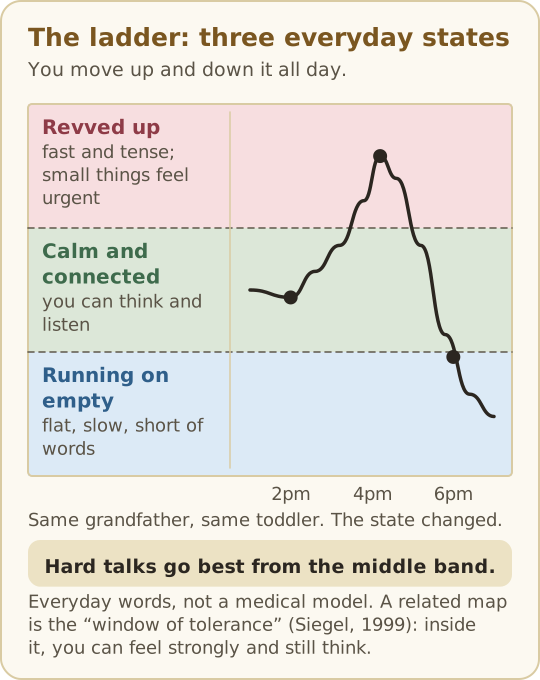
Figure 20 The ladder: three everyday states. You move up and down it all day; hard talks go best from the middle band. Filled-in example The ladder (the sky, in My weather today) Mike, who cares for his wife, Ann The sky
Pick the one closest to true right now. This is a reading of you, never of anyone else.
The sky
- Clear: Calm and connected
- Gusty: Revved up
- Chosen: Fogged in: Running on empty
Who you’ll mostly be around today
- A partner
- Family
- A co-parent
- Roommates
- Coworkers
- Chosen: Someone I care for
- Friends
- Mostly on my own
The pressure
- Light
- Building
- Chosen: Heavy
Last night’s sleep
- Chosen: Barely slept
- Short night
- About enough
- Properly rested
What’s blowing in
- Work
- Money
- Chosen: Kids or caring
- Chosen: Health
- Family
- The house
- One conversation
- Something I can’t name
What would actually help in the next hour?
- Space
- Food or water
- Chosen: Rest
- To move
- To be heard
- A plan
- Company
- Quiet
- Chosen: Someone to take something off me
Your forecast
- Fogged in today
- Running on empty · Very little room today
- Talk window
- another day is kinder
You were already carrying a heavy day before this. Treat the size of your reaction as a reading on the day, not on whoever is in front of you.
Between you and the person you care for today: do the essentials kindly and let the rest go. If anyone can cover one thing today, ask them.
If you need to say something now: “I’m at the end of what I can carry today. Could you take [one thing] off me?”
A made-up example. Names and details are invented. A heavy reading is information about a day, not a failing in a person.
Fill in your own: My weather today: the sky (spreadloveandacceptance.com/
quick-checks) -
When you’re flooded, thinking goes offline.
At the top of the stress curve, the body is in full alarm. Careful thinking, listening and seeing the other side get much harder. Many people call this being flooded. You might say things you don’t mean, freeze, or only want to get away. It isn’t a character flaw. It’s a body that needs to come down before the talk can go on.
For example: Two adult siblings start sorting their late father’s things. Within minutes they are shouting about a lamp. Neither cares about the lamp. Both are flooded with grief.
Words you could use: “I’m too flooded to listen well. Can we stop for twenty minutes and come back at four?”
Try this: Learn your own flood signs: heat, a racing heart, tunnel vision, a loud inner voice. When you notice two of them, pause.
Dig deeper: flooding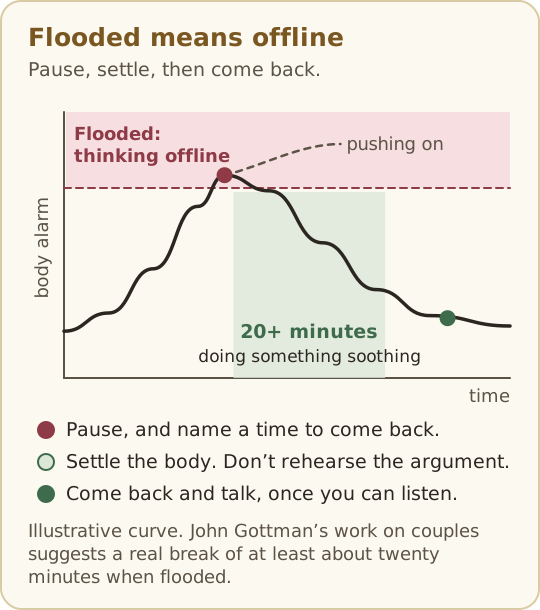
Figure 21 Flooded means offline. Pause and name a time to come back, settle the body for at least twenty minutes, then talk. Illustrative curve. -
Stress adds up, like a tank filling.
Think of a tank (in plain words: how much stress you are already carrying today). Stress from one place spills into the next. Traffic, a hard meeting, a noisy shop and a worrying text can all fill the same tank. By evening, a tiny thing makes it overflow. The last drop gets the blame, but the tank was nearly full already. Small daily hassles count, not just big events.
For example: A teenager explodes when asked to empty the dishwasher. The dishwasher isn’t the problem. A friendship fell apart at lunch, and the dishwasher was the last drop.
Words you could use: “My tank was already full when I got home. That wasn’t really about you.” “Rough day? You don’t have to explain.”
Try this: Before reacting to a small thing in the evening, ask: “How full was I before this happened?” Part Two’s Chapter III has a simple way to tell.
Dig deeper: why stress adds up -
Settle the body first.
You can’t think your way out of a body in alarm. You can help the body come down, and the thinking often follows. Slow breathing with long out-breaths, moving, cold water on your face, a familiar song, pressure (like a heavy blanket) or simply leaving a noisy room can all help. Different things work for different people.
For example: A manager feels her heart race before giving hard feedback. She walks round the block once, breathing out slowly. She goes in steadier.
Thoughts you could try: “Body first, words second.” “What has helped me settle before?”
Try this: On a calm day, list three things that settle you. Keep the list on your phone. The Calm-Down Kit helps you build it.
Dig deeper: settling the body -
Rest isn’t one thing.
Lying on the sofa scrolling isn’t always rest. Recovery comes in different kinds: sleep, switching off from work in your head, real relaxation, doing something absorbing you enjoy, and feeling in charge of your own time. Different kinds of tired need different kinds of rest. Being with people restores some people and drains others.
For example: Housemates plan a “relaxing” Saturday party. One loves it and wakes up refreshed. The other needs all of Sunday alone to recover. Both rested. They just needed different things.
Words you could use: “I need quiet rest tonight, not people rest. It’s not about you.” “What kind of tired are you?”
Try this: Ask yourself: am I body-tired, people-tired, brain-tired or feelings-tired? Pick a rest that matches.
Dig deeper: kinds of rest -
Sleep and stress feed each other.
Stress makes sleep harder, and poor sleep makes stress hit harder. After a short or broken night, small things feel bigger, tempers are shorter and people pull away from each other. In a brain-scan study by Yoo and colleagues (2007), one night without sleep made the brain’s alarm centre react more strongly to upsetting pictures.
In a daily study by Gordon and Chen (2014), people reported more conflict with their partner after nights of poor sleep. And in experiments by Ben Simon and Walker (2018), people who had missed a night’s sleep kept others at a greater distance and felt lonelier. You can’t always fix sleep, but you can notice when it’s part of the story.
For example: A nurse coming off three night shifts finds herself in tears over a parking ticket. Her sister says, “You’ve barely slept. Let’s sort it out on Thursday.” On Thursday, it’s just a parking ticket.
Words you could use: “I slept badly. If I’m short with you today, that’s why, and it’s not about you.” “Can we talk about this after we’ve both slept?”
Try this: Before a hard conversation, ask: “Have we both slept?” If not, pick another time. At night, try the same few calm steps before bed, in the same order, so your body learns the signal. If poor sleep goes on for weeks, talk to a doctor. Sleep problems are common and often treatable.
Dig deeper: sleep and stress -
Stress is easier to carry when it’s shared.
People calm each other. A steady voice, a hand on the shoulder or just a quiet person nearby can help a nervous system settle. Saying your state out loud also helps others read you right: “I’m stressed about work” stops a partner or friend from thinking it’s about them. Sharing stress isn’t dumping it. It’s letting someone stand beside you.
For example: A father tells his ten-year-old, “I’m a bit stressed about money this month. It’s my grown-up job to sort it, and you’re not in trouble.” His son stops tiptoeing round him.
Words you could use: “I’m stressed, and it’s not about you.” “Do you want help, a hug, or just some space?”
Try this: Tonight, tell one person your state in one sentence, and ask theirs.
Dig deeper: stress between people
Monday, 7:58am
Six minutes after the snap, you find your partner by the door. “Sorry. My tank was full before you said a word. Your keys are on the bathroom shelf.” They laugh. “Rough start?” “Very.” The morning is still busy. It isn’t a fight anymore.
In everyday life
- On your own: No one notices you’re running on empty, so build rest in before you need it. See On my own.
- With a partner: Agree a pause word on a calm day, and that whoever pauses names a time to come back. See One of you wants to talk now, the other needs space.
- With friends: A friend who cancels again may be overwhelmed, not uninterested. See Friends.
- Parents and children: A child can’t settle until the nearest grown-up does. Your calm is borrowed before it is learned.
- At work: A flooded colleague can’t take in feedback. Waiting an hour often works better than pushing now. See At work.
- Shift work, illness and caring: Some people run on empty for structural reasons. That calls for a different setup, not more effort. See Different hours, When one of you is ill and Caregivers.
- If you have ADHD: Keeping track of everything quietly fills the tank before the day starts. Move the remembering out of your head (a shared list, labelled alarms, one place for keys), and plan hard talks for your better time of day. More in the full chapter.
Common mix-ups
- “All stress is bad.” Short bursts of stress help you rise to a challenge. The problem is stress with no recovery.
- “If I’m calm, I can’t be upset.” Calm means steady, not happy. You can be calm and sad, or calm and firm.
- “Pausing is avoiding.” A pause with a time to come back is a way to finish the talk well. A pause with no return is avoiding.
- “Rest is lazy.” Recovery is part of the work. Bodies and minds that never recover tend to break down.
- “Everyone should be able to handle what I can.” People have different loads, different bodies and different resources. Compare the load, not the person.
- “Running on empty means they don’t care.” Short replies and flat faces often mean tired, not cold.
If you want to help someone else with this
- Be the calm, not the coach. A lower voice, slower words and a steady presence help more than “calm down.”
- Lighten the load, not just the mood. Taking one task off someone’s list can do more than any pep talk.
- Ask what kind of help. Practical help, company, a distraction or space? Ask, don’t guess.
- Don’t debate someone who is flooded. Offer a break and a time to come back. Facts can wait twenty minutes.
- Notice long stretches. If someone has been running on empty for weeks, gently mention it, and help them find support.
Words you could use: “You seem really stretched. Is there one thing I could take off your plate?” “We don’t have to sort this now. Shall we pick it up after dinner?”
When to get more help
Stress is normal. Constant stress that never lets up is a warning sign. It may be time to see a doctor, counsellor or other trained professional if:
- you’ve felt exhausted, dread-filled or numb most days for several weeks, even after rest;
- you can’t sleep, or sleep but never feel rested;
- you have physical signs that worry you, such as chest pain, constant headaches or stomach trouble (always get chest pain checked straight away);
- you’re relying on alcohol, drugs or other habits to get through the day;
- you feel you can’t cope, or have thoughts of harming yourself. If that is happening now, contact your local emergency number or a crisis line.
If the stress comes from being afraid of someone, such as how they will react, what they will do or whether you are allowed to leave, that is not ordinary stress. Your body may be warning you. Not safe at home? has free, private help.
This chapter is general education, not medical advice or diagnosis.
Workpapers, tools and reading on this site
Workpapers pages you fill in, on your own or together
- The Calm-Down Kit: your plan for heated moments.
Tools helpers you use on the site
- The Nervous System Ladder: a thirty-second self-check.
- Upset right now?: steps to calm down, alone or together.
- Drift, Brain Breakers and calm games: gentle ways to come down.
Reading pages to read on the site
- The library: the stress response, appraisal, the window of tolerance, flooding, burnout and slow breathing.
More for your situation
- Back: How feelings work · Next: How we see each other · All chapters in the contents
- Part Two, Chapter III: full tanks and different angles
- How to stop fighting: calm steps
- New baby, sharing the load and Coming home after time apart
- For teens: big feelings and stress
- Sensory overload at home
- Help by relationship
Last updated: October 2026