Part Three · Chapter 16
Worry, low mood and trauma
How worry and anxiety work, the difference between a low patch and depression, what trauma is and isn’t, what helps day to day, how to support someone, and when and where to get more help. For anyone, in any kind of relationship, or on your own.
In short:
- Worry, low mood and the after-effects of trauma are common, human and treatable. They are not weakness, and they are not your fault.
- They all run through the stress system from Chapter 2. Small, steady things that settle the body and reconnect you with life help more than big pushes.
- Avoiding and withdrawing feel safer but keep things going. Small steps back in, a little at a time, help most.
- Talking therapies work for many people, and so can medicines. If it has lasted weeks, is getting in the way of life, or you feel unsafe, get help. If you might act on thoughts of ending your life, call or text 988 (US) or call Samaritans on 116 123 (UK and Ireland) now.
Why the tools work: this chapter explains the thinking behind these tools from earlier in the book.
- The daily check-in’s “low, medium or high” (Part Two, Chapter I) works because worry and low mood shrink the room you have. Saying so lets the people around you adjust. Big idea: read your state first.
- “A full tank means later, not never” (Part Two, Chapter III) names a time to come back, because avoiding a thing keeps fear going, and a named time doesn’t.
- Pick one small goal (Part One, Next) fits low mood: doing often comes before feeling better.
Sunday, 10:50pm
The house is quiet. You’ve checked the front door twice. Tomorrow is the hospital appointment, and the same three thoughts go round: what if it’s bad, what if I can’t cope, what if there’s nobody to tell. Your chest is tight and your mind won’t stop. You haven’t really wanted to see anyone for a few weeks either. Everything feels like too much effort.
Almost everyone worries, feels low or goes through something frightening at some point. For some people these feelings settle by themselves. For others they stick, grow and start to shape every day. This chapter explains how they work, what tends to help, and when it’s time to ask for more help. It can’t diagnose anyone. If any of this is about you right now, you are not alone, and things can get better.
-
Worry and anxiety are the body’s alarm.
Fear is the body’s alarm for danger that is here now. Anxiety is the same alarm ringing about something that might happen. Worry is the thinking part: “What if…?” on repeat. They use the same stress system as Chapter 2: a racing heart, tight chest, shallow breathing, a churning stomach, poor sleep. The alarm is trying to protect you. The trouble is that it can be set too sensitive, and it can’t tell a real tiger from a worrying email.
For example: A teenager’s heart pounds before every class presentation. Nothing bad has ever happened. Her alarm still treats a room of classmates like danger.
Thoughts you could try: “This is my alarm, not a fact.” “My body is getting ready to protect me. I can thank it and carry on.”
Try this: When worry rises, breathe out slowly, longer out than in, five times. Then name three things you can see. It tells the body the danger isn’t here right now.
Dig deeper: how anxiety works -
Avoiding keeps fear going.
When something makes us anxious, stepping away brings quick relief. But the relief teaches the brain, “Good thing we escaped.” Next time, the fear is a little bigger and the world a little smaller. What helps is the opposite: going back towards the feared thing in small, chosen steps, and staying long enough to learn that you can cope. Therapists call this exposure. Craske and colleagues (2014) describe how it works best when each step tests what you expect to happen.
For example: After a panic attack on a bus, a man starts walking everywhere. With his sister’s help he takes one stop, then two, then a whole journey. The fear fades as his brain learns buses are survivable.
Thoughts you could try: “What do I think will happen? Let’s see what actually happens.” “Uncomfortable isn’t the same as dangerous.”
Try this: Pick one small thing you’ve been avoiding. Break it into three steps, from easiest to hardest. Do the easiest one this week.
Dig deeper: avoidance and small steps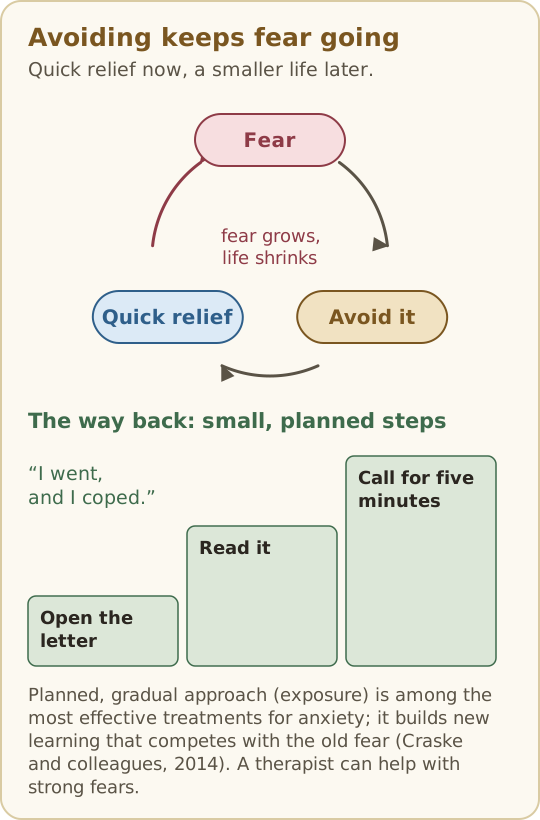
Figure 37 Avoiding keeps fear going. Small, planned steps back in help most, and a therapist can help with strong fears. -
Give worry a time and a place.
Trying hard not to worry rarely works. What helps many people is postponing it: noticing a worry, writing it down, and saving it for a set “worry time” later in the day. In an early study by Borkovec and colleagues (1983), people who practised this for four weeks reported worrying less each day. In worry time, sort each worry: is there something I can do? If yes, plan one step. If not, practise letting it go.
For example: A father caring for his own dad keeps a worry notebook by the kettle. At 6pm he gives it fifteen minutes. Many of the morning’s worries already look smaller.
Thoughts you could try: “Noted. I’ll think about that at six.” “Can I do anything about this today? If not, it can wait.”
Try this: Choose a fifteen-minute worry time, not just before bed. Keep a note on your phone for worries that pop up in between.
Dig deeper: worry time and problem-solvingFilled-in example Flip it Tolu, 17, at 1am, three days before an exam Flip it
- What’s on your mind?
- What if I fail my chemistry exam on Friday and don’t get into the course I want?
What kind is it?
- A complaint about someone
- Chosen: A worry
- Being hard on myself
- Anger
The flip
- The best outcome would be
- [what you hope for]
- The main thing in the way
- I fail my chemistry exam on Friday and don’t get into the course I want
- If that happens, I’ll
- [one small thing you could do]
- One step today
- [something that takes ten minutes or less]
This is WOOP, from Gabriele Oettingen’s research: Wish, Outcome, Obstacle, Plan. The worry becomes the obstacle you plan for. This is a starting point. Change any words you like.
- Tolu’s version
- Best outcome: I pass, and I feel I did my best. In the way: I freeze on the long questions. If that happens, I’ll do the short questions first and come back. One step today: one long question from a past paper, then bed.
- When the worry comes back at 1am
- It goes on the list for tomorrow’s worry time, 5pm, ten minutes.
A made-up example. Names and details are invented. If worry is stopping you sleeping or eating most days, tell someone you trust, or your doctor.
Fill in your own: Flip it (spreadloveandacceptance.com/
small-wins) -
Low mood is common. Depression is more than a bad week.
Everyone has low days, and sadness after a loss or a disappointment is normal. Depression is different: low mood, or losing interest in things you used to enjoy, most of the day, nearly every day, for two weeks or more, often with poor sleep, tiredness, changes in appetite, feeling worthless or guilty, and finding it hard to think. It can look like sadness, or like irritability, numbness or just running on empty. It is a health problem, not a character flaw.
For example: A retired teacher notices he has stopped going to his walking group, isn’t reading, and wakes at four every morning. He tells himself he’s just old. His daughter gently suggests it might be depression, and that it’s treatable.
Words you could use: “I’ve not been myself for a few weeks, and I don’t think it’s just tiredness.” “I don’t enjoy things I used to. Can I talk to you about it?”
Try this: If you’ve felt low or lost interest most days for two weeks or more, book a talk with a doctor this week. Write down what you’ve noticed to take with you.
Dig deeper: low mood and depression -
Doing often comes before feeling better.
Low mood says, “Wait until you feel like it.” But withdrawing makes life emptier, which deepens the low. A well-tested approach called behavioural activation turns this round: plan small, doable things that bring a bit of pleasure, meaning or achievement, and do them whether you feel like it or not. A review of 26 trials by Ekers and colleagues (2014) found it helped with depression, though many of the studies were small.
For example: A woman living alone after her divorce plans three small things a day: a ten-minute walk, one call or message, one task she can finish. Some days they feel pointless. Over a few weeks, the days start to feel less flat.
Thoughts you could try: “I don’t have to feel like it to do it.” “Small counts.”
Try this: Write down three tiny things for tomorrow: one for pleasure, one for connection, one you can finish. Tick them off, however small.
Dig deeper: behavioural activation -
Sleep, moving and people do a lot of the work.
These sound too simple to matter, but the evidence for them is solid. Improving sleep can lift mood: in a large trial with university students, Freeman and colleagues (2017) found that an online sleep course reduced insomnia, and with it some other mental health difficulties.
Exercise helps depression too: a review of 218 trials by Noetel and colleagues (2024) found walking or jogging, yoga and strength training all helped. And belonging to groups protects: Cruwys and colleagues (2013) found that people with depression who joined groups were less likely to relapse.
For example: A new dad, exhausted and flat, agrees with his partner on one protected long sleep each weekend each, a pram walk every morning, and a weekly game of five-a-side.
Words you could use: “I need help protecting my sleep for a while.” “Would you come for a short walk with me? I find it hard to go on my own.”
Try this: Pick the one basic that is most off for you right now, sleep, moving or people, and make one small change to it this week.
Dig deeper: sleep, exercise and connection -
Trauma is about what happened, and what it left behind.
Trauma usually means going through, or seeing, something that threatened life or safety, such as violence, abuse, a serious accident, war, or the sudden death of someone close. It is very common: in surveys across 24 countries, Kessler and colleagues (2017) found about 7 in 10 adults had been through at least one.
Most people recover over time. A smaller number develop post-traumatic stress disorder (PTSD), with memories that come back vividly, avoiding reminders, feeling on high alert, and sleep problems. Ordinary hard times and stress hurt too, even when they aren’t trauma in this sense.
For example: Months after a car crash, a woman still jumps at screeching brakes and avoids driving at night. She isn’t “overreacting.” Her alarm learned that cars can mean danger, and hasn’t unlearned it yet.
Thoughts you could try: “My reactions make sense after what happened.” “It’s in the past, even if my body doesn’t feel that yet.”
Try this: If something frightening happened more than a month ago and it still shapes your days, talk to a doctor. Trauma-focused talking therapies help many people.
Dig deeper: what trauma is and isn’t -
After something frightening: safety, choice and no pressure.
After a frightening event, people need safety, practical help, warmth and choice. They don’t need to be made to talk. In fact, a review of single-session “debriefing” after trauma by Rose and colleagues (2002) found it did not prevent PTSD, and might make things worse for some. Services that are “trauma-informed” (SAMHSA, 2014) put safety, trust, choice and working together first. The same ideas help in families, friendships and workplaces.
For example: After a break-in, a grandmother doesn’t want to talk about it. Her grandson doesn’t push. He fixes the lock, stays the night, and says, “If you ever want to talk about it, I’m here.” A week later, she does.
Words you could use: “You don’t have to tell me anything. What would help right now?” “You’re safe now. I’m staying.”
Try this: If someone you love has been through something frightening, ask one practical question (“What do you need today?”) and one open one (“How are you doing, really?”), and let them choose.
Dig deeper: trauma-informed care -
Talking therapies help many people, and medicines can too.
Cognitive behavioural therapy (CBT) teaches practical ways to notice and change patterns of thinking and doing. It is one of the most studied talking therapies: a review of over a hundred meta-analyses by Hofmann and colleagues (2012) found the strongest support for anxiety problems and stress, and support for many other problems too.
Guidelines such as NICE (2022) also recommend guided self-help, behavioural activation, exercise groups and, for some people, antidepressants. Questions about medicine, including starting, changing or stopping it, are for a doctor or prescriber. Please don’t stop a medicine suddenly without advice.
For example: A young man is embarrassed to ask for help with panic attacks. His GP refers him to a short course of CBT. Eight sessions later, he’s back on the train to work.
Words you could use: “I’d like to talk about my mood. It’s been going on for a while.” “What are my options, and what do you recommend for someone like me?”
Try this: Write three lines before an appointment: what you’ve noticed, how long, and what it’s stopping you doing. It makes the first conversation easier.
Dig deeper: what treatment involves
Monday, 7:30am
Last night you wrote the three worries on the back of an envelope and told them: tomorrow. You slept, a bit. This morning you breathe out long at the kitchen window, then text your neighbour: “Hospital at ten. A bit scared. Fancy a cuppa after?”
She replies with three hearts and “Of course.” The appointment is still the appointment. But you’re not facing it alone, and you’ve noticed something: it’s been weeks of feeling flat. You add a line to the envelope: “Ask the doctor about my mood too.”
If you’re a teenager
Exams, friends, group chats and the future can all pile up, often at 1am. A made-up example: Tolu, 17, can’t sleep before a chemistry exam. She writes the worry down for tomorrow’s ten-minute worry time, plans one small step, and puts her phone in another room. The next day she tells her mum, and it helps more than she expected.
If worry or low mood is stopping you sleeping, eating or going to school most days for a few weeks, tell someone you trust or your doctor. Under 19 in the UK, you can call Childline free on 0800 1111.
Words you could use: “I keep worrying at night. Can I talk it through?” “I don’t need you to fix it. I just need to say it.”
Dig deeper: give worry a time and a placeIn everyday life
- On your own: Living alone can make worry louder at night and low mood quieter and easier to miss. A daily small contact, a call, a message, a walk with someone, protects you. See On your own: when it’s lonely.
- With a partner: Low mood can look like not caring; anxiety can look like nagging. Name it: “I’m low, not cross with you.” See Chapter 2 on stress in two people.
- Parents and children: Children and teens get anxious and low too. Calm, routine and listening help more than reassurance on repeat. See For parents and For teens.
- With friends and family: A friend who keeps cancelling may be struggling, not drifting. Keep inviting, with no pressure. See When a friend goes quiet.
- After a loss: Grief and depression overlap but aren’t the same. See Chapter 8 and Grief and later life.
- At work: Stress, worry and low mood are common at work and rarely spoken about. A short, honest line to a manager often opens up support. See At work.
- If you have ADHD: Avoidance often looks like putting things off. Make the first step almost silly (“open the envelope”), set a ten-minute timer, or do it with someone else in the room. More in the full chapter.
Common mix-ups
- “Anxiety means something is wrong with me.” Anxiety is a normal alarm. It becomes a problem when it’s too loud, too often, or starts shrinking your life.
- “Depression is just sadness. Snap out of it.” Depression affects sleep, energy, thinking and body as well as mood. Nobody snaps out of it, but many people recover with the right help.
- “Everything bad that happens is trauma.” Trauma usually means threat to life or safety. Other hard things still hurt and still deserve care, and the word doesn’t need to fit for help to be fair.
- “Talking about trauma straight away helps everyone.” Some people want to talk, some don’t. Forcing it can make things worse. Safety and choice come first.
- “Asking someone about suicide puts the idea in their head.” It doesn’t. A review by Dazzi and colleagues (2014) found no evidence that asking increases suicidal thoughts, and it may help.
If you want to help someone else with this
- Notice and ask. “You’ve seemed low lately. How are you doing, really?” Then listen more than you talk.
- Don’t argue with the feeling. “Cheer up” and “It could be worse” push people away. “That sounds really hard” keeps them close.
- Offer something specific. A walk, a meal, a lift to the doctor, sitting together. Small and practical beats big and vague.
- Ask directly about safety if you’re worried. “Are you having thoughts of ending your life?” If yes, stay with them, and get help together today.
- Look after yourself too. Supporting someone who is struggling is tiring. See Chapter 12.
Words you could use: “I’m not trying to fix it. I just want you to know I’m here.” “Would it help if I came with you to the doctor?”
When to get more help
Talk to a doctor, a counsellor or a mental health service if:
- you’ve felt low, empty or hopeless, or lost interest in things, most days for two weeks or more;
- worry or panic is stopping you doing things, or you’re avoiding more and more;
- something frightening happened over a month ago and still shapes your days and nights;
- you’re using alcohol, drugs, food or anything else to cope;
- you’re not sleeping, eating or looking after yourself;
- you have thoughts of harming yourself.
If you might act on thoughts of ending your life, or you are in danger, get help now. Call your local emergency number (911 in the US and Canada, 999 in the UK, 112 in most of Europe). In the US, call or text 988, the Suicide & Crisis Lifeline, or text HOME to 741741. In the UK and Ireland, call Samaritans free on 116 123, or text SHOUT to 85258.
In Canada, call or text 988. In Australia, call Lifeline on 13 11 14. In New Zealand, call or text 1737. Under 19 in the UK? Childline is free on 0800 1111. Anywhere else, findahelpline.com lists free helplines in your country. More are on Someone to talk to, free.
In England you can usually refer yourself to NHS Talking Therapies without seeing a GP first. Find a counsellor or therapist has more places to start. If someone at home is hurting or frightening you, Not safe at home? lists free, private help.
This chapter is general education. It isn’t a diagnosis or a substitute for care from a professional.
Workpapers, tools and reading on this site
Workpapers pages you fill in, on your own or together
- The Calm-Down Kit: a plan, made on a calm day, for hard moments.
Tools helpers you use on the site
- Upset right now?: steps for when a feeling is very big, very fast.
- My weather today: a quick daily check-in on stress, sleep and people.
Reading pages to read on the site
- The calm visualizer for slow breathing.
- Help beyond this site: counsellors, helplines and support groups.
- The library: the stress response, the window of tolerance, sleep and mood, going over and over things, catastrophising and loneliness.
More for your situation
- On your own · Grief and later life
- For teens · For parents · New parents
- Caring for someone you love
- At work
- Not safe at home?
- More in Part Three: Stress · Self-worth and self-compassion · Healing
- Help by relationship: find the pages for your situation.
Last updated: October 2026