Part Three · Chapter 7
Self-worth, shame and self-compassion
Why your worth isn’t a score you keep earning, how shame is different from guilt, and how being kind to yourself makes it easier, not harder, to grow.
In short:
- Your worth isn’t a score. It doesn’t rise and fall with each day’s results.
- Guilt and shame are different. Guilt says “I did a bad thing.” Shame says “I am bad.” Guilt is easier to put right.
- Self-compassion isn’t letting yourself off. Being kind to yourself after a mistake makes it easier to own it and grow.
- Worth is something we can give. How we treat each other teaches people what they are worth.
Why the tools work: this chapter explains the thinking behind these tools from earlier in the book.
- “Writing it down isn’t keeping score” (the Preface to Part Two) and “It judges the setup, never a person” (Part Two, Chapter II) matter because shame makes people hide and defend. Tools that measure the setup, not anyone’s worth, keep shame out of the room. Big idea: fix the setup, not the person.
- “Covering is kind. Say it out loud” (Part Two, Chapter IV) is the everyday version of owning a slip without drowning in it.
Thursday, 11:20pm
You sent the wrong file to the whole team. Someone noticed, fixed it, and said “no worries.” Hours later you are still awake, replaying it. The voice in your head isn’t saying “that was a mistake.” It’s saying “you’re useless. They all know it now.”
This chapter is for anyone: on your own, at home, with friends, at work or in your community. It teaches how self-worth and shame work first, then what you can do. Nothing here is a diagnosis. Take what helps and leave the rest.
-
Your worth isn’t a score.
Many of us carry a quiet scoreboard: I’m worth something when I’m useful, liked, slim, busy, top of the class or never a bother. Psychologists call these “conditions of worth.” The trouble is that any score can drop. If your worth rises and falls with each day’s results, every bad day feels like a verdict on you.
For example: A retired teacher feels lost since she stopped working. She’s fine. But for forty years, “I’m needed” was how she knew she mattered.
Thoughts you could try: “Today went badly. That’s about today, not about my worth.” “I matter on days I achieve nothing.”
Try this: Finish the line “I feel okay about myself when I…” three times. Those are your scores. Just notice them.
Dig deeper: worth that doesn’t have to be earned -
Guilt says “I did a bad thing.” Shame says “I am bad.”
Guilt is about something you did, so it points towards fixing it: saying sorry, making it right. Shame is about who you are, and that feels impossible to fix. So shame tends to make people hide, freeze, blame someone else or lash out. Research on the two feelings, such as June Tangney and Ronda Dearing’s (2002), suggests guilt is more likely to lead to repair.
For example: A teenager breaks his mum’s favourite mug. Guilt says, “I should tell her and help pay for a new one.” Shame says, “I ruin everything,” and he hides the pieces in the bin.
Thoughts you could try: “What exactly did I do? What would make it right?” “I made a mistake. I am not a mistake.”
Try this: Next time you feel bad about something, ask: is this about what I did, or who I am? If it’s who you are, turn it into one thing you did.
Dig deeper: guilt, shame and repair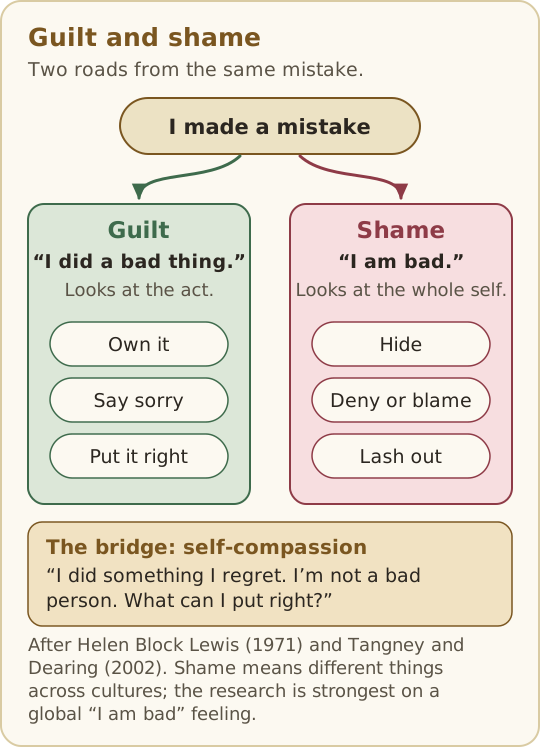
Figure 28 Guilt says “I did a bad thing.” Shame says “I am bad.” Guilt is easier to put right, and self-compassion helps you cross over. -
Shame makes you want to hide.
Shame shows up in the body first: a hot face, eyes down, a sinking stomach, wanting the floor to swallow you. It can also come out sideways, as sudden anger or a cold, closed face. That’s why a small comment can start a big fight: it touched shame, and shame defends.
For example: A coworker says in a meeting, “Didn’t we already cover this?” His colleague snaps back. Later she realises the snap wasn’t about the question. She felt stupid in front of everyone.
Words you could use: “I think I felt embarrassed just then, and it came out sharp. Can I try again?”
Try this: Learn your own shame signs. Next time you suddenly want to disappear or snap, name it quietly: “That’s shame.”
Dig deeper: how shame works in the body -
The inner critic is trying to protect you.
That harsh voice usually started as protection. If you criticise yourself first, maybe nobody else can hurt you. If you’re hard on yourself, maybe you’ll never fail again. It meant well. But a voice that only threatens keeps your body on alert, and it is tiring to live with.
For example: A young dad tells himself “idiot” every time he forgets something for the baby. His own father used that word. The voice is old, borrowed and not his.
Thoughts you could try: “Thanks for trying to protect me. I can take it from here.” “Whose voice is that, really?”
Try this: Write down one thing your inner critic says often. Then ask: would I say this to a friend I love? What would I say instead?
Dig deeper: the critic and the soothing systemFilled-in example Flip it Hamish, 44, after a mistake at work Flip it
- What’s on your mind?
- I got the figures wrong in the client report and my manager had to fix it. I’m hopeless at this job.
What kind is it?
- A complaint about someone
- A worry
- Chosen: Being hard on myself
- Anger
The flip
- What a good friend might say
- “That sounds like a hard moment. One mistake is not the whole of you. You’re not hopeless. You’re a person having a hard day.”
- Kinder words for yourself
- “I had a hard moment. I’m human. Next time I’ll [one thing].”
- One next step
- [one small thing, like a short sorry, a reminder on your phone, or some rest]
Talking to yourself the way you’d talk to a friend is a simple form of self-compassion. Being harsh rarely makes the next try easier. This is a starting point. Change any words you like.
- Hamish’s own words, after changing the flip
- I got two figures wrong and it was caught before the client saw it. I’m human. Next time I’ll ask a colleague to check the numbers before it goes out.
- His next step
- Send my manager a two-line sorry and the checking plan, today, then go home on time.
A made-up example. Names and details are invented. The flip is a starting point: Hamish changed the words until they were true and sounded like him.
Fill in your own: Flip it (spreadloveandacceptance.com/
small-wins) -
Self-compassion isn’t letting yourself off.
Self-compassion means treating yourself the way you would treat a good friend who is struggling. One well-known model has three parts: kindness instead of attack, remembering that everyone struggles, and noticing the pain without drowning in it. Studies, such as one by Juliana Breines and Serena Chen (2012), suggest people who are kind to themselves after a failure are often more likely to try to improve, not less.
For example: A woman fails her driving test for the third time. Instead of “I’m hopeless,” she tries: “This is hard. Lots of people need more goes. What will I practice before the next one?” She books another lesson.
Thoughts you could try: “This is a hard moment.” “Other people feel this too.” “What do I need right now?”
Try this: Put a hand on your chest or arm, if that feels okay, and say those three lines slowly to yourself once today.
Dig deeper: what self-compassion is, and isn’t -
Comparing yourself pulls your worth outside you.
We all measure ourselves against others. It’s how humans work out where they stand. But feeds full of other people’s best moments make that measuring unfair. Self-esteem that depends on being better than others goes up and down a lot. Self-compassion doesn’t need you to win.
For example: Two old friends meet up. One has a new house, the other is renting a room. The renter spends the evening quietly ranking herself, and misses that her friend is lonely and wanted to talk.
Thoughts you could try: “I’m comparing my inside to their outside.” “Their good news doesn’t take anything from me.”
Try this: Notice one comparison today. Then swap it for a question about the other person: “How are you, really?”
Dig deeper: comparison and steady self-worth -
You can own a mistake without drowning in it.
Owning a mistake is easier when it doesn’t mean you’re worthless. A simple shape helps: say what you did, say the effect, say what you’ll do now. Then stop. You don’t need to beat yourself up as proof that you’re sorry.
For example: A housemate forgot to pay her share of the bill, and the internet was cut off. “I forgot to pay. That left you without internet all weekend. I’ve paid it and set a reminder.” Done, without a speech about being a terrible person.
Words you could use: “I did this. I can see it affected you like this. Here’s what I’m doing about it.”
Try this: Think of one small thing you still feel bad about. Write the three-part sentence. Decide whether to send it, say it or simply let it rest.
Dig deeper: owning it, repairing it, letting it rest -
Worth is learned between people, and we can give it.
Children learn their worth from how they are treated, and adults keep learning it. How we talk to each other matters: “you did a careless thing” leaves room to change; “you’re so careless” doesn’t. Praise for effort and for who someone is, not only for results, helps people feel they matter on bad days too.
For example: A team lead starts each project review with “what did we learn?” instead of “who got it wrong?” Over time, people own up to problems earlier.
Words you could use: “I’m glad you’re here, whatever happened today.” “That didn’t work. You’re still welcome here.”
Try this: Say one thing to someone today that isn’t about their results: “I like how you…” or “I’m glad I know you.”
Dig deeper: how worth is given and learned
Friday, 9:15am
You write one line to the team: “Sorry for the mix-up with yesterday’s file, the right one is attached.” Then you notice the old voice and talk back to it the way you would to a friend: “You made a mistake. You fixed it. That’s what a decent colleague does.” The voice gets quieter. Nobody mentions the file again, and by lunch you’ve stopped thinking about it too.
In everyday life
- Partners: “You forgot to call” lands as “you’re a terrible partner,” and the reply comes out as a defence instead of a sorry.
- Parents and children: A child who is told “you’re so naughty” hears who they are. “That was a naughty thing to do” leaves them a way back.
- Friends: One friend always says yes to everything, then quietly burns out, because saying no feels like risking being dropped.
- Work: Someone hides a small error for weeks because owning it feels like proving they don’t belong there.
- Community: A newcomer at a club makes one mistake, feels everyone saw, and never comes back.
On your own: a kinder voice to keep
You don’t need anyone else to start this. You only need to notice how you talk to yourself, and to practice one gentler sentence.
- Catch the critic’s favourite words: “always,” “useless,” “pathetic,” “should.”
- Swap one of them for a fact: “I was late twice this week” instead of “I’m hopeless.”
- Keep a short list of things you did well, or simply did, on hard days. Getting up counts.
Thoughts you could try: “I’m allowed to be a work in progress.” “I can be disappointed in what I did and still be on my own side.”
Common mix-ups
- “Self-compassion is self-pity.” Self-pity says “only me, poor me.” Self-compassion says “this is hard, and other people go through it too.” It connects you to others.
- “If I’m kind to myself, I’ll get lazy.” Research suggests the opposite is more common: fear of your own attack makes people avoid trying and hide mistakes.
- “Self-worth means thinking I’m great.” It doesn’t. It means you matter even on the days you’re not great.
- “Feeling shame means I’m a bad person.” Shame is a feeling, not a fact. Almost everyone feels it.
- “Owning a mistake means agreeing I’m worthless.” The opposite. You can only really own a mistake when it doesn’t threaten your whole self.
- “I should just feel confident.” Confidence comes and goes. Kindness towards yourself is something you can practice on the days it’s gone.
If you want to help someone else with this
- Separate the person from the act. Talk about what happened, never about what kind of person they are.
- Don’t argue with their shame. “You’re not useless!” can feel like being told they’re wrong to feel it. Try: “It sounds like you feel really low about it. I don’t see you that way.”
- Make repair easy. Help them find one small thing they can do, so the feeling has somewhere to go.
- Notice them on ordinary days. Kindness when nothing has gone wrong teaches worth best.
Words you could use: “That sounds like it’s weighing on you. Want to work out one thing that would help?” “You don’t have to earn being cared about.”
When to get more help
Everyone feels shame and self-doubt sometimes. It’s worth talking to a doctor, counsellor or therapist if harsh thoughts about yourself are there most days, if they stop you working, eating, sleeping or seeing people, or if you feel you deserve to be hurt. Therapies such as compassion-focused therapy and cognitive behavioural therapy are built to help with exactly this.
If you are having thoughts of hurting yourself or not wanting to be here, please tell someone today. In the US and Canada, call or text 988. In the UK and Ireland, call Samaritans free on 116 123. In Australia, call Lifeline on 13 11 14. In New Zealand, call or text 1737. Anywhere else, findahelpline.com lists free helplines. If you are in danger right now, call your local emergency number.
If someone close to you keeps telling you you’re worthless, stupid or lucky to have them, that isn’t a self-esteem problem. It can be a way of controlling someone. Signs to look out for and Not safe at home? have free, private help.
Tools and reading on this site
Tools helpers you use on the site
- Upset right now? for a feeling that is too big to think through
- Ask Professor Puddles, the site’s chat host, to help you find a kinder sentence
Reading pages to read on the site
- Shame and guilt, in the site’s library of research notes
- Self-compassion and self-esteem
- Perfectionism and social comparison
- Masking, for anyone who has spent years trying to seem “normal”
- Where your lens came from, for where an old inner voice might have started
More for your situation
- On your own: Part One: where you came from · Your self-discovery path · On my own after a breakup
- Teens: For teens: feelings
- Neurodivergent: Wired differently · Neurodivergent relationships
- At work: At work
- Coming out: Coming out as an adult
- Carers and parents: Caring for someone you love · When a child has ADHD
- More in Part Three: Loss, grief and big life changes · Minds that work differently
Find your own starting point: Help by relationship.
Last updated: October 2026