Part One: The most important, yourself · Now
Know yourself: now, your wiring, your weather and your words
Why the same words can land differently on different days and in different people, and how to understand today’s you well enough to say what helps.
In short:
- Today has two layers you can work with: your wiring, which stays (work with it), and today’s conditions, which pass (work around them).
- Check your state before a hard talk. Weather, the three states, the load and the battery are different words for the same thing: how much room you have today.
- If a feeling is hard to name, start with the body. That is common, and it has a name: alexithymia.
- Your needs and limits are information. Plan what settles you on a calm day, and say what helps in one short sentence.
- Different isn’t wrong. A mix-up between two different minds runs both ways, so both of you adjust a little.
The big ideas: This part mostly teaches “Read your state first” and “Tune how you send and receive”, with help from “See the whole load” and “Fix the setup, not the person”. What are the five big ideas? (They are five plain ideas the whole program is built on.)
Sunday, 7:50pm
A friend asks, “Are you okay?” You say, “Fine.” The truth is you can’t tell whether you’re fine, tired or quietly bothered, and you couldn’t explain it to yourself, let alone to them.
-
Today is made of two layers you can work with.
Your wiring is the lasting part: your temperament, your pace, your senses, how you take in words. You work with it, by building a setup that suits you. Today’s conditions are the passing part: sleep, hunger, load, the room, the time of day. You work around them: eat first, sleep on it, talk tomorrow. Mixing the two up is where a lot of frustration comes from. (Then covered the third layer, the patterns life taught you.)
Dig deeper: wiring and conditions -
Know how you like to be spoken to.
Your pace, your tone, how much you need spelled out and what silence means to you all change how words land. How you connect helps you find words for how you think, talk and listen, with a four-letter Wave Code that is a fun description, not a test. The “How to talk to me” card puts how you take in words on one page you can share before a hard talk, not during one.
Dig deeper: your wiring and your Wave CodeFilled-in example “How to talk to me” card Ife, made on her own to give to a friend Your card
Pick what is usually true for you. Add a few words where the buttons are not enough. Leave a line blank if it does not apply.
Who it’s for
- A partner
- Family
- Chosen: A friend
- Work (a manager or coworker)
- Name on the card, optional
- Ife
WIRING CARD · NOT A DIAGNOSIS
- How I receive things best
- In writing. One thing at a time.
- I take words
- Literally when it matters, tone when it is light.
- Give me time to answer
- A few minutes.
- If I go quiet, it means
- I’m thinking.
- Please avoid
- Long texts or many topics at once.
- A request lands best as
- The ask in the first sentence.
Applies more strictly when I am running low. Not a contract, and not a label. Change it when it stops being true.
A made-up example. Names and details are invented.
Fill in your own: “How to talk to me” card (spreadloveandacceptance.com/
wiring-card) -
Check your weather before you speak.
Every conversation runs through your own state first. Chapter III in Part Two goes deep on the stress tank, so this part only adds the self side: a one-minute reading, on your own, before you decide what a hard moment means. My weather today is the quick one, and How much are you carrying? is the fuller one, a short worksheet.
Dig deeper: reading your state before you speakFilled-in example My weather today Joel, on his own, after a short night Check today’s weather
The sky
- Clear: Calm and connected
- Chosen: Gusty: Revved up
- Fogged in: Running on empty
Who you’ll mostly be around today
- A partner
- Family
- A co-parent
- Roommates
- Coworkers
- Someone I care for
- Friends
- Chosen: Mostly on my own
The pressure
- Light
- Chosen: Building
- Heavy
Ground conditions
- Chosen: Haven’t eaten in a while
- Thirsty
- In pain or unwell
- Been still all day
- Too much noise or light
- Running on caffeine
- Screens since I woke up
Last night’s sleep
- Barely slept
- Chosen: Short night
- About enough
- Properly rested
People load
- Barely any
- A normal amount
- Chosen: A lot
- Nonstop, no gaps
What’s blowing in
- Chosen: Work
- Money
- Kids or caring
- Health
- Family
- The house
- One conversation
- Something I can’t name
What would actually help in the next hour?
- Space
- Chosen: Food or water
- Rest
- Chosen: To move
- To be heard
- A plan
- Company
- Quiet
- Someone to take something off me
Your forecast
- Gusty today
- Revved up · Some room today
- Pace
- go gently, settle first
It’s gusty. You’re revved up. That energy is useful for doing something physical, but it is poor weather for big decisions.
You said what would help is food or water and to move. Arrange that before anything else.
Overall: some room today. There is less room than usual, so spend it carefully.
If you want to send someone a line: “I’m a bit wound up today, so I’ll keep replies short. It isn’t about you.”
A made-up example. Names and details are invented.
Fill in your own: My weather today (spreadloveandacceptance.com/
quick-checks) -
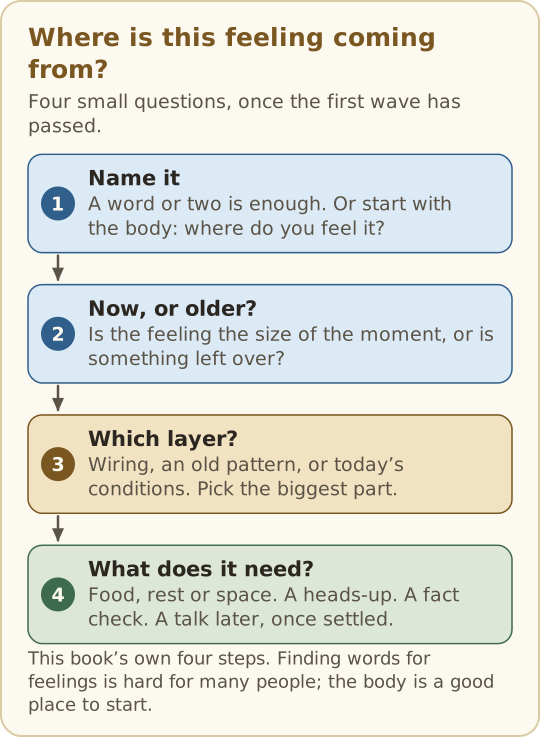
Ask where this feeling is coming from.
Name it (“tight, annoyed, a bit scared”). Then ask: is this the size of the moment, or does it feel older? Which layer is it? And what does it need right now: food, space, a heads-up, reassurance, or a real conversation later? It takes a minute, and it works best once the first wave has passed.
Dig deeper: a four-step self-check -
Plan what settles you on a calm day.
When you’re wound up is a bad time to work out what helps. The Calm-Down Kit is a plan you make while calm: what tends to set you off, two calming steps, and one sentence for stepping away that includes when you’ll be back. It is for you, never for the other person.
Dig deeper: deciding ahead -
Your needs and limits are information, not demands.
What helps you, what matters to you and what you have left are facts about you. Said kindly, they let other people plan around you: “A heads-up helps me,” “I can take this one, not that one,” “I’m low today, can we talk tomorrow?” Who did what (Part B) has ready-made kind ways to say no, and Say it so it lands turns a raw reaction into a fact, a feeling and an ask.
Dig deeper: saying your needs kindly -
Being wired differently is not being wrong.
Some people take in words, noise, change and feelings differently from what most social customs were built around. That is wiring, not a flaw to fix. You can understand it, plan around it and get support for it, if you choose. A mix-up also runs both ways: Wired Differently shows how two differently wired people can each misread the other, with nobody at fault.
Dig deeper: wiring is not a flaw -
Explain yourself without over-sharing.
Three short sentences cover most moments. “This is how I’m wired. It won’t change, but here’s what helps.” “This is an old alarm. I’m working on it, and here’s what helps in the moment.” “Today’s a low-battery day.” You never owe anyone your history. Share the part that helps them help you, as information and not as a list of rules.
Dig deeper: scripts, and how much to share -
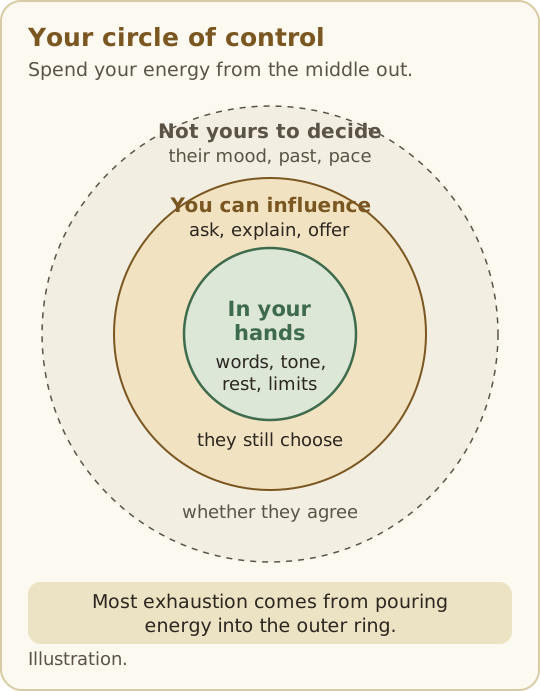
Do your part, and only your part.
Today you control your words, your effort, your rest, your limits and what you ask for. You don’t control someone else’s mood, reply, pace or choices, and trying to manage them drains you fast. So do your side well, then let go of theirs. And match energy with energy: meet warmth with warmth and effort with effort, and when you keep giving far more than comes back, give a little less until it balances. It protects your battery, and a protected battery is what keeps you kind.
Dig deeper: your circle of control, and matching energy
The ideas, one at a time
Each idea above again, with a real-life example, words you could use and one small step. Read one and stop if you like.
1. Two layers you can work with
For example: A dad who works nights finds the school-run chatter unbearable at 8am. That isn’t who he is. It’s the hour. He swaps to the afternoon pick-up, and the chatter is fun again. See Different hours.
Words you could use: “It’s not you, it’s the hour. Can we talk after I’ve slept?”
Try this: Write one thing that always bothers you (probably wiring) and one that only bothers you when you’re tired (conditions).
2. How you like to be spoken to
For example: A grandmother loves phone calls. Her grandson loves texts. Each thinks the other is being distant. Once they say how they like to talk, they settle on a Sunday call and texts in between.
Words you could use: “I take things in best when ___. How about you?”
Try this: Finish the sentence “I take things in best when…” and keep it for your “How to talk to me” card (a one-page note on how you like to be spoken to).
3. Check your weather first
For example: A long-distance couple notice their hard calls are always at the end of one partner’s late shift. They move serious talks to weekend mornings. See Long distance.
Words you could use: “I’m running on empty tonight. Can we pick this up tomorrow morning?”
Try this: For three mornings, describe your inner weather in one of the three sky words My weather today uses: clear, gusty or fogged in.
One state, many words. The book and its tools use a few everyday pictures for one thing: how much room you have today. They are different words for the same state, not different things to measure.
- The three states (Part Three calls them the ladder): calm and connected, revved up, and running on empty.
- My weather today uses sky words for the same three: clear is calm and connected, gusty is revved up, and fogged in is running on empty. Its pressure (light, building or heavy) is how much you were already carrying.
- The load, also called the stress tank, is the score from How much are you carrying?, from 0 to 1. Higher means heavier.
- The battery is the other side of the load: the energy you have left. A heavy load means a low battery.
So “gusty”, “revved up”, “a fairly full tank” and “a low battery” can all describe the same afternoon. Use whichever words suit you.
4. Where is the feeling coming from?
For example: A coworker says, “Quick question?” and your heart races. Name it: jumpy. Older? Yes, an old boss. Layer: a pattern, plus a busy day. Need: a moment to settle.
Words you could use: “Sure. Give me five minutes and I’ll be right with you.”
Try this: Next time a feeling surprises you, do just the first step: name it in two words.
When feelings are hard to name: For some people, “What are you feeling?” is a hard question most days, not just bad ones. They notice a racing heart or a heavy stomach, but can’t tell if it is worry, anger or hunger. Psychologists call this alexithymia (“no words for feelings”). It is a trait that runs from a little to a lot, not an illness, and it is common, especially in autistic people. The feelings are there; the words come slowly. What helps: start with the body (“tight chest, skipped lunch”), choose between two words (“more tired or more annoyed?”), use the three sky words instead of feeling words, and give it time. “I’ll tell you tomorrow” is a real answer.
5. Plan what settles you
For example: A teenager makes a plan with herself. When a row with her mum heats up, she says, “I need ten minutes in my room, then I’ll come back.” And she comes back.
Words you could use: “I’m too wound up to listen well. I need twenty minutes, then I’ll come back.”
Try this: On a calm day, write your one stepping-away sentence, including when you’ll be back.
6. Needs are information
For example: In a home with three partners, Quinn needs an hour alone after work. Said once, kindly, it becomes part of the plan instead of a mystery. See More than two partners at home.
Words you could use: “I can do ___. I can’t do ___ this week. Could we ___ instead?”
Try this: Write one need you’ve never said out loud. Practise saying it as a fact, not an apology.
7. Different isn’t wrong
For example: A woman with ADHD keeps forgetting plans with a friend. Instead of “I’m hopeless,” she says what helps: “If you text me the day before, I’ll be there.” See Neurodivergent relationships.
Words you could use: “My brain works a bit differently. Here’s what helps me get it right.”
A mix-up runs both ways: When an autistic and a non-autistic person misread each other, it is easy to blame the autistic person. The double empathy problem, named by the autistic researcher Damian Milton, is the idea that the gap runs both ways: each person reads the other through their own way of communicating, and each finds the other hard to read. In one study, a story passed along a chain of autistic people kept as much detail as one passed along non-autistic people; mixed chains lost detail faster. So nobody is the broken one. Ask “Where did we lose each other?” and both adjust a little.
Try this: Name one setting where you work best (quiet, written down, early, with music) and give yourself it once this week.
8. Explain, without over-sharing
For example: A man with a long-term illness tells a new friend, “Some days I have less energy. If I cancel, it isn’t about you.” He shares what helps, not his medical history. See When one of you is ill.
Words you could use: “Today’s a low-battery day. It isn’t about you.”
Try this: Pick one of the three short sentences above and say it out loud once, on your own.
9. Your part, and only your part
For example: A grown-up daughter keeps trying to stop her father worrying about her. She can’t. She can send a short “Home safe” text after long drives, then let his worry be his. See For grown-up children.
Words you could use: “I can’t stop you worrying, but I can text when I’m home.”
Try this: Write one thing you keep trying to control that isn’t yours. Next to it, write one thing that is. (If you are afraid of someone, this isn’t about managing them. Not safe at home? has people to talk to.)
Friday, 6:40pm
“Surprise! I booked us dinner with my cousins tonight.” They meant it as a gift. You felt your chest tighten and heard yourself say “Great” in a flat voice. Later you wonder: is that just me, is it something from years ago, or am I simply wiped out after this week? Probably a bit of all three.
You, in all your relationships
Your wiring and your weather come with you everywhere, starting with how you treat yourself on a hard day.
- With yourself: Noticing “I’m low today” before you decide “I’m failing.”
- With partners: A heads-up, a quiet hour, a better time to talk. Every partner, and every extra partner, has a wiring of their own.
- With friends and family: How you like to keep in touch, and how much you can give this month. See Friends.
- At work: An agenda ahead, a written plan, a minute before you answer.
- With housemates: Noise, light and quiet time. See Sharing a room.
- On your own: Building a week that suits how you’re built. See On my own.
Find your own situation in help by relationship.
Inside you, and between you
- In you: Check your state and know your wiring before you judge a reaction. Count the hidden effort, like masking (hiding or toning down how you naturally are, to fit in) or holding an old alarm down, as real load.
- Between you and others: Change the setup, not the person. Tell people what helps, tune how you send and receive, and treat a mismatch as tuning, not a moral failing.
In the individual program
This part goes with Steps 1, 2, 4 and 5 of the individual program: check your battery, get to know your wiring, plan what settles you, and find words for what you feel.
Your next step: Step 1: check your battery · Step 2: your wiring · Step 4: what settles you · Step 5: find the words · The whole book on knowing yourself
The fields behind this part
This part draws on 6 of the author’s thirteen fields (the About page lists them all):
- Psychology (Tune how you send and receive): How you take words in and send them out, and what helps you feel understood.
- Neurobiology (Read your state first): Your nervous system’s state comes before your words, and wiring is part of how you are built.
- Philosophy (Tune how you send and receive): Your honesty, your ask and your tone are up to you. The other person’s answer is up to them.
- Behavioural science (Read your state first): Try small routines on calm days, like a one-minute reading and a sentence you keep ready.
- Holistic therapies (Read your state first): Body first, words second. Decide on a calm day what settles you.
- Economics (See the whole load): Managing yourself costs effort that doesn’t show, and it counts as part of the load.
Two fields, one idea: Philosophy + Neurobiology. If getting revved up or shutting down is a body doing its job, it isn’t a character flaw. That changes what blame means, including the blame you aim at yourself.
See how all the fields connect, in the full version · The polymath way
In real life
- Partners: Sam knows surprise plans make their chest tighten, and says so on a calm day: “A heads-up helps me. It isn’t about you.” Now their partner knows what to try.
- Family: You need a quiet half hour after a long visit. You say so before you go: “I’ll be good company after a short rest.” It sounds like a plan, not a retreat.
- Housemates: One housemate needs an hour of quiet after work to recover. The other hears it as being shut out. A one-line note settles it: “Quiet until seven isn’t about you. I’m back after.”
- Coworkers: Someone thinks best with the agenda a day ahead. They say it once, as how they work and not as an apology: “Could the agenda come the day before?”
Common mix-ups
- “Knowing myself means finding the right label.” It’s about what helps, not a name. The three layers and a Wave Code are everyday words, not a diagnosis.
- “‘That’s just how I am’ ends the talk.” It may be true, especially for wiring. It works better as a start: “This is how I’m wired, and here’s what helps.”
- “If I tell people how I’m wired, they have to manage me.” Telling them helps their words land. You still do your part, and they still have their own needs.
- “I’m fine” means I’m fine. Sometimes. It can also mean you’ve been tired for so long you stopped noticing. A quick reading each week shows a baseline you’ve got used to.
- “Looking at myself is selfish.” Every conversation runs through your own state. Knowing it is part of being easier to talk with.
- “If I need something, I have to justify it.” You don’t. “A heads-up helps me” is enough. A reason is a kindness you can offer, not a fee you owe.
A note on care: This part is general education. It isn’t a diagnosis, a test or treatment, and it can’t tell you whether you’re autistic, have ADHD or anything else, or what anyone else has. If you’d like to understand yourself more deeply, a qualified professional can help, if and when you want that. Nothing here is required, and nothing you try needs to be shared. If talking about any of this with someone ever feels unsafe, or you feel you can’t say no, stop and talk with a trained counselor on your own. When someone is afraid of their partner, counseling together isn’t advised. Not safe at home? lists free, private hotlines.
Try this: Pick one reaction you had this week, and write one line for each layer.
“My wiring part is…” “The older part is…” “Today’s part was…”
Then take a one-minute reading of your weather, and write one sentence about what helps you, in your own words. Keep it to yourself for a few days.
When it feels right, share that one sentence with one person, on a calm day.
Know your own wiring → How you connect: the style quiz → Make your “How to talk to me” card → My weather today, a one-minute self-check → How much are you carrying? → The Calm-Down Kit → Next in the book: Next →
Last updated: October 2026