Part Three · Chapter 16
Worry, low mood and trauma
In short:
- Worry, low mood and the after-effects of trauma are common, human and treatable. They are not weakness, and they are not your fault.
- They all run through the stress system from Chapter 2. Small, steady things that settle the body and reconnect you with life help more than big pushes.
- Avoiding and withdrawing feel safer but keep things going. Small steps back in, a little at a time, help most.
- Talking therapies work for many people, and so can medicines. If it has lasted weeks, is getting in the way of life, or you feel unsafe, get help. If you might act on thoughts of ending your life, call or text 988 (US) or call Samaritans on 116 123 (UK and Ireland) now.
Why the tools work: this chapter explains the thinking behind these tools from earlier in the book.
- The daily check-in’s “low, medium or high” (Part Two, Chapter I) works because worry and low mood shrink the room you have. Saying so lets the people around you adjust. Big idea: read your state first.
- “A full tank means later, not never” (Part Two, Chapter III) names a time to come back, because avoiding a thing keeps fear going, and a named time doesn’t.
- Pick one small goal (Part One, Next) fits low mood: doing often comes before feeling better.
Sunday, 10:50pm
The house is quiet. You’ve checked the front door twice. Tomorrow is the hospital appointment, and the same three thoughts go round: what if it’s bad, what if I can’t cope, what if there’s nobody to tell. Your chest is tight and your mind won’t stop. You haven’t really wanted to see anyone for a few weeks either. Everything feels like too much effort.
Worry, low mood and the after-effects of frightening events are among the most common human experiences, and among the most misunderstood. People are told to relax, cheer up or move on, as if these were choices. This chapter explains what is known about how they work, what helps day to day, what treatment involves, and how to support someone else. It can’t diagnose anyone, and it is not a replacement for care from a professional.
Each section starts with what research has found, and says where the evidence is strong and where it is thin. Where it adds something, a section also looks at what philosophers have said, or at how things can look different for autistic people. Not every section has every lens. Some ideas simply don’t need one.
Ideas marked This site’s idea: are our own ways of putting things into practice, not established science.
Worry and anxiety are the body’s alarm
Fear, anxiety and worry are related but not the same. Fear is the alarm for a danger that is here now: a car swerving towards you. Anxiety is the same alarm ringing about something that might happen: the scan result, the money, the conversation next week. Worry is the thinking side of anxiety, a chain of “What if…?” thoughts that tries to solve a problem in advance.
Psychology
Anxiety runs on the stress system described in Chapter 2. The body prepares to deal with a threat: the heart speeds up, breathing quickens, muscles tense, digestion slows, attention narrows onto danger. That is useful for a few minutes. When it switches on often, or stays on for weeks, it is tiring and unpleasant, and it can disturb sleep, concentration and digestion. McEwen (1998) described how the stress system protects us in the short term but wears on the body when it is switched on again and again. See allostatic load in the library.
Anxiety tends to keep itself going through a few predictable loops. We pay more attention to possible threats, so we notice more of them. We read uncertain things as dangerous. We avoid or check (the door, the symptoms, the reassurance), which brings relief now and more anxiety later. And body sensations themselves can become frightening: a racing heart is read as a heart attack, which makes it race more. That last loop is at the heart of a panic attack. Panic attacks are very frightening, but they pass, usually within minutes, and they are not dangerous in themselves. Chest pain or breathlessness that is new or unusual should still be checked by a doctor.
Anxiety becomes a problem, and may be an anxiety disorder, when it is out of proportion to the situation, hard to control, lasts a long time, and gets in the way of daily life. Anxiety disorders are among the most common mental health conditions, and among the most treatable.
Philosophy
The Roman Stoic Seneca wrote to his friend Lucilius that there are more things likely to frighten us than to crush us, and that we suffer more often in imagination than in reality. The Danish philosopher Søren Kierkegaard, in The Concept of Anxiety (1844), took a different view: he called anxiety “the dizziness of freedom,” the feeling that comes from facing open possibilities. Both are useful. Seneca reminds us that most of what we fear doesn’t happen. Kierkegaard reminds us that anxiety is part of being a person with choices, not a sign that something is broken.
Through an autistic lens
Anxiety is common among autistic people. In a review of 35 studies, Hollocks and colleagues (2019) estimated that about a quarter of autistic adults had an anxiety disorder at the time they were studied, and about four in ten at some point in their lives, though estimates varied a lot between studies. Uncertainty is often a big part of it: a change of plan, a vague instruction or an unclear social rule can set the alarm ringing. Carleton (2016) argued that fear of the unknown may sit underneath many kinds of anxiety, autistic or not. Sensory overload can also feel very like anxiety. It helps to ask, “Is this worry, or is it too much noise and light?” The answers need different help: one needs reassurance or a plan, the other needs a quieter room. See intolerance of uncertainty.
Thoughts you could try: “This is my alarm, not a fact.” “Is this worry, or too much input?” “Panic feels dangerous, and it passes.”
Avoiding keeps fear going
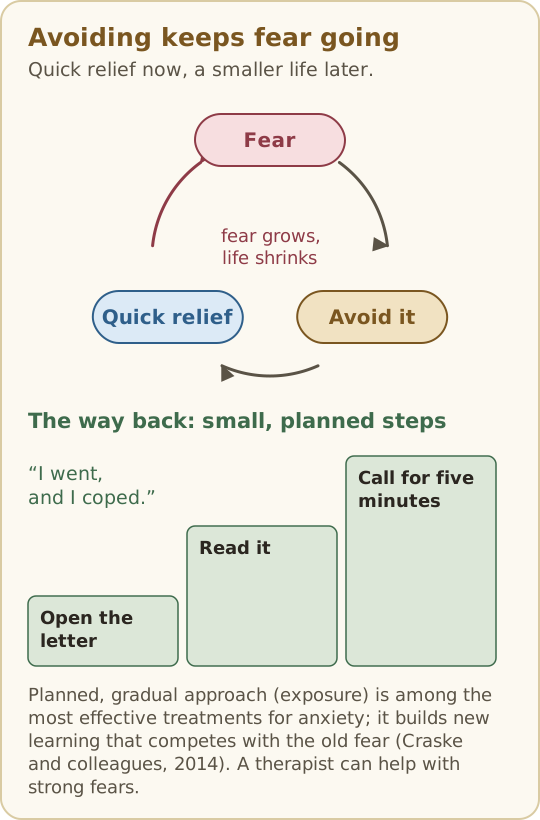
When something makes us anxious, avoiding it brings quick relief. That relief is powerful, and it teaches the brain a lesson: “Escaping kept us safe.” Over time, the avoided things grow in number, and life gets smaller.
Psychology
Avoidance comes in obvious forms (not going to the party, not opening the letter) and subtle ones, sometimes called safety behaviours: sitting near the exit, rehearsing every sentence, carrying medication you never use, asking for reassurance again and again. They all prevent the brain from learning that the feared thing is survivable. The most effective psychological treatments for anxiety include some form of exposure: approaching the feared situation gradually and on purpose. Craske and colleagues (2014) describe how exposure seems to work by building new learning (“I went, and I coped”) that competes with the old fear, rather than by erasing it. They suggest it works best when each step tests a specific prediction, when safety behaviours are dropped, and when practice happens in different places and at different times.
Exposure is not about forcing yourself through terror. It is planned, chosen and gradual. A therapist can help, especially for strong fears, panic or obsessive-compulsive problems.
This site’s idea: The step ladder. Write the thing you’re avoiding at the top of a page. Underneath, list six to eight smaller steps, from “barely uncomfortable” to “nearly there.” Before each step, write what you expect to happen. Afterwards, write what did happen. Stay on a step until it feels manageable, then go up one.
Through an ADHD lens
For many people with ADHD, avoidance looks like putting things off: the form that sits unopened for weeks, the email you can’t face. It is often less about laziness and more about a task that feels shapeless, boring or loaded with past failures, and a brain that struggles to start without a deadline. Each day it waits, the dread grows, which is the same loop as any other avoidance. The step ladder works here too, with the first step made almost silly: “open the envelope”, “write the subject line”, then stop if you want. A timer for ten minutes, or doing it with someone else in the room, can help a lot. Worry at night is also common, when the day’s distractions stop. A notebook by the bed for “tomorrow’s worry time” gives the thoughts somewhere to go.
Philosophy
Aristotle thought courage was learned by practice: we become brave by doing brave acts, just as we become builders by building. He also thought courage was not the absence of fear, but acting well while afraid. Exposure is, in a sense, Aristotle’s advice with a step ladder added.
Thoughts you could try: “What do I predict will happen? Let’s find out.” “Uncomfortable isn’t the same as dangerous.” “One step, not the whole staircase.”
Give worry a time and a place
Worry feels useful, which is part of why it’s hard to stop. It feels like preparing, or caring, or staying in control. Sometimes it is. Often it goes round in circles without reaching a plan.
Psychology
Telling yourself not to worry rarely works; trying to push thoughts away tends to bring them back. A gentler method is postponement. In an early study, Borkovec and colleagues (1983) taught people who described themselves as worriers to notice when they were worrying, put it off, and give it a set time and place later in the day. Over four weeks, they reported worrying less than people who had no instructions. The study was small, but the idea is now part of many CBT programmes for worry.
Worry time works better with a simple sort. For each worry ask: is this a problem I can do something about? If yes, write one next step, with a time. If no, practise noticing the worry and letting it pass, perhaps with slow breathing or by turning to something absorbing. Going over and over a worry without a plan is a kind of rumination, and like the rumination in Chapter 13, it tends to feed the feeling rather than settle it. See rumination.
Philosophy
The Stoic teacher Epictetus began his handbook by dividing the world into what is up to us and what is not. Worry time puts that idea into practice: the sorting question (“Can I do anything about this?”) is his question, asked every evening at six. Buddhist teaching offers a related image, the “second arrow.” The first arrow is the painful event. The second is our own reaction to it, the going over and over, which we fire into ourselves.
Thoughts you could try: “Noted. That one’s for six o’clock.” “Is there a next step? If so, what is it? If not, can I put it down for now?”
Flip it
- What’s on your mind?
- What if I fail my chemistry exam on Friday and don’t get into the course I want?
What kind is it?
- A complaint about someone
- Chosen: A worry
- Being hard on myself
- Anger
The flip
- The best outcome would be
- [what you hope for]
- The main thing in the way
- I fail my chemistry exam on Friday and don’t get into the course I want
- If that happens, I’ll
- [one small thing you could do]
- One step today
- [something that takes ten minutes or less]
This is WOOP, from Gabriele Oettingen’s research: Wish, Outcome, Obstacle, Plan. The worry becomes the obstacle you plan for. This is a starting point. Change any words you like.
- Tolu’s version
- Best outcome: I pass, and I feel I did my best. In the way: I freeze on the long questions. If that happens, I’ll do the short questions first and come back. One step today: one long question from a past paper, then bed.
- When the worry comes back at 1am
- It goes on the list for tomorrow’s worry time, 5pm, ten minutes.
A made-up example. Names and details are invented. If worry is stopping you sleeping or eating most days, tell someone you trust, or your doctor.
Fill in your own: Flip it (spreadloveandacceptance.com/
Low mood and depression
Feeling low is part of life. Sadness after a loss, disappointment after a setback, flatness on a grey week: these are normal and usually pass. Depression is something more lasting and more far-reaching.
Psychology
Clinicians usually describe depression as low mood, or loss of interest and pleasure, lasting most of the day, nearly every day, for at least two weeks, along with other changes: sleeping much more or less, tiredness, changes in appetite, slowed or restless movement, feeling worthless or excessively guilty, difficulty concentrating, and sometimes thoughts of death or suicide. It ranges from mild to severe, and it can come once or return. It affects the body as well as the mind. Many people with depression first notice tiredness, aches or poor sleep rather than sadness. Some notice irritability, numbness or a sense of running on empty.
Depression has no single cause. Life events (loss, money worries, illness, loneliness, caring for someone), long-term stress, difficult early experiences, physical illness, some medicines, alcohol, and inherited factors can all play a part. A low patch after a hard event isn’t the same as depression, and grief isn’t depression either, though the two can overlap. See Chapter 8. Guidelines such as NICE (2022) describe a range of effective help, matched to how severe the depression is and what the person prefers.
Philosophy
Philosophers have long noticed that low mood changes the whole world, not just one’s feelings about it. When depressed, nothing seems worth doing, and the future seems closed. That is part of why depression is so convincing from the inside: it doesn’t feel like a mood, it feels like the truth. Knowing this can help. Hopeless thoughts in depression are symptoms, not forecasts.
Across generations and cultures
In many families, cultures and generations, people talk about low mood mainly through the body (“I’m just tired,” “My back’s bad,” “I can’t sleep”), or not at all. Older people, men, and people from communities where mental illness carries stigma are often less likely to name depression or seek help. That doesn’t make their distress less real. Asking about sleep, energy and enjoyment can open a door that “Are you depressed?” would close.
Words you could use: “I’ve not been myself for a few weeks.” “Hopeless thoughts are part of how I feel right now, not the whole truth.” (to someone else) “How have you been sleeping? Are you still enjoying things?”
Doing often comes before feeling better
Depression drains motivation. Most of us wait to feel like doing something before we do it. In depression, that wait can last a very long time.
Psychology
Behavioural activation starts from a simple observation: when people are low, they tend to withdraw from activities and people, which removes sources of pleasure, achievement and connection, which deepens the low. The approach reverses the order. You plan small, specific, doable activities, linked to what matters to you, and do them on schedule, whether or not you feel like it. Mood often follows action rather than leading it. In a review of 26 randomised trials, Ekers and colleagues (2014) found that behavioural activation helped with depression compared with control conditions, and did at least as well as medication in the few trials that compared them. They also noted that many of the studies were small or of low quality, so the size of the benefit is uncertain.
The steps that tend to help: notice what you do in a day and how it affects your mood; choose a few activities that bring pleasure, achievement or closeness; make them small enough to be almost certain to happen; put them at a set time; and treat any doing as a success. A walk round the block counts. A shower counts. A text to a friend counts.
Through an autistic lens
For autistic people, “just get out more” can backfire if the activities are draining. Depression may look different too: losing interest in a special interest, or withdrawing even from safe people, can be an early sign. Behavioural activation can be adapted by choosing restoring activities (a favourite interest, a quiet walk, time with one trusted person) over socially demanding ones, and by planning around energy. Depression is common among autistic adults: Hollocks and colleagues (2019) estimated about a quarter at any one time. It can also be confused with autistic burnout; the two need different kinds of rest and help, though people can have both. See Chapter 9.
Thoughts you could try: “I don’t have to feel like it to do it.” “Small counts.” “Did it help a bit, even 5%?”
Sleep, moving and people
Sleep, physical activity and contact with other people sound like lifestyle advice, not treatment. But all three have good evidence behind them, and all three tend to slip when people are anxious or low.
Psychology
Sleep. Poor sleep is both a symptom and a cause. In the OASIS trial, Freeman and colleagues (2017) randomly assigned nearly 3,800 university students with insomnia to an online CBT course for sleep or to usual care. The course greatly improved insomnia, and reduced paranoid thoughts and hallucinatory experiences, with the improvement in sleep explaining much of the change. The authors argued that this supports insomnia as one cause of other mental health difficulties, though the sample was students, so it may not apply to everyone. CBT for insomnia, rather than sleeping pills, is usually the first recommended treatment for long-term sleep problems. See Chapter 2 on sleep.
Moving. In a large review of 218 trials, Noetel and colleagues (2024) found that exercise reduced depression, with walking or jogging, yoga and strength training showing some of the clearest benefits, and more vigorous exercise doing more. The quality of many studies was low, so the exact size of the effect is uncertain, but the direction was consistent. Exercise also helps many people with anxiety.
People. Strong social ties are linked with better health and longer life (Holt-Lunstad and colleagues, 2010). For depression specifically, Cruwys and colleagues (2013) followed several thousand adults aged 50 and over for up to four years. Belonging to fewer social groups predicted more depression later, and the benefits of groups were stronger for people who were already depressed: among them, joining one group was linked to a 24% lower risk of relapse, and joining three to a 63% lower risk. The study was observational, so it shows a link rather than proof, but it fits a wider pattern. A choir, a club, a faith group or a volunteering team can all be groups in this sense.
None of these replace treatment when it is needed. They support it, and they are within reach for most people, even in small doses.
Through an autistic lens
Each of the basics can be harder for autistic people for reasons that are easy to miss. Sleep can be disturbed by sensory discomfort. Gyms, team sports and group exercise can be overwhelming. Social groups may only help if they feel safe, which often means groups built around a shared interest, or autistic-led spaces, rather than general social events. The principle is the same: rest, movement and belonging. The forms need to fit.
Words you could use: “I need help protecting my sleep for a while.” “Would you walk with me? I’m more likely to go if someone’s with me.”
What trauma is, and what it isn’t
“Trauma” is used in many ways now, from life-threatening events to ordinary disappointments. Being clear about the word helps people get the right help, without making anyone’s pain seem smaller.
Psychology
In the clinical sense, a traumatic event involves actual or threatened death, serious injury or sexual violence, experienced directly, witnessed, learned about happening to someone close, or met repeatedly in some jobs. Such events are common. Using surveys from 24 countries, Kessler and colleagues (2017) found that about 70% of adults reported at least one in their lifetime, with interpersonal violence such as sexual assault carrying a particularly high risk of later PTSD.
Most people who go through a traumatic event do not develop PTSD. In an influential review, Bonanno (2004) argued that resilience, a fairly steady return to everyday functioning, is the most common response to loss and potentially traumatic events. In the same World Mental Health surveys, Koenen and colleagues (2017) estimated that about 5.6% of people exposed to trauma developed PTSD at some point. That is still a very large number of people, and the risk is much higher after some kinds of event and with less support.
PTSD involves four main kinds of difficulty: re-experiencing (vivid, intrusive memories, flashbacks or nightmares), avoidance of reminders, negative changes in mood and beliefs (guilt, shame, feeling cut off), and feeling on high alert (jumpy, irritable, poor sleep, scanning for danger). Distress in the first weeks after an event is normal. Help is worth seeking if it lasts beyond about a month, or is severe at any point.
Repeated or long-lasting harm, especially in childhood or in close relationships, can have wider effects: on trust, on feeling safe in your own body, on managing strong feelings. The Adverse Childhood Experiences study by Felitti and colleagues (1998) found that adults who reported more difficult childhood experiences had higher rates of many later health problems. That is a link across groups, not a prediction about any one person, and many people with hard childhoods live well.
Philosophy
Philosophers who write about trauma often stress that it breaks the sense of a world that makes sense and of a future that can be trusted. Recovery, on this view, is not only about calming symptoms. It is about rebuilding a story you can live inside, and relationships in which you are safe again. That fits closely with what trauma-informed care puts first.
Through an autistic lens
Some autistic people describe events that others might call ordinary, such as repeated bullying, being restrained, or long periods of sensory overload, as having a lasting, trauma-like effect. Whether or not these meet the clinical definition, the effects deserve to be taken seriously. Autistic people can also find it hard to get help that fits: therapy that relies on eye contact, vague questions or busy waiting rooms can add to the load. Asking for adjustments, such as written questions, a quieter room or extra time, is fair.
Thoughts you could try: “My reactions make sense after what happened.” “It’s over, even if my body hasn’t caught up yet.” “What happened to me is not who I am.”
After something frightening: safety, choice and no pressure
What helps most in the days and weeks after a frightening event is often surprisingly ordinary: safety, practical help, warmth, information, and choice about whether and when to talk.
Psychology
For years, it was common to offer everyone a single “debriefing” session soon after a traumatic event, going over what happened in detail. A Cochrane review by Rose and colleagues (2002) found no good evidence that this prevented PTSD, and some evidence that it might increase the risk for some people. The authors advised that compulsory debriefing should stop. Current approaches tend to offer practical support and information early, watch how people are doing over the following weeks, and offer trauma-focused treatment to those who are still struggling.
Trauma-informed care takes this further, into how services and organisations work. In a widely used framework, SAMHSA (2014) set out six principles: safety; trustworthiness and transparency; peer support; collaboration and mutuality; empowerment, voice and choice; and attention to cultural, historical and gender issues. The aim is to realise how common trauma is, recognise its signs, respond in ways that help, and avoid causing harm again. These ideas were written for services, but they translate well into homes, schools and workplaces: explain what’s happening, offer real choices, don’t surprise people, and let them set the pace.
In practice
If someone close to you has been through something frightening: make sure they are safe and have what they need today; stay calm and available; let them talk, or not; avoid pushing for details; help with practical things; and keep in touch over weeks, not just days. If they are still struggling after a month, or if they are very distressed at any point, encourage them to see a doctor. Trauma-focused CBT and EMDR (eye movement desensitisation and reprocessing) are among the treatments recommended for PTSD.
Words you could use: “You don’t have to tell me anything. What would help right now?” “You’re safe. I’m staying.” “Can I check in on you on Thursday?”
Talking therapies and medicines
Many people put off getting help because they don’t know what it involves, or fear being judged or told to “just take a pill.” Knowing what’s on offer makes the first step easier.
Psychology
Cognitive behavioural therapy (CBT) focuses on the links between thoughts, feelings, body and actions, and teaches practical skills to change unhelpful patterns. It is usually short (often six to twenty sessions), structured and collaborative. In a review of 106 meta-analyses, Hofmann and colleagues (2012) found that the strongest evidence was for anxiety problems and general stress, with support across many other difficulties too. They also noted gaps: few studies looked at specific groups such as ethnic minorities or people on low incomes.
For depression, guidelines such as NICE (2022) describe a range of options, including guided self-help, group or individual CBT, behavioural activation, group exercise, and other talking therapies, as well as antidepressant medicines, and stress that the choice should be made together with the person. For anxiety disorders and PTSD there are similar evidence-based options. Many services offer self-referral or a first conversation by phone.
Medicines help many people, especially with moderate or severe depression and some anxiety problems. They also have side effects, take time to work, and need to be stopped gradually and with advice. Every question about medicine, whether starting, changing, stopping or combining, belongs with a doctor or prescriber who knows your health. This chapter can’t give medical advice, and no website should.
Philosophy
Some people worry that getting help means they’ve failed, or that feelings should be handled alone. Most ethical traditions disagree. Caring for your own health is part of caring for the people who depend on you, and asking for help is something we do for each other all the time. Nobody thinks less of a person who sees a doctor for a broken leg.
Words you could use: “I’d like to talk about my mood. It’s been going on for a while.” “What are my options? What would you recommend for someone like me?” “I’d like to stop this medicine. How do I do that safely?”
Putting it together
Worry, anxiety, low mood and the after-effects of trauma all run through the same stress system. Each has its own loop: anxiety is kept going by avoidance and checking, worry by going round in circles, low mood by withdrawal, trauma reactions by an alarm that hasn’t learned the danger has passed. And each has a way out that starts small: stepping back towards what you fear, giving worry a time and a plan, doing before feeling, protecting the basics, and getting safe, steady support. Talking therapies and medicines help many people when self-help isn’t enough.
- It isn’t your fault, and it isn’t forever. These are common, treatable human experiences.
- Small steps beat big pushes. One step on the ladder, one activity, one call.
- The basics are treatment too. Sleep, moving and people.
- Safety and choice first. Especially after trauma.
- Ask early. Help works better before things get very bad, and it’s never too late.
Worked examples
These are made-up examples built from common patterns, not real people.
On your own: the night before the appointment
Back to the opening. You write the three worries on an envelope and give them a time: tomorrow, after the appointment. You breathe out slowly at the kitchen window, then text your neighbour, who offers a cuppa afterwards. At the appointment you also mention that you’ve felt flat for weeks. The doctor asks a few questions and suggests a self-referral to talking therapies, and a walking group that meets near you. It isn’t fixed overnight, but you’re not carrying it alone.
Partners: the worrier and the fixer
Gwen worries about money every night; her partner Hugo keeps saying “It’ll be fine,” which makes it worse. They agree a twenty-minute money worry time on Sundays, with a notebook. Problems that can be solved get a next step. The rest go on a “can’t control” list. Gwen still worries, but not every night, and Hugo stops trying to argue her out of it.
A teenager, at 1am
Tolu is 17, with a chemistry exam on Friday. At 1am the thought arrives again: “What if I fail and don’t get into the course?” She picks up her phone, which makes it worse: everyone in the group chat seems to be revising better. The filled-in “Flip it” example under Give worry a time and a place shows what she did with the worry. She also says it out loud to her mum the next day, which helps more than she expected. If worry is stopping you sleeping, eating or going to school most days for a few weeks, that is more than exam nerves, and it is worth telling someone you trust or your doctor.
Words you could use, as a teenager: “I keep worrying about the exam at night. Can I talk it through?” “I don’t need you to fix it. I just need to say it.” “Can you help me make a revision plan that’s actually doable?”
Parent and teenager: the stopped football
A fifteen-year-old has stopped going to football, stays in his room, and snaps when asked. His mum resists the urge to lecture. She says, “You’ve seemed really down. I’m not cross. I just want to understand.” Over a few days he tells her about being left out by his friends. They see the GP together. He starts with one small thing each day, and goes back to football with a different team.
Friends: the friend who keeps cancelling
Ama’s friend Femke has cancelled four times. Ama is tempted to give up. Instead she texts: “No pressure at all. I miss you. Fancy a short walk on Saturday, just round the park?” Femke comes, and admits she’s been struggling since her dad’s illness. Ama doesn’t try to fix it. She keeps the walks going, every Saturday.
At work: after the incident
After a frightening incident with a customer, a shop team is offered a group session to “talk it all through.” One worker, Deepak, doesn’t want to. His manager, who has read about trauma-informed approaches, makes it optional, offers time off and a check-in a week later. Deepak takes the check-in. A month on, he’s still jumpy at the till, and his manager helps him find a talking therapy service.
Later life: the widower
Two years after his wife died, Ted still sets two cups out. He’s stopped going to the bowls club and sleeps badly. His son worries it’s more than grief. Ted agrees to see the doctor “for the sleep.” The doctor gently asks about mood and enjoyment too. Together they make a plan: a sleep course, bowls once a week with his neighbour, and a follow-up in a month.
An autistic adult and the open-plan office
Celia, who is autistic, has felt anxious and low since her team moved to an open-plan office. She isn’t sure whether it’s depression, burnout or overload. She writes down what she’s noticed and takes it to her doctor, along with a list of what helps: headphones, a quiet room, written instructions. She asks her manager for adjustments, and starts a few restoring activities each week, like her model railway club, rather than “getting out more.”
Exercises
- Name the alarm. Next time worry rises, write: what is the alarm warning me about? What do I predict will happen? Later, write what actually happened.
- The step ladder. Pick one thing you avoid. List six to eight steps from easiest to hardest. Try the first step this week. (This site’s idea)
- Worry time. Set fifteen minutes at the same time each day for a week. Note worries as they come, and save them for then. In worry time, sort: can I do something? If yes, write one step.
- Three tiny things. Each evening, plan three small activities for tomorrow: one for pleasure, one for connection, one you can finish. Tick them off. Notice your mood before and after, out of ten.
- The basics check. Rate your sleep, movement and contact with people this week, each out of five. Choose the lowest and make one small change.
- Your help card. On a calm day, write the names and numbers you’d call if things got hard: one friend, your doctor, one helpline. Keep it in your phone and your wallet.
When it goes wrong, and when it goes right
When it goes wrong, anxiety and low mood are hidden or dismissed: “Pull yourself together,” “You’ve got nothing to be depressed about.” People avoid more and more, withdraw, sleep badly and stop doing what they enjoyed. Alcohol becomes the way to switch off. After trauma, people are either pressured to talk before they’re ready, or never asked at all. Help is sought late, or not at all, and the person feels alone and ashamed.
When it goes right, people notice changes early and say so. Someone close asks, listens and doesn’t try to argue the feeling away. Small steps are taken: a walk, a step on the ladder, a call. Sleep and routine are protected. After a frightening event, people are kept safe, given choice and checked on. When self-help isn’t enough, help is sought without shame, and treatment is chosen together. Over time, the alarm quietens and life grows bigger again.
Helping someone else
You don’t need to be an expert to help someone who is anxious, low or struggling after something frightening. Notice changes, and ask gently and directly: “You’ve not seemed yourself. How are you doing, really?” Listen more than you talk, and resist the urge to fix, cheer up or argue with the feeling. Offer specific, practical help: a lift, a meal, company on a walk, sitting with them in a waiting room. With anxiety, support small steps rather than doing everything for them, which can keep avoidance going. With low mood, keep inviting, with no pressure and no guilt. After trauma, put safety and choice first, and let them set the pace.
If you’re worried about suicide, ask directly: “Are you having thoughts of ending your life?” Asking doesn’t put the idea in someone’s head; a review by Dazzi and colleagues (2014) found no evidence that it increases suicidal thoughts, and it may reduce them. If the answer is yes, stay with them, remove obvious means if you safely can, and get help together today: call or text 988 in the US or Canada, call Samaritans on 116 123 in the UK and Ireland, Lifeline on 13 11 14 in Australia, or 1737 in New Zealand, or an emergency number if they are in immediate danger.
Look after yourself too. Supporting someone through a hard time is tiring, and it’s fine to share the load with others. See Chapter 12.
Words you could use: “I’m not trying to fix it. I just want you to know I’m here.” “Would it help if I came with you?” “Are you having thoughts of ending your life? I’m asking because I care, and I can handle the answer.”
Questions people often ask
How do I know if it’s anxiety or something physical?
Anxiety causes real physical symptoms: racing heart, chest tightness, dizziness, stomach upset. But physical problems can cause similar feelings, and some conditions (such as thyroid problems) can cause anxiety. If symptoms are new, severe or unusual, see a doctor. Chest pain or sudden breathlessness should always be checked urgently.
Is it depression or just a bad patch?
A bad patch usually lifts within days or a couple of weeks, and good moments still get through. If you’ve felt low or lost interest most of the day, nearly every day, for two weeks or more, and it’s affecting your sleep, energy, thinking or daily life, it’s worth talking to a doctor. You don’t need to be sure it’s depression to ask.
Is grief the same as depression?
No, though they can overlap. Grief tends to come in waves, with moments of warmth or even laughter, and it is focused on the person or thing lost. Depression is more constant and affects how you see yourself and everything else. If grief stays very intense for a long time, or you feel hopeless or unable to function, it’s worth getting support. See Chapter 8.
Was what happened to me “trauma”?
If you went through, saw or learned about something that threatened life, serious injury or sexual violence, it fits the clinical definition. If not, what happened can still have hurt badly and still deserve care. The label matters less than the effect: if something from the past still shapes your days, nights or relationships, it’s worth talking to someone.
Will I have to talk about the worst thing that happened?
Not straight away, and not without your choice. Good trauma treatment starts with safety and trust, and goes at a pace you agree. Some trauma-focused therapies do involve carefully revisiting memories, because that is often how the alarm learns the danger has passed. A good therapist will explain this and let you decide.
Should I take medication?
That is a question for a doctor or prescriber, who can talk through your options, the benefits and the side effects with you. Medicines help many people, and so do talking therapies; sometimes both together. Please don’t stop a medicine suddenly without advice.
Can these things get better?
Yes. Most people with anxiety, depression or PTSD improve, many fully, especially with the right help. Recovery isn’t usually a straight line, and setbacks are normal. They don’t mean you’re back at the start.
Limits, safety and where to get help
- This chapter is general education. It isn’t a diagnosis, therapy or medical advice, and it can’t assess anyone’s safety.
- If you might act on thoughts of ending your life, or you are in danger, get help now. Call your local emergency number: 911 in the US and Canada, 999 in the UK, 112 in most of Europe.
- In the US, call or text 988 (the Suicide & Crisis Lifeline) any time, or text HOME to 741741 (Crisis Text Line).
- In the UK and Ireland, call Samaritans free on 116 123 any time, or text SHOUT to 85258 (Shout, UK).
- In Canada, call or text 988. In Australia, call Lifeline on 13 11 14. In New Zealand, call or text 1737.
- If you are young: in the UK, Childline is free on 0800 1111 for anyone under 19. In Canada, Kids Help Phone is on 1-800-668-6868, or text CONNECT to 686868.
- Anywhere else, findahelpline.com lists free helplines in your country. Someone to talk to, free has more.
- For ongoing help, talk to a doctor. In England, you can usually refer yourself to NHS Talking Therapies. Find a counsellor or therapist lists directories in the US, UK and elsewhere.
- Questions about medicines, including starting, changing or stopping them, belong with a doctor or prescriber.
- If someone at home is hurting, threatening or controlling you, that is not your mental health problem to fix. Not safe at home? lists free, private help.
The library’s stress response, window of tolerance, sleep and mood, rumination and resilience entries have more on each idea.
Last updated: October 2026