Part Three · Chapter 17
Fitting in: groups, influence and culture
Why fitting in pulls so hard, how groups shape what we say and do, how culture and family set the unwritten rules, and how to stay yourself, and disagree kindly, without losing your place. For anyone in any group: a family, a friendship, a team, a faith, a neighbourhood or a group chat.
In short:
- The pull to fit in is old and strong. Being left out hurts, so we bend to stay in. That’s human, not weak.
- Groups shape us more than we notice: what we say, what we think is normal, and sometimes what we’re willing to do.
- Cultures and families each have unwritten rules. They differ a lot, and so do the people inside them.
- You can belong and still be yourself. One calm, kind voice saying “I see it differently” often frees others to say so too.
Why the tools work: this chapter explains the thinking behind these tools from earlier in the book.
- The rulebook from home (Part One, Then) and House rules for us (One owner per job) write down the rules nobody wrote down, so a group can choose them instead of just following them. Big idea: notice the quiet incentives.
- The monthly look-back (Part Two, Chapter V) is “not a review of either person”. That is what lets people speak up early, before the group drifts.
Thursday, 9:20pm
The family group chat is buzzing. Someone has posted a joke about your cousin’s new partner, and the laughing faces are piling up. Your thumb hovers. You don’t find it funny. You also don’t want to be the one who “can’t take a joke.” Everyone else seems fine with it. You start typing a laughing face.
We all belong to groups, and we need them. Chapter 5 looked at belonging: why we need each other and how trust grows. This chapter looks at the other side: how groups pull on us, why we go along, and how to stay true to yourself while staying connected.
-
The pull to fit in is old and strong.
For most of human history, being part of a group meant survival. Being left out still feels alarming. In studies by Williams and colleagues (2000), people who were simply left out of an online ball-throwing game, by strangers they would never meet, felt worse and less like they belonged. So we bend to stay in: laughing at jokes, keeping quiet, going along.
For example: A new starter at a warehouse laughs at a teasing nickname he dislikes, because he wants to be one of the team.
Thoughts you could try: “Wanting to fit in is normal. I still get to choose what I go along with.”
Try this: Notice one moment this week when you went along with something to fit in. No judging. Just notice.
Dig deeper: why being left out hurts -
We go along more than we think.
In Solomon Asch’s famous experiments (Asch, 1956), people judged which of three lines matched another line. When the actors around them all gave the same wrong answer, people went along with the group on about a third of the answers, even though the right answer was obvious.
Many never went along at all. Later research, such as a review by Bond and Smith (1996), found the effect is real but varies: it has been smaller in more recent studies, and larger in cultures that put the group first.
For example: In a meeting, everyone praises a plan. One woman sees a big problem, but stays quiet. Afterwards, two colleagues tell her they had doubts too.
Thoughts you could try: “Would I say this if I were on my own?” “If I’m thinking it, someone else might be too.”
Try this: Before a group decision, write down your own view first. Then listen to the group.
Dig deeper: Asch and what came after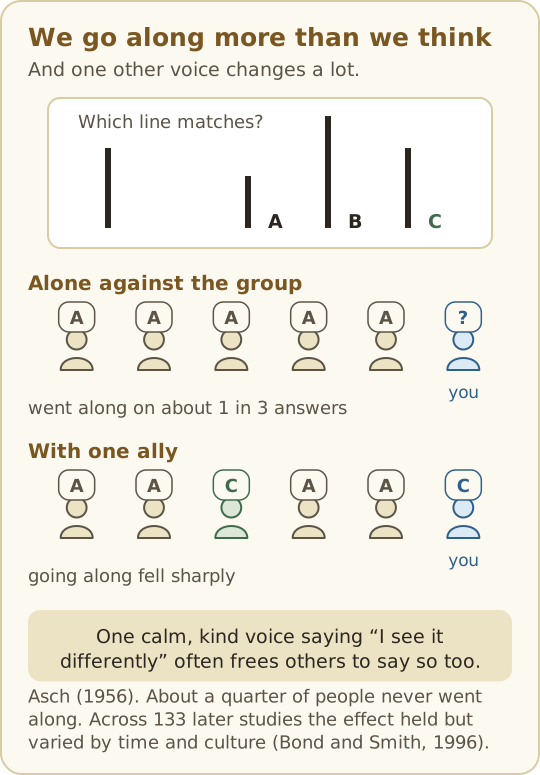
Figure 38 We go along more than we think, and one other voice changes a lot. In Asch’s studies, going along fell sharply when one other person gave the right answer. -
Authority can lead people a long way.
In Stanley Milgram’s experiments (Milgram, 1963), many ordinary people kept giving what they believed were painful electric shocks to a stranger, because a man in a lab coat told them to. (No shocks were real.) Burger (2009) repeated part of it safely and found similar results. But the studies are also debated: later researchers, such as Haslam and Reicher (2012), argue people went along when they believed in the cause, not blindly, and many people refused.
For example: A nurse is told by a senior doctor to give a dose that looks wrong. She checks, speaks up, and is right. Checking is not disloyalty.
Words you could use: “Before I do this, can I check one thing?” “I’m not comfortable with this. Can we look at it again?”
Try this: Think of one person whose word you tend to follow without question. Is there anything you’d want to check next time?
Dig deeper: Milgram and its critics -
“Us and them” forms fast.
Part of how we see ourselves comes from our groups: our family, town, team, faith or job. Tajfel and Turner (1979) called this social identity. It brings pride and loyalty. It also makes us quick to favour “us” and to see “them” as all the same, even when the groups are formed on almost nothing. Knowing that this happens is the first step to catching it.
For example: Two branches of a family always sit apart at weddings. Nobody quite remembers why. One year, a cousin swaps the seating plan, and the two sides discover they like the same terrible music.
Thoughts you could try: “Am I seeing a person, or a group?” “What do we have in common?”
Try this: Think of a “them” in your life. Name one person from that group as an individual: something they like, something they worry about.
Dig deeper: social identity -
Norms are the rules nobody wrote down.
Every group has norms: what you wear, how you speak, what you laugh at, what you never mention. We often guess the norms wrong. In studies at a university, Prentice and Miller (1993) found that most students were privately less comfortable with heavy drinking than they thought everyone else was. Each person thought they were the odd one out, so everyone kept going along.
For example: In an office, everyone answers emails at midnight because they think it’s expected. When one manager says, “I don’t expect replies after six,” relief spreads.
Thoughts you could try: “Is this really what everyone thinks, or just what everyone does?”
Try this: Pick one unwritten rule in a group you’re in. Ask one person, privately, what they really think of it.
Dig deeper: norms and wrong guessesFilled-in example House rules for us Shona and her son Dexter, 15 House rules for us
- Person A
- Shona
- Person B
- Dexter
- Date of this list
- 3 October 2026
Our rules, and who keeps each one
Rule Who keeps it Why it matters to Shona Why it matters to Dexter Phones charge in the kitchen from 10 on school nights Both (decide together) I sleep better knowing you’re not up at 2 Fine if it’s both our phones, not just mine Homework before games, Monday to Thursday Dexter Less nagging from me Weekends are mine, then Say where you’re going and when you’ll be back Both (decide together) So I don’t worry Mum does it too, so it’s fair Friday tea together, no phones at the table Both (decide together) It’s my favourite hour of the week Only if I can pick the food sometimes Does every job have an owner?
- Rules with someone who keeps them
- 4 of 4. Every rule has someone who keeps it.
Changes to the list
Date What changed Who 3 Oct 2026 Dexter asked for weekends without phone rules. Agreed for a month, then we look again. Shona and Dexter A made-up example. Names and details are invented. The norms nobody wrote down, written down, with room for both of them to change them.
Fill in your own: House rules for us (spreadloveandacceptance.com/
workpapers/ fill/ wp-03) -
Cultures differ, and so do people inside them.
Cultures differ in how much they put the individual or the group first. Researchers call this individualism and collectivism (Hofstede, 1980). In some, “standing out” is admired. In others, fitting in and keeping harmony are signs of maturity. Neither is better. But be careful with labels: a large review by Oyserman and colleagues (2002) found the differences were smaller and less tidy than often claimed, and individuals vary hugely within every culture.
For example: A woman raised in a close-knit family moves in with a partner who grew up encouraged to “do your own thing.” He sees her daily calls home as clingy; she sees his rare calls as cold. Both are following the rules they learned.
Words you could use: “Where I grew up, this was normal. What was normal for you?”
Try this: Name one thing you think of as simply “how people should behave.” Where did you learn it? Might someone else have learned the opposite?
Dig deeper: culture, with care -
Every family is a small culture.
Families have their own norms: how loud people are, how feelings are shown, who does what, what’s talked about and what isn’t, how you say sorry, or if you do. We often only notice our family’s rules when we live with someone from a different family. Part One looks at the rules you grew up with.
For example: Two housemates clash over the kitchen. In one’s family, you wash up straight away. In the other’s, you wash up in the morning. Neither is lazy or fussy; they grew up in different small cultures.
Words you could use: “In my family we always… What did yours do?” “Shall we make our own rule?”
Try this: Write three rules from the family you grew up in. Keep one you value, and question one you don’t.
Dig deeper: family culturesFilled-in example Kitchen-table check-in: family plan Amaka and Chris, new parents, with Chris’s parents Our family plan
A plan for the family, not a list of chores.
- Who’s in this plan (optional)
- Amaka, Chris, Nana Joy and Grandad Pete
- Visits
- Sunday lunch every other week, 12 to 3. Text the day before.
- Advice
- Ask first: “Do you want ideas, or just to talk?”
- The baby’s or children’s routines
- Nap at 1. Back to sleep on her back, always. Ask us before any new food.
- A regular job for a grandparent or relative
- Grandad Pete does the Tuesday morning walk with the pram.
- We’ll look at this again on
- The first Sunday of December
On the card
One topic at a time. We’re on the same side.
A made-up example. Names and details are invented. Two family cultures, one plan written on purpose.
Fill in your own: Kitchen-table check-in: family plan (spreadloveandacceptance.com/
check-ins) -
Online groups pull harder and faster.
Group chats, forums and social media make group pressure quicker and more public. Likes and replies show the norm instantly. In a study of over half a million posts, Brady and colleagues (2017) found that messages with more moral and emotional words spread further, mostly among people who already agreed. Outrage travels fast; quiet doubts don’t.
For example: A parents’ group chat turns against a teacher after one angry post. A dad who knows the teacher well sends a calm message: “I’d want to hear her side before we decide.” Two others agree.
Thoughts you could try: “Would I say this to their face?” “The loudest posts aren’t the whole group.”
Try this: Before you react to a heated post, wait ten minutes. Then decide whether to reply, reply privately, or not reply at all.
Dig deeper: groups online -
You can belong and still be yourself.
Belonging is being accepted as you are; fitting in is changing to be accepted (see Chapter 5). Good groups have room for difference. It helps to know your own values, to have more than one group, and to have at least one ally. In Asch’s experiments, when just one other person gave the right answer, going along with the group dropped sharply.
For example: A teenager loves chess but his friends tease it as “nerdy.” He joins a chess club as well as keeping his friends. With two groups, neither one can decide who he is.
Thoughts you could try: “Which groups let me be fully myself?” “Who would back me up if I spoke?”
Try this: Write down three things you value. Next time a group pulls you, check: is this in line with them?
Dig deeper: staying yourself -
Disagree kindly, and early.
You don’t have to choose between going along and starting a war. A kind dissent is short, calm, about the issue rather than the people, and leaves room for others. Speaking early is easier than speaking late. And you don’t have to do it in front of everyone: a private word often works better.
For example: Back to the group chat. Instead of a laughing face, you message your aunt privately: “I know it was meant as a joke, but it might hurt. Could we leave it?” She deletes it.
Words you could use: “I see it a bit differently. Can I say why?” “I’m not comfortable with that joke.” “I might be the only one, but I’d like us to think again.” “Can we hear from people who haven’t spoken yet?”
Try this: Choose one sentence from above that feels like you. Say it out loud a few times, so it’s ready when you need it.
Dig deeper: kind dissent
Thursday, 9:40pm
You delete the laughing face. Instead, you message your aunt, who posted the joke: “I know it was meant to be funny, but it might hurt if they see it. Could we leave it?” A few minutes later the joke disappears. Then your cousin messages you privately: “Thank you. I saw it before it went. Means a lot.” Nobody fell out. The group is still the group. It just has a bit more room in it now.
If you’re a teenager
Group chats are where a lot of friendship happens, and a lot of hurt. A made-up example: Rhys, 15, finds a photo of himself from PE being joked about in his class chat. He doesn’t answer back.
He screenshots it, mutes the chat and tells his sister, and they tell his form tutor. Then a girl in his class messages him privately: “That wasn’t funny. Sorry I didn’t say anything.” Most people in a group chat don’t like what’s happening. They just think everyone else does.
Words you could use: “I’m not okay with this. Please delete it.” To a friend: “That wasn’t okay. Are you alright?” To an adult: “Something’s happening online and I need help with it.”
Dig deeper: groups onlineIn everyday life
- On your own: Having no group can be as hard as having a pushy one. Look for groups built around something you enjoy, so the belonging comes with the activity. See Chapter 5 and casual ties.
- With a partner: Two families, two sets of rules. Talk about them openly, and make your own. See family scripts.
- Parents and children: Children and teens feel peer pressure strongly. Help them practise a “no” that saves face. See For teens: friends.
- With family: Old family roles (the joker, the peacekeeper, the black sheep) can be hard to step out of. See Old roles.
- At work: Teams where people feel safe to speak up make better decisions. See At work and the library on teams.
- Online: Mute, leave or take a break from groups that leave you feeling worse. You’re allowed.
- When everyone agrees too fast: That’s called groupthink. If you lead, share your view last and ask for one risk from each person before deciding. More in the full chapter.
- Teams rarely in one room: Write decisions down, go round everyone before deciding, and keep a short check-in so people at home aren’t forgotten. More in the full chapter.
Common mix-ups
- “Only weak people conform.” Everyone is influenced by groups. Knowing that makes you more free, not less.
- “Milgram proved people will do anything they’re told.” Many people refused, results varied a lot with the setup, and the studies have real critics. People seem most likely to go along when they believe in the cause.
- “Culture explains everything about a person.” Culture shapes us, but people vary hugely within every culture. Ask the person, don’t assume.
- “Disagreeing will ruin the relationship.” Calm, kind disagreement often builds trust. Swallowing it for years tends to do more harm.
- “Fitting in is the same as belonging.” Fitting in means changing to be accepted. Belonging means being accepted as you are.
If you want to help someone else with this
- Be the ally. If someone speaks up, back them up, even quietly: “I think that’s a fair point.” One ally makes a big difference.
- Make room. In any group you lead, invite quieter people and different views: “What haven’t we thought of?”
- Check in privately. If someone seems to be going along against their wishes, ask gently, away from the group.
- Watch for exclusion. Notice who is left out of chats, plans and jokes, and bring them in.
Words you could use: “I noticed you went quiet when they said that. Are you okay?” “I’d like to hear what you think, even if it’s different.”
When to get more help
Group pressure is part of life. It may be time for more help if:
- a group, family or partner controls who you see, what you wear, what you spend or what you believe, or punishes you for disagreeing;
- you feel you can’t leave a group without being threatened, shamed or cut off from everyone you know;
- you’re being bullied, at school, at work or online;
- being left out or pressured is leaving you very low, anxious or hopeless.
Talk to someone you trust, a counsellor or a doctor. Not safe at home? lists free, private help if someone at home controls or frightens you. For low mood or worry, see Chapter 16. If you are thinking about ending your life, please tell someone today.
In the US and Canada, call or text 988. In the UK and Ireland, call Samaritans free on 116 123. In Australia, call Lifeline on 13 11 14. In New Zealand, call or text 1737. Anywhere else, findahelpline.com lists free helplines.
This chapter is general education, not therapy.
Reading on this site
Reading pages to read on the site
- The wiring card: share how you work best, so a group can make room for you.
- Leading a group: a six-session guide with ground rules that make room for difference.
- The library on teams, including psychological safety.
- The library: family scripts, social comparison, the false consensus effect and confirmation bias.
- Chapter 4 on saying hard things so they land.
More for your situation
- For teens: friends and pressure
- Family rifts · In-laws
- At work
- For teachers
- More in Part Three: Belonging and trust · How we see each other · Values
- Help by relationship: find the pages for your situation.
Last updated: October 2026