Afterword
What the book adds up to
A short look back at the whole book: what each part was for, the few ideas that run through all of it, and where to go next. For anyone who has read some or all of it, in any kind of relationship, or on your own.
In short:
- Part One was about you: where your lens came from, how you work now, and where you want to go.
- Part Two was about sharing a life: seeing the work, sharing it fairly, and talking about it kindly.
- Part Three was about people: how feelings, stress, trust, change, loss, minds and groups work.
- The thread through all of it: notice before you judge, settle before you speak, say it plainly and kindly, take small steps, repair, and keep everyone safe.
You don’t need to have read every page to get something from this one. If you skipped around, that’s how most people read. The book was written so you could start anywhere, stop anywhere and pick it up again.
Three parts, one idea
Part One: Yourself looked at the lens you see through: what life taught you, how your mind and body work now, and what matters to you next. It came first because everything else depends on it. You can’t share a life well if you don’t know how you work.
Part Two: Between us looked at the quiet work of running a shared life, a home, a family, a team, and how to see it, share it fairly and talk about it without blame. Each chapter came with a worksheet, because ideas only help when they turn into something you do.
Part Three: Understanding people looked at how people work: feelings, stress, how we see each other, how we talk, why we need each other, how we change, our worth, loss, different minds, values, healing, helping, anger, personality, love, worry and low mood, and the pull of groups.
Underneath all three is one idea: most of what goes wrong between people is understandable, and much of it can be put right. Not by trying harder to be perfect, but by seeing more clearly and acting a little more kindly.
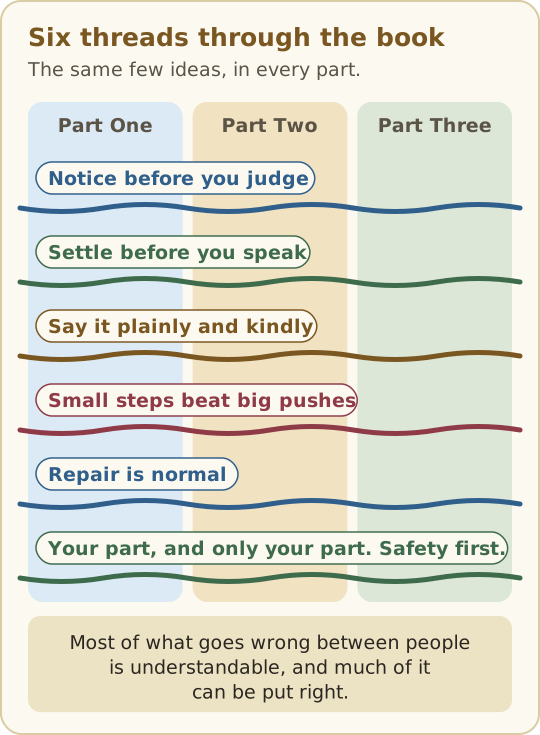
Six threads that run through the book
The book rests on five big ideas, set out at the front: see the whole load, fix the setup, not the person, read your state first, tune how you send and receive and notice the quiet incentives. The six threads below are the same ideas said as everyday habits, plus one rule that sits around all of them: safety first. The table after the list shows how they match.
-
Notice before you judge.
A sharp word, a forgotten job or a quiet evening usually has a reason: tiredness, a full stress tank, a different family rule, a different kind of mind. Asking “What might be going on?” before “What’s wrong with them?” changes most conversations. See Chapter 3.
-
Settle before you speak.
When the body is flooded, nobody listens well. Slow the breath, step away with a time to come back, then talk. See Chapter 2 and Chapter 13.
-
Say it plainly and kindly.
What happened, how it felt, what you’re asking for. Clear is kind, for everyone. See Chapter 4.
-
Small steps beat big pushes.
One job with one owner. One walk. One message. One step on the ladder. Change that lasts is usually small and repeated. See Chapter 6.
-
Repair is normal.
Everyone gets it wrong. What keeps relationships going is coming back: a short, real apology and a plan for next time. See Chapter 11.
-
Your part, and only your part. Safety first.
You can change what you do. You can’t make anyone else change, and you never have to accept being frightened, controlled or hurt. If that’s happening, getting safe comes before working it out. See Not safe at home?
How the six threads match the five big ideas
| Thread | Big idea |
|---|---|
| Notice before you judge | See the whole load; fix the setup, not the person |
| Settle before you speak | Read your state first |
| Say it plainly and kindly | Tune how you send and receive |
| Small steps beat big pushes | Fix the setup, not the person; notice the quiet incentives |
| Repair is normal | Tune how you send and receive |
| Your part, and only your part. Safety first. | Not one of the five: the frame around all of them |
Where to go from here
- On your own: The self path turns Part One into a few steps you can take at your own pace.
- With someone: The six-week program turns Part Two into one small step a week, for a home, a family or a team. Miss a week? Pick up anywhere.
- With a question: Ask Professor Puddles, the site’s private helper, about anything in the book.
- Want the evidence? The research behind this site lists every study the book draws on, in plain words, with how strong the evidence is.
- Read it again, differently: every chapter has a fuller version, and the contents lists them all.
- When it’s more than a book can help with: Help beyond this site lists counsellors, helplines and support groups.
Any day, any time
You close the book, or the tab. Nothing at home has changed yet. But maybe next time a sharp word lands, you’ll wonder what’s under it. Maybe you’ll breathe out before you answer. Maybe you’ll say the thing plainly, or say sorry sooner. That’s all this book was ever asking for: a little more understanding, a little more often. Thank you for reading.
This book is general education, not therapy. If you are struggling, please reach out: someone to talk to, free.
Last updated: October 2026