Afterword
What the book adds up to
In short:
- Part One was about you: where your lens came from, how you work now, and where you want to go.
- Part Two was about sharing a life: seeing the work, sharing it fairly, and talking about it kindly.
- Part Three was about people: how feelings, stress, trust, change, loss, minds and groups work.
- The thread through all of it: notice before you judge, settle before you speak, say it plainly and kindly, take small steps, repair, and keep everyone safe.
This is the fuller version of the afterword. It looks back at what each part of the book was for, the threads that run through all of it, how the book has handled evidence, and where you might go next.
Three parts, one idea
Part One: Yourself started with you, because the way we see others depends on the lens we see through. It looked back at where that lens came from (family rules, what life taught you, old hurts), at how you work now (your wiring, your weather, your words), and forward to what matters to you and the small steps that get you there. It can be read entirely on your own, and for many readers it is the whole book.
Part Two: Between us turned to the shared work of running a life with other people: the visible jobs and the invisible ones, the planning, remembering and worrying that someone always ends up carrying. It offered a way to see that work, give each job one owner, notice how full each person’s battery is, agree what fair means, and look back each month. Each chapter came with a worksheet, because understanding only helps when it turns into something you do together.
Part Three: Understanding people stepped back to ask how people work at all. It covered feelings and stress, how we see and talk to each other, belonging and trust, change, worth and shame, loss, minds that work differently, values, healing, helping, anger, personality, love, worry and low mood, and the pull of groups. Each chapter was written for any kind of relationship and for people on their own.
Underneath all three parts is one idea: most of what goes wrong between people is understandable, and much of it can be put right. Not by being perfect, and not by one person doing all the adjusting, but by seeing more clearly, settling before we speak, and acting a little more kindly, more often.
Six threads that run through the book
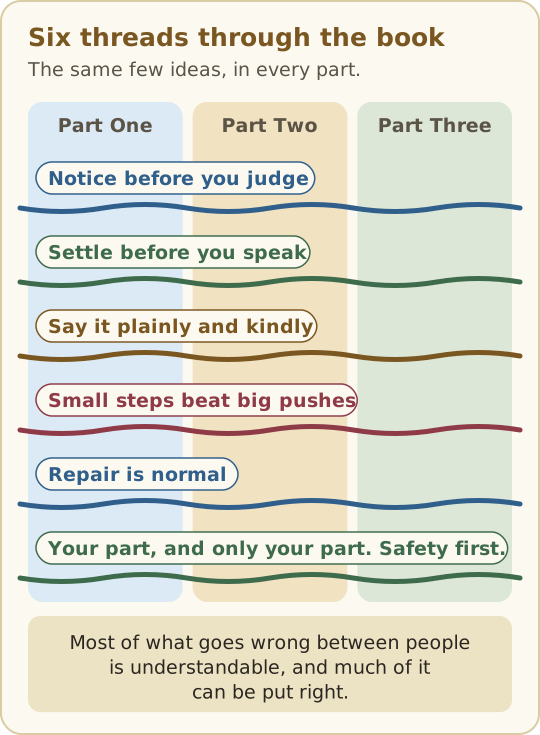
The book rests on five big ideas, set out at the front: see the whole load, fix the setup, not the person, read your state first, tune how you send and receive and notice the quiet incentives. The six threads below are the same ideas said as everyday habits, plus one rule that sits around all of them: safety first. The table after the list shows how they match.
1. Notice before you judge
Again and again, the book has found that behaviour has reasons: a full stress tank (Chapter 2), a different family script (Part One), a different kind of mind (Chapter 9), or simply the habit of judging ourselves by our reasons and others by their actions (Chapter 3). Noticing doesn’t excuse harm. It makes understanding possible.
2. Settle before you speak
A flooded body can’t listen. The hot minutes are for breathing out, stepping away and saying when you’ll come back (Chapter 13). Words come after.
3. Say it plainly and kindly
What happened, how it felt, what you’re asking for. Hints, sarcasm and silence are easy to misread. Clear is kind, and it helps every kind of mind (Chapter 4).
4. Small steps beat big pushes
Lasting change is usually small and repeated: one owner per job, one step up the ladder, three tiny things a day (Chapter 6, Chapter 16). No streaks, no guilt. Miss a day, start again.
5. Repair is normal
Every relationship has ruptures. What matters is coming back: naming what happened, without “but,” and saying what you’ll do differently (Chapter 11).
6. Your part, and only your part. Safety first.
Throughout the book, the advice has been about your part: what you can do, and what isn’t yours to carry. You can change how you act. You can’t make someone else change, and you never have to accept being frightened, controlled or hurt. When safety is at stake, getting safe comes before working it out. See Not safe at home?
How the six threads match the five big ideas
| Thread | Big idea |
|---|---|
| Notice before you judge | See the whole load; fix the setup, not the person |
| Settle before you speak | Read your state first |
| Say it plainly and kindly | Tune how you send and receive |
| Small steps beat big pushes | Fix the setup, not the person; notice the quiet incentives |
| Repair is normal | Tune how you send and receive |
| Your part, and only your part. Safety first. | Not one of the five: the frame around all of them |
How the book has used evidence
The book draws on a lot of research, and it has tried to be honest about it. Some findings are strong and well replicated: that calming the body helps with anger, that exercise and talking therapies help with depression, that social connection matters for health. Some are useful but debated, like the famous conformity and obedience experiments in Chapter 17. Some popular ideas have not held up well, and the book has said so where they come up. And some ideas are the site’s own ways of putting things into practice, marked This site’s idea, not established science.
Every study the book names is listed on The research behind this site, with what it found in plain words, how strong the evidence is, and a link to read more. If something in the book doesn’t match your experience, that matters too. Research describes patterns across many people. You are one person.
Why more than one lens
Many chapters looked at their ideas through more than one lens: what psychology has found, what philosophers from many traditions have said, and how things can look from an autistic point of view, with an ADHD point of view where it matters most. Psychology tells us what tends to happen. Philosophy asks what is worth wanting, and reminds us that people have thought hard about these questions for thousands of years. The autistic and ADHD lenses are a reminder that advice written for “most people” often needs adjusting, and that the adjustments usually help everyone.
What a book can’t do
A book can explain, suggest and encourage. It can’t see your situation, assess your safety, diagnose anything or replace care from someone who knows you. If you are struggling, if something has gone on for weeks, or if you or someone else is not safe, please reach out. Help beyond this site lists counsellors, helplines and support groups. If you are thinking about ending your life, please tell someone today. In the US and Canada, call or text 988. In the UK and Ireland, call Samaritans free on 116 123. In Australia, call Lifeline on 13 11 14. In New Zealand, call or text 1737. Anywhere else, findahelpline.com lists free helplines.
Where to go from here
- On your own: The self path turns Part One into a few steps at your own pace: your lens, your wiring, your battery and your words.
- With someone: The six-week program turns Part Two into one small step a week, for couples, families, housemates, co-parents or teams. Pick up anywhere.
- With a question: Ask Professor Puddles, the site’s private helper. Your conversation stays on your device.
- For the evidence: The research behind this site, in plain words.
- To read again: the contents, or the short version of this afterword.
Thank you for reading. We hope something in here made one conversation, one evening or one relationship a little easier.
Last updated: October 2026