Part Three · Chapter 6
Habits and change
In short:
- Change is hard for good reasons. Habits save effort, so the old way is always the easy way.
- Small and set up beats big and willpower. Make the first step tiny and change the setup around you.
- Slips are part of change. A missed day is information about the plan, not proof about you.
- Other people’s change is theirs. You can support it. You can’t force it.
Why the tools work: this chapter explains the thinking behind these tools from earlier in the book.
- One small step a week (the six-week program; Part One, Next) works because change that lasts starts smaller than feels useful, and an if-then plan does the deciding ahead of time.
- The setup score and One owner per job (Part Two, Chapter II; Part Two, Chapter IV) change the setup instead of asking for more willpower. Habits follow cues and easy paths. Big ideas: fix the setup, not the person and notice the quiet incentives.
- What keeps coming back? (Part Two, Chapter V) treats a repeat as information, not failure, because slips are a normal part of change.
Monday, 7:05am
The plan was a walk before work. The trainers are by the door. But the phone is in your hand, and somehow it’s 7:40 and you’re scrolling with cold coffee. By evening, a quiet voice says: “See? You never stick to anything.” That voice is wrong. You aren’t weak. You’ve met a habit.
Almost everyone has something they’d like to change: a habit, a reaction, a way of speaking to the people they love. And almost everyone has found that wanting to change is not the same as changing. This chapter explains why, drawing on what researchers have learned about habits and motivation, and then turns to what actually helps.
Each section looks at one idea through three lenses. Psychology tells us what researchers have found, and where findings are weaker than popular books suggest. Philosophy shows how thinkers have wrestled with habit, willpower and character for thousands of years. Through an autistic lens looks at change from the point of view of autistic people, for whom routines often matter deeply. Where it matters most, an ADHD lens does the same for people with ADHD. It is a perspective, not a diagnosis, and it sheds light on how everyone experiences change.
Ideas marked This site’s idea: are our own ways of putting things into practice, not established science.
Change is hard for good reasons
Our brains are built to save effort. Anything we do often in the same situation gradually becomes automatic, so we can do it without thinking and save our attention for something else. That’s a gift: imagine having to decide, every morning, how to brush your teeth. It’s also why change is hard. The old way is fast, easy and familiar. The new way is slow and takes effort, every time, until it isn’t new any more.
Psychology
Wendy Wood and colleagues (2002) asked people to keep diaries of what they did and thought throughout the day. Roughly four in ten everyday actions were done almost daily, in the same place, often while people were thinking about something else. Much of daily life, in other words, runs on habit. Neuroscientists such as Ann Graybiel have described how repeated actions get “chunked” in brain circuits so that a whole sequence can run from a single trigger.
Other forces protect the status quo too. William Samuelson and Richard Zeckhauser (1988) described a status quo bias: people tend to stick with the current option, even when a change would serve them better. Daniel Kahneman and Amos Tversky’s research on loss aversion suggests losses tend to feel bigger than equal gains, so what we’d give up by changing can loom larger than what we’d gain. None of this means change is impossible. It means difficulty is normal, not a sign of weak character.
Philosophy
Aristotle argued in the Nicomachean Ethics that character is built through habit: we become fair by doing fair things, and brave by doing brave things. Virtue, for him, was a settled disposition formed by practice, not a feeling or a one-off decision. (The popular line “We are what we repeatedly do” sums up his view well, but it was written by the historian Will Durant, not by Aristotle.) The hopeful side of his view is that if habits made us, new habits can remake us.
Through an autistic lens
Many autistic people rely on routines to make the world predictable and manageable. Routines reduce the number of decisions, lower uncertainty and save energy for everything else. From the outside, this is sometimes called “rigidity.” From the inside, it’s often regulation: a routine is a way of staying steady. Unexpected change can cost a great deal of energy and cause real distress. This lens is useful for everyone: change always costs something, and some people pay more. Respecting that cost, with warning, explanation and time to adjust, is not indulgence. It’s good sense.
Thoughts you could try: “This is hard because it’s a habit, not because I’m weak.” “Change costs me energy. I’ll plan for that.”
Habits run on cues
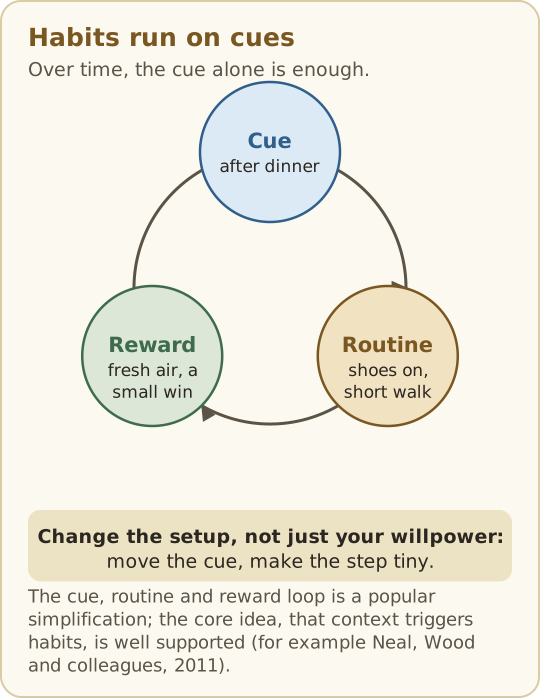
Most habits follow a simple pattern: a cue (a time, a place, a feeling, a person, or the action just before) sets off a routine, and some reward, often small and quick, keeps it going. Over time, the cue alone is enough. That’s why you can find yourself doing something before you’ve decided to.
Psychology
David Neal, Wendy Wood and colleagues (2011) gave people popcorn at a cinema, some of it fresh and some a week old. People who habitually ate popcorn at the cinema ate about as much of the stale popcorn as the fresh, while others ate less of the stale. In a meeting room, without the cinema cues, the habitual eaters ate less stale popcorn too. The setting was driving the behaviour more than the taste. Research like this suggests that habits are triggered by context, and that changing the context can loosen them.
The “cue, routine, reward” loop was popularised by the journalist Charles Duhigg. It’s a helpful simplification of a more complex research picture, but the core idea, that context triggers habits, is well supported. See Habits and cues.
Philosophy
The philosopher and psychologist William James wrote a famous chapter on “Habit” in his Principles of Psychology (1890). He called habit the great flywheel of society, keeping people in their grooves. His advice for building a new habit was to start with as strong a commitment as possible and never allow an exception until the habit was rooted. Modern research has softened that last point: missing once seems to matter less than he feared (see Slips). But his central insight holds: habits are the scaffolding of a life, so it is worth choosing them on purpose.
Through an autistic lens
Explicit cues can be very helpful: a visual schedule, a timer, an alarm with a label, a note on the door. Many autistic people describe deep, single-track focus (monotropism; see Chapter 9). Deep focus is a strength, and it can make switching from one task to another harder. Some also describe autistic inertia: difficulty starting, stopping or changing activity, even when they want to. A clear, gentle cue to leave the “tunnel,” with time to finish, often works better than a sudden demand. See Monotropism and Autistic inertia.
Thoughts you could try: “What happened just before I did that?” “What was it giving me: comfort, relief, a break?”
Start smaller than feels useful
When we decide to change, we often aim big: run every day, never shout, clear the whole house. Big goals feel inspiring, but they need a good day to do, and most days aren’t good days. Tiny steps are easy enough to do even when you’re tired. That’s what lets them repeat, and repetition is what builds a habit.
Psychology
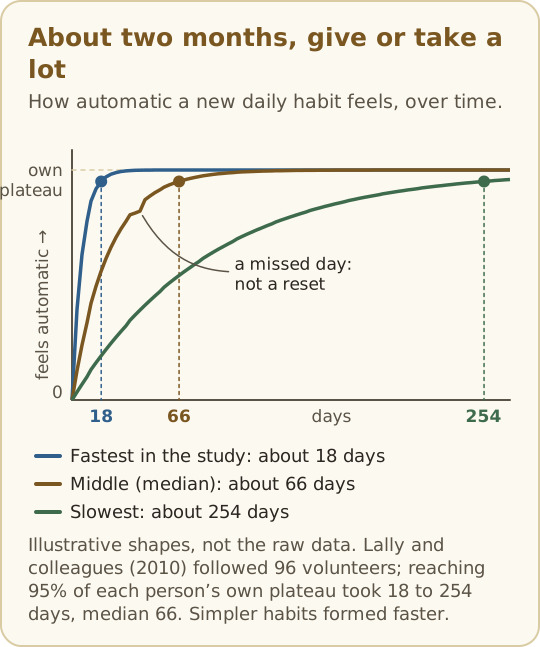
Phillippa Lally and colleagues (2010) followed people trying to build a new daily habit. On average it took about two months for the behaviour to feel automatic, with a very wide range from person to person, from a few weeks to most of a year. Simpler behaviours became automatic faster. Peter Gollwitzer’s research on implementation intentions (1999), plans in the form “When X happens, I will do Y,” found that people who made such plans were more likely to act on their goals. A review by Gollwitzer and Paschal Sheeran (2006) found the effect was reliable across many studies. See If-then plans.
The behaviour scientist B. J. Fogg popularised “tiny habits,” attaching a very small action to an existing routine. It fits well with the research above, though the tiny-habits method itself has been studied less formally.
Philosophy
The Tao Te Ching, traditionally attributed to Laozi, says that a tree you can barely reach around grows from a tiny shoot, and a journey of a thousand miles begins beneath your feet. Big things are made of small ones. The Japanese idea of kaizen, continuous small improvement, brought a similar idea into modern workplaces. Neither asks for heroic leaps. Both trust the steady accumulation of small steps.
Through an autistic lens
Many autistic people find vague goals (“be healthier,” “keep your room tidy”) hard to act on, because it isn’t clear what to actually do. Concrete, specific steps (“put the books on the shelf,” “drink one glass of water after brushing teeth”) are clearer for everyone. Changing one thing at a time also helps, because each change uses energy. For ADHD minds, which often run on interest and urgency, making a tiny step more interesting (music, a game, doing it with someone) can matter as much as making it small.
This site’s idea: The “tired-day version”: for any change, decide the smallest version you can still do on your worst day. One push-up. One sentence in the journal. One kind word. On hard days, the tired-day version counts in full.
Words you could use: “After I put the kettle on, I’ll...” “What’s the tired-day version of this?”
Your done list
Write down one small thing that went right, however small.
- A small win
- Went to the Thursday quiz with Rita and Joe
- Who it was with
- With a friend
This week: 4 small wins
Went to the Thursday quiz with Rita and Joe · Thu, Oct 8 · With a friend
Cleared one shelf in the spare room · Wed, Oct 7
Rang my brother back · Tue, Oct 6 · With family
Walked to the post office instead of driving · Mon, Oct 5
A made-up example. Names and details are invented. A done list is for encouragement, not proving who does more.
Fill in your own: Your done list (spreadloveandacceptance.com/
Change the setup, not just your willpower
We tend to believe change is a battle of willpower. But willpower is unreliable: it fades when we’re tired, hungry, stressed or unwell, which is exactly when old habits are strongest. Our surroundings, on the other hand, are there every day. Shaping them is one of the most effective things we can do.
Psychology
Roy Baumeister’s theory of “ego depletion” (1998) suggested that self-control works like a muscle that tires with use. It was very influential, but a large replication project led by Martin Hagger (2016), run across many labs, found an effect close to zero. The idea is now debated. Meanwhile, research by Wilhelm Hofmann and colleagues (2012) found that people who score high on self-control seem to report fewer temptations in daily life, perhaps because they set up their lives to avoid them, rather than resisting more often.
Richard Thaler and Cass Sunstein’s work on “nudges” (2008) showed how small changes in how choices are presented, such as which option is the default or which food is placed first, can shift behaviour. Wood’s habit research points the same way: add a little friction to the old habit (put it out of reach, add a step) and remove friction from the new one (put it in sight, get it ready).
Philosophy
In Homer’s Odyssey, Ulysses wants to hear the Sirens’ song without steering his ship onto the rocks. He doesn’t trust his willpower. Instead, he has his crew tie him to the mast and plug their own ears with wax. The philosopher Jon Elster (1979) used this story to explore precommitment: wise people sometimes bind their future selves, knowing their in-the-moment selves will be weak. That isn’t failure. It’s knowing yourself.
Through an autistic lens
The setup includes the sensory environment: light, noise, textures, smells, clutter. A habit that keeps failing might be failing because the space is overwhelming, not because the person isn’t trying. Lowering demands, reducing noise or changing lighting can make room for new habits. This fits a broader principle that runs through this site: fix the setup, not the person. It’s fairer, and it usually works better.
Through an ADHD lens
Plans that run on willpower and memory tend to fail first for people with ADHD, which is why changing the setup matters even more. What tends to help: make the cue impossible to miss (the bin bag hung on the door handle, an alarm with a label, not just a beep); do the step the moment the cue appears, before anything else catches your attention; make the reward come now, not next month (music while you clean, a tick on the fridge); and expect novelty to wear off, so swap the method every few weeks rather than blaming yourself. Doing a boring job alongside someone else, even on a video call, helps many people start. For lighter ways to use the book’s chore tools, see Chapter 9.
Words you could use: “What could we change about the setup so this gets easier?” “Let’s make the right thing the easy thing.”
Being in two minds is normal
Most of us are in two minds about our habits. We want to change, and we also don’t, because the old habit does something for us. Recognising both sides isn’t weakness. It’s honest. And it often unlocks change better than pushing harder against ourselves.
Psychology
William Miller and Stephen Rollnick developed motivational interviewing, a way of talking about change that treats mixed feelings (ambivalence) as normal. Rather than arguing for change, which tends to make people argue back, the helper draws out the person’s own reasons. It has good evidence for some areas, such as reducing drinking, and more mixed evidence for others. James Prochaska and Carlo DiClemente’s stages of change model (from the early 1980s) describes moving from not thinking about change, to considering it, to preparing, acting and maintaining. The model is widely used, but researchers have questioned whether people really move through neat stages. It’s best seen as a rough map. See Stages of change.
Edward Deci and Richard Ryan’s self-determination theory suggests that change lasts longer when people feel autonomy (it’s my choice), competence (I can do this) and relatedness (I’m connected to others). Pressure tends to undermine all three. See Self-determination theory.
Philosophy
Ancient Greek philosophers debated akrasia, or weakness of will: knowing what’s best and doing something else. In Plato’s Protagoras, Socrates argues that nobody knowingly chooses what’s worse, so apparent weakness must be a kind of ignorance. Aristotle disagreed, saying people really can know better and still act against it, swept along by desire. Augustine, in his Confessions, admitted praying, as a young man, to be made good, but not yet. Being in two minds is an old and deeply human experience.
Through an autistic lens
Many autistic people, and many non-autistic people, find that pressure to change triggers strong resistance or anxiety, even for changes they want. Some describe intense anxiety around demands. Offering choices, explaining the reason for a change, and letting the person shape it all help. Autonomy isn’t a nice extra here. It’s often the thing that makes change possible at all.
Thoughts you could try: “What does the old habit give me?” “What would make this change worth it to me?”
Slips are part of change
Almost no one changes in a straight line. People slip, restart, slip again and gradually slip less. The slip itself is rarely the problem. The thought that follows it often is: “I’ve ruined it, so I might as well give up.”
Psychology
In Lally’s habit study, missing a single day didn’t meaningfully set back progress. Alan Marlatt and Judith Gordon’s work on relapse prevention (1985) described the abstinence violation effect: after breaking a rule, people often feel guilt and a sense of total failure, which makes a full relapse more likely. Dieting researchers have described a similar “what-the-hell” effect: one biscuit becomes the whole packet because the day is “ruined.”
Kindness helps. Juliana Breines and Serena Chen (2012) found that people encouraged to think about a past mistake with self-compassion were more motivated to improve and to avoid repeating it than those encouraged simply to boost their self-esteem. Self-compassion isn’t letting yourself off the hook. It makes it easier to look honestly at what went wrong. See Self-compassion.
Philosophy
The Stoic philosopher Seneca described reviewing each day before sleep: what did I do well, where did I fall short, what will I do differently? He described doing it gently, more like a fair judge than a harsh one, pardoning himself this time and resolving to do better. Meditation traditions teach something similar: when your mind wanders, you notice and return to the breath without scolding. The return, not the wandering, is the practice.
Through an autistic lens
Many autistic adults describe autistic burnout, a period of deep exhaustion after long stretches of stress and masking, in which skills and routines that usually work can temporarily slip. Research led by Dora Raymaker (2020) helped describe it. In burnout, slipping isn’t failure. It’s a sign the system needs rest. A plan for change should include low-energy versions and permission to pause. All-or-nothing thinking also catches many people; planning in advance what “partly” looks like can help.
Thoughts you could try: “A slip is a moment, not a verdict.” “What made today harder? What can I plan for next time?”
Change that fits who you want to be
Changes made only because someone else wants them, or out of shame, tend to be fragile. Changes that connect to what we care about, and to the kind of person we want to be, have deeper roots. Each small action becomes a piece of evidence: “I’m someone who does this.”
Psychology
Daryl Bem’s self-perception theory (1972) suggested that we partly learn who we are by watching what we do, much as we would learn about someone else. Do something a few times, and you start to see yourself as that kind of person. Christopher Bryan and colleagues (2011) found that asking people about “being a voter” rather than “voting” increased turnout in their studies, though later attempts to repeat it had mixed results. Acceptance and Commitment Therapy, developed by Steven Hayes and colleagues, puts values at the centre: choosing actions that move towards what matters to you, even when they’re uncomfortable. See Values.
Philosophy
Jean-Paul Sartre argued that “existence precedes essence”: we aren’t born with a fixed nature but make ourselves through our choices. That can feel daunting, and freeing. The Confucian philosopher Xunzi compared self-cultivation to straightening wood with steam and a frame: our raw nature is shaped by practice, ritual and learning. Both views agree: who you are is not fixed. You are, in part, what you keep choosing.
Through an autistic lens
Change should never mean trying to become less yourself. For many autistic people, the most meaningful change is the reverse: unmasking, letting themselves stim, saying no to draining social events, and building a life that fits their mind. That is real change too. A good test for any change is: does this help me live more as myself, or does it ask me to hide? Changes that fit who you are tend to last. Changes that require constant pretending tend to cost too much.
Thoughts you could try: “This matters to me because...” “Does this change help me be more myself, or less?”
Supporting change in others
Many of us want other people to change: a partner who’s always late, a parent who drinks too much, a teenager glued to a screen, a colleague who never replies. It is natural, and often well meant. But other people’s change belongs to them. We can influence it, support it and ask for what we need. We can’t make it happen.
Psychology
Research on “social control” in relationships, such as by Megan Lewis and Karen Rook (1999), found that when partners try to control each other’s health habits, it can sometimes lead to change, but it often comes with resentment and distress. Niall Bolger and colleagues (2000) found that support was sometimes most helpful when the person receiving it hardly noticed it, perhaps because it didn’t make them feel less capable. Stephen Drigotas and colleagues (1999) described the Michelangelo phenomenon: partners who see and affirm the best in each other help each other grow towards their ideal selves. See The Michelangelo effect.
In couples research, Andrew Christensen and Neil Jacobson developed acceptance-based approaches, finding that when partners stop fighting every difference and accept some as part of who the other person is, some change often follows more easily. See Acceptance and change.
Philosophy
The Stoic teacher Epictetus began his handbook by dividing the world into what is up to us (our own judgements, choices and actions) and what is not (other people’s choices, among many other things). Peace, he said, comes from focusing on the first. That doesn’t mean not caring about others. It means putting your effort where it can actually work: in what you say, what you ask for, and what you do. See What’s up to us.
Through an autistic lens
Autistic people often experience change imposed by others: a new office layout, a changed plan, a different teacher, a rearranged kitchen. Those changes can be hard, not because of stubbornness, but because the predictability that helped them cope has been taken away. Giving advance notice, explaining why, involving the person in the decision and allowing time to adjust makes a big difference. In shared homes and workplaces, this is good practice for everyone.
This site’s idea: “Ask, offer, notice”: ask what would help, offer one concrete thing, and notice small steps out loud. It’s a simple way to support without taking over.
Words you could use: “I can’t change this for you, but I’d love to help if you want me to.” “I noticed you did that this week. Thank you.”
Putting it together
Change is hard because habits are efficient, the old way is easy, and losses loom large. Habits run on cues, so understanding your cues lets you plan for them. Small steps beat big leaps because they’re repeatable. Shaping your setup works better than relying on willpower. Mixed feelings are normal, and listening to them helps. Slips are part of the path, and kindness helps you restart. Change lasts longer when it connects to who you want to be. And other people’s change belongs to them, though you can support it.
A simple plan that brings it together:
- Pick one change that matters to you.
- Find the cue: when, where, after what.
- Make it tiny: “After I ___, I will ___.”
- Tweak the setup to make it easier.
- Plan the tired-day version and the kind sentence for slips.
- Connect it to a value: “because I care about...”
- Look back after a few weeks, kindly, and adjust.
The book’s Part One chapter Know yourself, next and the self path turn this into worksheets.
Worked examples
On your own: the morning walk
Back to the scrolling morning. Instead of “walk 30 minutes before work,” the plan becomes: “After I put the kettle on, I put my trainers on.” The phone charges in the hall overnight. The tired-day version is a walk to the end of the street. After two weeks, the walk is usually 20 minutes. On bad days it’s the end of the street, and that counts.
Partners: the evening phones
Nesrin wants her partner to spend less time on his phone in the evenings. Nagging hasn’t worked. She asks instead: “I miss talking in the evenings. Could we try something together?” They agree on a basket for both phones from nine, one evening a week to start. She notices out loud when it works. It’s a shared change, not a demand. See Gaming, phones and time together.
Parent and child: the bedtime routine
A family with an autistic seven-year-old needs a new bedtime after a move. They make a picture chart of each step, give a ten-minute warning before bath time, and keep the same order every night. The change is explained in advance, and the child picks which pyjamas go on the chart. Within two weeks, bedtime is calmer. See Neurodivergent relationships.
Coworkers: the meeting habit
A team keeps forgetting who agreed to do what. Instead of “be more organised,” they add one tiny habit: the last two minutes of every meeting are “who does what by when,” written in the shared notes. It’s a setup change, not a personality change, and it works. See At work.
Friends: moving more together
Two friends both want to exercise more and both keep cancelling the gym. They swap to a Saturday walk with coffee at the end. The friendship is the reward. Six months later, it’s the most reliable part of their week.
Housemates: the washing-up
Four students argue about dishes. They try a rota, which fails. Then they try a setup change: each person gets one plate, one bowl, one mug, and the rest go in a cupboard. The pile disappears. Nobody had to become a different person.
Big life change: a new baby
After their baby arrives, a couple’s old routines collapse. Instead of mourning them, they treat it as a fresh start: one tiny ritual each (a two-minute check-in at the evening feed, a walk with the pram on Sundays). Researchers have noticed that fresh starts, like new years, birthdays and big changes, can be good moments to begin new habits. See New parents.
Exercises
- Map a habit. For three days, note the cue, routine and reward each time a habit you’d like to change happens.
- Shrink it. Take a change you want and shrink it until it takes two minutes. Write it as “After I ___, I will ___.”
- One setup change. Change one thing in your surroundings today to make the new habit easier or the old one harder.
- Two lists. Write “What I like about how things are” and “What I’d like about changing.” Read both kindly.
- Plan for slips. Write the kind sentence you’ll say to yourself after a slip, and the one small step you’ll take to restart.
- The tired-day version. For your change, decide the smallest version you’ll do on your worst day. (This site’s idea)
- Ask, offer, notice. If you’re hoping someone else will change, try one week of asking what would help, offering one concrete thing, and noticing small steps out loud.
When it goes wrong, and when it goes right
When it goes wrong, someone sets a big goal on a hopeful Sunday. It needs a perfect day, so it slips on Wednesday. The slip feels like proof of weakness, so they give up until the next fresh start. If others are involved, there’s nagging, resentment and digging in. Nothing in the setup changed, so nothing much else does.
When it goes right, someone picks one small change tied to something they care about. They plan for the cue, adjust the setup and decide on a tired-day version. When they slip, they say something kind and start again the next day. The people around them notice small steps and help with the setup. Months later, the change isn’t something they do. It’s part of how they live.
Helping someone else change
If you want to support someone through a change, the research and traditions above point the same way. Start by asking rather than advising: “Would ideas help, or would you rather think out loud?” Help them find their own reasons, because change built on someone else’s reasons rarely lasts. Offer practical help with the setup, such as a lift, a shared calendar, a quieter evening or fewer snacks in the house, which often does more than encouragement. Notice small steps out loud and say little about the gaps. When they slip, respond the way you’d hope someone would respond to you: “That’s okay. Tomorrow’s another go.” And look after yourself. Caring about someone’s change doesn’t mean carrying it, and you can set limits on what you’ll live with while still being kind.
Words you could use: “I’m on your side with this. What would help?” “You’ve done this three days running. That’s not nothing.”
Questions people often ask
How long does it really take to form a habit?
There’s no single answer. In Lally’s study the average was around two months, with a huge range. Simpler habits form faster. The “21 days” figure often quoted doesn’t come from habit research.
Is willpower a myth?
Not exactly, but it’s less reliable than we think, and the idea that it runs out like fuel is now debated. Shaping your setup tends to work better than relying on willpower.
What if I’ve tried to change many times and always failed?
That’s very common, and it doesn’t mean you can’t change. It may mean the plan was too big, the setup didn’t change, or there’s something underneath, like stress, exhaustion or a health issue, that needs attention first. For habits that feel out of control, professional help can make a real difference.
How do I get my partner (or parent, or child) to change?
You can’t make them, but you can say clearly what you need, ask what would help, make changes together, and notice their small steps. If a behaviour is harmful to you, you can also decide what you’ll do if it doesn’t change. Saying calmly what you will do is a boundary, not a threat. If the behaviour is frightening or controlling, see Not safe at home?
I’m autistic and change is very hard for me. Is something wrong with me?
No. Many autistic people find change costly, because routines help them stay regulated. You can still change things that matter to you, often more easily with warning, clear steps, one change at a time, and support. And you don’t have to change things that are working for you just because others do them differently.
Should I tell people about my goal?
It depends. Telling a supportive person who’ll encourage you can help. Telling people who’ll nag or judge may not. Choose who you tell, and what you’d like from them.
Limits, safety and more help
- This chapter is general education about how habits and change tend to work. It isn’t treatment for addiction, eating difficulties, or mental health conditions.
- Some popular ideas about habits are stronger in books than in research. We’ve tried to say where findings are mixed or debated.
- If a habit is harming your health, such as drinking, drugs, gambling, disordered eating or self-harm, please talk to a doctor or specialist service. If you are in danger now, contact emergency services or see Upset right now.
- If someone is pressuring you to change through fear, threats or punishment, that is not support. Not safe at home? lists free, private help.
- If change feels impossible because you’re exhausted or low most days, a doctor or counsellor can help you look at what’s underneath.
The library’s motivation and habits page has more on each idea.
Last updated: October 2026