Part Three · Chapter 1
How feelings work: signals, the body, and naming what you feel
What feelings are for, where they start, and why putting a name to one can make it easier to carry. For anyone: on your own, at home, with friends, at work or out in the world.
In short:
- A feeling is a signal, not a verdict. It says “something here matters to me.” It doesn’t say what to do.
- Feelings start in the body. A tight chest or a hot face often comes before the word for it.
- Naming helps. “I feel let down” is easier to hold than a big, nameless rush.
- Feeling it isn’t doing it. You can let a feeling be there and still choose what you do next.
Why the tools work: this chapter explains the thinking behind these tools from earlier in the book.
- My weather today and the daily check-in (Part One, Now; Part Two, Chapter I) ask for one word about how you are. Naming a feeling turns its volume down a little, and a daily word catches feelings while they are still small. Big idea: read your state first.
- Say it so it lands (Part Two, Chapter IV) asks for a feeling, not a verdict. “I felt let down” is easier to hear than “you never care.” Big idea: tune how you send and receive.
Thursday, 4:50pm
A message from your manager: “Got a minute tomorrow?” Your stomach drops. By the time you get home you have snapped at the cat, skipped dinner and replayed every mistake from the last month. Nobody has said anything bad. Your body heard “trouble” before you had a single clear thought.
This part of the book is about how people work: you, and everyone around you. We start with feelings, because they are under almost everything else. How we talk, how we see each other and how we handle stress all run through them. This chapter teaches how feelings work first. What to do with them comes second.
-
A feeling is a signal, not a verdict.
Feelings are fast messages about what matters to you. Fear says “something might be a danger.” Anger says “something seems unfair, or in my way.” Sadness says “I lost something that mattered.” A signal is worth listening to. But it can be wrong about the details, the way a smoke alarm can go off for burnt toast.
For example: You feel jealous when a friend makes a new close friend. The jealousy isn’t proof that you’re a bad person, or that your friend is leaving. It is a signal that the friendship matters to you.
Thoughts you could try: “This feeling is telling me something matters. What is it?” “Is this the fire, or the toast?”
Try this: Next time a strong feeling arrives, finish this sentence: “This feeling is trying to protect…”
Dig deeper: what feelings are for -
Feelings start in the body.
Often your body reacts before your mind has a word: a racing heart, a hot face, a heavy chest, a knot in the stomach. Your brain then tries to make sense of it. That’s why being hungry, tired or in pain can feel a lot like being upset. The body is sending a strong signal, and the mind guesses what it means.
For example: A teenager comes home “furious” at their parent over nothing much. After a sandwich and a sit-down, the fury is mostly gone. Some of it was hunger wearing anger’s coat.
Thoughts you could try: “Where is this in my body?” “Am I hungry, tired, cold or sore right now?”
Try this: Three times today, pause and ask: “What does my body feel like right now?” Just notice. No need to change anything.
Dig deeper: the body and the brain’s best guess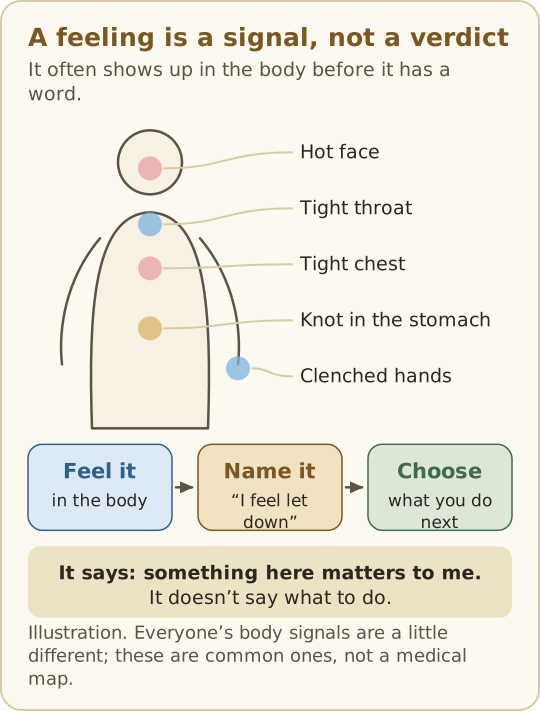
Figure 19 A feeling is a signal, not a verdict. It often shows up in the body first; naming it helps you choose what to do next. Filled-in example My weather today Esme, 29, at 4:50pm, after “Got a minute tomorrow?” from her manager Check today’s weather
The sky
- Clear: Calm and connected
- Chosen: Gusty: Revved up
- Fogged in: Running on empty
Who you’ll mostly be around today
- A partner
- Family
- A co-parent
- Roommates
- Chosen: Coworkers
- Someone I care for
- Friends
- Mostly on my own
The pressure
- Light
- Chosen: Building
- Heavy
Ground conditions
- Chosen: Haven’t eaten in a while
- Thirsty
- In pain or unwell
- Been still all day
- Too much noise or light
- Chosen: Running on caffeine
- Screens since I woke up
Last night’s sleep
- Barely slept
- Short night
- Chosen: About enough
- Properly rested
People load
- Barely any
- Chosen: A normal amount
- A lot
- Nonstop, no gaps
What’s blowing in
- Work
- Money
- Kids or caring
- Health
- Family
- The house
- Chosen: One conversation
- Something I can’t name
What would actually help in the next hour?
- Space
- Food or water
- Rest
- To move
- Chosen: To be heard
- Chosen: A plan
- Company
- Quiet
- Someone to take something off me
Your forecast
- Gusty today
- Revved up · Some room today
- Talk window
- wait about 20 minutes
It’s gusty. You’re revved up. That energy is useful for doing something physical, but it is poor weather for deciding anything about another person.
The ground underneath: you haven’t eaten in a while and you’re running on caffeine. That isn’t a side note. It’s likely a big part of why today feels the way it does, and it’s easier to change than character is.
Blowing in: one conversation. Weather from one front tends to land on whoever is nearest, often someone who had nothing to do with it. Worth saying out loud before it does.
You said what would help is a plan and to be heard. Arrange that before anything else.
If you want to send someone a line: “I don’t need it solved. I just need you to hear this for a few minutes first.”
A made-up example. Names and details are invented. Esme ate something, then rang her sister to be heard. She didn’t reply to the message until the morning.
Fill in your own: My weather today (spreadloveandacceptance.com/
quick-checks) -
Naming a feeling helps you hold it.
Putting a feeling into words can turn its volume down a little. In brain-scan research by Lieberman and colleagues (2007), simply putting a name to a feeling (“I feel scared”) turned down the brain’s alarm response. A name gives a big, cloudy rush some edges, so you can see it, talk about it and decide what to do.
For example: Two housemates are tense all evening. One finally says, “I think I’m embarrassed about the noise complaint, and I’ve been acting cross.” The other relaxes. Now they know what’s in the room.
Words you could use: “I think what I’m feeling is…” “I’m not sure what this is yet. Maybe worried?”
Try this: Once a day, name one feeling out loud or on paper. A guess is fine. “Something like sad” still counts.
Dig deeper: why naming works -
More words, better tools.
“Bad” is a very blunt word. “Disappointed,” “left out,” “overwhelmed” and “ashamed” each point to something different, and each needs something different. A review by Kashdan, Barrett and McKnight (2015) found that people who can tell their feelings apart more finely tend to cope with them in healthier ways. You don’t need fancy words. You can use numbers, colours or body words too.
For example: A dad tells his partner, “I feel bad about my mum.” They talk in circles. Then he says, “Actually, I feel guilty that I haven’t visited, and scared she’s getting worse.” Now the talk has somewhere to go.
Words you could use: “On a scale of one to ten, I’m about a six.” “It’s less angry and more… let down.” “It feels heavy, like a grey day.”
Try this: When you notice “bad,” try for one more exact word. When you notice “fine,” try for one more honest one.
Dig deeper: finer words, finer tools -
Feelings come in layers.
The feeling you show first isn’t always the first one you felt. Anger is often a cover for hurt or fear, because anger feels stronger and safer. And we often have feelings about our feelings: ashamed of being sad, scared of being angry. That second layer can hurt more than the first.
For example: A grandmother is short with her daughter after the grandkids’ visit is cancelled. Under the shortness is hurt. Under the hurt is a fear: “Am I still needed?”
Thoughts you could try: “What might be under this one?” “It’s okay to feel this. I don’t also have to feel bad for feeling it.”
Try this: Next time you feel angry, ask gently: “Is there hurt or worry underneath?” You don’t have to say it. Just look.
Dig deeper: first feelings and feelings about feelings -
Feelings rise and pass like waves.
Most feelings, even big ones, rise, peak and settle if you don’t keep feeding them. Moods are different. They are like weather (in plain words: a background feeling that lasts hours or days) that colours everything, often without you noticing. A grey mood can make a small thing feel huge, and a good mood can make the same thing feel like nothing.
For example: A woman living alone has a bad morning and decides “my whole life is going nowhere.” By evening, after a walk and a call with her sister, the same life looks ordinary and okay. The facts didn’t change. Her weather did.
Thoughts you could try: “This is a wave. It will peak and pass.” “Is this a feeling about now, or a mood colouring everything?”
Try this: Don’t make big decisions at the top of a wave. Write the decision down, and look at it again tomorrow.
Dig deeper: waves and weather -
Feelings spread between people.
We pick up each other’s feelings, often without noticing: a tense voice, a sigh, a slammed door. That’s part of how people bond. It also means stress can move round a home or a team like a cold. You can care about someone’s feeling without catching all of it.
For example: A team leader comes into a meeting rushed and anxious. Within ten minutes the whole team feels behind. The next week, she takes two slow breaths at the door first. The meeting feels different.
Thoughts you could try: “Is this feeling mine, or did I pick it up?” “I can stay beside their storm without standing in the middle of it.”
Try this: Notice who you tend to “catch” feelings from. Before your next talk with them, settle yourself for one minute first.
Dig deeper: how feelings spread -
If you weren’t brought up to talk about feelings.
Many people grew up in homes, generations or cultures where feelings were kept private: “Don’t make a fuss,” “Big boys don’t cry,” “We don’t talk about that.” This is common for men and for older people, and in some cultures it is a sign of respect and strength.
It isn’t a flaw. And it doesn’t mean you don’t feel. Many people who rarely say a feeling show it every day by doing: fixing the tap, driving someone to hospital, turning up. Caring by doing is real caring. Words can be added slowly, at your own pace, a few at a time.
For example: A retired builder whose wife has died has never talked about feelings in his life. At his grandson’s football match, he finally says to his son, “I wasn’t brought up to say this, but I miss her. Every morning.” His son puts a hand on his shoulder. Nothing else needs to be said.
Words you could use: “I wasn’t brought up to say this, but I miss her.” “I’m not good with words for this. It’s been a hard week.” “I don’t know what to call it. I just feel heavy.” “I’m not one for talking, but I wanted you to know I’m proud of you.”
Try this: Pick one sentence above and say it once this week, to one person, or even just out loud on your own. Short is fine. A text counts. So does writing it down.
Dig deeper: when feelings weren’t talked about -
Feeling it isn’t the same as doing it.
A feeling usually comes with an urge: to shout, run, hide, check, fix or text. The feeling isn’t a choice. What you do with the urge is more of one. Pushing a feeling down tends to make it come back stronger, and acting on every urge can hurt people. The middle path is: let the feeling be there, and choose the action.
For example: A father feels a hot rush of anger when his son breaks a window with a ball. He says, “I’m too cross to talk right now. Let’s sort this out in ten minutes.” The anger was real. The shouting didn’t happen.
Words you could use: “I’m feeling a lot right now. I’m going to take a minute before I answer.” “I want to reply when I’m calmer.”
Try this: Pick one urge you often act on too fast, like sending a sharp text. Make a rule: wait ten minutes first.
Dig deeper: feelings, urges and choices
Friday, 9:05am
You notice the knot in your stomach again. This time you name it: “I’m scared I’m in trouble.” You remember it’s a signal, not a verdict, and you ask your manager straight away: “Is today’s chat about something I should worry about?” “Oh no, it’s about the summer rota.” The knot loosens. The feeling was real. The story it told was not.
In everyday life
- On your own: No one else is there to notice for you, so a daily one-word check-in with yourself matters more. See On my own.
- With a partner: “What are you feeling?” can sound like a test. “Do you want to tell me, or shall I just sit with you?” is easier to answer.
- With friends: A friend going quiet may be feeling low, not cross with you. See Friends.
- Parents and children: Children learn feeling words from us. Naming your own (“I’m frustrated, so I’m taking a breath”) teaches more than any lesson. See For parents.
- At work: Feelings don’t stay at home. A short “I’m a bit flat today, not upset with anyone” can stop a team guessing. See At work.
- If you show love by doing: Fixing, driving, cooking and turning up are love. If someone close shows care that way, you can thank them for it in words: “I noticed you cleared the drive. Thank you.”
- With strangers: The rude person in the queue may be scared, in pain or grieving. You can’t know. You can choose not to catch it.
Common mix-ups
- “Some feelings are bad.” Feelings aren’t good or bad. Some are painful, and some actions are harmful. The feeling itself is information.
- “If I feel it, it must be true.” Feeling stupid doesn’t make you stupid. A feeling is a signal to check, not a fact.
- “Letting it out always helps.” Shouting or hitting a pillow tends to keep anger going. Naming it, moving, or talking it through calmly helps more.
- “Calm people don’t feel much.” Many calm people feel a lot. They have just practised letting feelings be there without acting on every one.
- “I should be able to name it straight away.” Many people find feelings hard to name, and some find it very hard. That’s a difference, not a failing. Body words, numbers and colours count.
- “Their face tells me what they feel.” Faces are a poor guide. People show the same feeling in different ways. Asking is kinder and more accurate than guessing.
If you want to help someone else with this
- Ask, don’t assign. “You’re angry” can feel like a label. “You seem upset. Am I reading that right?” leaves room for them to correct you.
- Make the feeling make sense. “Of course you’re upset, that was a lot” helps more than advice. You can make sense of a feeling without agreeing with every action.
- Offer choices. “Do you want ideas, or just someone to listen?” Many people only want the second.
- Accept other ways of saying it. Some people find words hard. A number, a text, a drawing or “I’m at a seven” is a real answer.
- Don’t make their feeling about you. If their sadness makes you anxious, settle yourself first, so they don’t have to look after your feelings too.
Words you could use: “That sounds really hard.” “Do you want to talk, or would company help more?” “You don’t have to find the right word. A number is fine.”
When to get more help
Everyone has hard days and big feelings. It may be time to talk to a doctor, a counsellor or another trained professional if:
- a low, numb, anxious or angry feeling stays most days for two weeks or more;
- feelings are stopping you from sleeping, eating, working or seeing people;
- you are using alcohol, drugs or other things to stop feeling;
- you feel you can’t cope, or have thoughts of harming yourself. If that’s happening now, contact your local emergency number or a crisis line straight away. You deserve help today.
If you feel afraid of someone you live with or are close to, that fear is an important signal. It is not something to “manage” on your own. Not safe at home? lists free, private help.
This chapter is general education, not a diagnosis or therapy. It can’t know your situation.
Workpapers, tools and reading on this site
Workpapers pages you fill in, on your own or together
- The Calm-Down Kit: a plan, made on a calm day, for heated moments.
Tools helpers you use on the site
- My weather today: a short, private daily check of your mood and state.
- Upset right now?: steps for when a feeling is very big, very fast.
Reading pages to read on the site
- Know your own wiring: how you tend to feel and react, and why.
- The library: what emotions are, naming feelings, emotional granularity, when feelings are hard to name, emotional contagion and sensing your body.
More for your situation
- Next in Part Three: Stress and the nervous system
- Part One, Now: your wiring, your weather and your words
- Wired differently and Neurodivergent relationships
- For teens: when feelings get loud
- For caregivers: resentment and guilt
- Grief and later life
- Help by relationship: find the pages for your situation.
Last updated: October 2026