Part Three · Chapter 13
Anger: what it’s for and what to do with it
What anger is for, what to do in the hot minutes, how to repair afterwards, and how to tell when anger has turned into harm. For anyone, in any kind of relationship, or on your own.
In short:
- Anger is a signal that something seems unfair, blocked or threatening. The feeling is allowed. What you do with it is the part you choose.
- The first minutes are about the body. Slow down, breathe out long, and step away with a time to come back.
- Letting rip doesn’t empty anger. Shouting tends to feed it. Calming the body, then putting it into words and repairing any sharp moments, helps more.
- Anger that frightens, controls or hurts someone has become harm. That needs more help, and safety comes first.
Why the tools work: this chapter explains the thinking behind these tools from earlier in the book.
- The Calm-Down Kit (Part One, Now) works because anger rises in the body first. Slowing the body is what makes the words possible. Big idea: read your state first.
- “Let a comment land before you react” and “Notice, name, decide” (Part Two, Chapter IV) are the step back this chapter describes: look from the outside, then choose.
Tuesday, 6:10pm
Your brother texts: “Can’t take Mum to the hospital on Thursday after all. Sorry!!” It’s the third time this month. Your jaw sets and your thumbs start typing fast: “TYPICAL. You never…” Your heart is pounding, your face is hot, and the message is nearly sent.
Many of us were taught anger was rude or dangerous, or grew up around anger that was frightening. But anger itself is a normal human feeling, and it often points at something real. This chapter explains how anger works first, and what to do with it second.
-
Anger is a signal about something that matters.
Anger usually says “That’s not fair,” “You’re in my way” or “Someone crossed a line.” It pushes us towards a problem, to change it. It can also land on the wrong person, or be far bigger than the problem.
For example: A woman keeps finding her lunch gone from the office fridge. Her anger tells her a line has been crossed, and gets her to raise it.
Thoughts you could try: “What is this anger trying to protect?” “Is this about fairness, a blocked plan, or feeling unsafe?”
Try this: Next time you feel angry, finish this sentence privately: “I’m angry because something I care about, which is ___, seems ___.”
Dig deeper: what anger is for -
Anger often guards a softer feeling.
Anger can arrive first because it feels stronger and safer than what sits under it: hurt, fear, shame, worry or plain tiredness. In Chapter 1 we called this layers. Finding the layer underneath often shows what you actually need.
For example: A man snaps at his teenage daughter for coming home an hour late. Under the anger is a cold hour of fear: “What if something happened?” When he says that part, she hears it, and apologises.
Words you could use: “I’m angry, and I think underneath I was really scared.” “I came across cross. I think I’m actually hurt.”
Try this: After the next angry moment, when you’re calm, ask: “Was there hurt, fear or tiredness under it?”
Dig deeper: what anger can cover -
Anger rises in the body fast.
A hot face, a tight jaw, a pounding heart, a louder voice, fists or shoulders tensing. This is the body getting ready for a fight, and it can happen in seconds. When anger is high, careful thinking and listening get much harder. Chapter 2 calls this being flooded: so stirred up that the thinking part of you goes quiet for a while.
For example: Arguing about the bins, a woman notices her hands shaking and realises she can’t hear a word her housemate says. That’s her sign to stop.
Thoughts you could try: “My body is ready for a fight. That doesn’t mean I have to have one.” “Where is this in my body?”
Try this: Learn your own early signs. Write down two or three, like “jaw tight” or “talking faster.” They are your cue to slow down.
Dig deeper: anger in the body -
In the hot minutes: slow the body first.
When anger is high, settle your body before you try to sort anything out. Simple steps help: stop talking or typing, breathe out slowly (longer out than in), unclench your hands, and if you can, move away for a while. A large review of 154 studies by Kjærvik and Bushman (2024) found that activities which calm the body, like slow breathing, relaxation and mindfulness, reduced anger, while ones that rev you up showed little or no benefit.
For example: A dad feels his temper rising while helping with homework. He says, “I’m getting frustrated, and that’s not your fault. I’m going to get a glass of water and come back in five minutes.” He does. The homework gets done.
Words you could use: “I’m too angry to talk well right now. I’ll come back at eight.” “I need ten minutes. I’m not leaving the conversation, I’m coming back to it.”
Try this: Make a three-step plan on a calm day: your early sign, the words you’ll say, and where you’ll go for ten minutes. Upset right now? has steps for the hottest moments.
Dig deeper: what to do in the moment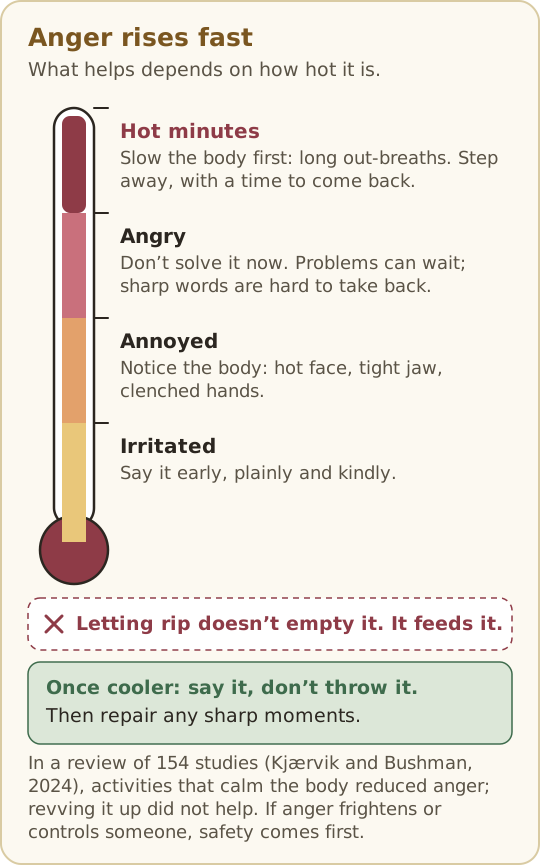
Figure 34 Anger rises fast, and what helps depends on how hot it is. In the hot minutes, slow the body first; letting rip feeds it. Filled-in example The Calm-Down Kit Pat, a grandmother raising her grandson Jay, 13 The Calm-Down Kit
- Whose kit is this? (your name)
- Pat (Nan)
- Date
- 4 October 2026
Part A: What tends to start it
What tends to start it How it shows up in my body first Door slammed after a call with his mum Shoulders up by my ears Being shouted at in front of the neighbours Hot face, can’t find words Part A: My two defaults
- First default
- Gating (lower the lights, step out)
- Second, if the first isn’t available
- Low, steady sound
Part A: My pause line
- In my words
- I’m too wound up to listen well. I’m putting the kettle on for twenty minutes. I’ll come and find you at half past.
Our pause plan (agree it together, and share it)
- Our pause word or signal
- “Kettle time”
- The shortest break we take
- 20 minutes
- How we set the time to come back
- Whoever pauses says a time before they go
- The first sentence when we come back
- “I’m back. Let’s start again, slower.”
Part B: In the moment
Say your pause word or line, then do your first calming step. Nothing in this kit works by cold, pain or shock, and none of it is treatment.
Part C: Coming back
Time What I did How I feel now 5:10 pm Gating (lower the lights, step out) Settled enough Where that leaves you
- Next
- Settled enough: go back to the conversation, at the time you named. When you come back, start with one small, simple task, like putting the dishes away.
- Next small action
- Sit with Jay and agree one screen-time rule
- If you put the conversation off: when you’ll pick it back up
- After tea, at 6
✓ I’m going with this
A made-up example. Names and details are invented. Jay agreed the pause plan with her on a calm Sunday. “Gating”, one of the kit’s calming steps, means cutting down what comes in through the senses: lower the lights, turn the sound down, or step out of the room.
Fill in your own: The Calm-Down Kit (spreadloveandacceptance.com/
workpapers/ fill/ wp-11) -
Letting rip doesn’t empty it.
Many people believe anger is like steam: let it out, by shouting, slamming or hitting a pillow, and it will be gone. Research doesn’t support this. In a well-known study by Bushman (2002), angry people who hit a punching bag while thinking about the person who annoyed them ended up angrier, not calmer.
So does going over and over what happened in your head: in studies by Bushman and colleagues (2005), people who dwelt on a provocation were later more aggressive, even towards someone who only mildly annoyed them. Anger tends to fade faster when the body is calmed and the mind has something else to do for a while.
For example: After a row with a coworker, a man spends his lunch telling three people how awful she is. By the afternoon he’s angrier than ever. Next time, he takes a walk instead, and by two o’clock he can think clearly.
Thoughts you could try: “Going over this again is feeding it.” “I can come back to this later, when I’m calmer.”
Try this: If you notice yourself replaying an argument, set a timer for twenty minutes and do something absorbing. Come back to the problem after.
Dig deeper: venting and going over it -
Step back and look from the outside.
Once the body has settled a little, it helps to look at the moment as if you were watching from across the room. What happened? What might the other person have been dealing with? In experiments by Mischkowski, Kross and Bushman (2012), people who looked back on an annoying moment “like a fly on the wall,” rather than reliving it, felt less angry and acted less aggressively. Rethinking what happened, which psychologists call reappraisal (Gross, 1998), helps too.
For example: Furious that a friend cancelled again, a woman imagines telling the story to a kind stranger. Told that way, she remembers her friend is caring for a sick parent. The anger softens into worry.
Thoughts you could try: “If I were watching this from the side, what would I see?” “What else might be going on for them?”
Try this: Write two lines about the moment, starting with your own name instead of “I”: “Wes got angry because…”
Dig deeper: stepping back -
Say it, don’t throw it.
Anger is often a fair message sent in a hurtful way. When you are calmer, you can still say you were angry, and why, without attacking. A simple shape helps: what happened (the facts), how you felt, and what you’re asking for.
For example: Instead of “You always let me down,” a woman says to her sister: “When you cancelled Mum’s appointment again, I felt really angry and alone with it. Can we make a plan for who takes her, for the next three months?”
Words you could use: “I was angry about what happened on Monday. Can I tell you why?” “When ___ happened, I felt ___. What I’m asking for is ___.”
Try this: Write your angry message, then rewrite it in the three-part shape before you send anything. See Chapter 4 for more on saying hard things.
Dig deeper: saying anger in words -
After anger, repair.
Everyone gets angry, and most of us say something sharp sometimes. What matters a great deal is what happens next. A short, real repair (naming what you did, without “but,” and saying what you’ll do differently) helps rebuild trust.
For example: A grandmother shouts at her grandson for breaking a vase, and he cries. An hour later she sits with him: “I shouted, and that was scary. The vase isn’t as important as you. I’m sorry.” He hugs her.
Words you could use: “I was sharp with you earlier. That wasn’t fair, and I’m sorry.” “I’m still upset about what happened, and I also shouldn’t have spoken to you that way.”
Try this: Think of one recent moment when your anger landed on someone. Is there a short repair you could still make? Chapter 11 has more on apologies that land.
Dig deeper: repair after anger -
When anger becomes harm.
Feeling angry is human. But some things done in anger are harm, whatever the feeling behind them: hitting, pushing, throwing things at or near someone, breaking their things, threatening, shouting so someone is scared, or using anger to control what another person does, wears, spends or who they see. People walking on eggshells around you is a sign too. Anger is never a reason someone deserves to be hurt.
For example: A man realises his partner and children go quiet when he comes home in a bad mood. He doesn’t hit anyone, but they are afraid of him. He talks to his doctor and joins an anger course.
Words you could use: “I think my anger is scaring people I love. I want help with it.” (If it’s happening to you) “I’m frightened of how they get when they’re angry.”
Try this: If this sounds like you, see help with your own anger. If you’re afraid of someone else’s anger, Not safe at home? lists free, private help.
Dig deeper: when anger becomes harm
Tuesday, 6:40pm
You put the phone face down and walk round the block. Breathing out long, you notice what’s under the anger: you’re tired, and you’re scared about Mum. Back home you send a different message: “I’m really frustrated. This is the third time and I feel alone with Mum’s care. Can we talk tonight and make a plan?”
Your brother rings within ten minutes. His shifts have changed and he’s been too embarrassed to say. You make a plan together. The anger was right that something needed to change. It just needed words instead of capitals.
If you’re a teenager
A made-up example. Maisie, 16, has her phone taken at ten, mid-chat with her friends. She shouts and slams the door. The next morning, calmer, she says: “It felt like you didn’t trust me. Sorry for the door. Could I have ten minutes’ warning?” Her dad says yes.
Being angry with a parent is normal, and arguments often feel most intense in the middle teens. A rule given out of care isn’t control, even when it feels unfair. A calm ask the next day works more often than a slammed door.
Words you could use: “I’m too angry to talk properly. Can we talk tomorrow?” “It’s not the rule I mind, it’s how it happened.” “Could we try it for two weeks and then check?”
Dig deeper: more worked examplesIn everyday life
- On your own: Anger at yourself counts too. “I’m so stupid” is anger turned inward. Speak to yourself as you would to a friend who made the same mistake. See Chapter 7.
- With a partner: Agree on a pause word on a calm day, and a time you’ll always come back. See When we keep having the same fight.
- Parents and children: Children copy what we do with anger more than what we say about it. See For parents.
- With family and friends: Old anger can flare at gatherings. Plan a short break. See Family rifts.
- At work: Anger at work is common and rarely said. “I’m frustrated about the deadline change. Can we talk about what’s realistic?” keeps it useful. See At work.
- If you have ADHD: Anger can arrive fast and big, then pass quickly. Plan for the speed: a three-word pause line (“Back in ten”), and a rule to wait before you send anything. More in the full chapter.
- Managing a clash between two people: Hear each person alone first, then together, about what happened, not about each other. Often the fight is about the setup, like two people who both think they own the same job. A worked example.
Common mix-ups
- “Anger is a bad feeling.” Anger is a normal feeling. Some things done in anger are harmful. The feeling itself is information.
- “Letting it out is healthy.” Shouting or hitting things tends to keep anger going. Calming the body and then talking helps more.
- “They made me angry, so it’s their fault I shouted.” Someone can do something unfair. What you do next is still yours.
- “Holding it in is the safe option.” Swallowing anger for years tends to come out sideways: as coldness, sarcasm or a sudden explosion. Saying it calmly and early is safer.
If you want to help someone else with this
- Keep yourself safe first. If someone’s anger scares you, step away. You don’t have to stay and calm them down.
- Lower, slower, fewer words. Speak quietly and simply. Don’t argue the point while they are flooded.
- Take the message, not the blow. Often there’s something fair under the anger. You can hear that part and still say the way it was said wasn’t okay.
Words you could use: “I want to hear this, and I can’t while we’re both shouting. Can we try again at seven?” “I can tell this really matters to you.”
When to get more help
Everyone gets angry. It may be time to talk to a doctor, a counsellor or an anger management course if:
- your anger feels out of control, or you often regret what you do or say when angry;
- people close to you seem nervous or walk on eggshells around you;
- you have hit, pushed, thrown things, broken things or threatened anyone;
- anger is hurting your work, your friendships or your health;
- you are using alcohol or drugs to cope with angry feelings.
Help for anger works for many people: a review of anger treatments by Del Vecchio and O’Leary (2004) found medium to large benefits. It is good for your health too: a review by Chida and Steptoe (2009) linked anger and hostility with a higher risk of heart disease. Asking for help is a responsible thing to do. Help with your own anger has first steps.
If you are afraid of someone else’s anger, that fear is an important signal. Not safe at home? lists free, private help. If you or anyone is in danger right now, call your local emergency number.
This chapter is general education, not therapy.
Workpapers, tools and reading on this site
Workpapers pages you fill in, on your own or together
- The Calm-Down Kit: a plan, made on a calm day, for heated moments.
Tools helpers you use on the site
- Upset right now?: steps for when a feeling is very big, very fast.
Reading pages to read on the site
- When we keep having the same fight and When one talks and one goes quiet.
- How to apologise so it counts.
- The library: anger, going over and over things, rethinking versus holding it in, time-outs and managing flooding.
More for your situation
- For parents: help with your own anger · Repair after you’ve scared a child
- For teens
- Family rifts · Caring for someone you love
- At work
- Not safe at home?
- Help by relationship: find the pages for your situation.
Last updated: October 2026